Making information Technology
work for Rural India
Ramanjaneyulu
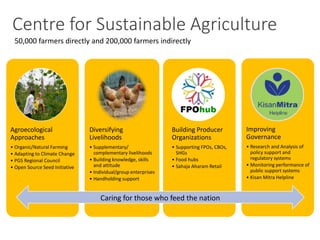
Centre for Sustainable Agriculture
50,000 farmers directly and 200,000 farmers indirectly
Agroecological
Approaches
• Organic/Natural Farming
• Adapting to Climate Change
• PGS Regional Council
• Open Source Seed Initiative
Diversifying
Livelihoods
• Supplementary/
complementary livelihoods
• Building knowledge, skills
and attitude
• Individual/group enterprises
• Handholding support
Building Producer
Organizations
• Supporting FPOs, CBOs,
SHGs
• Food hubs
• Sahaja Aharam Retail
Improving
Governance
• Research and Analysis of
policy support and
regulatory systems
• Monitoring performance of
public support systems
• Kisan Mitra Helpline
Caring for those who feed the nation
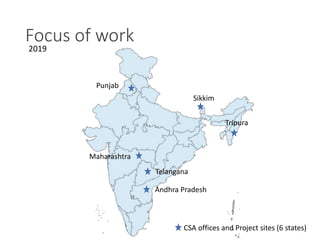
Focus of work
2019
Sikkim
Tripura
Punjab
Maharashtra
Telangana
Andhra Pradesh
CSA offices and Project sites (6 states)
Context
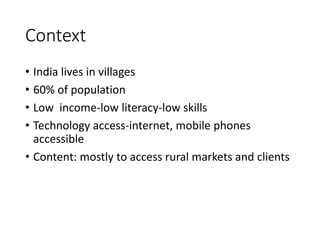
• India lives in villages
• 60% of population
• Low income-low literacy-low skills
• Technology access-internet, mobile phones
accessible
• Content: mostly to access rural markets and clients
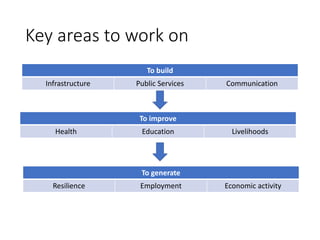
Key areas to work on
To build
Infrastructure Public Services Communication
To improve
Health Education Livelihoods
To generate
Resilience Employment Economic activity
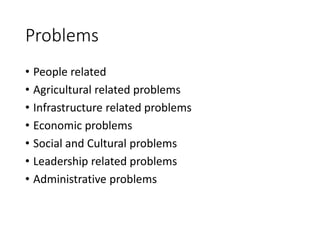
Problems
• People related
• Agricultural related problems
• Infrastructure related problems
• Economic problems
• Social and Cultural problems
• Leadership related problems
• Administrative problems
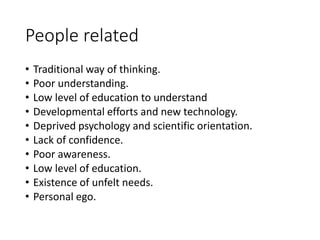
People related
• Traditional way of thinking.
• Poor understanding.
• Low level of education to understand
• Developmental efforts and new technology.
• Deprived psychology and scientific orientation.
• Lack of confidence.
• Poor awareness.
• Low level of education.
• Existence of unfelt needs.
• Personal ego.
Agriculture related
• Lack of expected awareness, knowledge, skill and
attitude.
• Unavailability of inputs.
• Poor marketing facility.
• Insufficient extension staff and services.
• Multidimensional tasks to extension personnel.
• Small size of land holding.
• Division of land.
• Unwillingness to work and stay in rural areas.
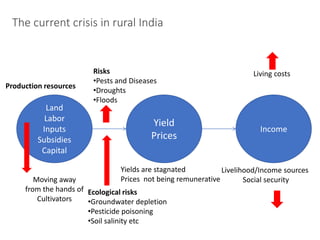
The current crisis in rural India
Land
Labor
Inputs
Subsidies
Capital
Yield
Prices
Income
Production resources
Risks
•Pests and Diseases
•Droughts
•Floods
Moving away
from the hands of
Cultivators
Yields are stagnated
Prices not being remunerative
Ecological risks
•Groundwater depletion
•Pesticide poisoning
•Soil salinity etc
Living costs
Livelihood/Income sources
Social security
Poor infrastructure facilities
• Water
• Electricity
• Transport
• Educational institutions
• Communication
• Health
• Employment
• Storage facility etc
Economic problems
• Unfavorable economic condition to adopt high cost
technology.
• High cost of inputs/services
• Under privileged rural industries
Leadership
• Leadership among the hands of inactive and
incompetent people.
• Self interest of leaders.
• Biased political will
Administrative problems
• Political interference.
• Lack of motivation and interest.
• Unwillingness to work in villages.
• Improper utilization of budget.
• No proper monitoring of programs and lack in their
implementation
1800 120 3244; 08500 98 3300
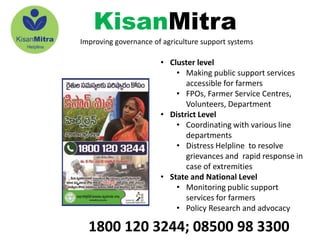
• Cluster level
• Making public support services
accessible for farmers
• FPOs, Farmer Service Centres,
Volunteers, Department
• District Level
• Coordinating with various line
departments
• Distress Helpline to resolve
grievances and rapid response in
case of extremities
• State and National Level
• Monitoring public support
services for farmers
• Policy Research and advocacy
KisanMitra
Improving governance of agriculture support systems
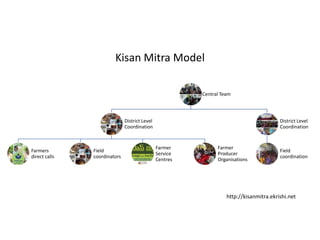
Central Team
District Level
Coordination
Farmers
direct calls
Field
coordinators
Farmer
Service
Centres
Farmer
Producer
Organisations
District Level
Coordination
Field
coordination
Kisan Mitra Model
http://kisanmitra.ekrishi.net
KisanMitra
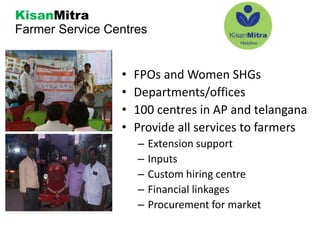
Farmer Service Centres
• FPOs and Women SHGs
• Departments/offices
• 100 centres in AP and telangana
• Provide all services to farmers
– Extension support
– Inputs
– Custom hiring centre
– Financial linkages
– Procurement for market
v
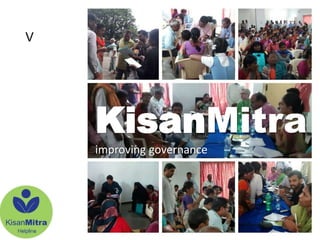
KisanMitra
improving governance
KISAN MITRA - IMPACT AREAS
● Distress/Suicide Farmer Families
○ Pesticide Poisoning
○ Distress Case Counselling & Relief
○ Education for children & Livelihood support
○ Ex-Gratia & other beneficiary schemes
○ Welfare schemes being targeted to Distressed & Needy
● Improving Access to Credit
● Resolving land title related issues
● Feed back to the district and state level bankers committees
● Facilitating ~5000 LEC cards & JLG Group Loans for Tenant Farmers (All Districts)
● Crop Loss & Compensation
● Improving Policies like PMFBY(Crop Insurance) by feedback
● Analysis and presentations on natural disasters like drought, floods, Hailstorms etc
● Improving access to markets
● Open procurement centres
● Timely payments
● Other support systems
● Electricity issues like Transformer Issues, Loose Wires, New connections to villages etc.,
● Water supply and Irrigation/Canal related issues proactively resolved
● Grouping of Issues of FPOs, SHGs and collectively representing & Solving
● Revenue & Rythu Bandhu Issues followed up & communicated
● Improving Regulations: Seeds, Pesticides etc
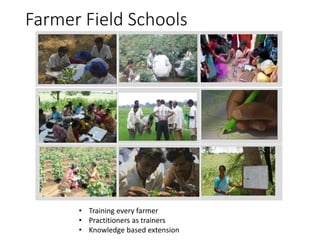
Farmer Field Schools
• Training every farmer
• Practitioners as trainers
• Knowledge based extension
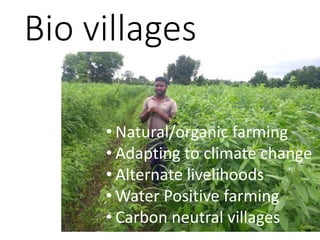
Bio villages
• Natural/organic farming
• Adapting to climate change
• Alternate livelihoods
• Water Positive farming
• Carbon neutral villages
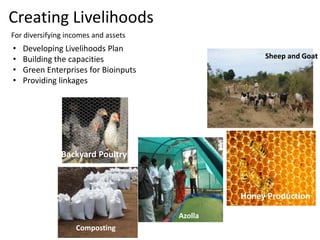
Creating Livelihoods
Sericulture
Backyard Poultry
Honey Production
• Developing Livelihoods Plan
• Building the capacities
• Green Enterprises for Bioinputs
• Providing linkages
For diversifying incomes and assets
Composting
Azolla
Sheep and Goat
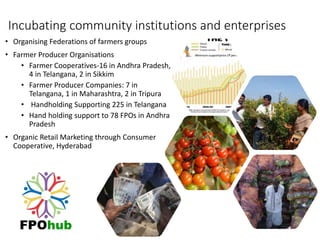
Incubating community institutions and enterprises
• Organising Federations of farmers groups
• Farmer Producer Organisations
• Farmer Cooperatives-16 in Andhra Pradesh,
4 in Telangana, 2 in Sikkim
• Farmer Producer Companies: 7 in
Telangana, 1 in Maharashtra, 2 in Tripura
• Handholding Supporting 225 in Telangana
• Hand holding support to 78 FPOs in Andhra
Pradesh
• Organic Retail Marketing through Consumer
Cooperative, Hyderabad
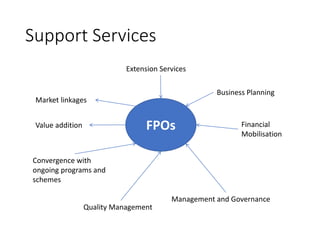
Support Services
FPOs
Extension Services
Business Planning
Financial
Mobilisation
Management and Governance
Quality Management
Convergence with
ongoing programs and
schemes
Market linkages
Value addition
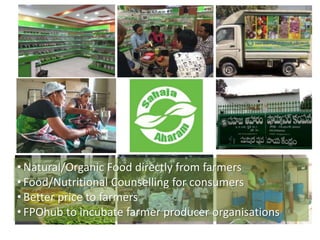
• Natural/Organic Food directly from farmers
• Food/Nutritional Counselling for consumers
• Better price to farmers
• FPOhub to incubate farmer producer organisations
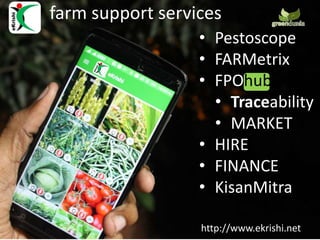
farm support services
http://www.ekrishi.net
• Pestoscope
• FARMetrix
• FPOhub
• Traceability
• MARKET
• HIRE
• FINANCE
• KisanMitra
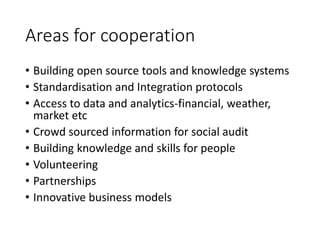
Areas for cooperation
• Building open source tools and knowledge systems
• Standardisation and Integration protocols
• Access to data and analytics-financial, weather,
market etc
• Crowd sourced information for social audit
• Building knowledge and skills for people
• Volunteering
• Partnerships
• Innovative business models
Centre for sustainable agriculture
http://www.csa-india.org
http://www.krishi.tv
http://www.ekrishi.net
http://www.sahajaaharam.com
eKrishi : 08500 68 3300
Sahaja Aharam : 08500 78 33 00
Rytu Swarajya Vedhika: 08500 98 33 00
mobile : 090 0069 9702
csa@csa-india.org, Facebook: ramoo.agripage

Making information technology work for rural india

  • 1.
    Making information Technology workfor Rural India Ramanjaneyulu
  • 2.
    Centre for SustainableAgriculture 50,000 farmers directly and 200,000 farmers indirectly Agroecological Approaches • Organic/Natural Farming • Adapting to Climate Change • PGS Regional Council • Open Source Seed Initiative Diversifying Livelihoods • Supplementary/ complementary livelihoods • Building knowledge, skills and attitude • Individual/group enterprises • Handholding support Building Producer Organizations • Supporting FPOs, CBOs, SHGs • Food hubs • Sahaja Aharam Retail Improving Governance • Research and Analysis of policy support and regulatory systems • Monitoring performance of public support systems • Kisan Mitra Helpline Caring for those who feed the nation
  • 3.
    Focus of work 2019 Sikkim Tripura Punjab Maharashtra Telangana AndhraPradesh CSA offices and Project sites (6 states)
  • 4.
    Context • India livesin villages • 60% of population • Low income-low literacy-low skills • Technology access-internet, mobile phones accessible • Content: mostly to access rural markets and clients
  • 5.
    Key areas towork on To build Infrastructure Public Services Communication To improve Health Education Livelihoods To generate Resilience Employment Economic activity
  • 6.
    Problems • People related •Agricultural related problems • Infrastructure related problems • Economic problems • Social and Cultural problems • Leadership related problems • Administrative problems
  • 7.
    People related • Traditionalway of thinking. • Poor understanding. • Low level of education to understand • Developmental efforts and new technology. • Deprived psychology and scientific orientation. • Lack of confidence. • Poor awareness. • Low level of education. • Existence of unfelt needs. • Personal ego.
  • 8.
    Agriculture related • Lackof expected awareness, knowledge, skill and attitude. • Unavailability of inputs. • Poor marketing facility. • Insufficient extension staff and services. • Multidimensional tasks to extension personnel. • Small size of land holding. • Division of land. • Unwillingness to work and stay in rural areas.
  • 9.
    The current crisisin rural India Land Labor Inputs Subsidies Capital Yield Prices Income Production resources Risks •Pests and Diseases •Droughts •Floods Moving away from the hands of Cultivators Yields are stagnated Prices not being remunerative Ecological risks •Groundwater depletion •Pesticide poisoning •Soil salinity etc Living costs Livelihood/Income sources Social security
  • 10.
    Poor infrastructure facilities •Water • Electricity • Transport • Educational institutions • Communication • Health • Employment • Storage facility etc
  • 11.
    Economic problems • Unfavorableeconomic condition to adopt high cost technology. • High cost of inputs/services • Under privileged rural industries
  • 12.
    Leadership • Leadership amongthe hands of inactive and incompetent people. • Self interest of leaders. • Biased political will
  • 13.
    Administrative problems • Politicalinterference. • Lack of motivation and interest. • Unwillingness to work in villages. • Improper utilization of budget. • No proper monitoring of programs and lack in their implementation
  • 14.
    1800 120 3244;08500 98 3300 • Cluster level • Making public support services accessible for farmers • FPOs, Farmer Service Centres, Volunteers, Department • District Level • Coordinating with various line departments • Distress Helpline to resolve grievances and rapid response in case of extremities • State and National Level • Monitoring public support services for farmers • Policy Research and advocacy KisanMitra Improving governance of agriculture support systems
  • 15.
    Central Team District Level Coordination Farmers directcalls Field coordinators Farmer Service Centres Farmer Producer Organisations District Level Coordination Field coordination Kisan Mitra Model http://kisanmitra.ekrishi.net
  • 16.
    KisanMitra Farmer Service Centres •FPOs and Women SHGs • Departments/offices • 100 centres in AP and telangana • Provide all services to farmers – Extension support – Inputs – Custom hiring centre – Financial linkages – Procurement for market
  • 17.
  • 18.
    KISAN MITRA -IMPACT AREAS ● Distress/Suicide Farmer Families ○ Pesticide Poisoning ○ Distress Case Counselling & Relief ○ Education for children & Livelihood support ○ Ex-Gratia & other beneficiary schemes ○ Welfare schemes being targeted to Distressed & Needy ● Improving Access to Credit ● Resolving land title related issues ● Feed back to the district and state level bankers committees ● Facilitating ~5000 LEC cards & JLG Group Loans for Tenant Farmers (All Districts) ● Crop Loss & Compensation ● Improving Policies like PMFBY(Crop Insurance) by feedback ● Analysis and presentations on natural disasters like drought, floods, Hailstorms etc ● Improving access to markets ● Open procurement centres ● Timely payments ● Other support systems ● Electricity issues like Transformer Issues, Loose Wires, New connections to villages etc., ● Water supply and Irrigation/Canal related issues proactively resolved ● Grouping of Issues of FPOs, SHGs and collectively representing & Solving ● Revenue & Rythu Bandhu Issues followed up & communicated ● Improving Regulations: Seeds, Pesticides etc
  • 19.
    Farmer Field Schools •Training every farmer • Practitioners as trainers • Knowledge based extension
  • 20.
    Bio villages • Natural/organicfarming • Adapting to climate change • Alternate livelihoods • Water Positive farming • Carbon neutral villages
  • 21.
    Creating Livelihoods Sericulture Backyard Poultry HoneyProduction • Developing Livelihoods Plan • Building the capacities • Green Enterprises for Bioinputs • Providing linkages For diversifying incomes and assets Composting Azolla Sheep and Goat
  • 22.
    Incubating community institutionsand enterprises • Organising Federations of farmers groups • Farmer Producer Organisations • Farmer Cooperatives-16 in Andhra Pradesh, 4 in Telangana, 2 in Sikkim • Farmer Producer Companies: 7 in Telangana, 1 in Maharashtra, 2 in Tripura • Handholding Supporting 225 in Telangana • Hand holding support to 78 FPOs in Andhra Pradesh • Organic Retail Marketing through Consumer Cooperative, Hyderabad
  • 23.
    Support Services FPOs Extension Services BusinessPlanning Financial Mobilisation Management and Governance Quality Management Convergence with ongoing programs and schemes Market linkages Value addition
  • 24.
    • Natural/Organic Fooddirectly from farmers • Food/Nutritional Counselling for consumers • Better price to farmers • FPOhub to incubate farmer producer organisations
  • 25.
    farm support services http://www.ekrishi.net •Pestoscope • FARMetrix • FPOhub • Traceability • MARKET • HIRE • FINANCE • KisanMitra
  • 27.
    Areas for cooperation •Building open source tools and knowledge systems • Standardisation and Integration protocols • Access to data and analytics-financial, weather, market etc • Crowd sourced information for social audit • Building knowledge and skills for people • Volunteering • Partnerships • Innovative business models
  • 28.
    Centre for sustainableagriculture http://www.csa-india.org http://www.krishi.tv http://www.ekrishi.net http://www.sahajaaharam.com eKrishi : 08500 68 3300 Sahaja Aharam : 08500 78 33 00 Rytu Swarajya Vedhika: 08500 98 33 00 mobile : 090 0069 9702 csa@csa-india.org, Facebook: ramoo.agripage

Editor's Notes

  • #18 Kisanmitra helpline to improve the governance and make public support services work for farmers. Three districts, partnership with district administration, women self groups, FPOs and CII
  • #21 Now working with several state governments in taking forward natural/organic farming. More farmers shifting and now is becoming a mainstream policy. Making farming sustainable, farmers livelihoods viable and villages becoming carbon neutral and water self sufficient