High Bionutrient Crop
Production 2012
Day 1
Addressing Limiting Factors
• General principle and objective
• Life will do the best with what she has
• Identify limiting factors and endeavor to
address them.
• Minerals, biology, carbon, water, air.
Life is the Objective
• Supporting and empowering soil life is
the key to healthy plants.
• Things that you do or let be done that
harm soil life harm your plants.
Quality Objective
• Nutrient Level
• Flavor
• Shelf Life
Correlations of Health
• Soil Health
• Plant Health
• Human Health
• Cultural / Environmental Health
Topics for Today
• Soil Testing / Mineral Balancing
• Biological Inoculation
• Potting Soil
• Tillage
• Fertigation / Irrigation
• Foliar Spraying
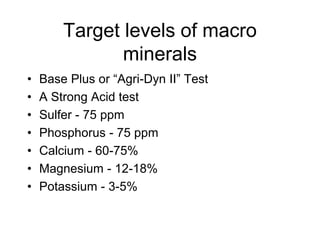
Target levels of macro
minerals
• Base Plus or “Agri-Dyn II” Test
• A Strong Acid test
• Sulfer - 75 ppm
• Phosphorus - 75 ppm
• Calcium - 60-75%
• Magnesium - 12-18%
• Potassium - 3-5%
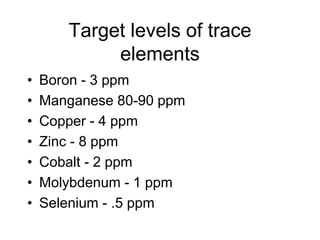
Target levels of trace
elements
• Boron - 3 ppm
• Manganese 80-90 ppm
• Copper - 4 ppm
• Zinc - 8 ppm
• Cobalt - 2 ppm
• Molybdenum - 1 ppm
• Selenium - .5 ppm
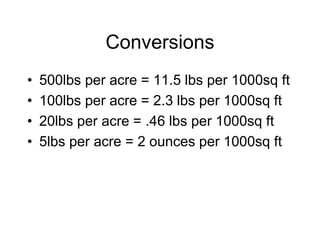
Conversions
• 500lbs per acre = 11.5 lbs per 1000sq ft
• 100lbs per acre = 2.3 lbs per 1000sq ft
• 20lbs per acre = .46 lbs per 1000sq ft
• 5lbs per acre = 2 ounces per 1000sq ft
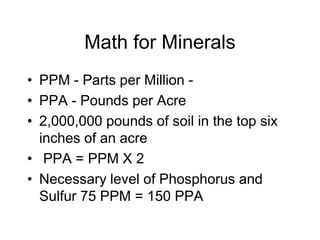
Math for Minerals
• PPM - Parts per Million -
• PPA - Pounds per Acre
• 2,000,000 pounds of soil in the top six
inches of an acre
• PPA = PPM X 2
• Necessary level of Phosphorus and
Sulfur 75 PPM = 150 PPA
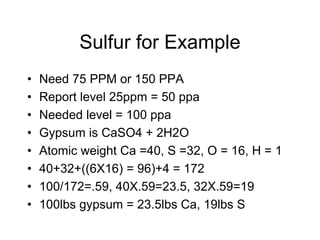
Sulfur for Example
• Need 75 PPM or 150 PPA
• Report level 25ppm = 50 ppa
• Needed level = 100 ppa
• Gypsum is CaSO4 + 2H2O
• Atomic weight Ca =40, S =32, O = 16, H = 1
• 40+32+((6X16) = 96)+4 = 172
• 100/172=.59, 40X.59=23.5, 32X.59=19
• 100lbs gypsum = 23.5lbs Ca, 19lbs S
Max yearly application Sulfur
• Sulfur - with Calcium needed, 500 pounds per
acre (ppa) gypsum
• Sulfur - with Magnesium and Potassium
needed 300-500 ppa Sul-Po-Mag or K-mag
• Sulfur - with Potassium needed 200-300 ppa
potassium sulfate.
• Sulfur - with Magnesium needed 200 ppa
magnesium sulfate (epsom salt)
• Sulfate forms of the trace elements
Max yearly application
Phosphorus
• Phosphorus - with calcium needed, 500-
2000 ppa colloidal soft rock phosphate,
Tennessee brown rock phosphate,
Black hard rock phosphate
• Phosphorus - with potassium needed,
animal manure, or animal manure
based compost.
Max yearly application
Calcium
• Calcium - 500-2000 lbs Calcium Carbonate (Calcite
or Hi-cal Lime) Also Aragonite, Coral Calcium, Egg
Shells,
• Calcium - with Magnesium needed 500-2000 ppa
Calcium Magnesium Carbonate, (Dolomite, or
Dolomitic Lime)
• Calcium - with Sulfur needed, 500 ppa gypsum
• Calcium - with Phosphorus needed, 500-2000 ppa
Soft Rock Phosphate.
• Calcium - Phosphorus and Traces and
Paramagnetic needed 500-2000 ppa Carbonatite
Max yearly application
Magnesium
• Magnesium - with Calcium needed 500-
2000 ppa Dolomite
• Magnesium with Sulfur and Potassium
needed 300-500 ppa Sul-Po-Mag or K-
mag
• Magnesium - with Sulfur needed, 200
ppa magnesium sulfate (epsom salts)
Max yearly application
Potassium
• Potassium - Spread well, clean wood ash
• Potassium - with Magnesium and Sulfur
needed, 300-500 ppa Sul-Po-Mag or K-mag
• Potassium - with Sulfur needed, 200-300 ppa
potassium sulfate
• Potassium - with Phosphorus needed, animal
manure or animal manure based compost
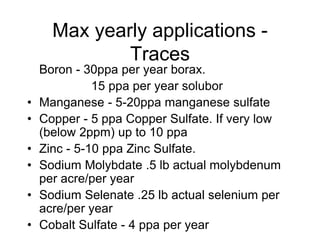
Max yearly applications -
Traces
Boron - 30ppa per year borax.
15 ppa per year solubor
• Manganese - 5-20ppa manganese sulfate
• Copper - 5 ppa Copper Sulfate. If very low
(below 2ppm) up to 10 ppa
• Zinc - 5-10 ppa Zinc Sulfate.
• Sodium Molybdate .5 lb actual molybdenum
per acre/per year
• Sodium Selenate .25 lb actual selenium per
acre/per year
• Cobalt Sulfate - 4 ppa per year
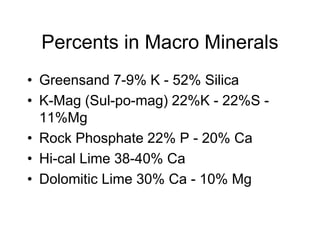
Percents in Macro Minerals
• Greensand 7-9% K - 52% Silica
• K-Mag (Sul-po-mag) 22%K - 22%S -
11%Mg
• Rock Phosphate 22% P - 20% Ca
• Hi-cal Lime 38-40% Ca
• Dolomitic Lime 30% Ca - 10% Mg
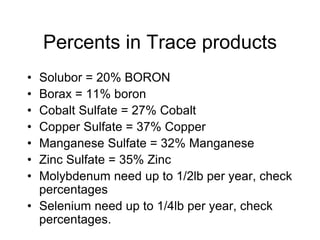
Percents in Trace products
• Solubor = 20% BORON
• Borax = 11% boron
• Cobalt Sulfate = 27% Cobalt
• Copper Sulfate = 37% Copper
• Manganese Sulfate = 32% Manganese
• Zinc Sulfate = 35% Zinc
• Molybdenum need up to 1/2lb per year, check
percentages
• Selenium need up to 1/4lb per year, check
percentages.
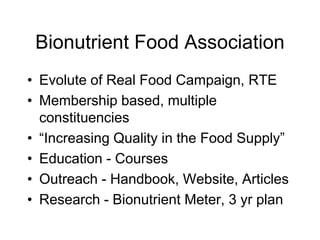
Bionutrient Food Association
• Evolute of Real Food Campaign, RTE
• Membership based, multiple
constituencies
• “Increasing Quality in the Food Supply”
• Education - Courses
• Outreach - Handbook, Website, Articles
• Research - Bionutrient Meter, 3 yr plan
Inoculants
• Collostrum
• Critical symbiotes for plants.
Foundational life in the food chain
• Bacterial and Fungal species
• Ideally present at germination
Seed
• Seed size
• Seed history
• Seedling vigor - culling
• Yield potential - spacing
Potting soil
• Besides Compost, peat, vermiculite and
perlite, Consider, Kelp, Alfalfa, Zeolite,
Humate, Montmorillonite, Lime, Rock
Phosphate, Gypsum, Trace Elements,
and critical role of biological inoculants
and enzyme stimulants.
Tillage
• Effect of tillage on soil life
• Strategy for minimal tillage
• Permanent raised beds - green or
brown mulch
Complexing Compounds
• Simple sugars
• Complete carbohydrates
• Complete proteins
• Lipids / essential oils
• Phytonutrients, phytoalexins,
antioxidants, plant secondary
metabolytes
Evolution of pest and
diesease resistance
• Complete carbs - soil borne pathogens
Fusarium, verticilium, alternaria
• Complete proteins - larval forms of insects
aphids, cabbage looper, tomato hornworm,
corn earworm, colorado potato beetle larvae
• Complete lipids - air borne pathogens
mildews and blights
• Complete Phytoalexins - Cucumber beetle,
potato beetle, flea beetle, japanese beetle
Fertigation / Irrigation
• Drip tape, sprinkler, hose
• Maintain water at good level in soil at all
times. Critical.
• “Good Level” able to pick up soil, clench
it into ball and have it stay as a ball.
• Plan to have this system in place
• Fertigation capacity to feed in season
Foliar Spray
• Plant feeding through the leaf surface.
• Backpack sprayer, squirt bottle, etc.
• Best response when an immediate turn
around is desired.
• Very powerful if all other pieces are
working.
• Plan to be able to do this now.
Homework
• Build permanent beds
• Mulch, apply minerals and cover crops
• Procure inoculants
• Good seed
• Potting soil
• Fertigation and Foliar infrastructure
• Read, read, read

Bio nutrient crop production 2012 Day 1

  • 1.
  • 2.
    Addressing Limiting Factors •General principle and objective • Life will do the best with what she has • Identify limiting factors and endeavor to address them. • Minerals, biology, carbon, water, air.
  • 3.
    Life is theObjective • Supporting and empowering soil life is the key to healthy plants. • Things that you do or let be done that harm soil life harm your plants.
  • 4.
    Quality Objective • NutrientLevel • Flavor • Shelf Life
  • 5.
    Correlations of Health •Soil Health • Plant Health • Human Health • Cultural / Environmental Health
  • 6.
    Topics for Today •Soil Testing / Mineral Balancing • Biological Inoculation • Potting Soil • Tillage • Fertigation / Irrigation • Foliar Spraying
  • 7.
    Target levels ofmacro minerals • Base Plus or “Agri-Dyn II” Test • A Strong Acid test • Sulfer - 75 ppm • Phosphorus - 75 ppm • Calcium - 60-75% • Magnesium - 12-18% • Potassium - 3-5%
  • 8.
    Target levels oftrace elements • Boron - 3 ppm • Manganese 80-90 ppm • Copper - 4 ppm • Zinc - 8 ppm • Cobalt - 2 ppm • Molybdenum - 1 ppm • Selenium - .5 ppm
  • 9.
    Conversions • 500lbs peracre = 11.5 lbs per 1000sq ft • 100lbs per acre = 2.3 lbs per 1000sq ft • 20lbs per acre = .46 lbs per 1000sq ft • 5lbs per acre = 2 ounces per 1000sq ft
  • 10.
    Math for Minerals •PPM - Parts per Million - • PPA - Pounds per Acre • 2,000,000 pounds of soil in the top six inches of an acre • PPA = PPM X 2 • Necessary level of Phosphorus and Sulfur 75 PPM = 150 PPA
  • 11.
    Sulfur for Example •Need 75 PPM or 150 PPA • Report level 25ppm = 50 ppa • Needed level = 100 ppa • Gypsum is CaSO4 + 2H2O • Atomic weight Ca =40, S =32, O = 16, H = 1 • 40+32+((6X16) = 96)+4 = 172 • 100/172=.59, 40X.59=23.5, 32X.59=19 • 100lbs gypsum = 23.5lbs Ca, 19lbs S
  • 12.
    Max yearly applicationSulfur • Sulfur - with Calcium needed, 500 pounds per acre (ppa) gypsum • Sulfur - with Magnesium and Potassium needed 300-500 ppa Sul-Po-Mag or K-mag • Sulfur - with Potassium needed 200-300 ppa potassium sulfate. • Sulfur - with Magnesium needed 200 ppa magnesium sulfate (epsom salt) • Sulfate forms of the trace elements
  • 13.
    Max yearly application Phosphorus •Phosphorus - with calcium needed, 500- 2000 ppa colloidal soft rock phosphate, Tennessee brown rock phosphate, Black hard rock phosphate • Phosphorus - with potassium needed, animal manure, or animal manure based compost.
  • 14.
    Max yearly application Calcium •Calcium - 500-2000 lbs Calcium Carbonate (Calcite or Hi-cal Lime) Also Aragonite, Coral Calcium, Egg Shells, • Calcium - with Magnesium needed 500-2000 ppa Calcium Magnesium Carbonate, (Dolomite, or Dolomitic Lime) • Calcium - with Sulfur needed, 500 ppa gypsum • Calcium - with Phosphorus needed, 500-2000 ppa Soft Rock Phosphate. • Calcium - Phosphorus and Traces and Paramagnetic needed 500-2000 ppa Carbonatite
  • 15.
    Max yearly application Magnesium •Magnesium - with Calcium needed 500- 2000 ppa Dolomite • Magnesium with Sulfur and Potassium needed 300-500 ppa Sul-Po-Mag or K- mag • Magnesium - with Sulfur needed, 200 ppa magnesium sulfate (epsom salts)
  • 16.
    Max yearly application Potassium •Potassium - Spread well, clean wood ash • Potassium - with Magnesium and Sulfur needed, 300-500 ppa Sul-Po-Mag or K-mag • Potassium - with Sulfur needed, 200-300 ppa potassium sulfate • Potassium - with Phosphorus needed, animal manure or animal manure based compost
  • 17.
    Max yearly applications- Traces Boron - 30ppa per year borax. 15 ppa per year solubor • Manganese - 5-20ppa manganese sulfate • Copper - 5 ppa Copper Sulfate. If very low (below 2ppm) up to 10 ppa • Zinc - 5-10 ppa Zinc Sulfate. • Sodium Molybdate .5 lb actual molybdenum per acre/per year • Sodium Selenate .25 lb actual selenium per acre/per year • Cobalt Sulfate - 4 ppa per year
  • 18.
    Percents in MacroMinerals • Greensand 7-9% K - 52% Silica • K-Mag (Sul-po-mag) 22%K - 22%S - 11%Mg • Rock Phosphate 22% P - 20% Ca • Hi-cal Lime 38-40% Ca • Dolomitic Lime 30% Ca - 10% Mg
  • 19.
    Percents in Traceproducts • Solubor = 20% BORON • Borax = 11% boron • Cobalt Sulfate = 27% Cobalt • Copper Sulfate = 37% Copper • Manganese Sulfate = 32% Manganese • Zinc Sulfate = 35% Zinc • Molybdenum need up to 1/2lb per year, check percentages • Selenium need up to 1/4lb per year, check percentages.
  • 20.
    Bionutrient Food Association •Evolute of Real Food Campaign, RTE • Membership based, multiple constituencies • “Increasing Quality in the Food Supply” • Education - Courses • Outreach - Handbook, Website, Articles • Research - Bionutrient Meter, 3 yr plan
  • 21.
    Inoculants • Collostrum • Criticalsymbiotes for plants. Foundational life in the food chain • Bacterial and Fungal species • Ideally present at germination
  • 22.
    Seed • Seed size •Seed history • Seedling vigor - culling • Yield potential - spacing
  • 23.
    Potting soil • BesidesCompost, peat, vermiculite and perlite, Consider, Kelp, Alfalfa, Zeolite, Humate, Montmorillonite, Lime, Rock Phosphate, Gypsum, Trace Elements, and critical role of biological inoculants and enzyme stimulants.
  • 24.
    Tillage • Effect oftillage on soil life • Strategy for minimal tillage • Permanent raised beds - green or brown mulch
  • 25.
    Complexing Compounds • Simplesugars • Complete carbohydrates • Complete proteins • Lipids / essential oils • Phytonutrients, phytoalexins, antioxidants, plant secondary metabolytes
  • 26.
    Evolution of pestand diesease resistance • Complete carbs - soil borne pathogens Fusarium, verticilium, alternaria • Complete proteins - larval forms of insects aphids, cabbage looper, tomato hornworm, corn earworm, colorado potato beetle larvae • Complete lipids - air borne pathogens mildews and blights • Complete Phytoalexins - Cucumber beetle, potato beetle, flea beetle, japanese beetle
  • 27.
    Fertigation / Irrigation •Drip tape, sprinkler, hose • Maintain water at good level in soil at all times. Critical. • “Good Level” able to pick up soil, clench it into ball and have it stay as a ball. • Plan to have this system in place • Fertigation capacity to feed in season
  • 28.
    Foliar Spray • Plantfeeding through the leaf surface. • Backpack sprayer, squirt bottle, etc. • Best response when an immediate turn around is desired. • Very powerful if all other pieces are working. • Plan to be able to do this now.
  • 29.
    Homework • Build permanentbeds • Mulch, apply minerals and cover crops • Procure inoculants • Good seed • Potting soil • Fertigation and Foliar infrastructure • Read, read, read