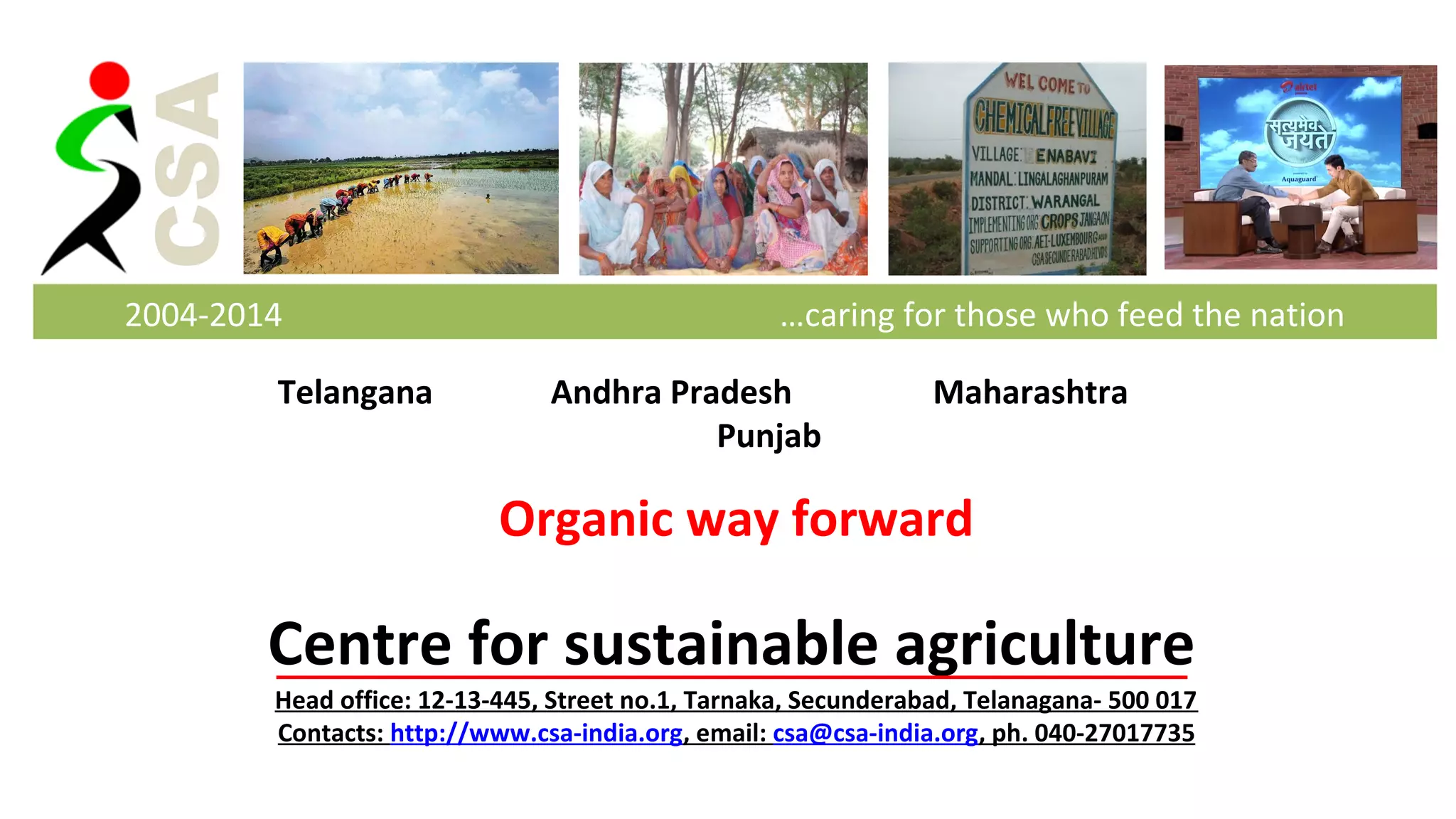
2004-2014 …caring for those who feed the nation 
Telangana Andhra Pradesh Maharashtra 
Punjab 
Organic way forward 
Centre for sustainable agriculture 
Head office: 12-13-445, Street no.1, Tarnaka, Secunderabad, Telanagana- 500 017 
Contacts: http://www.csa-india.org, email: csa@csa-india.org, ph. 040-27017735
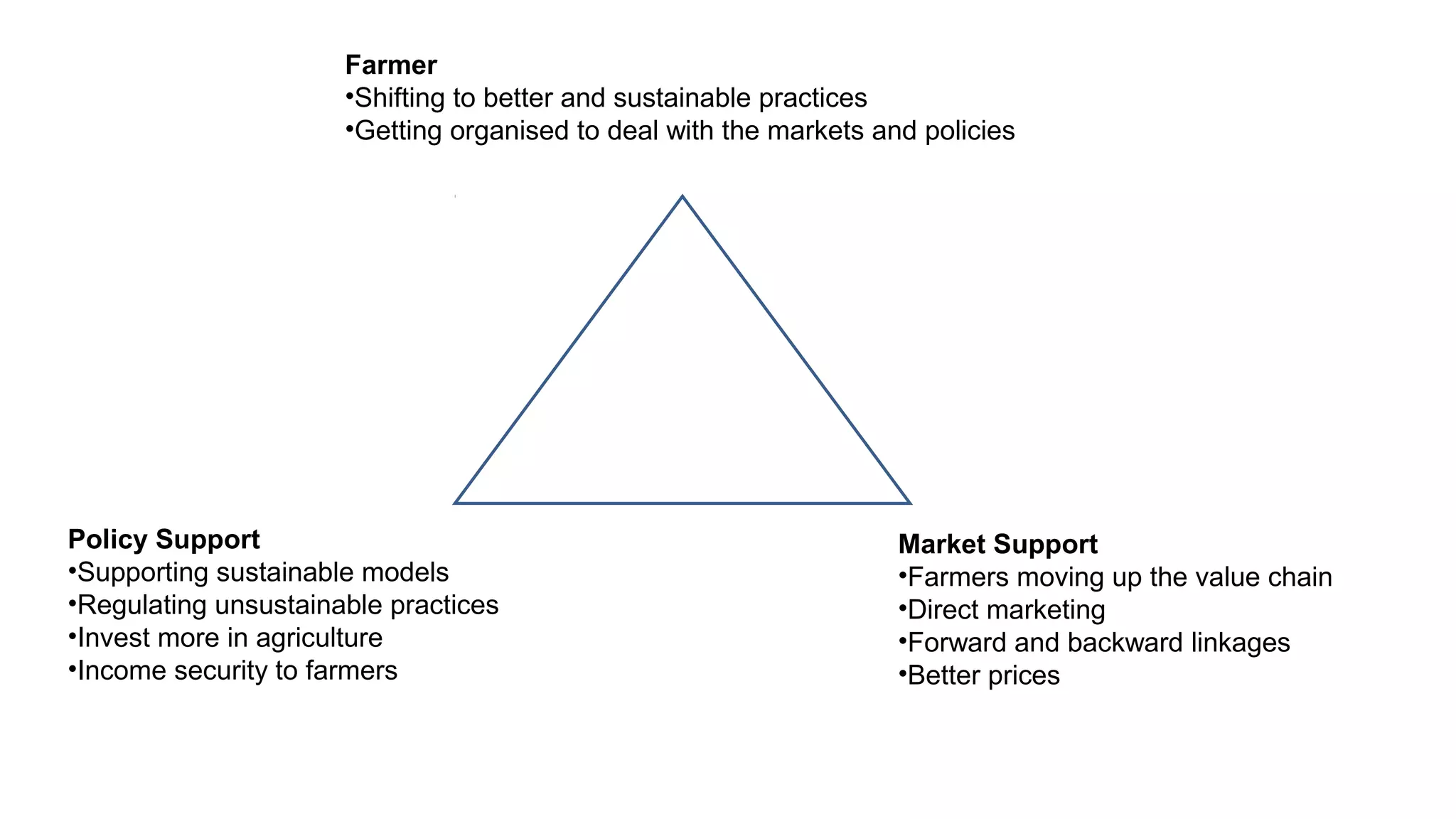
Farmer 
•Shifting to better and sustainable practices 
•Getting organised to deal with the markets and policies 
Policy Support 
•Supporting sustainable models 
•Regulating unsustainable practices 
•Invest more in agriculture 
•Income security to farmers 
Market Support 
•Farmers moving up the value chain 
•Direct marketing 
•Forward and backward linkages 
•Better prices
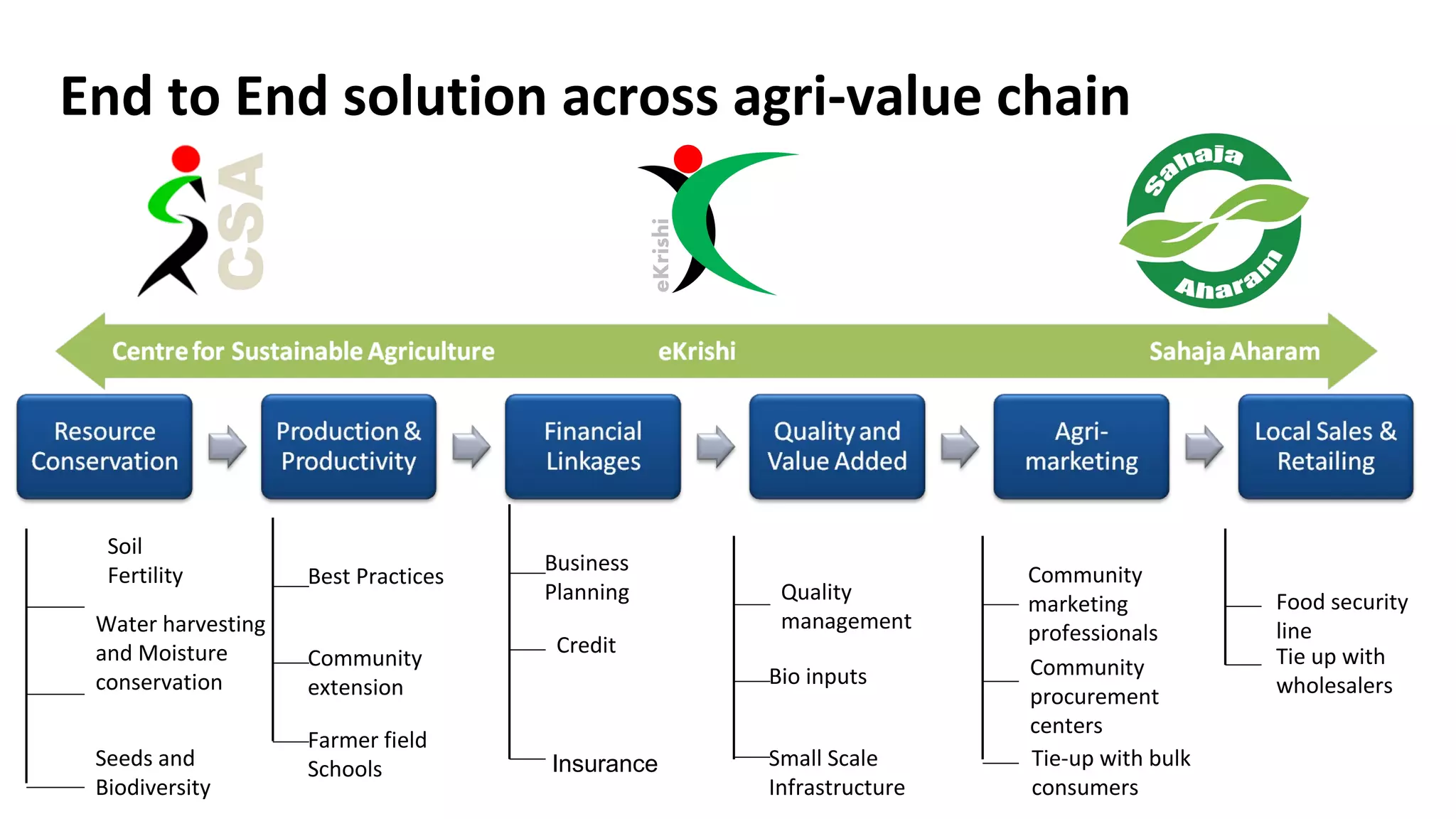
End to End solution across agri-value chain 
•Mobilization, capacity building 
Soil 
Fertility 
Water harvesting 
and Moisture 
conservation 
Seeds and 
Biodiversity 
Community 
marketing 
professionals 
Community 
procurement 
centers 
Tie-up with bulk 
consumers 
Quality 
management 
Bio inputs 
Small Scale 
Infrastructure 
Best Practices Business 
Community 
extension 
Farmer field 
Schools 
Planning 
Credit 
Food security 
line 
Tie up with 
wholesalers 
Insurance
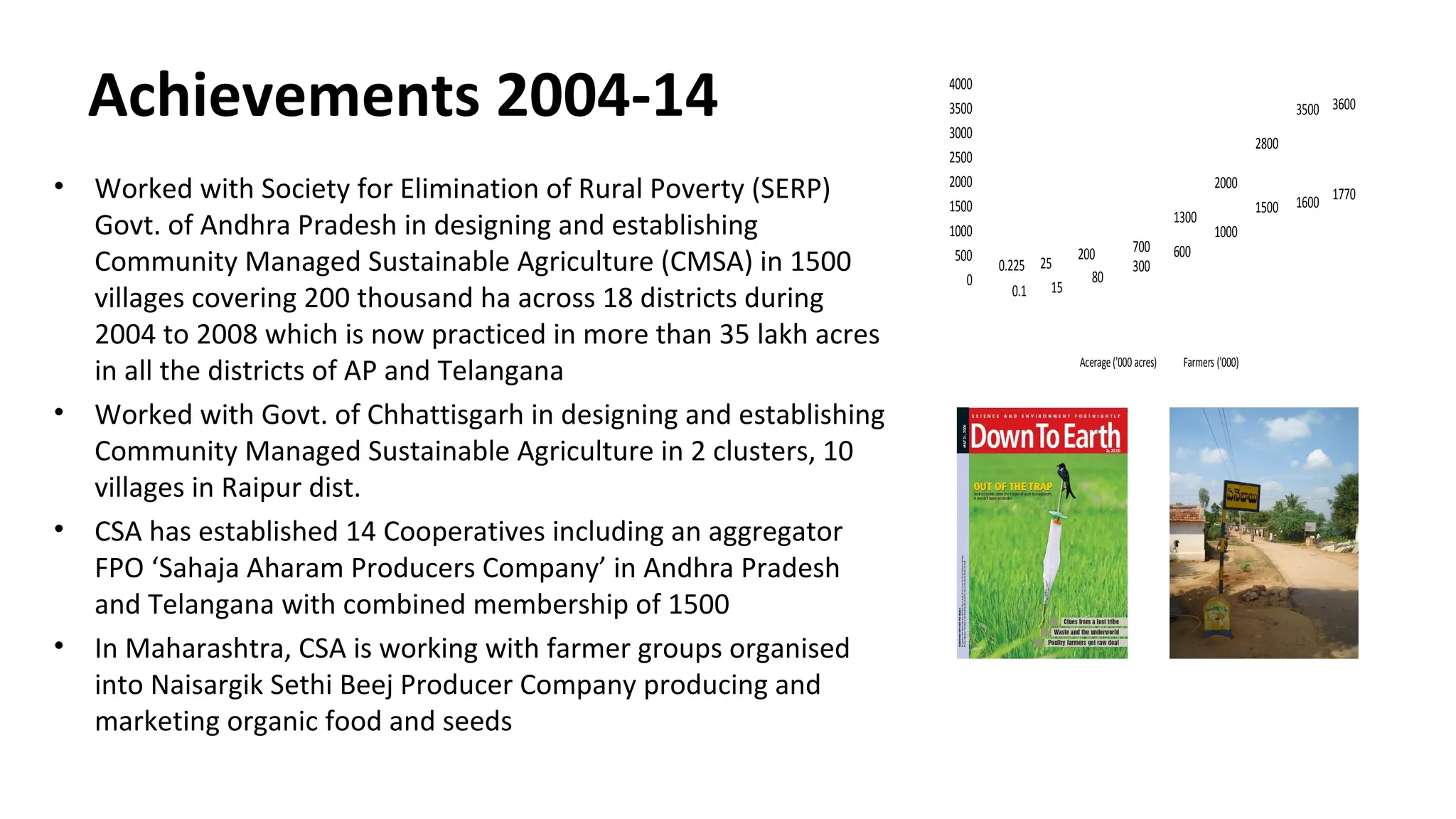
Achievements 2004-14 
• Worked with Society for Elimination of Rural Poverty (SERP) 
Govt. of Andhra Pradesh in designing and establishing 
Community Managed Sustainable Agriculture (CMSA) in 1500 
villages covering 200 thousand ha across 18 districts during 
2004 to 2008 which is now practiced in more than 35 lakh acres 
in all the districts of AP and Telangana 
• Worked with Govt. of Chhattisgarh in designing and establishing 
Community Managed Sustainable Agriculture in 2 clusters, 10 
villages in Raipur dist. 
• CSA has established 14 Cooperatives including an aggregator 
FPO ‘Sahaja Aharam Producers Company’ in Andhra Pradesh 
and Telangana with combined membership of 1500 
• In Maharashtra, CSA is working with farmer groups organised 
into Naisargik Sethi Beej Producer Company producing and 
marketing organic food and seeds 
0.225 25 200 700 
1300 
2000 
2800 
3500 3600 
0.1 15 
80 
300 
600 
1000 
1500 1600 1770 
4000 
3500 
3000 
2500 
2000 
1500 
1000 
500 
0 
Acerage ('000 acres) Farmers ('000)
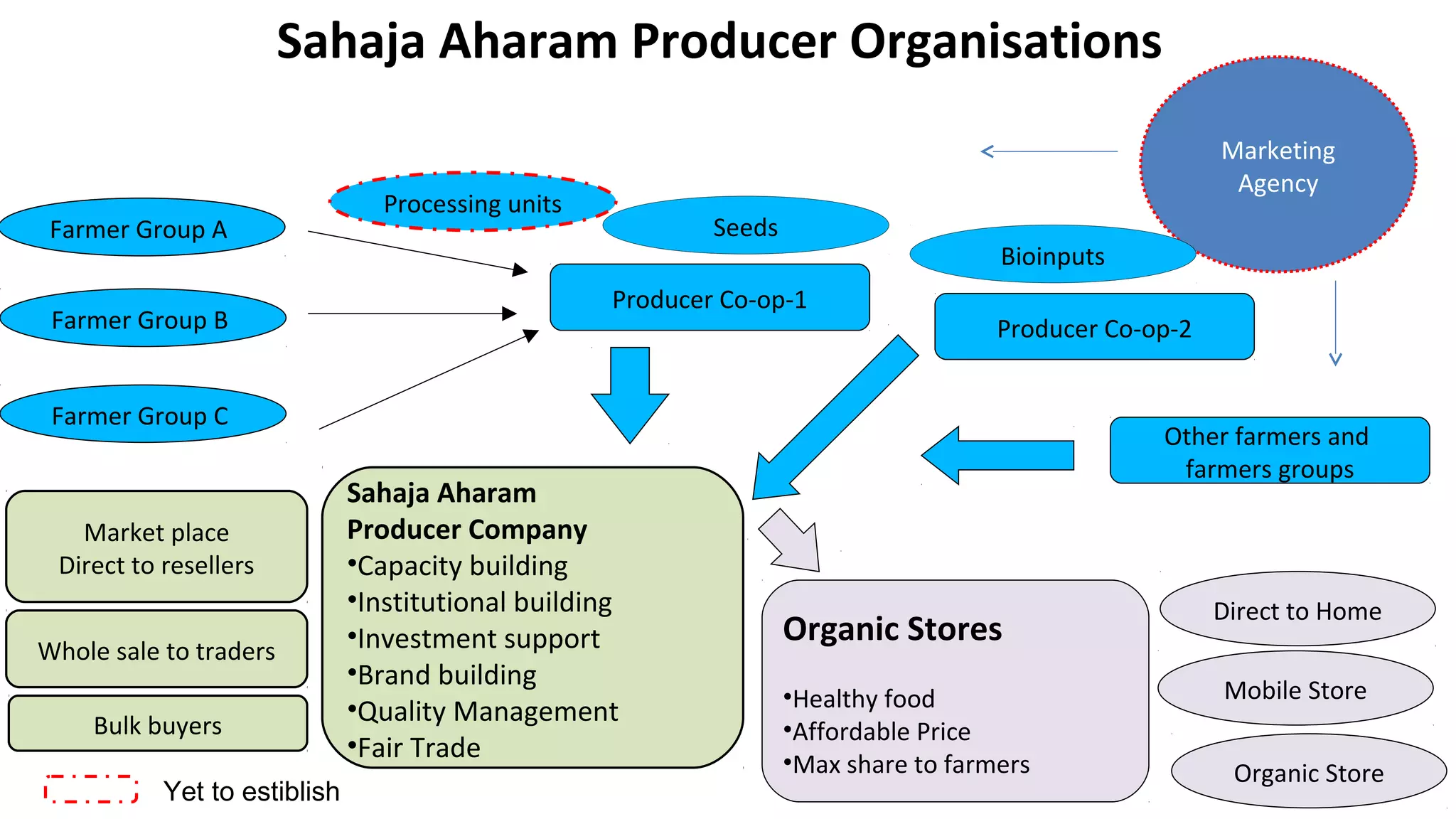
Sahaja Aharam Producer Organisations 
Producer Co-op-1 
Farmer Group B 
Direct to Home 
Organic Stores 
•Healthy food 
Mobile Store 
•Affordable Price 
•Max share to farmers Organic Store 
Producer Co-op-2 
Other farmers and 
farmers groups 
Farmer Group A 
Farmer Group C 
Sahaja Aharam 
Producer Company 
•Capacity building 
•Institutional building 
•Investment support 
•Brand building 
•Quality Management 
•Fair Trade 
Market place 
Direct to resellers 
Whole sale to traders 
Bulk buyers 
Processing units 
Seeds 
Yet to estiblish 
Marketing 
Agency 
Bioinputs
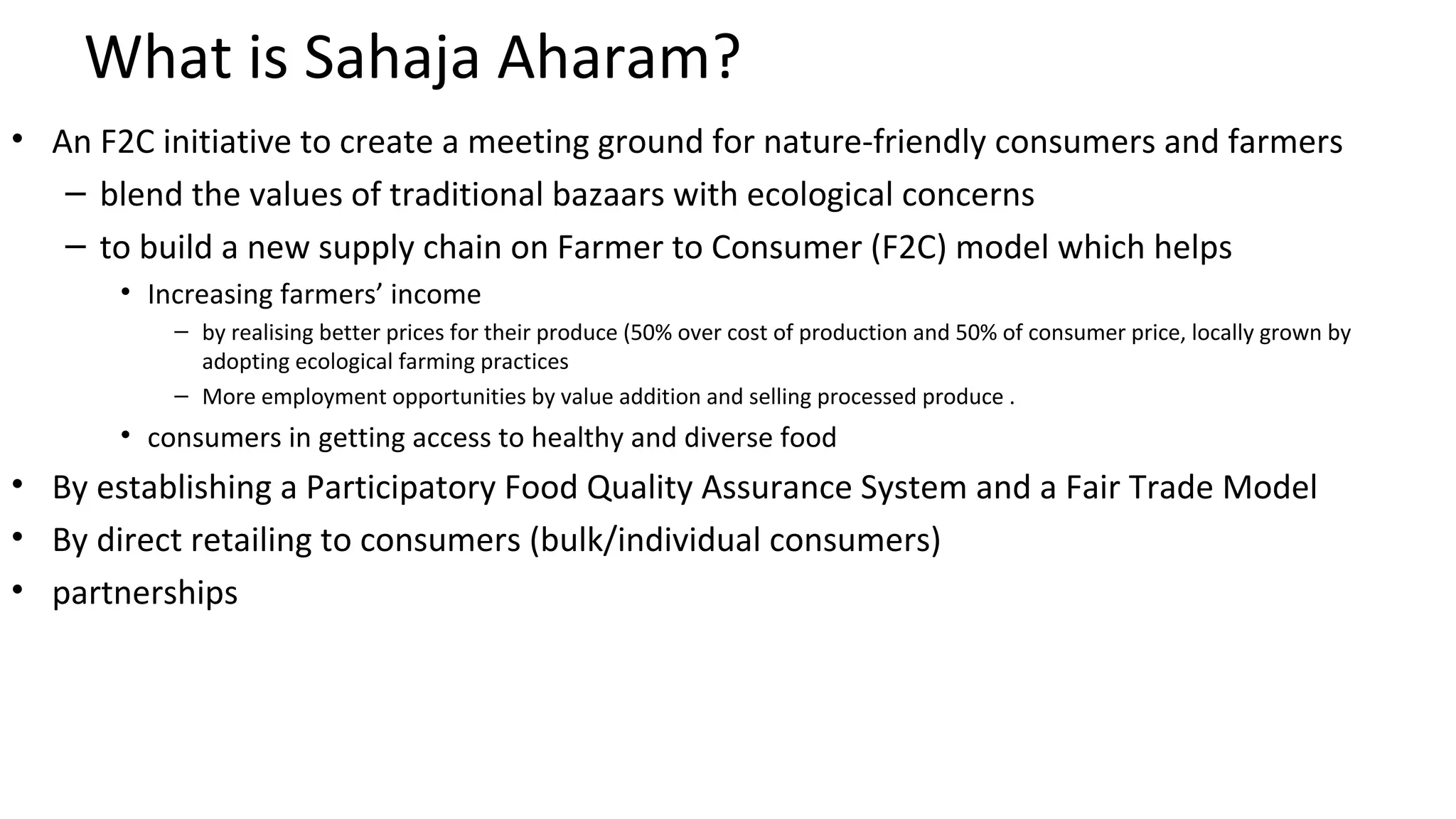
What is Sahaja Aharam? 
• An F2C initiative to create a meeting ground for nature-friendly consumers and farmers 
– blend the values of traditional bazaars with ecological concerns 
– to build a new supply chain on Farmer to Consumer (F2C) model which helps 
• Increasing farmers’ income 
– by realising better prices for their produce (50% over cost of production and 50% of consumer price, locally grown by 
adopting ecological farming practices 
– More employment opportunities by value addition and selling processed produce . 
• consumers in getting access to healthy and diverse food 
• By establishing a Participatory Food Quality Assurance System and a Fair Trade Model 
• By direct retailing to consumers (bulk/individual consumers) 
• partnerships
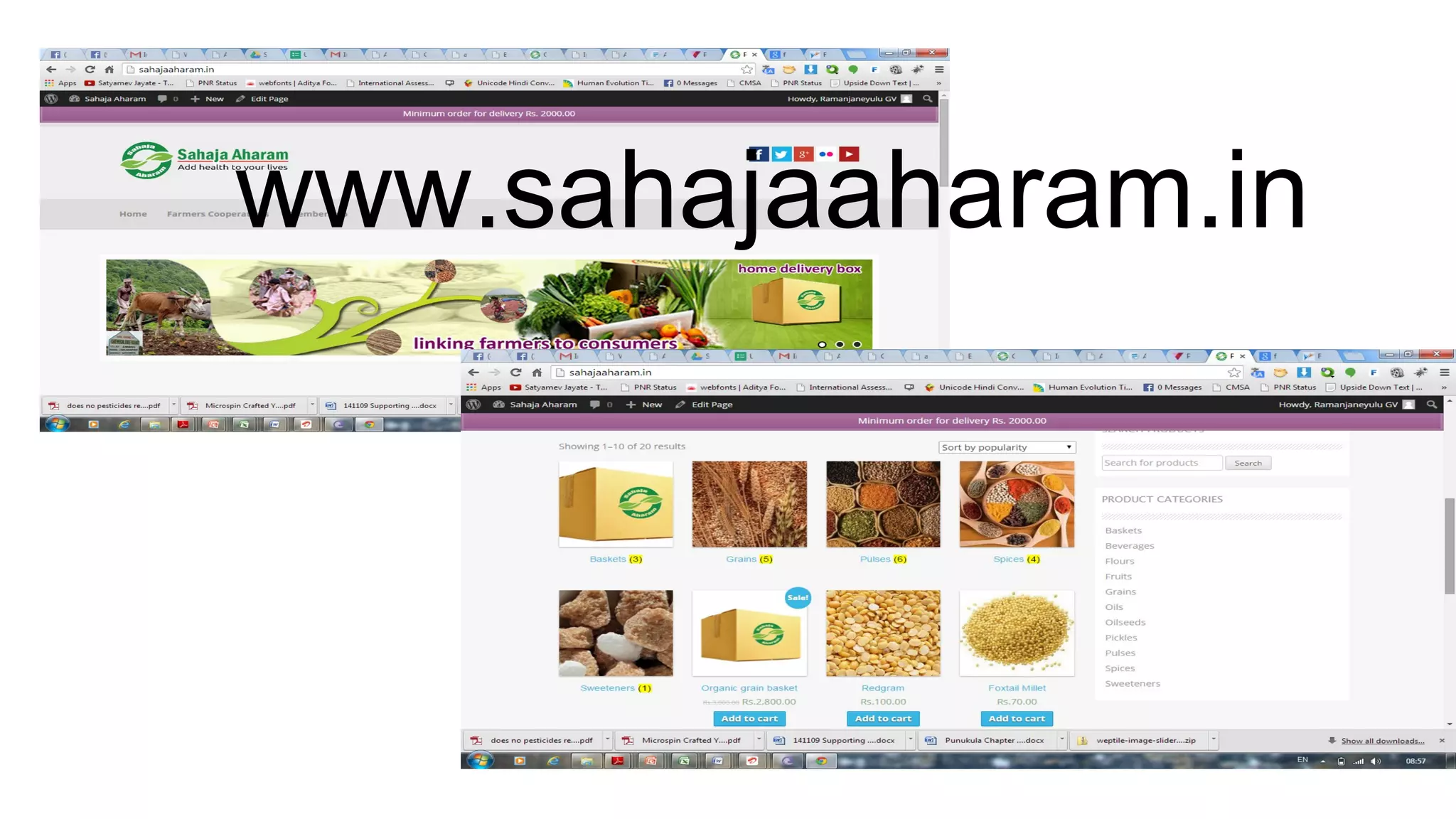
www.sahajaaharam.in
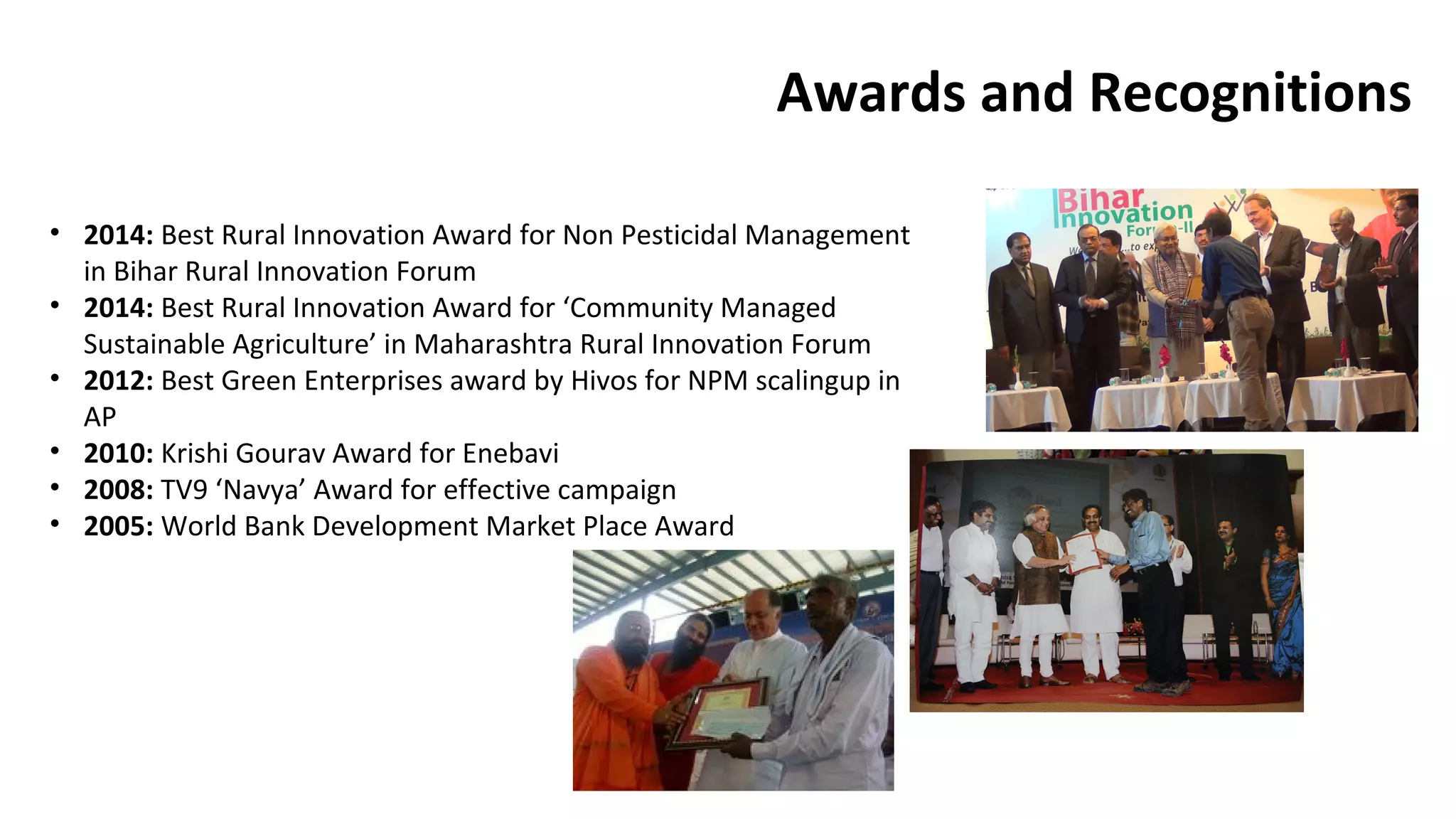
Awards and Recognitions 
• 2014: Best Rural Innovation Award for Non Pesticidal Management 
in Bihar Rural Innovation Forum 
• 2014: Best Rural Innovation Award for ‘Community Managed 
Sustainable Agriculture’ in Maharashtra Rural Innovation Forum 
• 2012: Best Green Enterprises award by Hivos for NPM scalingup in 
AP 
• 2010: Krishi Gourav Award for Enebavi 
• 2008: TV9 ‘Navya’ Award for effective campaign 
• 2005: World Bank Development Market Place Award
Public Policy 
• Increase right investments in agriculture 
– Budgetary allocations to 10-15% 
– increase more informed choices to farmers than driven by captive 
institutions 
– Support to farmers own labor, resources and knowledge 
– Infrastructure support 
• Regulations over unsustainable practices 
– GM crops 
– Chemical pesticides
We are what we eat
What makes food unsafe? 
• bad practices (poor hygiene, reliance on antibiotics and 
pesticides) 
• unproven or risky technologies (genetic modification, 
nanotechnology, irradiation, cloning) 
• deliberate contamination (such as tampering) 
• just poor supervision, 
• Genetic predisposition causing allergies, and 
• Food habits including the combinations
Food is as safe as it is grown 
•What is sprayed comes to your plate 
•What is left comes into your bottle of water, 
tea, coffee, softdrink, packed or breast milk
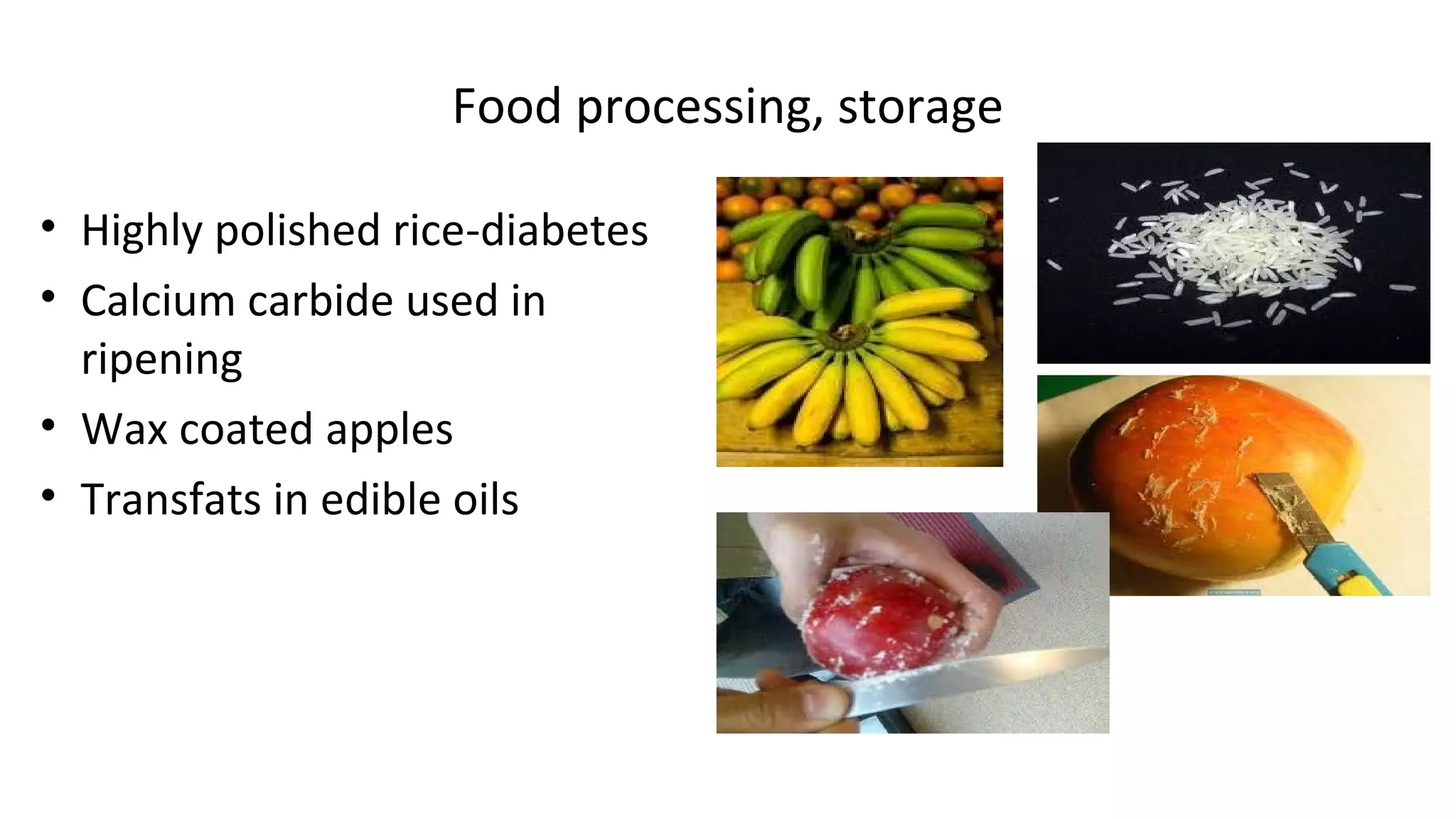
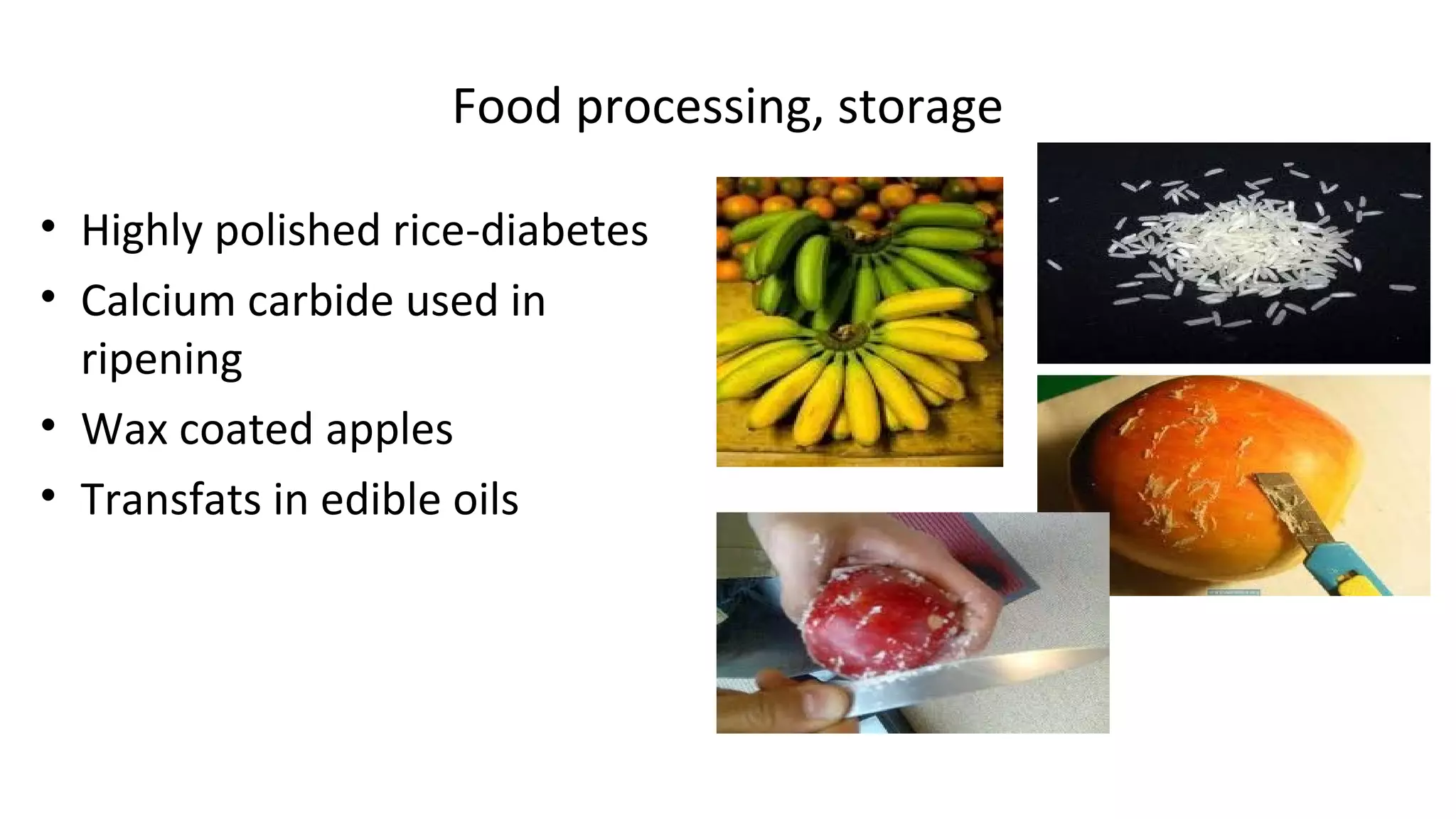
Food processing, storage 
• Highly polished rice-diabetes 
• Calcium carbide used in 
ripening 
• Wax coated apples 
• Transfats in edible oils
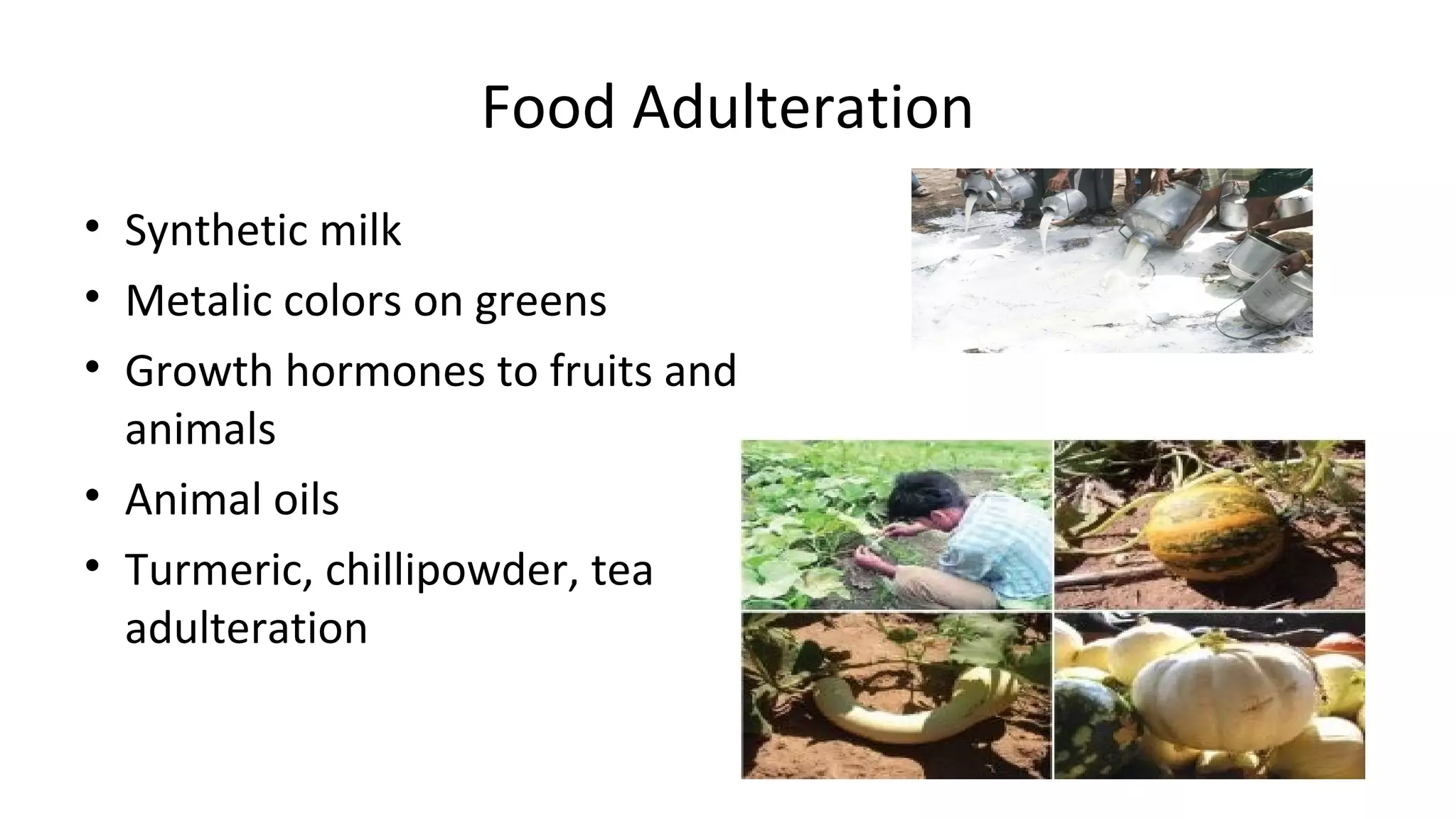
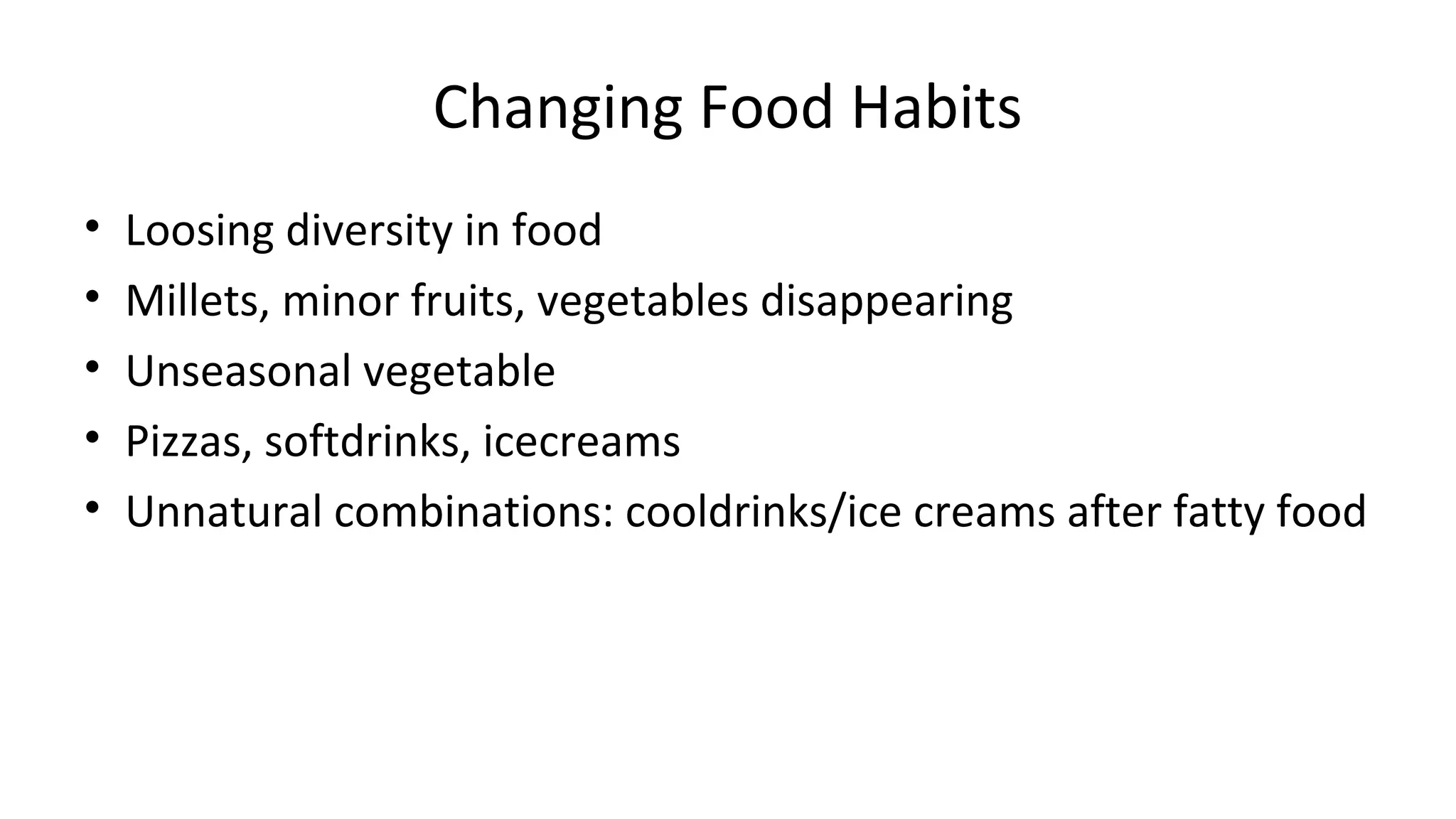
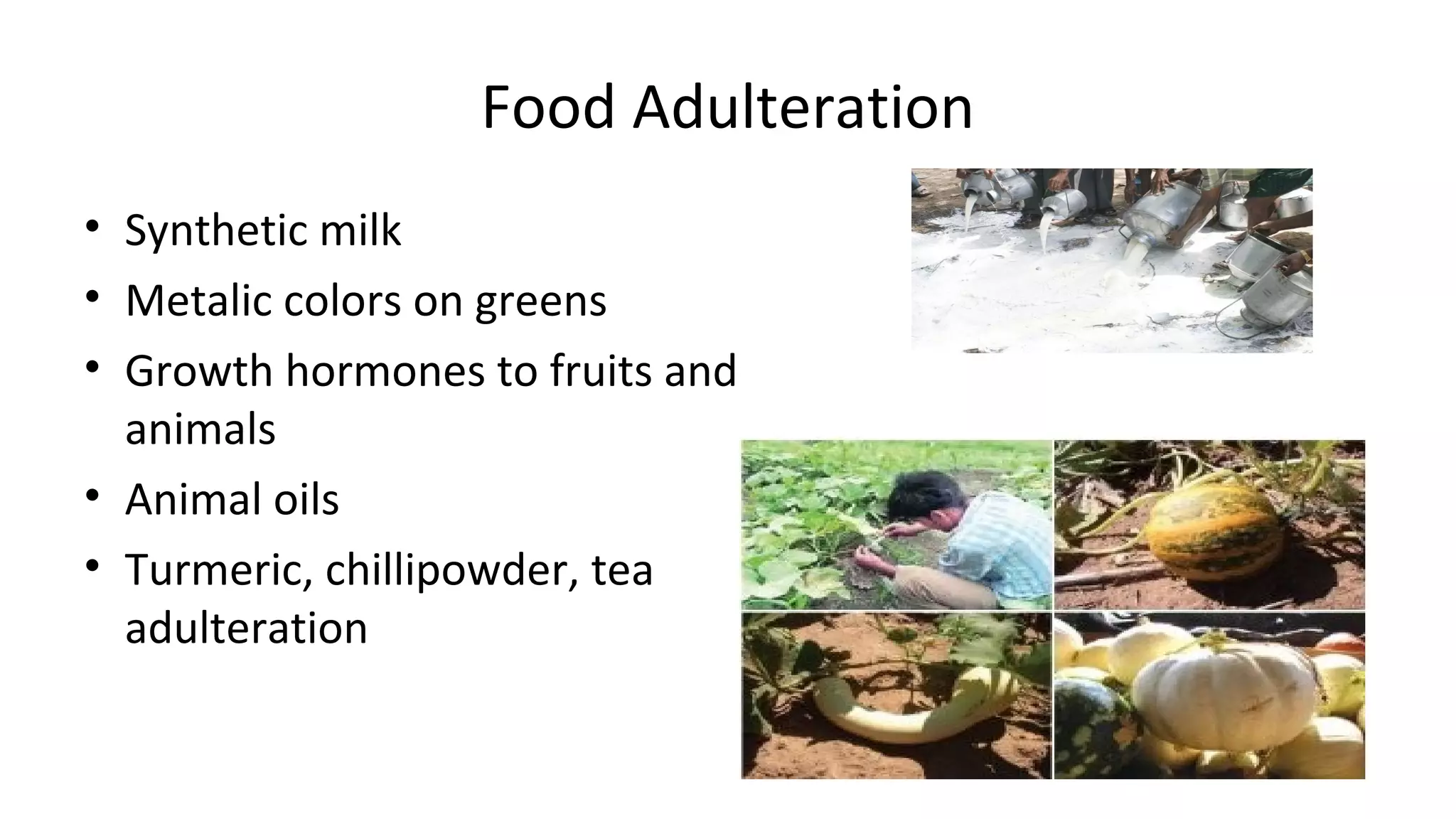
Food Adulteration 
• Synthetic milk 
• Metalic colors on greens 
• Growth hormones to fruits and 
animals 
• Animal oils 
• Turmeric, chillipowder, tea 
adulteration
Changing Food Habits 
• Loosing diversity in food 
• Millets, minor fruits, vegetables disappearing 
• Unseasonal vegetable 
• Pizzas, softdrinks, icecreams 
• Unnatural combinations: cooldrinks/ice creams after fatty food
Junk food 
• Junk food is bad for health 
• It lacks nutrition and is loaded with empty calories (refined carbohydrates) 
• High on Salt, Sugar and Fats, including Trans fat 
• Unhealthy diet is one key cause of the growing global burden of disease- 
WHO 
• Changing diet -- low on nutrients and high on salt, sugar and fat, are 
directly indicted to disease. 
• Junk food is responsible for rising cases of obesity and non communicable 
diseases (NCDs) like cardiovascular diseases and diabetes
Food processing, storage 
• Highly polished rice-diabetes 
• Calcium carbide used in 
ripening 
• Wax coated apples 
• Transfats in edible oils
Food Adulteration 
• Synthetic milk 
• Metalic colors on greens 
• Growth hormones to fruits and 
animals 
• Animal oils 
• Turmeric, chillipowder, tea 
adulteration
Changing Food Habits 
• Loosing diversity in food 
• Millets, minor fruits, vegetables disappearing 
• Unseasonal vegetable 
• Pizzas, softdrinks, icecreams 
• Unnatural combinations: cooldrinks/ice creams after fatty food
Junk food 
• Junk food is bad for health 
• It lacks nutrition and is loaded with empty calories (refined carbohydrates) 
• High on Salt, Sugar and Fats, including Trans fat 
• Unhealthy diet is one key cause of the growing global burden of disease- 
WHO 
• Changing diet -- low on nutrients and high on salt, sugar and fat, are 
directly indicted to disease. 
• Junk food is responsible for rising cases of obesity and non communicable 
diseases (NCDs) like cardiovascular diseases and diabetes
Organic Food Market: Growing potential 
• Organic agriculture systems and products are not always certified and are referred to 
as “Non-certified Organic agriculture or products". 
• Government of India has initiated Participatory Guarantee System (PGS) through 
National Centre for Organic Farming (NCOF) 
• Certified Organic products are generally more expensive than their conventional 
counter parts for a number of reasons 
• Production cost for Organic food is typically higher because of greater labour inputs 
per unit of output. 
• Post-harvest handling of relatively small quantities of Organic food results in higher 
costs because of the mandatory segregation of Organic and conventional produce. 
• Marketing and Distribution chain for Organic products is relatively inefficient and costs 
are higher because of relatively small volumes
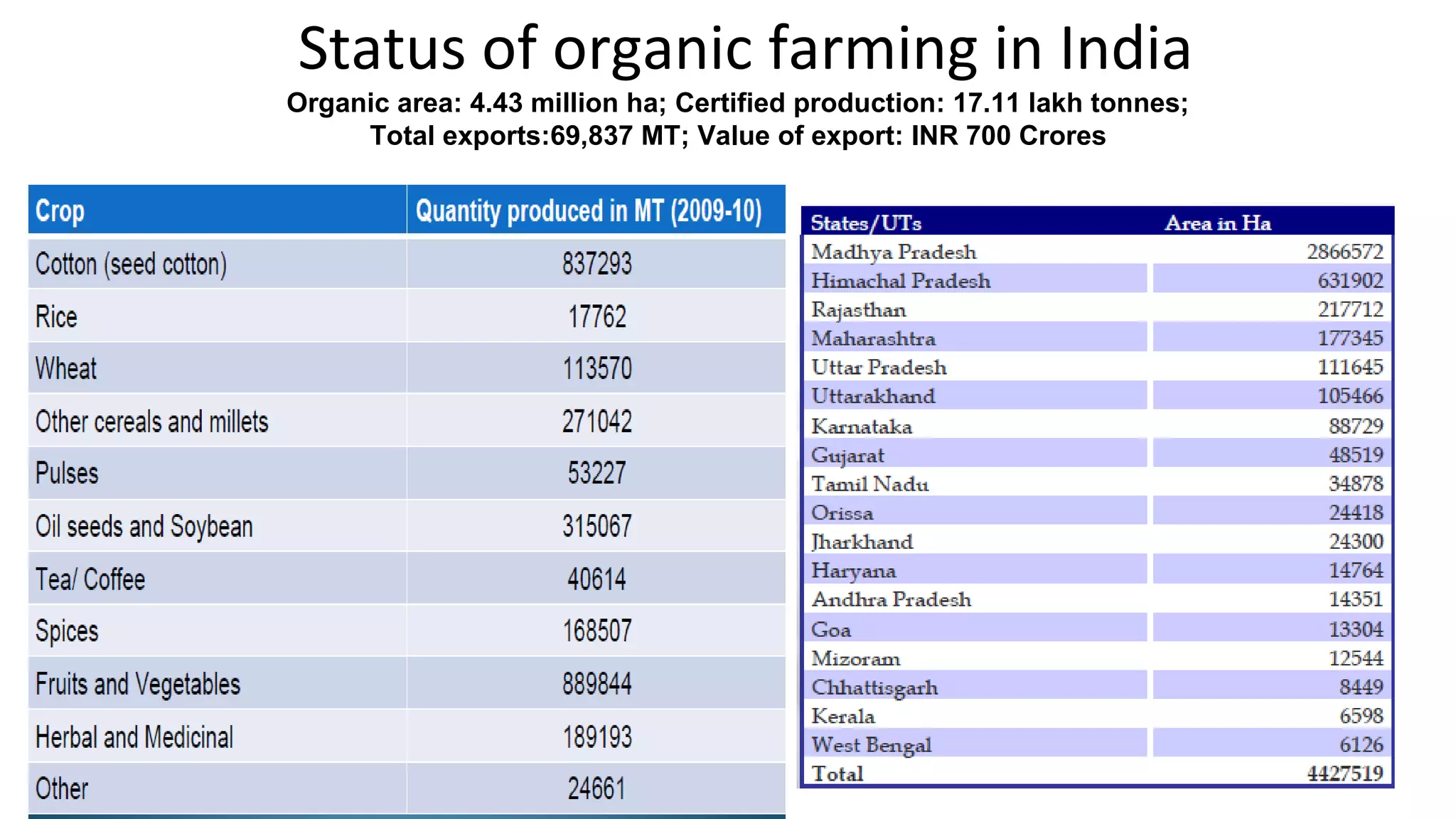
Status of organic farming in India 
Organic area: 4.43 million ha; Certified production: 17.11 lakh tonnes; 
Total exports:69,837 MT; Value of export: INR 700 Crores
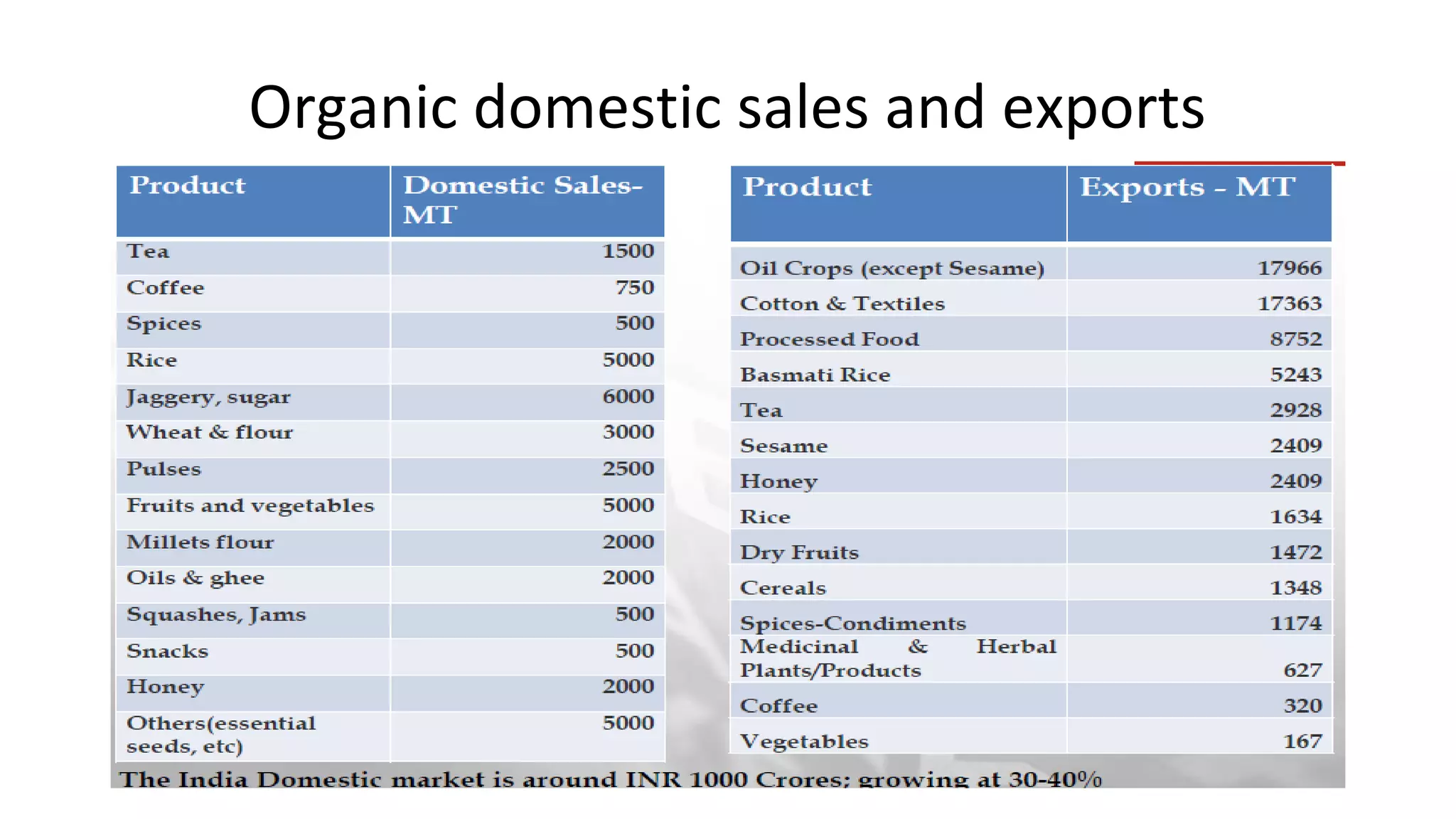
Organic domestic sales and exports
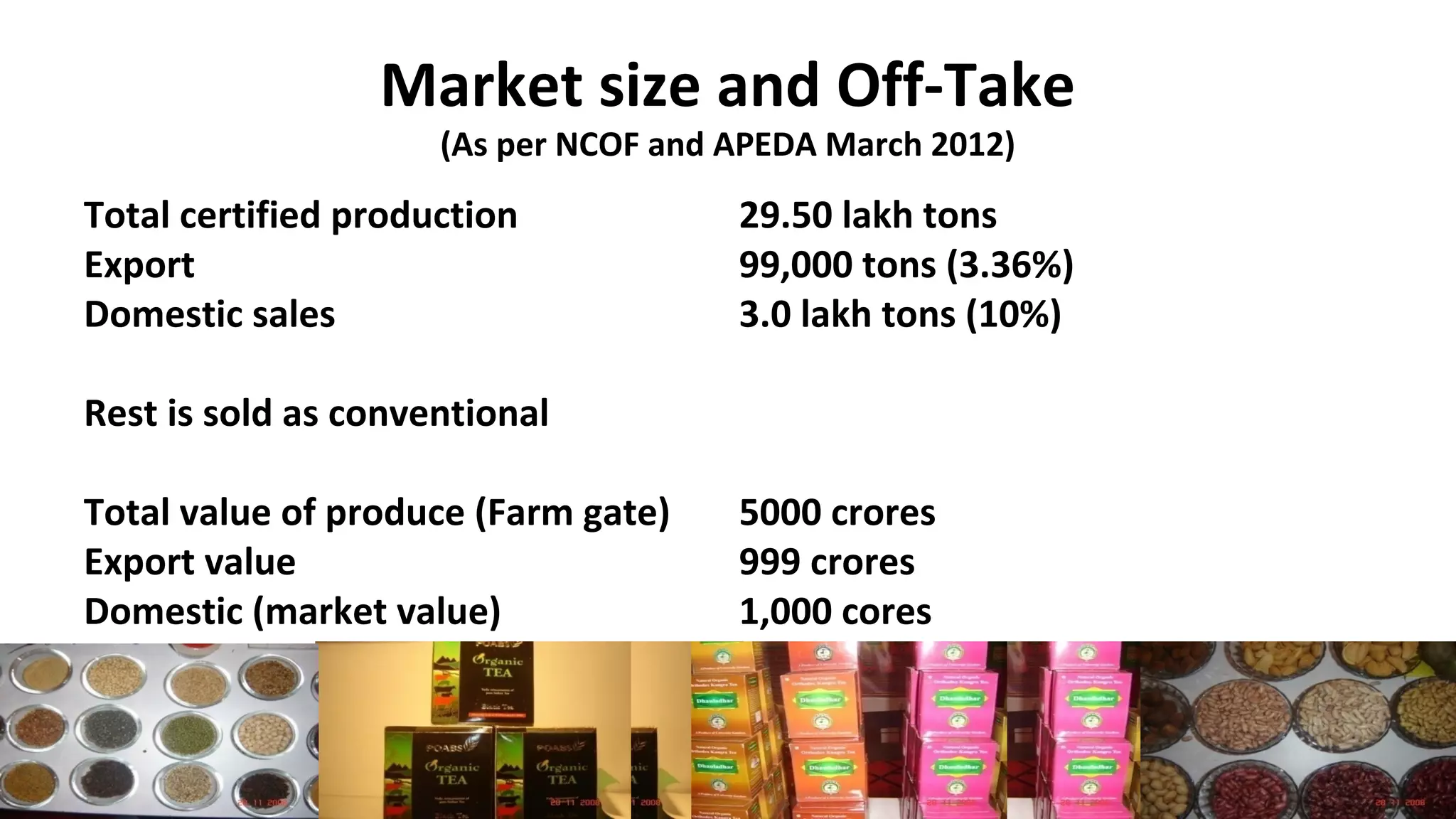
Market size and Off-Take 
(As per NCOF and APEDA March 2012) 
Total certified production 29.50 lakh tons 
Export 99,000 tons (3.36%) 
Domestic sales 3.0 lakh tons (10%) 
Rest is sold as conventional 
Total value of produce (Farm gate) 5000 crores 
Export value 999 crores 
Domestic (market value) 1,000 cores 
Potential to be tapped 4000 crores
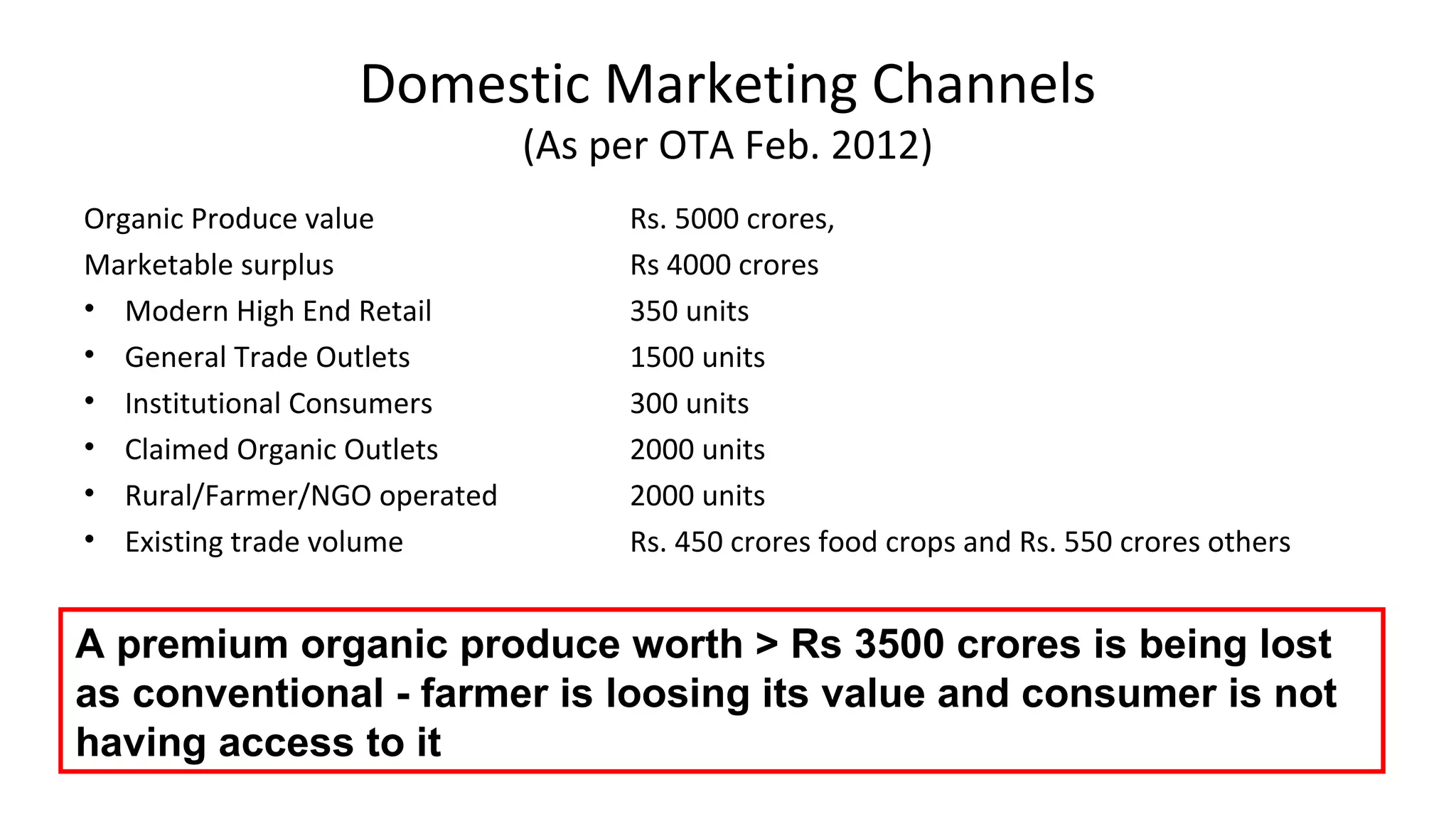
Domestic Marketing Channels 
(As per OTA Feb. 2012) 
Organic Produce value Rs. 5000 crores, 
Marketable surplus Rs 4000 crores 
• Modern High End Retail 350 units 
• General Trade Outlets 1500 units 
• Institutional Consumers 300 units 
• Claimed Organic Outlets 2000 units 
• Rural/Farmer/NGO operated 2000 units 
• Existing trade volume Rs. 450 crores food crops and Rs. 550 crores others 
A premium organic produce worth > Rs 3500 crores is being lost 
as conventional - farmer is loosing its value and consumer is not 
having access to it
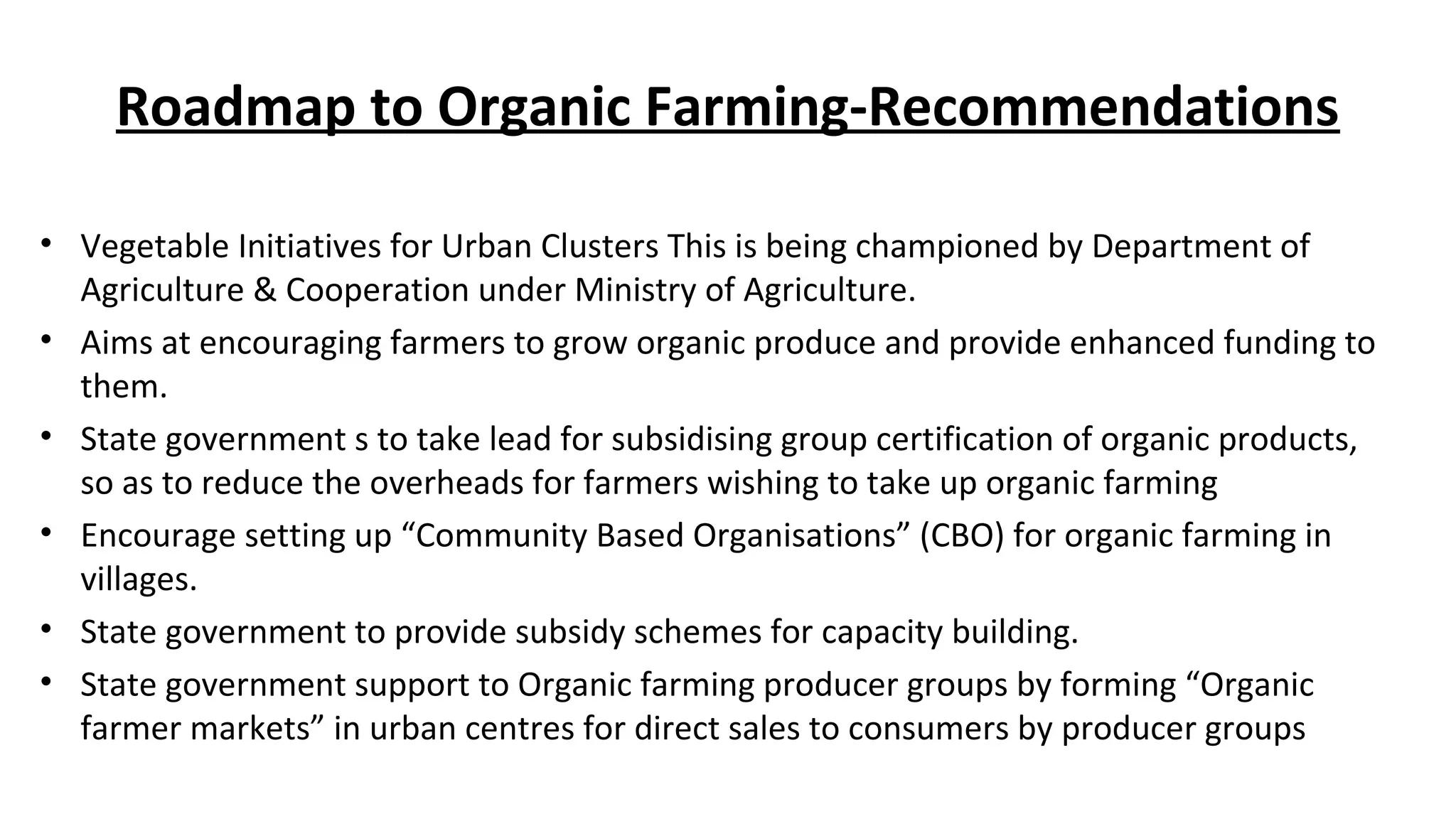
Roadmap to Organic Farming-Recommendations 
• Vegetable Initiatives for Urban Clusters This is being championed by Department of 
Agriculture & Cooperation under Ministry of Agriculture. 
• Aims at encouraging farmers to grow organic produce and provide enhanced funding to 
them. 
• State government s to take lead for subsidising group certification of organic products, 
so as to reduce the overheads for farmers wishing to take up organic farming 
• Encourage setting up “Community Based Organisations” (CBO) for organic farming in 
villages. 
• State government to provide subsidy schemes for capacity building. 
• State government support to Organic farming producer groups by forming “Organic 
farmer markets” in urban centres for direct sales to consumers by producer groups
Centre for sustainable agriculture 
Head office: 12-13-445, Street no.1, Tarnaka, Secunderabad, Telanagana- 500 017 
Contacts: http://www.csa-india.org, email: csa@csa-india.org, ph. 040-27017735

Organic way forward

  • 1.
    2004-2014 …caring forthose who feed the nation Telangana Andhra Pradesh Maharashtra Punjab Organic way forward Centre for sustainable agriculture Head office: 12-13-445, Street no.1, Tarnaka, Secunderabad, Telanagana- 500 017 Contacts: http://www.csa-india.org, email: csa@csa-india.org, ph. 040-27017735
  • 2.
    Farmer •Shifting tobetter and sustainable practices •Getting organised to deal with the markets and policies Policy Support •Supporting sustainable models •Regulating unsustainable practices •Invest more in agriculture •Income security to farmers Market Support •Farmers moving up the value chain •Direct marketing •Forward and backward linkages •Better prices
  • 3.
    End to Endsolution across agri-value chain •Mobilization, capacity building Soil Fertility Water harvesting and Moisture conservation Seeds and Biodiversity Community marketing professionals Community procurement centers Tie-up with bulk consumers Quality management Bio inputs Small Scale Infrastructure Best Practices Business Community extension Farmer field Schools Planning Credit Food security line Tie up with wholesalers Insurance
  • 4.
    Achievements 2004-14 •Worked with Society for Elimination of Rural Poverty (SERP) Govt. of Andhra Pradesh in designing and establishing Community Managed Sustainable Agriculture (CMSA) in 1500 villages covering 200 thousand ha across 18 districts during 2004 to 2008 which is now practiced in more than 35 lakh acres in all the districts of AP and Telangana • Worked with Govt. of Chhattisgarh in designing and establishing Community Managed Sustainable Agriculture in 2 clusters, 10 villages in Raipur dist. • CSA has established 14 Cooperatives including an aggregator FPO ‘Sahaja Aharam Producers Company’ in Andhra Pradesh and Telangana with combined membership of 1500 • In Maharashtra, CSA is working with farmer groups organised into Naisargik Sethi Beej Producer Company producing and marketing organic food and seeds 0.225 25 200 700 1300 2000 2800 3500 3600 0.1 15 80 300 600 1000 1500 1600 1770 4000 3500 3000 2500 2000 1500 1000 500 0 Acerage ('000 acres) Farmers ('000)
  • 5.
    Sahaja Aharam ProducerOrganisations Producer Co-op-1 Farmer Group B Direct to Home Organic Stores •Healthy food Mobile Store •Affordable Price •Max share to farmers Organic Store Producer Co-op-2 Other farmers and farmers groups Farmer Group A Farmer Group C Sahaja Aharam Producer Company •Capacity building •Institutional building •Investment support •Brand building •Quality Management •Fair Trade Market place Direct to resellers Whole sale to traders Bulk buyers Processing units Seeds Yet to estiblish Marketing Agency Bioinputs
  • 6.
    What is SahajaAharam? • An F2C initiative to create a meeting ground for nature-friendly consumers and farmers – blend the values of traditional bazaars with ecological concerns – to build a new supply chain on Farmer to Consumer (F2C) model which helps • Increasing farmers’ income – by realising better prices for their produce (50% over cost of production and 50% of consumer price, locally grown by adopting ecological farming practices – More employment opportunities by value addition and selling processed produce . • consumers in getting access to healthy and diverse food • By establishing a Participatory Food Quality Assurance System and a Fair Trade Model • By direct retailing to consumers (bulk/individual consumers) • partnerships
  • 7.
  • 8.
    Awards and Recognitions • 2014: Best Rural Innovation Award for Non Pesticidal Management in Bihar Rural Innovation Forum • 2014: Best Rural Innovation Award for ‘Community Managed Sustainable Agriculture’ in Maharashtra Rural Innovation Forum • 2012: Best Green Enterprises award by Hivos for NPM scalingup in AP • 2010: Krishi Gourav Award for Enebavi • 2008: TV9 ‘Navya’ Award for effective campaign • 2005: World Bank Development Market Place Award
  • 9.
    Public Policy •Increase right investments in agriculture – Budgetary allocations to 10-15% – increase more informed choices to farmers than driven by captive institutions – Support to farmers own labor, resources and knowledge – Infrastructure support • Regulations over unsustainable practices – GM crops – Chemical pesticides
  • 10.
  • 11.
    What makes foodunsafe? • bad practices (poor hygiene, reliance on antibiotics and pesticides) • unproven or risky technologies (genetic modification, nanotechnology, irradiation, cloning) • deliberate contamination (such as tampering) • just poor supervision, • Genetic predisposition causing allergies, and • Food habits including the combinations
  • 12.
    Food is assafe as it is grown •What is sprayed comes to your plate •What is left comes into your bottle of water, tea, coffee, softdrink, packed or breast milk
  • 13.
    Food processing, storage • Highly polished rice-diabetes • Calcium carbide used in ripening • Wax coated apples • Transfats in edible oils
  • 14.
    Food Adulteration •Synthetic milk • Metalic colors on greens • Growth hormones to fruits and animals • Animal oils • Turmeric, chillipowder, tea adulteration
  • 15.
    Changing Food Habits • Loosing diversity in food • Millets, minor fruits, vegetables disappearing • Unseasonal vegetable • Pizzas, softdrinks, icecreams • Unnatural combinations: cooldrinks/ice creams after fatty food
  • 16.
    Junk food •Junk food is bad for health • It lacks nutrition and is loaded with empty calories (refined carbohydrates) • High on Salt, Sugar and Fats, including Trans fat • Unhealthy diet is one key cause of the growing global burden of disease- WHO • Changing diet -- low on nutrients and high on salt, sugar and fat, are directly indicted to disease. • Junk food is responsible for rising cases of obesity and non communicable diseases (NCDs) like cardiovascular diseases and diabetes
  • 17.
    Food processing, storage • Highly polished rice-diabetes • Calcium carbide used in ripening • Wax coated apples • Transfats in edible oils
  • 18.
    Food Adulteration •Synthetic milk • Metalic colors on greens • Growth hormones to fruits and animals • Animal oils • Turmeric, chillipowder, tea adulteration
  • 19.
    Changing Food Habits • Loosing diversity in food • Millets, minor fruits, vegetables disappearing • Unseasonal vegetable • Pizzas, softdrinks, icecreams • Unnatural combinations: cooldrinks/ice creams after fatty food
  • 20.
    Junk food •Junk food is bad for health • It lacks nutrition and is loaded with empty calories (refined carbohydrates) • High on Salt, Sugar and Fats, including Trans fat • Unhealthy diet is one key cause of the growing global burden of disease- WHO • Changing diet -- low on nutrients and high on salt, sugar and fat, are directly indicted to disease. • Junk food is responsible for rising cases of obesity and non communicable diseases (NCDs) like cardiovascular diseases and diabetes
  • 21.
    Organic Food Market:Growing potential • Organic agriculture systems and products are not always certified and are referred to as “Non-certified Organic agriculture or products". • Government of India has initiated Participatory Guarantee System (PGS) through National Centre for Organic Farming (NCOF) • Certified Organic products are generally more expensive than their conventional counter parts for a number of reasons • Production cost for Organic food is typically higher because of greater labour inputs per unit of output. • Post-harvest handling of relatively small quantities of Organic food results in higher costs because of the mandatory segregation of Organic and conventional produce. • Marketing and Distribution chain for Organic products is relatively inefficient and costs are higher because of relatively small volumes
  • 22.
    Status of organicfarming in India Organic area: 4.43 million ha; Certified production: 17.11 lakh tonnes; Total exports:69,837 MT; Value of export: INR 700 Crores
  • 23.
  • 24.
    Market size andOff-Take (As per NCOF and APEDA March 2012) Total certified production 29.50 lakh tons Export 99,000 tons (3.36%) Domestic sales 3.0 lakh tons (10%) Rest is sold as conventional Total value of produce (Farm gate) 5000 crores Export value 999 crores Domestic (market value) 1,000 cores Potential to be tapped 4000 crores
  • 25.
    Domestic Marketing Channels (As per OTA Feb. 2012) Organic Produce value Rs. 5000 crores, Marketable surplus Rs 4000 crores • Modern High End Retail 350 units • General Trade Outlets 1500 units • Institutional Consumers 300 units • Claimed Organic Outlets 2000 units • Rural/Farmer/NGO operated 2000 units • Existing trade volume Rs. 450 crores food crops and Rs. 550 crores others A premium organic produce worth > Rs 3500 crores is being lost as conventional - farmer is loosing its value and consumer is not having access to it
  • 27.
    Roadmap to OrganicFarming-Recommendations • Vegetable Initiatives for Urban Clusters This is being championed by Department of Agriculture & Cooperation under Ministry of Agriculture. • Aims at encouraging farmers to grow organic produce and provide enhanced funding to them. • State government s to take lead for subsidising group certification of organic products, so as to reduce the overheads for farmers wishing to take up organic farming • Encourage setting up “Community Based Organisations” (CBO) for organic farming in villages. • State government to provide subsidy schemes for capacity building. • State government support to Organic farming producer groups by forming “Organic farmer markets” in urban centres for direct sales to consumers by producer groups
  • 28.
    Centre for sustainableagriculture Head office: 12-13-445, Street no.1, Tarnaka, Secunderabad, Telanagana- 500 017 Contacts: http://www.csa-india.org, email: csa@csa-india.org, ph. 040-27017735