WALT: Assess the 
Functionalist view of 
culture. 
WILFs: 
E – Describe the functionalist view of culture. 
C – Explain the functionalist view of culture 
A – Evaluate the functionalist view of culture.
Culture 
• Links individual to wider society via culture… 
• Cultures vary across societies… 
• Cultures vary over time… 
• Cultures are composed of three main elements: Beliefs, 
Values, Norms 
• Larger and more socially complex the society, the greater 
the likelihood is that there will be a range of different 
values. These variations are known as subcultures.
(Remote indian tribe in Brazil) 
• The Indians sit next to him [the leader of the 
anthropolgists], laughing with him. The chief, Shishu, puts 
his arm around him for half an hour. Shishu makes us tea by 
grating a vine over a club encrusted with monkey-teeth, and 
then wetting and squeezing the result. One man pulls up my 
shirt to see if I have breasts and looks down the trousers of 
Possuelo’s long haired teenage son. 
• 1. What do you think the significance of making tea? 
• 2. The tribe
Question 
• Shared culture that really holds society together. 
• No cultures could exist without societies. But equally, no societies 
could exist without culture. Without culture no one can be human 
at all. 
• Society is made up of all the formal and informal social institutions 
that people create (marriage etc) 
• Culture dictates how those institutions work by setting behavioral 
rules (norms) and by shaping expectations about the social roles 
people should play in those institutions. 
• Narrower alternative ways in which the concept of culture has 
been used by sociologists. IE High Culture – affects identity …
Sociobiology. 
• Social biologists generally believe that culture is the product 
of biology or nature as opposed to the idea that it is 
learned. 
• Morris (1968) argues that biology shapes culture, because 
sharing culture is based on the in-built or genetic need to 
continue the life of the social group over time. 
• Sociologists argue that if human behaviour is affected by 
biology it is only reflex. E.g. we feel hungry. Culture 
determines what is eaten. 
• IE UK disproves of cannibalism, eating horses, insects and 
dogs.
Functionalism 
• Functionalism says that the individual is the product of 
society. 
• Emile Durkheim (1858-1917) was one of the founders of 
sociology. In his view, society is made up of various 
institutions, each of which has a useful function. So 
Durkheim and his followers are known as functionalists. 
• They looked at how society was structured (Functionalism is 
a structural theory).
Functionalism 
• Functionalists looked at how institutions in society work and 
how they affect individuals; 
- The Family – has the function of socializing children. 
- Education – has the function of preparing young people for 
adult society. 
- Religion – has the function of uniting society through 
shared beliefs.
Functionalist. 34 
• What is meant by value consensus? 
• What is the functionalist view on culture? 
• What is the functionalist view on culture in pre-industrial 
societies? 
• What is anomie? 
• How would social order be maintained? 
• How does specialized division of labor maintain this?
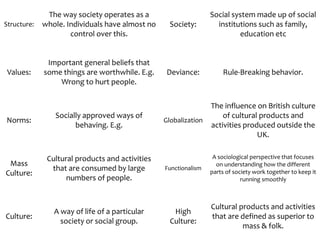
Structure: 
The way society operates as a 
whole. Individuals have almost no 
control over this. 
Society: 
Social system made up of social 
institutions such as family, 
education etc 
Values: 
Important general beliefs that 
some things are worthwhile. E.g. 
Wrong to hurt people. 
Deviance: Rule-Breaking behavior. 
Norms: 
Socially approved ways of 
behaving. E.g. 
Globalization 
The influence on British culture 
of cultural products and 
activities produced outside the 
UK. 
Mass 
Culture: 
Cultural products and activities 
that are consumed by large 
numbers of people. 
Functionalism 
A sociological perspective that focuses 
on understanding how the different 
parts of society work together to keep it 
running smoothly 
Culture: 
A way of life of a particular 
society or social group. 
High 
Culture: 
Cultural products and activities 
that are defined as superior to 
mass & folk.

1206 Functionalist View of Culture

  • 1.
    WALT: Assess the Functionalist view of culture. WILFs: E – Describe the functionalist view of culture. C – Explain the functionalist view of culture A – Evaluate the functionalist view of culture.
  • 2.
    Culture • Linksindividual to wider society via culture… • Cultures vary across societies… • Cultures vary over time… • Cultures are composed of three main elements: Beliefs, Values, Norms • Larger and more socially complex the society, the greater the likelihood is that there will be a range of different values. These variations are known as subcultures.
  • 3.
    (Remote indian tribein Brazil) • The Indians sit next to him [the leader of the anthropolgists], laughing with him. The chief, Shishu, puts his arm around him for half an hour. Shishu makes us tea by grating a vine over a club encrusted with monkey-teeth, and then wetting and squeezing the result. One man pulls up my shirt to see if I have breasts and looks down the trousers of Possuelo’s long haired teenage son. • 1. What do you think the significance of making tea? • 2. The tribe
  • 4.
    Question • Sharedculture that really holds society together. • No cultures could exist without societies. But equally, no societies could exist without culture. Without culture no one can be human at all. • Society is made up of all the formal and informal social institutions that people create (marriage etc) • Culture dictates how those institutions work by setting behavioral rules (norms) and by shaping expectations about the social roles people should play in those institutions. • Narrower alternative ways in which the concept of culture has been used by sociologists. IE High Culture – affects identity …
  • 5.
    Sociobiology. • Socialbiologists generally believe that culture is the product of biology or nature as opposed to the idea that it is learned. • Morris (1968) argues that biology shapes culture, because sharing culture is based on the in-built or genetic need to continue the life of the social group over time. • Sociologists argue that if human behaviour is affected by biology it is only reflex. E.g. we feel hungry. Culture determines what is eaten. • IE UK disproves of cannibalism, eating horses, insects and dogs.
  • 6.
    Functionalism • Functionalismsays that the individual is the product of society. • Emile Durkheim (1858-1917) was one of the founders of sociology. In his view, society is made up of various institutions, each of which has a useful function. So Durkheim and his followers are known as functionalists. • They looked at how society was structured (Functionalism is a structural theory).
  • 7.
    Functionalism • Functionalistslooked at how institutions in society work and how they affect individuals; - The Family – has the function of socializing children. - Education – has the function of preparing young people for adult society. - Religion – has the function of uniting society through shared beliefs.
  • 8.
    Functionalist. 34 •What is meant by value consensus? • What is the functionalist view on culture? • What is the functionalist view on culture in pre-industrial societies? • What is anomie? • How would social order be maintained? • How does specialized division of labor maintain this?
  • 9.
    Structure: The waysociety operates as a whole. Individuals have almost no control over this. Society: Social system made up of social institutions such as family, education etc Values: Important general beliefs that some things are worthwhile. E.g. Wrong to hurt people. Deviance: Rule-Breaking behavior. Norms: Socially approved ways of behaving. E.g. Globalization The influence on British culture of cultural products and activities produced outside the UK. Mass Culture: Cultural products and activities that are consumed by large numbers of people. Functionalism A sociological perspective that focuses on understanding how the different parts of society work together to keep it running smoothly Culture: A way of life of a particular society or social group. High Culture: Cultural products and activities that are defined as superior to mass & folk.