WALT: Define Global 
Culture. 
E – Give a basic definition and an example of Global Culture. 
C – Give a good definition of Global Culture with several 
examples. 
A – Give characteristics and examples of Global Culture.
What have these got to do with Sociology? 
Link each of them to anything you’ve learnt.
Culture is not an easy term to define. However, it is not too difficult 
to identify some of the elements that go to making a culture. These 
include language, norms, values and beliefs. 
Nor is there complete agreement on what the role or purpose of 
culture is. However, sociologists are united in the view that culture 
is something which is learned from other members of a group or 
community, rather than being transmitted biologically or 
genetically. Culture, is also something which is shared by members 
of a society. For example, it would be hard to imagine a language 
spoken by only one person – unless of course he or she was the last 
surviving member of a group that spoke the language. 
However, especially in large complex societies, not every individual 
shares exactly the same culture, and different ‘kinds’ of culture may 
exist alongside one another within the same society, such as high 
culture and folk culture, for example. 
What is culture – In exactly 20 words. No more no less…
Exam … 
A narrow definition of culture is that it is the artistic and 
intellectual work of a society. Sociologists define culture in 
this sense as high culture. However, sociologies identify many 
other types and definitions of culture. For example, some 
sociologists contrast folk culture with mass culture, while 
others discuss the idea of a global culture. 
Explain what is meant by ‘global culture’. (2 marks) 
Identify two characteristics of folk culture (4 marks) 
Suggest three ways in which individuals may be socialized into 
a class identity. (6 marks)
Exam … 
Q. Identify two characteristics of mass culture (4 marks). 
- Created by commercial organizations 
- Manufactured 
- Passive 
- Inauthentic 
- Associated with industrial societies 
- Produced for profit.
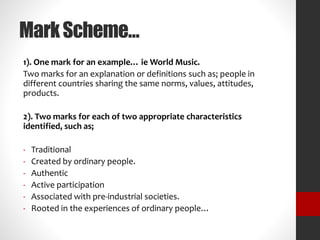
Mark Scheme… 
1). One mark for an example… ieWorld Music. 
Two marks for an explanation or definitions such as; people in 
different countries sharing the same norms, values, attitudes, 
products. 
2). Two marks for each of two appropriate characteristics 
identified, such as; 
- Traditional 
- Created by ordinary people. 
- Authentic 
- Active participation 
- Associated with pre-industrial societies. 
- Rooted in the experiences of ordinary people…
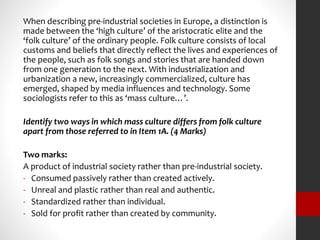
When describing pre-industrial societies in Europe, a distinction is 
made between the ‘high culture’ of the aristocratic elite and the 
‘folk culture’ of the ordinary people. Folk culture consists of local 
customs and beliefs that directly reflect the lives and experiences of 
the people, such as folk songs and stories that are handed down 
from one generation to the next. With industrialization and 
urbanization a new, increasingly commercialized, culture has 
emerged, shaped by media influences and technology. Some 
sociologists refer to this as ‘mass culture…’. 
Identify two ways in which mass culture differs from folk culture 
apart from those referred to in Item 1A. (4 Marks) 
Two marks: 
A product of industrial society rather than pre-industrial society. 
- Consumed passively rather than created actively. 
- Unreal and plastic rather than real and authentic. 
- Standardized rather than individual. 
- Sold for profit rather than created by community.
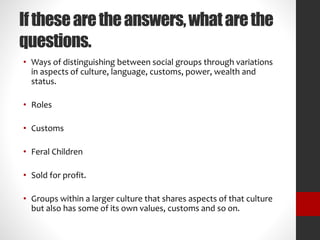
If these are the answers, what are the 
questions. 
• Ways of distinguishing between social groups through variations 
in aspects of culture, language, customs, power, wealth and 
status. 
• Roles 
• Customs 
• Feral Children 
• Sold for profit. 
• Groups within a larger culture that shares aspects of that culture 
but also has some of its own values, customs and so on.
Link this image to today’s 
learning.

-

  • 1.
    WALT: Define Global Culture. E – Give a basic definition and an example of Global Culture. C – Give a good definition of Global Culture with several examples. A – Give characteristics and examples of Global Culture.
  • 2.
    What have thesegot to do with Sociology? Link each of them to anything you’ve learnt.
  • 3.
    Culture is notan easy term to define. However, it is not too difficult to identify some of the elements that go to making a culture. These include language, norms, values and beliefs. Nor is there complete agreement on what the role or purpose of culture is. However, sociologists are united in the view that culture is something which is learned from other members of a group or community, rather than being transmitted biologically or genetically. Culture, is also something which is shared by members of a society. For example, it would be hard to imagine a language spoken by only one person – unless of course he or she was the last surviving member of a group that spoke the language. However, especially in large complex societies, not every individual shares exactly the same culture, and different ‘kinds’ of culture may exist alongside one another within the same society, such as high culture and folk culture, for example. What is culture – In exactly 20 words. No more no less…
  • 4.
    Exam … Anarrow definition of culture is that it is the artistic and intellectual work of a society. Sociologists define culture in this sense as high culture. However, sociologies identify many other types and definitions of culture. For example, some sociologists contrast folk culture with mass culture, while others discuss the idea of a global culture. Explain what is meant by ‘global culture’. (2 marks) Identify two characteristics of folk culture (4 marks) Suggest three ways in which individuals may be socialized into a class identity. (6 marks)
  • 5.
    Exam … Q.Identify two characteristics of mass culture (4 marks). - Created by commercial organizations - Manufactured - Passive - Inauthentic - Associated with industrial societies - Produced for profit.
  • 6.
    Mark Scheme… 1).One mark for an example… ieWorld Music. Two marks for an explanation or definitions such as; people in different countries sharing the same norms, values, attitudes, products. 2). Two marks for each of two appropriate characteristics identified, such as; - Traditional - Created by ordinary people. - Authentic - Active participation - Associated with pre-industrial societies. - Rooted in the experiences of ordinary people…
  • 7.
    When describing pre-industrialsocieties in Europe, a distinction is made between the ‘high culture’ of the aristocratic elite and the ‘folk culture’ of the ordinary people. Folk culture consists of local customs and beliefs that directly reflect the lives and experiences of the people, such as folk songs and stories that are handed down from one generation to the next. With industrialization and urbanization a new, increasingly commercialized, culture has emerged, shaped by media influences and technology. Some sociologists refer to this as ‘mass culture…’. Identify two ways in which mass culture differs from folk culture apart from those referred to in Item 1A. (4 Marks) Two marks: A product of industrial society rather than pre-industrial society. - Consumed passively rather than created actively. - Unreal and plastic rather than real and authentic. - Standardized rather than individual. - Sold for profit rather than created by community.
  • 8.
    If these arethe answers, what are the questions. • Ways of distinguishing between social groups through variations in aspects of culture, language, customs, power, wealth and status. • Roles • Customs • Feral Children • Sold for profit. • Groups within a larger culture that shares aspects of that culture but also has some of its own values, customs and so on.
  • 9.
    Link this imageto today’s learning.