WALT: State what the 
Sociological Theories say 
about Socialization? 
C - Can describe, explain and summarise what sociological 
theories say about socialization 
B - Can assess what Sociological Theories say about Socialization 
A - Can evaluate what Sociological Theories say about Socialization
Socialisation 
• How we learn the norms, values roles and customs that 
make up our culture. 
“The processes by which individuals are taught, learn and 
internalize the culture of their society.” 
Where does this begin? 
Family – Language, morals & rules. (PRIMARY) 
Beyond the Family – Formal education (SECONDARY)
KEY VOCABULARY 
• Agencies of Socialisation – The institutions, places and 
groups within which people are socialised into their culture. 
• Focal Agencies – The agent of socialisation which, at various 
points in our lives in the dominant influence (ie Parents, 
Teachers, Work)
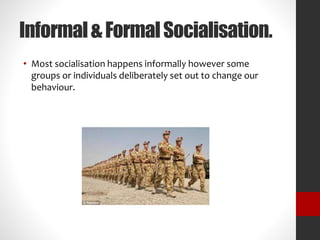
Informal & Formal Socialisation. 
• Most socialisation happens informally however some 
groups or individuals deliberately set out to change our 
behaviour.
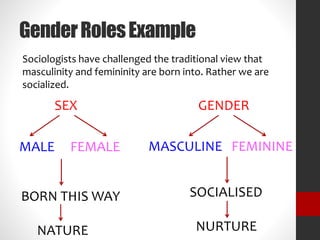
Gender Roles Example 
Sociologists have challenged the traditional view that 
masculinity and femininity are born into. Rather we are 
socialized. 
SEX GENDER 
MALE FEMALE MASCULINE FEMININE 
BORN THIS WAY 
NATURE 
SOCIALISED 
NURTURE
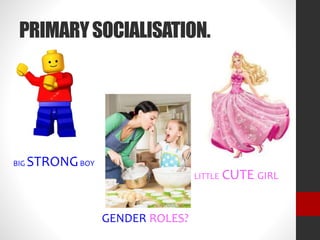
PRIMARY SOCIALISATION. 
BIG STRONGBOY 
LITTLE CUTE GIRL 
GENDER ROLES?
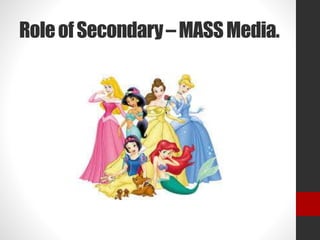
Role of Secondary –MASS Media.
Getting you thinking 
• Page 39
All write consensus 
1. Explain what Sociologists mean by Primary Socialization 
2. Name 6 skills that children acquire during primary 
socialization 
3. How do children learn to differentiate between right and 
wrong during primary socialization? 
4. Why is the peer group such an important agent of 
socialization?
What is Socialization for? 
Rally table a list of ideas…
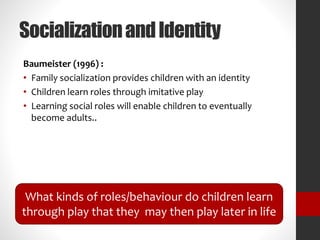
Socialization and Identity 
Baumeister (1996) : 
• Family socialization provides children with an identity 
• Children learn roles through imitative play 
• Learning social roles will enable children to eventually 
become adults.. 
What kinds of roles/behaviour do children learn 
through play that they may then play later in life
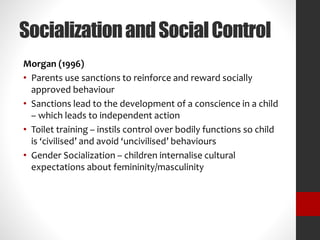
Socialization and Social Control 
Morgan (1996) 
• Parents use sanctions to reinforce and reward socially 
approved behaviour 
• Sanctions lead to the development of a conscience in a child 
– which leads to independent action 
• Toilet training – instils control over bodily functions so child 
is ‘civilised’ and avoid ‘uncivilised’ behaviours 
• Gender Socialization – children internalise cultural 
expectations about femininity/masculinity
Evaluation of 
Baumeister/Morgan 
• 3 criticisms and strengths
Experts – 4 agencies of socialization 
1. Number off 1-4 
2. Allocate topic: 
Education 
Religion 
Mass Media 
Peer Group 
3. Create a summary for topic
Experts 
4. Join other experts to reinforce learning 
5. With experts, create 4 knowledge questions – you will take 
these back to your group to do as numbered heads 
together or all write consensus6 
6. Return to home table. Take it into turns to deliver expert 
topic 
7. When everyone has finished…then test them using 4 
knowledge questions
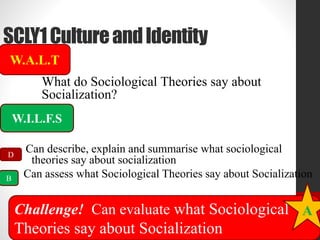
SCLY1 Culture and Identity 
W.A.L.T 
What do Sociological Theories say about 
Socialization? 
W.I.L.F.S 
Can describe, explain and summarise what sociological 
theories say about socialization 
Can assess what Sociological Theories say about Socialization 
Challenge! Can evaluate what Sociological 
Theories say about Socialization 
A 
D 
B

1208 Theory of Socialization.

  • 1.
    WALT: State whatthe Sociological Theories say about Socialization? C - Can describe, explain and summarise what sociological theories say about socialization B - Can assess what Sociological Theories say about Socialization A - Can evaluate what Sociological Theories say about Socialization
  • 2.
    Socialisation • Howwe learn the norms, values roles and customs that make up our culture. “The processes by which individuals are taught, learn and internalize the culture of their society.” Where does this begin? Family – Language, morals & rules. (PRIMARY) Beyond the Family – Formal education (SECONDARY)
  • 3.
    KEY VOCABULARY •Agencies of Socialisation – The institutions, places and groups within which people are socialised into their culture. • Focal Agencies – The agent of socialisation which, at various points in our lives in the dominant influence (ie Parents, Teachers, Work)
  • 4.
    Informal & FormalSocialisation. • Most socialisation happens informally however some groups or individuals deliberately set out to change our behaviour.
  • 5.
    Gender Roles Example Sociologists have challenged the traditional view that masculinity and femininity are born into. Rather we are socialized. SEX GENDER MALE FEMALE MASCULINE FEMININE BORN THIS WAY NATURE SOCIALISED NURTURE
  • 6.
    PRIMARY SOCIALISATION. BIGSTRONGBOY LITTLE CUTE GIRL GENDER ROLES?
  • 7.
    Role of Secondary–MASS Media.
  • 8.
  • 9.
    All write consensus 1. Explain what Sociologists mean by Primary Socialization 2. Name 6 skills that children acquire during primary socialization 3. How do children learn to differentiate between right and wrong during primary socialization? 4. Why is the peer group such an important agent of socialization?
  • 10.
    What is Socializationfor? Rally table a list of ideas…
  • 11.
    Socialization and Identity Baumeister (1996) : • Family socialization provides children with an identity • Children learn roles through imitative play • Learning social roles will enable children to eventually become adults.. What kinds of roles/behaviour do children learn through play that they may then play later in life
  • 12.
    Socialization and SocialControl Morgan (1996) • Parents use sanctions to reinforce and reward socially approved behaviour • Sanctions lead to the development of a conscience in a child – which leads to independent action • Toilet training – instils control over bodily functions so child is ‘civilised’ and avoid ‘uncivilised’ behaviours • Gender Socialization – children internalise cultural expectations about femininity/masculinity
  • 13.
    Evaluation of Baumeister/Morgan • 3 criticisms and strengths
  • 14.
    Experts – 4agencies of socialization 1. Number off 1-4 2. Allocate topic: Education Religion Mass Media Peer Group 3. Create a summary for topic
  • 15.
    Experts 4. Joinother experts to reinforce learning 5. With experts, create 4 knowledge questions – you will take these back to your group to do as numbered heads together or all write consensus6 6. Return to home table. Take it into turns to deliver expert topic 7. When everyone has finished…then test them using 4 knowledge questions
  • 16.
    SCLY1 Culture andIdentity W.A.L.T What do Sociological Theories say about Socialization? W.I.L.F.S Can describe, explain and summarise what sociological theories say about socialization Can assess what Sociological Theories say about Socialization Challenge! Can evaluate what Sociological Theories say about Socialization A D B