Define Culture
• The two basic elements of society:
  Culture                   Social Structure
• Definition: a patterned way of life
               a symbolic system
   It includes the set of practices such as traditions,
  customs, rituals, beliefs, values, rules for proper
  conducts, and also material objects: all human
  creations such as artifacts, building, music, dance,
  technology etc.
The Characteristics of Culture
• Culture is universal,
  learned,
  shared,
  cumulative,
  paradoxical.
• Any behavior or set of behavior that are
  biologically determined is NOT cultural
  phenomena.
Questions for the Movie:
• How did the native Indians give name to a bird?
• Why did native Indians and Europeans build
  buildings differently?
• Which place does the narrator call a “wilderness”?
• Why some could native Indians not understand the
  concept of “time”
• Based on your understanding of the movie, answer
  how cultures were developed,
• why human societies develop different cultures, And
• How cultures change.
Components of Culture
• Non material culture: ways of thinking
  and acting
Symbolic culture: symbols, languages, gestures, non-verbal communication:
     body language
Cognitive culture: values, belief, ideology,
Normative culture: socially expected behavior: norms and sanctions

• Material culture:items such as technology, arts,
     clothing etc.


• Relationship between the two:
     compatibility and cultural lag
Symbolic Culture
• Symbols: something to which people attach meaning
  and then is used to communicate.
• Basis of nonmaterial culture
• Elements: Gestures: can facilitate and hinder
  communication
• Language: primary means of communication, means
  of transmission of experiences, allows culture to
  develop, without, human culture could not progress
  beyond that of lower primates.
• The Sapir-Whorf Hypothesis: One’s language
  determines how reality is constructed. Also termed as
  Linguistic-Relativity Hypothesis
Linguistic-Relativity
         Hypothesis
• A culture’s language expresses how the
  people of that culture perceive and
  understand the world, and at the same
  time, influence people’s perceptions and
  understanding, and even mental process.
Normative Culture
• Norms and sanctions: rules for behavior and social response
• Positive sanction: approval for following a norm
• Negative sanction: disapproval for breaking a norm.

• Basic elements:
• Folkways:norms not strictly enforced
•  mores: rules concerning the core value of society.
•  laws: rules in the form of legal codes, enforced by
  government agencies.
• taboos: a strongly ingrained norm, the violation of
  which is repugnant (cannibalism)
Cognitive Culture: learned ideas
          and knowledge
• Values: what is desirable in life
• Ideal value vs real value
• Value cluster: values are not mutually exclusive, some
  bound as a “cluster”.
• Value contradiction: some values conflict with other
  values. A source for social change.
• Ideologies: Beliefs that are used to justify social
  arrangement, rationalize and support the existing
  structure. Ideological hegemony
•            cultural industry
Cultural changes
• Cultural diffusion: the spread of cultural
  characteristics from one culture to another.
  cultures.
• Cultural leveling: As one part of a culture
  changes, the other parts has to follow, cultural
  leveling refers to the process by which culture
  becomes similar to one another.
• Cultural lag: William Ogburn’s term for a
  situation in which nonmaterial culture lags behind
  changes in the material culture.
• Cultural shock: the psychological and social
  maladjustment many people suffer when they visit
  or live in another society.
Cultural Variation
• Cultural universals: traits believed to exist in all
  cultures
• Culture diversity: cultural elements differ in contents.
•
• Subculture: within one culture, subgroups may have
  values, behavioral norms and lifestyles that are different from
  the mainstream culture.
• Counterculture: a subculture whose members
  consciously and often proudly reject some of the
  most important cultural standards of the
  mainstream society.
•
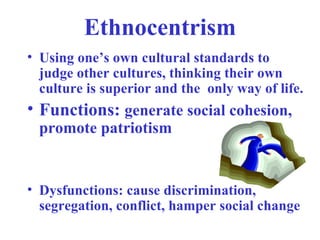
Ethnocentrism
• Using one’s own cultural standards to
  judge other cultures, thinking their own
  culture is superior and the only way of life.
• Functions: generate social cohesion,
  promote patriotism


• Dysfunctions: cause discrimination,
  segregation, conflict, hamper social change
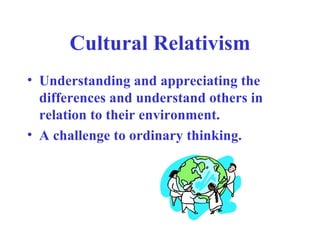
Cultural Relativism
• Understanding and appreciating the
  differences and understand others in
  relation to their environment.
• A challenge to ordinary thinking.
Understand Cultures
• The cultural ecological perspective:
• Culture is the means by which people adapt
  to their environment. It reflects people’s
  perception of their environment.

• Herbert Spencer: human beings
evolved through cultural rather
 than biological mutation
to survive.
Sociobiology on human social
             behavior
• Studies how genetic factors affect
  social behavior of human beings.
• Basic argument: certain behaviors
  are genetically programmed.(e.g.
  incest taboo, mother’s love)

Culture

  • 1.
    Define Culture • Thetwo basic elements of society: Culture Social Structure • Definition: a patterned way of life a symbolic system It includes the set of practices such as traditions, customs, rituals, beliefs, values, rules for proper conducts, and also material objects: all human creations such as artifacts, building, music, dance, technology etc.
  • 2.
    The Characteristics ofCulture • Culture is universal, learned, shared, cumulative, paradoxical. • Any behavior or set of behavior that are biologically determined is NOT cultural phenomena.
  • 3.
    Questions for theMovie: • How did the native Indians give name to a bird? • Why did native Indians and Europeans build buildings differently? • Which place does the narrator call a “wilderness”? • Why some could native Indians not understand the concept of “time” • Based on your understanding of the movie, answer how cultures were developed, • why human societies develop different cultures, And • How cultures change.
  • 4.
    Components of Culture •Non material culture: ways of thinking and acting Symbolic culture: symbols, languages, gestures, non-verbal communication: body language Cognitive culture: values, belief, ideology, Normative culture: socially expected behavior: norms and sanctions • Material culture:items such as technology, arts, clothing etc. • Relationship between the two: compatibility and cultural lag
  • 5.
    Symbolic Culture • Symbols:something to which people attach meaning and then is used to communicate. • Basis of nonmaterial culture • Elements: Gestures: can facilitate and hinder communication • Language: primary means of communication, means of transmission of experiences, allows culture to develop, without, human culture could not progress beyond that of lower primates. • The Sapir-Whorf Hypothesis: One’s language determines how reality is constructed. Also termed as Linguistic-Relativity Hypothesis
  • 6.
    Linguistic-Relativity Hypothesis • A culture’s language expresses how the people of that culture perceive and understand the world, and at the same time, influence people’s perceptions and understanding, and even mental process.
  • 7.
    Normative Culture • Normsand sanctions: rules for behavior and social response • Positive sanction: approval for following a norm • Negative sanction: disapproval for breaking a norm. • Basic elements: • Folkways:norms not strictly enforced • mores: rules concerning the core value of society. • laws: rules in the form of legal codes, enforced by government agencies. • taboos: a strongly ingrained norm, the violation of which is repugnant (cannibalism)
  • 8.
    Cognitive Culture: learnedideas and knowledge • Values: what is desirable in life • Ideal value vs real value • Value cluster: values are not mutually exclusive, some bound as a “cluster”. • Value contradiction: some values conflict with other values. A source for social change. • Ideologies: Beliefs that are used to justify social arrangement, rationalize and support the existing structure. Ideological hegemony • cultural industry
  • 9.
    Cultural changes • Culturaldiffusion: the spread of cultural characteristics from one culture to another. cultures. • Cultural leveling: As one part of a culture changes, the other parts has to follow, cultural leveling refers to the process by which culture becomes similar to one another. • Cultural lag: William Ogburn’s term for a situation in which nonmaterial culture lags behind changes in the material culture. • Cultural shock: the psychological and social maladjustment many people suffer when they visit or live in another society.
  • 10.
    Cultural Variation • Culturaluniversals: traits believed to exist in all cultures • Culture diversity: cultural elements differ in contents. • • Subculture: within one culture, subgroups may have values, behavioral norms and lifestyles that are different from the mainstream culture. • Counterculture: a subculture whose members consciously and often proudly reject some of the most important cultural standards of the mainstream society. •
  • 11.
    Ethnocentrism • Using one’sown cultural standards to judge other cultures, thinking their own culture is superior and the only way of life. • Functions: generate social cohesion, promote patriotism • Dysfunctions: cause discrimination, segregation, conflict, hamper social change
  • 12.
    Cultural Relativism • Understandingand appreciating the differences and understand others in relation to their environment. • A challenge to ordinary thinking.
  • 13.
    Understand Cultures • Thecultural ecological perspective: • Culture is the means by which people adapt to their environment. It reflects people’s perception of their environment. • Herbert Spencer: human beings evolved through cultural rather than biological mutation to survive.
  • 14.
    Sociobiology on humansocial behavior • Studies how genetic factors affect social behavior of human beings. • Basic argument: certain behaviors are genetically programmed.(e.g. incest taboo, mother’s love)