Culture
Flamiano, Jb Angelo
What is Culture??
Culture encompasses religion, food, what we wear, how we wear it, our language,
marriage, music and is different all over the world.
Culture is the characteristics and knowledge of a particular group of people,
encompassing language, religion, cuisine, social habits, music and arts.
Culture is a system of knowledge, behaviors, ways of life, arts, belief, values,
attitudes, meanings, religion, role and institutions of a population shared by
relatively large group of people that are passed down from generation to
generation.
Culture has been called “the way of life for an entire society.
Traditionally, as defined by English anthropologist Sir Edward Burnett Tylor in 1871,culture
is the complex whole which encompasses beliefs, practices, values,attitudes, laws,
norms, artifacts, symbols, and knowledge that a person learns and shares as a member
of society.
For Leslie A. White (1995), culture refers to an organization of phenomena that is
dependent upon symbols and includes acts (patterns of behavior), objects(material
things), ideas (beliefs and knowledge), and sentiments(attitudes and values). It
transcends among different groups, regardless of age, gender.economic status, and
affiliations.
Another definition of culture comes from American anthropologist Richley Crapo
(2001),who describes culture as a system of ideas, feelings, and survival strategies
shared in a particular group. He claims that culture is the structure that unifies a human
group and gives it an identity as a society.
A good example is provided by Chester Hunt in his study with two Americanand two
Filipino scholars, Sociology in the Philippine Setting (1954). The passage says:
Aspects of Culture
Aspects of Culture
Culture has essential characteristics that need to be acknowledged for anyone to understand
clearly its nature and dynamism.
One must understand that culture-given that a society is composed of different people with
different characters-is shared and contested. No culture will be accepted by everyone in the
society. Some will always propagate the beauty of a certain culture, while some will contest
and question its substance.
Culture,being a complex set of patterned social interactions,is learned and transmitted
through socialization or enculturation. Cultural elements are learned,rather than acquired,
through inheritance or through any biological processes.Thus,reflexes,instincts, and the like
are not part of culture.
Most people adopt the complexities of culture from the environment they are in because
cultural behavior and actions can only be learned through observation, experience, and
education. For example, wearing maong and eating balut and other street food are assimilated
through experience. Others,like kissing the hands of elders, are taught through generations.
This aspect of culture may be well represented by the saying, “Birds of the same feather flock
together."
Culture also requires language and other forms of communication. American anthropologist George
Murdock (1949) has pointed out. what differentiates humans from animals is their ability to
communicate,using complex systems of symbols, storing knowledge, and transmitting them to the
next generations. Just imagine the difficulty of everyday survival if basic and essential knowledge are
to be discovered and rediscovered by each generation separately.
Language is a key factor in the success of the human race in creating and preserving culture.Without
language,the ability to convey ideas and traditions is impossible.
Culture is also dynamic, flexible,and adaptive. It is constantly changing. Noculture is permanent or
static. The rate of cultural change among societies in the world varies, depending on their
geographical,economic,social,and political conditions.
At times, culture may be unstable. This is due to the constantly changing practices of the people in the
society. With this, new ideas and techniques are being integrated, while the old ones-especially those
that are no longer widely practiced-are being modified or even discarded.
Material and
Nonmaterial Culture
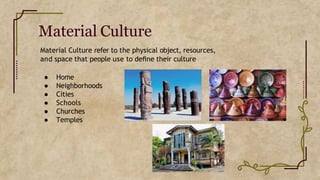
Material Culture
Material Culture refer to the physical object, resources,
and space that people use to define their culture
● Home
● Neighborhoods
● Cities
● Schools
● Churches
● Temples
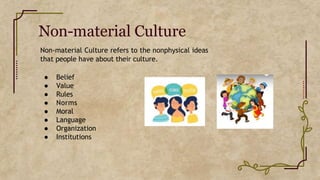
Non-material Culture
Non-material Culture refers to the nonphysical ideas
that people have about their culture.
● Belief
● Value
● Rules
● Norms
● Moral
● Language
● Organization
● Institutions
Subculture and
Counterculture
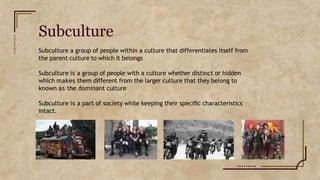
Subculture
Subculture a group of people within a culture that differentiates itself from
the parent culture to which it belongs
Subculture is a group of people with a culture whether distinct or hidden
which makes them different from the larger culture that they belong to
known as the dominant culture
Subculture is a part of society while keeping their specific characteristics
intact.
Counterculture
Counterculture is a group with expectation and values that
strongly disagree with the main values.
A counterculture is a culture whose values and norms of
behavior differ substantially from those of mainstream society,
sometimes diametrically opposed to mainstream cultural mores.
A countercultural movement expresses the ethos and
aspirations of a specific population during a well-defined era.
Ideal culture
and Real culture
ideal culture is a set of values and practices
that a culture aims to achieve. It paints a
picture of the best version of a particular
society.Max Weber defines ideal culture
as:"an imaginary construct that serves as an
ideal for the assessment of actual
culture"(1922)
Ideal Culture
Real culture refers to the actual values,
beliefs, practices, and norms that exist in a
society at any giventime.It reveals the
imperfections and inconsistencies in a
society rather than an idealized version of
culture that is often imagined in fictional
texts or political campaigns.
Real Culture
Beliefs
What is belief in culture??
Cultural beliefs are the ideas and thoughts
common to several individuals that govern
interaction-between these people, and between
them, their gods, and other groups-and differ from
knowledge in that they are not empirically
discovered or analytically proved.
Symbols
What is Symbols in culture??
Symbols are the basis of culture. A symbol is an
object, word, or action that stands for something
else with no natural relationship that is culturally
defined. Everything one does throughout their life
is based and organized through cultural
symbolism. Symbolism is when something
represents abstract ideas or concepts.
Language
What is Language in culture??
Language is intrinsic to the expression of culture.
As a means of communicating values, beliefs and
customs, it has an important social function and
fosters feelings of group identity and solidarity. It
is the means by which culture and its traditions
and shared values may be conveyed and preserved.
Values
What is Values in culture??
Cultural values are a culture's core beliefs about
what's good or right. We all have cultural values.
These are sometimes called 'cultural value
preferences'. They're informed by the cultures we
most associate ourselves with. These values are
neither positive nor negative - they're just
differences.
things for
lisining

Culture

  • 1.
  • 2.
    What is Culture?? Cultureencompasses religion, food, what we wear, how we wear it, our language, marriage, music and is different all over the world. Culture is the characteristics and knowledge of a particular group of people, encompassing language, religion, cuisine, social habits, music and arts. Culture is a system of knowledge, behaviors, ways of life, arts, belief, values, attitudes, meanings, religion, role and institutions of a population shared by relatively large group of people that are passed down from generation to generation. Culture has been called “the way of life for an entire society.
  • 3.
    Traditionally, as definedby English anthropologist Sir Edward Burnett Tylor in 1871,culture is the complex whole which encompasses beliefs, practices, values,attitudes, laws, norms, artifacts, symbols, and knowledge that a person learns and shares as a member of society. For Leslie A. White (1995), culture refers to an organization of phenomena that is dependent upon symbols and includes acts (patterns of behavior), objects(material things), ideas (beliefs and knowledge), and sentiments(attitudes and values). It transcends among different groups, regardless of age, gender.economic status, and affiliations. Another definition of culture comes from American anthropologist Richley Crapo (2001),who describes culture as a system of ideas, feelings, and survival strategies shared in a particular group. He claims that culture is the structure that unifies a human group and gives it an identity as a society. A good example is provided by Chester Hunt in his study with two Americanand two Filipino scholars, Sociology in the Philippine Setting (1954). The passage says:
  • 4.
  • 5.
    Aspects of Culture Culturehas essential characteristics that need to be acknowledged for anyone to understand clearly its nature and dynamism. One must understand that culture-given that a society is composed of different people with different characters-is shared and contested. No culture will be accepted by everyone in the society. Some will always propagate the beauty of a certain culture, while some will contest and question its substance. Culture,being a complex set of patterned social interactions,is learned and transmitted through socialization or enculturation. Cultural elements are learned,rather than acquired, through inheritance or through any biological processes.Thus,reflexes,instincts, and the like are not part of culture. Most people adopt the complexities of culture from the environment they are in because cultural behavior and actions can only be learned through observation, experience, and education. For example, wearing maong and eating balut and other street food are assimilated through experience. Others,like kissing the hands of elders, are taught through generations. This aspect of culture may be well represented by the saying, “Birds of the same feather flock together."
  • 6.
    Culture also requireslanguage and other forms of communication. American anthropologist George Murdock (1949) has pointed out. what differentiates humans from animals is their ability to communicate,using complex systems of symbols, storing knowledge, and transmitting them to the next generations. Just imagine the difficulty of everyday survival if basic and essential knowledge are to be discovered and rediscovered by each generation separately. Language is a key factor in the success of the human race in creating and preserving culture.Without language,the ability to convey ideas and traditions is impossible. Culture is also dynamic, flexible,and adaptive. It is constantly changing. Noculture is permanent or static. The rate of cultural change among societies in the world varies, depending on their geographical,economic,social,and political conditions. At times, culture may be unstable. This is due to the constantly changing practices of the people in the society. With this, new ideas and techniques are being integrated, while the old ones-especially those that are no longer widely practiced-are being modified or even discarded.
  • 7.
  • 8.
    Material Culture Material Culturerefer to the physical object, resources, and space that people use to define their culture ● Home ● Neighborhoods ● Cities ● Schools ● Churches ● Temples
  • 9.
    Non-material Culture Non-material Culturerefers to the nonphysical ideas that people have about their culture. ● Belief ● Value ● Rules ● Norms ● Moral ● Language ● Organization ● Institutions
  • 10.
  • 11.
    Subculture Subculture a groupof people within a culture that differentiates itself from the parent culture to which it belongs Subculture is a group of people with a culture whether distinct or hidden which makes them different from the larger culture that they belong to known as the dominant culture Subculture is a part of society while keeping their specific characteristics intact.
  • 12.
    Counterculture Counterculture is agroup with expectation and values that strongly disagree with the main values. A counterculture is a culture whose values and norms of behavior differ substantially from those of mainstream society, sometimes diametrically opposed to mainstream cultural mores. A countercultural movement expresses the ethos and aspirations of a specific population during a well-defined era.
  • 13.
  • 14.
    ideal culture isa set of values and practices that a culture aims to achieve. It paints a picture of the best version of a particular society.Max Weber defines ideal culture as:"an imaginary construct that serves as an ideal for the assessment of actual culture"(1922) Ideal Culture
  • 15.
    Real culture refersto the actual values, beliefs, practices, and norms that exist in a society at any giventime.It reveals the imperfections and inconsistencies in a society rather than an idealized version of culture that is often imagined in fictional texts or political campaigns. Real Culture
  • 16.
  • 17.
    What is beliefin culture?? Cultural beliefs are the ideas and thoughts common to several individuals that govern interaction-between these people, and between them, their gods, and other groups-and differ from knowledge in that they are not empirically discovered or analytically proved.
  • 18.
  • 19.
    What is Symbolsin culture?? Symbols are the basis of culture. A symbol is an object, word, or action that stands for something else with no natural relationship that is culturally defined. Everything one does throughout their life is based and organized through cultural symbolism. Symbolism is when something represents abstract ideas or concepts.
  • 20.
  • 21.
    What is Languagein culture?? Language is intrinsic to the expression of culture. As a means of communicating values, beliefs and customs, it has an important social function and fosters feelings of group identity and solidarity. It is the means by which culture and its traditions and shared values may be conveyed and preserved.
  • 22.
  • 23.
    What is Valuesin culture?? Cultural values are a culture's core beliefs about what's good or right. We all have cultural values. These are sometimes called 'cultural value preferences'. They're informed by the cultures we most associate ourselves with. These values are neither positive nor negative - they're just differences.
  • 24.