Building Self-
Esteem
2Part 1- Definition of self-esteem
* Self-worth
*Our confidence in our ability to think and cope
with our life challenges
*Confidence in our right to be happy and
successful
*A feeling that we are deserving, entitled to our
needs and desires
Synonyms of self-esteem: self-worth, self-regard, self-
respect, self-integrity, self confidence, "amour
propre"
3Part 1- Definition of self-esteem
*Abraham Maslow's pyramid model states that
psychological health is not possible unless the
essential core of the person is fundamentally
accepted, loved and respected by others and by
her or his self.
*Self-esteem allows people to face life with more
confidence, benevolence and optimism, and thus
easily reach their goals and self-actualize.
Usually ….
• Self-esteem increases gradually
throughout adulthood, peaking
sometime around the late 40s.
• Over the course of adulthood,
individuals increasingly occupy
positions of power and status,
which might promote feelings of
self- worth
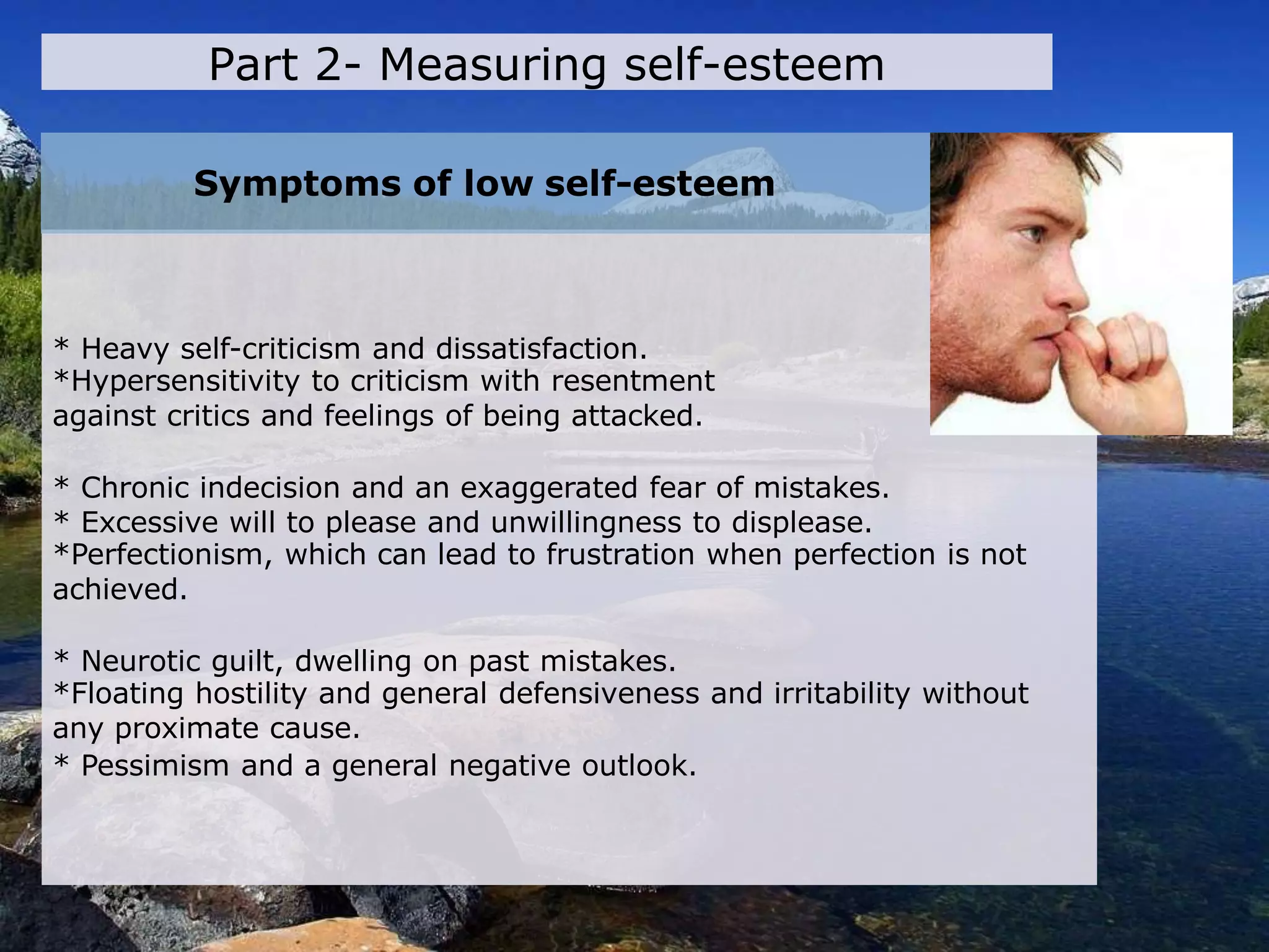
* Heavy self-criticism and dissatisfaction.
*Hypersensitivity to criticism with resentment
against critics and feelings of being attacked.
* Chronic indecision and an exaggerated fear of mistakes.
* Excessive will to please and unwillingness to displease.
*Perfectionism, which can lead to frustration when perfection is not
achieved.
* Neurotic guilt, dwelling on past mistakes.
*Floating hostility and general defensiveness and irritability without
any proximate cause.
* Pessimism and a general negative outlook.
Symptoms of low self-esteem
Part 2- Measuring self-esteem
* like to meet new people.
* Not worried about how others will judge you.
* Have the courage to express themselves.
*Living a live enriched with each new
encounter.
Recognizing high self-esteem
Part 2- Measuring self-esteem
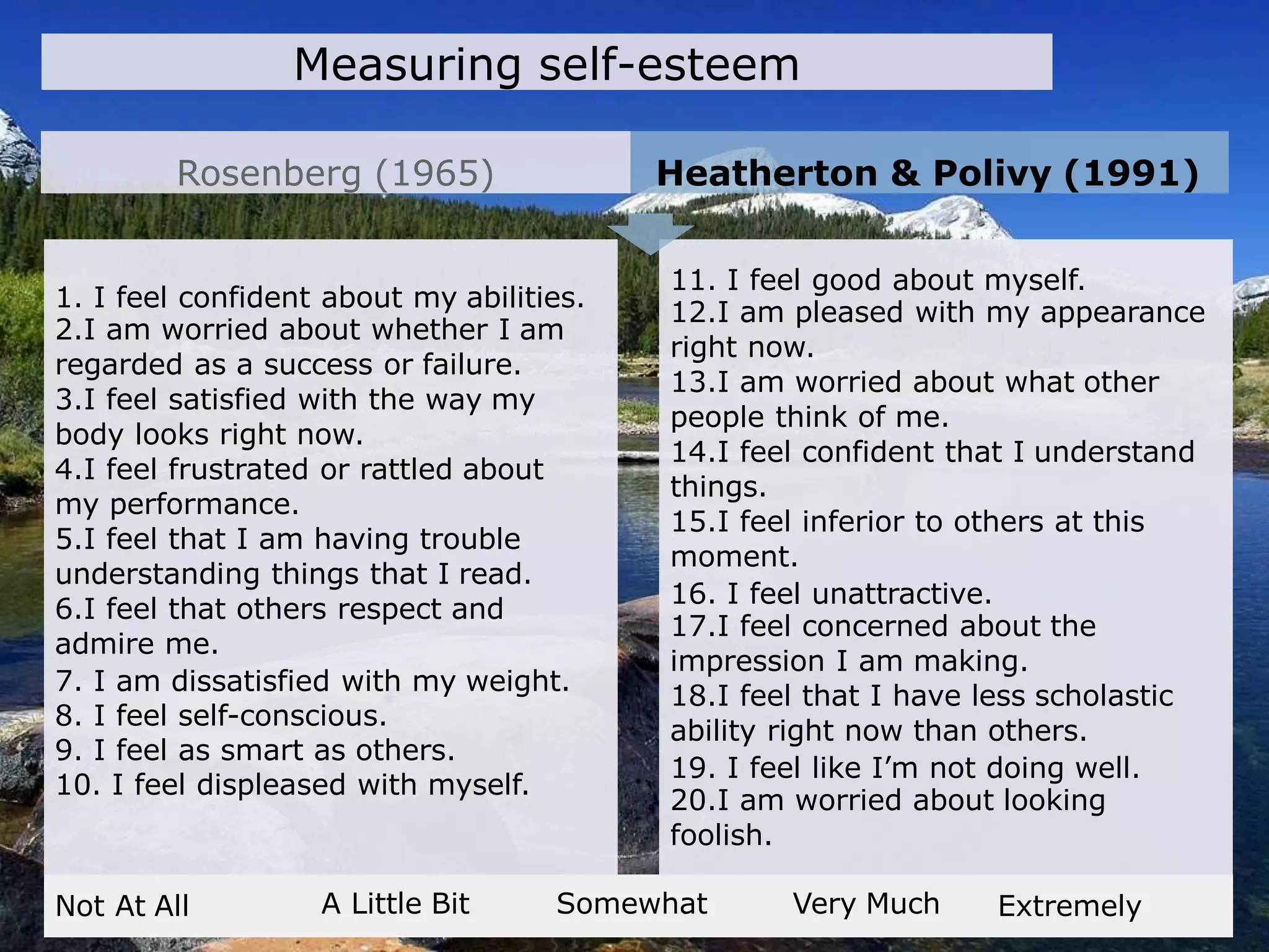
Rosenberg (1965) Heatherton & Polivy (1991)
1. I feel confident about my abilities.
2.I am worried about whether I am
regarded as a success or failure.
3.I feel satisfied with the way my
body looks right now.
4.I feel frustrated or rattled about
my performance.
5.I feel that I am having trouble
understanding things that I read.
6.I feel that others respect and
admire me.
7. I am dissatisfied with my weight.
8. I feel self-conscious.
9. I feel as smart as others.
10. I feel displeased with myself.
11. I feel good about myself.
12.I am pleased with my appearance
right now.
13.I am worried about what other
people think of me.
14.I feel confident that I understand
things.
15.I feel inferior to others at this
moment.
16. I feel unattractive.
17.I feel concerned about the
impression I am making.
18.I feel that I have less scholastic
ability right now than others.
19. I feel like I’m not doing well.
20.I am worried about looking
foolish.
Not At All A Little Bit Somewhat Very Much Extremely
Measuring self-esteem
12 steps to grow your self-esteem
* Step 1: Forgive & forget your past mistakes.
* Step 2: Focus on your positive emotions.
* Step 3: Follow the example of successful people.
*Step 4: Become a self talker, improve your
assertiveness
*Step : Exhibit a good attitude, manage your
stress level (learning module)
* Step 6: Get plenty of sleep (learning module)
12 steps to grow your self-esteem
Continued:
* Step 7: Make your work skills your own
* Step 8: Practice your talents
* Step 9: Become physically fit.
* Step 10: Learn new things.
* Step 11: Improve your personal relationships
* Step 12: Dress well ,spend time and effort in
self grooming!
Part 4- Building children's self-esteem
*How much the child feels wanted, appreciated and
loved
*How your child sees himself, often built from what
parents and those close say
* His or her sense of achievement
* How the child relates to others
Source: http://www.more-selfesteem.com/
Part 4- Building children's self-esteem
7. Show your child there is a way they can control their feelings.
8.Teach your child to set goals, follow through and complete
projects: small and short in the beginning and then get more
involved. Each positive event in your child's life is building a
more positive self-esteem
9.Remind your child to think positive thoughts by putting notes
around the house with smiley faces drawn on them.
10.Say "I love you" and mean it, everyday. Children need to
hear it often, especially when it seems like they don't deserve it.
11.Positive Word Exercise. How do you want your child to feel?
Happy, confident, calm, peaceful, smart, hard-working,
cooperative, etc. Cut pieces of colored paper and write each
word on a separate piece and then put up around the house or
the child's room.
Building children's self-esteem
1.The higher the parents self-esteem, the more
positive the child's will be. Be a good role model.
2.Honest praise is the quickest way to build a person's
self-esteem. Find ways to praise your child every day.
3.Focus on the positive aspects of your child's behavior.
Even if you don't like some of the behavior, find
something positive to focus on.
4.Put a picture of your child with family members next to your child's
bed. This is a subtle reminder to your child that he/she has family
support and they are not alone in the world.
5.Communicate with your child. That means listening to how your
child feels without making judgments about those feelings.
6.Keep criticism to a minimum. Criticism does not produce positive
behavior. Praise does.
Part 4- Building children's self-esteem
12.Teach your child to say and do good deeds. It builds good
character and produces positive feelings within the child.
13.When your child is feeling down, help your child write a
letter to a make believe child who is having a bad day also.
Let your child give the other child advice on how to feel good.
14.Teach your child anger control. Building self-control can be a
major source of pride for your child.
15.Once a day, have your child stand in front of a mirror, smile and
give herself/himself a big hug and say "I love you.
16.Have your child write a name poem and then post it where it can
be seen often. A name poem starts with "I am" and then under it go
his/her name, one letter per line, and finishing with the last name.
Applying the learning from this module
& boost your self-esteem:
* Self-esteem comes from every experience of your life.
* How you view yourself affects everything you do in life.
* High self-esteem gives you a good feeling about yourself.
* Low self-esteem distorts your view of yourself.
* Self-esteem can be taught and self-improved!
In summary
Symptoms
LOW SELF ESTEEM
Passive
excessively dependent
Difficulty making
decisions
Hesitant to express views
Critical of self
Lack of self confidence
Blames others for
shortcomings
Afraid of competitions
Parents and self esteem
lick on "Open speaker notes" in the menu
ocated at the bottom-left of this screen:
AGE
GENDER
BODY IMAGE
Factors affecting self esteem
HEALTH &
ILLNESS
EXPERIENCE
RELATIONS

12 steps self esteem

  • 1.
  • 2.
    2Part 1- Definitionof self-esteem * Self-worth *Our confidence in our ability to think and cope with our life challenges *Confidence in our right to be happy and successful *A feeling that we are deserving, entitled to our needs and desires Synonyms of self-esteem: self-worth, self-regard, self- respect, self-integrity, self confidence, "amour propre"
  • 3.
    3Part 1- Definitionof self-esteem *Abraham Maslow's pyramid model states that psychological health is not possible unless the essential core of the person is fundamentally accepted, loved and respected by others and by her or his self. *Self-esteem allows people to face life with more confidence, benevolence and optimism, and thus easily reach their goals and self-actualize.
  • 4.
    Usually …. • Self-esteemincreases gradually throughout adulthood, peaking sometime around the late 40s. • Over the course of adulthood, individuals increasingly occupy positions of power and status, which might promote feelings of self- worth
  • 5.
    * Heavy self-criticismand dissatisfaction. *Hypersensitivity to criticism with resentment against critics and feelings of being attacked. * Chronic indecision and an exaggerated fear of mistakes. * Excessive will to please and unwillingness to displease. *Perfectionism, which can lead to frustration when perfection is not achieved. * Neurotic guilt, dwelling on past mistakes. *Floating hostility and general defensiveness and irritability without any proximate cause. * Pessimism and a general negative outlook. Symptoms of low self-esteem Part 2- Measuring self-esteem
  • 6.
    * like tomeet new people. * Not worried about how others will judge you. * Have the courage to express themselves. *Living a live enriched with each new encounter. Recognizing high self-esteem Part 2- Measuring self-esteem
  • 7.
    Rosenberg (1965) Heatherton& Polivy (1991) 1. I feel confident about my abilities. 2.I am worried about whether I am regarded as a success or failure. 3.I feel satisfied with the way my body looks right now. 4.I feel frustrated or rattled about my performance. 5.I feel that I am having trouble understanding things that I read. 6.I feel that others respect and admire me. 7. I am dissatisfied with my weight. 8. I feel self-conscious. 9. I feel as smart as others. 10. I feel displeased with myself. 11. I feel good about myself. 12.I am pleased with my appearance right now. 13.I am worried about what other people think of me. 14.I feel confident that I understand things. 15.I feel inferior to others at this moment. 16. I feel unattractive. 17.I feel concerned about the impression I am making. 18.I feel that I have less scholastic ability right now than others. 19. I feel like I’m not doing well. 20.I am worried about looking foolish. Not At All A Little Bit Somewhat Very Much Extremely Measuring self-esteem
  • 8.
    12 steps togrow your self-esteem * Step 1: Forgive & forget your past mistakes. * Step 2: Focus on your positive emotions. * Step 3: Follow the example of successful people. *Step 4: Become a self talker, improve your assertiveness *Step : Exhibit a good attitude, manage your stress level (learning module) * Step 6: Get plenty of sleep (learning module)
  • 9.
    12 steps togrow your self-esteem Continued: * Step 7: Make your work skills your own * Step 8: Practice your talents * Step 9: Become physically fit. * Step 10: Learn new things. * Step 11: Improve your personal relationships * Step 12: Dress well ,spend time and effort in self grooming!
  • 10.
    Part 4- Buildingchildren's self-esteem *How much the child feels wanted, appreciated and loved *How your child sees himself, often built from what parents and those close say * His or her sense of achievement * How the child relates to others Source: http://www.more-selfesteem.com/
  • 11.
    Part 4- Buildingchildren's self-esteem 7. Show your child there is a way they can control their feelings. 8.Teach your child to set goals, follow through and complete projects: small and short in the beginning and then get more involved. Each positive event in your child's life is building a more positive self-esteem 9.Remind your child to think positive thoughts by putting notes around the house with smiley faces drawn on them. 10.Say "I love you" and mean it, everyday. Children need to hear it often, especially when it seems like they don't deserve it. 11.Positive Word Exercise. How do you want your child to feel? Happy, confident, calm, peaceful, smart, hard-working, cooperative, etc. Cut pieces of colored paper and write each word on a separate piece and then put up around the house or the child's room.
  • 12.
    Building children's self-esteem 1.Thehigher the parents self-esteem, the more positive the child's will be. Be a good role model. 2.Honest praise is the quickest way to build a person's self-esteem. Find ways to praise your child every day. 3.Focus on the positive aspects of your child's behavior. Even if you don't like some of the behavior, find something positive to focus on. 4.Put a picture of your child with family members next to your child's bed. This is a subtle reminder to your child that he/she has family support and they are not alone in the world. 5.Communicate with your child. That means listening to how your child feels without making judgments about those feelings. 6.Keep criticism to a minimum. Criticism does not produce positive behavior. Praise does.
  • 13.
    Part 4- Buildingchildren's self-esteem 12.Teach your child to say and do good deeds. It builds good character and produces positive feelings within the child. 13.When your child is feeling down, help your child write a letter to a make believe child who is having a bad day also. Let your child give the other child advice on how to feel good. 14.Teach your child anger control. Building self-control can be a major source of pride for your child. 15.Once a day, have your child stand in front of a mirror, smile and give herself/himself a big hug and say "I love you. 16.Have your child write a name poem and then post it where it can be seen often. A name poem starts with "I am" and then under it go his/her name, one letter per line, and finishing with the last name.
  • 14.
    Applying the learningfrom this module & boost your self-esteem: * Self-esteem comes from every experience of your life. * How you view yourself affects everything you do in life. * High self-esteem gives you a good feeling about yourself. * Low self-esteem distorts your view of yourself. * Self-esteem can be taught and self-improved! In summary
  • 15.
    Symptoms LOW SELF ESTEEM Passive excessivelydependent Difficulty making decisions Hesitant to express views Critical of self Lack of self confidence Blames others for shortcomings Afraid of competitions
  • 16.
    Parents and selfesteem lick on "Open speaker notes" in the menu ocated at the bottom-left of this screen:
  • 17.
  • 18.