Mann Rentoy
Thank you, Teachers!
Ate Germaine
Miss nyo na rin ba ang
2019?
Let’s Count
Our Blessings.
BLESSINGS
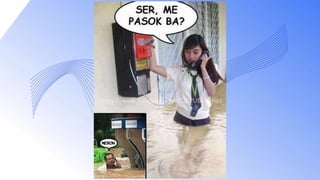
No traffic.
No allowance.
Iwas baha.
BLESSINGS
Family always together.
You Teach
LOGO
PAGEANTRY
OF VANITY
Sense of
Entitlement
As Aristotle taught,
people do not
naturally become
morally excellent
or practically wise.
They become so, if at all, only as
the result of life-long personal and
community effort.
- Jon Moline

PRINCIPLES
Character Formation
is not just another
subject.
It is what every good
educator tries to do.
The only effective way
to teach character is
through the example of
our life.
Stop teaching subjects,
start teaching students.
Thank you,
Teachers!
Character is destiny.
- Heraclitus
“The Altruistic
Personality”
A 1988
Research by
Samuel & Pearl
Oliner
People who “rescued”
Jews from the Nazis
did it “because that
was how they were
raised”.
Character
can be a matter
of life and death
Psychiatrist Frank
Pittman
“Stability of our
lives depends
upon
CHARACTER”
Psychiatrist
Frank Pittman
“CHARACTER,
not passion,
keeps
marriages
together.”
Psychiatrist Frank
Pittman
“CHARACTER
enables
people to
survive, to
endure, to
transcend
misfortunes.”
crisis in society
Rise in suicide
cases
Youth homicide
6-year old killed his
3-yr old brother
with the help of
her 5-yr old friend
6-yr old boy killed his
Grade 1 classmate with
a .32 semiautomatic
160,000 miss
school each day for
fear of being bullied
Substance abuse among
kids
Growing disrespect for
parents, teachers and other
legitimate authority figures
Widespread cheating and
dishonesty
Increase of vulgarity
Alcohol use
Hyperactivity and attention
deficits increased 700% in
the last two decades
Tragedy in Taber
On April 20, 1999, two students went on
a deadly rampage at Columbine High

School in Littleton, Colo. One week later,
a similar attack struck a small town in
Alberta.
A 14-year-old boy opened fire with a

.22-calibre rifle.
School’s
Response
Metal detectors in schools
Installation of cctv and other
sophisticated cameras
Home-schooling option
becoming a real alternative
But the real
key solution:
Character
Formation
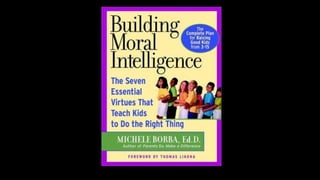
Moral Literacy
Moral
Intelligence
Enhancing
MORAL
INTELLIGENCE is
our best hope to
get them on the
right course so
that they
ACT and THINK
right.
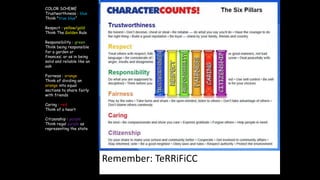
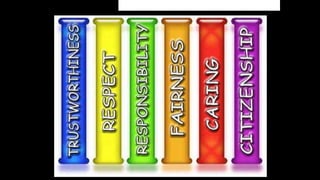
Remember: TeRRiFiCC
COLOR SCHEME
Trustworthiness : blue
Think "true blue“
Respect : yellow/gold
Think The Golden Rule
Responsibility : green
Think being responsible
for a garden or
finances; or as in being
solid and reliable like an
oak
Fairness : orange
Think of dividing an
orange into equal
sections to share fairly
with friends
Caring : red
Think of a heart
Citizenship : purple
Think regal purple as
representing the state
“The first step in
teaching moral
intelligence is by being a
moral example”
-Michelle Borba
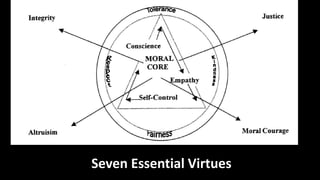
Seven Essential Virtues
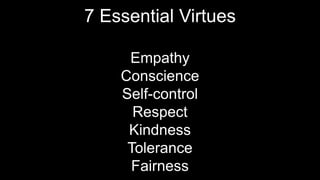
7 Essential Virtues
Empathy
Conscience
Self-control
Respect
Kindness
Tolerance
Fairness
1. Commit to Raising A
Moral Child
Research: parents who feel strongly
about their kids turning out morally
usually succeed because they
committed themselves to that effort.
1. Commit to Raising A
Moral Child
Research: teachers who feel strongly
about their students turning out morally
usually succeed because they
committed themselves to that effort.
If you really want to raise a
moral child, then make a
personal commitment to
raise one, and don’t stop until
he does.
2. Be a strong
Moral Example
Each day ask yourself:
“If my student had only
my behavior to watch,
what example would
he catch?”
3. Know your beliefs
and share them.
They will hear messages that
counter your values: music,
videos, television, internet.
World Without
Teachers
4. Use Teachable
Moments
5. Use discipline as a
Moral Lesson.
6. Expect moral
behavior.
7. Reflect on the
behaviors’ effects.
8. Reinforce moral
behavior.
9. Prioritize morals daily.
10. Incorporate the
Golden Rule.
Without morals, the young do not
learn how to deal with others
correctly and appropriately.
Thank you,
Teachers!
THE
ESSENTIAL
VIRTUES
Identifying
with and
feeling other
people’s
concerns
Crisis in the Development of
Empathy
6 Factors
1. Emotional
Unavailability of
Parents
2. Huge
Classrooms
3. Absence of
Supportive Fathers
4. Barrage of Cruel
Media Images
5. Raising Boys to
Mask Their
Feelings
6. Abuse in the
Cradle
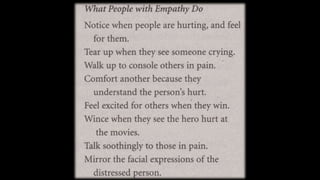
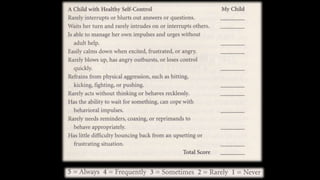
Signs of Empathy
How emphatic
is your student?
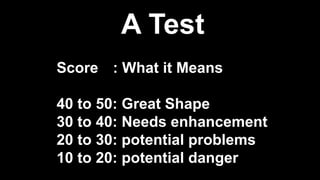
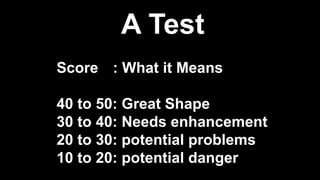
A Test
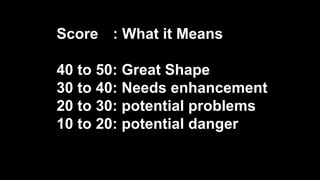
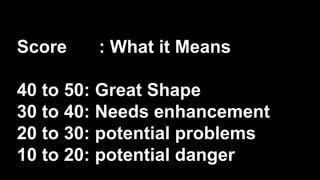
Score : What it Means
40 to 50: Great Shape
30 to 40: Needs enhancement
20 to 30: potential problems
10 to 20: potential danger
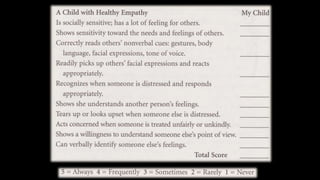
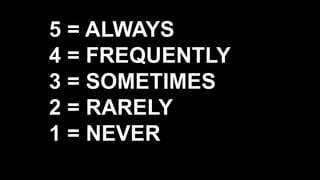
5 = ALWAYS
4 = FREQUENTLY
3 = SOMETIMES
2 = RARELY
1 = NEVER
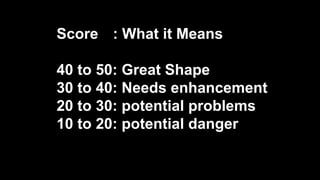
Score : What it Means
40 to 50: Great Shape
30 to 40: Needs enhancement
20 to 30: potential problems
10 to 20: potential danger
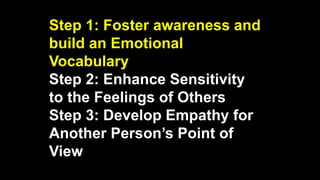
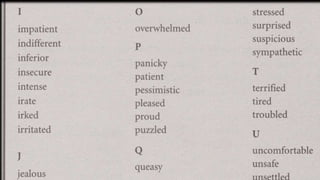
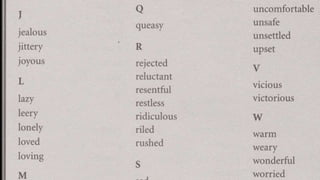
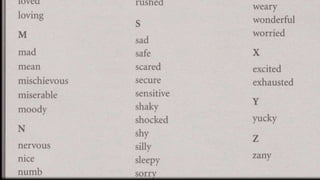
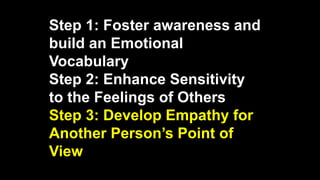
Step 1: Foster awareness and
build an Emotional
Vocabulary
Step 2: Enhance Sensitivity
to the Feelings of Others
Step 3: Develop Empathy for
Another Person’s Point of
View
Step 1: Foster
awareness
and build an
Emotional
Vocabulary
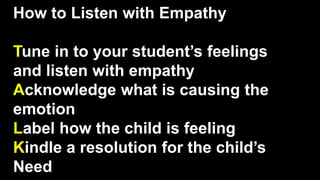
How to Listen with Empathy
Tune in to your student’s feelings
and listen with empathy
Acknowledge what is causing the
emotion
Label how the child is feeling
Kindle a resolution for the child’s
Need
Step 2:
Enhance
Sensitivity to
the Feelings
of Others
Six Simple
Ways to
Nurture Kids’
Sensitivity
1. Praise sensitive, kind
actions
2. Show the effect of
sensitivity
3. Draw attention to
nonverbal feeling
cues
4. Ask often, “How does
he feel?”
5. Use the formula
“feels + needs”
6. Share why you feel
the way you do.
9 Factors that Favor the Development
of Empathy
1 Age 2 Gender
3 Intelligence 4 Emotional
understanding
5 Emphatic Parents 6 Emotional
Security
7 Temperament 8 Similarity
9 Attachment
Five Fun Ways to Help Kids
Read Nonverbal Emotions
1. Play “Feeling Charades”
2. Make Comic Mood
Characters
3. Read with Feeling
4. Watch Silent TV
5. Hold a Feeling Lookout
Step 1: Foster awareness and
build an Emotional
Vocabulary
Step 2: Enhance Sensitivity
to the Feelings of Others
Step 3: Develop Empathy for
Another Person’s Point of
View
Step 3:
Develop
Empathy for
Another
Person’s
Point of View
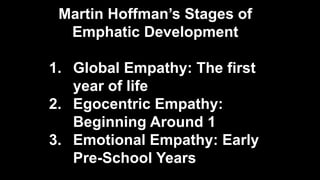
Martin Hoffman’s Stages of
Emphatic Development
1. Global Empathy: The first
year of life
2. Egocentric Empathy:
Beginning Around 1
3. Emotional Empathy: Early
Pre-School Years
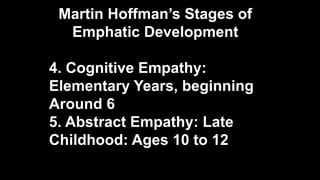
Martin Hoffman’s Stages of
Emphatic Development
4. Cognitive Empathy:
Elementary Years, beginning
Around 6
5. Abstract Empathy: Late
Childhood: Ages 10 to 12
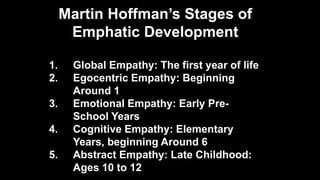
Martin Hoffman’s Stages of
Emphatic Development
1. Global Empathy: The first year of life
2. Egocentric Empathy: Beginning
Around 1
3. Emotional Empathy: Early Pre-
School Years
4. Cognitive Empathy: Elementary
Years, beginning Around 6
5. Abstract Empathy: Late Childhood:
Ages 10 to 12
Three Simple Ways to
Increase Children’s
Ability to Take Different
Perspectives
1.Switch Roles to
Feel the Other
Side
2. Walk in My
Shoes
3. Imagine How

the Person Feels
Classroom Discipline that Builds
Empathy
C – Call attention to insensitive, uncaring
behavior
A – Ask: “How would you feel?”
R – Recognize the consequences of the
behavior
E – Express and explain your disapproval of
the insensitive action
KNOWING THE RIGHT AND
DECENT WAY TO ACT AND
ACTING THAT WAY
Crisis of
Conscience
6 Signs
CRISIS IN CONSCIENCE
6 Signs
1. Rise of Youth
Violence
2. Increase in Peer
Cruelty
3. Rise in Youth
Stealing
4. Escalation of
Youth Cheating
5. Increase in Sexual
Promiscuity
6. Rise in
Substance Abuse
Bonus.
Technological
Addiction
Auto-Correct Humanity
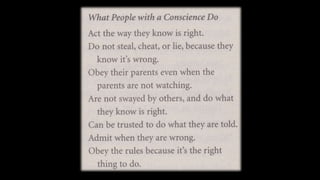
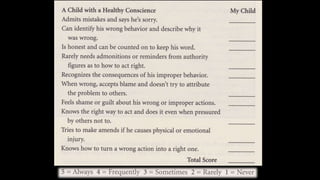
Signs of Conscience
How strong is
your student’s
Conscience?
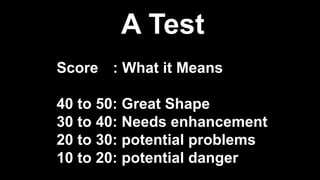
A Test
Score : What it Means
40 to 50: Great Shape
30 to 40: Needs enhancement
20 to 30: potential problems
10 to 20: potential danger
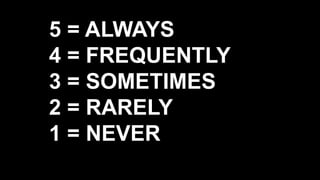
5 = ALWAYS
4 = FREQUENTLY
3 = SOMETIMES
2 = RARELY
1 = NEVER
Score : What it Means
40 to 50: Great Shape
30 to 40: Needs enhancement
20 to 30: potential problems
10 to 20: potential danger
Three Steps to Build Stronger
Conscience
Step 1: Create the
Context for Moral
Growth
Three Steps to Build Stronger
Conscience
Step 2: Teach Virtues to
Strengthen the
Conscience and Guide
Behavior
Three Steps to Build Stronger
Conscience
Step 3: Use Moral
Discipline to Help
Your Student Learn
Right from Wrong
Three Steps to Build Stronger
Conscience
1: Create the Context for Moral
Growth
2: Teach Virtues to Strengthen the
Conscience and Guide Behavior
3: Use Moral Discipline to Help Your
Student Learn Right from Wrong
Three Steps to Build Stronger
Conscience
Step 1: Create the
Context for Moral
Growth
6 Practices that Promote
Development of Stronger
Conscience
1. Be a strong Moral
Example.
6 Practices that Promote
Development of Stronger
Conscience
2. Develop a close,
mutually respectful
relationship.
6 Practices that Promote
Development of Stronger
Conscience
3. Share your Moral
Beliefs
6 Practices that Promote
Development of Stronger
Conscience
4. Expect and
demand moral
behaviors.
6 Practices that Promote
Development of Stronger
Conscience
5. Use moral
reasoning and
questioning.
6 Practices that Promote
Development of Stronger
Conscience
6. Explain your own
moral behavior.
Are we walking
our (Moral)
Talk?
Some things
to think
about:
Your boss phones,
and you tell your
child that you’re not
home.
Your child misses
school because she
oversleeps, and you
write a note excusing
her by claiming she
was ill.
You drive faster
than the speed limit
with your child as a
passenger.
You do the majority of
your child’s work on a
school project but had
him sign his name.
You buy a ticket for a
“child under twelve”
even though your
child is older.
Three Steps to Build Stronger
Conscience
1: Create the Context for Moral
Growth
2: Teach Virtues to Strengthen the
Conscience and Guide Behavior
3: Use Moral Discipline to Help Your
Student Learn Right from Wrong
Three Steps to Build Stronger
Conscience
Step 2: Teach Virtues to
Strengthen the
Conscience and Guide
Behavior
6 Strategies to Teach Virtues
That Promote Strong
Conscience
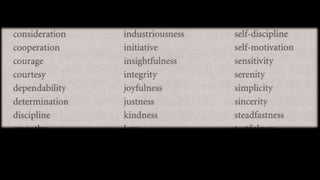
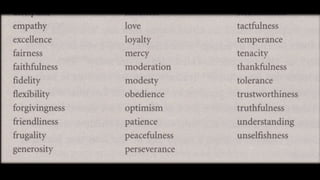
1. Identify the virtues
you want most to
develop in your
students.
6 Strategies to Teach Virtues
That Promote Strong
Conscience
2. Accentuate a Virtue
each month.
6 Strategies to Teach Virtues
That Promote Strong
Conscience
3. Describe the value
and meaning of the
virtue.
3 ideas to
Accomplish
this:
Virtue Talks
Read-Alouds
Articles
6 Strategies to Teach Virtues
That Promote Strong
Conscience
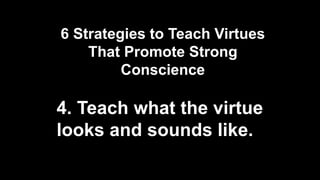
4. Teach what the virtue
looks and sounds like.
6 Strategies to Teach Virtues
That Promote Strong
Conscience
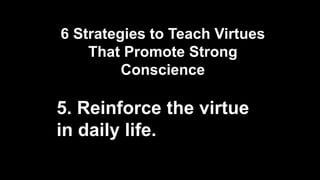
5. Reinforce the virtue
in daily life.
6 Strategies to Teach Virtues
That Promote Strong
Conscience
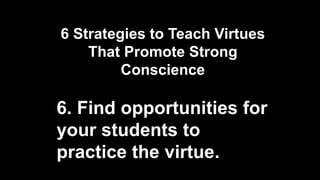
6. Find opportunities for
your students to
practice the virtue.
presenting
VIRTUES
that enhance
Moral
Intelligence
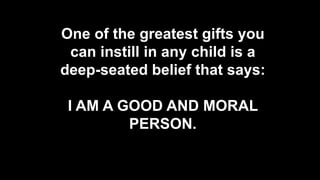
One of the greatest gifts you
can instill in any child is a
deep-seated belief that says:
I AM A GOOD AND MORAL
PERSON.
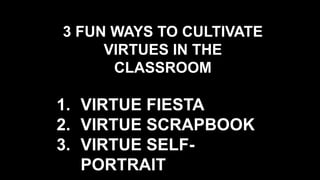
3 FUN WAYS TO CULTIVATE
VIRTUES IN THE
CLASSROOM
1. VIRTUE FIESTA
2. VIRTUE SCRAPBOOK
3. VIRTUE SELF-
PORTRAIT
Three Steps to Build Stronger
Conscience
1: Create the Context for Moral
Growth
2: Teach Virtues to Strengthen the
Conscience and Guide Behavior
3: Use Moral Discipline to Help Your
Student Learn Right from Wrong
Three Steps to Build Stronger
Conscience
Step 3: Use Moral
Discipline to Help
Your Student Learn
Right from Wrong
The 4 R’s
of Moral
Discipline
4 R’s of Moral Discipline
RESPOND calmly
and assess the
child’s intention
4 R’s of Moral Discipline
REVIEW why the
behavior is
wrong
4 R’s of Moral Discipline
REFLECT on the
behavior’s effect
4 R’s of Moral Discipline
RIGHT The wrong
by encouraging
the child to make
a reparation
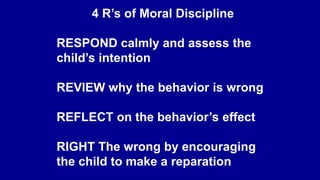
4 R’s of Moral Discipline
RESPOND calmly and assess the
child’s intention
REVIEW why the behavior is wrong
REFLECT on the behavior’s effect
RIGHT The wrong by encouraging
the child to make a reparation
Application of
Kholberg’s
Stages of Moral
Development
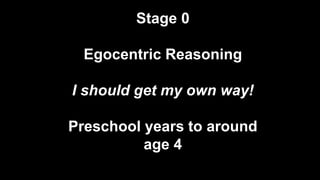
Stage 0
Egocentric Reasoning
I should get my own way!
Preschool years to around
age 4
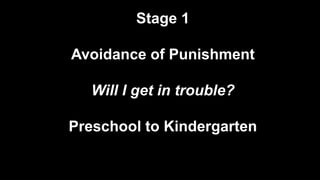
Stage 1
Avoidance of Punishment
Will I get in trouble?
Preschool to Kindergarten
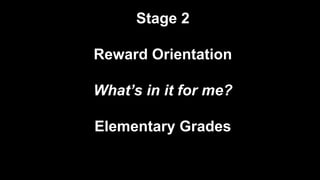
Stage 2
Reward Orientation
What’s in it for me?
Elementary Grades
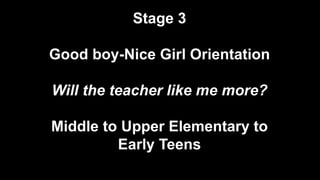
Stage 3
Good boy-Nice Girl Orientation
Will the teacher like me more?
Middle to Upper Elementary to
Early Teens
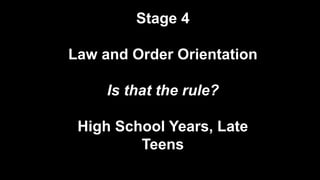
Stage 4
Law and Order Orientation
Is that the rule?
High School Years, Late
Teens
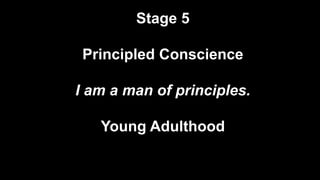
Stage 5
Principled Conscience
I am a man of principles.
Young Adulthood
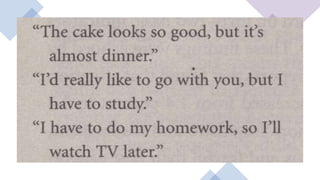
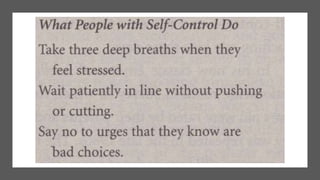
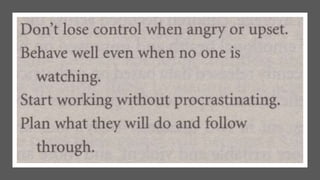
Regulating your
thoughts and actions
so that you stop any
pressures from
within or without,
and act the way you
know and feel is right
The Crisis of
Poor Self
Control
4 Factors
1. Overworked,
Stressed-Out
Parents (and
Teachers)
2. Early Abuse
and Trauma
3. Over-Reliance
on Chemical
Restraints
Instead of Self-
Constraints
4. Glorification of
Out-of-Control
Behavior in
Entertainment
Signs of
Self-Control
How strong is
your student’s
Self-Control?
A Test
Score : What it Means
40 to 50: Great Shape
30 to 40: Needs enhancement
20 to 30: potential problems
10 to 20: potential danger
5 = ALWAYS
4 = FREQUENTLY
3 = SOMETIMES
2 = RARELY
1 = NEVER
Score : What it Means
40 to 50: Great Shape
30 to 40: Needs enhancement
20 to 30: potential problems
10 to 20: potential danger
Three Steps to Build
Self-Control
Step 1: Model Self-Control and Make
it a Priority for them
Step 2: Encourage them to be their
own Motivator
Step 3: Teach them to control their
Urges and think before acting
Three Steps to Build
Self-Control
Step 1: Model Self-
Control and Make it
a Priority for them
Think About:
How do I act in front
of my students when
the day is hard and
my patience is
lacking?
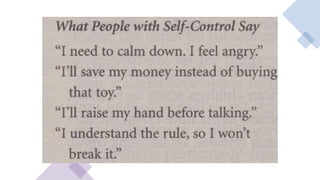
How do I control my
own anger and
stress?
In the middle of an
argument, am I able
to stop and say, “Let’s
stay calm?”
Am I doing anything in
excess - drinking, eating,
smoking, swearing,
spending, working, playing
– that might send a wrong
signal?
Four
Practices
That
Nurture
Self-
Control
Four Practices That Nurture
Self-Control
1. Teach the
Meaning and Value
of Self-Control
The
Marshmallow
Experiment
Four Practices That Nurture
Self-Control
2. Commit yourself
to raising kids with
Self-Control
Four Practices That Nurture
Self-Control
3. Create a Class
Self-Control Motto
Four Practices That Nurture
Self-Control
4. Set a rule to talk
ONLY when in
control.
Three Steps to Build
Self-Control
Step 1: Model Self-Control and Make
it a Priority for them
Step 2: Encourage them to be their
own Motivator
Step 3: Teach them to control their
Urges and think before acting
Three Steps to Build
Self-Control
Step 2: Encourage
them to be their own
Motivator
Five Simple Ways to
Help Kids Reinforce
Themselves for a Job
Well Done
1. Switch your
pronouns from “I” to
“You”
Five Simple Ways to Help Kids Reinforce Themselves
for a Job Well Done
2. Encourage Internal
Praise
Five Simple Ways to Help Kids Reinforce Themselves
for a Job Well Done
3. Ask the Child to
acknowledge
herself/himself.
Five Simple Ways to Help Kids Reinforce Themselves
for a Job Well Done
4. Keep an
accomplishment
journal.
Five Simple Ways to Help Kids Reinforce Themselves
for a Job Well Done
5. Design a Certificate
Five Simple Ways to Help Kids Reinforce Themselves
for a Job Well Done
Strategies for
Effective Praise
1. Praise the action, not the
child.
2. Make the praise as
specific as possible.
3. The praise should be
deserved.
4. The praise should be
genuine.
Three Steps to Build
Self-Control
Step 1: Model Self-Control and Make
it a Priority for them
Step 2: Encourage them to be their
own Motivator
Step 3: Teach them to control their
Urges and think before acting
Three Steps to Build
Self-Control
Step 3: Teach them
to control their
Urges and think
before acting
Four
Anger-Control
Strategies
1. Develop a feeling
vocabulary.
2. Identify anger warning
signs.
3. Use Self-Talk to stay in
control.
4. Teach Abdominal
Breath Control
8 Ways to Help
Kids Control
their Spending
Urges
1. Give weekly or monthly
allowance (depending on the
age) so that he/she can learn
to budget money.
2. Buy him/her a piggy bank
to save coins. Make a rule
that it must be filled before
the money is spent.
3. Make him draw/write down
intended purchase and post it
for a few days before he buys
it.
4. Require him to spend his
own money on entertainment
and non-essential items.
5. Help him open up a
savings account so that he
can monitor his money and
spending.
6. Require that a portion of
his allowance go to a charity
of his choice.
7. Require a set portion of his
allowance to be saved.
8. Say no to frivolous, rash
buying – and don’t give in.
Mann Rentoy

Building Moral Intelligence (PART 1)