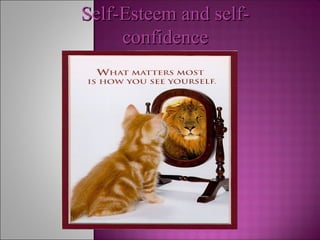

Self-Esteem and self-Self-Esteem and self-
confidenceconfidence
 Self + Esteem
 The total, essential, or particular being of
a person; the individual: +Worth, Value,
Opinion ,judgment
Mrs.Najam-un-Nissa 2
3
 Self-concept: Picture or perception of
ourselves/ a person's mental model of his or
her abilities and attributes
 Self Efficacy: The set of beliefs that one can
perform adequately in a particular situation.
4
 Self-ideal: The way we would like to be
 Self-actualization A concept in
personality psychology referring to a
person's constant striving to realize his or
her potential and to develop inherent
talents and capabilities.
 Self-awareness The top level of
consciousness; cognizance of the
autobiographical character of personally
experienced events.
5
 Your self-esteem is
made up of all the
experiences and
interpersonal
relationships you’ve had
in your life. Everyone
you’ve ever met has
added to or taken away
from how you see
yourself!
6
 Self-esteem refers to the way
we see and think about
ourselves
 Self esteem is your opinion of
yourself.
 High self esteem is a good
opinion of yourself and
 low self esteem is a bad
opinion of yourself.
7
 Abraham Maslow theory 1943.
 The sociometer theory theory 1995: it was developed
by Mark Leary and his colleagues . it states that each
individual human being has an internal gauge, known
as a sociometer, which monitors the environment for
threats to social inclusion.
 Terror management theory TMT : proposed by Jeff
Greenberg, Sheldon Solomon, and Tom Pyszczynski
1986.It is an explanation of self-esteem based on two
major components: the fear of death and an
understanding of a cultural world view.it  tries to
account for why we need self-esteem, and what
psychological functions it may serve.
8
How should we measure self-
esteem?
9
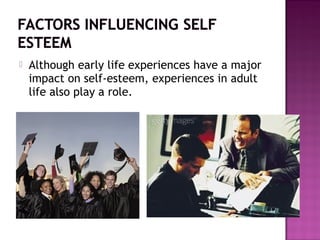
 Although early life experiences have a major
impact on self-esteem, experiences in adult
life also play a role.
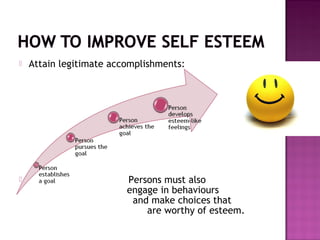
 Attain legitimate accomplishments:
 Persons must also
engage in behaviours
and make choices that
are worthy of esteem.
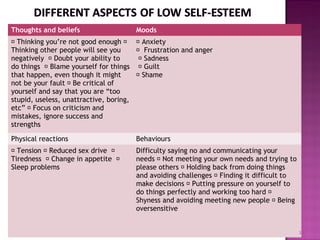
Thoughts and beliefs Moods
 Thinking you’re not good enough 
Thinking other people will see you
negatively  Doubt your ability to
do things  Blame yourself for things
that happen, even though it might
not be your fault  Be critical of
yourself and say that you are “too
stupid, useless, unattractive, boring,
etc”  Focus on criticism and
mistakes, ignore success and
strengths
 Anxiety
 Frustration and anger
 Sadness
 Guilt
 Shame
Physical reactions Behaviours
 Tension  Reduced sex drive 
Tiredness  Change in appetite 
Sleep problems
Difficulty saying no and communicating your
needs  Not meeting your own needs and trying to
please others  Holding back from doing things
and avoiding challenges  Finding it difficult to
make decisions  Putting pressure on yourself to
do things perfectly and working too hard 
Shyness and avoiding meeting new people  Being
oversensitive
14
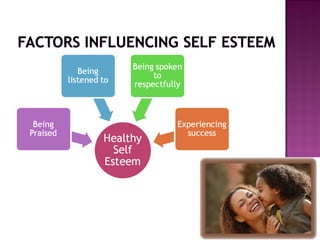
 Having a healthy self – esteem
creates confidence, self-
reliance, and overall happiness in
an individual
 Self esteem increases your confidence. If
you have confidence you will respect
yourself and then you can respect others,
improve your relationships and
become happier....this is not a selfish goal
as you will contribute more and share
yourself with the world and those around
you.
15
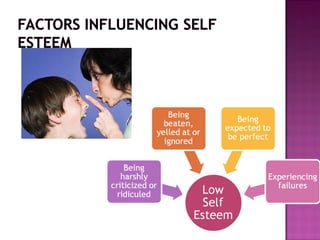
 Low esteem causes depression,
unhappiness,insecurity and low
confidence.
 Other's desires may take preference
over yours.
 Inner criticism, that nagging voice of
disapproval inside you, causes you to
stumble at every challenge and
challenges seem impossible
16
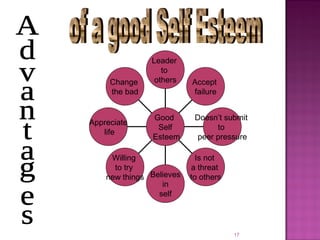
Change
the bad
Appreciate
life
Willing
to try
new things Believes
in
self
Is not
a threat
to others
Doesn’t submit
to
peer pressure
Accept
failure
Leader
to
others
Good
Self
Esteem
17
18
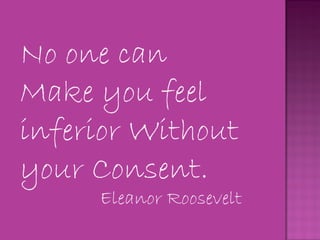
No one can
Make you feel
inferior Without
your Consent.
Eleanor Roosevelt
19
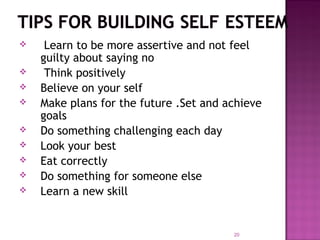
 Learn to be more assertive and not feel
guilty about saying no
 Think positively
 Believe on your self
 Make plans for the future .Set and achieve
goals
 Do something challenging each day
 Look your best
 Eat correctly
 Do something for someone else
 Learn a new skill
20
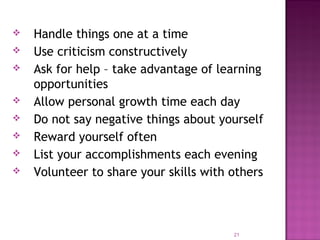
 Handle things one at a time
 Use criticism constructively
 Ask for help – take advantage of learning
opportunities
 Allow personal growth time each day
 Do not say negative things about yourself
 Reward yourself often
 List your accomplishments each evening
 Volunteer to share your skills with others
21
22
 Accept yourself: Stop worrying about the thingsAccept yourself: Stop worrying about the things
you can’t change. Be more accepting of othersyou can’t change. Be more accepting of others
and the things they can’t change.and the things they can’t change.
 Try not to compare with others. It’s unfair.Try not to compare with others. It’s unfair.
You may compare their strengths with yourYou may compare their strengths with your
weaknesses. Judge yourself in terms of yourweaknesses. Judge yourself in terms of your
own growthown growth
Have Realistic Expectations – We expect too
much from ourselves. Perfection is not possible
but bettering our-self should be a lifetime goal.
23
 Emphasize your strengths.
 Change what can be changed. Some things
fast, others gradual, and others never.
There are things we inherit but we can
change our attitude about it. Try new
experiences.
24
 There are two different people in the world.
One that says “I wish I had” and the one that
says “I’m glad I did”. Remember you can
have anything in this world if you just
believe in yourself.
25
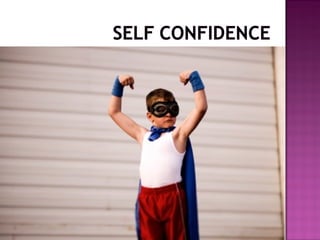
 Self confidence is assuredness in one’s
personal judgment and abilities.
 Self efficacy refers to confidence
in one’s ability to carry
out a specific task
.
 Self confidence results from 5 sources of
information:
 1. Personal experiences, or things we have
done.
 2. The experiences of others, or modeling.
 3. Social comparison.
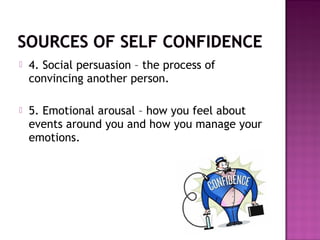
 4. Social persuasion – the process of
convincing another person.
 5. Emotional arousal – how you feel about
events around you and how you manage your
emotions.
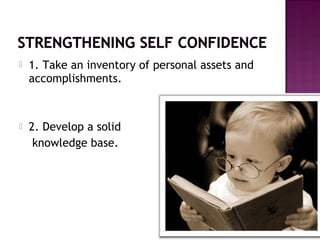
 1. Take an inventory of personal assets and
accomplishments.
 2. Develop a solid
knowledge base.
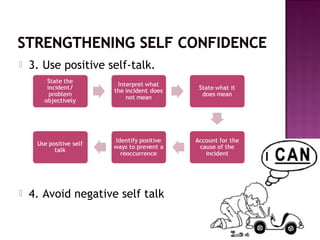
 3. Use positive self-talk.
 4. Avoid negative self talk
 Even though they are not the same thing,
self-confidence and self-esteem are very
closely related
 Is one more important than the other? Not
really because they go hand in hand. To be a
happy, healthy, fully functional person you
need both.
 Confident behavior and performance are
a reflection of a healthy self-esteem and will
be evident in your level of assertiveness or
confidence.
33
Final Thought
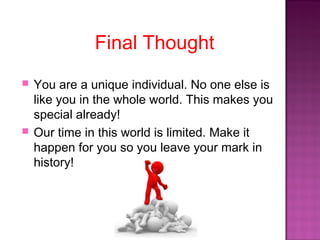
 You are a unique individual. No one else is
like you in the whole world. This makes you
special already!
 Our time in this world is limited. Make it
happen for you so you leave your mark in
history!
35

Psychology

  • 1.
    Self-Esteem and self-Self-Esteemand self- confidenceconfidence
  • 2.
     Self +Esteem  The total, essential, or particular being of a person; the individual: +Worth, Value, Opinion ,judgment Mrs.Najam-un-Nissa 2
  • 3.
  • 4.
     Self-concept: Pictureor perception of ourselves/ a person's mental model of his or her abilities and attributes  Self Efficacy: The set of beliefs that one can perform adequately in a particular situation. 4
  • 5.
     Self-ideal: Theway we would like to be  Self-actualization A concept in personality psychology referring to a person's constant striving to realize his or her potential and to develop inherent talents and capabilities.  Self-awareness The top level of consciousness; cognizance of the autobiographical character of personally experienced events. 5
  • 6.
     Your self-esteemis made up of all the experiences and interpersonal relationships you’ve had in your life. Everyone you’ve ever met has added to or taken away from how you see yourself! 6
  • 7.
     Self-esteem refersto the way we see and think about ourselves  Self esteem is your opinion of yourself.  High self esteem is a good opinion of yourself and  low self esteem is a bad opinion of yourself. 7
  • 8.
     Abraham Maslowtheory 1943.  The sociometer theory theory 1995: it was developed by Mark Leary and his colleagues . it states that each individual human being has an internal gauge, known as a sociometer, which monitors the environment for threats to social inclusion.  Terror management theory TMT : proposed by Jeff Greenberg, Sheldon Solomon, and Tom Pyszczynski 1986.It is an explanation of self-esteem based on two major components: the fear of death and an understanding of a cultural world view.it  tries to account for why we need self-esteem, and what psychological functions it may serve. 8
  • 9.
    How should wemeasure self- esteem? 9
  • 12.
     Although earlylife experiences have a major impact on self-esteem, experiences in adult life also play a role.
  • 13.
     Attain legitimateaccomplishments:  Persons must also engage in behaviours and make choices that are worthy of esteem.
  • 14.
    Thoughts and beliefsMoods  Thinking you’re not good enough  Thinking other people will see you negatively  Doubt your ability to do things  Blame yourself for things that happen, even though it might not be your fault  Be critical of yourself and say that you are “too stupid, useless, unattractive, boring, etc”  Focus on criticism and mistakes, ignore success and strengths  Anxiety  Frustration and anger  Sadness  Guilt  Shame Physical reactions Behaviours  Tension  Reduced sex drive  Tiredness  Change in appetite  Sleep problems Difficulty saying no and communicating your needs  Not meeting your own needs and trying to please others  Holding back from doing things and avoiding challenges  Finding it difficult to make decisions  Putting pressure on yourself to do things perfectly and working too hard  Shyness and avoiding meeting new people  Being oversensitive 14
  • 15.
     Having ahealthy self – esteem creates confidence, self- reliance, and overall happiness in an individual  Self esteem increases your confidence. If you have confidence you will respect yourself and then you can respect others, improve your relationships and become happier....this is not a selfish goal as you will contribute more and share yourself with the world and those around you. 15
  • 16.
     Low esteemcauses depression, unhappiness,insecurity and low confidence.  Other's desires may take preference over yours.  Inner criticism, that nagging voice of disapproval inside you, causes you to stumble at every challenge and challenges seem impossible 16
  • 17.
    Change the bad Appreciate life Willing to try newthings Believes in self Is not a threat to others Doesn’t submit to peer pressure Accept failure Leader to others Good Self Esteem 17
  • 18.
  • 19.
    No one can Makeyou feel inferior Without your Consent. Eleanor Roosevelt 19
  • 20.
     Learn tobe more assertive and not feel guilty about saying no  Think positively  Believe on your self  Make plans for the future .Set and achieve goals  Do something challenging each day  Look your best  Eat correctly  Do something for someone else  Learn a new skill 20
  • 21.
     Handle thingsone at a time  Use criticism constructively  Ask for help – take advantage of learning opportunities  Allow personal growth time each day  Do not say negative things about yourself  Reward yourself often  List your accomplishments each evening  Volunteer to share your skills with others 21
  • 22.
    22  Accept yourself:Stop worrying about the thingsAccept yourself: Stop worrying about the things you can’t change. Be more accepting of othersyou can’t change. Be more accepting of others and the things they can’t change.and the things they can’t change.  Try not to compare with others. It’s unfair.Try not to compare with others. It’s unfair. You may compare their strengths with yourYou may compare their strengths with your weaknesses. Judge yourself in terms of yourweaknesses. Judge yourself in terms of your own growthown growth
  • 23.
    Have Realistic Expectations– We expect too much from ourselves. Perfection is not possible but bettering our-self should be a lifetime goal. 23
  • 24.
     Emphasize yourstrengths.  Change what can be changed. Some things fast, others gradual, and others never. There are things we inherit but we can change our attitude about it. Try new experiences. 24
  • 25.
     There aretwo different people in the world. One that says “I wish I had” and the one that says “I’m glad I did”. Remember you can have anything in this world if you just believe in yourself. 25
  • 28.
     Self confidenceis assuredness in one’s personal judgment and abilities.  Self efficacy refers to confidence in one’s ability to carry out a specific task .
  • 29.
     Self confidenceresults from 5 sources of information:  1. Personal experiences, or things we have done.  2. The experiences of others, or modeling.  3. Social comparison.
  • 30.
     4. Socialpersuasion – the process of convincing another person.  5. Emotional arousal – how you feel about events around you and how you manage your emotions.
  • 31.
     1. Takean inventory of personal assets and accomplishments.  2. Develop a solid knowledge base.
  • 32.
     3. Usepositive self-talk.  4. Avoid negative self talk
  • 33.
     Even thoughthey are not the same thing, self-confidence and self-esteem are very closely related  Is one more important than the other? Not really because they go hand in hand. To be a happy, healthy, fully functional person you need both.  Confident behavior and performance are a reflection of a healthy self-esteem and will be evident in your level of assertiveness or confidence. 33
  • 34.
    Final Thought  Youare a unique individual. No one else is like you in the whole world. This makes you special already!  Our time in this world is limited. Make it happen for you so you leave your mark in history!
  • 35.