VOICE
✔ is relationshipbetween
the action(state) that the
verb expresses and the
participants identified by
its argument (subject,
object, etc..
3.
VOICE
✔ refers tothe form of a
verb that indicates whether
the subject of the sentence
is DOING THE ACTION OR
IS THE RECEIVER OF THE
ACTION
4.
VERB
is aword used to
describe an action, state,
or occurrence and
forming the main part of
the predicate part of the
sentence.
5.
SENTENCE
1. A WORDOR GROUP OF
WORDS EXPRESSING A
COMPLETE THOUGHT-----
2. CONSISTS OF A SUBJECT
AND A PREDICATE
6.
PARTS OF ASENTENCE
1. SUBJECT – is the person
or thing that is doing an
action, or the person or
thing that is the focus of
a sentence.
Doer – a person who does
the action in a sentence
7.
PARTS OF ASENTENCE
Direct object – the thing
that a subject acts
upon in a sentence
2. PREDICATE – the part of a
sentence that contains the
action
8.
TWO(2) TYPES OFVOICE
1.ACTIVE VOICE-a
voice wherein the subject
does the action
2. PASSIVE VOICE-
a voice wherein the subject
receives the action or when the
action is done to the subject.
9.
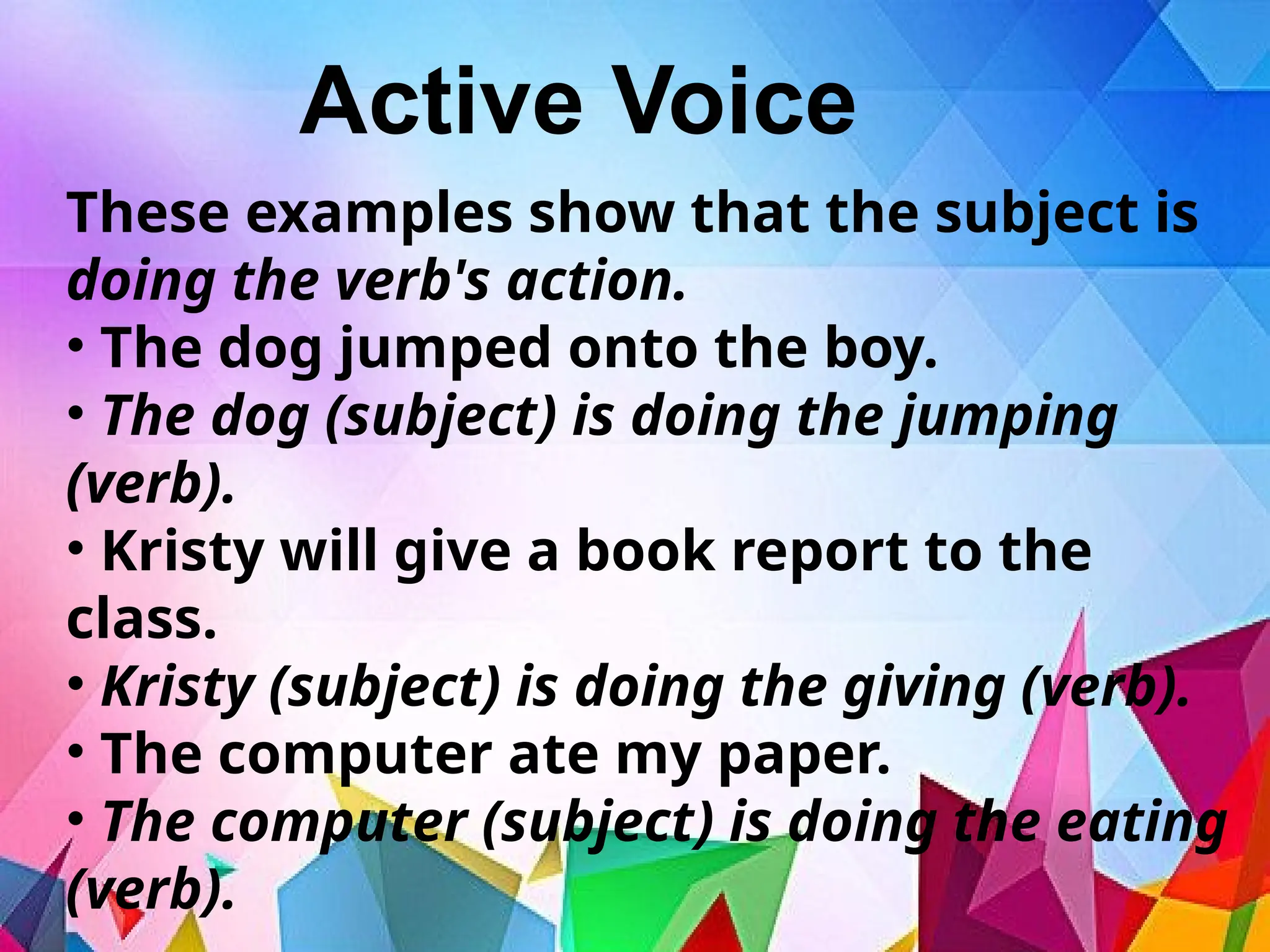
Active Voice
These examplesshow that the subject is
doing the verb's action.
• The dog jumped onto the boy.
• The dog (subject) is doing the jumping
(verb).
• Kristy will give a book report to the
class.
• Kristy (subject) is doing the giving (verb).
• The computer ate my paper.
• The computer (subject) is doing the eating
(verb).
10.
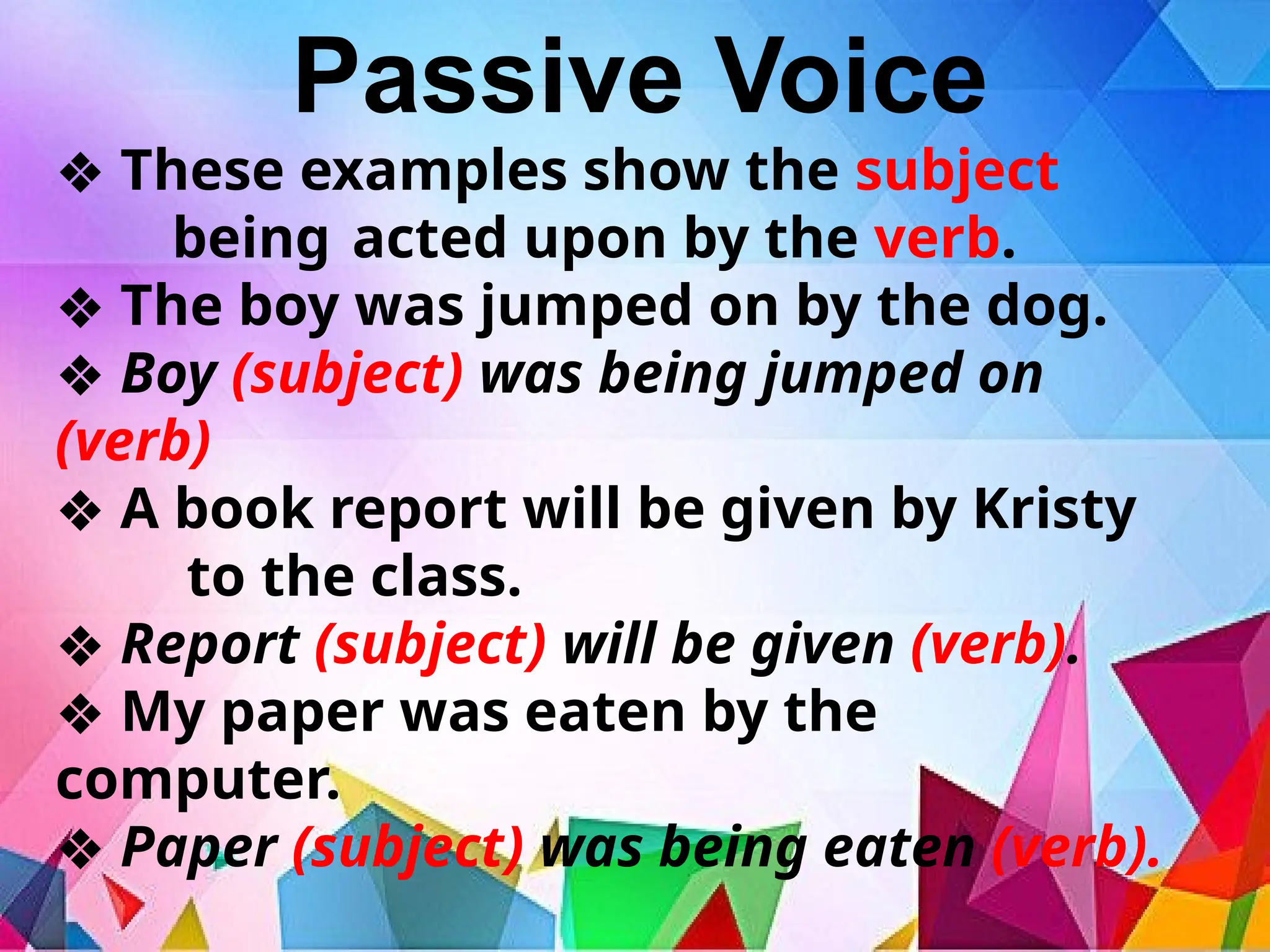
Passive Voice
❖ Theseexamples show the subject
being acted upon by the verb.
❖ The boy was jumped on by the dog.
❖ Boy (subject) was being jumped on
(verb)
❖ A book report will be given by Kristy
to the class.
❖ Report (subject) will be given (verb).
❖ My paper was eaten by the
computer.
❖ Paper (subject) was being eaten (verb).
11.
Reasons to Usethe Active Voice
• Most writers prefer to use
active voicebecause it is
more direct.
Compare
• Active: The waiter dropped the
tray of food.
• Passive: The tray of food was
dropped by the waiter.
12.
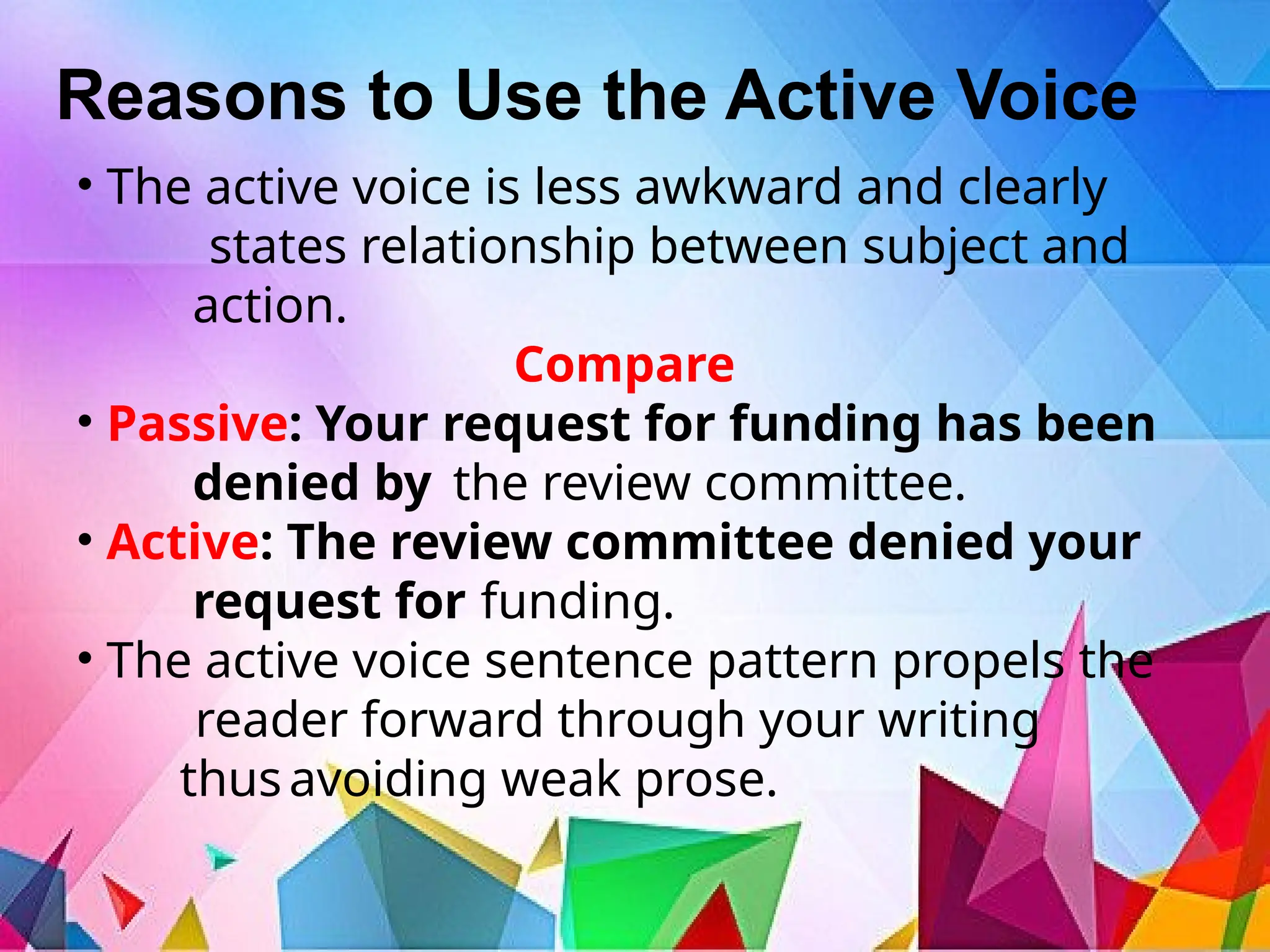
Reasons to Usethe Active Voice
• The active voice is less awkward and clearly
states relationship between subject and
action.
Compare
• Passive: Your request for funding has been
denied by the review committee.
• Active: The review committee denied your
request for funding.
• The active voice sentence pattern propels the
reader forward through your writing
thusavoiding weak prose.
13.
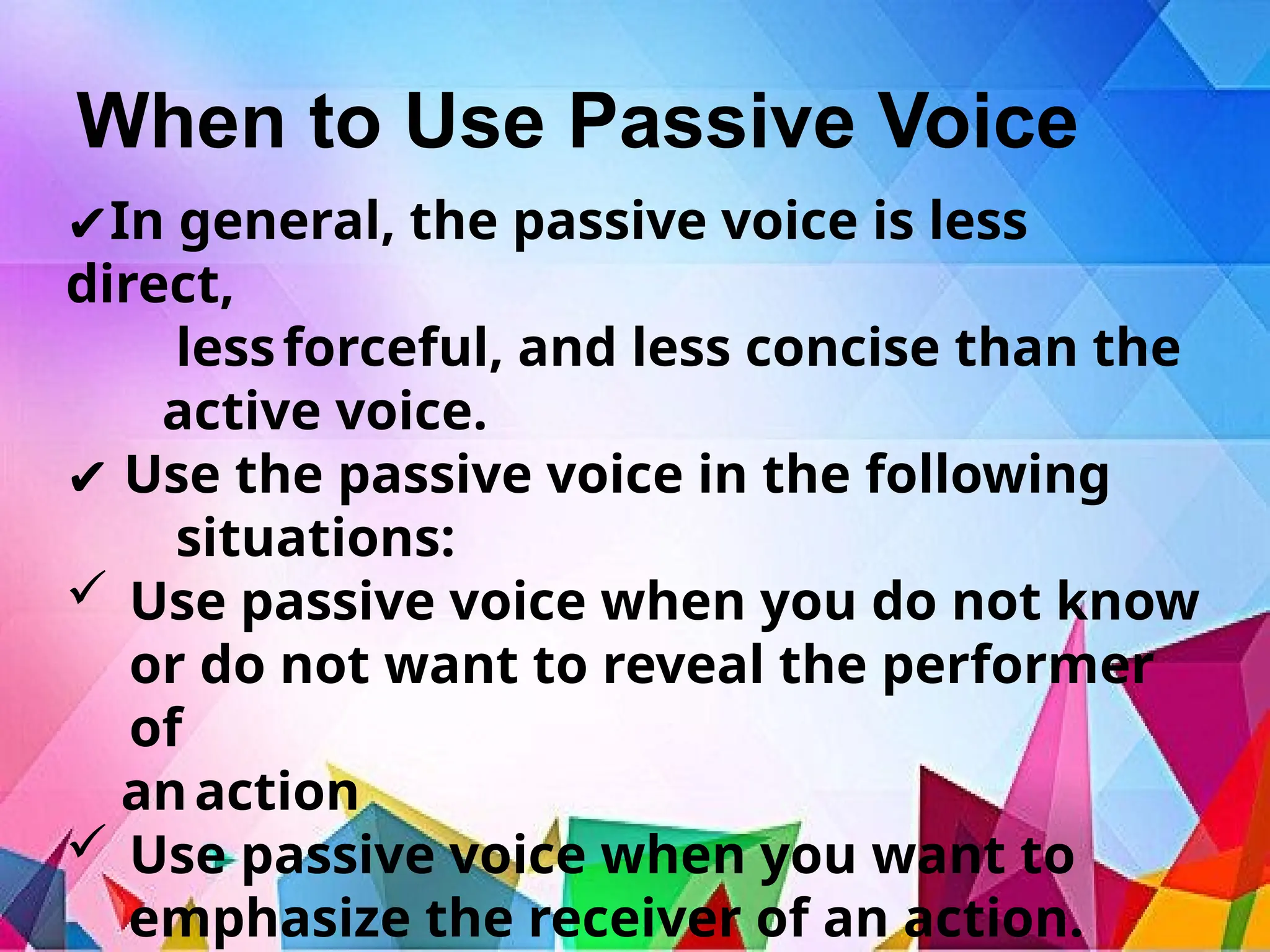
When to UsePassive Voice
✔In general, the passive voice is less
direct,
lessforceful, and less concise than the
active voice.
✔ Use the passive voice in the following
situations:
Use passive voice when you do not know
or do not want to reveal the performer
of
anaction
Use passive voice when you want to
emphasize the receiver of an action.
14.
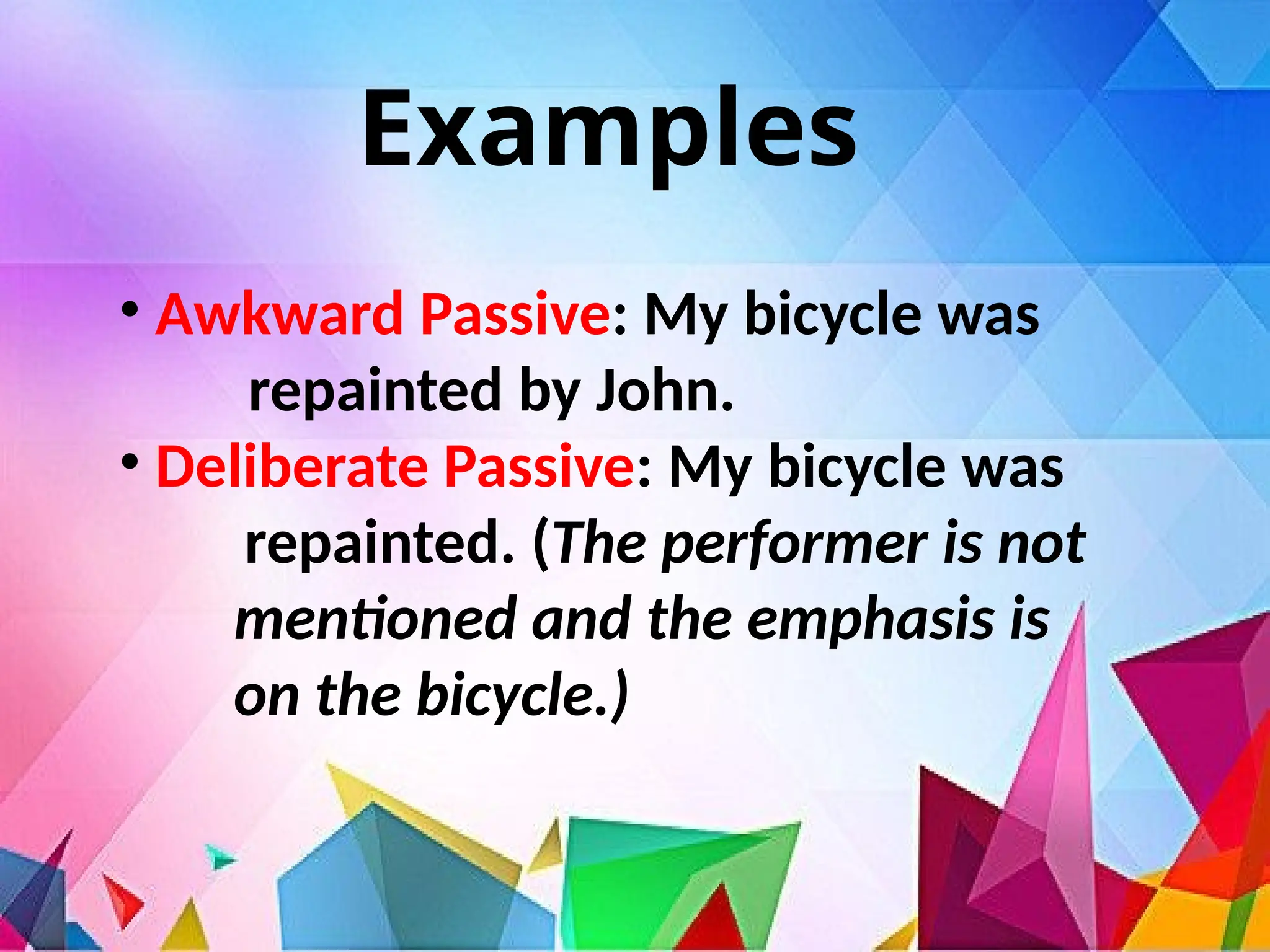
Examples
• Awkward Passive:My bicycle was
repainted by John.
• Deliberate Passive: My bicycle was
repainted. (The performer is not
mentioned and the emphasis is
on the bicycle.)
15.
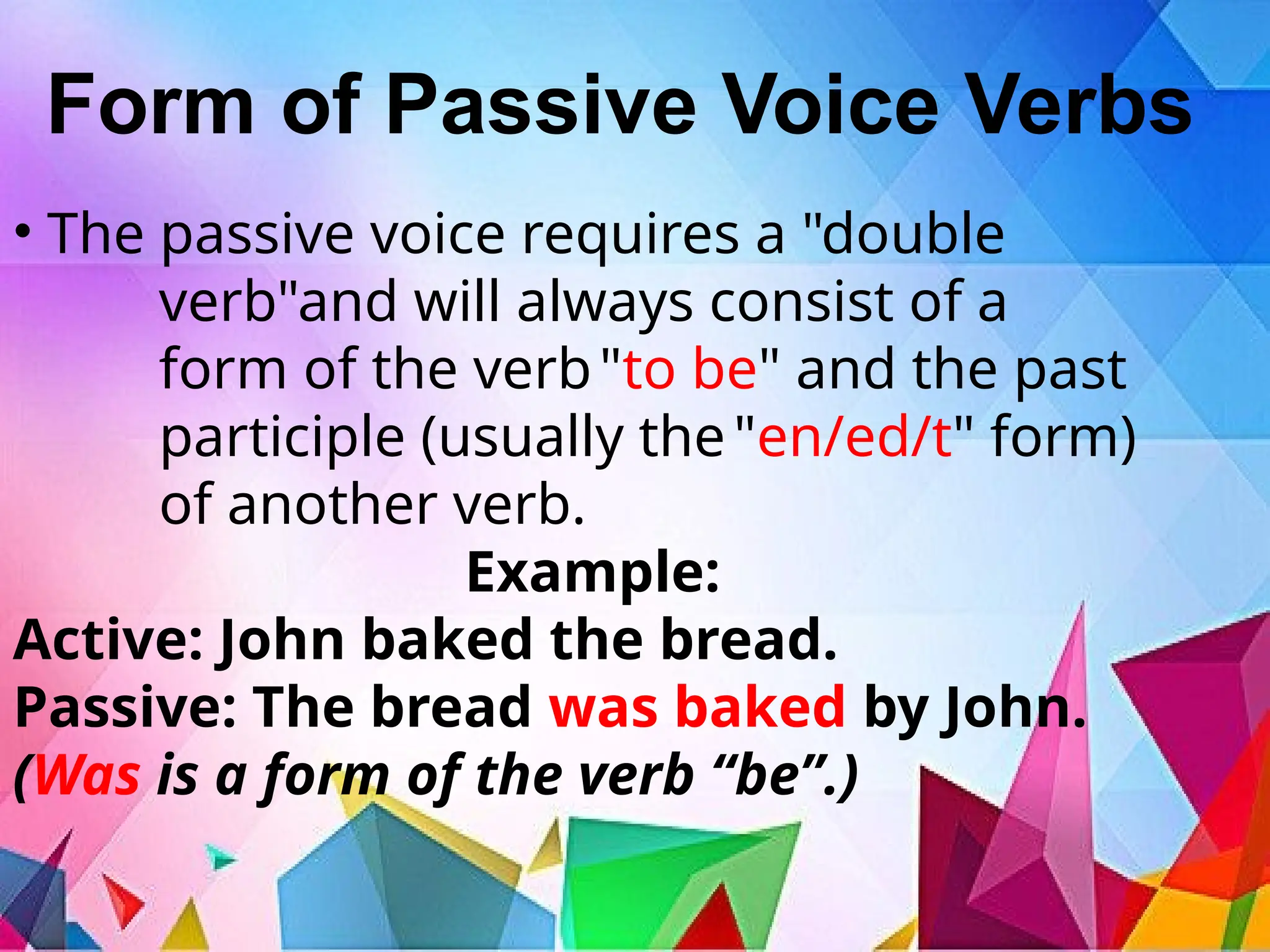
Form of PassiveVoice Verbs
• The passive voice requires a "double
verb"and will always consist of a
form of the verb"to be" and the past
participle (usually the"en/ed/t" form)
of another verb.
Example:
Active: John baked the bread.
Passive: The bread was baked by John.
(Was is a form of the verb “be”.)
16.
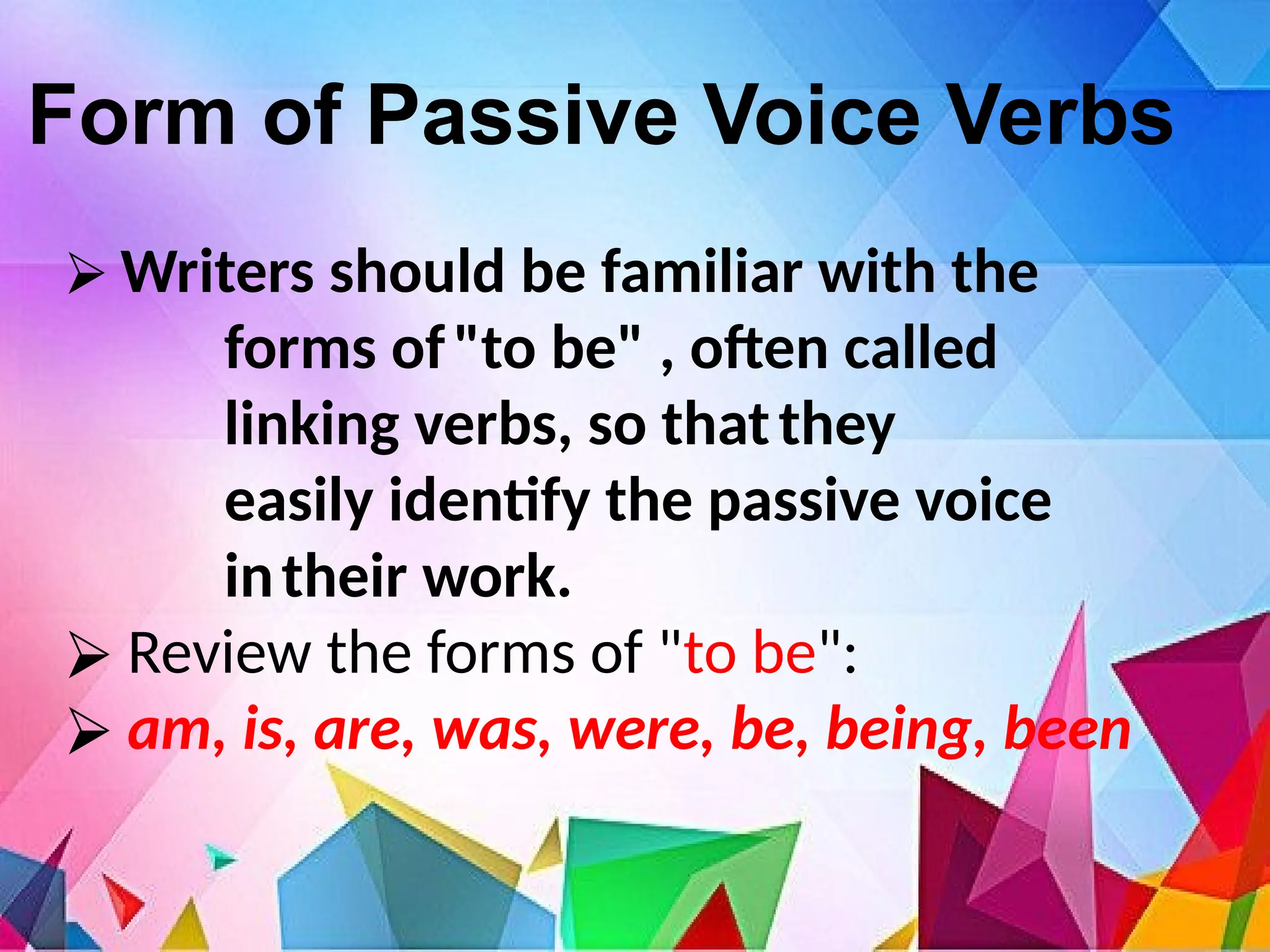
Form of PassiveVoice Verbs
⮚ Writers should be familiar with the
forms of"to be" , often called
linking verbs, so thatthey
easily identify the passive voice
intheir work.
⮚ Review the forms of "to be":
⮚ am, is, are, was, were, be, being, been
17.
Form of PassiveVoice Verbs
Note the forms of "to be" in the
examples of the verb "to kick" in
various forms of thepassive voice:
• is kicked----------------had been kicked
• was kicked-------------is going to be
kicked
• is being kicked---------will be kicked
• has been kicked-------can be kicked
• was being kicked------should be
kicked
18.
Form of PassiveVoice Verbs
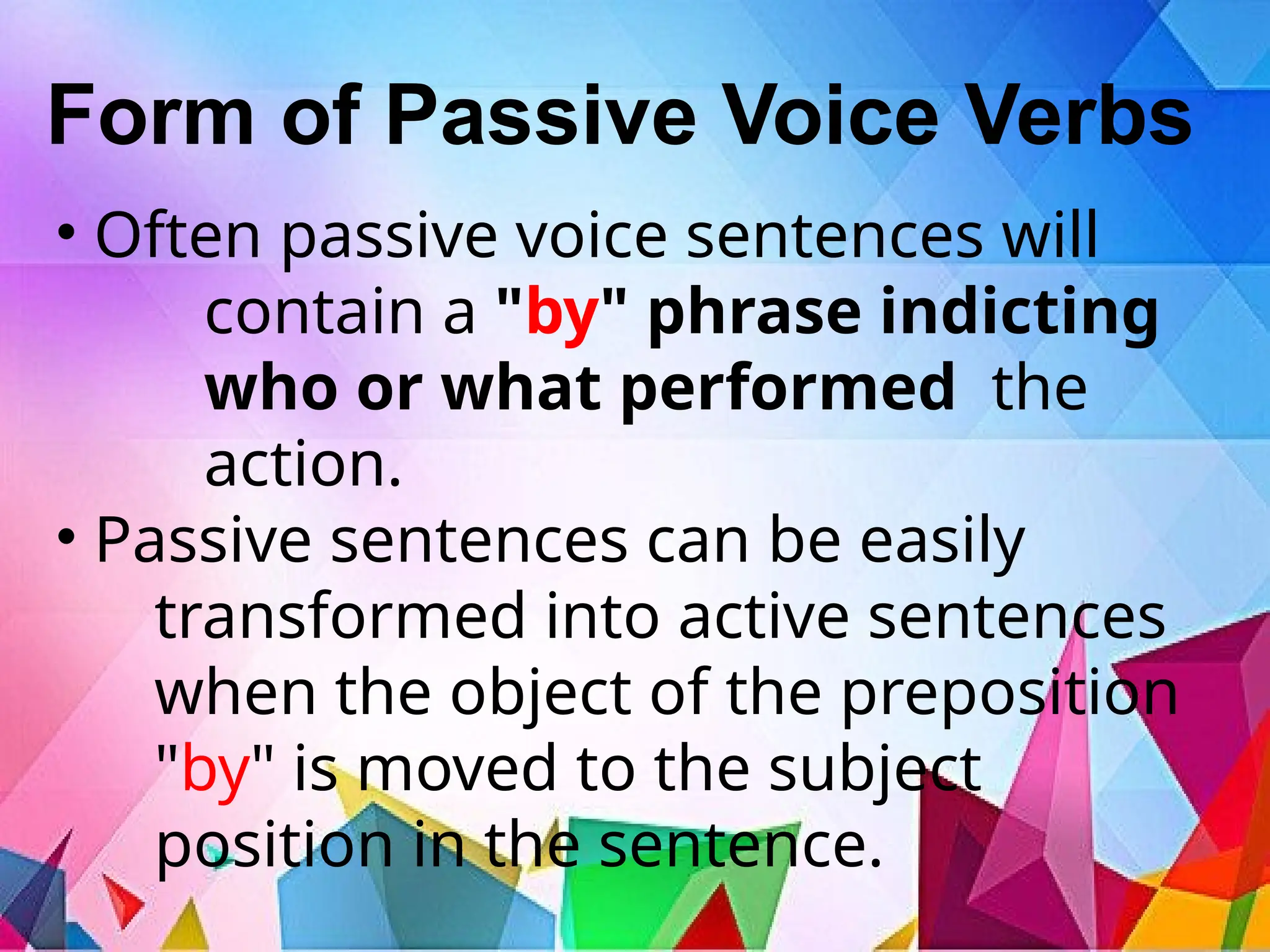
• Often passive voice sentences will
contain a "by" phrase indicting
who or what performed the
action.
• Passive sentences can be easily
transformed into active sentences
when the object of the preposition
"by" is moved to the subject
position in the sentence.
19.
Form of PassiveVoice Verbs
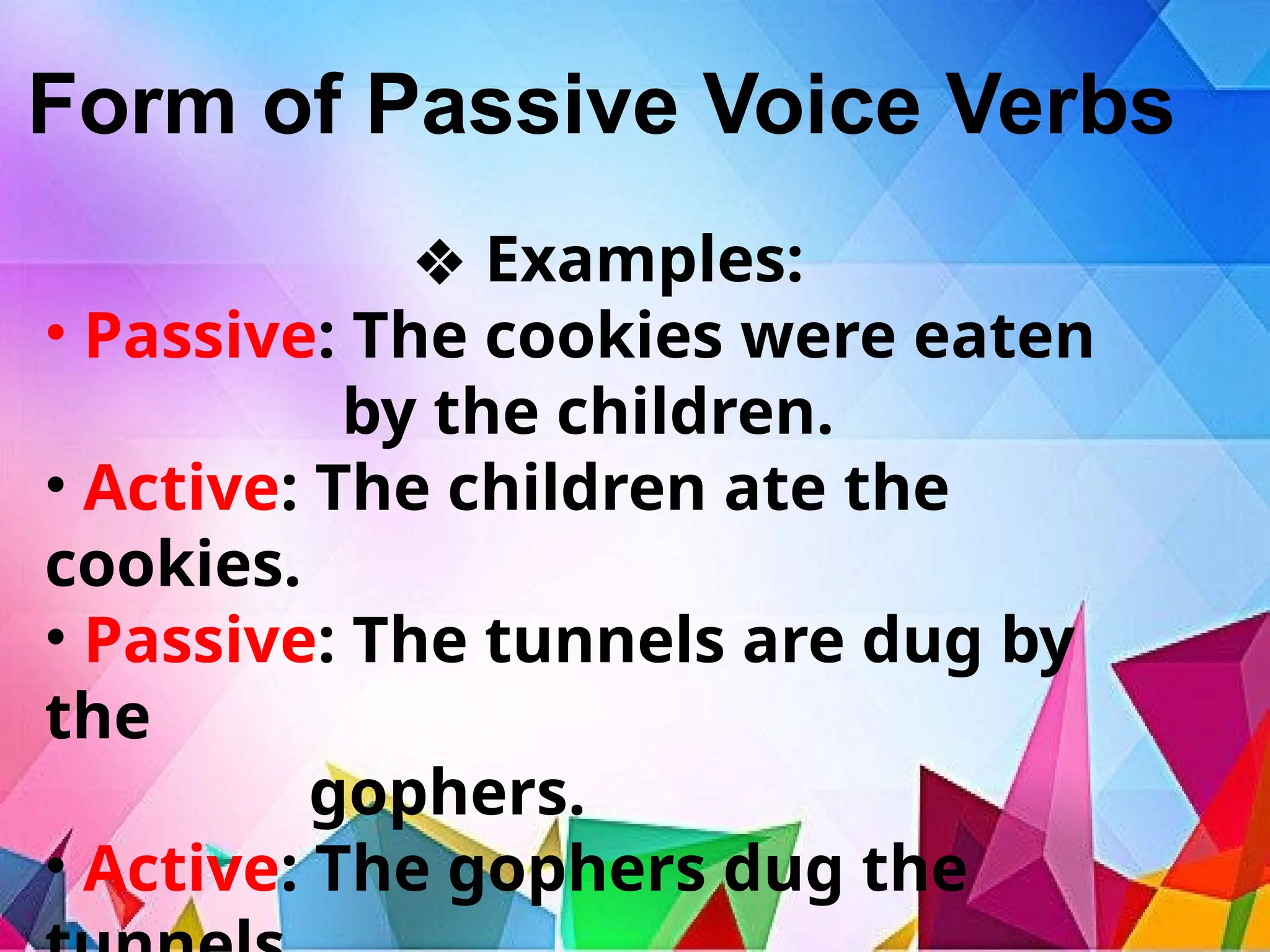
❖ Examples:
• Passive: The cookies were eaten
by the children.
• Active: The children ate the
cookies.
• Passive: The tunnels are dug by
the
gophers.
• Active: The gophers dug the
20.
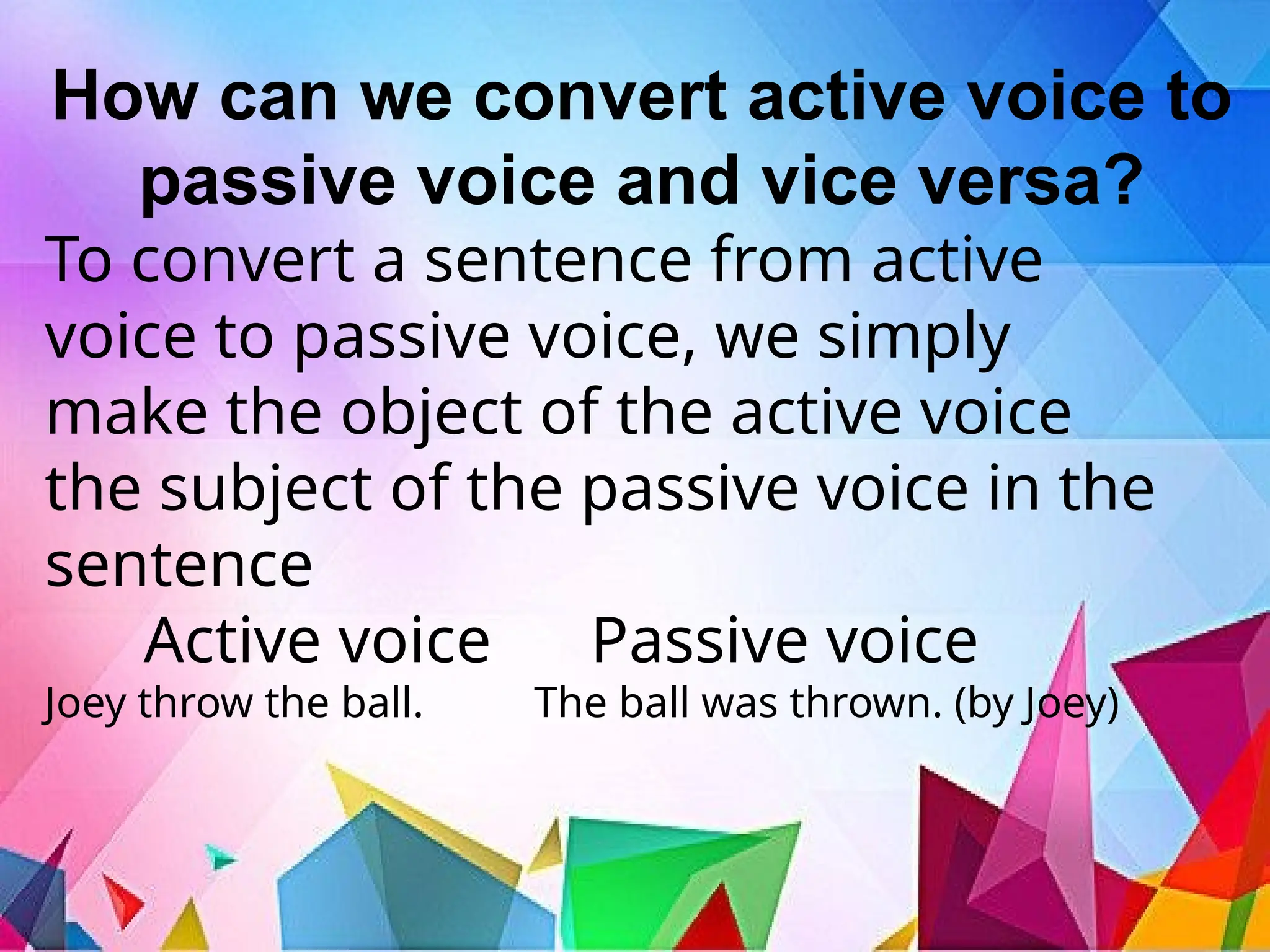
How can weconvert active voice to
passive voice and vice versa?
To convert a sentence from active
voice to passive voice, we simply
make the object of the active voice
the subject of the passive voice in the
sentence
Active voice Passive voice
Joey throw the ball. The ball was thrown. (by Joey)