27-28 May 2013, Munich, Germany
EuroBioForum 2013 2nd Annual Conference
Katherine Payne
The University of Manchester
Personalised Medicine(s)?
• From a hyped theoretical concept to clinical application:
now the perfect solution to offer good value for money?
• Targeting of medicines using a biomarker or genetic-based
diagnostic to identify the eligible patient population
• The most common current applications involve stratifying
cancer patient populations using companion diagnostics
• But other personalised applications in medicine are
emerging eg. stratified (risk-based) breast screening
programmes
The Context
• Poor global economic climate: greater emphasis on the
need to effectively use finite healthcare budgets
• There is substantial diversity in how healthcare systems are
provided and funded across European countries
• There is a commonality in the need for decision-makers
working within these healthcare systems at local, regional
or national levels to think about how best to spend the
available healthcare budget effectively
• Decision-makers need/want a sufficiently robust evidence
base to reassure them they are spending the resources in
the best way possible
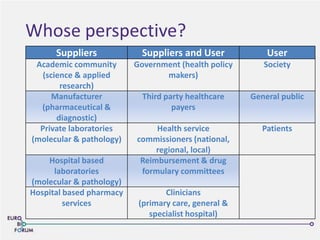
Whose perspective?
Suppliers Suppliers and User User
Academic community
(science & applied
research)
Government (health policy
makers)
Society
Manufacturer
(pharmaceutical &
diagnostic)
Third party healthcare
payers
General public
Private laboratories
(molecular & pathology)
Health service
commissioners (national,
regional, local)
Patients
Hospital based
laboratories
(molecular & pathology)
Reimbursement & drug
formulary committees
Hospital based pharmacy
services
Clinicians
(primary care, general &
specialist hospital)
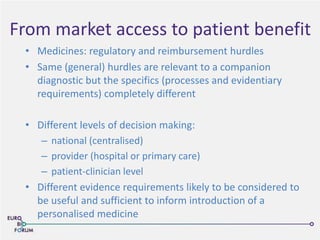
From market access to patient benefit
• Medicines: regulatory and reimbursement hurdles
• Same (general) hurdles are relevant to a companion
diagnostic but the specifics (processes and evidentiary
requirements) completely different
• Different levels of decision making:
– national (centralised)
– provider (hospital or primary care)
– patient-clinician level
• Different evidence requirements likely to be considered to
be useful and sufficient to inform introduction of a
personalised medicine
Health Technology Assessment
• There is substantial variation across Europe in:
– the process of funding and producing HTAs
– the technical details used in the evaluative methods
– the intended use of the HTA reports
• HTAs can potentially be used to inform clinical guidelines or
reimbursement decisions for local, regional or national use
• In some jurisdictions, HTAs have a more formal legal status
and are used by national decision makers working for
healthcare third party payer organisations
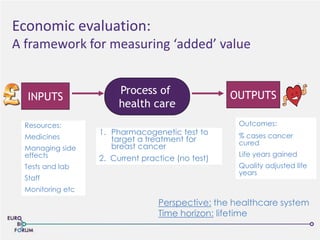
Economic evaluation:
A framework for measuring ‘added’ value
INPUTS
Process of
health care
OUTPUTS
Resources:
Medicines
Managing side
effects
Tests and lab
Staff
Monitoring etc
Outcomes:
% cases cancer
cured
Life years gained
Quality adjusted life
years
1. Pharmacogenetic test to
target a treatment for
breast cancer
2. Current practice (no test)
Perspective: the healthcare system
Time horizon: lifetime
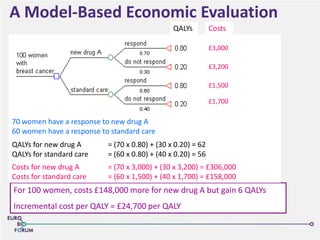
A Model-Based Economic Evaluation
QALYs Costs
For 100 women, costs £148,000 more for new drug A but gain 6 QALYs
Incremental cost per QALY = £24,700 per QALY
Costs for new drug A = (70 x 3,000) + (30 x 3,200) = £306,000
Costs for standard care = (60 x 1,500) + (40 x 1,700) = £158,000
£3,000
£3,200
£1,500
£1,700
70 women have a response to new drug A
60 women have a response to standard care
QALYs for new drug A = (70 x 0.80) + (30 x 0.20) = 62
QALYs for standard care = (60 x 0.80) + (40 x 0.20) = 56
Costs
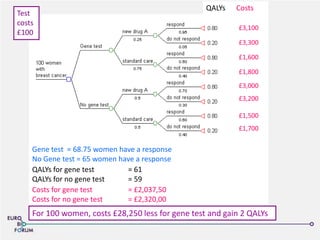
For 100 women, costs £28,250 less for gene test and gain 2 QALYs
Costs for gene test = £2,037,50
Costs for no gene test = £2,320,00
QALYs for gene test = 61
QALYs for no gene test = 59
Gene test = 68.75 women have a response
No Gene test = 65 women have a response
QALYs
£3,100
£3,300
£1,600
£1,800
£3,000
£3,200
£1,500
£1,700
Test
costs
£100
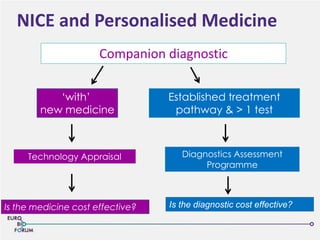
NICE and Personalised Medicine
Companion diagnostic
‘with’
new medicine
Established treatment
pathway & > 1 test
Technology Appraisal
Is the medicine cost effective?
Diagnostics Assessment
Programme
Is the diagnostic cost effective?
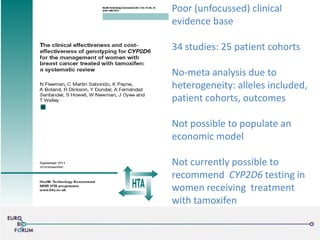
Poor (unfocussed) clinical
evidence base
34 studies: 25 patient cohorts
No-meta analysis due to
heterogeneity: alleles included,
patient cohorts, outcomes
Not possible to populate an
economic model
Not currently possible to
recommend CYP2D6 testing in
women receiving treatment
with tamoxifen
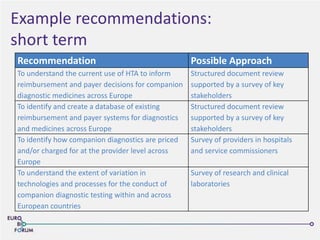
Example recommendations:
short term
Recommendation Possible Approach
To understand the current use of HTA to inform
reimbursement and payer decisions for companion
diagnostic medicines across Europe
Structured document review
supported by a survey of key
stakeholders
To identify and create a database of existing
reimbursement and payer systems for diagnostics
and medicines across Europe
Structured document review
supported by a survey of key
stakeholders
To identify how companion diagnostics are priced
and/or charged for at the provider level across
Europe
Survey of providers in hospitals
and service commissioners
To understand the extent of variation in
technologies and processes for the conduct of
companion diagnostic testing within and across
European countries
Survey of research and clinical
laboratories
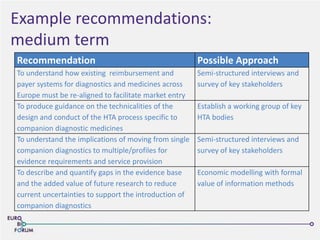
Example recommendations:
medium term
Recommendation Possible Approach
To understand how existing reimbursement and
payer systems for diagnostics and medicines across
Europe must be re-aligned to facilitate market entry
Semi-structured interviews and
survey of key stakeholders
To produce guidance on the technicalities of the
design and conduct of the HTA process specific to
companion diagnostic medicines
Establish a working group of key
HTA bodies
To understand the implications of moving from single
companion diagnostics to multiple/profiles for
evidence requirements and service provision
Semi-structured interviews and
survey of key stakeholders
To describe and quantify gaps in the evidence base
and the added value of future research to reduce
current uncertainties to support the introduction of
companion diagnostics
Economic modelling with formal
value of information methods
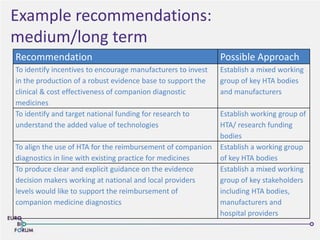
Example recommendations:
medium/long term
Recommendation Possible Approach
To identify incentives to encourage manufacturers to invest
in the production of a robust evidence base to support the
clinical & cost effectiveness of companion diagnostic
medicines
Establish a mixed working
group of key HTA bodies
and manufacturers
To identify and target national funding for research to
understand the added value of technologies
Establish working group of
HTA/ research funding
bodies
To align the use of HTA for the reimbursement of companion
diagnostics in line with existing practice for medicines
Establish a working group
of key HTA bodies
To produce clear and explicit guidance on the evidence
decision makers working at national and local providers
levels would like to support the reimbursement of
companion medicine diagnostics
Establish a mixed working
group of key stakeholders
including HTA bodies,
manufacturers and
hospital providers
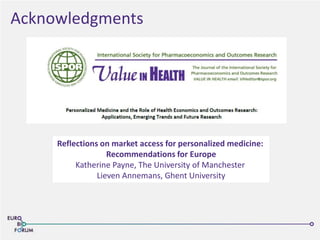
Acknowledgments
Reflections on market access for personalized medicine:
Recommendations for Europe
Katherine Payne, The University of Manchester
Lieven Annemans, Ghent University

EuroBioForum 2013 - Day 1 | Katherine Payne

  • 1.
    27-28 May 2013,Munich, Germany EuroBioForum 2013 2nd Annual Conference Katherine Payne The University of Manchester
  • 2.
    Personalised Medicine(s)? • Froma hyped theoretical concept to clinical application: now the perfect solution to offer good value for money? • Targeting of medicines using a biomarker or genetic-based diagnostic to identify the eligible patient population • The most common current applications involve stratifying cancer patient populations using companion diagnostics • But other personalised applications in medicine are emerging eg. stratified (risk-based) breast screening programmes
  • 3.
    The Context • Poorglobal economic climate: greater emphasis on the need to effectively use finite healthcare budgets • There is substantial diversity in how healthcare systems are provided and funded across European countries • There is a commonality in the need for decision-makers working within these healthcare systems at local, regional or national levels to think about how best to spend the available healthcare budget effectively • Decision-makers need/want a sufficiently robust evidence base to reassure them they are spending the resources in the best way possible
  • 4.
    Whose perspective? Suppliers Suppliersand User User Academic community (science & applied research) Government (health policy makers) Society Manufacturer (pharmaceutical & diagnostic) Third party healthcare payers General public Private laboratories (molecular & pathology) Health service commissioners (national, regional, local) Patients Hospital based laboratories (molecular & pathology) Reimbursement & drug formulary committees Hospital based pharmacy services Clinicians (primary care, general & specialist hospital)
  • 5.
    From market accessto patient benefit • Medicines: regulatory and reimbursement hurdles • Same (general) hurdles are relevant to a companion diagnostic but the specifics (processes and evidentiary requirements) completely different • Different levels of decision making: – national (centralised) – provider (hospital or primary care) – patient-clinician level • Different evidence requirements likely to be considered to be useful and sufficient to inform introduction of a personalised medicine
  • 6.
    Health Technology Assessment •There is substantial variation across Europe in: – the process of funding and producing HTAs – the technical details used in the evaluative methods – the intended use of the HTA reports • HTAs can potentially be used to inform clinical guidelines or reimbursement decisions for local, regional or national use • In some jurisdictions, HTAs have a more formal legal status and are used by national decision makers working for healthcare third party payer organisations
  • 7.
    Economic evaluation: A frameworkfor measuring ‘added’ value INPUTS Process of health care OUTPUTS Resources: Medicines Managing side effects Tests and lab Staff Monitoring etc Outcomes: % cases cancer cured Life years gained Quality adjusted life years 1. Pharmacogenetic test to target a treatment for breast cancer 2. Current practice (no test) Perspective: the healthcare system Time horizon: lifetime
  • 8.
    A Model-Based EconomicEvaluation QALYs Costs For 100 women, costs £148,000 more for new drug A but gain 6 QALYs Incremental cost per QALY = £24,700 per QALY Costs for new drug A = (70 x 3,000) + (30 x 3,200) = £306,000 Costs for standard care = (60 x 1,500) + (40 x 1,700) = £158,000 £3,000 £3,200 £1,500 £1,700 70 women have a response to new drug A 60 women have a response to standard care QALYs for new drug A = (70 x 0.80) + (30 x 0.20) = 62 QALYs for standard care = (60 x 0.80) + (40 x 0.20) = 56
  • 9.
    Costs For 100 women,costs £28,250 less for gene test and gain 2 QALYs Costs for gene test = £2,037,50 Costs for no gene test = £2,320,00 QALYs for gene test = 61 QALYs for no gene test = 59 Gene test = 68.75 women have a response No Gene test = 65 women have a response QALYs £3,100 £3,300 £1,600 £1,800 £3,000 £3,200 £1,500 £1,700 Test costs £100
  • 10.
    NICE and PersonalisedMedicine Companion diagnostic ‘with’ new medicine Established treatment pathway & > 1 test Technology Appraisal Is the medicine cost effective? Diagnostics Assessment Programme Is the diagnostic cost effective?
  • 11.
    Poor (unfocussed) clinical evidencebase 34 studies: 25 patient cohorts No-meta analysis due to heterogeneity: alleles included, patient cohorts, outcomes Not possible to populate an economic model Not currently possible to recommend CYP2D6 testing in women receiving treatment with tamoxifen
  • 12.
    Example recommendations: short term RecommendationPossible Approach To understand the current use of HTA to inform reimbursement and payer decisions for companion diagnostic medicines across Europe Structured document review supported by a survey of key stakeholders To identify and create a database of existing reimbursement and payer systems for diagnostics and medicines across Europe Structured document review supported by a survey of key stakeholders To identify how companion diagnostics are priced and/or charged for at the provider level across Europe Survey of providers in hospitals and service commissioners To understand the extent of variation in technologies and processes for the conduct of companion diagnostic testing within and across European countries Survey of research and clinical laboratories
  • 13.
    Example recommendations: medium term RecommendationPossible Approach To understand how existing reimbursement and payer systems for diagnostics and medicines across Europe must be re-aligned to facilitate market entry Semi-structured interviews and survey of key stakeholders To produce guidance on the technicalities of the design and conduct of the HTA process specific to companion diagnostic medicines Establish a working group of key HTA bodies To understand the implications of moving from single companion diagnostics to multiple/profiles for evidence requirements and service provision Semi-structured interviews and survey of key stakeholders To describe and quantify gaps in the evidence base and the added value of future research to reduce current uncertainties to support the introduction of companion diagnostics Economic modelling with formal value of information methods
  • 14.
    Example recommendations: medium/long term RecommendationPossible Approach To identify incentives to encourage manufacturers to invest in the production of a robust evidence base to support the clinical & cost effectiveness of companion diagnostic medicines Establish a mixed working group of key HTA bodies and manufacturers To identify and target national funding for research to understand the added value of technologies Establish working group of HTA/ research funding bodies To align the use of HTA for the reimbursement of companion diagnostics in line with existing practice for medicines Establish a working group of key HTA bodies To produce clear and explicit guidance on the evidence decision makers working at national and local providers levels would like to support the reimbursement of companion medicine diagnostics Establish a mixed working group of key stakeholders including HTA bodies, manufacturers and hospital providers
  • 15.
    Acknowledgments Reflections on marketaccess for personalized medicine: Recommendations for Europe Katherine Payne, The University of Manchester Lieven Annemans, Ghent University