1
CHAPTER TWELVE
ARBITRAGE PRICING
THEORY
2
BackgroundBackground
• Estimating expected return with the AssetEstimating expected return with the Asset
Pricing Models of Modern FinancePricing Models of Modern Finance
– CAPMCAPM
• Strong assumption - strong predictionStrong assumption - strong prediction
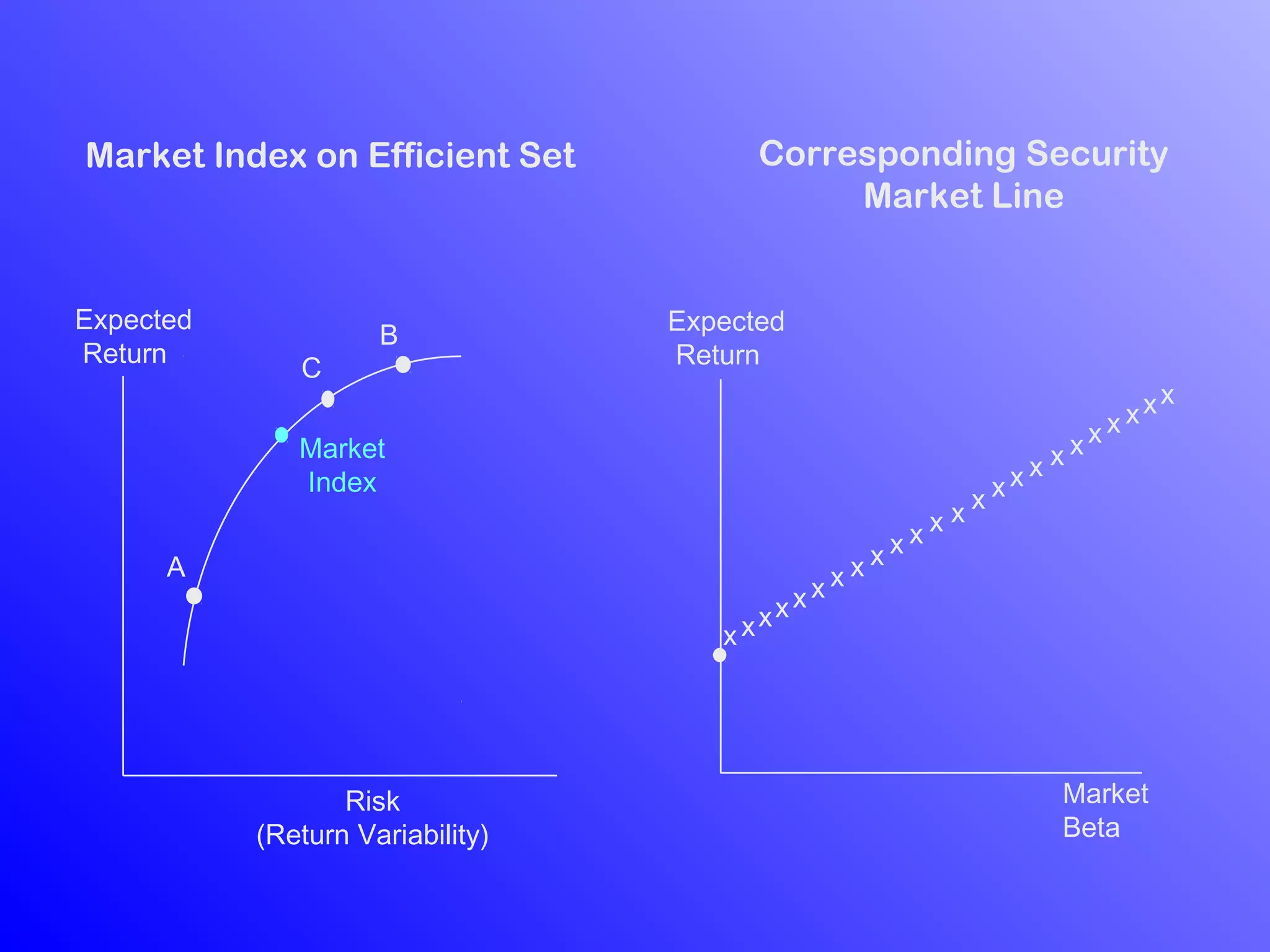
Expected
Return
Risk
(Return Variability)
Market Index on Efficient Set
Market
Index
A
B
C
Market
Beta
Expected
Return
Corresponding Security
Market Line
xxx
xxxx
xxxx
xx
xx
x x x
xxx
xx
x
Market
Index
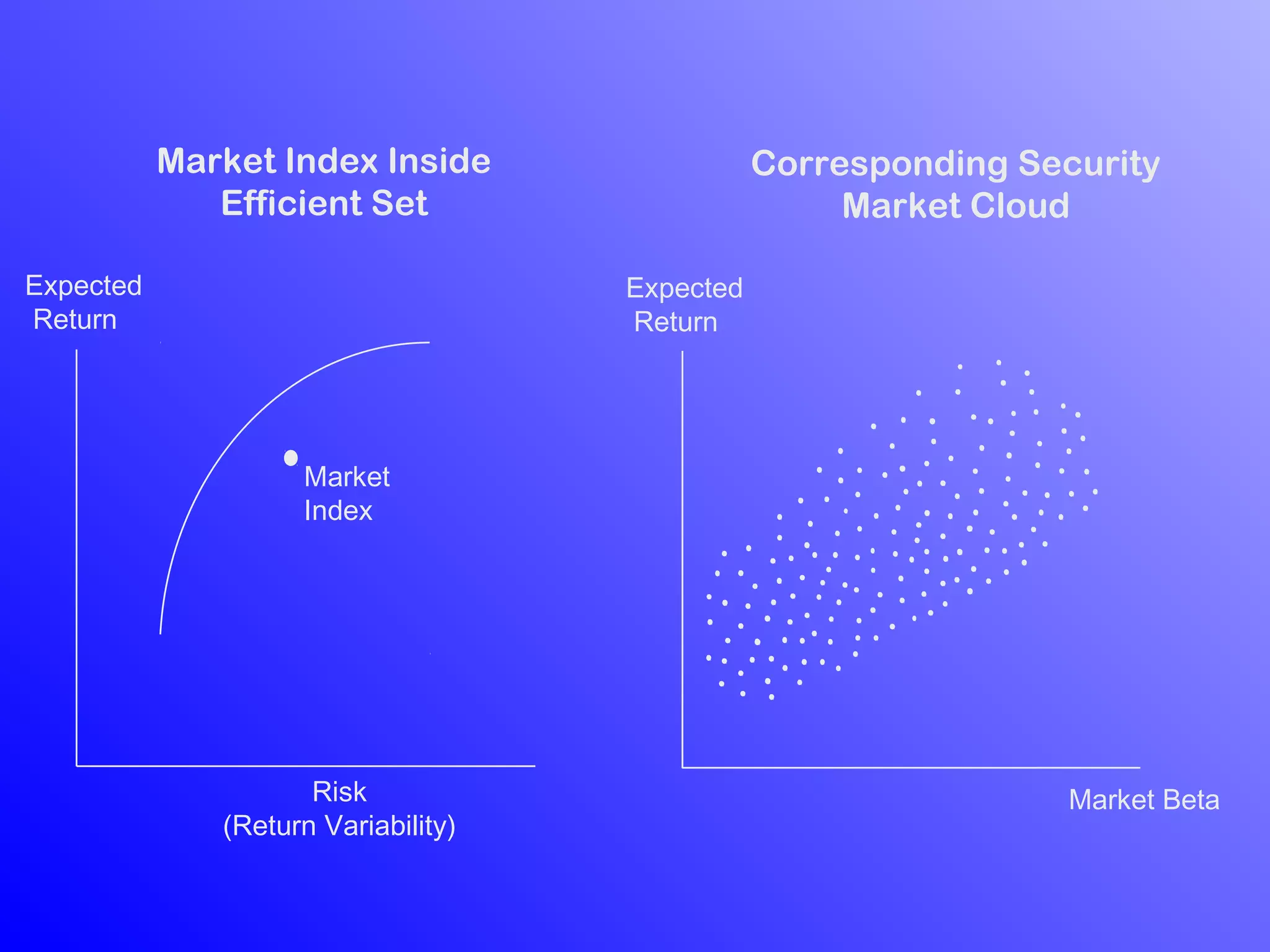
Expected
Return
Risk
(Return Variability)
Market Index Inside
Efficient Set
Corresponding Security
Market Cloud
Expected
Return
Market Beta
5
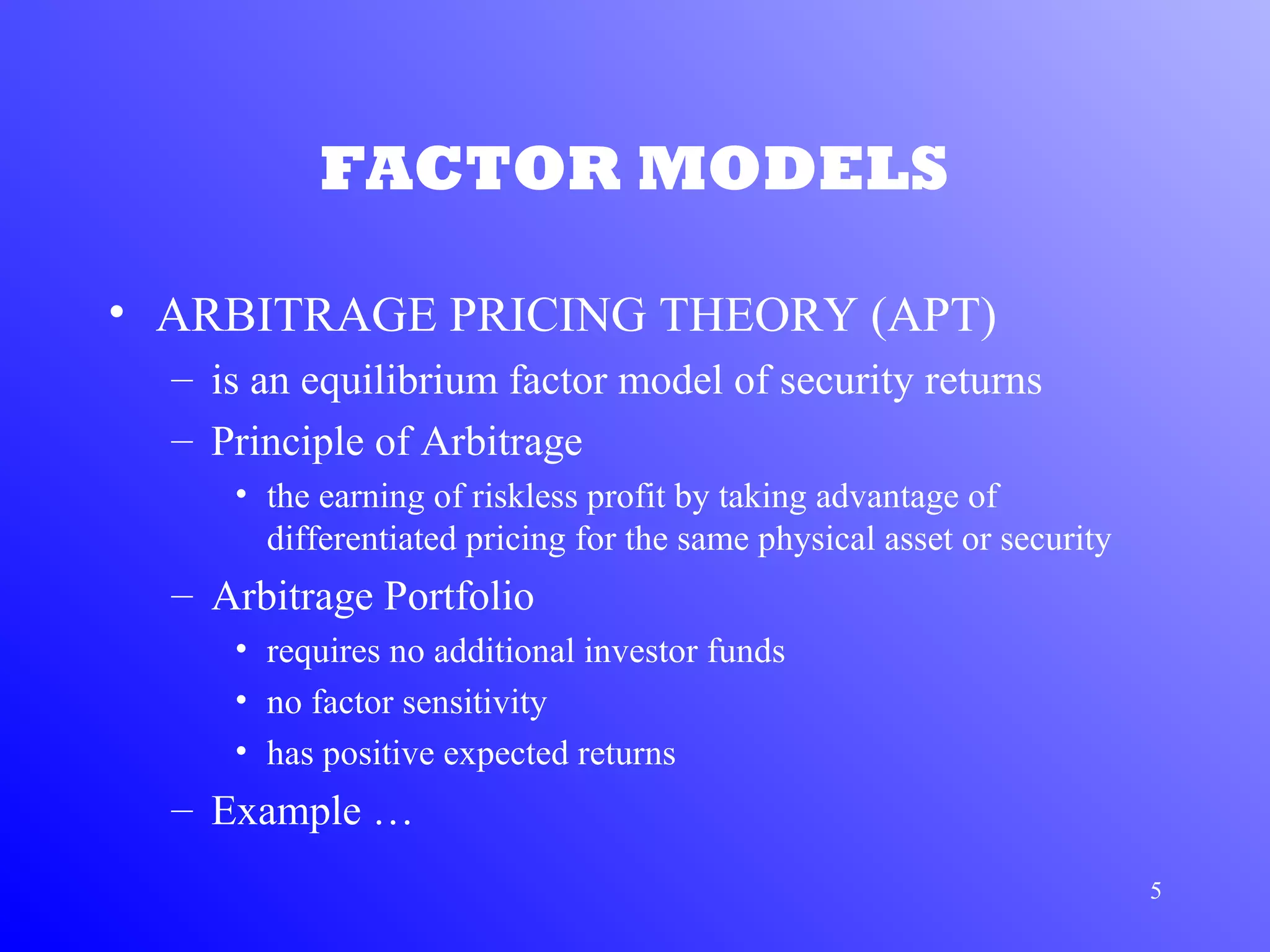
FACTOR MODELS
• ARBITRAGE PRICING THEORY (APT)
– is an equilibrium factor model of security returns
– Principle of Arbitrage
• the earning of riskless profit by taking advantage of
differentiated pricing for the same physical asset or security
– Arbitrage Portfolio
• requires no additional investor funds
• no factor sensitivity
• has positive expected returns
– Example …
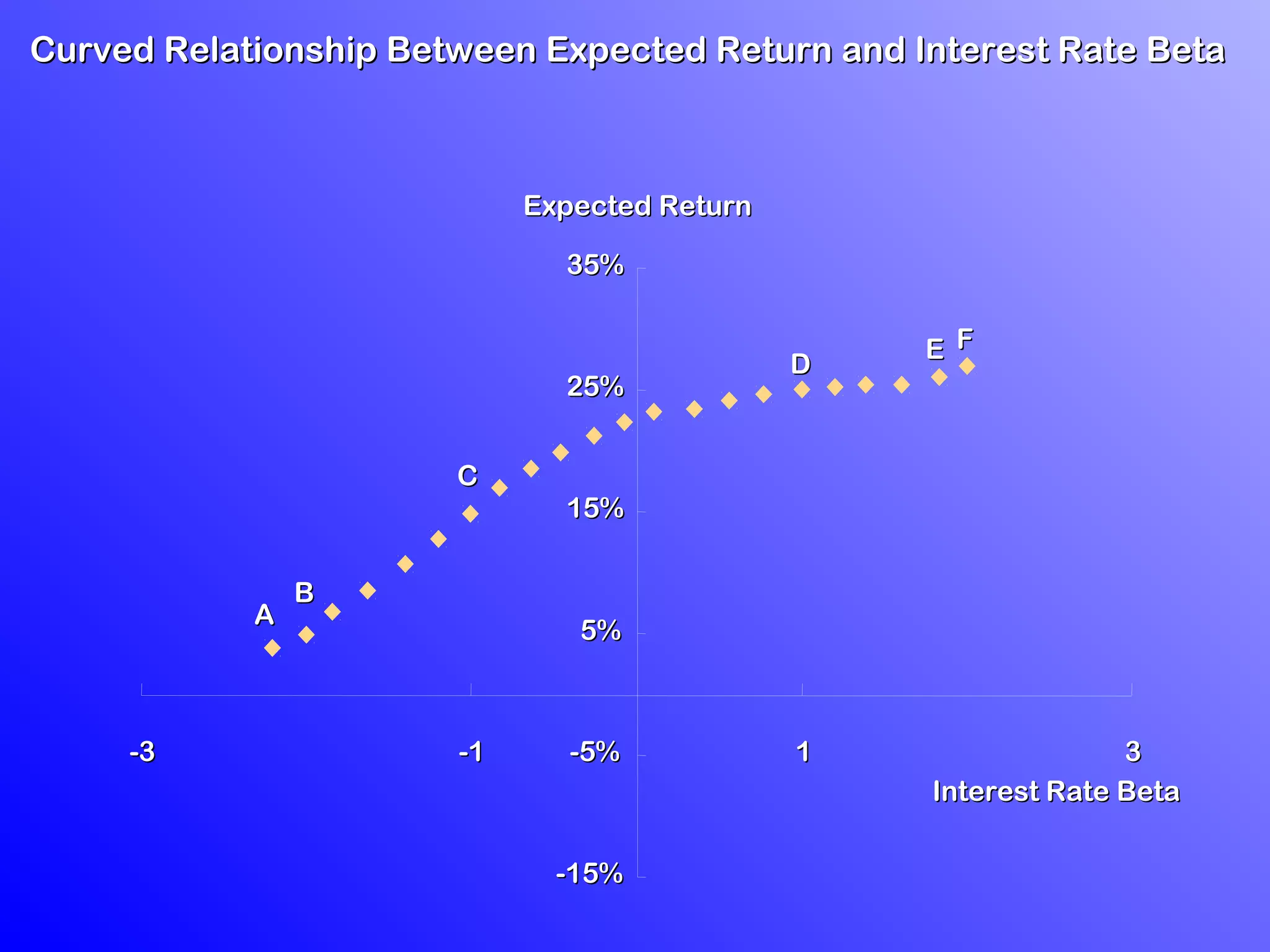
Curved Relationship Between Expected Return and Interest Rate BetaCurved Relationship Between Expected Return and Interest Rate Beta
-15%-15%
-5%-5%
5%5%
15%15%
25%25%
35%35%
Expected ReturnExpected Return
-3-3 -1-1 11 33
Interest Rate BetaInterest Rate Beta
AA
BB
CC
DD EE FF
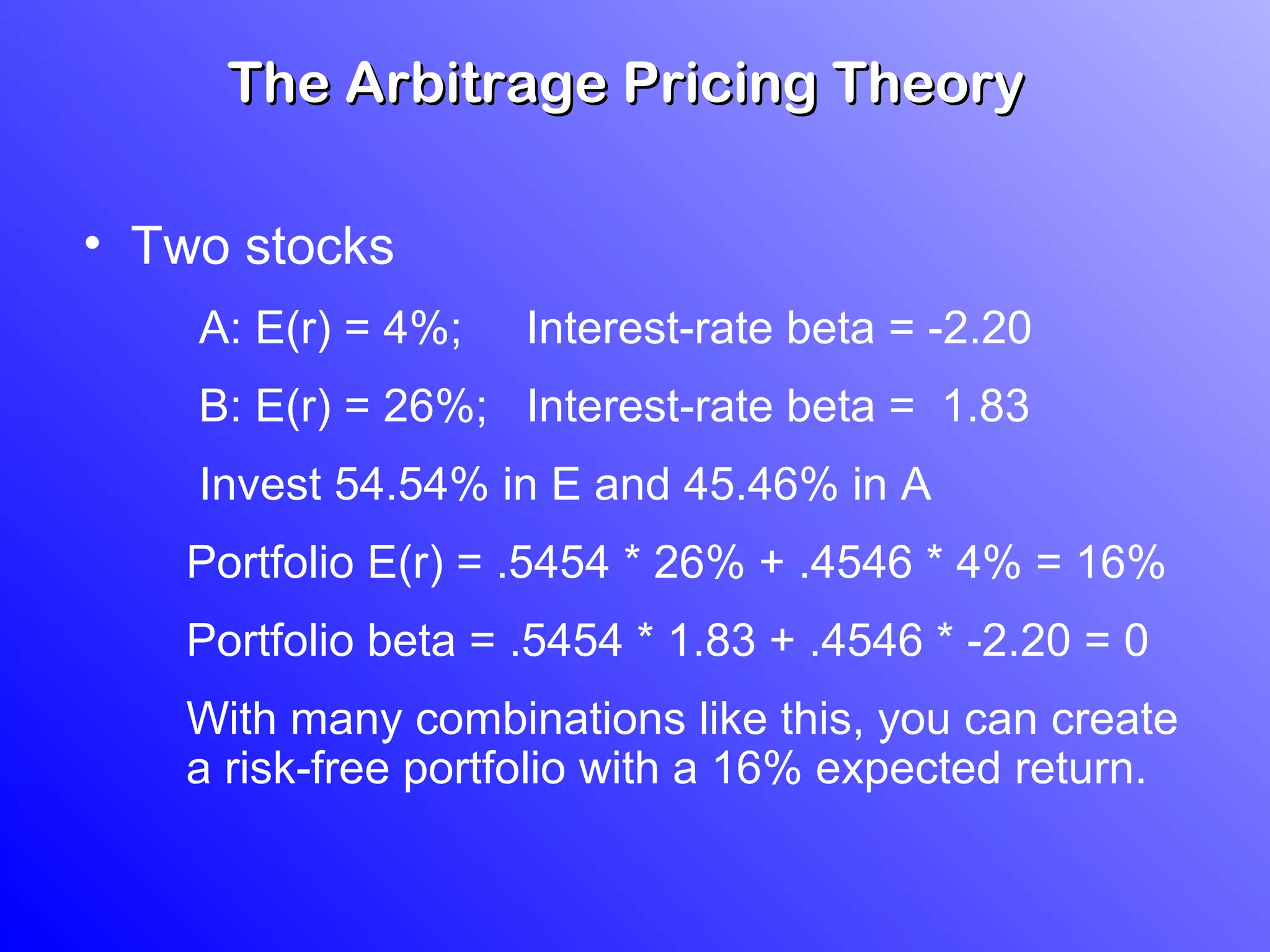
• Two stocks
A: E(r) = 4%; Interest-rate beta = -2.20
B: E(r) = 26%; Interest-rate beta = 1.83
Invest 54.54% in E and 45.46% in A
Portfolio E(r) = .5454 * 26% + .4546 * 4% = 16%
Portfolio beta = .5454 * 1.83 + .4546 * -2.20 = 0
With many combinations like this, you can create
a risk-free portfolio with a 16% expected return.
The Arbitrage Pricing TheoryThe Arbitrage Pricing Theory
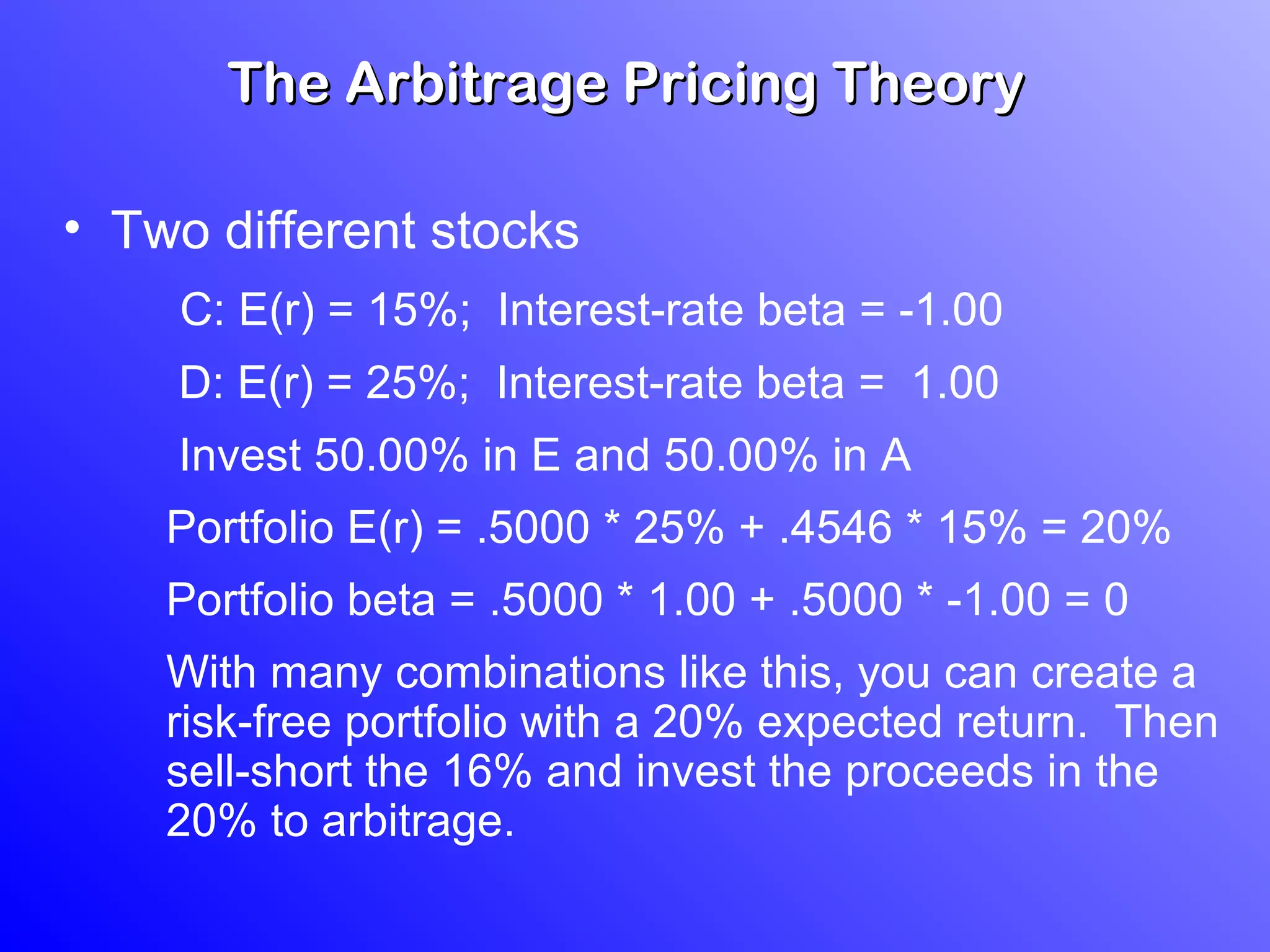
• Two different stocks
C: E(r) = 15%; Interest-rate beta = -1.00
D: E(r) = 25%; Interest-rate beta = 1.00
Invest 50.00% in E and 50.00% in A
Portfolio E(r) = .5000 * 25% + .4546 * 15% = 20%
Portfolio beta = .5000 * 1.00 + .5000 * -1.00 = 0
With many combinations like this, you can create a
risk-free portfolio with a 20% expected return. Then
sell-short the 16% and invest the proceeds in the
20% to arbitrage.
9
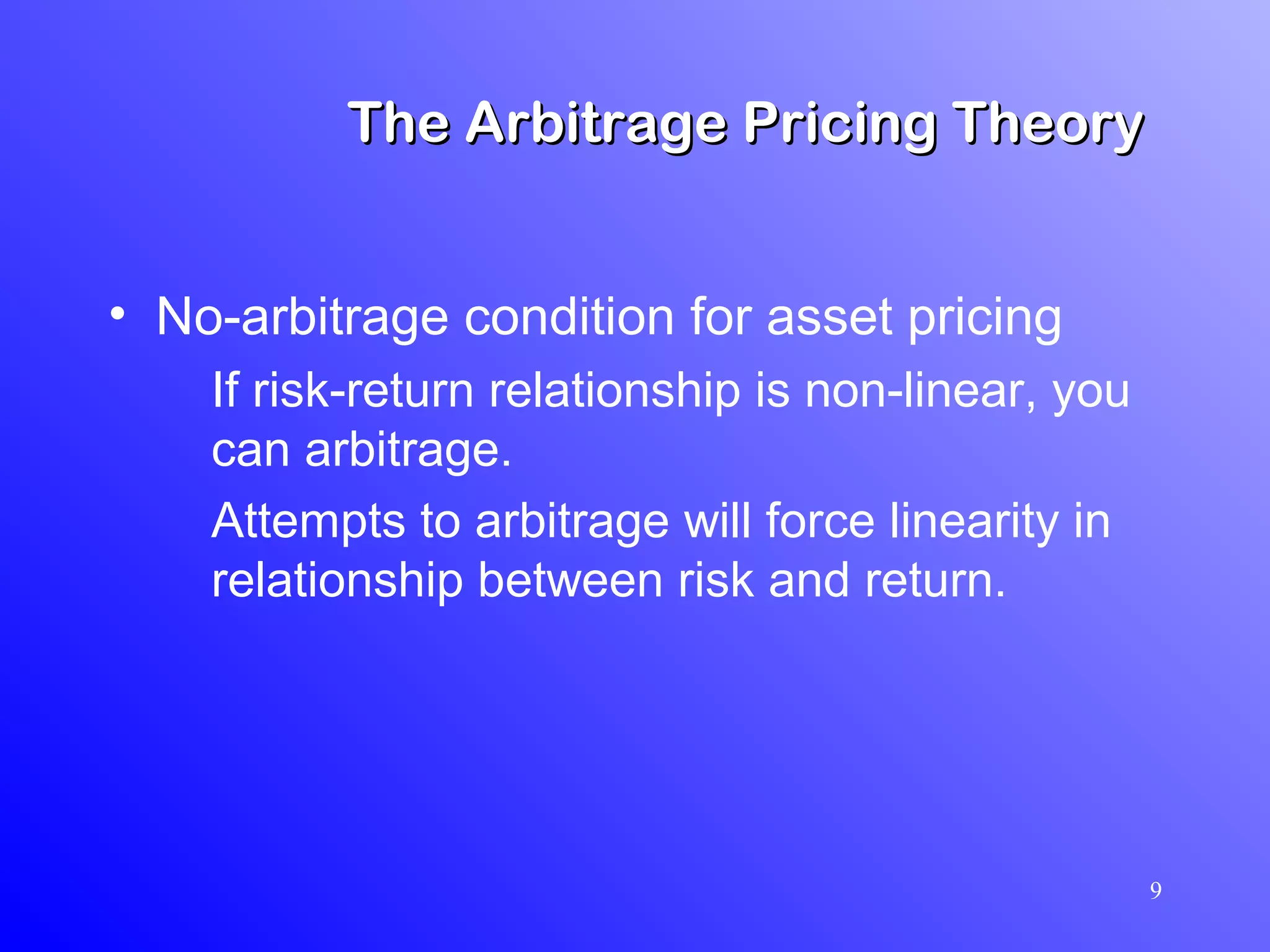
• No-arbitrage condition for asset pricing
If risk-return relationship is non-linear, you
can arbitrage.
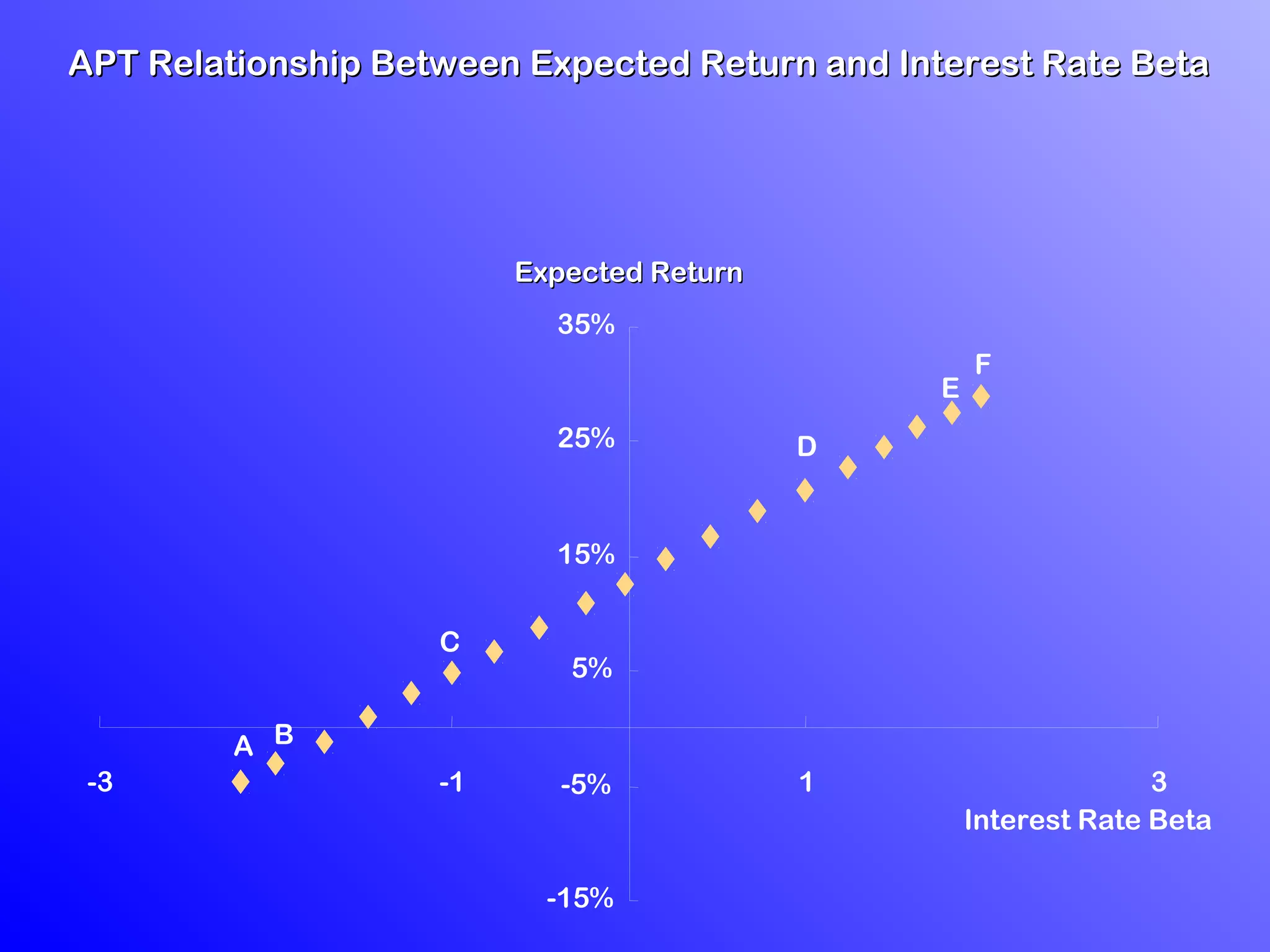
Attempts to arbitrage will force linearity in
relationship between risk and return.
The Arbitrage Pricing TheoryThe Arbitrage Pricing Theory
APT Relationship Between Expected Return and Interest Rate BetaAPT Relationship Between Expected Return and Interest Rate Beta
-15%
-5%
5%
15%
25%
35%
Expected ReturnExpected Return
-3 -1 1 3
Interest Rate Beta
A B
C
D
E
F
11
FACTOR MODELS
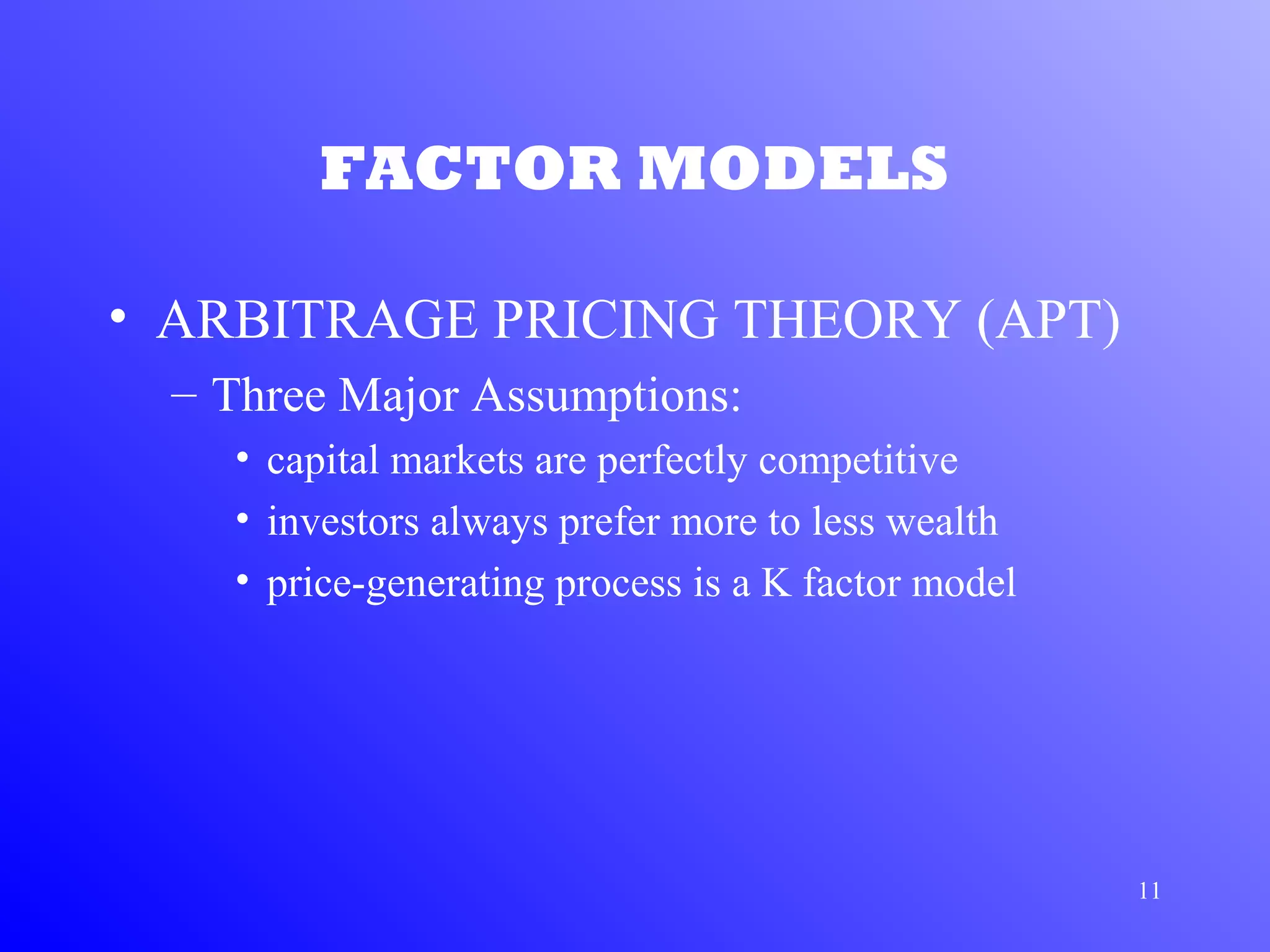
• ARBITRAGE PRICING THEORY (APT)
– Three Major Assumptions:
• capital markets are perfectly competitive
• investors always prefer more to less wealth
• price-generating process is a K factor model
12
FACTOR MODELS
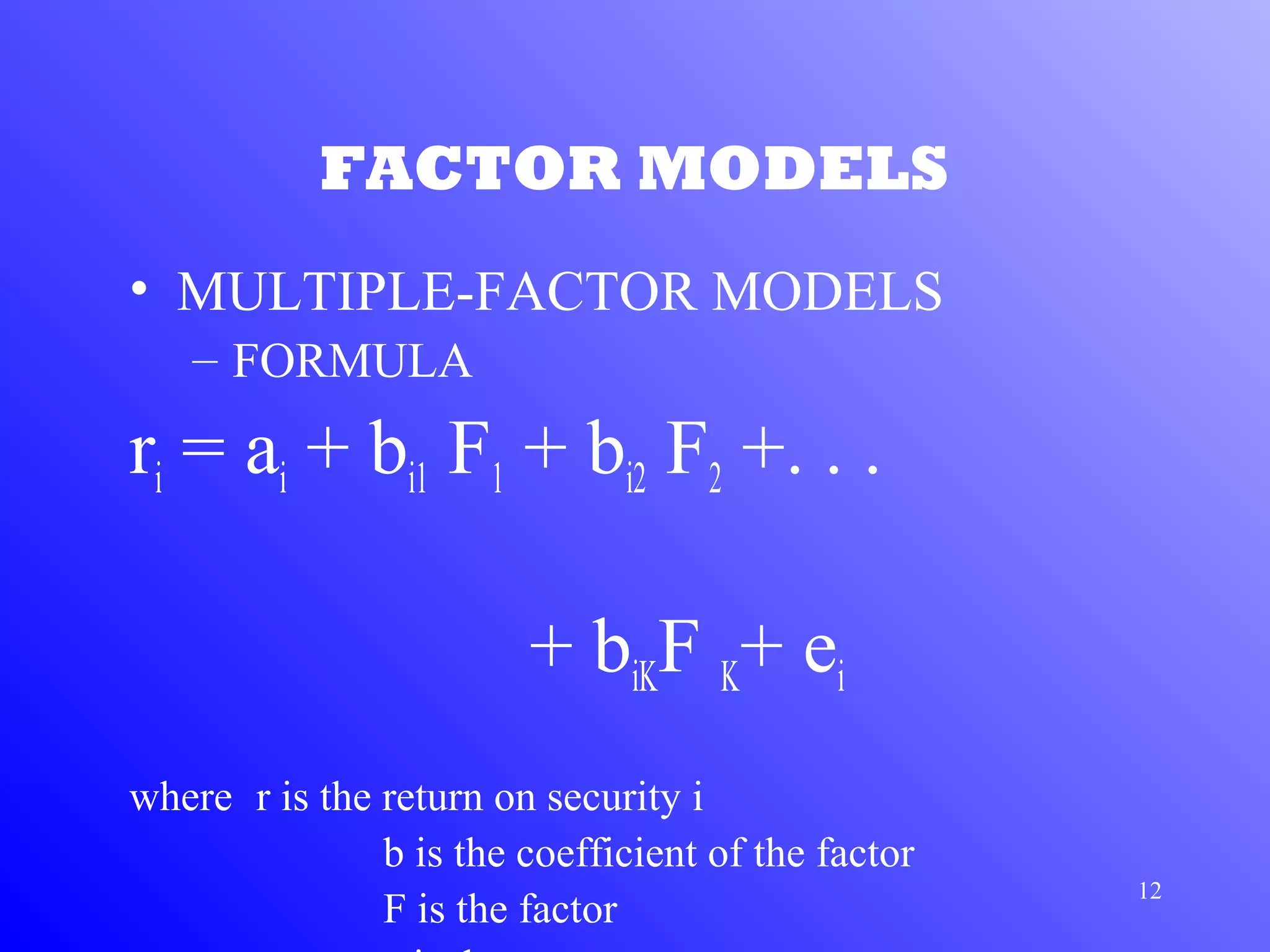
• MULTIPLE-FACTOR MODELS
– FORMULA
ri = ai + bi1 F1 + bi2 F2 +. . .
+ biKF K+ ei
where r is the return on security i
b is the coefficient of the factor
F is the factor
13
FACTOR MODELS
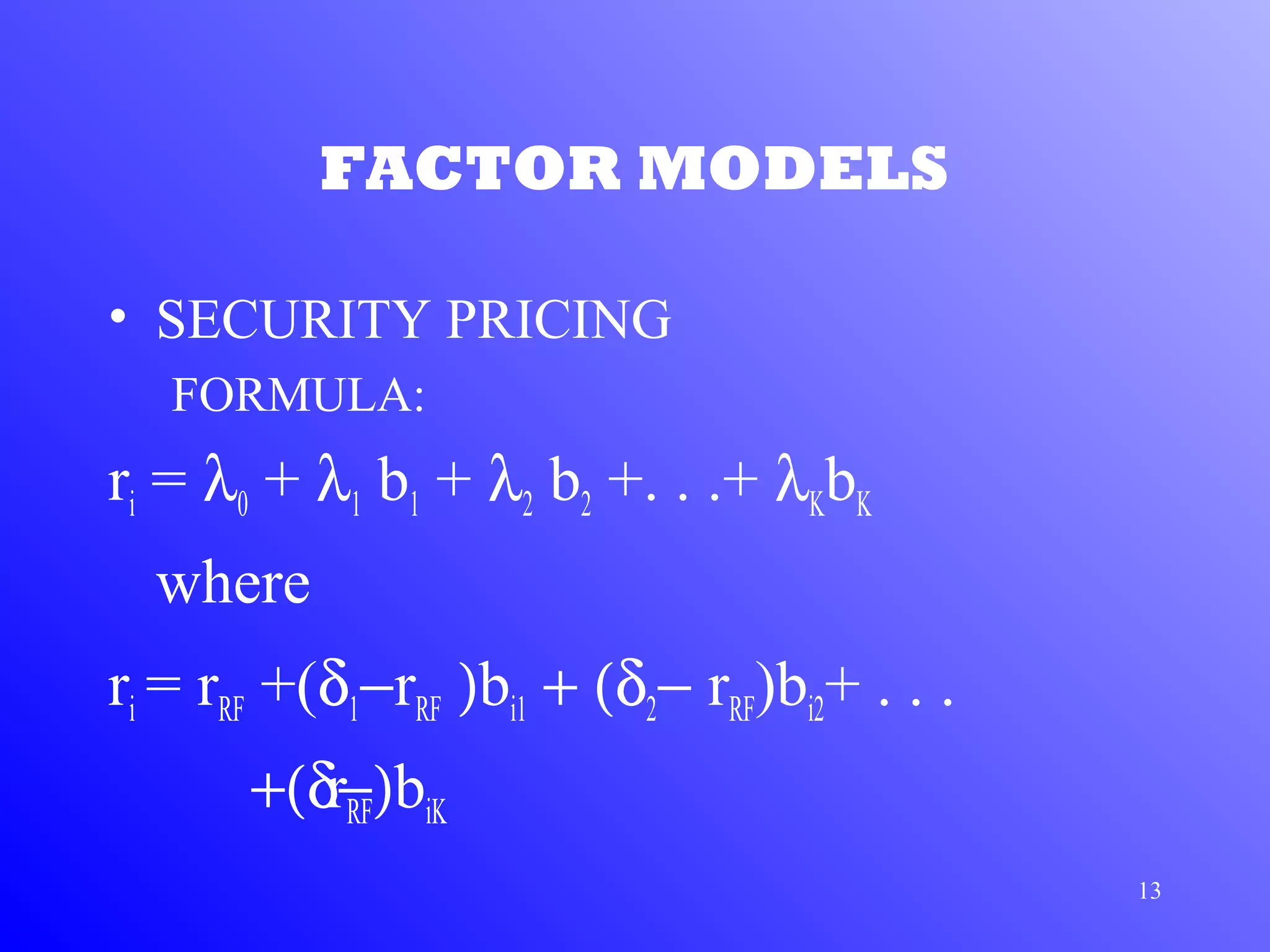
• SECURITY PRICING
FORMULA:
ri = λ0 + λ1 b1 + λ2 b2 +. . .+ λKbK
where
ri = rRF +(δ1−rRF )bi1 + (δ2− rRF)bi2+ . . .
+(δ−rRF)biK
14
FACTOR MODELS
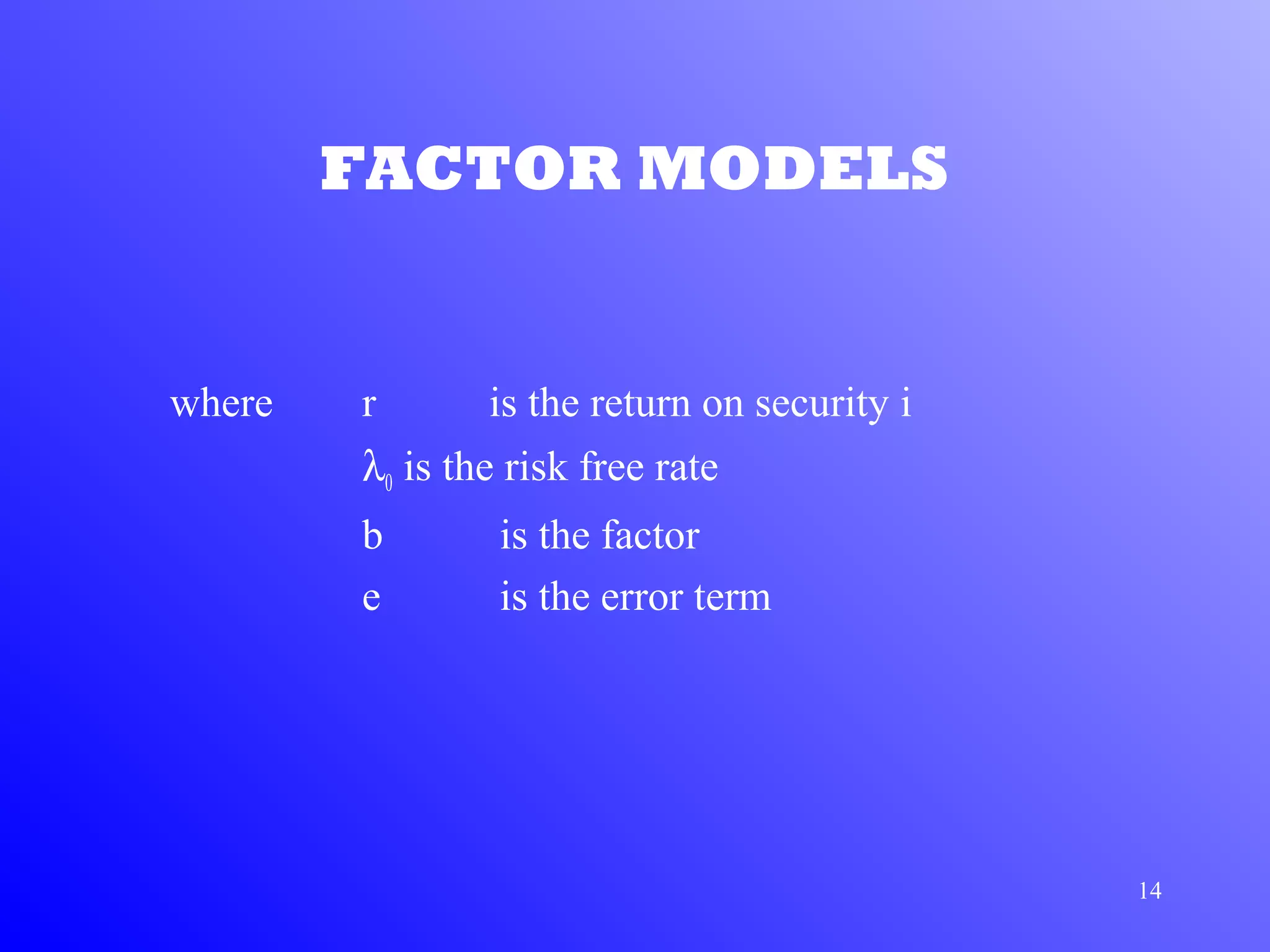
where r is the return on security i
λ0 is the risk free rate
b is the factor
e is the error term
15
FACTOR MODELS
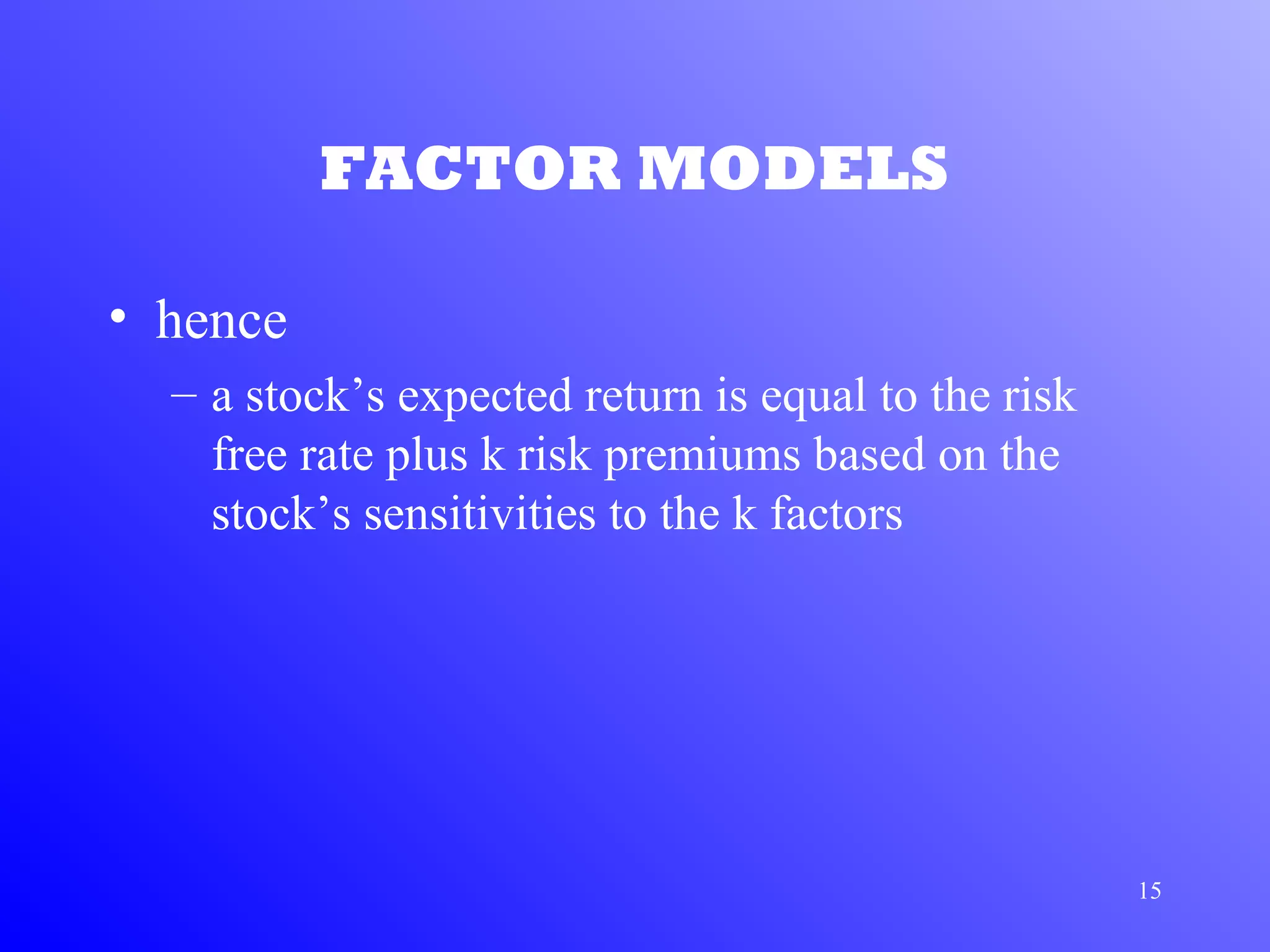
• hence
– a stock’s expected return is equal to the risk
free rate plus k risk premiums based on the
stock’s sensitivities to the k factors

12 apt

  • 1.
  • 2.
    2 BackgroundBackground • Estimating expectedreturn with the AssetEstimating expected return with the Asset Pricing Models of Modern FinancePricing Models of Modern Finance – CAPMCAPM • Strong assumption - strong predictionStrong assumption - strong prediction
  • 3.
    Expected Return Risk (Return Variability) Market Indexon Efficient Set Market Index A B C Market Beta Expected Return Corresponding Security Market Line xxx xxxx xxxx xx xx x x x xxx xx x
  • 4.
    Market Index Expected Return Risk (Return Variability) Market IndexInside Efficient Set Corresponding Security Market Cloud Expected Return Market Beta
  • 5.
    5 FACTOR MODELS • ARBITRAGEPRICING THEORY (APT) – is an equilibrium factor model of security returns – Principle of Arbitrage • the earning of riskless profit by taking advantage of differentiated pricing for the same physical asset or security – Arbitrage Portfolio • requires no additional investor funds • no factor sensitivity • has positive expected returns – Example …
  • 6.
    Curved Relationship BetweenExpected Return and Interest Rate BetaCurved Relationship Between Expected Return and Interest Rate Beta -15%-15% -5%-5% 5%5% 15%15% 25%25% 35%35% Expected ReturnExpected Return -3-3 -1-1 11 33 Interest Rate BetaInterest Rate Beta AA BB CC DD EE FF
  • 7.
    • Two stocks A:E(r) = 4%; Interest-rate beta = -2.20 B: E(r) = 26%; Interest-rate beta = 1.83 Invest 54.54% in E and 45.46% in A Portfolio E(r) = .5454 * 26% + .4546 * 4% = 16% Portfolio beta = .5454 * 1.83 + .4546 * -2.20 = 0 With many combinations like this, you can create a risk-free portfolio with a 16% expected return. The Arbitrage Pricing TheoryThe Arbitrage Pricing Theory
  • 8.
    The Arbitrage PricingTheoryThe Arbitrage Pricing Theory • Two different stocks C: E(r) = 15%; Interest-rate beta = -1.00 D: E(r) = 25%; Interest-rate beta = 1.00 Invest 50.00% in E and 50.00% in A Portfolio E(r) = .5000 * 25% + .4546 * 15% = 20% Portfolio beta = .5000 * 1.00 + .5000 * -1.00 = 0 With many combinations like this, you can create a risk-free portfolio with a 20% expected return. Then sell-short the 16% and invest the proceeds in the 20% to arbitrage.
  • 9.
    9 • No-arbitrage conditionfor asset pricing If risk-return relationship is non-linear, you can arbitrage. Attempts to arbitrage will force linearity in relationship between risk and return. The Arbitrage Pricing TheoryThe Arbitrage Pricing Theory
  • 10.
    APT Relationship BetweenExpected Return and Interest Rate BetaAPT Relationship Between Expected Return and Interest Rate Beta -15% -5% 5% 15% 25% 35% Expected ReturnExpected Return -3 -1 1 3 Interest Rate Beta A B C D E F
  • 11.
    11 FACTOR MODELS • ARBITRAGEPRICING THEORY (APT) – Three Major Assumptions: • capital markets are perfectly competitive • investors always prefer more to less wealth • price-generating process is a K factor model
  • 12.
    12 FACTOR MODELS • MULTIPLE-FACTORMODELS – FORMULA ri = ai + bi1 F1 + bi2 F2 +. . . + biKF K+ ei where r is the return on security i b is the coefficient of the factor F is the factor
  • 13.
    13 FACTOR MODELS • SECURITYPRICING FORMULA: ri = λ0 + λ1 b1 + λ2 b2 +. . .+ λKbK where ri = rRF +(δ1−rRF )bi1 + (δ2− rRF)bi2+ . . . +(δ−rRF)biK
  • 14.
    14 FACTOR MODELS where ris the return on security i λ0 is the risk free rate b is the factor e is the error term
  • 15.
    15 FACTOR MODELS • hence –a stock’s expected return is equal to the risk free rate plus k risk premiums based on the stock’s sensitivities to the k factors