The paper presents an optimal, power-aware Built-In Self-Test (BIST) framework for delay testing in System-on-Chip (SoC) designs, utilizing a data-path based test pattern generator (TPG) that implements iterative pseudo-exhaustive two-patterns for efficient testing. It introduces a CMOS low power architecture that reduces test power dissipation while maintaining fault coverage, alongside FPGA implementations demonstrating reduced hardware overhead and test times. The study emphasizes the need for effective Design for Testability (DfT) techniques due to the challenges posed by process variations in high-speed VLSI circuits.
![Full Paper
ACEEE Int. J. on Control System and Instrumentation, Vol. 4, No. 2, June 2013
Optimal and Power Aware BIST for Delay Testing of
System-On-Chip
Deepa Jose1, Dr. Nirmal Kumar P.2, Jayakumar P3
1,2,3
Department of Electronics and Communication Engineering, College of Engineering Guindy,
Anna University, Chennai - 600 025, India
1Email: deepajose11@gmail.com
Abstract—Test engineering for fault tolerant VLSI systems is
encumbered with optimization requisites for hardware
overhead, test power and test time. The high level quality of
these complex high-speed VLSI circuits can be assured only
through delay testing, which involves checking for accurate
temporal behavior. In the present paper, a data-path based
built-in test pattern generator (TPG) that generates iterative
pseudo-exhaustive two-patterns (IPET) for parallel delay
testing of modules with different input cone capacities is
implemented. Further, in the present study a CMOS
implementation of low power architecture (LPA) for scan based
built-in self test (BIST) for delay testing and combinational
testing is carried out. This reduces test power dissipation in
the circuit under test (CUT). Experimental results and
comparisons with pre-existing methods prove the reduction
in hardware overhead and test-time.
accumulator based IPET test generation exists except in [3].
In this paper, less complex circuits already existing in the
SOC are utilized for efficient BIST applications. The
implementation of a built-in test pattern generator (TPG) for
generating iterative pseudo-exhaustive two-patterns (IPET)
is discussed. This TPG enables testing of iterative logic arrays
as well as VLSI circuits partitioned for pseudo-exhaustive
testing. The design aims at the reduction of test time, hardware
overhead incurred due to DFT and optimal fault coverage.
Very few dynamic test power reduction methods for scan
based delay testing are discussed in the present available
literature [4]. In [5], a method for minimizing peak power
consumption during scan testing using x-filling heuristics is
explained. In [6], a method for reducing the test power is scan
BIST using dynamic clock control circuit is presented. Hence,
in the present paper a CMOS implementation of a low power
architecture (LPA) for scan based delay testing as well as
combinational fault testing of VLSI systems is implemented.
Further, the FPGA implementations of these architectures is
carried out.
The structure of the paper is as follows: In section II, the
preliminaries for pseudo-exhaustive testing and delay testing
is given. Section III, IV, and V outlines the architectures and
the analytical basis. Section VI presents the discussion of
experimental results. Finally, Section VII summarizes the
methodology and scope for future work.
Index Terms—delay testing, parallel BIST, digital VLSI, FPGA,
fault tolerance, low power.
I. INTRODUCTION
Current system on chip (SoC) are high performance multicore heterogeneous systems, which include reconfigurable
resources such as field programmable gate arrays (FPGA) to
increase design flexibility. These high speed SOC designs
fabricated in the deep-submicron/ lesser sub-micron domains
are prone to process variations and large spatial variations,
caused by intrinsic aspects such as line-edge roughness,
random dopant and body thickness fluctuations. These
variations lead to large spreads in circuit delay and power,
making them more susceptible to delay faults of the order of
picoseconds.
Delay faults affect the timing of the circuit at its operating
speed. These faults can limit the continued scaling of silicon
fabrication technologies. Design for testability (DFT) and
fault tolerant design for delay testing needs to be addressed
at the early stages of the VLSI design cycle. Path delay and
transition delay are the most popular delay fault models, both
of which requires two-pattern test for delay fault detection.
The test requires a pair of vectors {T1, T2} to be applied at
speed, where T1 initializes the target node/path and T2
launches the appropriate transition and propagates it to an
observable point.
Iterative structures suited for VLSI implementations like
multipliers, digital signal processing systems, bit-sliced
microprocessors and embedded memories require IPET for
delay testing. Iterative pseudo-exhaustive one-pattern
generators are proposed in [1] and [2]. No scheme for
© 2013 ACEEE
DOI: 01.IJCSI.4.2.1181
II. BACKGROUND
Many previous works prove that, external testing
techniques using automatic test equipment (ATE) and
pseudo-random testing, practiced by the industry, are
inefficient for at-speed delay testing. An alternate to
pseudorandom testing is exhaustive testing, which requires
22n test patterns for delay testing, where ‘n’ is the number of
inputs of the VLSI circuit. Apparently, true exhaustive testing
is impractical for large VLSI circuits. Partitioning to allow
exhaustive test of sub-circuits offers an attractive alternative,
which leads to pseudo-exhaustive testing approach [1].
Pseudo-exhaustive testing provides 100% fault-coverage
for detectable faults. For an ‘n’ input CUT with ‘m’ outputs
and cone-size ‘k’, pseudo-exhaustive testing involves in
applying exhaustive test to the ‘m’ output cones. In many
cases, each output of (n, m, k) CUT depends only on a subset
of primary inputs. A segment with a single output is called a
cone. Here, the dependency set ‘k’ of an output represents
the number of inputs on which an output depends. This CUT,
45](https://image.slidesharecdn.com/1181-131205004201-phpapp02/85/Optimal-and-Power-Aware-BIST-for-Delay-Testing-of-System-On-Chip-1-320.jpg)
![Full Paper
ACEEE Int. J. on Control System and Instrumentation, Vol. 4, No. 2, June 2013
Optimal and Power Aware BIST for Delay Testing of
System-On-Chip
Deepa Jose1, Dr. Nirmal Kumar P.2, Jayakumar P3
1,2,3
Department of Electronics and Communication Engineering, College of Engineering Guindy,
Anna University, Chennai - 600 025, India
1Email: deepajose11@gmail.com
Abstract—Test engineering for fault tolerant VLSI systems is
encumbered with optimization requisites for hardware
overhead, test power and test time. The high level quality of
these complex high-speed VLSI circuits can be assured only
through delay testing, which involves checking for accurate
temporal behavior. In the present paper, a data-path based
built-in test pattern generator (TPG) that generates iterative
pseudo-exhaustive two-patterns (IPET) for parallel delay
testing of modules with different input cone capacities is
implemented. Further, in the present study a CMOS
implementation of low power architecture (LPA) for scan based
built-in self test (BIST) for delay testing and combinational
testing is carried out. This reduces test power dissipation in
the circuit under test (CUT). Experimental results and
comparisons with pre-existing methods prove the reduction
in hardware overhead and test-time.
accumulator based IPET test generation exists except in [3].
In this paper, less complex circuits already existing in the
SOC are utilized for efficient BIST applications. The
implementation of a built-in test pattern generator (TPG) for
generating iterative pseudo-exhaustive two-patterns (IPET)
is discussed. This TPG enables testing of iterative logic arrays
as well as VLSI circuits partitioned for pseudo-exhaustive
testing. The design aims at the reduction of test time, hardware
overhead incurred due to DFT and optimal fault coverage.
Very few dynamic test power reduction methods for scan
based delay testing are discussed in the present available
literature [4]. In [5], a method for minimizing peak power
consumption during scan testing using x-filling heuristics is
explained. In [6], a method for reducing the test power is scan
BIST using dynamic clock control circuit is presented. Hence,
in the present paper a CMOS implementation of a low power
architecture (LPA) for scan based delay testing as well as
combinational fault testing of VLSI systems is implemented.
Further, the FPGA implementations of these architectures is
carried out.
The structure of the paper is as follows: In section II, the
preliminaries for pseudo-exhaustive testing and delay testing
is given. Section III, IV, and V outlines the architectures and
the analytical basis. Section VI presents the discussion of
experimental results. Finally, Section VII summarizes the
methodology and scope for future work.
Index Terms—delay testing, parallel BIST, digital VLSI, FPGA,
fault tolerance, low power.
I. INTRODUCTION
Current system on chip (SoC) are high performance multicore heterogeneous systems, which include reconfigurable
resources such as field programmable gate arrays (FPGA) to
increase design flexibility. These high speed SOC designs
fabricated in the deep-submicron/ lesser sub-micron domains
are prone to process variations and large spatial variations,
caused by intrinsic aspects such as line-edge roughness,
random dopant and body thickness fluctuations. These
variations lead to large spreads in circuit delay and power,
making them more susceptible to delay faults of the order of
picoseconds.
Delay faults affect the timing of the circuit at its operating
speed. These faults can limit the continued scaling of silicon
fabrication technologies. Design for testability (DFT) and
fault tolerant design for delay testing needs to be addressed
at the early stages of the VLSI design cycle. Path delay and
transition delay are the most popular delay fault models, both
of which requires two-pattern test for delay fault detection.
The test requires a pair of vectors {T1, T2} to be applied at
speed, where T1 initializes the target node/path and T2
launches the appropriate transition and propagates it to an
observable point.
Iterative structures suited for VLSI implementations like
multipliers, digital signal processing systems, bit-sliced
microprocessors and embedded memories require IPET for
delay testing. Iterative pseudo-exhaustive one-pattern
generators are proposed in [1] and [2]. No scheme for
© 2013 ACEEE
DOI: 01.IJCSI.4.2.1181
II. BACKGROUND
Many previous works prove that, external testing
techniques using automatic test equipment (ATE) and
pseudo-random testing, practiced by the industry, are
inefficient for at-speed delay testing. An alternate to
pseudorandom testing is exhaustive testing, which requires
22n test patterns for delay testing, where ‘n’ is the number of
inputs of the VLSI circuit. Apparently, true exhaustive testing
is impractical for large VLSI circuits. Partitioning to allow
exhaustive test of sub-circuits offers an attractive alternative,
which leads to pseudo-exhaustive testing approach [1].
Pseudo-exhaustive testing provides 100% fault-coverage
for detectable faults. For an ‘n’ input CUT with ‘m’ outputs
and cone-size ‘k’, pseudo-exhaustive testing involves in
applying exhaustive test to the ‘m’ output cones. In many
cases, each output of (n, m, k) CUT depends only on a subset
of primary inputs. A segment with a single output is called a
cone. Here, the dependency set ‘k’ of an output represents
the number of inputs on which an output depends. This CUT,
45](https://image.slidesharecdn.com/1181-131205004201-phpapp02/75/Optimal-and-Power-Aware-BIST-for-Delay-Testing-of-System-On-Chip-1-2048.jpg)
![Full Paper
ACEEE Int. J. on Control System and Instrumentation, Vol. 4, No. 2, June 2013
Figure 1. Architecture of the TPG
a module with n-inputs E[n:1], which are used to select conesize „k of the IPET generated at the outputs of the accumulator. The TPG consists of two parts: data-path module and
control module. The control module controls the entire IPET
generation process. The selective counter is designed so
that, its increment value in each clock cycle for every signal
E[k] is as shown in Table I. The n-stage accumulator accumulates the output of selective counter. Depending on the values of E[k], the n-stage selective counter and accumulator
are reconfigured to work as k-sub-stage counters and k-substage accumulators respectively. The carry input of each subaccumulator is driven by the carry output of the preceding
sub-accumulator. The E[k] signals and the carry outputs of
the n-stage generic accumulator form the input of carry generator module. In this module, when E[k] is enabled, the corresponding Cout[k] signal of the n-stage accumulator is
propagated as carry input (Cin) to the accumulator. As depicted in Fig. 2, the control module detects specific states of
the selective counter and accumulator, to generate the required control signals for the entire architecture.
After each (n,k) pseudo-exhaustive two-pattern test is
complete, ‘endtest’ signal is generated and ‘k’ is incremented
until kd”n to iterate the two-patterns. For this purpose, the
‘endtest’ signal clocks a [log2n] stage counter which drives
the inputs of a [log2n]:n decoder. General pseudo-exhaustive
two-patterns are obtained by excluding these two blocks.
partitioned into ‘m’ cones with cone-size ‘k’, can be tested in
parallel, thus reducing the total test time and test vector
length. Parallel testing can be achieved by inserting suitable
DFT logic at the partitioned points [7].
In CMOS VLSI circuits, dynamic power significantly
contributes to total power dissipation. Dynamic power results
from the activity of a circuit in changing its states due to the
charging and discharging of the effective capacitive loads.
Dynamic Power ‘P’ dissipated at a node is given by:
(1)
where ‘c’ is the capacitance of the node, ‘v’ is supply voltage, ‘f’ is the clock frequency and ‘±’ is the node activity
factor. Circuits are often designed to operate in normal and
test modes. Dissipation of power is more in a test mode than
a normal mode, especially if a scan mechanism is employed.
This is due to random combinational logic activity in the
CUT due to scan in and scan out of test data that subsequently increases the power consumption and test time. Yield
loss can result if this consumption is higher than that of the
normal functional operation for which the circuit is designed.
III. THE TPG ARCHITECTURE
In IPET, the entire ‘n’ bit space will be exhaustively covered, if for all ‘n-k+1’ adjacent ‘k’ bit subspaces, all possible
two-patterns occur at least once.The TPG shown in Fig. 1 is
© 2013 ACEEE
DOI: 01.IJCSI.4.2.1181
46](https://image.slidesharecdn.com/1181-131205004201-phpapp02/85/Optimal-and-Power-Aware-BIST-for-Delay-Testing-of-System-On-Chip-2-320.jpg)
![Full Paper
ACEEE Int. J. on Control System and Instrumentation, Vol. 4, No. 2, June 2013
signal ‘reseta’ and a ‘dividebytwo’ signal for the selective
counter. This process continues until selective counter and
the accumulator reaches N-1=7 (56th clock cycle). For this
condition, the control module has to generate endtest signal,
to indicate end of (n,k)-pseudo-exhaustive two-pattern test.
TABLE I. FUNCTIONALITY OF TPG G ENERATOR
IV. CONTROL MODULE OPERATION
The control module operation which forms the crux of the
design is given below. Its operation is based on two-pattern
test algorithm proposed in [8]. The algorithm generates all nbit two-pattern test transitions within 2n x (2n -1) +
1cycles.The algorithm consists of three steps:
Generation of n-bit s-circle(2n-3) starting from
( 2n-1)
• Generation of n-bit circle(2n-2) starting from
(2n-1)
• Generation of zero-transitions
where,
• S-circle(i) - generates vectors starting from A and performing
consecutive sequence(i) until returning to A after the final
step(i) of sequence(i).
• Step(i) - generates transitions from number A to number B
such that B = (A+i) mod N
• Circle(i) - generates vectors originating from A and
performing consecutive step(i) until returning to number A.
• Sequence(k) - generates vectors starting from A and
performing consecutive step(i) such that, i = 1, 2, 3.... k.
Assuming n=4, k=3, N=2n and K=2k, the control module
operation is as per the following phases (refer Fig. 2):
• Phase 1: In this phase, selective counter starts counting in
each clock cycle and accumulator accumulates the count
value. This continues until the selective counter reaches K3=5.When selective counter value is 5(fifth clock cycle), it is
reset and count is resumed in the sixth clock cycle. For this
purpose, the control logic should generate ‘resetc’ control
signal. Accumulator continues the accumulation process and
enters phase 2.
• Phase 2: In this phase, when accumulator value is N-1=15
and selective counter value is K-3=5 (35th clock cycle), the
selective counter value is incremented by one clock cycle
and is disabled. The algorithm enters phase 3. The control
module has to generate ‘hold’ signal to disable the counter.
• Phase 3: In this phase, when accumulator again holds the
value N-1=15(42nd clock cycle), clock of the selective counter
is divided by 2. The accumulator continues to accumulate
and is reset to zero every second clock cycle. During this
phase, the control module has to generate accumulator reset
© 2013 ACEEE
DOI: 01.IJCSI.4.2.1181
Figure 2. Flowchart of control module operation
V. LOW POWER ARCHITECTURE FOR DELAY TESTING
In the present work, the low power architecture (LPA)
reduces the number of switching transitions from propagating
into the CUT, subsequently reducing the dynamic power.
This is achieved by modifying the scan chain using a separate
C-chain of flip-flops and a logic array of XOR gates and AND
gates as shown in Fig. 3 [9]. Test data is transferred from the
C-chain to the D-register cells. Cells in the C-chain change
only in the shift mode. In this mode, the enable signal (clke)
is 0. Therefore, transitions in the C-chain are masked by the
enable signal (clke) of the AND gate. The transitions can
47](https://image.slidesharecdn.com/1181-131205004201-phpapp02/85/Optimal-and-Power-Aware-BIST-for-Delay-Testing-of-System-On-Chip-3-320.jpg)
![Full Paper
ACEEE Int. J. on Control System and Instrumentation, Vol. 4, No. 2, June 2013
Figure 3. The low power architecture
on 0.18 micrometer technology library. Comparisons in test
length for exhaustive two-pattern generator and pseudo-exhaustive two-pattern generator for various values of ‘n’ and
‘k’ for optimal fault coverage are given in Table II.
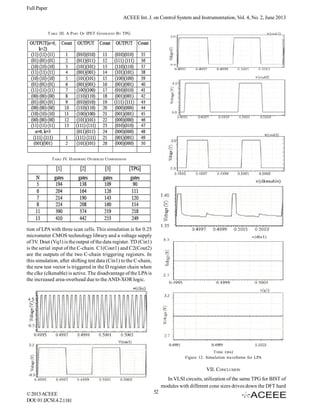
Reduction in test-vector length, results in reduced testtime and test-power. Test-length depends on cone-size, regardless of the VLSI network size. From the generated patterns depicted in Table. III, it can be inferred that, identical
test patterns are generated with different cone size depending on the value of E[k]. This leads to variations in the degree
of parallelism for testing. Hence the TPG can be used to test
systems with varying cone-sizes, thus easily varying the
degree of parallelism for testing.
only affect the XOR gate. This causes a small number of
transitions at the data register outputs and hence low test
power dissipation in the CUT. As most flip-flops provide
both Q and its complement Q0, XOR functionality can be
provided by using two transistors in a pass transistor-based
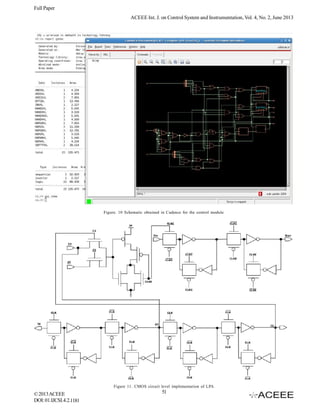
structure (refer Fig. 11). The effects of this implementation
on power consumption are negligible due to pass-transistor
based structure. As shown in Fig. 11, the logic required for
providing the enable signal (clke) signal requires only six
transistors.
Testing a delay fault requires the application of different
vectors at two consecutive clocks. Unlike the conventional
scan cells, the LPA architecture allows the at-speed
application of arbitrary vector pairs to the CUT in two
consecutive clocks, resulting in testing of delay faults. This
is accomplished as follows: Assume that the test generated
for a delay fault includes the vector pair (V1,V2). First, the DR
chain is loaded with V1. Then, the difference vector TD that
is required for changing the D vector V1 to V2 is shifted into
the C- chain. At the next clock edge, the D vector V1 is
changed to V2. Furthermore, C-chain hardware is designed
to take advantage of similar adjacent test data. Reconstruction
of the original test vectors from the difference information is
possible using the LPA. Consequently, this attribute makes
the architecture suitable for algorithms that are based on
compressing test vectors. LPA can reduce test time and power
in conjunction with test reformatting techniques. Test data
compression can additionally decrease test time and memory
requirements.
TABLE II. TEST-LENGTH C OMPARISIONS
The control module is designed by representing its
functionality using a finite state machine (FSM). Design entry
in done by a behavioral description of its functionality using
verilog hardware description language (VHDL). Synthesis
and optimization for different values of „n is carried out
using Cadence Encounter tool. Carry generator module is
VI. SIMULATION ENVIRONMENT AND RESULTS
The discussed architectures are synthesized using Cadence encounter tool and technology mapping is done based
© 2013 ACEEE
DOI: 01.IJCSI.4.2.1181
48](https://image.slidesharecdn.com/1181-131205004201-phpapp02/85/Optimal-and-Power-Aware-BIST-for-Delay-Testing-of-System-On-Chip-4-320.jpg)
![Full Paper
ACEEE Int. J. on Control System and Instrumentation, Vol. 4, No. 2, June 2013
Figure 4. Generation of control signals
Figure. 5 Generation of IPET patterns
Figure 6. Signature obtained for s27 benchmark circuit with stuck-at-1 fault
Figure 7. Signature obtained for fault free s27 benchmark circuit
designed with ‘n’ AND gates and an OR gate. Design of ‘m to
n’ decoder and ‘m’ stage counter is done with ‘2n’ gates with
‘m’ D flip-flops. Selective counter design is obtained by
modifying D-registers in the data-path with ‘n’ 2:1 multiplexers
© 2013 ACEEE
DOI: 01.IJCSI.4.2.1181
and ‘2n’ OR gates [3]. The RTL schematics of the synthesized
modules and simulation results are shown in Fig. 3-6.
Very few IPET generators are proposed for hardware
overhead comparisons. Hence, one option is to multiplex the
outputs of two pseudo-exhaustive one-pattern generators
49](https://image.slidesharecdn.com/1181-131205004201-phpapp02/85/Optimal-and-Power-Aware-BIST-for-Delay-Testing-of-System-On-Chip-5-320.jpg)
![Full Paper
ACEEE Int. J. on Control System and Instrumentation, Vol. 4, No. 2, June 2013
Figure.8 RTL schematic of selective counter
Figure 9. FPGA implementation of control module
hensive fault coverage can be obtained. The BIST logic
ceases to exist when the circuit is reconfigured for its normal
system function. Thus, testability can be achieved without
any area overhead or performance degradation.
The proposed LPA does not increase the delay during
normal operation during delay fault testing. The generated
test vectors are applied to s27 benchmark circuit and the
output of CUT is applied to a signature analyzer. From the
generated signature, any stuck-at-faults in the CUT can be
identified. From the simulation results shown in Fig. 6 and
Fig. 7, the difference in signature for fault-free and fault injected circuit is observed. Fig. 12 and Fig. 13 show the TSPICE
simulation waveforms obtained from the CMOS implementa-
proposed in [1] and [2]. Hardware overhead comparisons are
made assuming that XOR gate consists of 4-gate equivalents,
D-flip-flop consists of 8-gate equivalents and multiplexer
consists of 3-gate equivalents.
From Table IV, it can be concluded that compared with
pre-existing works, there is a reduction in hardware overhead
for the proposed TPG design. Datapath based TPG is realized
on target device Spartan 6E field programmable gate array
(FPGA).The synthesis results shows very less device utilization. Hence, this TPG can aid the BIST of FPGA systems.
The reprogramability of FPGAs can be utilized to create the
BIST logic. The FPGA can be configured as parallel 1-D iterative logic arrays (ILA). By repeated reconfiguration, compre
© 2013 ACEEE
DOI: 01.IJCSI.4.2.1181
50](https://image.slidesharecdn.com/1181-131205004201-phpapp02/85/Optimal-and-Power-Aware-BIST-for-Delay-Testing-of-System-On-Chip-6-320.jpg)
![Full Paper
ACEEE Int. J. on Control System and Instrumentation, Vol. 4, No. 2, June 2013
[2] J. Rajski and J. Tyszer, “Recursive pseudoexhaustive test
pattern generation,” IEEE Trans. Comput., vol. 42, no. 12,
pp. 1517–1521, December 1993.
[3] I. Voyiatzis, D. Gizopoulos and A. Paschalis, “Recursive
Pseudo-Exhaustive Two-Pattern Generation,” IEEE
transactions on very large scale integration (VLSI) systems,
vol. 18, no. 1, January 2010.
[4] P. Girard, “Survey of Low-Power Testing of VLSI Circuits,”
IEEE Design and Test of Computers, vol. 19, pp. 80–90, June
2002.
[5] N. Badereddine, P. Girard, S. Pravossoudovitch, C. Landrault,
and A. Virazel, “Minimizing Peak Power Consumption during
Scan Testing: Test Pattern Modification with X Filling
Heuristics,” in Proc. Int. Conf.on Design and Test of Integrated
Systems in Nanoscale Technology, pp. 359–364, September
2006.
[6] P Shanmugasundaram and V. D. Agrawal, “Dynamic Scan
Clock Control in BIST Circuits,” Proc. 2 nd IEEE Int. Conf.on
Reliability Aware System Design and Test of Integrated
Systems, pp. 25-30, January 2011.
[7] K. Kumar, S.U. Bhaskar, P.S. Chattopadhyay, P. Mandal,
“Circuit Partitioning using Particle Swarm Optimization for
Pseudo-Exhaustive Testing,” Proc. IEEE Int. Conf. Advances
in Recent Technologies in Communication and Computing,
pp. 346-350, 2009
[8] I. Voyiatzis, A. Paschalis, D. Nikolos, and C. Halatsis,
“Accumulator-Based BIST Approach for Two-pattern
Testing,” Journal of Electronic Testing Theory and
Applications, vol. 15, no. 3, pp. 267-278, December 1999.
[9] M. Hosseinabady, S. Sharifi, F. Lombardi, Z. Navabi, “A
Selective Trigger Scan Architecture for VLSI Testing,” IEEE
Transactions on Computers. 57, 316—328, 2008.
Figure13. Power results obtained for Low Power Architecture
ware overhead and DFT cost. The datapath based TPG presented in the current paper provides optimal fault coverage,
at-speed parallel testing, reduction in hardware overhead
and reduction in test time. In the future, this TPG will be
used to aid the design of fault tolerant self-checking VLSI
systems. The implementation of LPA for delay testing proves
its improved performance in terms of test time and test power.
In the future, the LPA performance will be improvised by
applying efficient compression algorithms to the test data
vectors.
REFERENCES
[1] P. Dasgupta, S. Chattopadhyay, P. P. Chaudhuri, and I.
Sengupta, “Cellular automata-based recursive pseudoexhaustive test pattern generation,” IEEE Trans. Comput.,
vol. 50, no. 2, pp. 177–185, February 2001.
© 2013 ACEEE
DOI: 01.IJCSI.4.2.1181
53](https://image.slidesharecdn.com/1181-131205004201-phpapp02/85/Optimal-and-Power-Aware-BIST-for-Delay-Testing-of-System-On-Chip-9-320.jpg)


![[8] implementation of pmsm servo drive using digital signal processing](https://cdn.slidesharecdn.com/ss_thumbnails/8implementationofpmsmservodriveusingdigitalsignalprocessing-200723180820-thumbnail.jpg?width=640&height=640&fit=bounds)


