HSC Physics
9.3 Motors and Generators
Faraday’s Law
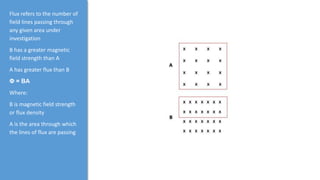
Flux refers to the number of
field lines passing through
any given area under
investigation
B has a greater magnetic
field strength than A
A has greater flux than B
Φ = BA
Where:
B is magnetic field strength
or flux density
A is the area through which
the lines of flux are passing
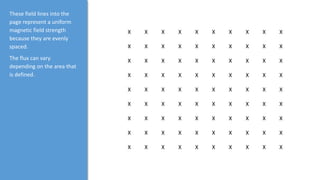
These field lines into the
page represent a uniform
magnetic field strength
because they are evenly
spaced.
The flux can vary
depending on the area that
is defined.
X X X X X X X X X X
X X X X X X X X X X
X X X X X X X X X X
X X X X X X X X X X
X X X X X X X X X X
X X X X X X X X X X
X X X X X X X X X X
X X X X X X X X X X
X X X X X X X X X X
Faraday’s Experiment
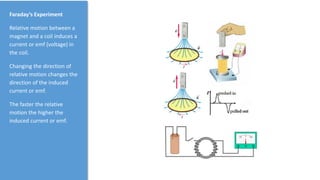
Relative motion between a
magnet and a coil induces a
current or emf (voltage) in
the coil.
Changing the direction of
relative motion changes the
direction of the induced
current or emf.
The faster the relative
motion the higher the
induced current or emf.
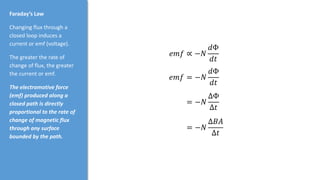
Faraday’s Law
Changing flux through a
closed loop induces a
current or emf (voltage).
The greater the rate of
change of flux, the greater
the current or emf.
The electromotive force
(emf) produced along a
closed path is directly
proportional to the rate of
change of magnetic flux
through any surface
bounded by the path.
𝑒𝑚𝑓 ∝ −𝑁
𝑑Φ
𝑑𝑡
𝑒𝑚𝑓 = −𝑁
𝑑Φ
𝑑𝑡
= −𝑁
ΔΦ
Δ𝑡
= −𝑁
Δ𝐵𝐴
Δ𝑡
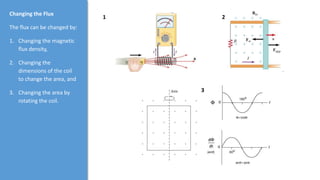
Changing the Flux
The flux can be changed by:
1. Changing the magnetic
flux density,
2. Changing the
dimensions of the coil
to change the area, and
3. Changing the area by
rotating the coil.
1 2
3
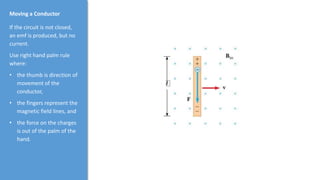
Moving a Conductor
If the circuit is not closed,
an emf is produced, but no
current.
Use right hand palm rule
where:
• the thumb is direction of
movement of the
conductor,
• the fingers represent the
magnetic field lines, and
• the force on the charges
is out of the palm of the
hand.

Presentation 93C1 - Faraday's Law

  • 1.
    HSC Physics 9.3 Motorsand Generators Faraday’s Law
  • 2.
    Flux refers tothe number of field lines passing through any given area under investigation B has a greater magnetic field strength than A A has greater flux than B Φ = BA Where: B is magnetic field strength or flux density A is the area through which the lines of flux are passing
  • 3.
    These field linesinto the page represent a uniform magnetic field strength because they are evenly spaced. The flux can vary depending on the area that is defined. X X X X X X X X X X X X X X X X X X X X X X X X X X X X X X X X X X X X X X X X X X X X X X X X X X X X X X X X X X X X X X X X X X X X X X X X X X X X X X X X X X X X X X X X X X
  • 4.
    Faraday’s Experiment Relative motionbetween a magnet and a coil induces a current or emf (voltage) in the coil. Changing the direction of relative motion changes the direction of the induced current or emf. The faster the relative motion the higher the induced current or emf.
  • 5.
    Faraday’s Law Changing fluxthrough a closed loop induces a current or emf (voltage). The greater the rate of change of flux, the greater the current or emf. The electromotive force (emf) produced along a closed path is directly proportional to the rate of change of magnetic flux through any surface bounded by the path. 𝑒𝑚𝑓 ∝ −𝑁 𝑑Φ 𝑑𝑡 𝑒𝑚𝑓 = −𝑁 𝑑Φ 𝑑𝑡 = −𝑁 ΔΦ Δ𝑡 = −𝑁 Δ𝐵𝐴 Δ𝑡
  • 6.
    Changing the Flux Theflux can be changed by: 1. Changing the magnetic flux density, 2. Changing the dimensions of the coil to change the area, and 3. Changing the area by rotating the coil. 1 2 3
  • 7.
    Moving a Conductor Ifthe circuit is not closed, an emf is produced, but no current. Use right hand palm rule where: • the thumb is direction of movement of the conductor, • the fingers represent the magnetic field lines, and • the force on the charges is out of the palm of the hand.