Zoltan Juhasz, M.D.


                      1
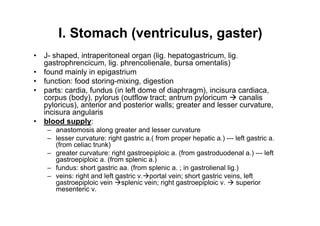
I. Stomach (ventriculus, gaster)
J- shaped, intraperitoneal organ (lig. hepatogastricum, lig.
gastrophrencicum, lig. phrencolienale, bursa omentalis)
found mainly in epigastrium
function: food storing-mixing, digestion
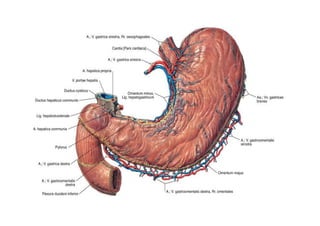
parts: cardia, fundus (in left dome of diaphragm), incisura cardiaca,
corpus (body), pylorus (outflow tract; antrum pyloricum      canalis
pyloricus), anterior and posterior walls; greater and lesser curvature,
incisura angularis
blood supply:
   anastomosis along greater and lesser curvature
   lesser curvature: right gastric a.( from proper hepatic a.) --- left gastric a.
   (from celiac trunk)
   greater curvature: right gastroepiploic a. (from gastroduodenal a.) --- left
   gastroepiploic a. (from splenic a.)
   fundus: short gastric aa. (from splenic a. ; in gastrolienal lig.)
   veins: right and left gastric v. portal vein; short gastric veins, left
   gastroepiploic vein splenic vein; right gastroepiploic v.        superior
   mesenteric v.
                                                                                     2
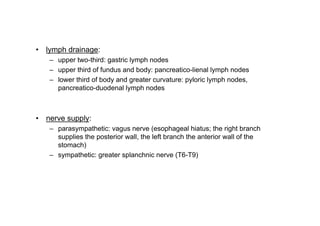
lymph drainage:
   upper two-third: gastric lymph nodes
   upper third of fundus and body: pancreatico-lienal lymph nodes
   lower third of body and greater curvature: pyloric lymph nodes,
   pancreatico-duodenal lymph nodes


nerve supply:
   parasympathetic: vagus nerve (esophageal hiatus; the right branch
   supplies the posterior wall, the left branch the anterior wall of the
   stomach)
   sympathetic: greater splanchnic nerve (T6-T9)


                                                                           3
4
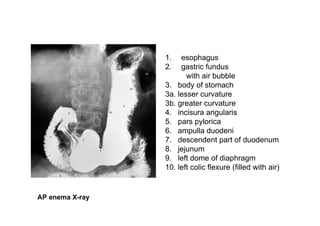
1.   esophagus
                 2.   gastric fundus
                        with air bubble
                 3. body of stomach
                 3a. lesser curvature
                 3b. greater curvature
                 4. incisura angularis
                 5. pars pylorica
                 6. ampulla duodeni
                 7. descendent part of duodenum
                 8. jejunum
                 9. left dome of diaphragm
                 10. left colic flexure (filled with air)


AP enema X-ray
                                                        5
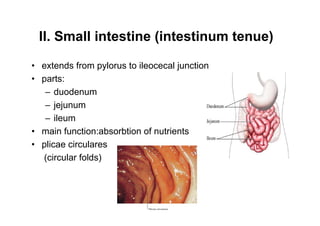
II. Small intestine (intestinum tenue)

extends from pylorus to ileocecal junction
parts:
    duodenum
    jejunum
    ileum
main function:absorbtion of nutrients
plicae circulares
(circular folds)


                                             6
1. Duodenum
the first and shortest segment of small intestine
surround in C-shape the head of pancreas
most of duodenum is attached to the posterior abdominal wall by the
peritoneum, partly retroperitoneal
parts:
    superior horizontal part (intraperitoneal, hepatoduodenal lig.; omental/epiploic
    foramen of Winslow; at the level of L1)
    descendent part (7-10 cm; major duodenal papilla of Vater- m.sphincter Oddi ;
    minor duodenal papilla; L1-L3)
    inferior horizontal part (6-8 cm; L3)
    ascendent part (5 cm; L3 L2; ligament of Treitz= m. suspensorius duodeni)
    duoudeno-jejunal flexure (L2)
blood supply:
    gastroduodenal a. (from common hepatic a.) superior pancreatico-duodenal a.; inferior
    pancreatico- duodenal a. (from superior mesenteric a.) anastomosis between them
    venous drainage: superior mesenteric v. and splenic vein

lymph drainage: pancreatico-duodenal,- pyloric, - mesenteric supp., -celiac lymph nodes

nerve suppply: celiac plexus, superior mesenteric plexus (psy.: vagus n., sy.: greater and lesser
splanchnic nerves)

                                                                                                    7
2. Jejunum and ileum
altogether 6-7 m in length
main part of ileum lies in the right lower quadrant of abdomen, the last part is
in the pelvis
intraperitoneal (mesenterium- root of mesenterium;at the level of L2,
vessels, nerves,lymphatics, fat)
blood supply : branches of superior mesenteric artery: ileal et jejunal aa.;
superior mesenteric v. (with the splenic vein it forms the portal vein)
lymph drainage: mesenteric and ileocolic lymph nodes
nerve supply: vagus n., greater and lesser splanchnic nerves
   presynaptic sympathic fibers synape in celiac and inferior mesenteric ganglion
   presynaptic parasympathic fibers synapse in myenteric and submucous plexus
   visceral afferent sensory fibers- PAIN (distension of intestine wall -- colic:abdominal pain with
   spasm)


                                                                                                 8
9
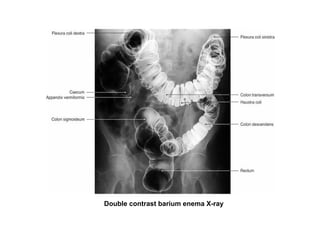
Double contrast barium enema X-ray   10
III. Large intestine
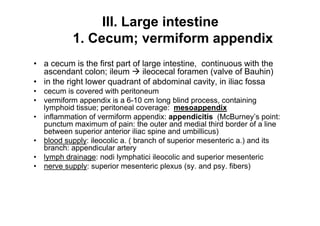
        1. Cecum; vermiform appendix
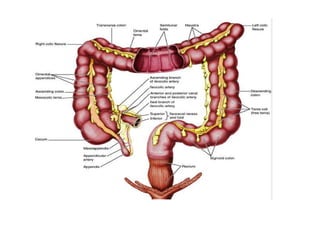
a cecum is the first part of large intestine, continuous with the
ascendant colon; ileum       ileocecal foramen (valve of Bauhin)
in the right lower quadrant of abdominal cavity, in iliac fossa
cecum is covered with peritoneum
vermiform appendix is a 6-10 cm long blind process, containing
lymphoid tissue; peritoneal coverage: mesoappendix
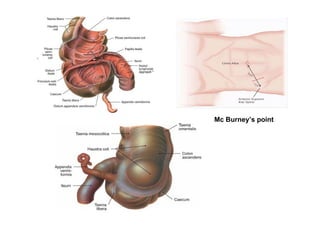
inflammation of vermiform appendix: appendicitis (McBurney s point:
punctum maximum of pain: the outer and medial third border of a line
between superior anterior iliac spine and umbillicus)
blood supply: ileocolic a. ( branch of superior mesenteric a.) and its
branch: appendicular artery
lymph drainage: nodi lymphatici ileocolic and superior mesenteric
nerve supply: superior mesenteric plexus (sy. and psy. fibers)


                                                                    11
Mc Burney s point


                    12
2. Ascendent colon
extends from cecum to right lobe of liver when it turns
left: left colic flexure
only the anterior and lateral part is covered by
peritoneum
blood supply: right colic a., ileocolic a., middle colic a.
(arcade anastomosis)- marginal a.; right colic v.,
ileocolic v. superior mesenteric vein
lymph drainage: paracolic-, epicolic-, ileocolic-,
superior mesenteric lymph nodes
innervation: superior mesenteric plexus
                                                       13
3.Transverse colon
 45 cm in length, right colic flexure     left colic flexure
 phrenicocolic lig., phrenicolienal lig., gastrocolic lig.
intraperitoneal (transverse mesocolon)
blood supply: middle colic a. , right and left colic arteries
(anastomosis); superior mesenteric vein
lymph drainage: superior mesenteric lymph nodes
innervation: superior mesenteric plexus (sympathetic,
parasympathetic and visceral afferent fibers)


                4. Descendent colon

secondarily retroperitoneal (peritoneal coverage anteriorly and
laterally)
left colic flexure left iliac fossa, continuous with sigmoid colon

                                                                     14
4. Sigmoid colon

40 cm in length, S-shaped
extends from iliac fossa to S3 segment, where it joins rectum
15 cm before anus taenias disappear, this is the rectosigmoideal
junction
intraperitoneal- mesosigmoid
blood supply: left colic a. and sigmoid a. (from inferior mesenteric
a.); inferior mesenteric vein
lymph drainage: intermedial colic and superior mesenteric lymph
nodes
nerve supply:
   sympathetic: aortic plexus, superior mesenteric plexus
   parasympathetic: pelvic splanchnical nerves- inferior hypogastric plexus
   a visceral afferent fibers run together with the autonomic fibers


                                                                         15
slightly S-shaped
sacral flexure, perineal flexure
anal canal, rectal ampulla
upper third intraperitoneal, middle third
retroperitoneal, lower third infraperitoneal
 rectovesical/rectouterine pouch (cavity of
Douglas)
in males the prostate and seminal vesicles, in
females the vagina can be palpated through
the rectum (rectal digital examination)      16
blood supply: superior rectal a. (from inferior mesenteric a.),
middle rectal a. (from internal iliac a.), inferior rectal a. (from
internal pudendal a.)- anastomosis
venous drainage: portosystemic anastomosis;v. superior
rectal v. portal vein; middle and inferior rectal v. inferior
vena cava
clinical importance: absorption of medicines from rectum is
more effective as it avoids the liver; rich submucosal venous
plexuses- dilatation and protrusion: haemorrhoidal nodes
 lymph drainage: pararectal and sacral lymph nodes
lymph nodes around aorta and IVC
nerve supply: inferior hypogatric plexus/pelvic nn.,
anus: m. sphincter ani internus (smooth muscle) and
externus (striated muscle), m. levator ani (striated)


                                                               17

10e stomach

  • 1.
  • 2.
    I. Stomach (ventriculus,gaster) J- shaped, intraperitoneal organ (lig. hepatogastricum, lig. gastrophrencicum, lig. phrencolienale, bursa omentalis) found mainly in epigastrium function: food storing-mixing, digestion parts: cardia, fundus (in left dome of diaphragm), incisura cardiaca, corpus (body), pylorus (outflow tract; antrum pyloricum canalis pyloricus), anterior and posterior walls; greater and lesser curvature, incisura angularis blood supply: anastomosis along greater and lesser curvature lesser curvature: right gastric a.( from proper hepatic a.) --- left gastric a. (from celiac trunk) greater curvature: right gastroepiploic a. (from gastroduodenal a.) --- left gastroepiploic a. (from splenic a.) fundus: short gastric aa. (from splenic a. ; in gastrolienal lig.) veins: right and left gastric v. portal vein; short gastric veins, left gastroepiploic vein splenic vein; right gastroepiploic v. superior mesenteric v. 2
  • 3.
    lymph drainage: upper two-third: gastric lymph nodes upper third of fundus and body: pancreatico-lienal lymph nodes lower third of body and greater curvature: pyloric lymph nodes, pancreatico-duodenal lymph nodes nerve supply: parasympathetic: vagus nerve (esophageal hiatus; the right branch supplies the posterior wall, the left branch the anterior wall of the stomach) sympathetic: greater splanchnic nerve (T6-T9) 3
  • 4.
  • 5.
    1. esophagus 2. gastric fundus with air bubble 3. body of stomach 3a. lesser curvature 3b. greater curvature 4. incisura angularis 5. pars pylorica 6. ampulla duodeni 7. descendent part of duodenum 8. jejunum 9. left dome of diaphragm 10. left colic flexure (filled with air) AP enema X-ray 5
  • 6.
    II. Small intestine(intestinum tenue) extends from pylorus to ileocecal junction parts: duodenum jejunum ileum main function:absorbtion of nutrients plicae circulares (circular folds) 6
  • 7.
    1. Duodenum the firstand shortest segment of small intestine surround in C-shape the head of pancreas most of duodenum is attached to the posterior abdominal wall by the peritoneum, partly retroperitoneal parts: superior horizontal part (intraperitoneal, hepatoduodenal lig.; omental/epiploic foramen of Winslow; at the level of L1) descendent part (7-10 cm; major duodenal papilla of Vater- m.sphincter Oddi ; minor duodenal papilla; L1-L3) inferior horizontal part (6-8 cm; L3) ascendent part (5 cm; L3 L2; ligament of Treitz= m. suspensorius duodeni) duoudeno-jejunal flexure (L2) blood supply: gastroduodenal a. (from common hepatic a.) superior pancreatico-duodenal a.; inferior pancreatico- duodenal a. (from superior mesenteric a.) anastomosis between them venous drainage: superior mesenteric v. and splenic vein lymph drainage: pancreatico-duodenal,- pyloric, - mesenteric supp., -celiac lymph nodes nerve suppply: celiac plexus, superior mesenteric plexus (psy.: vagus n., sy.: greater and lesser splanchnic nerves) 7
  • 8.
    2. Jejunum andileum altogether 6-7 m in length main part of ileum lies in the right lower quadrant of abdomen, the last part is in the pelvis intraperitoneal (mesenterium- root of mesenterium;at the level of L2, vessels, nerves,lymphatics, fat) blood supply : branches of superior mesenteric artery: ileal et jejunal aa.; superior mesenteric v. (with the splenic vein it forms the portal vein) lymph drainage: mesenteric and ileocolic lymph nodes nerve supply: vagus n., greater and lesser splanchnic nerves presynaptic sympathic fibers synape in celiac and inferior mesenteric ganglion presynaptic parasympathic fibers synapse in myenteric and submucous plexus visceral afferent sensory fibers- PAIN (distension of intestine wall -- colic:abdominal pain with spasm) 8
  • 9.
  • 10.
    Double contrast bariumenema X-ray 10
  • 11.
    III. Large intestine 1. Cecum; vermiform appendix a cecum is the first part of large intestine, continuous with the ascendant colon; ileum ileocecal foramen (valve of Bauhin) in the right lower quadrant of abdominal cavity, in iliac fossa cecum is covered with peritoneum vermiform appendix is a 6-10 cm long blind process, containing lymphoid tissue; peritoneal coverage: mesoappendix inflammation of vermiform appendix: appendicitis (McBurney s point: punctum maximum of pain: the outer and medial third border of a line between superior anterior iliac spine and umbillicus) blood supply: ileocolic a. ( branch of superior mesenteric a.) and its branch: appendicular artery lymph drainage: nodi lymphatici ileocolic and superior mesenteric nerve supply: superior mesenteric plexus (sy. and psy. fibers) 11
  • 12.
    Mc Burney spoint 12
  • 13.
    2. Ascendent colon extendsfrom cecum to right lobe of liver when it turns left: left colic flexure only the anterior and lateral part is covered by peritoneum blood supply: right colic a., ileocolic a., middle colic a. (arcade anastomosis)- marginal a.; right colic v., ileocolic v. superior mesenteric vein lymph drainage: paracolic-, epicolic-, ileocolic-, superior mesenteric lymph nodes innervation: superior mesenteric plexus 13
  • 14.
    3.Transverse colon 45cm in length, right colic flexure left colic flexure phrenicocolic lig., phrenicolienal lig., gastrocolic lig. intraperitoneal (transverse mesocolon) blood supply: middle colic a. , right and left colic arteries (anastomosis); superior mesenteric vein lymph drainage: superior mesenteric lymph nodes innervation: superior mesenteric plexus (sympathetic, parasympathetic and visceral afferent fibers) 4. Descendent colon secondarily retroperitoneal (peritoneal coverage anteriorly and laterally) left colic flexure left iliac fossa, continuous with sigmoid colon 14
  • 15.
    4. Sigmoid colon 40cm in length, S-shaped extends from iliac fossa to S3 segment, where it joins rectum 15 cm before anus taenias disappear, this is the rectosigmoideal junction intraperitoneal- mesosigmoid blood supply: left colic a. and sigmoid a. (from inferior mesenteric a.); inferior mesenteric vein lymph drainage: intermedial colic and superior mesenteric lymph nodes nerve supply: sympathetic: aortic plexus, superior mesenteric plexus parasympathetic: pelvic splanchnical nerves- inferior hypogastric plexus a visceral afferent fibers run together with the autonomic fibers 15
  • 16.
    slightly S-shaped sacral flexure,perineal flexure anal canal, rectal ampulla upper third intraperitoneal, middle third retroperitoneal, lower third infraperitoneal rectovesical/rectouterine pouch (cavity of Douglas) in males the prostate and seminal vesicles, in females the vagina can be palpated through the rectum (rectal digital examination) 16
  • 17.
    blood supply: superiorrectal a. (from inferior mesenteric a.), middle rectal a. (from internal iliac a.), inferior rectal a. (from internal pudendal a.)- anastomosis venous drainage: portosystemic anastomosis;v. superior rectal v. portal vein; middle and inferior rectal v. inferior vena cava clinical importance: absorption of medicines from rectum is more effective as it avoids the liver; rich submucosal venous plexuses- dilatation and protrusion: haemorrhoidal nodes lymph drainage: pararectal and sacral lymph nodes lymph nodes around aorta and IVC nerve supply: inferior hypogatric plexus/pelvic nn., anus: m. sphincter ani internus (smooth muscle) and externus (striated muscle), m. levator ani (striated) 17