Dr. NDAYISABA CORNEILLE
CEO of CHG
MBChB,DCM,BCSIT,CCNA
Supported BY
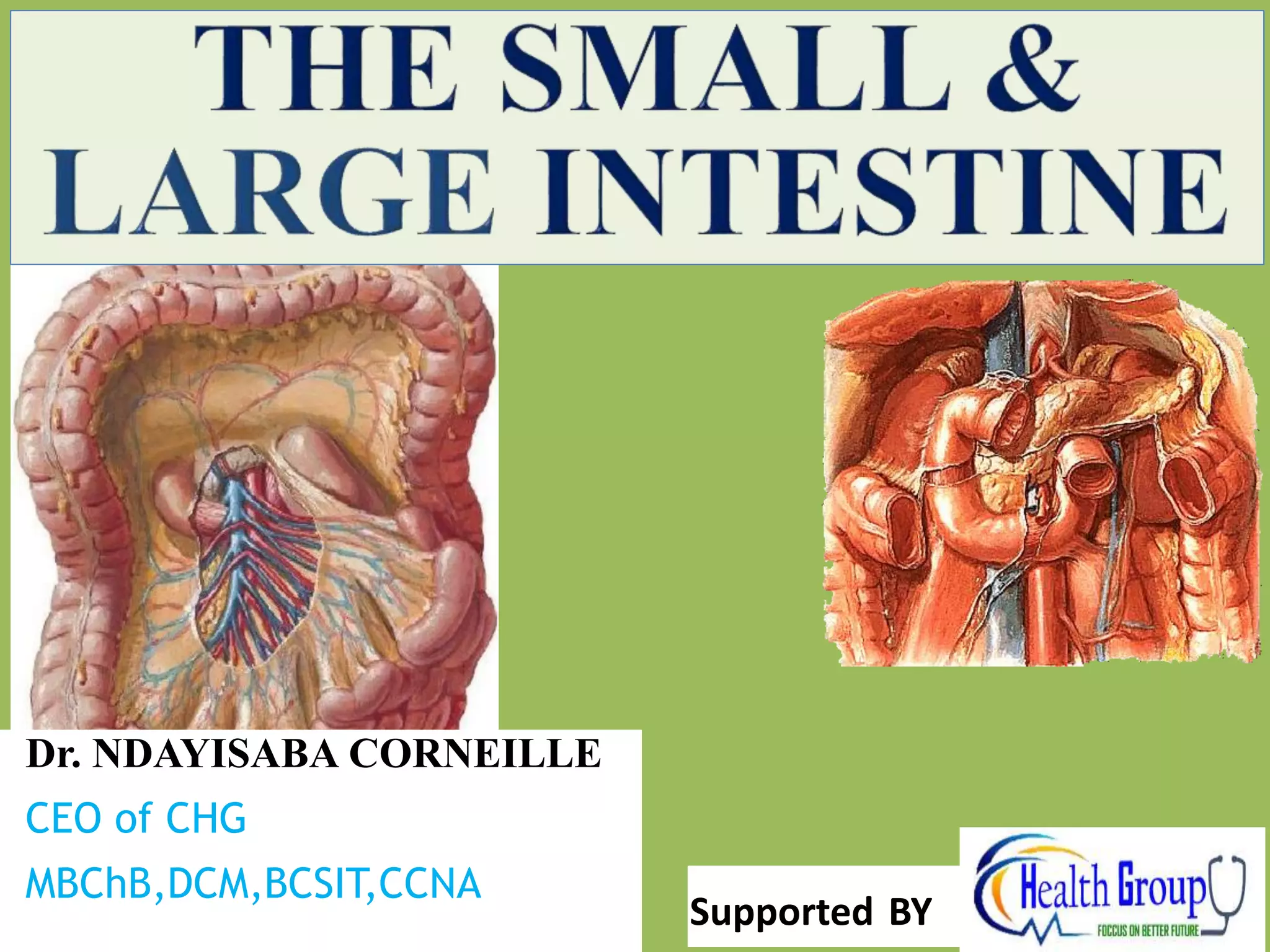
SMALL INTESTINE
• The small intestine is the part of the
alimentary canal that is continuous with the
stomach at the pyloric orifice and leads into
the large intestine through the iliocaecal valve.
It is the part where the chemical digestion of
food is completed and most of the absorption
of nutrients take place.
Dr Ndayisaba Corneille 2
LOCATION
• It is found lying mainly at the
central and lower part of the
abdomen cavity mostly within
the colonic loop where it lies
post to the greater omentum
and anterior abdominal wall. It
also extends into the pelvic
region where it lies anterior to
the rectum.
Dr Ndayisaba Corneille 3
Length
• The length of the small intestine varies between
6-7m but on the average it is about 5m in a living
adult.
Dr Ndayisaba Corneille 4
Histology of the Small Intestine
• Unlike the stomach
the small intestine has
four (4) basic coats:
 Serosa
 Muscularis External
 Submucosa
• Mucosa
Dr Ndayisaba Corneille 5
SUBDIVISION
• The small
intestine is
divided in to three
parts:
• The duodenum
• The Jejunum
• The Ileum
Dr Ndayisaba Corneille 6
THE DUODENUM
• Historically the duodenum is a Latin
word that is derived from a Greek
word that signifies 12 because it was
believed that the length of the
duodenum is about 12 fingers
breadth. The duodenum is actually
25cm in length
• The duodenum is the shortest, most
fixed and dilated proximal part of
Small intestine.
• And lies above the umbilicus opposite
to 1, 2 & 3rd Lumbar Vertebrae
Dr Ndayisaba Corneille 7
It is devoid of mesentery and it is fixed to
posterior abdominal Wall.
It curved around head of pancreas in a C –
shaped curvature
It receives Bile duct and pancreatic duct.
Dr Ndayisaba Corneille 8
1
2
3
Dr Ndayisaba Corneille 9
The subdivided parts does not have any
anatomical demarcating landmarks, they
are named base on position. The parts
include:
First / upper part – 5 cm
Second / vertical part – 7.5 cm
Third / horizontal part – 10 cm
Fourth / ascending part – 2.5 cm
1st
2nd
Dr Ndayisaba Corneille 10
Dr Ndayisaba Corneille 11
a) The first part is the most movable part
b) It is devoid of circular mucous fold which is
present in other parts of the small
intestine.
c) Seen as duodenal cap / Bulb
in Radiographs.
d) In the submucosa are present numerous
Brunner’s gland which secrets mucus that
protect its wall from the acidic content of
the chyme discharged from the stomach
e) Supplied by end arteries
f) May be affected by peptic ulcer
Dr Ndayisaba Corneille 12
Begins at superior duodenal flexure
opposite the L1 vertebra
passes vertically downwards and ends
at inferior duodenal flexure where
it continues with the 3rd part
opposite the Lower border of L3
- it lies in front of hilum of Right
Kidney
- along right Side of vertebral column
in paravertebral gutter
Rt. Lat. Plane
Dr Ndayisaba Corneille 13
Here marks the commencement of a unique
Circular folds in the small intestine known as
the Plica Circularis – Permanent, circular &
thick.
Major duodenal papilla is present
(on posteromedial wall of 2nd part
10 cm distal to pylorus)
It is the opening of the combine ducts of the
Bile duct & pancreatic ducts (Ampulla of
vater)
Minor duodenal papilla
2 cms above major papilla is also present
another smaller papilla for the opening of the
Accessory pancreatic duct opens
Dr Ndayisaba Corneille 14
Extends from inferior Duodenal
flexure in front of aorta at L3
level
Relations - Anteriorly : it is
Covered by peritoneum except
at the point of attachment of
root of mesentery of the Small
intestine
Anterior Surface is crossed by
Superior Mesenteric vessels
and root of mesentery
Dr Ndayisaba Corneille 15
Extends from front of aorta to
Duodeno-jejunal flexure, which is
situated on the left side of L2 about
1.25 cm below transpyloric plan and
2.5 cms to left of median plane
Kept in position by suspensory muscle
of Duodenum (Ligament of Trezt)
Relations Anteriorly :
Covered with peritoneum.
Related to transverse colon and its
mesocolon
PosteroInferiorly it is separated from the
Surface of stomach by the lesser sac
Dr Ndayisaba Corneille 16
Dr Ndayisaba Corneille 17
Most of the duodenum except 1st part is supplied by
Ventral and dorsal anastomoses of Superior & Inferior Pancreaticoduodenal
arteries.
Vasa Recta arises and supply adjacent areas of duodenum and head of pancreas
Dr Ndayisaba Corneille 18
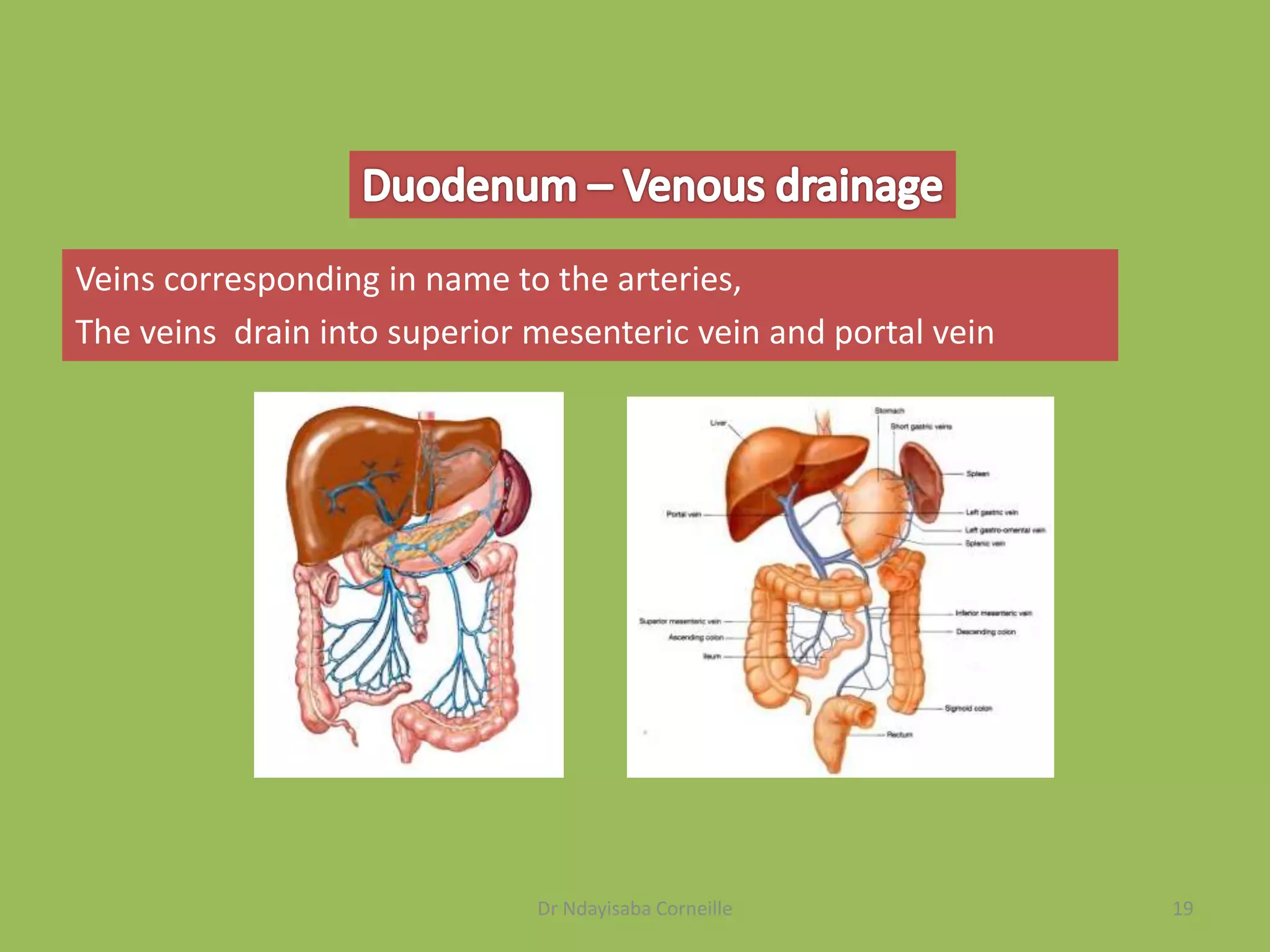
Veins corresponding in name to the arteries,
The veins drain into superior mesenteric vein and portal vein
Dr Ndayisaba Corneille 19
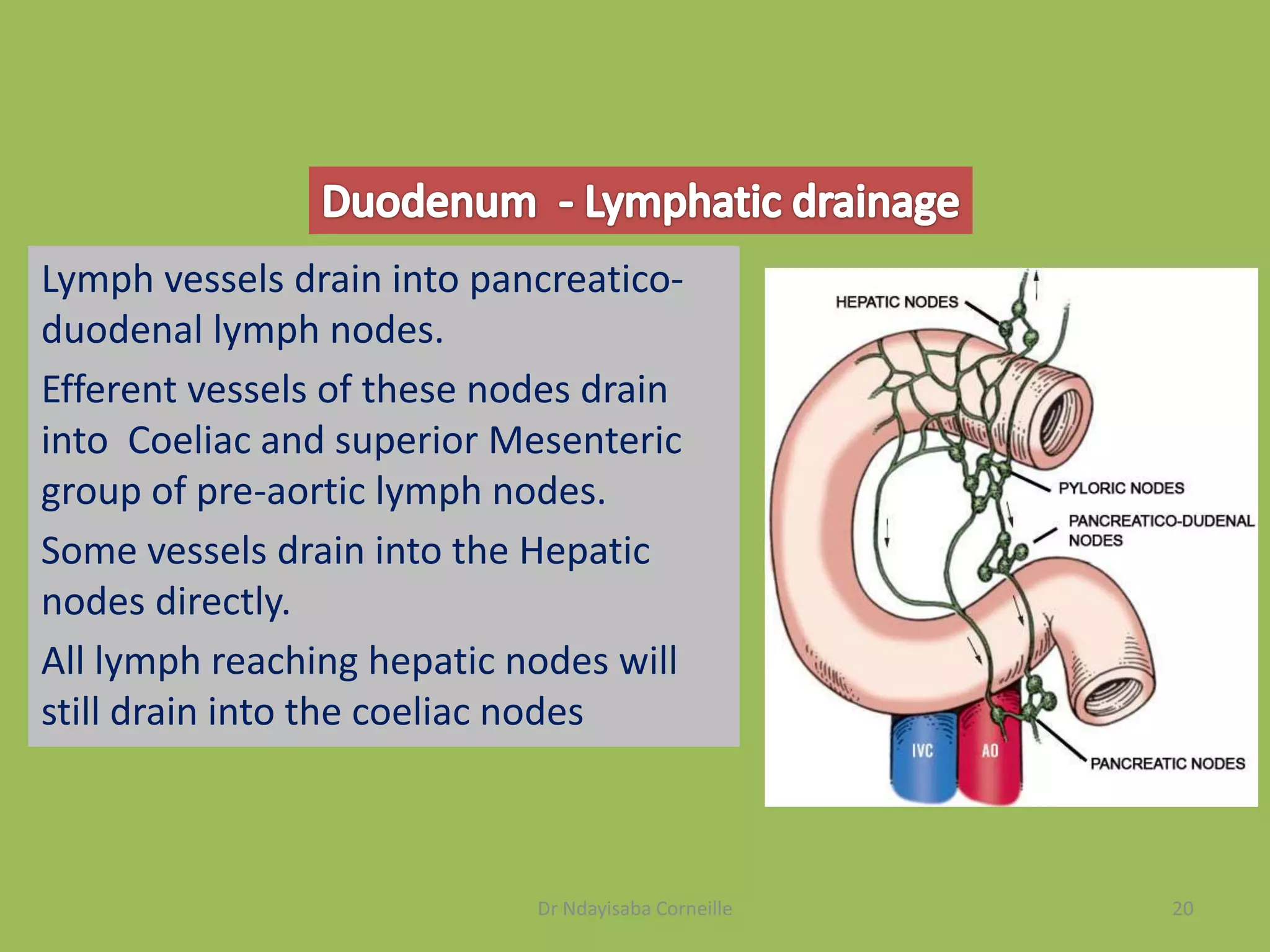
Lymph vessels drain into pancreatico-
duodenal lymph nodes.
Efferent vessels of these nodes drain
into Coeliac and superior Mesenteric
group of pre-aortic lymph nodes.
Some vessels drain into the Hepatic
nodes directly.
All lymph reaching hepatic nodes will
still drain into the coeliac nodes
Dr Ndayisaba Corneille 20
APPLIED ANATOMY of the duodenum
• Cancer of the duodenum could be very severe and sometimes
could not be easily controlled as a result of the numerous
venous and lymphatic channels that exist between the
duodenum and post abdominal wall.
• Duodenal ulcer: The duodenum especially the superior part
(duodenal cap) is most prone to peptic ulceration and its
frequency is about four times higher than gastric ulceration.
• Superior mesenteric syndrome: Based on the relation of the
superior mesenteric artery to the anterior and superior part of
the horizontal part of the duodenum. It could sometimes leads
to compression of the duodenum which will lead to
obstruction.
Dr Ndayisaba Corneille 21
THE JEJUNUM AND THE ILEUA
• This remaining part of the small
intestine is mainly involved in the
absorption of digested nutrients and
fluid from the chyme as a result it is
involved in the conservation of fluid
• it is made up of series of coils that are
attached to the posterior abdominal
wall by a double layer of peritoneum
which is referred to as Mesentery
proper.
Dr Ndayisaba Corneille 22
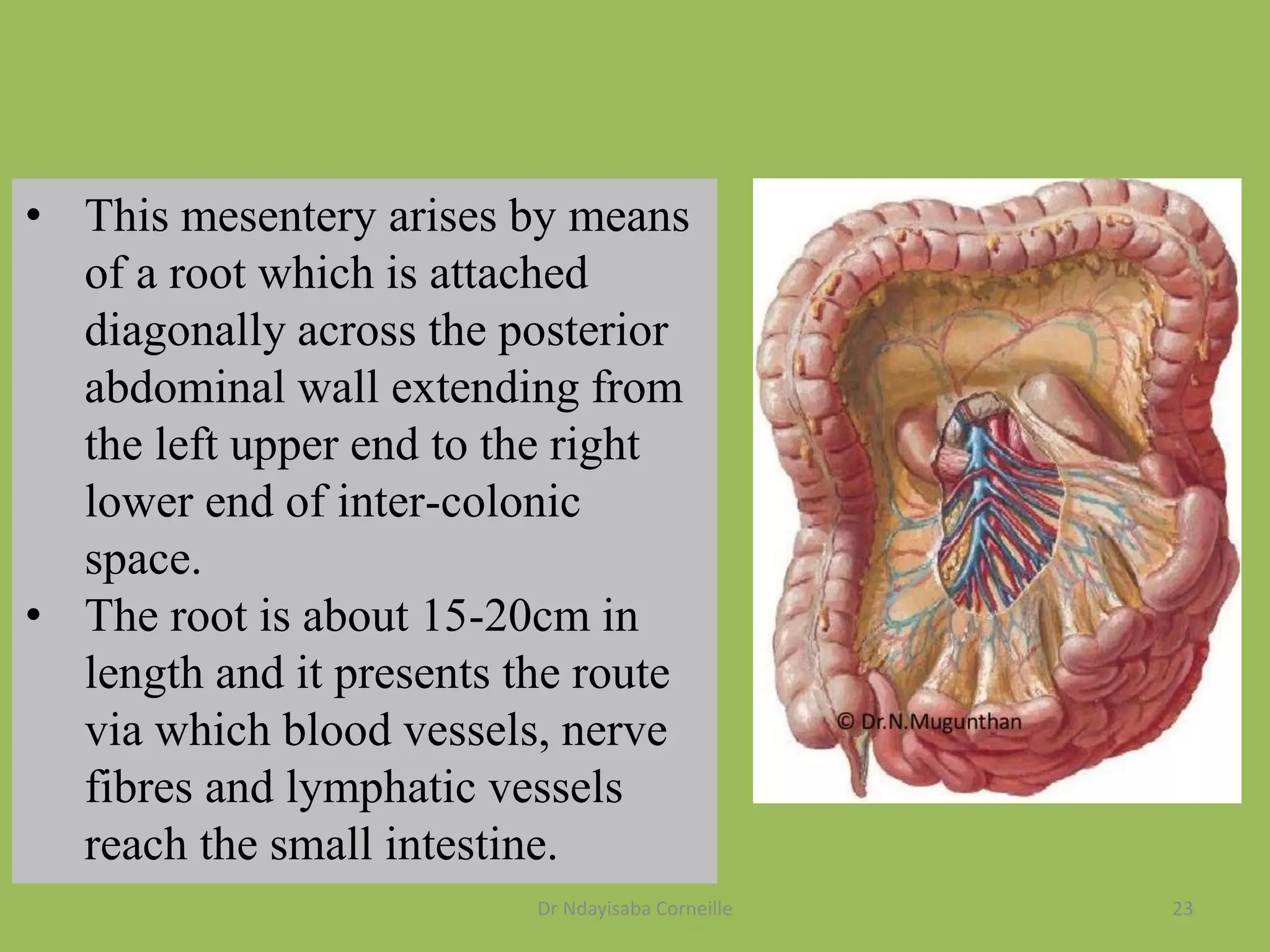
• This mesentery arises by means
of a root which is attached
diagonally across the posterior
abdominal wall extending from
the left upper end to the right
lower end of inter-colonic
space.
• The root is about 15-20cm in
length and it presents the route
via which blood vessels, nerve
fibres and lymphatic vessels
reach the small intestine.
Dr Ndayisaba Corneille 23
From the root of the mesentery to the
point where it attaches to the small
intestine is about 10cm and the
mesentery entirely encloses the small
intestine except at the region where it
diverges to enclose the small intestine.
The part where the mesentery attaches
to the small intestine is known as the
mesenteric border, while the anterior
free part in relation to the anterior
abdominal wall is referred to as the
anti mesenteric border.
Dr Ndayisaba Corneille 24
DIVISIONS OF THE PERITONEAL PART
OF THE SMALL INTESTINE
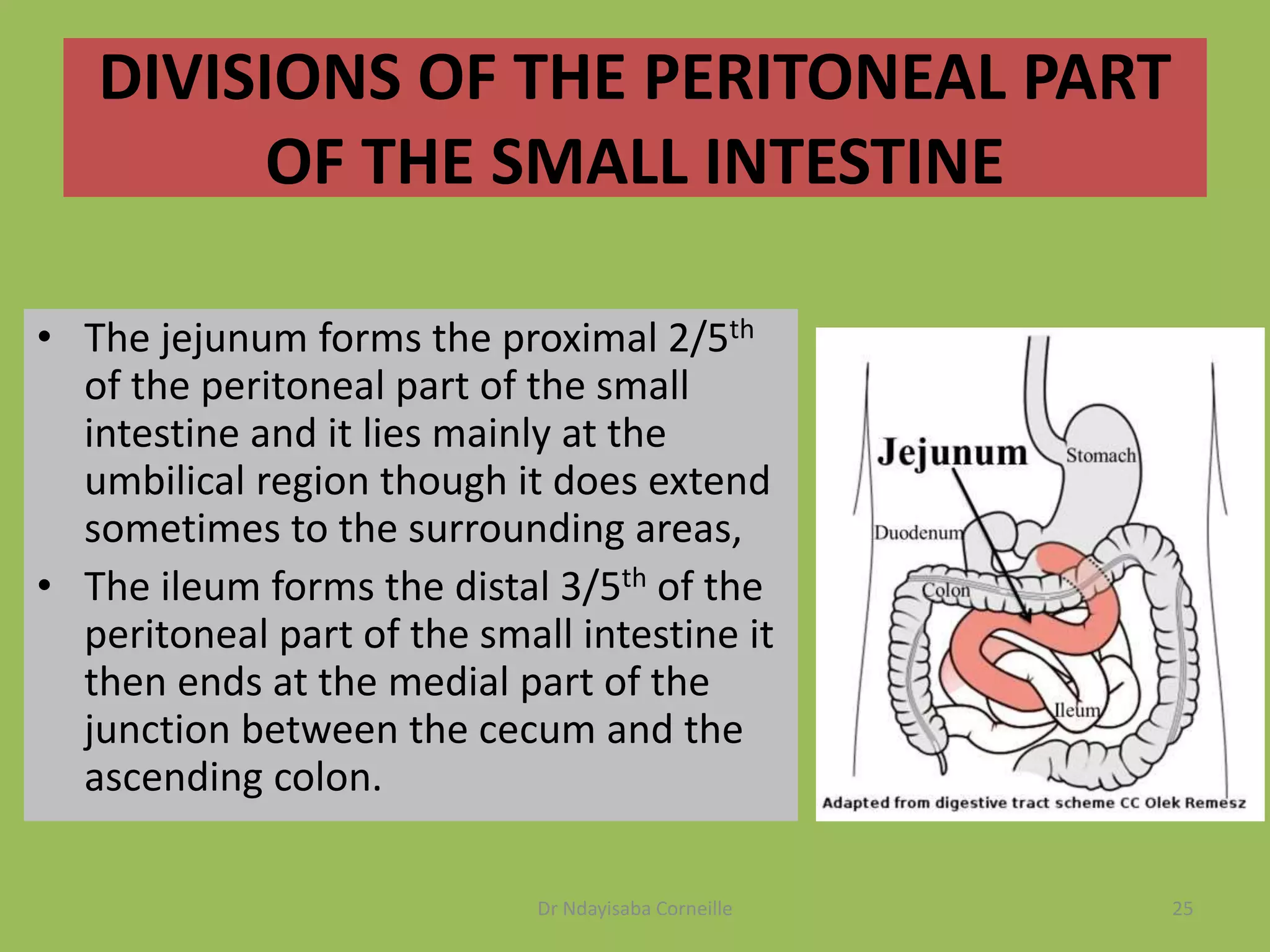
• The jejunum forms the proximal 2/5th
of the peritoneal part of the small
intestine and it lies mainly at the
umbilical region though it does extend
sometimes to the surrounding areas,
• The ileum forms the distal 3/5th of the
peritoneal part of the small intestine it
then ends at the medial part of the
junction between the cecum and the
ascending colon.
Dr Ndayisaba Corneille 25
It should be noted that since the
duodenum and ileum share
similar blood supply, common
nerve supply, common
mesenteric fold and similar
function and based on the fact
that there is no distinct
demarcation between both of
them, they are studied as a unit.
Dr Ndayisaba Corneille 26
INTERNAL STRUCTURE OF JEJUNUM
AND ILEUM
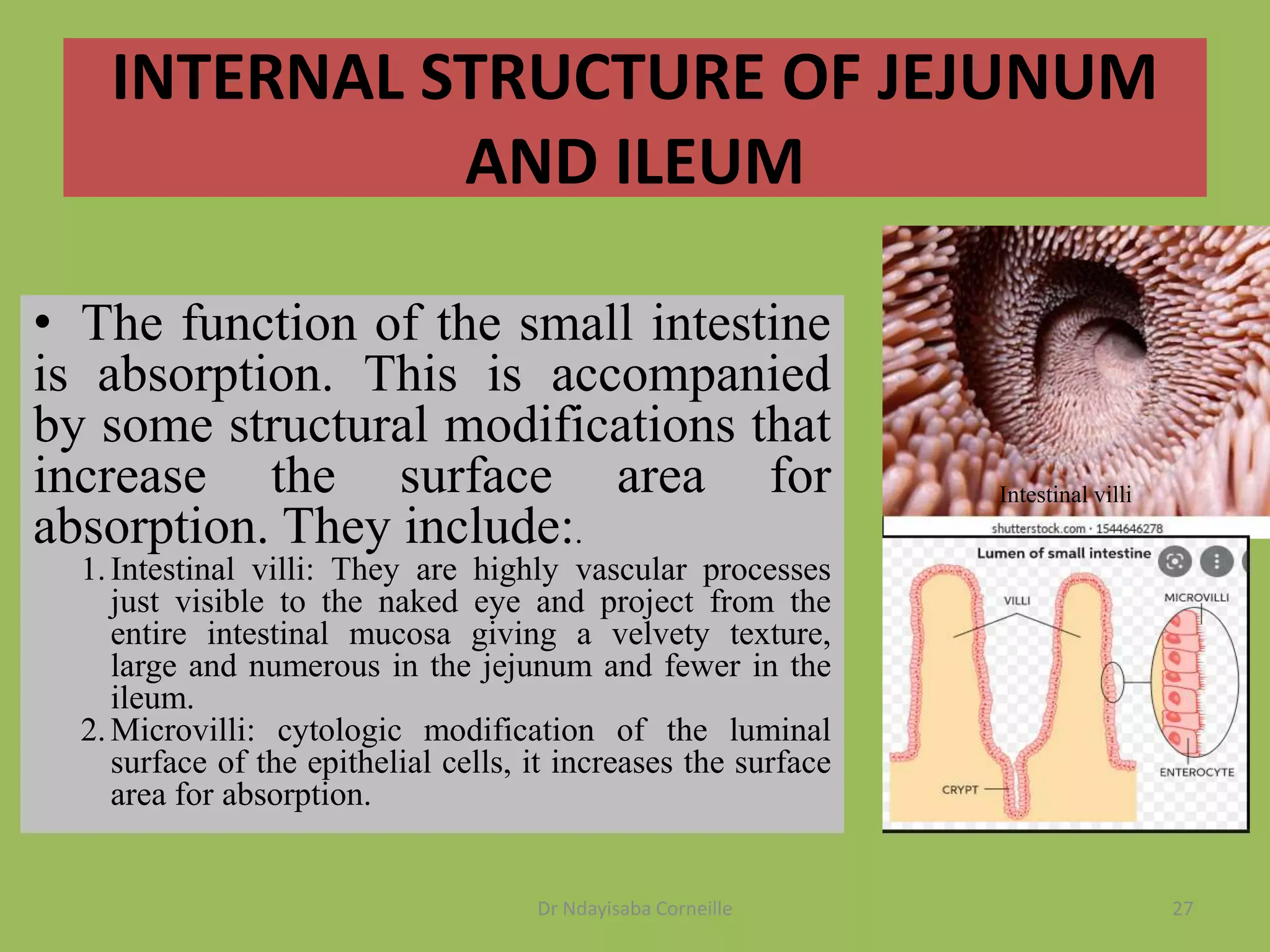
• The function of the small intestine
is absorption. This is accompanied
by some structural modifications that
increase the surface area for
absorption. They include:.
1.Intestinal villi: They are highly vascular processes
just visible to the naked eye and project from the
entire intestinal mucosa giving a velvety texture,
large and numerous in the jejunum and fewer in the
ileum.
2.Microvilli: cytologic modification of the luminal
surface of the epithelial cells, it increases the surface
area for absorption.
Intestinal villi
Dr Ndayisaba Corneille 27
Plicae circularis or valve of Kerkring:
these are circular folds sometimes spiral
fold of mucosa which projects into the
intestinal lumen transverse to the long
axis.
They begin from the 2nd part of
duodenum and diminish midway along
the ileum disappearing almost entirely at
the distal ileum. The plicae circularis
helps to slow down the passage of
content thereby increasing the digestive
and absorption time
Dr Ndayisaba Corneille 28
BLOOD SUPPLY
• Arterial supply to the jejunum and the ileum is
from the jejunal and ileum arteries.
• They are about 20 in number and as they
pass into the mesentery proper they form
anastomotic arcades with each other
which ensures adequate collateral blood
supply in case of constriction of arteries of
certain region during peristaltic movement
• The arcades in the jejunum are larger but fewer
that those of the ileum which are smaller and
numerous. From the arcades arises straight
branched arteries (arteriae rectal or vasa recta)
which runs directly into the wall of the jejunum
and ileum where they give of anterior and
posterior branches in the sides of the viscus
Dr Ndayisaba Corneille 29
The vasa recta usually anastomose on the
mesenteric border but in the antimesenteric
border they are more or less end arteries and
when occluded they could lead to local
infraction.
It should be noted that the vasa recta of the
ileum are shorter and more numerous than
those of the jejunum.
Also the ileum receives addition blood
supply from the ileal branches of the
ileocolic artery which is one of the terminal
branches of the superior mesenteric artery.
They supply the terminal part of the ileum.
Dr Ndayisaba Corneille 30
VENOUS DRAINAGE
• The veins follow the
arteries and they
drain into the
superior mesenteric
vein which drains
into the portal
system.
Dr Ndayisaba Corneille 31
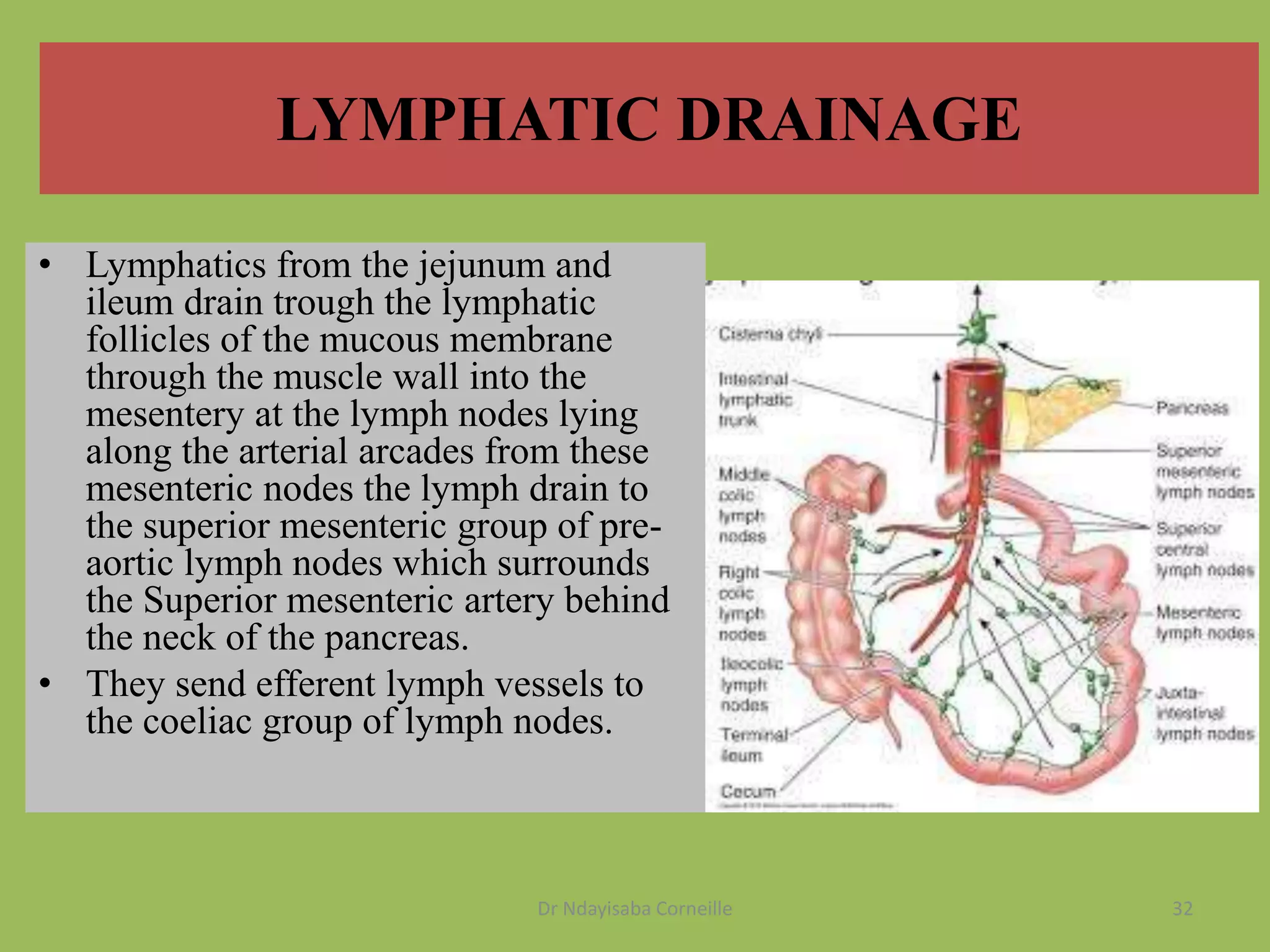
LYMPHATIC DRAINAGE
• Lymphatics from the jejunum and
ileum drain trough the lymphatic
follicles of the mucous membrane
through the muscle wall into the
mesentery at the lymph nodes lying
along the arterial arcades from these
mesenteric nodes the lymph drain to
the superior mesenteric group of pre-
aortic lymph nodes which surrounds
the Superior mesenteric artery behind
the neck of the pancreas.
• They send efferent lymph vessels to
the coeliac group of lymph nodes.
Dr Ndayisaba Corneille 32
Sympathetic nerves are derived from coeliac and superior
Mesenteric Plexuses.
Parasympathetic are derived from the vagus nerves .
The myenteric (Auerbach’s plexus) & Meisner’s plexuses
Myenteric plexus of nerves and ganglia lies between the circular
and longitudinal layers of the Muscularis externa.
Then from this plexus fibers pass to form a second submucosa
plexus (Meisner’s plexuses)
Dr Ndayisaba Corneille 33
NERVE SUPPLY…………………………………
• In general the sympathetic system inhibits peristalsis but
stimulates the sphincters and muscularis mucosae.
• The parasympathetic helps in peristalsis and inhibits the
sphincters, it also argument intestinal secretions.
• It should be note that segmental and pendular
movements of the small intestine is mainly controlled
by enteric reflexes which are intrinsic and they give rise
to the Bayliss-Starling law of the gut which states that a
bolus of chyme exerting transverse pressure on the
intestinal wall, results in muscular tone contraction
immediately oral to the bolus and relaxation in the
adjacent aboral region.
• This reflex mechanism ensures unidirectional oral to
aboral flow of intestinal contents.
Dr Ndayisaba Corneille 34
DISTINGUISHING FEATURES BETWEEN JEJUNUM
AND ILEUM
• 1. Diameter Lager 2-4cm 2.5-3cm
• 2. Wall thicker & heavy thin & light
• 3. Vascularity Greater Less
• 4. Color Deeper red pale
pink
• 5. Arterial vasa recta Long Short
• 6. Arcades Large loops (few) Small loop(many)
• 7. Fat in mesentery window Less
More
• 8 Plicae Circularis well dev (numerous) Rudimentary (few)
• 9. Payer patches Few Many
CHARACTERISTICS JEJUNUM ILEUM
Dr Ndayisaba Corneille 35
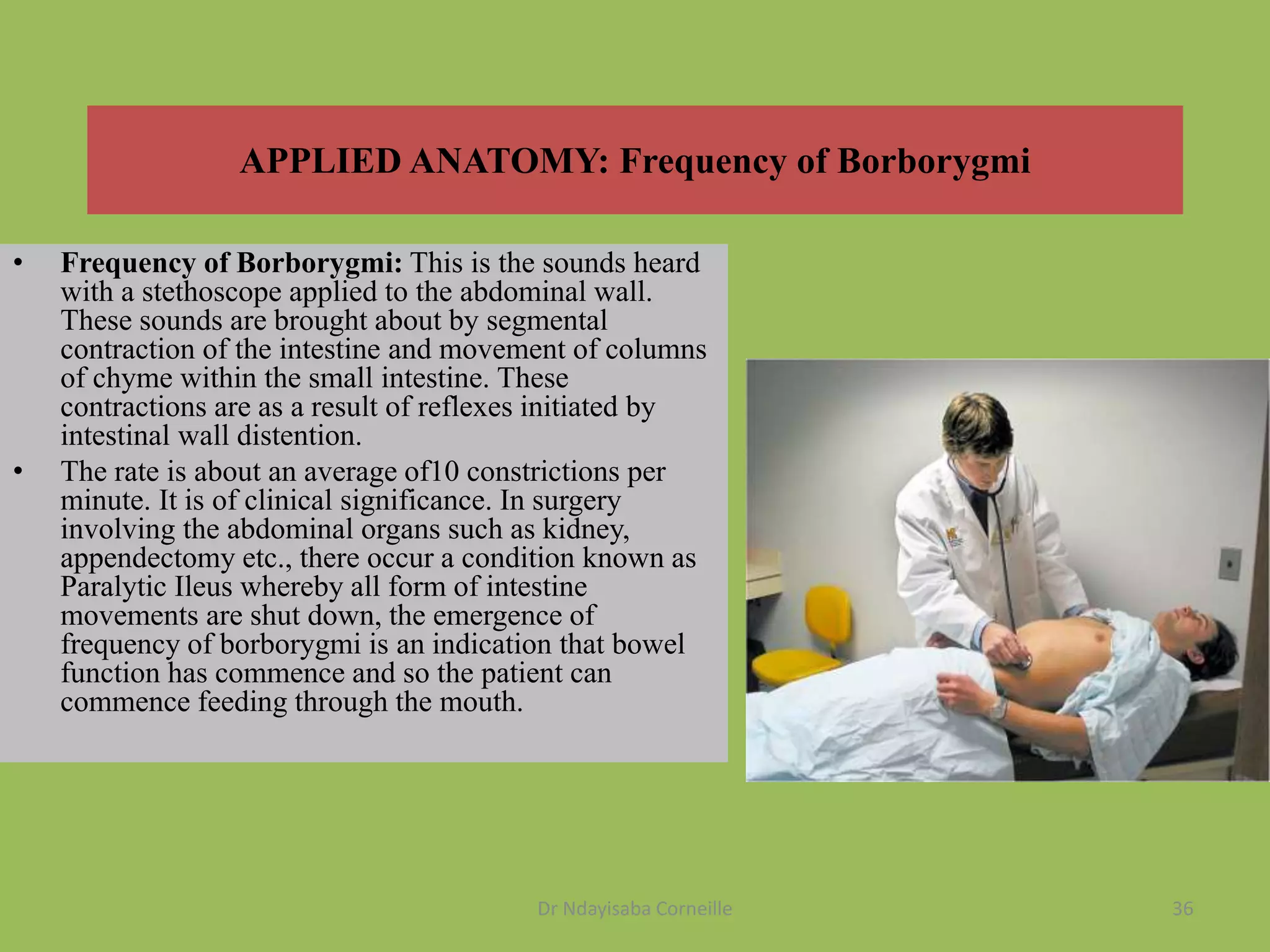
APPLIED ANATOMY: Frequency of Borborygmi
• Frequency of Borborygmi: This is the sounds heard
with a stethoscope applied to the abdominal wall.
These sounds are brought about by segmental
contraction of the intestine and movement of columns
of chyme within the small intestine. These
contractions are as a result of reflexes initiated by
intestinal wall distention.
• The rate is about an average of10 constrictions per
minute. It is of clinical significance. In surgery
involving the abdominal organs such as kidney,
appendectomy etc., there occur a condition known as
Paralytic Ileus whereby all form of intestine
movements are shut down, the emergence of
frequency of borborygmi is an indication that bowel
function has commence and so the patient can
commence feeding through the mouth.
Dr Ndayisaba Corneille 36
Meckel's Diverticulum
• This is a persistent remnant of the vitello
intestinal duct of the embryo. It projects from
the Antimesenteric border of the distal ileum
in about 2% of subjects. It is about 2m above
the ileoceacal junction and it’s average length
is about 2 inches (5cm) with diameter similar
to that of the ileum it’s terminal end is either
free or connected with the abdominal wall by
a fibrous band.
• IMPLICATIONS
It may become inflamed and presents symptoms
which are similar to the symptoms of inflamed
appendix and this might require surgical
intervention. It is always sort for during
appendectomy and it is always removed as a
preventive measure.
Dr Ndayisaba Corneille 37
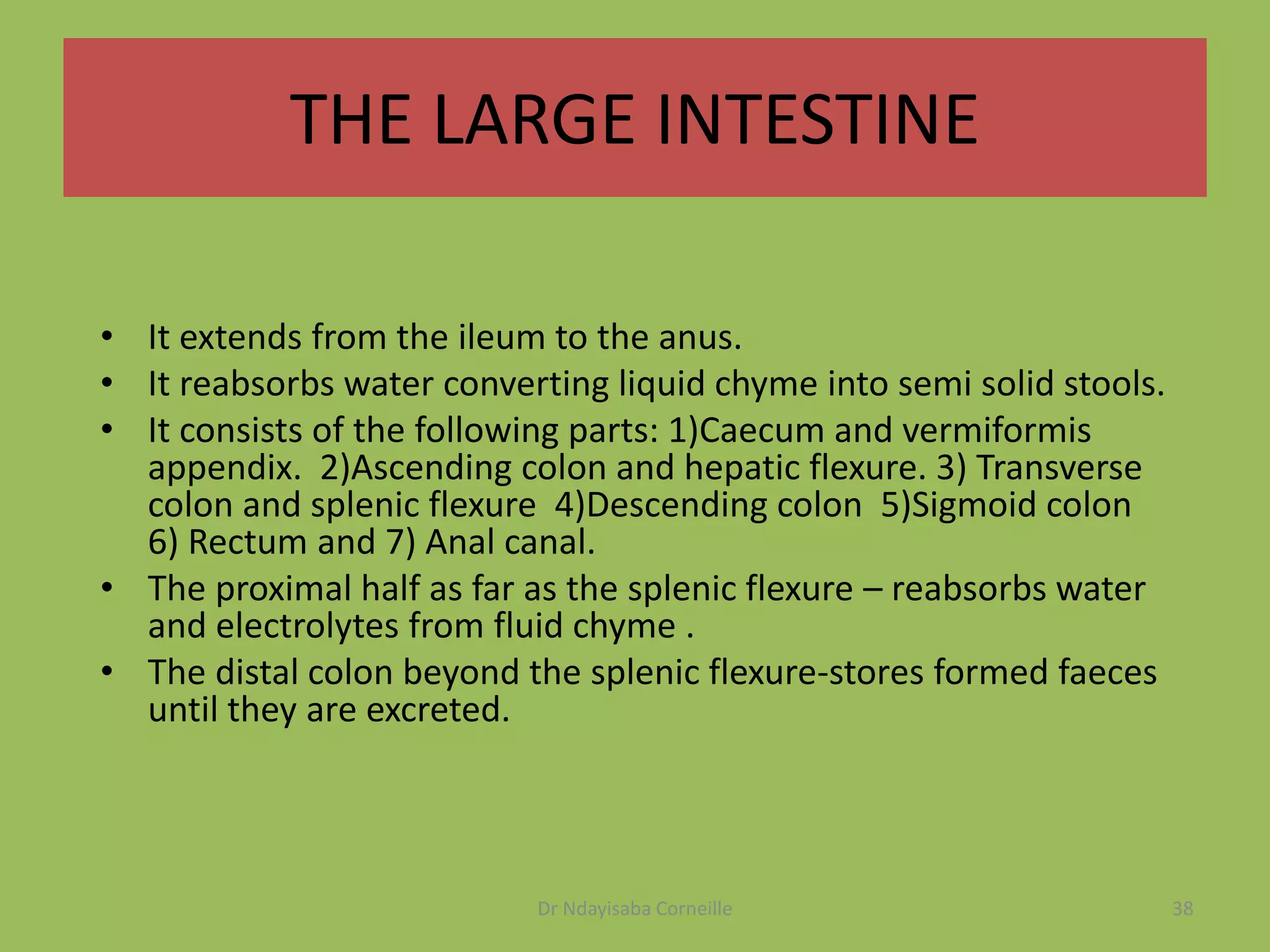
THE LARGE INTESTINE
• It extends from the ileum to the anus.
• It reabsorbs water converting liquid chyme into semi solid stools.
• It consists of the following parts: 1)Caecum and vermiformis
appendix. 2)Ascending colon and hepatic flexure. 3) Transverse
colon and splenic flexure 4)Descending colon 5)Sigmoid colon
6) Rectum and 7) Anal canal.
• The proximal half as far as the splenic flexure – reabsorbs water
and electrolytes from fluid chyme .
• The distal colon beyond the splenic flexure-stores formed faeces
until they are excreted.
Dr Ndayisaba Corneille 38
Dr Ndayisaba Corneille 39
1. CONTINUATION…..
As the name implies ,the large intestine is wider than
the small intestine.
-Other features : I ) taenie coli . 3 whitish longitudinal
muscle bands which start at the base of the appendix .
These muscle bands pucker the large intestine and with
the activity of the circular layer of muscles forms
haustra or sacculations. 2)Appeandicess epiploicae- are
fat filled pouches of serosa that are scattered over the
surface of the large intestine.
Dr Ndayisaba Corneille 40
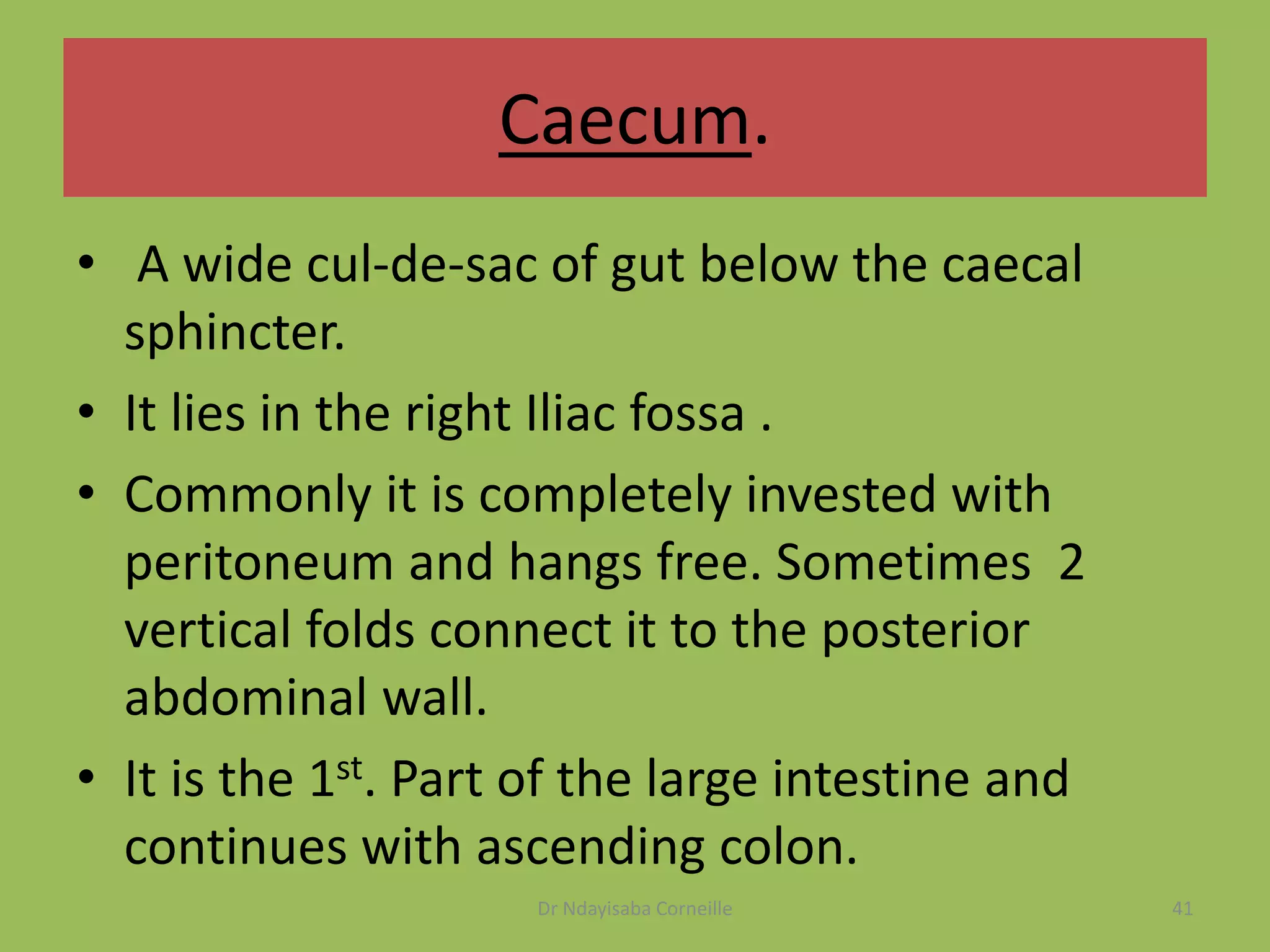
Caecum.
• A wide cul-de-sac of gut below the caecal
sphincter.
• It lies in the right Iliac fossa .
• Commonly it is completely invested with
peritoneum and hangs free. Sometimes 2
vertical folds connect it to the posterior
abdominal wall.
• It is the 1st. Part of the large intestine and
continues with ascending colon.
Dr Ndayisaba Corneille 41
The appendix vermiformis.
Dr Ndayisaba Corneille 42
• The appendix is attached to the caecum to the
point of convergence of the 3 tenia . On the
surface of the abdomen, this point lies at Mc
Burnys point, a point 1/3 way, the oblique line
from anterior superior iliac spine and the
umbilicus. This point is constant ,and it signifies
the base of the appendix.
• The mesoappendix encloses the appendicular
artery which is a branch of the ileal caecal artery.
• Both the length and position of the appendix are
variable. The average length is 5cm, and the most
common positions are retrocaecal and pelvic.
Dr Ndayisaba Corneille 43
The Ascending Colon
• Continuous with the upper end of the caecum
and it extends up to the hepatic flexure.
• It is retroperitoneal
• A peritoneal fold ,the Rt. Phrenico colic
ligament connects the hepatic flexure to the
diaphragm.
• The Rt. Lateral paracolic gutter separates the
colon from the abdominal wall and the medial
paracolic gutter is occupied by coils of
jejunum and ileum.
Dr Ndayisaba Corneille 44
Transverse Colon
• It is approximately 15” .
• It begins at the hepatic flexure and arches across the
abdomen to the splenic flexure.
• It has a transverse meso colon.
• The splenic flexure is suspended from the diaphragm by the
phrenico colic ligament.
• Relations : Anteriorly coils of the small intestine and greater
omentum. Posteriorly –lateral border of the Left Kidney,
the origin transversus abdominis muscle and the Quadratus
lumborum, iliac crest and the left psoas muscle .The ILIO
INGUINAL and Iliohypogastric nerves , the lateral
cutaneous nerve of thigh and the femoral nerve also lie
posteriorly.
Dr Ndayisaba Corneille 45
Descending Colon
• It extends from the splenic flexure to the
pelvic brim.
• It is about 12 inches long.
• It is reteperitoneal.
• Its 3 tineae are in continuity with those of the
transvers colon
• The appendicae are very numerous.
Dr Ndayisaba Corneille 46
Sigmoid colon.
• It is mobile and convoluted and has a
mesentery. The root of the mesocoln forms an
inverted V attached along the pelvic brim and
then on the front of the sacrum.
• It is approximately 40 CM in length, but this is
very variable, as it is a storage organ for
faeces.
• In the tropics ,people eat a lot of high residue
diet, a “REDUNDANT SIGMOID COLON “. This
predisposes sigmoid volvulus.
Dr Ndayisaba Corneille 47
Blood Supply .
• The colon gets its blood supply the superior and inferior
mesenteric arteries. The superior mesenteric artery is the
artery to the mid gut. It supplies colon up to the splenic
flexure .
• THE inferior mesenteric artery is the smallest of the 3
trunks. I t is the artery to the hind gut and supplies the
colon from the splenic flexure to the rectum.
• The branches of both superior and inferior mesenteric
arteries supplying the colon anastomose freely with each
other and form the Marginal artery of Drummond.
Dr Ndayisaba Corneille 48
Dr Ndayisaba Corneille 49
Branches of superior mesenteric
artery to the colon.
• 1)The ileocolic artery-It from the R. side of the of the superior mesenteric trunk
low down in the base of the mesentery. It supplies the terminal ileum ,the
appendix vermiformis and the caecum. It anastomoses freely with the R. Colic
branch.
• 2)The Right Colic branch.-Arises in the root of the mesentery from the right side of
Superior Mesenteric artery. It divides near the left side of the ascending colon into
2 branches :I )The descending branch runs down to anastomose with the colic
branch of the Ileocolic artery. Ii) The ascending branch runs up across the inferior
pole of the R. Kidney to the hepatic flexure where it anastomoses with a branch of
the middle colic artery. From these 2 branches, multiple versa recta sink into the
wall of the ascending colon to supply it.
• 3) The middle colic artery is the highest branch from right side of the S. mesenteric
artery. It divides into right and left branches. THE LEFT BRANCH supplies the
transverse colon to the splenic flexure ,where it anastomoses with L. colic artery. T
he R. branch anastomoses with the R. colic artery ,and it supplies the
transverse colon to the splenic flexure.
Dr Ndayisaba Corneille 50
Dr Ndayisaba Corneille 51
The inferior mesenteric artery
• It is the smallest of the 3 trunks. It gives 3
branches.
• 1)the left colic artery –supplies the
descending colon from the splenic flexure to
the sigmoid colon
• The sigmoid branch –supplies the sigmoid
colon.
• The superior rectal artery – supplies the
rectum
Dr Ndayisaba Corneille 52
Dr Ndayisaba Corneille 53
Venous drainage
• All the GIT is drained by the portal venous
system to the liver.
• The names of the veins correspond with the
named arteries.
• The ascending colon and transverse colon is
drained by the superior mesenteric vein.
• The sigmoid colon and descending colon
,drains into the inferior mesenteric vein ,which
in turn drains into the splenic vein.
Dr Ndayisaba Corneille 54
Dr Ndayisaba Corneille 55
Lymphatic drainage
• Caecum ,ascending and transverse colon drain
to the para colic nodes to the Superior
mesenteric group of lymph nodes to the pre
aortic lymph nodes.
• Descending colon and sigmoid colon drain into
the inferior mesenteric group of lymph nodes
to the para aortic lymph nodes
Dr Ndayisaba Corneille 56
Dr Ndayisaba Corneille 57
Dr Ndayisaba Corneille 58
Dr Ndayisaba Corneille 59
END
Dr Ndayisaba Corneille
THANKS FOR LISTENING
By
DR NDAYISABA CORNEILLE
MBChB,DCM,BCSIT,CCNA
Contact us:
amentalhealths@gmail.com/
ndayicoll@gmail.com
whatsaps :+256772497591
/+250788958241
60

The Small & Large Intestine.pptx

  • 1.
    Dr. NDAYISABA CORNEILLE CEOof CHG MBChB,DCM,BCSIT,CCNA Supported BY
  • 2.
    SMALL INTESTINE • Thesmall intestine is the part of the alimentary canal that is continuous with the stomach at the pyloric orifice and leads into the large intestine through the iliocaecal valve. It is the part where the chemical digestion of food is completed and most of the absorption of nutrients take place. Dr Ndayisaba Corneille 2
  • 3.
    LOCATION • It isfound lying mainly at the central and lower part of the abdomen cavity mostly within the colonic loop where it lies post to the greater omentum and anterior abdominal wall. It also extends into the pelvic region where it lies anterior to the rectum. Dr Ndayisaba Corneille 3
  • 4.
    Length • The lengthof the small intestine varies between 6-7m but on the average it is about 5m in a living adult. Dr Ndayisaba Corneille 4
  • 5.
    Histology of theSmall Intestine • Unlike the stomach the small intestine has four (4) basic coats:  Serosa  Muscularis External  Submucosa • Mucosa Dr Ndayisaba Corneille 5
  • 6.
    SUBDIVISION • The small intestineis divided in to three parts: • The duodenum • The Jejunum • The Ileum Dr Ndayisaba Corneille 6
  • 7.
    THE DUODENUM • Historicallythe duodenum is a Latin word that is derived from a Greek word that signifies 12 because it was believed that the length of the duodenum is about 12 fingers breadth. The duodenum is actually 25cm in length • The duodenum is the shortest, most fixed and dilated proximal part of Small intestine. • And lies above the umbilicus opposite to 1, 2 & 3rd Lumbar Vertebrae Dr Ndayisaba Corneille 7
  • 8.
    It is devoidof mesentery and it is fixed to posterior abdominal Wall. It curved around head of pancreas in a C – shaped curvature It receives Bile duct and pancreatic duct. Dr Ndayisaba Corneille 8
  • 9.
  • 10.
    The subdivided partsdoes not have any anatomical demarcating landmarks, they are named base on position. The parts include: First / upper part – 5 cm Second / vertical part – 7.5 cm Third / horizontal part – 10 cm Fourth / ascending part – 2.5 cm 1st 2nd Dr Ndayisaba Corneille 10
  • 11.
  • 12.
    a) The firstpart is the most movable part b) It is devoid of circular mucous fold which is present in other parts of the small intestine. c) Seen as duodenal cap / Bulb in Radiographs. d) In the submucosa are present numerous Brunner’s gland which secrets mucus that protect its wall from the acidic content of the chyme discharged from the stomach e) Supplied by end arteries f) May be affected by peptic ulcer Dr Ndayisaba Corneille 12
  • 13.
    Begins at superiorduodenal flexure opposite the L1 vertebra passes vertically downwards and ends at inferior duodenal flexure where it continues with the 3rd part opposite the Lower border of L3 - it lies in front of hilum of Right Kidney - along right Side of vertebral column in paravertebral gutter Rt. Lat. Plane Dr Ndayisaba Corneille 13
  • 14.
    Here marks thecommencement of a unique Circular folds in the small intestine known as the Plica Circularis – Permanent, circular & thick. Major duodenal papilla is present (on posteromedial wall of 2nd part 10 cm distal to pylorus) It is the opening of the combine ducts of the Bile duct & pancreatic ducts (Ampulla of vater) Minor duodenal papilla 2 cms above major papilla is also present another smaller papilla for the opening of the Accessory pancreatic duct opens Dr Ndayisaba Corneille 14
  • 15.
    Extends from inferiorDuodenal flexure in front of aorta at L3 level Relations - Anteriorly : it is Covered by peritoneum except at the point of attachment of root of mesentery of the Small intestine Anterior Surface is crossed by Superior Mesenteric vessels and root of mesentery Dr Ndayisaba Corneille 15
  • 16.
    Extends from frontof aorta to Duodeno-jejunal flexure, which is situated on the left side of L2 about 1.25 cm below transpyloric plan and 2.5 cms to left of median plane Kept in position by suspensory muscle of Duodenum (Ligament of Trezt) Relations Anteriorly : Covered with peritoneum. Related to transverse colon and its mesocolon PosteroInferiorly it is separated from the Surface of stomach by the lesser sac Dr Ndayisaba Corneille 16
  • 17.
  • 18.
    Most of theduodenum except 1st part is supplied by Ventral and dorsal anastomoses of Superior & Inferior Pancreaticoduodenal arteries. Vasa Recta arises and supply adjacent areas of duodenum and head of pancreas Dr Ndayisaba Corneille 18
  • 19.
    Veins corresponding inname to the arteries, The veins drain into superior mesenteric vein and portal vein Dr Ndayisaba Corneille 19
  • 20.
    Lymph vessels draininto pancreatico- duodenal lymph nodes. Efferent vessels of these nodes drain into Coeliac and superior Mesenteric group of pre-aortic lymph nodes. Some vessels drain into the Hepatic nodes directly. All lymph reaching hepatic nodes will still drain into the coeliac nodes Dr Ndayisaba Corneille 20
  • 21.
    APPLIED ANATOMY ofthe duodenum • Cancer of the duodenum could be very severe and sometimes could not be easily controlled as a result of the numerous venous and lymphatic channels that exist between the duodenum and post abdominal wall. • Duodenal ulcer: The duodenum especially the superior part (duodenal cap) is most prone to peptic ulceration and its frequency is about four times higher than gastric ulceration. • Superior mesenteric syndrome: Based on the relation of the superior mesenteric artery to the anterior and superior part of the horizontal part of the duodenum. It could sometimes leads to compression of the duodenum which will lead to obstruction. Dr Ndayisaba Corneille 21
  • 22.
    THE JEJUNUM ANDTHE ILEUA • This remaining part of the small intestine is mainly involved in the absorption of digested nutrients and fluid from the chyme as a result it is involved in the conservation of fluid • it is made up of series of coils that are attached to the posterior abdominal wall by a double layer of peritoneum which is referred to as Mesentery proper. Dr Ndayisaba Corneille 22
  • 23.
    • This mesenteryarises by means of a root which is attached diagonally across the posterior abdominal wall extending from the left upper end to the right lower end of inter-colonic space. • The root is about 15-20cm in length and it presents the route via which blood vessels, nerve fibres and lymphatic vessels reach the small intestine. Dr Ndayisaba Corneille 23
  • 24.
    From the rootof the mesentery to the point where it attaches to the small intestine is about 10cm and the mesentery entirely encloses the small intestine except at the region where it diverges to enclose the small intestine. The part where the mesentery attaches to the small intestine is known as the mesenteric border, while the anterior free part in relation to the anterior abdominal wall is referred to as the anti mesenteric border. Dr Ndayisaba Corneille 24
  • 25.
    DIVISIONS OF THEPERITONEAL PART OF THE SMALL INTESTINE • The jejunum forms the proximal 2/5th of the peritoneal part of the small intestine and it lies mainly at the umbilical region though it does extend sometimes to the surrounding areas, • The ileum forms the distal 3/5th of the peritoneal part of the small intestine it then ends at the medial part of the junction between the cecum and the ascending colon. Dr Ndayisaba Corneille 25
  • 26.
    It should benoted that since the duodenum and ileum share similar blood supply, common nerve supply, common mesenteric fold and similar function and based on the fact that there is no distinct demarcation between both of them, they are studied as a unit. Dr Ndayisaba Corneille 26
  • 27.
    INTERNAL STRUCTURE OFJEJUNUM AND ILEUM • The function of the small intestine is absorption. This is accompanied by some structural modifications that increase the surface area for absorption. They include:. 1.Intestinal villi: They are highly vascular processes just visible to the naked eye and project from the entire intestinal mucosa giving a velvety texture, large and numerous in the jejunum and fewer in the ileum. 2.Microvilli: cytologic modification of the luminal surface of the epithelial cells, it increases the surface area for absorption. Intestinal villi Dr Ndayisaba Corneille 27
  • 28.
    Plicae circularis orvalve of Kerkring: these are circular folds sometimes spiral fold of mucosa which projects into the intestinal lumen transverse to the long axis. They begin from the 2nd part of duodenum and diminish midway along the ileum disappearing almost entirely at the distal ileum. The plicae circularis helps to slow down the passage of content thereby increasing the digestive and absorption time Dr Ndayisaba Corneille 28
  • 29.
    BLOOD SUPPLY • Arterialsupply to the jejunum and the ileum is from the jejunal and ileum arteries. • They are about 20 in number and as they pass into the mesentery proper they form anastomotic arcades with each other which ensures adequate collateral blood supply in case of constriction of arteries of certain region during peristaltic movement • The arcades in the jejunum are larger but fewer that those of the ileum which are smaller and numerous. From the arcades arises straight branched arteries (arteriae rectal or vasa recta) which runs directly into the wall of the jejunum and ileum where they give of anterior and posterior branches in the sides of the viscus Dr Ndayisaba Corneille 29
  • 30.
    The vasa rectausually anastomose on the mesenteric border but in the antimesenteric border they are more or less end arteries and when occluded they could lead to local infraction. It should be noted that the vasa recta of the ileum are shorter and more numerous than those of the jejunum. Also the ileum receives addition blood supply from the ileal branches of the ileocolic artery which is one of the terminal branches of the superior mesenteric artery. They supply the terminal part of the ileum. Dr Ndayisaba Corneille 30
  • 31.
    VENOUS DRAINAGE • Theveins follow the arteries and they drain into the superior mesenteric vein which drains into the portal system. Dr Ndayisaba Corneille 31
  • 32.
    LYMPHATIC DRAINAGE • Lymphaticsfrom the jejunum and ileum drain trough the lymphatic follicles of the mucous membrane through the muscle wall into the mesentery at the lymph nodes lying along the arterial arcades from these mesenteric nodes the lymph drain to the superior mesenteric group of pre- aortic lymph nodes which surrounds the Superior mesenteric artery behind the neck of the pancreas. • They send efferent lymph vessels to the coeliac group of lymph nodes. Dr Ndayisaba Corneille 32
  • 33.
    Sympathetic nerves arederived from coeliac and superior Mesenteric Plexuses. Parasympathetic are derived from the vagus nerves . The myenteric (Auerbach’s plexus) & Meisner’s plexuses Myenteric plexus of nerves and ganglia lies between the circular and longitudinal layers of the Muscularis externa. Then from this plexus fibers pass to form a second submucosa plexus (Meisner’s plexuses) Dr Ndayisaba Corneille 33
  • 34.
    NERVE SUPPLY………………………………… • Ingeneral the sympathetic system inhibits peristalsis but stimulates the sphincters and muscularis mucosae. • The parasympathetic helps in peristalsis and inhibits the sphincters, it also argument intestinal secretions. • It should be note that segmental and pendular movements of the small intestine is mainly controlled by enteric reflexes which are intrinsic and they give rise to the Bayliss-Starling law of the gut which states that a bolus of chyme exerting transverse pressure on the intestinal wall, results in muscular tone contraction immediately oral to the bolus and relaxation in the adjacent aboral region. • This reflex mechanism ensures unidirectional oral to aboral flow of intestinal contents. Dr Ndayisaba Corneille 34
  • 35.
    DISTINGUISHING FEATURES BETWEENJEJUNUM AND ILEUM • 1. Diameter Lager 2-4cm 2.5-3cm • 2. Wall thicker & heavy thin & light • 3. Vascularity Greater Less • 4. Color Deeper red pale pink • 5. Arterial vasa recta Long Short • 6. Arcades Large loops (few) Small loop(many) • 7. Fat in mesentery window Less More • 8 Plicae Circularis well dev (numerous) Rudimentary (few) • 9. Payer patches Few Many CHARACTERISTICS JEJUNUM ILEUM Dr Ndayisaba Corneille 35
  • 36.
    APPLIED ANATOMY: Frequencyof Borborygmi • Frequency of Borborygmi: This is the sounds heard with a stethoscope applied to the abdominal wall. These sounds are brought about by segmental contraction of the intestine and movement of columns of chyme within the small intestine. These contractions are as a result of reflexes initiated by intestinal wall distention. • The rate is about an average of10 constrictions per minute. It is of clinical significance. In surgery involving the abdominal organs such as kidney, appendectomy etc., there occur a condition known as Paralytic Ileus whereby all form of intestine movements are shut down, the emergence of frequency of borborygmi is an indication that bowel function has commence and so the patient can commence feeding through the mouth. Dr Ndayisaba Corneille 36
  • 37.
    Meckel's Diverticulum • Thisis a persistent remnant of the vitello intestinal duct of the embryo. It projects from the Antimesenteric border of the distal ileum in about 2% of subjects. It is about 2m above the ileoceacal junction and it’s average length is about 2 inches (5cm) with diameter similar to that of the ileum it’s terminal end is either free or connected with the abdominal wall by a fibrous band. • IMPLICATIONS It may become inflamed and presents symptoms which are similar to the symptoms of inflamed appendix and this might require surgical intervention. It is always sort for during appendectomy and it is always removed as a preventive measure. Dr Ndayisaba Corneille 37
  • 38.
    THE LARGE INTESTINE •It extends from the ileum to the anus. • It reabsorbs water converting liquid chyme into semi solid stools. • It consists of the following parts: 1)Caecum and vermiformis appendix. 2)Ascending colon and hepatic flexure. 3) Transverse colon and splenic flexure 4)Descending colon 5)Sigmoid colon 6) Rectum and 7) Anal canal. • The proximal half as far as the splenic flexure – reabsorbs water and electrolytes from fluid chyme . • The distal colon beyond the splenic flexure-stores formed faeces until they are excreted. Dr Ndayisaba Corneille 38
  • 39.
  • 40.
    1. CONTINUATION….. As thename implies ,the large intestine is wider than the small intestine. -Other features : I ) taenie coli . 3 whitish longitudinal muscle bands which start at the base of the appendix . These muscle bands pucker the large intestine and with the activity of the circular layer of muscles forms haustra or sacculations. 2)Appeandicess epiploicae- are fat filled pouches of serosa that are scattered over the surface of the large intestine. Dr Ndayisaba Corneille 40
  • 41.
    Caecum. • A widecul-de-sac of gut below the caecal sphincter. • It lies in the right Iliac fossa . • Commonly it is completely invested with peritoneum and hangs free. Sometimes 2 vertical folds connect it to the posterior abdominal wall. • It is the 1st. Part of the large intestine and continues with ascending colon. Dr Ndayisaba Corneille 41
  • 42.
    The appendix vermiformis. DrNdayisaba Corneille 42
  • 43.
    • The appendixis attached to the caecum to the point of convergence of the 3 tenia . On the surface of the abdomen, this point lies at Mc Burnys point, a point 1/3 way, the oblique line from anterior superior iliac spine and the umbilicus. This point is constant ,and it signifies the base of the appendix. • The mesoappendix encloses the appendicular artery which is a branch of the ileal caecal artery. • Both the length and position of the appendix are variable. The average length is 5cm, and the most common positions are retrocaecal and pelvic. Dr Ndayisaba Corneille 43
  • 44.
    The Ascending Colon •Continuous with the upper end of the caecum and it extends up to the hepatic flexure. • It is retroperitoneal • A peritoneal fold ,the Rt. Phrenico colic ligament connects the hepatic flexure to the diaphragm. • The Rt. Lateral paracolic gutter separates the colon from the abdominal wall and the medial paracolic gutter is occupied by coils of jejunum and ileum. Dr Ndayisaba Corneille 44
  • 45.
    Transverse Colon • Itis approximately 15” . • It begins at the hepatic flexure and arches across the abdomen to the splenic flexure. • It has a transverse meso colon. • The splenic flexure is suspended from the diaphragm by the phrenico colic ligament. • Relations : Anteriorly coils of the small intestine and greater omentum. Posteriorly –lateral border of the Left Kidney, the origin transversus abdominis muscle and the Quadratus lumborum, iliac crest and the left psoas muscle .The ILIO INGUINAL and Iliohypogastric nerves , the lateral cutaneous nerve of thigh and the femoral nerve also lie posteriorly. Dr Ndayisaba Corneille 45
  • 46.
    Descending Colon • Itextends from the splenic flexure to the pelvic brim. • It is about 12 inches long. • It is reteperitoneal. • Its 3 tineae are in continuity with those of the transvers colon • The appendicae are very numerous. Dr Ndayisaba Corneille 46
  • 47.
    Sigmoid colon. • Itis mobile and convoluted and has a mesentery. The root of the mesocoln forms an inverted V attached along the pelvic brim and then on the front of the sacrum. • It is approximately 40 CM in length, but this is very variable, as it is a storage organ for faeces. • In the tropics ,people eat a lot of high residue diet, a “REDUNDANT SIGMOID COLON “. This predisposes sigmoid volvulus. Dr Ndayisaba Corneille 47
  • 48.
    Blood Supply . •The colon gets its blood supply the superior and inferior mesenteric arteries. The superior mesenteric artery is the artery to the mid gut. It supplies colon up to the splenic flexure . • THE inferior mesenteric artery is the smallest of the 3 trunks. I t is the artery to the hind gut and supplies the colon from the splenic flexure to the rectum. • The branches of both superior and inferior mesenteric arteries supplying the colon anastomose freely with each other and form the Marginal artery of Drummond. Dr Ndayisaba Corneille 48
  • 49.
  • 50.
    Branches of superiormesenteric artery to the colon. • 1)The ileocolic artery-It from the R. side of the of the superior mesenteric trunk low down in the base of the mesentery. It supplies the terminal ileum ,the appendix vermiformis and the caecum. It anastomoses freely with the R. Colic branch. • 2)The Right Colic branch.-Arises in the root of the mesentery from the right side of Superior Mesenteric artery. It divides near the left side of the ascending colon into 2 branches :I )The descending branch runs down to anastomose with the colic branch of the Ileocolic artery. Ii) The ascending branch runs up across the inferior pole of the R. Kidney to the hepatic flexure where it anastomoses with a branch of the middle colic artery. From these 2 branches, multiple versa recta sink into the wall of the ascending colon to supply it. • 3) The middle colic artery is the highest branch from right side of the S. mesenteric artery. It divides into right and left branches. THE LEFT BRANCH supplies the transverse colon to the splenic flexure ,where it anastomoses with L. colic artery. T he R. branch anastomoses with the R. colic artery ,and it supplies the transverse colon to the splenic flexure. Dr Ndayisaba Corneille 50
  • 51.
  • 52.
    The inferior mesentericartery • It is the smallest of the 3 trunks. It gives 3 branches. • 1)the left colic artery –supplies the descending colon from the splenic flexure to the sigmoid colon • The sigmoid branch –supplies the sigmoid colon. • The superior rectal artery – supplies the rectum Dr Ndayisaba Corneille 52
  • 53.
  • 54.
    Venous drainage • Allthe GIT is drained by the portal venous system to the liver. • The names of the veins correspond with the named arteries. • The ascending colon and transverse colon is drained by the superior mesenteric vein. • The sigmoid colon and descending colon ,drains into the inferior mesenteric vein ,which in turn drains into the splenic vein. Dr Ndayisaba Corneille 54
  • 55.
  • 56.
    Lymphatic drainage • Caecum,ascending and transverse colon drain to the para colic nodes to the Superior mesenteric group of lymph nodes to the pre aortic lymph nodes. • Descending colon and sigmoid colon drain into the inferior mesenteric group of lymph nodes to the para aortic lymph nodes Dr Ndayisaba Corneille 56
  • 57.
  • 58.
  • 59.
  • 60.
    END Dr Ndayisaba Corneille THANKSFOR LISTENING By DR NDAYISABA CORNEILLE MBChB,DCM,BCSIT,CCNA Contact us: amentalhealths@gmail.com/ ndayicoll@gmail.com whatsaps :+256772497591 /+250788958241 60