ANATOMY OF THE G.I.T.
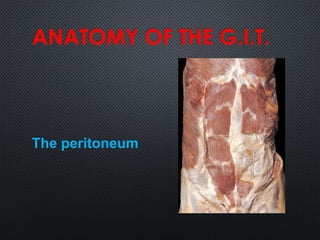
The peritoneum
1- To describe the general arrangement of
peritoneal folds.
2- To define the peritoneal cavities.
3- To describe peritoneal arrangement for
individual organs.
4- To list the retroperitoneal organs.
5- To locate peritoneal fossae & recesses
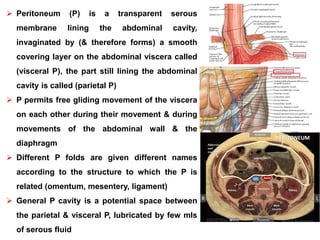
 Peritoneum (P) is a transparent serous
membrane lining the abdominal cavity,
invaginated by (& therefore forms) a smooth
covering layer on the abdominal viscera called
(visceral P), the part still lining the abdominal
cavity is called (parietal P)
 P permits free gliding movement of the viscera
on each other during their movement & during
movements of the abdominal wall & the
diaphragm
 Different P folds are given different names
according to the structure to which the P is
related (omentum, mesentery, ligament)
 General P cavity is a potential space between
the parietal & visceral P, lubricated by few mls
of serous fluid
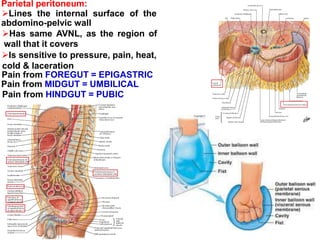
Parietal peritoneum:
Lines the internal surface of the
abdomino-pelvic wall
Has same AVNL, as the region of
wall that it covers
Is sensitive to pressure, pain, heat,
cold & laceration
Pain from FOREGUT = EPIGASTRIC
Pain from MIDGUT = UMBILICAL
Pain from HINDGUT = PUBIC
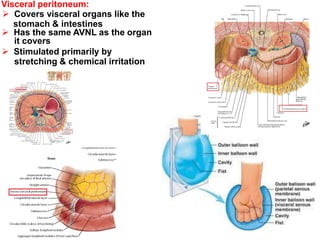
Visceral peritoneum:
 Covers visceral organs like the
stomach & intestines
 Has the same AVNL as the organ
it covers
 Stimulated primarily by
stretching & chemical irritation
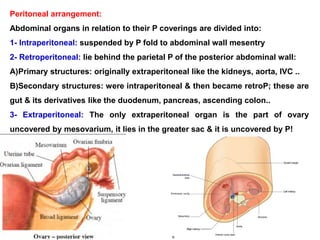
Peritoneal arrangement:
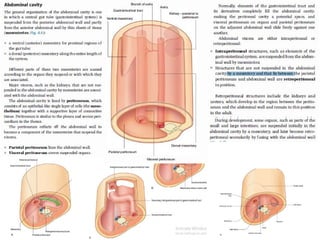
Abdominal organs in relation to their P coverings are divided into:
1- Intraperitoneal: suspended by P fold to abdominal wall mesentry
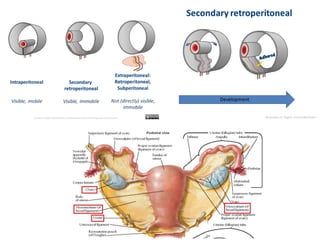
2- Retroperitoneal: lie behind the parietal P of the posterior abdominal wall:
A)Primary structures: originally extraperitoneal like the kidneys, aorta, IVC ..
B)Secondary structures: were intraperitoneal & then became retroP; these are
gut & its derivatives like the duodenum, pancreas, ascending colon..
3- Extraperitoneal: The only extraperitoneal organ is the part of ovary
uncovered by mesovarium, it lies in the greater sac & it is uncovered by P!
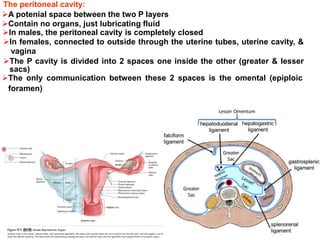
The peritoneal cavity:
A potenial space between the two P layers
Contain no organs, just lubricating fluid
In males, the peritoneal cavity is completely closed
In females, connected to outside through the uterine tubes, uterine cavity, &
vagina
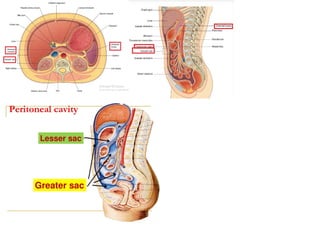
The P cavity is divided into 2 spaces one inside the other (greater & lesser
sacs)
The only communication between these 2 spaces is the omental (epiploic
foramen)
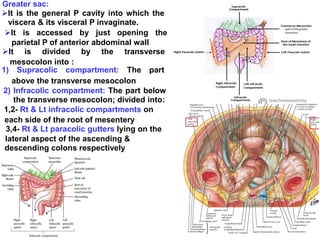
Greater sac:
It is the general P cavity into which the
viscera & its visceral P invaginate.
It is accessed by just opening the
parietal P of anterior abdominal wall
It is divided by the transverse
mesocolon into :
1) Supracolic compartment: The part
above the transverse mesocolon
2) Infracolic compartment: The part below
the transverse mesocolon; divided into:
1,2- Rt & Lt infracolic compartments on
each side of the root of mesentery
3,4- Rt & Lt paracolic gutters lying on the
lateral aspect of the ascending &
descending colons respectively
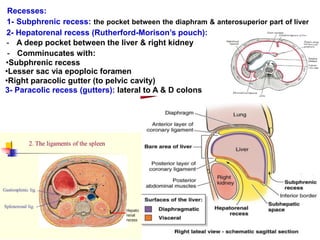
Recesses:
1- Subphrenic recess: the pocket between the diaphram & anterosuperior part of liver
2- Hepatorenal recess (Rutherford-Morison’s pouch):
- A deep pocket between the liver & right kidney
- Comminucates with:
•Subphrenic recess
•Lesser sac via epoploic foramen
•Right paracolic gutter (to pelvic cavity)
3- Paracolic recess (gutters): lateral to A & D colons
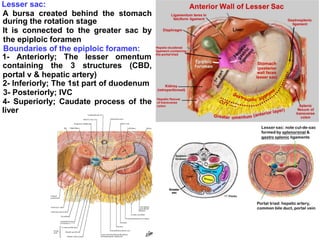
Lesser sac:
A bursa created behind the stomach
during the rotation stage
It is connected to the greater sac by
the epiploic foramen
Boundaries of the epiploic foramen:
1- Anteriorly; The lesser omentum
containing the 3 structures (CBD,
portal v & hepatic artery)
2- Inferiorly; The 1st part of duodenum
3- Posteriorly; IVC
4- Superiorly; Caudate process of the
liver
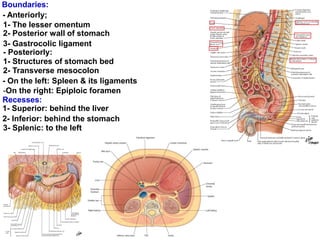
Boundaries:
- Anteriorly;
1- The lesser omentum
2- Posterior wall of stomach
3- Gastrocolic ligament
- Posteriorly:
1- Structures of stomach bed
2- Transverse mesocolon
- On the left: Spleen & its ligaments
-On the right: Epiploic foramen
Recesses:
1- Superior: behind the liver
2- Inferior: behind the stomach
3- Splenic: to the left
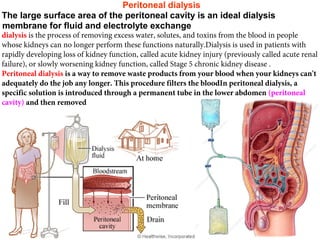
Peritoneal dialysis
The large surface area of the peritoneal cavity is an ideal dialysis
membrane for fluid and electrolyte exchange
dialysis is the process of removing excess water, solutes, and toxins from the blood in people
whose kidneys can no longer perform these functions naturally.Dialysis is used in patients with
rapidly developing loss of kidney function, called acute kidney injury (previously called acute renal
failure), or slowly worsening kidney function, called Stage 5 chronic kidney disease .
Peritoneal dialysis is a way to remove waste products from your blood when your kidneys can't
adequately do the job any longer. This procedure filters the bloodIn peritoneal dialysis, a
specific solution is introduced through a permanent tube in the lower abdomen (peritoneal
cavity) and then removed
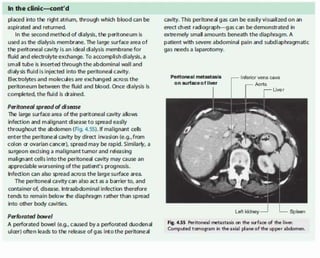
Ventriculo-peritoneal shunt
The large surface area of the peritoneal cavity is an ideal site of
absorption of CSF if drained to this membrane by a shunt
are commonly used to treat hydrocephalus, the swelling of the brain due to excess buildup of
cerebrospinal fluid (CSF). If left unchecked, the cerebrospinal fluid can build up leading to an
increase in intracranial pressure (ICP) which can lead to intracranial hematoma, cerebral
edema, crushed brain tissue or herniation.[1] The cerebral shunt can be used to alleviate or
prevent these problems in patients who suffer from hydrocephalus or other related diseases.
Shunts can come in a variety of forms but most of them consist of a valve housing connected to
a catheter, the end of which is usually placed in the peritoneal cavity.
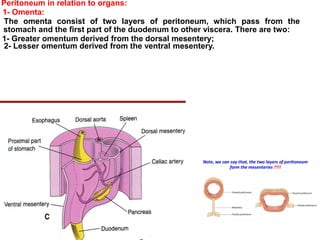
Peritoneum in relation to organs:
1- Omenta:
The omenta consist of two layers of peritoneum, which pass from the
stomach and the first part of the duodenum to other viscera. There are two:
1- Greater omentum derived from the dorsal mesentery;
2- Lesser omentum derived from the ventral mesentery.
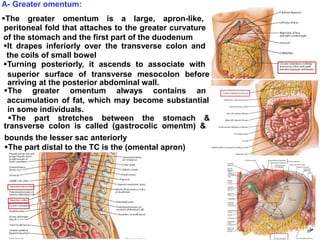
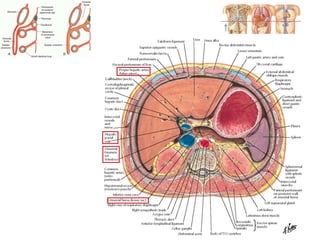
A- Greater omentum:
The greater omentum is a large, apron-like,
peritoneal fold that attaches to the greater curvature
of the stomach and the first part of the duodenum
It drapes inferiorly over the transverse colon and
the coils of small bowel
Turning posteriorly, it ascends to associate with
superior surface of transverse mesocolon before
arriving at the posterior abdominal wall.
The greater omentum always contains an
accumulation of fat, which may become substantial
in some individuals.
The part stretches between the stomach &
transverse colon is called (gastrocolic omentm) &
bounds the lesser sac anteriorly
The part distal to the TC is the (omental apron)
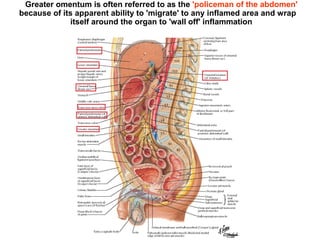
Greater omentum is often referred to as the 'policeman of the abdomen'
because of its apparent ability to 'migrate' to any inflamed area and wrap
itself around the organ to 'wall off' inflammation
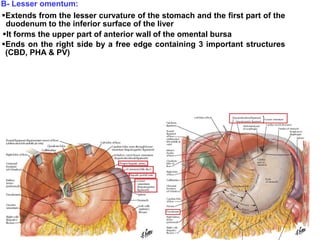
B- Lesser omentum:
Extends from the lesser curvature of the stomach and the first part of the
duodenum to the inferior surface of the liver
It forms the upper part of anterior wall of the omental bursa
Ends on the right side by a free edge containing 3 important structures
(CBD, PHA & PV)
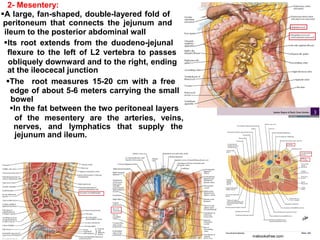
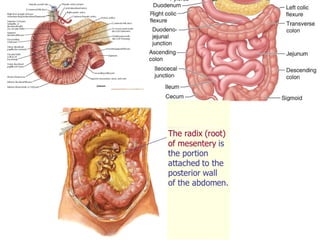
2- Mesentery:
A large, fan-shaped, double-layered fold of
peritoneum that connects the jejunum and
ileum to the posterior abdominal wall
Its root extends from the duodeno-jejunal
flexure to the left of L2 vertebra to passes
obliquely downward and to the right, ending
at the ileocecal junction
The root measures 15-20 cm with a free
edge of about 5-6 meters carrying the small
bowel
In the fat between the two peritoneal layers
of the mesentery are the arteries, veins,
nerves, and lymphatics that supply the
jejunum and ileum.
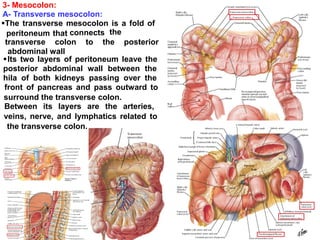
3- Mesocolon:
A- Transverse mesocolon:
The transverse mesocolon is a fold of
peritoneum that connects the
transverse colon to the posterior
abdominal wall
Its two layers of peritoneum leave the
posterior abdominal wall between the
hila of both kidneys passing over the
front of pancreas and pass outward to
surround the transverse colon.

Between its layers are the arteries,
veins, nerve, and lymphatics related to
the transverse colon.
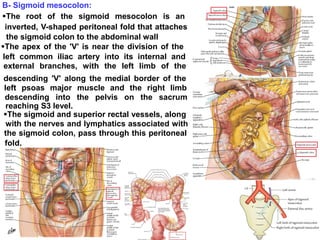
B- Sigmoid mesocolon:
The root of the sigmoid mesocolon is an
inverted, V-shaped peritoneal fold that attaches
the sigmoid colon to the abdominal wall
The apex of the 'V' is near the division of the
left common iliac artery into its internal and
external branches, with the left limb of the
descending 'V' along the medial border of the
left psoas major muscle and the right limb
descending into the pelvis on the sacrum
reaching S3 level.
The sigmoid and superior rectal vessels, along
with the nerves and lymphatics associated with
the sigmoid colon, pass through this peritoneal
fold.
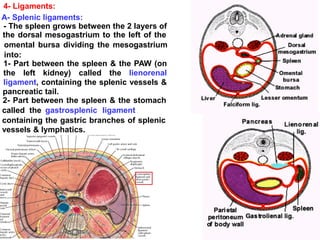
4- Ligaments:
A- Splenic ligaments:
- The spleen grows between the 2 layers of
the dorsal mesogastrium to the left of the
omental bursa dividing the mesogastrium
into:
1- Part between the spleen & the PAW (on
the left kidney) called the lienorenal
ligament, containing the splenic vessels &
pancreatic tail.
2- Part between the spleen & the stomach
called the gastrosplenic ligament
containing the gastric branches of splenic
vessels & lymphatics.
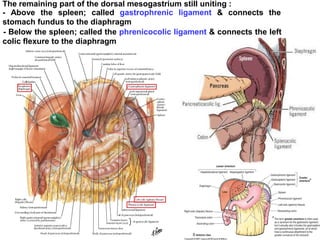
The remaining part of the dorsal mesogastrium still uniting :
- Above the spleen; called gastrophrenic ligament & connects the
stomach fundus to the diaphragm
- Below the spleen; called the phrenicocolic ligament & connects the left
colic flexure to the diaphragm
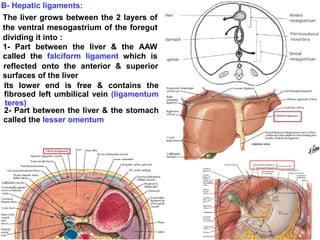
B- Hepatic ligaments:
The liver grows between the 2 layers of
the ventral mesogastrium of the foregut
dividing it into :
1- Part between the liver & the AAW
called the falciform ligament which is
reflected onto the anterior & superior
surfaces of the liver
Its lower end is free & contains the
fibrosed left umbilical vein (ligamentum
teres)
2- Part between the liver & the stomach
called the lesser omentum
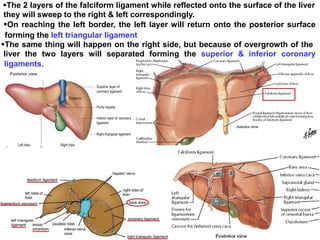
The 2 layers of the falciform ligament while reflected onto the surface of the liver
they will sweep to the right & left correspondingly.
On reaching the left border, the left layer will return onto the posterior surface
forming the left triangular ligament
The same thing will happen on the right side, but because of overgrowth of the
liver the two layers will separated forming the superior & inferior coronary
ligaments.
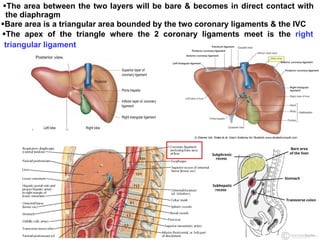
The area between the two layers will be bare & becomes in direct contact with
the diaphragm
Bare area is a triangular area bounded by the two coronary ligaments & the IVC
The apex of the triangle where the 2 coronary ligaments meet is the right
triangular ligament
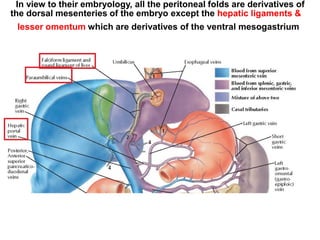
In view to their embryology, all the peritoneal folds are derivatives of
the dorsal mesenteries of the embryo except the hepatic ligaments &
lesser omentum which are derivatives of the ventral mesogastrium
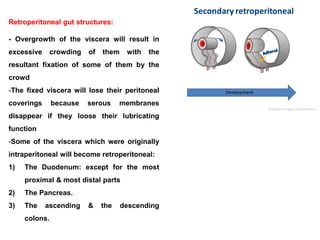
Retroperitoneal gut structures:
- Overgrowth of the viscera will result in
excessive crowding of them with the
resultant fixation of some of them by the
crowd
-The fixed viscera will lose their peritoneal
coverings because serous membranes
disappear if they loose their lubricating
function
-Some of the viscera which were originally
intraperitoneal will become retroperitoneal:
1) The Duodenum: except for the most
proximal & most distal parts
2) The Pancreas.
3) The ascending & the descending
colons.
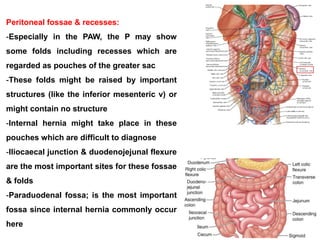
Peritoneal fossae & recesses:
-Especially in the PAW, the P may show
some folds including recesses which are
regarded as pouches of the greater sac
-These folds might be raised by important
structures (like the inferior mesenteric v) or
might contain no structure
-Internal hernia might take place in these
pouches which are difficult to diagnose
-Iliocaecal junction & duodenojejunal flexure
are the most important sites for these fossae
& folds
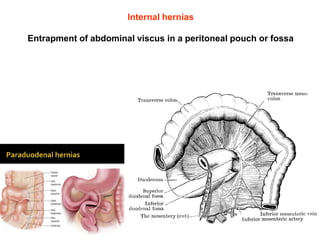
-Paraduodenal fossa; is the most important
fossa since internal hernia commonly occur
here
Internal hernias
Entrapment of abdominal viscus in a peritoneal pouch or fossa

peritoneum

  • 1.
    ANATOMY OF THEG.I.T. The peritoneum
  • 2.
    1- To describethe general arrangement of peritoneal folds. 2- To define the peritoneal cavities. 3- To describe peritoneal arrangement for individual organs. 4- To list the retroperitoneal organs. 5- To locate peritoneal fossae & recesses
  • 3.
     Peritoneum (P)is a transparent serous membrane lining the abdominal cavity, invaginated by (& therefore forms) a smooth covering layer on the abdominal viscera called (visceral P), the part still lining the abdominal cavity is called (parietal P)  P permits free gliding movement of the viscera on each other during their movement & during movements of the abdominal wall & the diaphragm  Different P folds are given different names according to the structure to which the P is related (omentum, mesentery, ligament)  General P cavity is a potential space between the parietal & visceral P, lubricated by few mls of serous fluid
  • 5.
    Parietal peritoneum: Lines theinternal surface of the abdomino-pelvic wall Has same AVNL, as the region of wall that it covers Is sensitive to pressure, pain, heat, cold & laceration Pain from FOREGUT = EPIGASTRIC Pain from MIDGUT = UMBILICAL Pain from HINDGUT = PUBIC
  • 6.
    Visceral peritoneum:  Coversvisceral organs like the stomach & intestines  Has the same AVNL as the organ it covers  Stimulated primarily by stretching & chemical irritation
  • 7.
    Peritoneal arrangement: Abdominal organsin relation to their P coverings are divided into: 1- Intraperitoneal: suspended by P fold to abdominal wall mesentry 2- Retroperitoneal: lie behind the parietal P of the posterior abdominal wall: A)Primary structures: originally extraperitoneal like the kidneys, aorta, IVC .. B)Secondary structures: were intraperitoneal & then became retroP; these are gut & its derivatives like the duodenum, pancreas, ascending colon.. 3- Extraperitoneal: The only extraperitoneal organ is the part of ovary uncovered by mesovarium, it lies in the greater sac & it is uncovered by P!
  • 9.
    The peritoneal cavity: Apotenial space between the two P layers Contain no organs, just lubricating fluid In males, the peritoneal cavity is completely closed In females, connected to outside through the uterine tubes, uterine cavity, & vagina The P cavity is divided into 2 spaces one inside the other (greater & lesser sacs) The only communication between these 2 spaces is the omental (epiploic foramen)
  • 10.
    Greater sac: It isthe general P cavity into which the viscera & its visceral P invaginate. It is accessed by just opening the parietal P of anterior abdominal wall It is divided by the transverse mesocolon into : 1) Supracolic compartment: The part above the transverse mesocolon 2) Infracolic compartment: The part below the transverse mesocolon; divided into: 1,2- Rt & Lt infracolic compartments on each side of the root of mesentery 3,4- Rt & Lt paracolic gutters lying on the lateral aspect of the ascending & descending colons respectively
  • 12.
    Recesses: 1- Subphrenic recess:the pocket between the diaphram & anterosuperior part of liver 2- Hepatorenal recess (Rutherford-Morison’s pouch): - A deep pocket between the liver & right kidney - Comminucates with: •Subphrenic recess •Lesser sac via epoploic foramen •Right paracolic gutter (to pelvic cavity) 3- Paracolic recess (gutters): lateral to A & D colons
  • 13.
    Lesser sac: A bursacreated behind the stomach during the rotation stage It is connected to the greater sac by the epiploic foramen Boundaries of the epiploic foramen: 1- Anteriorly; The lesser omentum containing the 3 structures (CBD, portal v & hepatic artery) 2- Inferiorly; The 1st part of duodenum 3- Posteriorly; IVC 4- Superiorly; Caudate process of the liver
  • 14.
    Boundaries: - Anteriorly; 1- Thelesser omentum 2- Posterior wall of stomach 3- Gastrocolic ligament - Posteriorly: 1- Structures of stomach bed 2- Transverse mesocolon - On the left: Spleen & its ligaments -On the right: Epiploic foramen Recesses: 1- Superior: behind the liver 2- Inferior: behind the stomach 3- Splenic: to the left
  • 16.
    Peritoneal dialysis The largesurface area of the peritoneal cavity is an ideal dialysis membrane for fluid and electrolyte exchange dialysis is the process of removing excess water, solutes, and toxins from the blood in people whose kidneys can no longer perform these functions naturally.Dialysis is used in patients with rapidly developing loss of kidney function, called acute kidney injury (previously called acute renal failure), or slowly worsening kidney function, called Stage 5 chronic kidney disease . Peritoneal dialysis is a way to remove waste products from your blood when your kidneys can't adequately do the job any longer. This procedure filters the bloodIn peritoneal dialysis, a specific solution is introduced through a permanent tube in the lower abdomen (peritoneal cavity) and then removed
  • 17.
    Ventriculo-peritoneal shunt The largesurface area of the peritoneal cavity is an ideal site of absorption of CSF if drained to this membrane by a shunt are commonly used to treat hydrocephalus, the swelling of the brain due to excess buildup of cerebrospinal fluid (CSF). If left unchecked, the cerebrospinal fluid can build up leading to an increase in intracranial pressure (ICP) which can lead to intracranial hematoma, cerebral edema, crushed brain tissue or herniation.[1] The cerebral shunt can be used to alleviate or prevent these problems in patients who suffer from hydrocephalus or other related diseases. Shunts can come in a variety of forms but most of them consist of a valve housing connected to a catheter, the end of which is usually placed in the peritoneal cavity.
  • 18.
    Peritoneum in relationto organs: 1- Omenta: The omenta consist of two layers of peritoneum, which pass from the stomach and the first part of the duodenum to other viscera. There are two: 1- Greater omentum derived from the dorsal mesentery; 2- Lesser omentum derived from the ventral mesentery.
  • 19.
    A- Greater omentum: Thegreater omentum is a large, apron-like, peritoneal fold that attaches to the greater curvature of the stomach and the first part of the duodenum It drapes inferiorly over the transverse colon and the coils of small bowel Turning posteriorly, it ascends to associate with superior surface of transverse mesocolon before arriving at the posterior abdominal wall. The greater omentum always contains an accumulation of fat, which may become substantial in some individuals. The part stretches between the stomach & transverse colon is called (gastrocolic omentm) & bounds the lesser sac anteriorly The part distal to the TC is the (omental apron)
  • 21.
    Greater omentum isoften referred to as the 'policeman of the abdomen' because of its apparent ability to 'migrate' to any inflamed area and wrap itself around the organ to 'wall off' inflammation
  • 22.
    B- Lesser omentum: Extendsfrom the lesser curvature of the stomach and the first part of the duodenum to the inferior surface of the liver It forms the upper part of anterior wall of the omental bursa Ends on the right side by a free edge containing 3 important structures (CBD, PHA & PV)
  • 23.
    2- Mesentery: A large,fan-shaped, double-layered fold of peritoneum that connects the jejunum and ileum to the posterior abdominal wall Its root extends from the duodeno-jejunal flexure to the left of L2 vertebra to passes obliquely downward and to the right, ending at the ileocecal junction The root measures 15-20 cm with a free edge of about 5-6 meters carrying the small bowel In the fat between the two peritoneal layers of the mesentery are the arteries, veins, nerves, and lymphatics that supply the jejunum and ileum.
  • 25.
    3- Mesocolon: A- Transversemesocolon: The transverse mesocolon is a fold of peritoneum that connects the transverse colon to the posterior abdominal wall Its two layers of peritoneum leave the posterior abdominal wall between the hila of both kidneys passing over the front of pancreas and pass outward to surround the transverse colon.  Between its layers are the arteries, veins, nerve, and lymphatics related to the transverse colon.
  • 26.
    B- Sigmoid mesocolon: Theroot of the sigmoid mesocolon is an inverted, V-shaped peritoneal fold that attaches the sigmoid colon to the abdominal wall The apex of the 'V' is near the division of the left common iliac artery into its internal and external branches, with the left limb of the descending 'V' along the medial border of the left psoas major muscle and the right limb descending into the pelvis on the sacrum reaching S3 level. The sigmoid and superior rectal vessels, along with the nerves and lymphatics associated with the sigmoid colon, pass through this peritoneal fold.
  • 27.
    4- Ligaments: A- Splenicligaments: - The spleen grows between the 2 layers of the dorsal mesogastrium to the left of the omental bursa dividing the mesogastrium into: 1- Part between the spleen & the PAW (on the left kidney) called the lienorenal ligament, containing the splenic vessels & pancreatic tail. 2- Part between the spleen & the stomach called the gastrosplenic ligament containing the gastric branches of splenic vessels & lymphatics.
  • 28.
    The remaining partof the dorsal mesogastrium still uniting : - Above the spleen; called gastrophrenic ligament & connects the stomach fundus to the diaphragm - Below the spleen; called the phrenicocolic ligament & connects the left colic flexure to the diaphragm
  • 29.
    B- Hepatic ligaments: Theliver grows between the 2 layers of the ventral mesogastrium of the foregut dividing it into : 1- Part between the liver & the AAW called the falciform ligament which is reflected onto the anterior & superior surfaces of the liver Its lower end is free & contains the fibrosed left umbilical vein (ligamentum teres) 2- Part between the liver & the stomach called the lesser omentum
  • 30.
    The 2 layersof the falciform ligament while reflected onto the surface of the liver they will sweep to the right & left correspondingly. On reaching the left border, the left layer will return onto the posterior surface forming the left triangular ligament The same thing will happen on the right side, but because of overgrowth of the liver the two layers will separated forming the superior & inferior coronary ligaments.
  • 31.
    The area betweenthe two layers will be bare & becomes in direct contact with the diaphragm Bare area is a triangular area bounded by the two coronary ligaments & the IVC The apex of the triangle where the 2 coronary ligaments meet is the right triangular ligament
  • 32.
    In view totheir embryology, all the peritoneal folds are derivatives of the dorsal mesenteries of the embryo except the hepatic ligaments & lesser omentum which are derivatives of the ventral mesogastrium
  • 33.
    Retroperitoneal gut structures: -Overgrowth of the viscera will result in excessive crowding of them with the resultant fixation of some of them by the crowd -The fixed viscera will lose their peritoneal coverings because serous membranes disappear if they loose their lubricating function -Some of the viscera which were originally intraperitoneal will become retroperitoneal: 1) The Duodenum: except for the most proximal & most distal parts 2) The Pancreas. 3) The ascending & the descending colons.
  • 34.
    Peritoneal fossae &recesses: -Especially in the PAW, the P may show some folds including recesses which are regarded as pouches of the greater sac -These folds might be raised by important structures (like the inferior mesenteric v) or might contain no structure -Internal hernia might take place in these pouches which are difficult to diagnose -Iliocaecal junction & duodenojejunal flexure are the most important sites for these fossae & folds -Paraduodenal fossa; is the most important fossa since internal hernia commonly occur here
  • 35.
    Internal hernias Entrapment ofabdominal viscus in a peritoneal pouch or fossa