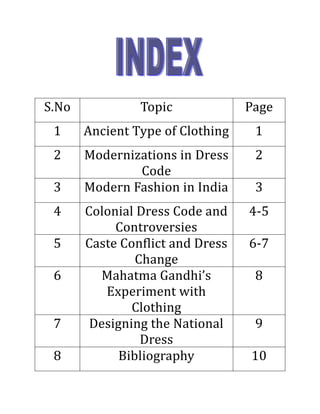
S.No               Topic             Page
       1      Ancient Type of Clothing     1
       2       Modernizations in Dress     2
                       Code
       3       Modern Fashion in India     3
       4       Colonial Dress Code and    4-5
                    Controversies
       5       Caste Conflict and Dress   6-7
                        Change
       6         Mahatma Gandhi’s          8
                  Experiment with
                       Clothing
       7        Designing the National     9
                         Dress
       8             Bibliography         10

Nilesh Maheshwari
Ancient type of Clothing
    People in India wore mostly cotton clothing. India was the first
    place where cotton was grown, even as early as 2500 BC in the
    Harappan period.
    By the Aryan period, women wore one very long piece
    of cloth called a sari that they wrapped around themselves in
    different ways. The word “SARI” comes from a Sanskrit word
    that just means cloth. Saris are first mentioned in the Vedas,
    about 600 BC. Rich women wore saris made of silk, but most
    women wore cotton ones. There were many different ways of
    draping saris – to dress up women wore them like skirts with a
    top part thrown over their shoulder or worn over their heads
    as a veil. Working women often pulled their sari up between
    their legs to make a sort of pants. Women who were fighting
    with the army tucked in the top part of the sari in the back, to
    free up their arms for fighting. Most saris were five or six yards
    long, although some saris were nine yards. Younger women
    generally wore brightly coloured saris, but widows and other
    women in mourning wore only white ones.
    Men also wore one long piece of cloth called the dhoti, which
    was generally white. They wrapped the “DHOTI” around their
    legs to make sort of pants like the working women. Dhotis
    though were shorter so they didn’t have the part that covered
    the chest and shoulders. Men also often wore long cotton cloths
    wrapped around their heads as turbans.


Nilesh Maheshwari
Modernizations in Dress Code
    India is known across the world for its diverse and colorful dresses.
    Indian saris and salwar suits are known for their beautiful designs
    and patterns. The modern Indian clothing is a blend and an effect of
    various cultures and nationalities that made India their home in the
    ancient times. Hence, the Indian clothes you see today are a reflection
    of various changes in the Indian history.

    Harappan Period --2500 BC-India was perhaps the first country to
    grow cotton in the Harappan period. In this period, people mostly
    wore cotton clothing. Women generally wore a long cotton cloth called
    sari.

    Aryan Period --1500 BC-During this period, most women wore sari
    that could be draped in different ways. The material generally used
    was cotton for the poor and silk for the rich. The men wore pieces of
    white cloth around their waste in a pants-like fashion, which was
    known as dhoti.

    Islamic Period -- 1000 AD-With the invasion of the Islamic rulers,
    Indian fashion underwent a great change. While sari and dhoti were
    still popular, women also started wearing long tunics with trousers
    called salwar kameez, which were accompanied by a scarf.

    19th Century-The 19th century saw a lot of modifications to Indian
    clothing. The Western and Islamic influences were greatly seen in the
    Indian saris and salwar kameez.

    21st Century-The modern Indian clothing is now a confluence of
    Eastern and Western cultures. Westernized salwar kameez and other
    new fashionable attire have modernized the traditional Indian
    clothing.


Nilesh Maheshwari
Modern Fashion in India
    Many aspects of Western Fashion have become common
    among Indian men, particularly in the professional
    community. Horizontal stripes and plaids are common on
    casual business shirts. Owing to growth of women
    empowerment and influence of western culture, nowadays
    most of the teen and adult girls in cities wear low hip jeans,
    low neck tops, tight jean trousers with salwar, half trousers,
    sleeveless T shirts etc.
    The most accepted formal dressing for couples in formal
    occasions like parties and weddings is saree for the ladies
    and formal pants and shirts with suits in the winter for the
    men.
    The Indian women have however modernized and working
    women find Western Wear like shirts and trousers a
    comfortable dressing option to work. With entry of
    international Fashion brands like FCUK, DNKY, Guess and
    many more, Indian women are increasingly becoming
    fashionable. Among the league of high fashion international
    brands, a domestic brand, MADAME has also gained
    popularity. Next in the category are Globus, Black Berry’s,
    Allen Solly, Park Avenue and Van Heusen.


Nilesh Maheshwari
COLONIAL DRESS CODES AND
            CONTROVERSIES
    Fashion had more to do with Indian independence than
    what most people know. Because the British did not let any
    Indian wear their own cloth the Indians started to fight
    back. Clothes became a symbol for the struggle of Indian’s
    independence. Women’s fashion was only slightly affected
    during this period of time whereas the men’s clothing
    entirely changed. Men had to wear items such as shirts and
    trousers which were unheard of in India before the British
    came                                                  along.
    Traditional "office" clothing was introduce to India, this
    include the suit and tie which was greatly unpopular
    because of Indian weather. In different cultures, specific
    items of clothing often convey contrary meanings. This
    frequently leads to misunderstanding and conflict. Styles of
    clothing in British India changed through such conflicts.


    When European traders first began frequenting India, they
    were distinguished from the Indian 'turban wearers' as the
    'hat wearers.' These two headgears not only looked
    different, they also signified different things. The turban in
    India was not just for protection from the heat but was a
    sign of respectability, and could not be removed at will. In
    the Western tradition, the hat had to be removed before

Nilesh Maheshwari
social superiors as a sign of respect. This cultural difference
    created misunderstanding. The British were often offended
    if Indians did not take off their turban when they met
    colonial officials. Many Indians on the other hand wore the
    turban to consciously assert their regional or national
    identity.
    Another such conflict related to the wearing of shoes. At the
    beginning of the nineteenth century, it was customary for
    British officials to follow Indian etiquette and remove their
    footwear in the courts of ruling kings or chiefs. Some British
    officials also wore Indian clothes. But in 1830, Europeans
    were forbidden from wearing Indian clothes at official
    functions, so that the cultural identity of the white masters
    was not undermined.
    At the same time, Indians were expected to wear Indian
    clothes to office and follow Indian dress codes. In 1824 -
    1828, Governor-General Amherst insisted that Indians take
    their shoes off as a sign of respect when they appeared
    before him, but this was not strictly followed. By the mid-
    nineteenth century, when Lord Dalhousie was Governor-
    General, 'shoe respect' was made stricter, and Indians were
    made to take off their shoes when entering any government
    institution; only those who wore European clothes were
    exempted from this rule.


Nilesh Maheshwari
Caste Conflict and Dress Change
    India had its own strict social codes of food and dress.
    The caste system clearly defined what subordinate and
    dominant caste Hindus should wear, eat, etc., and these
    codes had the force of law. Changes in clothing styles
    that threatened these norms therefore often created
    violent social reactions.
    In May 1822, women of the Shanar caste were attacked
    by upper-caste Nairs in public places in the southern
    princely state of Travancore, for wearing a cloth across
    their upper bodies. Over subsequent decades, a violent
    conflict over dress codes ensued.
    The Shanars (also called Nadars) were considered a
    'subordinate caste’; they were prohibited from using
    umbrellas and wearing shoes or golden ornaments. Men
    and women were also expected to follow the local
    custom of never covering their upper bodies before the
    upper castes.
    Under the influence of Christian missions, Shanar
    women converts began in the 1820s to wear tailored
    blouses and cloths to cover themselves like the upper
    castes. Soon Nairs, one of the upper castes of the region,
    attacked these women in public places and tore off their
    upper cloths. Complaints were also filed in court against
    this dress change, especially since Shanars were also
    refusing to render free labour for the upper castes.


Nilesh Maheshwari
At first, the Government of Travancore issued a
    proclamation in 1829 ordering Shanar women 'to
    abstain in future from covering the upper parts of the
    body.' But this did not prevent Shanar Christian women,
    and even Shanar Hindus, from adopting the blouse and
    upper cloth.
    The abolition of slavery in Travancore in 1855 led to
    even more frustration among the upper castes who felt
    they were losing control. In October 1859, riots broke
    out as Shanar women were attacked in the marketplace
    and stripped of their upper cloths. Houses were looted
    and chapels burned. Finally, the government issued
    another proclamation permitting Shanar women,
    whether Christian or Hindu, to wear a jacket, or cover
    their upper bodies 'in any manner whatever, but not like
    the women of high caste'.


Nilesh Maheshwari
Mahatma Gandhi's Experiments
            with Clothing
    Gandhi adopted the clothing style of most Indians in the early
    20th century. His adoption of khadi, or homespun cloth, was
    intended to help eradicate the evils of poverty, social and
    economic discrimination. It was also aimed as a challenge to
    the contrast that he saw between most Indians, who were poor
    and traditional, and the richer classes of educated, liberal-
    minded Indians who had adopted Western mannerisms,
    clothing and practices.


    The clothing policy was designed to protest against the violence
    of British economic policies in India. Millions of poor Indian
    workers had been left unemployed and entrenched in poverty,
    owing to the industrialization of cotton processing in Britain.
    Gandhi promoted khadi as a direct boycott of the ‘Lancashire’
    cotton industry, linking British imperialism to Indian poverty.
    He focused on persuading all members of the Indian National
    Congress to spend some time each day hand-spinning on the
    charkha (spinning wheel). In addition to its point as an
    economic campaign, the drive for hand-spinning was an
    attempt to connect the privileged Indian Brahmins and lawyers
    of Congress to connect with the mass of Indian peasantry.
    Many prominent figures of the Indian independence movement,
    including Motilal Nehru, were persuaded by Gandhi to
    renounce their smart London-made clothes in favour of khadi.


Nilesh Maheshwari
Designing the National Dress

    The Tagore family of Bengal experimented, beginning in the
    1870s, with designs for a national dress for both men and
    women in India. Rabindranath Tagore suggested that
    instead of combining Indian and European dress, India's
    national dress should combine elements of Hindu and
    Muslim dress. Thus the Chapman (a long buttoned coat) was
    considered the most suitable dress for men.

    In the late 1870s, Jnanadanandini Devi, wife of
    Satyendranath Tagore, She adopted the Parsi style of
    wearing the sari pinned to the left shoulder with a brooch,
    and worn with a blouse and shoes. This was quickly
    adopted by Brahmo Samaji women and came to be known
    as the Brahmika sari.


Nilesh Maheshwari

Clothing

  • 1.
    S.No Topic Page 1 Ancient Type of Clothing 1 2 Modernizations in Dress 2 Code 3 Modern Fashion in India 3 4 Colonial Dress Code and 4-5 Controversies 5 Caste Conflict and Dress 6-7 Change 6 Mahatma Gandhi’s 8 Experiment with Clothing 7 Designing the National 9 Dress 8 Bibliography 10 Nilesh Maheshwari
  • 2.
    Ancient type ofClothing People in India wore mostly cotton clothing. India was the first place where cotton was grown, even as early as 2500 BC in the Harappan period. By the Aryan period, women wore one very long piece of cloth called a sari that they wrapped around themselves in different ways. The word “SARI” comes from a Sanskrit word that just means cloth. Saris are first mentioned in the Vedas, about 600 BC. Rich women wore saris made of silk, but most women wore cotton ones. There were many different ways of draping saris – to dress up women wore them like skirts with a top part thrown over their shoulder or worn over their heads as a veil. Working women often pulled their sari up between their legs to make a sort of pants. Women who were fighting with the army tucked in the top part of the sari in the back, to free up their arms for fighting. Most saris were five or six yards long, although some saris were nine yards. Younger women generally wore brightly coloured saris, but widows and other women in mourning wore only white ones. Men also wore one long piece of cloth called the dhoti, which was generally white. They wrapped the “DHOTI” around their legs to make sort of pants like the working women. Dhotis though were shorter so they didn’t have the part that covered the chest and shoulders. Men also often wore long cotton cloths wrapped around their heads as turbans. Nilesh Maheshwari
  • 3.
    Modernizations in DressCode India is known across the world for its diverse and colorful dresses. Indian saris and salwar suits are known for their beautiful designs and patterns. The modern Indian clothing is a blend and an effect of various cultures and nationalities that made India their home in the ancient times. Hence, the Indian clothes you see today are a reflection of various changes in the Indian history. Harappan Period --2500 BC-India was perhaps the first country to grow cotton in the Harappan period. In this period, people mostly wore cotton clothing. Women generally wore a long cotton cloth called sari. Aryan Period --1500 BC-During this period, most women wore sari that could be draped in different ways. The material generally used was cotton for the poor and silk for the rich. The men wore pieces of white cloth around their waste in a pants-like fashion, which was known as dhoti. Islamic Period -- 1000 AD-With the invasion of the Islamic rulers, Indian fashion underwent a great change. While sari and dhoti were still popular, women also started wearing long tunics with trousers called salwar kameez, which were accompanied by a scarf. 19th Century-The 19th century saw a lot of modifications to Indian clothing. The Western and Islamic influences were greatly seen in the Indian saris and salwar kameez. 21st Century-The modern Indian clothing is now a confluence of Eastern and Western cultures. Westernized salwar kameez and other new fashionable attire have modernized the traditional Indian clothing. Nilesh Maheshwari
  • 4.
    Modern Fashion inIndia Many aspects of Western Fashion have become common among Indian men, particularly in the professional community. Horizontal stripes and plaids are common on casual business shirts. Owing to growth of women empowerment and influence of western culture, nowadays most of the teen and adult girls in cities wear low hip jeans, low neck tops, tight jean trousers with salwar, half trousers, sleeveless T shirts etc. The most accepted formal dressing for couples in formal occasions like parties and weddings is saree for the ladies and formal pants and shirts with suits in the winter for the men. The Indian women have however modernized and working women find Western Wear like shirts and trousers a comfortable dressing option to work. With entry of international Fashion brands like FCUK, DNKY, Guess and many more, Indian women are increasingly becoming fashionable. Among the league of high fashion international brands, a domestic brand, MADAME has also gained popularity. Next in the category are Globus, Black Berry’s, Allen Solly, Park Avenue and Van Heusen. Nilesh Maheshwari
  • 5.
    COLONIAL DRESS CODESAND CONTROVERSIES Fashion had more to do with Indian independence than what most people know. Because the British did not let any Indian wear their own cloth the Indians started to fight back. Clothes became a symbol for the struggle of Indian’s independence. Women’s fashion was only slightly affected during this period of time whereas the men’s clothing entirely changed. Men had to wear items such as shirts and trousers which were unheard of in India before the British came along. Traditional "office" clothing was introduce to India, this include the suit and tie which was greatly unpopular because of Indian weather. In different cultures, specific items of clothing often convey contrary meanings. This frequently leads to misunderstanding and conflict. Styles of clothing in British India changed through such conflicts. When European traders first began frequenting India, they were distinguished from the Indian 'turban wearers' as the 'hat wearers.' These two headgears not only looked different, they also signified different things. The turban in India was not just for protection from the heat but was a sign of respectability, and could not be removed at will. In the Western tradition, the hat had to be removed before Nilesh Maheshwari
  • 6.
    social superiors asa sign of respect. This cultural difference created misunderstanding. The British were often offended if Indians did not take off their turban when they met colonial officials. Many Indians on the other hand wore the turban to consciously assert their regional or national identity. Another such conflict related to the wearing of shoes. At the beginning of the nineteenth century, it was customary for British officials to follow Indian etiquette and remove their footwear in the courts of ruling kings or chiefs. Some British officials also wore Indian clothes. But in 1830, Europeans were forbidden from wearing Indian clothes at official functions, so that the cultural identity of the white masters was not undermined. At the same time, Indians were expected to wear Indian clothes to office and follow Indian dress codes. In 1824 - 1828, Governor-General Amherst insisted that Indians take their shoes off as a sign of respect when they appeared before him, but this was not strictly followed. By the mid- nineteenth century, when Lord Dalhousie was Governor- General, 'shoe respect' was made stricter, and Indians were made to take off their shoes when entering any government institution; only those who wore European clothes were exempted from this rule. Nilesh Maheshwari
  • 7.
    Caste Conflict andDress Change India had its own strict social codes of food and dress. The caste system clearly defined what subordinate and dominant caste Hindus should wear, eat, etc., and these codes had the force of law. Changes in clothing styles that threatened these norms therefore often created violent social reactions. In May 1822, women of the Shanar caste were attacked by upper-caste Nairs in public places in the southern princely state of Travancore, for wearing a cloth across their upper bodies. Over subsequent decades, a violent conflict over dress codes ensued. The Shanars (also called Nadars) were considered a 'subordinate caste’; they were prohibited from using umbrellas and wearing shoes or golden ornaments. Men and women were also expected to follow the local custom of never covering their upper bodies before the upper castes. Under the influence of Christian missions, Shanar women converts began in the 1820s to wear tailored blouses and cloths to cover themselves like the upper castes. Soon Nairs, one of the upper castes of the region, attacked these women in public places and tore off their upper cloths. Complaints were also filed in court against this dress change, especially since Shanars were also refusing to render free labour for the upper castes. Nilesh Maheshwari
  • 8.
    At first, theGovernment of Travancore issued a proclamation in 1829 ordering Shanar women 'to abstain in future from covering the upper parts of the body.' But this did not prevent Shanar Christian women, and even Shanar Hindus, from adopting the blouse and upper cloth. The abolition of slavery in Travancore in 1855 led to even more frustration among the upper castes who felt they were losing control. In October 1859, riots broke out as Shanar women were attacked in the marketplace and stripped of their upper cloths. Houses were looted and chapels burned. Finally, the government issued another proclamation permitting Shanar women, whether Christian or Hindu, to wear a jacket, or cover their upper bodies 'in any manner whatever, but not like the women of high caste'. Nilesh Maheshwari
  • 9.
    Mahatma Gandhi's Experiments with Clothing Gandhi adopted the clothing style of most Indians in the early 20th century. His adoption of khadi, or homespun cloth, was intended to help eradicate the evils of poverty, social and economic discrimination. It was also aimed as a challenge to the contrast that he saw between most Indians, who were poor and traditional, and the richer classes of educated, liberal- minded Indians who had adopted Western mannerisms, clothing and practices. The clothing policy was designed to protest against the violence of British economic policies in India. Millions of poor Indian workers had been left unemployed and entrenched in poverty, owing to the industrialization of cotton processing in Britain. Gandhi promoted khadi as a direct boycott of the ‘Lancashire’ cotton industry, linking British imperialism to Indian poverty. He focused on persuading all members of the Indian National Congress to spend some time each day hand-spinning on the charkha (spinning wheel). In addition to its point as an economic campaign, the drive for hand-spinning was an attempt to connect the privileged Indian Brahmins and lawyers of Congress to connect with the mass of Indian peasantry. Many prominent figures of the Indian independence movement, including Motilal Nehru, were persuaded by Gandhi to renounce their smart London-made clothes in favour of khadi. Nilesh Maheshwari
  • 10.
    Designing the NationalDress The Tagore family of Bengal experimented, beginning in the 1870s, with designs for a national dress for both men and women in India. Rabindranath Tagore suggested that instead of combining Indian and European dress, India's national dress should combine elements of Hindu and Muslim dress. Thus the Chapman (a long buttoned coat) was considered the most suitable dress for men. In the late 1870s, Jnanadanandini Devi, wife of Satyendranath Tagore, She adopted the Parsi style of wearing the sari pinned to the left shoulder with a brooch, and worn with a blouse and shoes. This was quickly adopted by Brahmo Samaji women and came to be known as the Brahmika sari. Nilesh Maheshwari