ASME & API CODE WHICH RELATED
WITH PROJECT PHASE 22 & 24
MAINTENANCE TEAM
PROJECT DESIGN SPECIFICATION
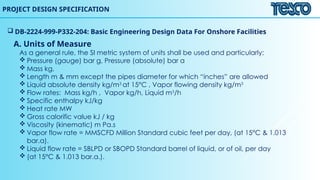
 DB-2224-999-P332-204: Basic Engineering Design Data For Onshore Facilities
A. Units of Measure
As a general rule, the SI metric system of units shall be used and particularly:
 Pressure (gauge) bar g, Pressure (absolute) bar a
 Mass kg,
 Length m & mm except the pipes diameter for which “inches” are allowed
 Liquid absolute density kg/m3
at 15°C , Vapor flowing density kg/m3
 Flow rates: Mass kg/h , Vapor kg/h, Liquid m3
/h
 Specific enthalpy kJ/kg
 Heat rate MW
 Gross calorific value kJ / kg
 Viscosity (kinematic) m Pa.s
 Vapor flow rate = MMSCFD Million Standard cubic feet per day, (at 15°C & 1.013
bar.a).
 Liquid flow rate = SBLPD or SBOPD Standard barrel of liquid, or of oil, per day
 (at 15°C & 1.013 bar.a.).
B. Service Life
The design service life of the onshore plant is
25 years.
PROJECT DESIGN SPECIFICATION
C. Noise Level
The noise level at the plant boundary shall not
exceed 70 dB(A).
PROJECT DESIGN SPECIFICATION
D. Unprotected surface max. temperature
70° C
PROJECT DESIGN SPECIFICATION
E. Water
Desalinated water produced from sea water feeds, eventually after
treatment, is used in the following systems:
♦ Drinking water
♦ Fire water
♦ Utility water
♦ Demineralized water
♦ Chilled cooling water (restricted use to machine cooling)
♦ Boiler Feed water (HP and LP levels)
PROJECT DESIGN SPECIFICATION
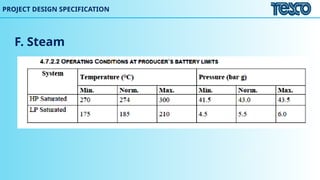
F. Steam
PROJECT DESIGN SPECIFICATION
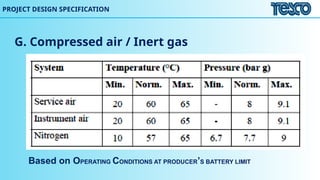
G. Compressed air / Inert gas
Based on OPERATING CONDITIONS AT PRODUCER’S BATTERY LIMIT
PROJECT DESIGN SPECIFICATION
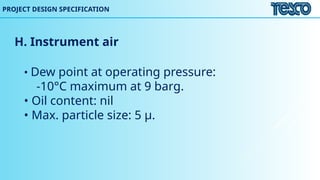
H. Instrument air
• Dew point at operating pressure:
-10°C maximum at 9 barg.
• Oil content: nil
• Max. particle size: 5 μ.
PROJECT DESIGN SPECIFICATION
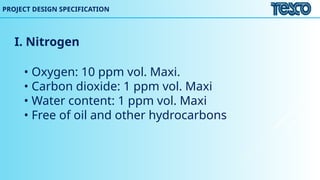
I. Nitrogen
• Oxygen: 10 ppm vol. Maxi.
• Carbon dioxide: 1 ppm vol. Maxi
• Water content: 1 ppm vol. Maxi
• Free of oil and other hydrocarbons
PROJECT DESIGN SPECIFICATION
WHAT IS THE ASME CODE AND WHY IS IT IMPORTANT?
A Code is:
An accepted set of rule or regulations governing a specific activity.
If we have no any fabrication code, all equipment could not
be guaranteed
All equipment are fabricate based on minimum
requirement of codes & standards
WHAT IS THE ASME CODE AND WHY IS IT IMPORTANT?
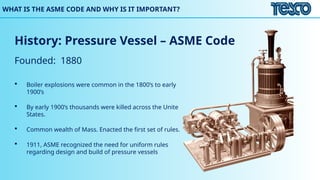
History: Pressure Vessel – ASME Code
Founded: 1880
 Boiler explosions were common in the 1800’s to early
1900’s
 By early 1900’s thousands were killed across the Unite
States.
 Common wealth of Mass. Enacted the first set of rules.
 1911, ASME recognized the need for uniform rules
regarding design and build of pressure vessels
WHAT IS THE ASME CODE AND WHY IS IT IMPORTANT?
ASME Code & Standards
Component standards to ensure dimensional
compatibility and to provide pressure / temperature
ratings of piping, pipe threads, flanges, fittings,
gaskets, etc.
Piping design and construction standards.
Boilers and pressure vessels.
In-service inspection, fitness-for-service evaluation,
repair and testing.
12 volume or code sections:
I. Power Boilers
II. Materials
III. Rules for Construction of Nuclear Facility Components
IV. Heating Boilers
V. Nondestructive Examination
VI. Recommended Rules for the Care and Operation of Heating Boilers
VII. Recommended Guidelines for the Care of Power Boilers
VIII. Pressure Vessels
IX. Welding and Brazing Qualifications
X. Fiber-Reinforced Plastic Pressure Vessels
XI. Rules for In-service Inspection of Nuclear Power Plant Components
XII. Rules for Construction and Continued Service of Transport Tanks
BOILER AND PRESSURE VESSEL CODE
I. POWER BOILERS
 This Section provides requirements for all methods of construction of :
 power, electric, and miniature boilers;
 high temperature water boilers used in stationary service;
 and power boilers used in locomotive, portable, and traction service.
 And Requirements for:
 Boilers Fabricated by Welding;
 Boilers Fabricated by Riveting (by reference only);
 Watertube Boilers;
 Firetube Boilers;
 Feedwater Heaters;
 Miniature Boilers;
 Electric Boilers;
 Organic Fluid Vaporizer Generators.
BOILER AND PRESSURE VESSEL CODE
II. MATERIALS
 Part A-Ferrous Material Specifications
 Part B-Nonferrous Material Specifications
 Part C-Specifications for Welding Rods, Electrodes, and Filler Metals
 Part D-Properties
BOILER AND PRESSURE VESSEL CODE
 This Subsection provides requirements for:
 design, fabrication, installation and inspection of steam generating boilers,
 hot water boilers intended for low pressure service that are directly fired by oil,
gas, electricity, or coal.
 It contains appendices which cover approval of new material, methods of
checking safety valve and safety relief valve capacity,
 examples of methods of checking safety valve and safety relief valve capacity,
 examples of methods of calculation and computation, definitions relating to boiler
design and welding, and quality control systems.
IV. HEATING BOILERS
BOILER AND PRESSURE VESSEL CODE
V. NONDESTRUCTIVE EXAMINATION
 Requirements and methods for nondestructive examination which are
referenced and required by other code Sections.
 It also includes manufacturer's examination responsibilities, duties of
authorized inspectors and requirements for qualification of personnel,
inspection and examination.
 Examination methods are intended to detect surface and internal
discontinuities in materials, welds, and fabricated parts and
components.
 A glossary of related terms is included.
BOILER AND PRESSURE VESSEL CODE
VI. RECOMMENDED RULES FOR THE CARE AND OPERATION
OF HEATING BOILERS
 General descriptions, terminology and operation
guidelines applicable to steel and cast iron boilers limited
to the operating ranges of Section IV Heating Boilers.
 It includes guidelines for associated controls and
automatic fuel burning equipment.
 Illustrations show typical examples of available equipment.
 Also included is a glossary of terms commonly associated
with boilers, controls, and fuel burning equipment.
BOILER AND PRESSURE VESSEL CODE
VII. RECOMMENDED GUIDELINES FOR THE CARE OF
POWER BOILERS
 Guidelines to promote safety in the use of stationary, portable, and traction type heating
boilers.
 The section provides guidelines to assist operators of power boilers in maintaining their plants
as safely as possible.
 Emphasis has been placed on industrial-type boilers because of their extensive use. Contains
Fuels for Routine Operation;
 Operating and Maintaining Boiler Appliances;
 Inspection;
 Prevention of Direct Causes of Boiler Failure;
 Design of Installation;
 Operation of Boiler Auxiliaries;
 Control of Internal Chemical Conditions
BOILER AND PRESSURE VESSEL CODE
VIII. PRESSURE VESSELS
 Division 1 - Provides requirements applicable to the design, fabrication, inspection,
testing, and certification of pressure vessels operating at either internal or external
pressures exceeding 15 psig.
 Division 2 - Alternative Rules, provides requirements applicable to the design,
fabrication, inspection, testing, and certification of pressure vessels operating at either
internal or external pressures exceeding 15 psig.
 Division 3 - Alternative Rules for Construction of High Pressure Vessels, provides
requirements applicable to the design, fabrication, inspection, testing, and
certification of pressure vessels operating at either internal or external pressures
generally above 10,000 psi.
BOILER AND PRESSURE VESSEL CODE
IX. WELDING AND BRAZING QUALIFICATIONS
 Rules relating to the qualification of welding and brazing procedures as required by other
Code Sections for component manufacture.
 Covers rules relating to the qualification and re-qualification of welders, brazers, and welding
and brazing operators in order that they may perform welding or brazing as required by other
Code Sections in the manufacture of components.
 General Welding Requirements
 Welding Procedure Qualifications;
 Welding Performance Qualifications;
 Welding Data;
 Welding Forms;
 General Brazing Requirements
 Brazing Procedure Qualifications;
 Brazing Performance Qualifications;
 Brazing Data;
 Brazing Forms.
BOILER AND PRESSURE VESSEL CODE
X. FIBER-REINFORCED PLASTIC PRESSURE VESSELS
 Requirements for construction of an FRP pressure vessel in
conformance with a manufacturer's design report.
 It includes production, processing, fabrication, inspection
and testing methods required for the vessel.
BOILER AND PRESSURE VESSEL CODE
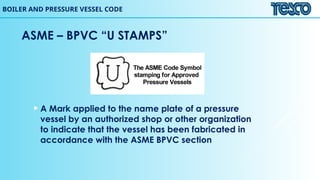
ASME – BPVC “U STAMPS”
 A Mark applied to the name plate of a pressure
vessel by an authorized shop or other organization
to indicate that the vessel has been fabricated in
accordance with the ASME BPVC section
BOILER AND PRESSURE VESSEL CODE
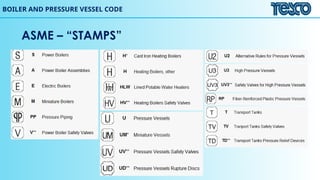
ASME – “STAMPS”
PRESSURE PIPING CODE
 B31.1 - Power Piping
 B31.2 – Fuels Gas Piping
 B31.3 - Process Piping
 B31.4 - Pipeline Transportation Systems for Liquid Hydrocarbons and Other Liquids
 B31.5 - Refrigeration Piping
 B31.8 - Gas Transportation and Distribution Piping
 B31.9 - Building Services Piping
 B31.11 - Slurry Transportation Piping Systems
 B31.12 - hydrogen piping
 B31G - Manual for Determining Remaining Strength of Corroded Pipelines
THE ASME PRESSURE PIPING CODE (B31)
B31.8 - Gas Transportation and Distribution Piping
Design, Fabrication, operation, and Testing Terms
 Chapter I : Materials and equipment
 Chapter II : Welding
 Chapter III : Piping system components and Fabrication Details
 Chapter IV : Design, Installation and Testing
 Chapter V : Operation and Maintenance Procedure
 Chapter VI : Corrosion Control
 Chapter VII : Miscellaneous
 Chapter VIII : Offshore Gas Transmission
PRESSURE PIPING CODE
API CODE
API Background
 March 20, 1919: API founded as non-
profit national trade association
 1923: Standards Department was
formed and the first standards on
pipe sizes, threads, and couplings
were published in the following year
API CODE
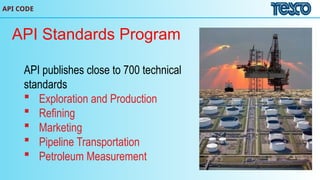
API Standards Program
API publishes close to 700 technical
standards
 Exploration and Production
 Refining
 Marketing
 Pipeline Transportation
 Petroleum Measurement
API CODE
API Code & Standards
 API SPEC 5L :Specification for Line Pipe
 API STD 605 : Large Diameter Carbon Steel
 API STD 620 : Design and Construction of Large, Welded, Low-Pressure
Tanks
 API STD 650 : Welded Steel Tanks for Oil Storage
 API 510 : Pressure Vessel Inspection Code
 API 570 : Piping Inspection Code
 API RP 571 : Damage Mechanisms Affecting Fixed Equip. in Refining
industry
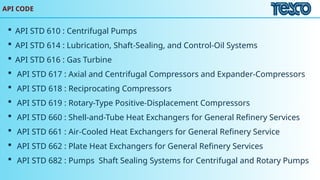
API CODE
 API STD 610 : Centrifugal Pumps
 API STD 614 : Lubrication, Shaft-Sealing, and Control-Oil Systems
 API STD 616 : Gas Turbine
 API STD 617 : Axial and Centrifugal Compressors and Expander-Compressors
 API STD 618 : Reciprocating Compressors
 API STD 619 : Rotary-Type Positive-Displacement Compressors
 API STD 660 : Shell-and-Tube Heat Exchangers for General Refinery Services
 API STD 661 : Air-Cooled Heat Exchangers for General Refinery Service
 API STD 662 : Plate Heat Exchangers for General Refinery Services
 API STD 682 : Pumps Shaft Sealing Systems for Centrifugal and Rotary Pumps
THANK YOU

ASME_and_API_code FOR OIL& GAS (1).pptx

  • 1.
    ASME & APICODE WHICH RELATED WITH PROJECT PHASE 22 & 24 MAINTENANCE TEAM
  • 2.
    PROJECT DESIGN SPECIFICATION DB-2224-999-P332-204: Basic Engineering Design Data For Onshore Facilities A. Units of Measure As a general rule, the SI metric system of units shall be used and particularly:  Pressure (gauge) bar g, Pressure (absolute) bar a  Mass kg,  Length m & mm except the pipes diameter for which “inches” are allowed  Liquid absolute density kg/m3 at 15°C , Vapor flowing density kg/m3  Flow rates: Mass kg/h , Vapor kg/h, Liquid m3 /h  Specific enthalpy kJ/kg  Heat rate MW  Gross calorific value kJ / kg  Viscosity (kinematic) m Pa.s  Vapor flow rate = MMSCFD Million Standard cubic feet per day, (at 15°C & 1.013 bar.a).  Liquid flow rate = SBLPD or SBOPD Standard barrel of liquid, or of oil, per day  (at 15°C & 1.013 bar.a.).
  • 3.
    B. Service Life Thedesign service life of the onshore plant is 25 years. PROJECT DESIGN SPECIFICATION
  • 4.
    C. Noise Level Thenoise level at the plant boundary shall not exceed 70 dB(A). PROJECT DESIGN SPECIFICATION
  • 5.
    D. Unprotected surfacemax. temperature 70° C PROJECT DESIGN SPECIFICATION
  • 6.
    E. Water Desalinated waterproduced from sea water feeds, eventually after treatment, is used in the following systems: ♦ Drinking water ♦ Fire water ♦ Utility water ♦ Demineralized water ♦ Chilled cooling water (restricted use to machine cooling) ♦ Boiler Feed water (HP and LP levels) PROJECT DESIGN SPECIFICATION
  • 7.
  • 8.
    G. Compressed air/ Inert gas Based on OPERATING CONDITIONS AT PRODUCER’S BATTERY LIMIT PROJECT DESIGN SPECIFICATION
  • 9.
    H. Instrument air •Dew point at operating pressure: -10°C maximum at 9 barg. • Oil content: nil • Max. particle size: 5 μ. PROJECT DESIGN SPECIFICATION
  • 10.
    I. Nitrogen • Oxygen:10 ppm vol. Maxi. • Carbon dioxide: 1 ppm vol. Maxi • Water content: 1 ppm vol. Maxi • Free of oil and other hydrocarbons PROJECT DESIGN SPECIFICATION
  • 11.
    WHAT IS THEASME CODE AND WHY IS IT IMPORTANT? A Code is: An accepted set of rule or regulations governing a specific activity. If we have no any fabrication code, all equipment could not be guaranteed All equipment are fabricate based on minimum requirement of codes & standards
  • 12.
    WHAT IS THEASME CODE AND WHY IS IT IMPORTANT? History: Pressure Vessel – ASME Code Founded: 1880  Boiler explosions were common in the 1800’s to early 1900’s  By early 1900’s thousands were killed across the Unite States.  Common wealth of Mass. Enacted the first set of rules.  1911, ASME recognized the need for uniform rules regarding design and build of pressure vessels
  • 13.
    WHAT IS THEASME CODE AND WHY IS IT IMPORTANT? ASME Code & Standards Component standards to ensure dimensional compatibility and to provide pressure / temperature ratings of piping, pipe threads, flanges, fittings, gaskets, etc. Piping design and construction standards. Boilers and pressure vessels. In-service inspection, fitness-for-service evaluation, repair and testing.
  • 14.
    12 volume orcode sections: I. Power Boilers II. Materials III. Rules for Construction of Nuclear Facility Components IV. Heating Boilers V. Nondestructive Examination VI. Recommended Rules for the Care and Operation of Heating Boilers VII. Recommended Guidelines for the Care of Power Boilers VIII. Pressure Vessels IX. Welding and Brazing Qualifications X. Fiber-Reinforced Plastic Pressure Vessels XI. Rules for In-service Inspection of Nuclear Power Plant Components XII. Rules for Construction and Continued Service of Transport Tanks BOILER AND PRESSURE VESSEL CODE
  • 15.
    I. POWER BOILERS This Section provides requirements for all methods of construction of :  power, electric, and miniature boilers;  high temperature water boilers used in stationary service;  and power boilers used in locomotive, portable, and traction service.  And Requirements for:  Boilers Fabricated by Welding;  Boilers Fabricated by Riveting (by reference only);  Watertube Boilers;  Firetube Boilers;  Feedwater Heaters;  Miniature Boilers;  Electric Boilers;  Organic Fluid Vaporizer Generators. BOILER AND PRESSURE VESSEL CODE
  • 16.
    II. MATERIALS  PartA-Ferrous Material Specifications  Part B-Nonferrous Material Specifications  Part C-Specifications for Welding Rods, Electrodes, and Filler Metals  Part D-Properties BOILER AND PRESSURE VESSEL CODE
  • 17.
    BOILER AND PRESSUREVESSEL CODE  This Subsection provides requirements for:  design, fabrication, installation and inspection of steam generating boilers,  hot water boilers intended for low pressure service that are directly fired by oil, gas, electricity, or coal.  It contains appendices which cover approval of new material, methods of checking safety valve and safety relief valve capacity,  examples of methods of checking safety valve and safety relief valve capacity,  examples of methods of calculation and computation, definitions relating to boiler design and welding, and quality control systems. IV. HEATING BOILERS
  • 18.
    BOILER AND PRESSUREVESSEL CODE V. NONDESTRUCTIVE EXAMINATION  Requirements and methods for nondestructive examination which are referenced and required by other code Sections.  It also includes manufacturer's examination responsibilities, duties of authorized inspectors and requirements for qualification of personnel, inspection and examination.  Examination methods are intended to detect surface and internal discontinuities in materials, welds, and fabricated parts and components.  A glossary of related terms is included.
  • 19.
    BOILER AND PRESSUREVESSEL CODE VI. RECOMMENDED RULES FOR THE CARE AND OPERATION OF HEATING BOILERS  General descriptions, terminology and operation guidelines applicable to steel and cast iron boilers limited to the operating ranges of Section IV Heating Boilers.  It includes guidelines for associated controls and automatic fuel burning equipment.  Illustrations show typical examples of available equipment.  Also included is a glossary of terms commonly associated with boilers, controls, and fuel burning equipment.
  • 20.
    BOILER AND PRESSUREVESSEL CODE VII. RECOMMENDED GUIDELINES FOR THE CARE OF POWER BOILERS  Guidelines to promote safety in the use of stationary, portable, and traction type heating boilers.  The section provides guidelines to assist operators of power boilers in maintaining their plants as safely as possible.  Emphasis has been placed on industrial-type boilers because of their extensive use. Contains Fuels for Routine Operation;  Operating and Maintaining Boiler Appliances;  Inspection;  Prevention of Direct Causes of Boiler Failure;  Design of Installation;  Operation of Boiler Auxiliaries;  Control of Internal Chemical Conditions
  • 21.
    BOILER AND PRESSUREVESSEL CODE VIII. PRESSURE VESSELS  Division 1 - Provides requirements applicable to the design, fabrication, inspection, testing, and certification of pressure vessels operating at either internal or external pressures exceeding 15 psig.  Division 2 - Alternative Rules, provides requirements applicable to the design, fabrication, inspection, testing, and certification of pressure vessels operating at either internal or external pressures exceeding 15 psig.  Division 3 - Alternative Rules for Construction of High Pressure Vessels, provides requirements applicable to the design, fabrication, inspection, testing, and certification of pressure vessels operating at either internal or external pressures generally above 10,000 psi.
  • 22.
    BOILER AND PRESSUREVESSEL CODE IX. WELDING AND BRAZING QUALIFICATIONS  Rules relating to the qualification of welding and brazing procedures as required by other Code Sections for component manufacture.  Covers rules relating to the qualification and re-qualification of welders, brazers, and welding and brazing operators in order that they may perform welding or brazing as required by other Code Sections in the manufacture of components.  General Welding Requirements  Welding Procedure Qualifications;  Welding Performance Qualifications;  Welding Data;  Welding Forms;  General Brazing Requirements  Brazing Procedure Qualifications;  Brazing Performance Qualifications;  Brazing Data;  Brazing Forms.
  • 23.
    BOILER AND PRESSUREVESSEL CODE X. FIBER-REINFORCED PLASTIC PRESSURE VESSELS  Requirements for construction of an FRP pressure vessel in conformance with a manufacturer's design report.  It includes production, processing, fabrication, inspection and testing methods required for the vessel.
  • 24.
    BOILER AND PRESSUREVESSEL CODE ASME – BPVC “U STAMPS”  A Mark applied to the name plate of a pressure vessel by an authorized shop or other organization to indicate that the vessel has been fabricated in accordance with the ASME BPVC section
  • 25.
    BOILER AND PRESSUREVESSEL CODE ASME – “STAMPS”
  • 26.
    PRESSURE PIPING CODE B31.1 - Power Piping  B31.2 – Fuels Gas Piping  B31.3 - Process Piping  B31.4 - Pipeline Transportation Systems for Liquid Hydrocarbons and Other Liquids  B31.5 - Refrigeration Piping  B31.8 - Gas Transportation and Distribution Piping  B31.9 - Building Services Piping  B31.11 - Slurry Transportation Piping Systems  B31.12 - hydrogen piping  B31G - Manual for Determining Remaining Strength of Corroded Pipelines THE ASME PRESSURE PIPING CODE (B31)
  • 27.
    B31.8 - GasTransportation and Distribution Piping Design, Fabrication, operation, and Testing Terms  Chapter I : Materials and equipment  Chapter II : Welding  Chapter III : Piping system components and Fabrication Details  Chapter IV : Design, Installation and Testing  Chapter V : Operation and Maintenance Procedure  Chapter VI : Corrosion Control  Chapter VII : Miscellaneous  Chapter VIII : Offshore Gas Transmission PRESSURE PIPING CODE
  • 28.
    API CODE API Background March 20, 1919: API founded as non- profit national trade association  1923: Standards Department was formed and the first standards on pipe sizes, threads, and couplings were published in the following year
  • 29.
    API CODE API StandardsProgram API publishes close to 700 technical standards  Exploration and Production  Refining  Marketing  Pipeline Transportation  Petroleum Measurement
  • 30.
    API CODE API Code& Standards  API SPEC 5L :Specification for Line Pipe  API STD 605 : Large Diameter Carbon Steel  API STD 620 : Design and Construction of Large, Welded, Low-Pressure Tanks  API STD 650 : Welded Steel Tanks for Oil Storage  API 510 : Pressure Vessel Inspection Code  API 570 : Piping Inspection Code  API RP 571 : Damage Mechanisms Affecting Fixed Equip. in Refining industry
  • 31.
    API CODE  APISTD 610 : Centrifugal Pumps  API STD 614 : Lubrication, Shaft-Sealing, and Control-Oil Systems  API STD 616 : Gas Turbine  API STD 617 : Axial and Centrifugal Compressors and Expander-Compressors  API STD 618 : Reciprocating Compressors  API STD 619 : Rotary-Type Positive-Displacement Compressors  API STD 660 : Shell-and-Tube Heat Exchangers for General Refinery Services  API STD 661 : Air-Cooled Heat Exchangers for General Refinery Service  API STD 662 : Plate Heat Exchangers for General Refinery Services  API STD 682 : Pumps Shaft Sealing Systems for Centrifugal and Rotary Pumps
  • 32.