YOUR LOGO
Assessing brown rot resistance in peach fruits
Igor Pacheco, Bénédicte Quilot-Turion, Daniele Bassi
YOUR LOGO
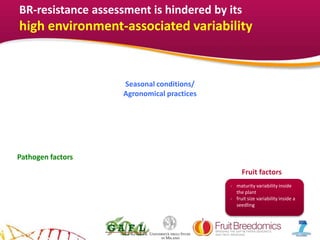
BR-resistance assessment is hindered by its
high environment-associated variability
Seasonal conditions/
Agronomical practices
Pathogen factors
Fruit factors
- maturity variability inside
the plant
- fruit size variability inside a
seedling
YOUR LOGO
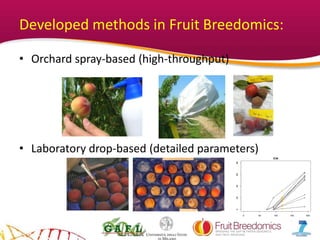
Developed methods in Fruit Breedomics:
• Orchard spray-based (high-throughput)
• Laboratory drop-based (detailed parameters)
0 50 100 150 200
020406080
E36
temps_heure
diam_inf
YOUR LOGO
Paper-protected fruit clusters
+3fruit clusters containing 3-6
fruits each
Fruit cluster inoculation
of Monilinia laxa
(105 spores/ml until runoff)
incubation time
(e.g. 7 days in dry
environment; 3 days
in moist environment)
Methods for BR-resistance phenotyping
Orchard spray test
Register number of infected and
healthy fruits
Infection probability - Drop 2014 (lab)
Infection probability
Numberofgenotypes
0.0 0.2 0.4 0.6 0.8 1.0
01020304050
Infection probability - Spray 2014 (orchard)
Infection probability
Numberofgenotypes
0.0 0.2 0.4 0.6 0.8 1.0
010203040
• BC2 (Zephir x [(Summergrand x P.davidiana) x Summergrand]; 98 to
118 individuals in 2013 and 2014. INRA-Av
• Bolinha-self. Around 90 individuals in 2013 and 2014. INRA-Av
• Contender x Elegant Lady F2. 120 individuals in 2012 and 2013. UMIL
YOUR LOGO
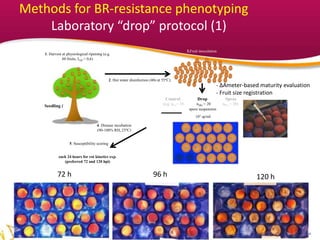
2. Hot water disinfection (40s at 55ºC).
Control Drop Spray
(e.g. nCi = 10 nSKi = 20 nFLi = 20)
4. Disease incubation
(90-100% RH, 25ºC)
5. Susceptibility scoring
spore suspension
1. Harvest at physiological ripening (e.g.
60 fruits, IAD < 0,6)
3.Fruit inoculation
Seedling i
105 sp/ml
each 24 hours for rot kinetics exp.
(preferred 72 and 120 hpi)
- ∆Ameter-based maturity evaluation
- Fruit size registration
72 h 96 h 120 h
Methods for BR-resistance phenotyping
Laboratory “drop” protocol (1)
YOUR LOGO
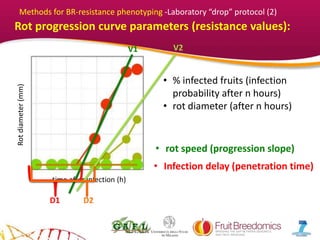
time after infection (h)
Rotdiameter(mm)
Rot progression curve parameters (resistance values):
• % infected fruits (infection
probability after n hours)
• rot diameter (after n hours)
• Infection delay (penetration time)
V1 V2
D1 D2
• rot speed (progression slope)
Methods for BR-resistance phenotyping -Laboratory “drop” protocol (2)
YOUR LOGO
Phenotyped material (Drop-lab)
• BC2 (Zephir x [(Summergrand x P.davidiana) x Summergrand]; 98 to 118 individuals
in 2013 and 2014.
• Bolero x OroA. 80-120 individuals in 2012 and 2014.
• Contender x Elegant Lady. 50 individuals in 2013-2014
Infection minimal lead time
(hour)
Numberofgenotypes
50 100 150 200
0510152025
Infection maximal lead time
(hour)
Numberofgenotypes
50 100 150 200
05101520
Maximal speed of progress
of infection diameter
(mm/h)
Numberofgenotypes
0.0 0.5 1.0 1.5 2.0 2.5 3.0
05101520253035
Infection diameter at 120 hours after drop deposit
(mm/h)
Numberofgenotypes
0 10 20 30 40 50 60 70
0510152025
0.0 0.2 0.4 0.6 0.8 1.0
0.00.20.40.60.81.0
probaSpray13
probaSpray14
C206
C208
C212
C213
C216
C221
C226
C227
C231
C232
C234 C235
C247
E1
E10
E14
E17
E18
E19
E20
E21
E22
E25
E26
E31
E33
E34
E35
E36
E37E38
E43
E44
E45
E46
E6
E8
F101
F102F104 F105 F107
F109
F110
F111
F114
F117 F118
F120
F121
F123
F127
F128
F129
F143F146
F147
F149
F152
F153F160
F162
F163
F82
F83
F94
F95
F96
F97
F98H153
H157
H162
H163
H165
H167
H179
H182
H186
H189
H191
H192 H193
H194
H195
H196
H197
H218
H226
11 génotypes avec proba Spray = 0 les 2 années
aov 0.00848 corr 0.28 pval 0.00848
0.0 0.2 0.4 0.6 0.8
0.00.20.40.60.8
probaDrop13
probaDrop14
C199
C202
C208
C212C213
C216
C224
C227
C231
C232
C235
C238
C243
E1
E10
E12
E14 E17 E18
E19
E20E21
E23
E25
E26
E30
E31
E33
E34
E36
E37E38
E41
E43
E44
E45
E46
E49 E5
E6
E8
E9F100F102
F104
F105
F106
F107
F109
F110
F111
F114F115
F117
F118F126
F128
F129
F135
F143 F146
F147
F149
F151
F152
F153
F160
F162
F163
F168
F82
F83
F94
F95
F96
F97
F98
H153
H158
H160
H163
H167
H168
H171
H174
H175
H179
H182
H184
H186
H187
H189
H190
H192
H193
H194
H195
H197
H199
H207
H218
H221H224
14 génotypes avec proba Drop = 0 les 2 années
aov 0.00111 corr 0.32 pval 0.00111aov 0.00111 corr 0.32 pval 0.00111
r2 = 0,28 p = 0,0084
2013
2014
2013
2014
r2 = 0,32 p = 0,0011
Spray - orchard Drop - Lab
YOUR LOGO
Phenotypic dissection of BR-resistance trait:
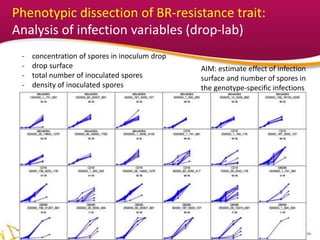
Analysis of infection variables (drop-lab)
- concentration of spores in inoculum drop
- drop surface
- total number of inoculated spores
- density of inoculated spores
AIM: estimate effect of infection
surface and number of spores in
the genotype-specific infections
YOUR LOGO
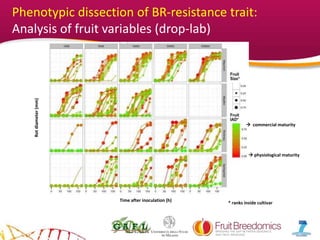
Rotdiameter(mm)
Time after inoculation (h)
* ranks inside cultivar
Phenotypic dissection of BR-resistance trait:
Analysis of fruit variables (drop-lab)
 commercial maturity
 physiological maturity
YOUR LOGO
A
50 µm
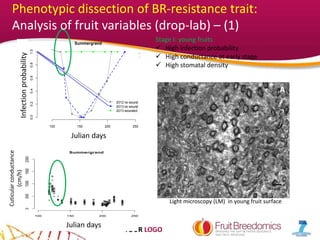
Light microscopy (LM) in young fruit surface
julian days
Infectionprobability
100 150 200 250
0.00.20.40.60.81.0
2012 no wound
2013 no wound
2013 wounded
Summergrand
tabCinet$jul
tabCinet$probafin 100 150 200 250
Zephyr
Infectionprobability
Julian days
julian days
cuticularconductance(cm/h)
100 150 200 250
0500100015002000
Summergrand
100 150 200 250
Zephyr
Julian days
Cuticularconductance
(cm/h)
Stage I: young fruits
 High infection probability
 High conductance at early stage
 High stomatal density
Phenotypic dissection of BR-resistance trait:
Analysis of fruit variables (drop-lab) – (1)
YOUR LOGO
julian days
cuticularconductance(cm/h)
100 150 200 250
0500100015002000
Summergrand
100 150 200 250
Zephyr
julian days
Infectionprobability
100 150 200 250
0.00.20.40.60.81.0
2012 no wound
2013 no wound
2013 wounded
Summergrand
tabCinet$jul
tabCinet$probafin
100 150 200 250
Zephyr
Infectionprobability
Julian days
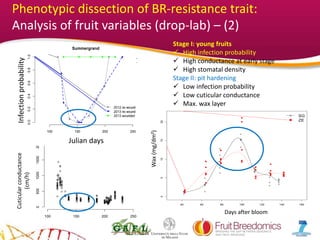
Stage I: young fruits
 High infection probability
 High conductance at early stage
 High stomatal density
Stage II: pit hardening
 Low infection probability
 Low cuticular conductance
 Max. wax layer
40 60 80 100 120 140 160
05101520
total cuticular wax quantities (mg/dm²)
DAB
waxaccumulationmg/dm²
SG
ZE
Wax(mg/dm²)
Days after bloom
Cuticularconductance
(cm/h)
Phenotypic dissection of BR-resistance trait:
Analysis of fruit variables (drop-lab) – (2)
YOUR LOGOjulian days
cuticularconductance(cm/h)
100 150 200 250
0500100015002000
Summergrand
100 150 200 250
Zephyrjulian days
Infectionprobability
100 150 200 250
0.00.20.40.60.81.0
2012 no wound
2013 no wound
2013 wounded
Summergrand
tabCinet$jul
tabCinet$probafin
100 150 200 250
Zephyr
Infectionprobability
Julian days
B
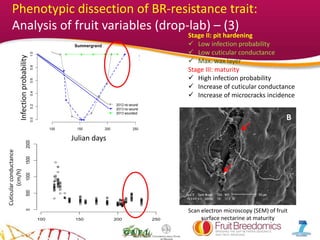
Scan electron microscopy (SEM) of fruit
surface nectarine at maturity
Stage II: pit hardening
 Low infection probability
 Low cuticular conductance
 Max. wax layer
Stage III: maturity
 High infection probability
 Increase of cuticular conductance
 Increase of microcracks incidence
Cuticularconductance
(cm/h)
Phenotypic dissection of BR-resistance trait:
Analysis of fruit variables (drop-lab) – (3)
YOUR LOGO
Phenotypic dissection of BR-resistance trait:
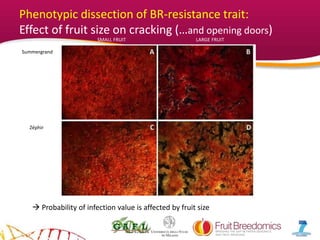
Effect of fruit size on cracking (…and opening doors)
 Probability of infection value is affected by fruit size
Summergrand
Zéphir
SMALL FRUIT LARGE FRUIT
YOUR LOGO
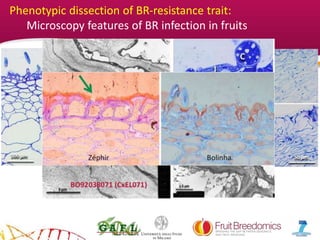
• Qualitative relationship BR resistance and fungal colonization on
fruit tissue
• Effects of pathogen colonization on fruit tissue of cultivars with
contrasting BR-resistance
• Morphology of physical fruit barriers (e.g., µcracks, cuticle,
epidermis)
Phenotypic dissection of BR-resistance trait:
Microscopy features of BR infection in fruits
Bolinha - 48 hpi Zéphir - 48 hpi
YOUR LOGO
• Fungal inhibition proportional to compound concentration
• Inhibitor effect (in function of concentration): FA > PCA > CA
• Related with rot progression speed??
*
*
*7
9
11
13
15
17
19
21
Colonydiameter(mm)
eau stérile
1% éthanol
CA
PCA
FA
0,1 0,5 1 2
Concentration (mM)
72 hours after inoculation
Caffeic acid [CA]
p-coumaric acid [PCA]
Ferulic acid [AF]
Phenotypic dissection of BR-resistance trait:
Antifungal activity of polyphenolic compounds
YOUR LOGO
0
1
2
3
4
5
6
Proba infection _ Spray _ carte P.davidiana
Chromosome
lod
1 2 3 4 5 6 7 8
IM
CIM
MQM_1Covar
0
1
2
3
4
Proba infection _ Drop _ carte P.davidiana
Chromosome
lod
1 2 3 4 5 6 7 8
IM
CIM
cova
interactiveCovar
0.0
0.5
1.0
1.5
2.0
Proba infection _ Spray _ carte Zephir
Chromosome
lod
1 2 3 4 5 6 7 8
IM
CIM
MQM_1Covar
0.0
0.5
1.0
1.5
2.0
Proba infection _ drop _ carte Ze_corr
Chromosome
lod
1 2 3 4 5 6 7 8
IM
CIM
MQM_auto
0
1
2
3
4
Proba infection _ Vitmax _ carte P.davidiana
Chromosome
lod
1 2 3 4 5 6 7 8
IM
CIM
interactiveCovar
MQM_1Covar
0
1
2
3
4
Proba infection _ Vitmax _ carte P.Zephir
Chromosome
lod
1 2 3 4 5 6 7 8
IM
CIM
interactiveCovar
MQM_1Covar
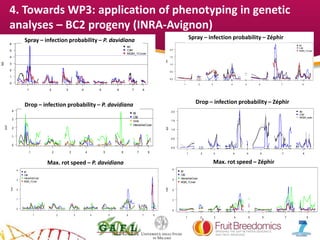
Spray – infection probability – P. davidiana
Drop – infection probability – P. davidiana
Max. rot speed – P. davidiana
Spray – infection probability – Zéphir
Drop – infection probability – Zéphir
Max. rot speed – Zéphir
4. Towards WP3: application of phenotyping in genetic
analyses – BC2 progeny (INRA-Avignon)
YOUR LOGO
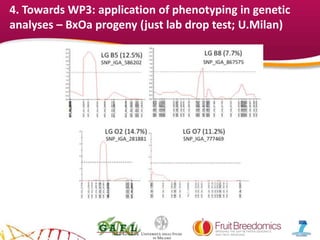
4. Towards WP3: application of phenotyping in genetic
analyses – BxOa progeny (just lab drop test; U.Milan)
YOUR LOGO
Conclusions and Perspectives
• Two methods have been developed for BR resistance scoring.
• Four populations have been phenotyped for two years and phenotypic
data is under analysis
• Different “sub-traits” have been associated to the BR impact:
• “open doors” (cuticular conductance and stomata number) are
associated to infection probability
• sample factors (maturity index and fruit size) affect the extent of open
doors
• rot progression speed can be affected by polyphenol composition in
cuticle, epidermis and flesh
• different sub-traits could be pyramided to generate more BR-resistant
cultivars

06 pacheco

  • 1.
    YOUR LOGO Assessing brownrot resistance in peach fruits Igor Pacheco, Bénédicte Quilot-Turion, Daniele Bassi
  • 2.
    YOUR LOGO BR-resistance assessmentis hindered by its high environment-associated variability Seasonal conditions/ Agronomical practices Pathogen factors Fruit factors - maturity variability inside the plant - fruit size variability inside a seedling
  • 3.
    YOUR LOGO Developed methodsin Fruit Breedomics: • Orchard spray-based (high-throughput) • Laboratory drop-based (detailed parameters) 0 50 100 150 200 020406080 E36 temps_heure diam_inf
  • 4.
    YOUR LOGO Paper-protected fruitclusters +3fruit clusters containing 3-6 fruits each Fruit cluster inoculation of Monilinia laxa (105 spores/ml until runoff) incubation time (e.g. 7 days in dry environment; 3 days in moist environment) Methods for BR-resistance phenotyping Orchard spray test Register number of infected and healthy fruits Infection probability - Drop 2014 (lab) Infection probability Numberofgenotypes 0.0 0.2 0.4 0.6 0.8 1.0 01020304050 Infection probability - Spray 2014 (orchard) Infection probability Numberofgenotypes 0.0 0.2 0.4 0.6 0.8 1.0 010203040 • BC2 (Zephir x [(Summergrand x P.davidiana) x Summergrand]; 98 to 118 individuals in 2013 and 2014. INRA-Av • Bolinha-self. Around 90 individuals in 2013 and 2014. INRA-Av • Contender x Elegant Lady F2. 120 individuals in 2012 and 2013. UMIL
  • 5.
    YOUR LOGO 2. Hotwater disinfection (40s at 55ºC). Control Drop Spray (e.g. nCi = 10 nSKi = 20 nFLi = 20) 4. Disease incubation (90-100% RH, 25ºC) 5. Susceptibility scoring spore suspension 1. Harvest at physiological ripening (e.g. 60 fruits, IAD < 0,6) 3.Fruit inoculation Seedling i 105 sp/ml each 24 hours for rot kinetics exp. (preferred 72 and 120 hpi) - ∆Ameter-based maturity evaluation - Fruit size registration 72 h 96 h 120 h Methods for BR-resistance phenotyping Laboratory “drop” protocol (1)
  • 6.
    YOUR LOGO time afterinfection (h) Rotdiameter(mm) Rot progression curve parameters (resistance values): • % infected fruits (infection probability after n hours) • rot diameter (after n hours) • Infection delay (penetration time) V1 V2 D1 D2 • rot speed (progression slope) Methods for BR-resistance phenotyping -Laboratory “drop” protocol (2)
  • 7.
    YOUR LOGO Phenotyped material(Drop-lab) • BC2 (Zephir x [(Summergrand x P.davidiana) x Summergrand]; 98 to 118 individuals in 2013 and 2014. • Bolero x OroA. 80-120 individuals in 2012 and 2014. • Contender x Elegant Lady. 50 individuals in 2013-2014 Infection minimal lead time (hour) Numberofgenotypes 50 100 150 200 0510152025 Infection maximal lead time (hour) Numberofgenotypes 50 100 150 200 05101520 Maximal speed of progress of infection diameter (mm/h) Numberofgenotypes 0.0 0.5 1.0 1.5 2.0 2.5 3.0 05101520253035 Infection diameter at 120 hours after drop deposit (mm/h) Numberofgenotypes 0 10 20 30 40 50 60 70 0510152025 0.0 0.2 0.4 0.6 0.8 1.0 0.00.20.40.60.81.0 probaSpray13 probaSpray14 C206 C208 C212 C213 C216 C221 C226 C227 C231 C232 C234 C235 C247 E1 E10 E14 E17 E18 E19 E20 E21 E22 E25 E26 E31 E33 E34 E35 E36 E37E38 E43 E44 E45 E46 E6 E8 F101 F102F104 F105 F107 F109 F110 F111 F114 F117 F118 F120 F121 F123 F127 F128 F129 F143F146 F147 F149 F152 F153F160 F162 F163 F82 F83 F94 F95 F96 F97 F98H153 H157 H162 H163 H165 H167 H179 H182 H186 H189 H191 H192 H193 H194 H195 H196 H197 H218 H226 11 génotypes avec proba Spray = 0 les 2 années aov 0.00848 corr 0.28 pval 0.00848 0.0 0.2 0.4 0.6 0.8 0.00.20.40.60.8 probaDrop13 probaDrop14 C199 C202 C208 C212C213 C216 C224 C227 C231 C232 C235 C238 C243 E1 E10 E12 E14 E17 E18 E19 E20E21 E23 E25 E26 E30 E31 E33 E34 E36 E37E38 E41 E43 E44 E45 E46 E49 E5 E6 E8 E9F100F102 F104 F105 F106 F107 F109 F110 F111 F114F115 F117 F118F126 F128 F129 F135 F143 F146 F147 F149 F151 F152 F153 F160 F162 F163 F168 F82 F83 F94 F95 F96 F97 F98 H153 H158 H160 H163 H167 H168 H171 H174 H175 H179 H182 H184 H186 H187 H189 H190 H192 H193 H194 H195 H197 H199 H207 H218 H221H224 14 génotypes avec proba Drop = 0 les 2 années aov 0.00111 corr 0.32 pval 0.00111aov 0.00111 corr 0.32 pval 0.00111 r2 = 0,28 p = 0,0084 2013 2014 2013 2014 r2 = 0,32 p = 0,0011 Spray - orchard Drop - Lab
  • 8.
    YOUR LOGO Phenotypic dissectionof BR-resistance trait: Analysis of infection variables (drop-lab) - concentration of spores in inoculum drop - drop surface - total number of inoculated spores - density of inoculated spores AIM: estimate effect of infection surface and number of spores in the genotype-specific infections
  • 9.
    YOUR LOGO Rotdiameter(mm) Time afterinoculation (h) * ranks inside cultivar Phenotypic dissection of BR-resistance trait: Analysis of fruit variables (drop-lab)  commercial maturity  physiological maturity
  • 10.
    YOUR LOGO A 50 µm Lightmicroscopy (LM) in young fruit surface julian days Infectionprobability 100 150 200 250 0.00.20.40.60.81.0 2012 no wound 2013 no wound 2013 wounded Summergrand tabCinet$jul tabCinet$probafin 100 150 200 250 Zephyr Infectionprobability Julian days julian days cuticularconductance(cm/h) 100 150 200 250 0500100015002000 Summergrand 100 150 200 250 Zephyr Julian days Cuticularconductance (cm/h) Stage I: young fruits  High infection probability  High conductance at early stage  High stomatal density Phenotypic dissection of BR-resistance trait: Analysis of fruit variables (drop-lab) – (1)
  • 11.
    YOUR LOGO julian days cuticularconductance(cm/h) 100150 200 250 0500100015002000 Summergrand 100 150 200 250 Zephyr julian days Infectionprobability 100 150 200 250 0.00.20.40.60.81.0 2012 no wound 2013 no wound 2013 wounded Summergrand tabCinet$jul tabCinet$probafin 100 150 200 250 Zephyr Infectionprobability Julian days Stage I: young fruits  High infection probability  High conductance at early stage  High stomatal density Stage II: pit hardening  Low infection probability  Low cuticular conductance  Max. wax layer 40 60 80 100 120 140 160 05101520 total cuticular wax quantities (mg/dm²) DAB waxaccumulationmg/dm² SG ZE Wax(mg/dm²) Days after bloom Cuticularconductance (cm/h) Phenotypic dissection of BR-resistance trait: Analysis of fruit variables (drop-lab) – (2)
  • 12.
    YOUR LOGOjulian days cuticularconductance(cm/h) 100150 200 250 0500100015002000 Summergrand 100 150 200 250 Zephyrjulian days Infectionprobability 100 150 200 250 0.00.20.40.60.81.0 2012 no wound 2013 no wound 2013 wounded Summergrand tabCinet$jul tabCinet$probafin 100 150 200 250 Zephyr Infectionprobability Julian days B Scan electron microscopy (SEM) of fruit surface nectarine at maturity Stage II: pit hardening  Low infection probability  Low cuticular conductance  Max. wax layer Stage III: maturity  High infection probability  Increase of cuticular conductance  Increase of microcracks incidence Cuticularconductance (cm/h) Phenotypic dissection of BR-resistance trait: Analysis of fruit variables (drop-lab) – (3)
  • 13.
    YOUR LOGO Phenotypic dissectionof BR-resistance trait: Effect of fruit size on cracking (…and opening doors)  Probability of infection value is affected by fruit size Summergrand Zéphir SMALL FRUIT LARGE FRUIT
  • 14.
    YOUR LOGO • Qualitativerelationship BR resistance and fungal colonization on fruit tissue • Effects of pathogen colonization on fruit tissue of cultivars with contrasting BR-resistance • Morphology of physical fruit barriers (e.g., µcracks, cuticle, epidermis) Phenotypic dissection of BR-resistance trait: Microscopy features of BR infection in fruits Bolinha - 48 hpi Zéphir - 48 hpi
  • 15.
    YOUR LOGO • Fungalinhibition proportional to compound concentration • Inhibitor effect (in function of concentration): FA > PCA > CA • Related with rot progression speed?? * * *7 9 11 13 15 17 19 21 Colonydiameter(mm) eau stérile 1% éthanol CA PCA FA 0,1 0,5 1 2 Concentration (mM) 72 hours after inoculation Caffeic acid [CA] p-coumaric acid [PCA] Ferulic acid [AF] Phenotypic dissection of BR-resistance trait: Antifungal activity of polyphenolic compounds
  • 16.
    YOUR LOGO 0 1 2 3 4 5 6 Proba infection_ Spray _ carte P.davidiana Chromosome lod 1 2 3 4 5 6 7 8 IM CIM MQM_1Covar 0 1 2 3 4 Proba infection _ Drop _ carte P.davidiana Chromosome lod 1 2 3 4 5 6 7 8 IM CIM cova interactiveCovar 0.0 0.5 1.0 1.5 2.0 Proba infection _ Spray _ carte Zephir Chromosome lod 1 2 3 4 5 6 7 8 IM CIM MQM_1Covar 0.0 0.5 1.0 1.5 2.0 Proba infection _ drop _ carte Ze_corr Chromosome lod 1 2 3 4 5 6 7 8 IM CIM MQM_auto 0 1 2 3 4 Proba infection _ Vitmax _ carte P.davidiana Chromosome lod 1 2 3 4 5 6 7 8 IM CIM interactiveCovar MQM_1Covar 0 1 2 3 4 Proba infection _ Vitmax _ carte P.Zephir Chromosome lod 1 2 3 4 5 6 7 8 IM CIM interactiveCovar MQM_1Covar Spray – infection probability – P. davidiana Drop – infection probability – P. davidiana Max. rot speed – P. davidiana Spray – infection probability – Zéphir Drop – infection probability – Zéphir Max. rot speed – Zéphir 4. Towards WP3: application of phenotyping in genetic analyses – BC2 progeny (INRA-Avignon)
  • 17.
    YOUR LOGO 4. TowardsWP3: application of phenotyping in genetic analyses – BxOa progeny (just lab drop test; U.Milan)
  • 18.
    YOUR LOGO Conclusions andPerspectives • Two methods have been developed for BR resistance scoring. • Four populations have been phenotyped for two years and phenotypic data is under analysis • Different “sub-traits” have been associated to the BR impact: • “open doors” (cuticular conductance and stomata number) are associated to infection probability • sample factors (maturity index and fruit size) affect the extent of open doors • rot progression speed can be affected by polyphenol composition in cuticle, epidermis and flesh • different sub-traits could be pyramided to generate more BR-resistant cultivars

Editor's Notes

  • #2 Hello, I’m Igor Pacheco, and I am here to present to you the main results in the research for methods to phenotype and characterize resistance to Monilinia fungi (namely brown rot) on peach. This task is developed by the collaboration of the Unit of Genetics and Improvement of Fruits and Vegetables of the INRA Avignon, and the Department of Agricultural and Environmental Sciences of the University of Milan. - is the major cause of fungicide applications in stone fruits - threat to sustainable production of these crops - interest in develop cultivars more resistant to this disease
  • #3 …that is strongly influenced by the environment by one hand the v and d of the f - in the other hand , rainfalls and agronomical practices affect different aspects influencing the occurrence of constitutive barriers in the fruit such given this great environmental influence, in this work we aimed to develop phenotyping tools for the BR resistance assessment in cultivars and crosses
  • #5 Orchard test was designed as an more high-throughput alternative to lab test. To setup this approach, we used 3 levels of humidity maintenance, in order to enhance pathogen activity. After inoculating fruit clusters with a spore suspension, fruit clusters were enclosed with paper and plastic. after a period of incubation, we determined the proportion of infected fruits. Paper protection presented practical advantages at the moment of identify specifically Monilinia-rotten fruits
  • #15 MICROSCOPY ANALYSIS
  • #16 Ferulic acid  easy to test, complex to terpenoids?? Difficulty to perform experiments in hydrophobic compounds
  • #18 FIX FIGURES
  • #19 ARTICULATE WELL