ANGLES
ANGLE
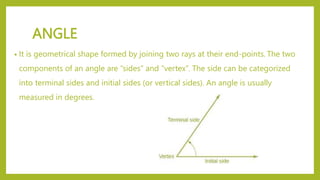
• It is geometrical shape formed by joining two rays at their end-points. The two
components of an angle are “sides” and “vertex”. The side can be categorized
into terminal sides and initial sides (or vertical sides). An angle is usually
measured in degrees.
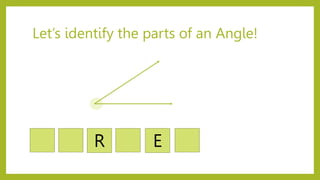
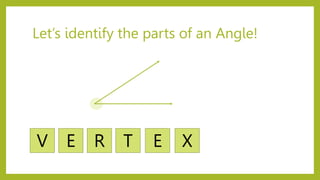
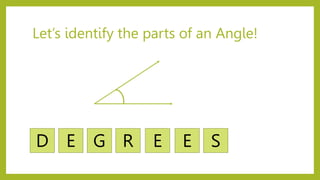
Let’s identify the parts of an Angle!
R E
Let’s identify the parts of an Angle!
V X
E R T E
Let’s identify the parts of an Angle!
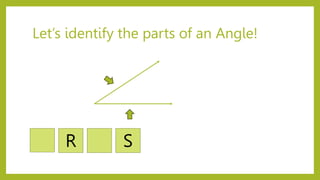
R S
Let’s identify the parts of an Angle!
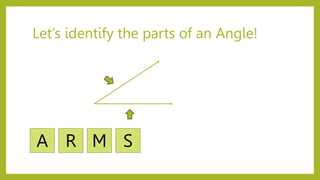
A R M S
Let’s identify the parts of an Angle!
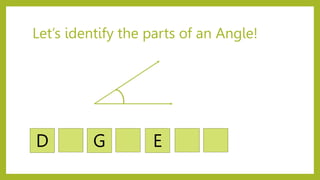
D G E
Let’s identify the parts of an Angle!
D E
E G R E S
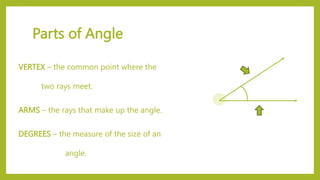
Parts of Angle
VERTEX – the common point where the
two rays meet.
ARMS – the rays that make up the angle.
DEGREES – the measure of the size of an
angle.
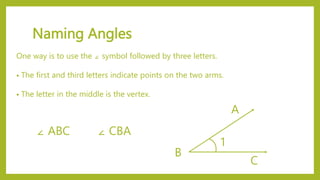
Naming Angles
One way is to use the ∠ symbol followed by three letters.
• The first and third letters indicate points on the two arms.
• The letter in the middle is the vertex.
A
B
C
1
∠ ABC ∠ CBA
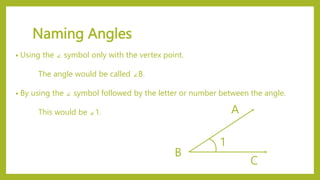
Naming Angles
• Using the ∠ symbol only with the vertex point.
The angle would be called ∠B.
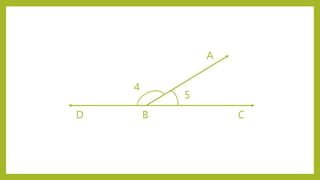
• By using the ∠ symbol followed by the letter or number between the angle.
This would be ∠1. A
B
C
1
A
C
B
D
4
5
Six Types of Angles
In Math, there are mainly 5 types of angles based on their direction. These
five angle types are the most common ones used in geometry. These are:
• Acute Angles
• Obtuse Angles
• Right Angles
• Straight Angles
• Reflex Angles
• Full Rotation
ACUTE ANGLE
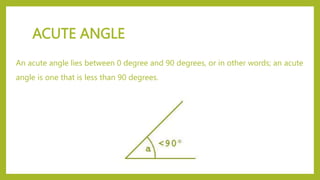
An acute angle lies between 0 degree and 90 degrees, or in other words; an acute
angle is one that is less than 90 degrees.
OBTUSE ANGLE
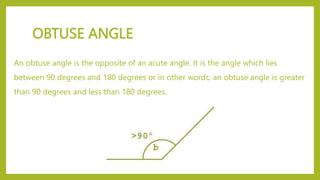
An obtuse angle is the opposite of an acute angle. It is the angle which lies
between 90 degrees and 180 degrees or in other words; an obtuse angle is greater
than 90 degrees and less than 180 degrees.
RIGHT ANGLE
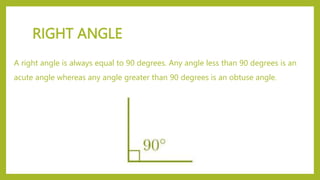
A right angle is always equal to 90 degrees. Any angle less than 90 degrees is an
acute angle whereas any angle greater than 90 degrees is an obtuse angle.
STRAIGHT ANGLE
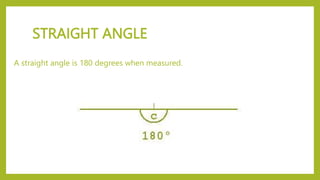
A straight angle is 180 degrees when measured.
REFLEX ANGLE
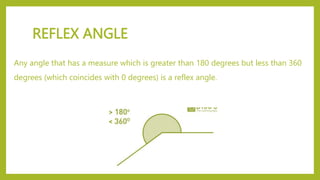
Any angle that has a measure which is greater than 180 degrees but less than 360
degrees (which coincides with 0 degrees) is a reflex angle.
Full Rotation
An angle equal to 360 degrees is called full rotation or full angle. It is formed
when one of the arms takes a complete rotation to form an angle.
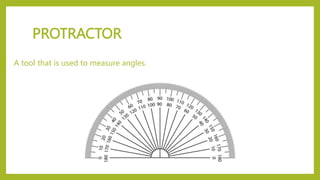
PROTRACTOR
A tool that is used to measure angles.
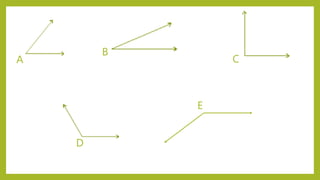
A
B
C
D
E
Pair of Angles
When two angles are paired, then there exist different angles, such as
•Complementary angles
•Supplementary angles
•Linear Pair
•Adjacent angles
•Vertically Opposite angles
Complementary and Supplementary
Angles
If the sum of two angles is equal to 180°, then they are SUPPLEMENTARY
ANGLES.
If the sum is equal to 90°, then they are called COMPLEMENTARY ANGLES.
Linear Pair
When the non-common arms of adjacent angles are just opposite to each other,
or they extend in the opposite direction, then they are called linear pairs. By
linear they form a straight line.
Adjacent Angles
When two angles are connected with one common arm and have one common
vertex and also the non-common arms are either side of the common arm, then
they are called adjacent angles.
Vertical Angles
When two lines intersect each other at a single point (called vertex), then the
angle formed on either side of the common vertex is called vertical angles or
vertically opposite angles.
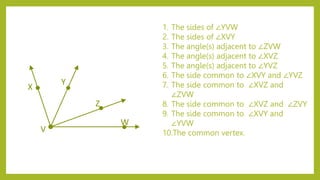
1. The sides of ∠YVW
2. The sides of ∠XVY
3. The angle(s) adjacent to ∠ZVW
4. The angle(s) adjacent to ∠XVZ
5. The angle(s) adjacent to ∠YVZ
6. The side common to ∠XVY and ∠YVZ
7. The side common to ∠XVZ and
∠ZVW
8. The side common to ∠XVZ and ∠ZVY
9. The side common to ∠XVY and
∠YVW
10.The common vertex.
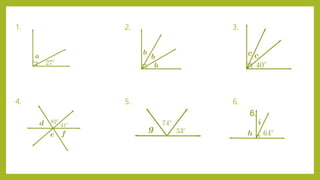
1. 2. 3.
4. 5. 6.

Angles.pptx

  • 1.
  • 2.
    ANGLE • It isgeometrical shape formed by joining two rays at their end-points. The two components of an angle are “sides” and “vertex”. The side can be categorized into terminal sides and initial sides (or vertical sides). An angle is usually measured in degrees.
  • 3.
    Let’s identify theparts of an Angle! R E
  • 4.
    Let’s identify theparts of an Angle! V X E R T E
  • 5.
    Let’s identify theparts of an Angle! R S
  • 6.
    Let’s identify theparts of an Angle! A R M S
  • 7.
    Let’s identify theparts of an Angle! D G E
  • 8.
    Let’s identify theparts of an Angle! D E E G R E S
  • 9.
    Parts of Angle VERTEX– the common point where the two rays meet. ARMS – the rays that make up the angle. DEGREES – the measure of the size of an angle.
  • 10.
    Naming Angles One wayis to use the ∠ symbol followed by three letters. • The first and third letters indicate points on the two arms. • The letter in the middle is the vertex. A B C 1 ∠ ABC ∠ CBA
  • 11.
    Naming Angles • Usingthe ∠ symbol only with the vertex point. The angle would be called ∠B. • By using the ∠ symbol followed by the letter or number between the angle. This would be ∠1. A B C 1
  • 12.
  • 13.
    Six Types ofAngles In Math, there are mainly 5 types of angles based on their direction. These five angle types are the most common ones used in geometry. These are: • Acute Angles • Obtuse Angles • Right Angles • Straight Angles • Reflex Angles • Full Rotation
  • 14.
    ACUTE ANGLE An acuteangle lies between 0 degree and 90 degrees, or in other words; an acute angle is one that is less than 90 degrees.
  • 15.
    OBTUSE ANGLE An obtuseangle is the opposite of an acute angle. It is the angle which lies between 90 degrees and 180 degrees or in other words; an obtuse angle is greater than 90 degrees and less than 180 degrees.
  • 16.
    RIGHT ANGLE A rightangle is always equal to 90 degrees. Any angle less than 90 degrees is an acute angle whereas any angle greater than 90 degrees is an obtuse angle.
  • 17.
    STRAIGHT ANGLE A straightangle is 180 degrees when measured.
  • 18.
    REFLEX ANGLE Any anglethat has a measure which is greater than 180 degrees but less than 360 degrees (which coincides with 0 degrees) is a reflex angle.
  • 19.
    Full Rotation An angleequal to 360 degrees is called full rotation or full angle. It is formed when one of the arms takes a complete rotation to form an angle.
  • 20.
    PROTRACTOR A tool thatis used to measure angles.
  • 21.
  • 22.
    Pair of Angles Whentwo angles are paired, then there exist different angles, such as •Complementary angles •Supplementary angles •Linear Pair •Adjacent angles •Vertically Opposite angles
  • 23.
    Complementary and Supplementary Angles Ifthe sum of two angles is equal to 180°, then they are SUPPLEMENTARY ANGLES. If the sum is equal to 90°, then they are called COMPLEMENTARY ANGLES.
  • 24.
    Linear Pair When thenon-common arms of adjacent angles are just opposite to each other, or they extend in the opposite direction, then they are called linear pairs. By linear they form a straight line.
  • 25.
    Adjacent Angles When twoangles are connected with one common arm and have one common vertex and also the non-common arms are either side of the common arm, then they are called adjacent angles.
  • 26.
    Vertical Angles When twolines intersect each other at a single point (called vertex), then the angle formed on either side of the common vertex is called vertical angles or vertically opposite angles.
  • 27.
    1. The sidesof ∠YVW 2. The sides of ∠XVY 3. The angle(s) adjacent to ∠ZVW 4. The angle(s) adjacent to ∠XVZ 5. The angle(s) adjacent to ∠YVZ 6. The side common to ∠XVY and ∠YVZ 7. The side common to ∠XVZ and ∠ZVW 8. The side common to ∠XVZ and ∠ZVY 9. The side common to ∠XVY and ∠YVW 10.The common vertex.
  • 28.