B.J.P.S Samiti’s
M V HERWADKAR
ENGLISH MEDIUM SCHOOL
Class – VI Subject : Mathematics
Topic : LINES AND ANGLES
Introduction
Let’s recall !
Do you remember shapes ?
Name some shapes.
How are these shapes made ?
What is Geometry ?
Geometry
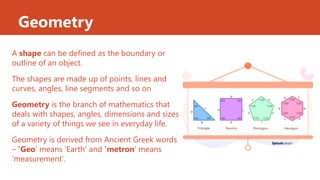
A shape can be defined as the boundary or
outline of an object.
The shapes are made up of points, lines and
curves, angles, line segments and so on
Geometry is the branch of mathematics that
deals with shapes, angles, dimensions and sizes
of a variety of things we see in everyday life.
Geometry is derived from Ancient Greek words
– 'Geo' means 'Earth' and 'metron' means
'measurement'.
Basic terms and Definitions
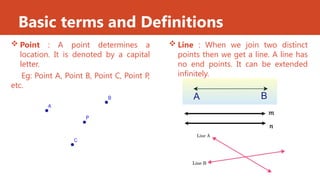
 Point : A point determines a
location. It is denoted by a capital
letter.
Eg: Point A, Point B, Point C, Point P,
etc.
 Line : When we join two distinct
points then we get a line. A line has
no end points. It can be extended
infinitely.
Basic terms and Definitions
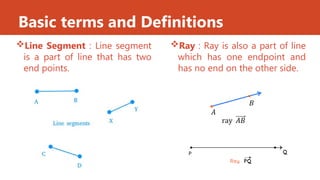
Line Segment : Line segment
is a part of line that has two
end points.
Ray : Ray is also a part of line
which has one endpoint and
has no end on the other side.
Basic terms and Definitions
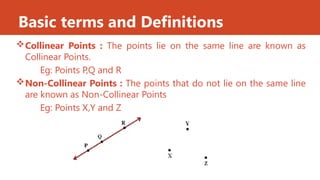
Collinear Points : The points lie on the same line are known as
Collinear Points.
Eg: Points P,Q and R
Non-Collinear Points : The points that do not lie on the same line
are known as Non-Collinear Points
Eg: Points X,Y and Z
Angles
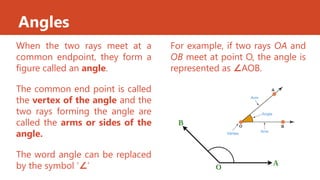
When the two rays meet at a
common endpoint, they form a
figure called an angle.
The common end point is called
the vertex of the angle and the
two rays forming the angle are
called the arms or sides of the
angle.
The word angle can be replaced
by the symbol ‘∠’
For example, if two rays OA and
OB meet at point O, the angle is
represented as ∠AOB.
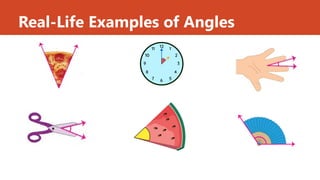
Real-Life Examples of Angles
Comparing Angles
Comparing angles by Superimposition
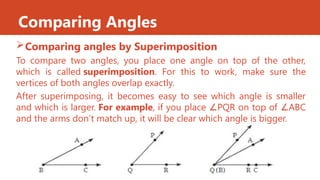
To compare two angles, you place one angle on top of the other,
which is called superimposition. For this to work, make sure the
vertices of both angles overlap exactly.
After superimposing, it becomes easy to see which angle is smaller
and which is larger. For example, if you place PQR on top of ABC
∠ ∠
and the arms don’t match up, it will be clear which angle is bigger.
Comparing Angles
 Comparing angles by Superimposition
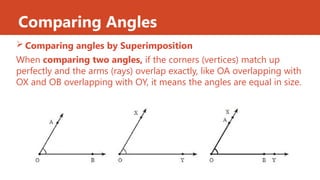
When comparing two angles, if the corners (vertices) match up
perfectly and the arms (rays) overlap exactly, like OA overlapping with
OX and OB overlapping with OY, it means the angles are equal in size.
Comparing Angles
 Comparing angles without Superimposition
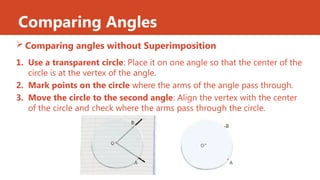
1. Use a transparent circle: Place it on one angle so that the center of the
circle is at the vertex of the angle.
2. Mark points on the circle where the arms of the angle pass through.
3. Move the circle to the second angle: Align the vertex with the center
of the circle and check where the arms pass through the circle.
Measuring of Angles
To measure angles precisely, mathematicians divided the circle into 360 equal parts.
Each part represents 1 degree, written as 1°. The idea is that the measure of an
angle is simply the number of these 1° units that fit inside it.
For example:
An angle that contains 30 of these units would have a measure of 30°.
Measures of Different Angles
Full Turn: A full circle contains 360°. So, a full turn is 360°.
Straight Angle: A straight angle is half of a full turn. Since a full turn is 360°, a
straight angle is 180°.
Right Angle: Two right angles together make a straight angle. Since a straight angle
is 180°, a right angle is 90°.
Measuring of Angles
Why 360 Degrees?
But why 360°? The exact reason is a bit of a mystery, but there are
several historical reasons:
Ancient civilizations, like those in India, Persia, Babylon, and Egypt, used
a year with 360 days in their calendars.
The number 360 is practical because it can be divided evenly by
many numbers (like 1, 2, 3, 4, 5, 6, 8, 9, 10, and 12), making it easier
to split a circle into equal parts.
Degree Measures of Angles
Measuring angles is a fundamental concept in geometry, and to do this
accurately, we use a tool called a protractor. A protractor is either a full
circle divided into 360 equal parts or a half-circle divided into 180 equal
parts.
Using a Protractor
Protractor Structure: A typical protractor has a straight angle at the
center, divided into 180 units of 1 degree each. These units help you
measure angles precisely.
Reading the Protractor: Starting from the rightmost point, there are long
marks for every 10 degrees and medium-sized marks for every 5 degrees.
This makes it easier to count and measure angles.
Degree Measures of Angles
 Unlabelled Protractor: A
protractor without numbers,
showing only marks. You count the
degree units from the markings to
measure an angle. This requires you
to carefully count each small mark
to determine the angle.
 Labelled Protractor: A
protractor with numbers marked,
making it easier to measure angles.
The numbers typically range from
0° to 180° in both directions
(clockwise and counterclockwise).
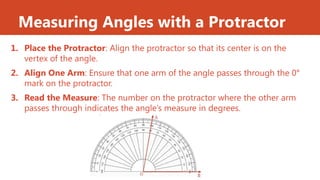
Measuring Angles with a Protractor
1. Place the Protractor: Align the protractor so that its center is on the
vertex of the angle.
2. Align One Arm: Ensure that one arm of the angle passes through the 0°
mark on the protractor.
3. Read the Measure: The number on the protractor where the other arm
passes through indicates the angle’s measure in degrees.
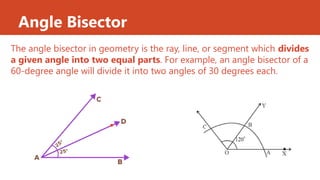
Angle Bisector
The angle bisector in geometry is the ray, line, or segment which divides
a given angle into two equal parts. For example, an angle bisector of a
60-degree angle will divide it into two angles of 30 degrees each.
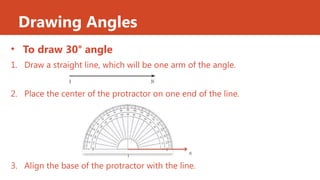
Drawing Angles
• To draw 30° angle
1. Draw a straight line, which will be one arm of the angle.
2. Place the center of the protractor on one end of the line.
3. Align the base of the protractor with the line.
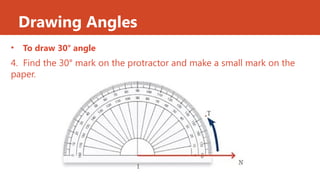
Drawing Angles
• To draw 30° angle
4. Find the 30° mark on the protractor and make a small mark on the
paper.
Drawing Angles
• To draw 30° angle
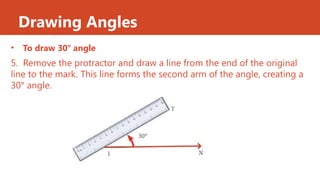
5. Remove the protractor and draw a line from the end of the original
line to the mark. This line forms the second arm of the angle, creating a
30° angle.
Types of Angles
Angles are classified based on their measurement:
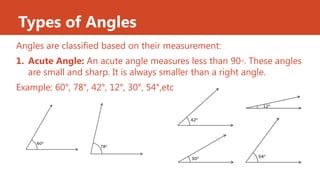
1. Acute Angle: An acute angle measures less than 90◦. These angles
are small and sharp. It is always smaller than a right angle.
Example: 60°, 78°, 42°, 12°, 30°, 54°,etc .
Types of Angles
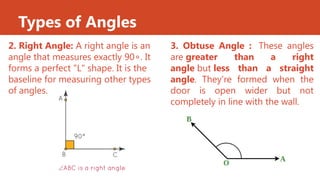
2. Right Angle: A right angle is an
angle that measures exactly 90 . It
∘
forms a perfect "L" shape. It is the
baseline for measuring other types
of angles.
3. Obtuse Angle : These angles
are greater than a right
angle but less than a straight
angle. They’re formed when the
door is open wider but not
completely in line with the wall.
Types of Angles
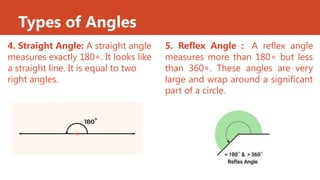
4. Straight Angle: A straight angle
measures exactly 180 . It looks like
∘
a straight line. It is equal to two
right angles.
5. Reflex Angle : A reflex angle
measures more than 180 but less
∘
than 360 . These angles are very
∘
large and wrap around a significant
part of a circle.
Thank You
Class VI !!! Any Doubts ?

Line_and_angles_chap_2.pptx ppt ppt ppt ppt

  • 1.
    B.J.P.S Samiti’s M VHERWADKAR ENGLISH MEDIUM SCHOOL Class – VI Subject : Mathematics Topic : LINES AND ANGLES
  • 2.
    Introduction Let’s recall ! Doyou remember shapes ? Name some shapes. How are these shapes made ? What is Geometry ?
  • 3.
    Geometry A shape canbe defined as the boundary or outline of an object. The shapes are made up of points, lines and curves, angles, line segments and so on Geometry is the branch of mathematics that deals with shapes, angles, dimensions and sizes of a variety of things we see in everyday life. Geometry is derived from Ancient Greek words – 'Geo' means 'Earth' and 'metron' means 'measurement'.
  • 4.
    Basic terms andDefinitions  Point : A point determines a location. It is denoted by a capital letter. Eg: Point A, Point B, Point C, Point P, etc.  Line : When we join two distinct points then we get a line. A line has no end points. It can be extended infinitely.
  • 5.
    Basic terms andDefinitions Line Segment : Line segment is a part of line that has two end points. Ray : Ray is also a part of line which has one endpoint and has no end on the other side.
  • 6.
    Basic terms andDefinitions Collinear Points : The points lie on the same line are known as Collinear Points. Eg: Points P,Q and R Non-Collinear Points : The points that do not lie on the same line are known as Non-Collinear Points Eg: Points X,Y and Z
  • 7.
    Angles When the tworays meet at a common endpoint, they form a figure called an angle. The common end point is called the vertex of the angle and the two rays forming the angle are called the arms or sides of the angle. The word angle can be replaced by the symbol ‘∠’ For example, if two rays OA and OB meet at point O, the angle is represented as ∠AOB.
  • 8.
  • 9.
    Comparing Angles Comparing anglesby Superimposition To compare two angles, you place one angle on top of the other, which is called superimposition. For this to work, make sure the vertices of both angles overlap exactly. After superimposing, it becomes easy to see which angle is smaller and which is larger. For example, if you place PQR on top of ABC ∠ ∠ and the arms don’t match up, it will be clear which angle is bigger.
  • 10.
    Comparing Angles  Comparingangles by Superimposition When comparing two angles, if the corners (vertices) match up perfectly and the arms (rays) overlap exactly, like OA overlapping with OX and OB overlapping with OY, it means the angles are equal in size.
  • 11.
    Comparing Angles  Comparingangles without Superimposition 1. Use a transparent circle: Place it on one angle so that the center of the circle is at the vertex of the angle. 2. Mark points on the circle where the arms of the angle pass through. 3. Move the circle to the second angle: Align the vertex with the center of the circle and check where the arms pass through the circle.
  • 12.
    Measuring of Angles Tomeasure angles precisely, mathematicians divided the circle into 360 equal parts. Each part represents 1 degree, written as 1°. The idea is that the measure of an angle is simply the number of these 1° units that fit inside it. For example: An angle that contains 30 of these units would have a measure of 30°. Measures of Different Angles Full Turn: A full circle contains 360°. So, a full turn is 360°. Straight Angle: A straight angle is half of a full turn. Since a full turn is 360°, a straight angle is 180°. Right Angle: Two right angles together make a straight angle. Since a straight angle is 180°, a right angle is 90°.
  • 13.
    Measuring of Angles Why360 Degrees? But why 360°? The exact reason is a bit of a mystery, but there are several historical reasons: Ancient civilizations, like those in India, Persia, Babylon, and Egypt, used a year with 360 days in their calendars. The number 360 is practical because it can be divided evenly by many numbers (like 1, 2, 3, 4, 5, 6, 8, 9, 10, and 12), making it easier to split a circle into equal parts.
  • 14.
    Degree Measures ofAngles Measuring angles is a fundamental concept in geometry, and to do this accurately, we use a tool called a protractor. A protractor is either a full circle divided into 360 equal parts or a half-circle divided into 180 equal parts. Using a Protractor Protractor Structure: A typical protractor has a straight angle at the center, divided into 180 units of 1 degree each. These units help you measure angles precisely. Reading the Protractor: Starting from the rightmost point, there are long marks for every 10 degrees and medium-sized marks for every 5 degrees. This makes it easier to count and measure angles.
  • 15.
    Degree Measures ofAngles  Unlabelled Protractor: A protractor without numbers, showing only marks. You count the degree units from the markings to measure an angle. This requires you to carefully count each small mark to determine the angle.  Labelled Protractor: A protractor with numbers marked, making it easier to measure angles. The numbers typically range from 0° to 180° in both directions (clockwise and counterclockwise).
  • 16.
    Measuring Angles witha Protractor 1. Place the Protractor: Align the protractor so that its center is on the vertex of the angle. 2. Align One Arm: Ensure that one arm of the angle passes through the 0° mark on the protractor. 3. Read the Measure: The number on the protractor where the other arm passes through indicates the angle’s measure in degrees.
  • 17.
    Angle Bisector The anglebisector in geometry is the ray, line, or segment which divides a given angle into two equal parts. For example, an angle bisector of a 60-degree angle will divide it into two angles of 30 degrees each.
  • 18.
    Drawing Angles • Todraw 30° angle 1. Draw a straight line, which will be one arm of the angle. 2. Place the center of the protractor on one end of the line. 3. Align the base of the protractor with the line.
  • 19.
    Drawing Angles • Todraw 30° angle 4. Find the 30° mark on the protractor and make a small mark on the paper.
  • 20.
    Drawing Angles • Todraw 30° angle 5. Remove the protractor and draw a line from the end of the original line to the mark. This line forms the second arm of the angle, creating a 30° angle.
  • 21.
    Types of Angles Anglesare classified based on their measurement: 1. Acute Angle: An acute angle measures less than 90◦. These angles are small and sharp. It is always smaller than a right angle. Example: 60°, 78°, 42°, 12°, 30°, 54°,etc .
  • 22.
    Types of Angles 2.Right Angle: A right angle is an angle that measures exactly 90 . It ∘ forms a perfect "L" shape. It is the baseline for measuring other types of angles. 3. Obtuse Angle : These angles are greater than a right angle but less than a straight angle. They’re formed when the door is open wider but not completely in line with the wall.
  • 23.
    Types of Angles 4.Straight Angle: A straight angle measures exactly 180 . It looks like ∘ a straight line. It is equal to two right angles. 5. Reflex Angle : A reflex angle measures more than 180 but less ∘ than 360 . These angles are very ∘ large and wrap around a significant part of a circle.
  • 24.
    Thank You Class VI!!! Any Doubts ?

Editor's Notes

  • #24 In Slide Show mode, click the arrow to enter the PowerPoint Getting Started Center.