IntegratingSegmentationwithPredictive
Models-BuildingMoreRobustSolutions
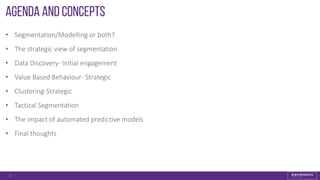
AGENDA AND CONCEPTS
2
• Segmentation/Modelling or both?
• The strategic view of segmentation
• Data Discovery- Initial engagement
• Value Based Behaviour- Strategic
• Clustering-Strategic
• Tactical Segmentation
• The impact of automated predictive models
• Final thoughts
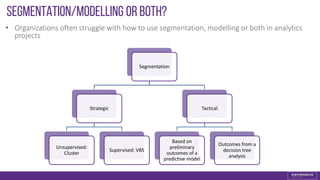
Segmentation
Strategic
Unsupervised:
Cluster
Supervised: VBS
Tactical
Based on
preliminary
outcomes of a
predictive model
Outcomes from a
decision tree
analysis
Segmentation/MODELLING OR BOTH?
• Organizations often struggle with how to use segmentation, modelling or both in analytics
projects
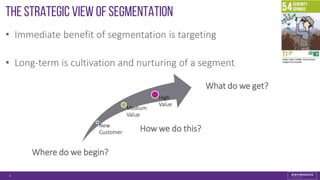
The strategic View of Segmentation
• Immediate benefit of segmentation is targeting
• Long-term is cultivation and nurturing of a segment
4
New
Customer
Medium
Value
High
Value
How we do this?
Where do we begin?
What do we get?
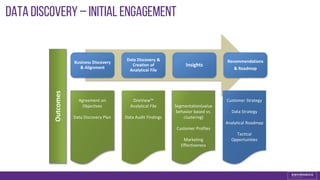
Data Discovery – Initial Engagement
Agreement on
Objectives
Data Discovery Plan
OneView™
Analytical File
Data Audit Findings
Segmentation(value
behavior based vs.
clustering)
Customer Profiles
Marketing
Effectiveness
Customer Strategy
Data Strategy
Analytical Roadmap
Tactical
Opportunities
Outcomes
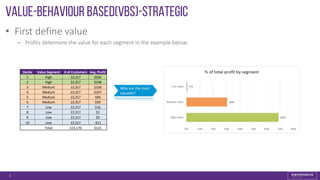
Value-behaviour based(VBS)-Strategic
• First define value
– Profits determine the value for each segment in the example below:
6
Decile Value Segment # of Customers Avg. Profit
1 High 22,317 $592
2 High 22,317 $248
3 Medium 22,317 $156
4 Medium 22,317 $107
5 Medium 22,317 $69
6 Medium 22,317 $39
7 Low 22,317 $16
8 Low 22,317 $2
9 Low 22,317 $0
10 Low 22,317 -$11
Total 223,170 $122
Who are the most
valuable?
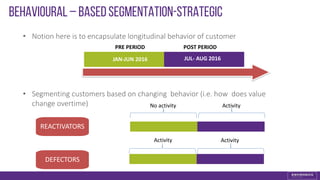
• Notion here is to encapsulate longitudinal behavior of customer
• Segmenting customers based on changing behavior (i.e. how does value
change overtime)
Behavioural – Based Segmentation-Strategic
PRE PERIOD POST PERIOD
JAN-JUN 2016 JUL- AUG 2016
REACTIVATORS
DEFECTORS
No activity Activity
Activity No Activity
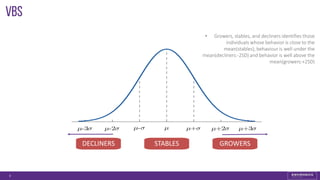
VBS
8
STABLESDECLINERS GROWERS
• Growers, stables, and decliners identifies those
individuals whose behavior is close to the
mean(stables), behaviour is well under the
mean(decliners:-2SD) and behavior is well above the
mean(growers:+2SD)
Example of Behavioural Segment creation- Growers,Decliners,
Stables-Strategic
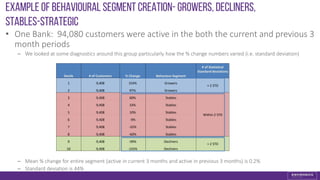
• One Bank: 94,080 customers were active in the both the current and previous 3
month periods
– We looked at some diagnostics around this group particularly how the % change numbers varied (i.e. standard deviation)
– Mean % change for entire segment (active in current 3 months and active in previous 3 months) is 0.2%
– Standard deviation is 44%
Decile # of Customers % Change Behaviour Segment
# of Statistical
Standard deviations
1 9,408 154% Growers
> 2 STD
2 9,408 97% Growers
3 9,408 60% Stables
Within 2 STD
4 9,408 33% Stables
5 9,408 10% Stables
6 9,408 -9% Stables
7 9,408 -32% Stables
8 9,408 -60% Stables
9 9,408 -99% Decliners
> 2 STD
10 9,408 -155% Decliners
Integrating Value and Behaviour(VBS) Matrix-
Strategic
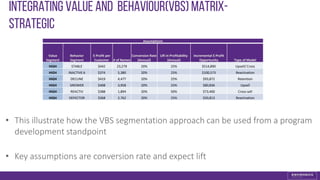
• This illustrate how the VBS segmentation approach can be used from a program
development standpoint
• Key assumptions are conversion rate and expect lift
Assumptions
Value
Segment
Behavior
Segment
$ Profit per
Customer # of Names
Conversion Rate
(Annual)
Lift in Profitability
(Annual)
Incremental $ Profit
Opportunity Type of Model
HIGH STABLE $442 23,279 20% 25% $514,890 Upsell/ Cross
HIGH INACTIVE 6 $374 5,380 20% 25% $100,573 Reactivation
HIGH DECLINE $419 4,477 20% 25% $93,872 Retention
HIGH GROWER $408 3,958 20% 25% $80,836 Upsell
HIGH REACTIV $388 1,894 20% 50% $73,400 Cross-sell
HIGH DEFECTOR $368 2,762 20% 25% $50,813 Reactivation
Case Study – Wealth Management company
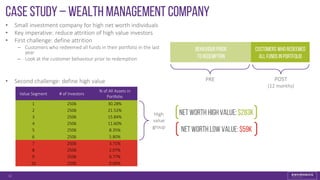
• Small investment company for high net worth individuals
• Key imperative: reduce attrition of high value investors
• First challenge: define attrition
– Customers who redeemed all funds in their portfolio in the last
year
– Look at the customer behaviour prior to redemption
• Second challenge: define high value
11
Value Segment # of Investors
% of All Assets in
Portfolio
1 2506 30.28%
2 2506 21.52%
3 2506 15.84%
4 2506 11.60%
5 2506 8.35%
6 2506 5.80%
7 2506 3.71%
8 2506 2.07%
9 2506 0.77%
10 2506 0.06%
BEHAVIOUR PRIOR
TOREDEMPTION
CUSTOMERS WHO REDEEMED
ALL FUNDS IN PORTFOLIO
POST
(12 months)
High
value
group
Net worth HighValue: $283K
Net worth LOW Value: $59K
PRE
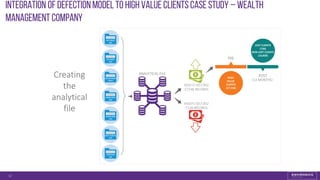
Integration of Defectionmodel to highvalue clients Case Study – Wealth
Managementcompany
12
Creating
the
analytical
file
(12 MONTHS)
Wealth Management company
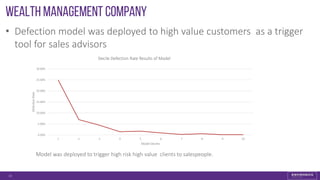
• Defection model was deployed to high value customers as a trigger
tool for sales advisors
13
0.00%
5.00%
10.00%
15.00%
20.00%
25.00%
30.00%
1 2 3 4 5 6 7 8 9 10
DefectionRate
Model Deciles
Decile Defection Rate Results of Model
Model was deployed to trigger high risk high value clients to salespeople.
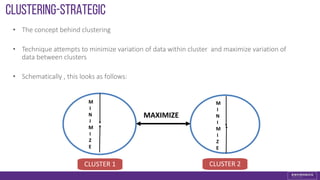
• The concept behind clustering
• Technique attempts to minimize variation of data within cluster and maximize variation of
data between clusters
• Schematically , this looks as follows:
MAXIMIZE
M
I
N
I
M
I
Z
E
M
I
N
I
M
I
Z
E
Clustering-strategic
CLUSTER 1 CLUSTER 2
Clustering-strategic-FACTOR ANALYSIS
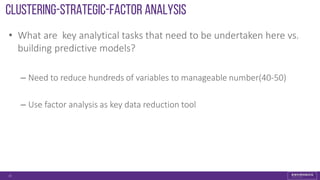
• What are key analytical tasks that need to be undertaken here vs.
building predictive models?
– Need to reduce hundreds of variables to manageable number(40-50)
– Use factor analysis as key data reduction tool
15
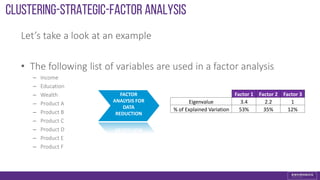
Let’s take a look at an example
• The following list of variables are used in a factor analysis
– Income
– Education
– Wealth
– Product A
– Product B
– Product C
– Product D
– Product E
– Product F
Factor 1 Factor 2 Factor 3
Eigenvalue 3.4 2.2 1
% of Explained Variation 53% 35% 12%
FACTOR
ANALYSIS FOR
DATA
REDUCTION
Clustering-strategic-FACTOR ANALYSIS
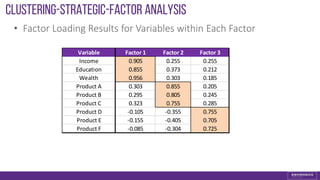
• Factor Loading Results for Variables within Each Factor
Clustering-strategic-FACTOR ANALYSIS
Variable Factor 1 Factor 2 Factor 3
Income 0.905 0.255 0.255
Education 0.855 0.373 0.212
Wealth 0.956 0.303 0.185
Product A 0.303 0.855 0.205
Product B 0.295 0.805 0.245
Product C 0.323 0.755 0.285
Product D -0.105 -0.355 0.755
Product E -0.155 -0.405 0.705
Product F -0.085 -0.304 0.725
Clustering-strategic-STANDARDIZATION
• What are key analytical tasks that need to be undertaken here vs.
building predictive models?
– Need to scale or standardize all variables
– Let’s see what this looks like
18
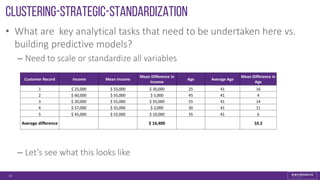
Customer Record Income Mean Income
Mean Difference in
Income
Age Average Age
Mean Difference in
Age
1 $ 25,000 $ 55,000 $ 30,000 25 41 16
2 $ 60,000 $ 55,000 $ 5,000 45 41 4
3 $ 20,000 $ 55,000 $ 35,000 55 41 14
4 $ 57,000 $ 55,000 $ 2,000 30 41 11
5 $ 45,000 $ 55,000 $ 10,000 35 41 6
Average difference $ 16,400 10.2
19
Clustering-strategic-STANDARDIZATION
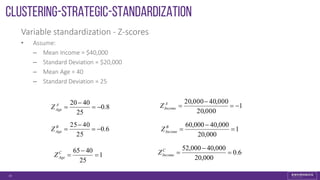
Variable standardization - Z-scores
• Assume:
– Mean Income = $40,000
– Standard Deviation = $20,000
– Mean Age = 40
– Standard Deviation = 25
1
000,20
000,40000,20


A
IncomeZ8.0
25
4020


A
AgeZ
6.0
25
4025


B
AgeZ
6.0
000,20
000,40000,52


C
IncomeZ1
25
4065


C
AgeZ
1
000,20
000,40000,60


B
IncomeZ
20
Clustering-strategic-STANDARDIZATION
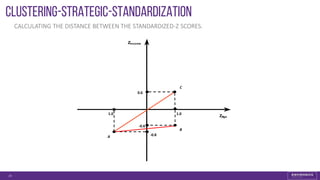
CALCULATING THE DISTANCE BETWEEN THE STANDARDIZED-Z SCORES.
ZAge
ZIncome
A
B
C
0.6
1.01.0
-0.6
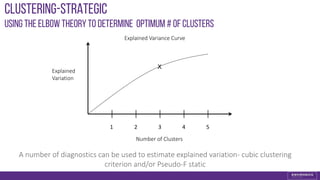
-0.8
Explained
Variation
1 2 3 4 5
Number of Clusters
X
Explained Variance Curve
Clustering-strategic
using the elbowtheory to determine optimum # of clusters
A number of diagnostics can be used to estimate explained variation- cubic clustering
criterion and/or Pseudo-F static
22
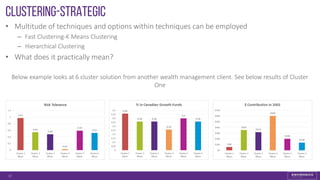
Clustering-strategic
• Multitude of techniques and options within techniques can be employed
– Fast Clustering-K Means Clustering
– Hierarchical Clustering
• What does it practically mean?
Below example looks at 6 cluster solution from another wealth management client. See below results of Cluster
One
23
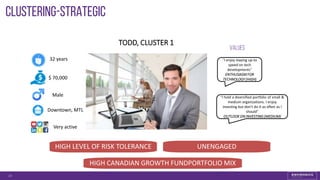
Clustering-strategic
HIGH LEVEL OF RISK TOLERANCE UNENGAGED
HIGH CANADIAN GROWTH FUNDPORTFOLIO MIX
TODD, CLUSTER 1
32 years
$ 70,000
Male
Downtown, MTL
Very active
“I enjoy staying up-to
speed on tech
developments”
ENTHUSIASM FOR
TECHNOLOGY (HIGH)
Values
“I hold a diversified portfolio of small &
medium organizations. I enjoy
investing but don’t do it as often as I
should”
OUTLOOK ON INVESTING (MEDIUM)
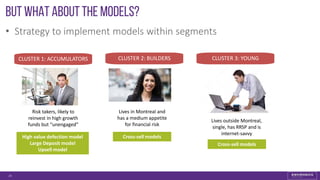
But what about the models?
24
CLUSTER 2: BUILDERS
• Strategy to implement models within segments
Cross-sell models
CLUSTER 1: ACCUMULATORS
High value defection model
Large Deposit model
Upsell model
Risk takers, likely to
reinvest in high growth
funds but “unengaged”
Lives in Montreal and
has a medium appetite
for financial risk
CLUSTER 3: YOUNG
Cross-sell models
Lives outside Montreal,
single, has RRSP and is
internet-savvy
But what about the models?
25
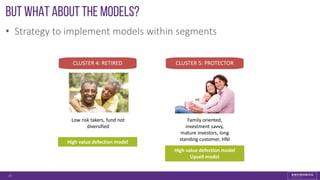
CLUSTER 4: RETIRED CLUSTER 5: PROTECTOR
• Strategy to implement models within segments
High value defection model
Upsell model
Low risk takers, fund not
diversified
Family oriented,
investment savvy,
mature investors, long
standing customer, HNI
What about Tactical Segmentation?
• Different from Strategic Segmentation
• Initial Analytics are Predictive Models which then leads to
development of multi-segment approach. Why?
– The Hockey Stick Model
– Domination of Few Variables
26
Tactical Segmentation:
Thehockey stick model-lottery example
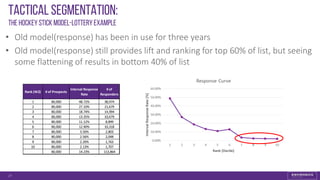
• Old model(response) has been in use for three years
• Old model(response) still provides lift and ranking for top 60% of list, but seeing
some flattening of results in bottom 40% of list
27
Rank (W2) # of Prospects
Interval Response
Rate
# of
Responders
1 80,000 48.72% 38,974
2 80,000 27.10% 21,679
3 80,000 18.74% 14,994
4 80,000 13.35% 10,679
5 80,000 11.12% 8,899
6 80,000 12.90% 10,318
7 80,000 3.50% 2,803
8 80,000 2.56% 2,048
9 80,000 2.20% 1,763
10 80,000 2.13% 1,707
80,000 14.23% 113,864
The hockey stick model-what did we do?
• Build two models
– One for top 60% and one for bottom 40%.
• Key differences between 2 models are:
– Top 60% contains primarily donation activity type variables
– Bottom 40% contains primarily demographic and more non-behavioural type
variables
28
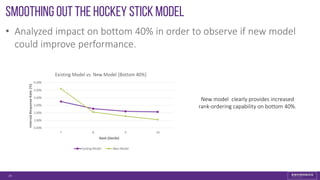
Smoothing out the Hockey Stick model
• Analyzed impact on bottom 40% in order to observe if new model
could improve performance.
29
New model clearly provides increased
rank-ordering capability on bottom 40%.
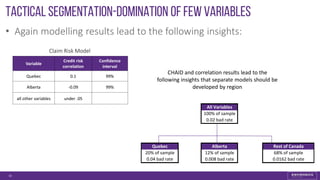
Tactical segmentation-Domination of Few variables
• Again modelling results lead to the following insights:
30
Variable
Credit risk
correlation
Confidence
interval
Quebec 0.1 99%
Alberta -0.09 99%
all other variables under .05
Claim Risk Model
CHAID and correlation results lead to the
following insights that separate models should be
developed by region
All Variables
100% of sample
0.02 bad rate
Quebec Alberta Rest of Canada
20% of sample 12% of sample 68% of sample
0.04 bad rate 0.008 bad rate 0.0162 bad rate
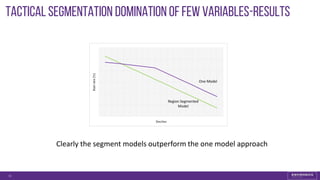
Tactical segmentation Domination of few variables-results
31
Clearly the segment models outperform the one model approach
Region Segmented
Model
One Model
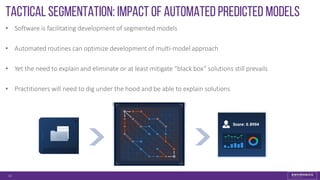
Tactical segmentation: Impact of automated predicted models
• Software is facilitating development of segmented models
• Automated routines can optimize development of multi-model approach
• Yet the need to explain and eliminate or at least mitigate “black box” solutions still prevails
• Practitioners will need to dig under the hood and be able to explain solutions
32
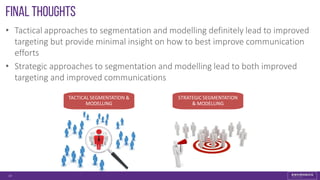
Final Thoughts
• Tactical approaches to segmentation and modelling definitely lead to improved
targeting but provide minimal insight on how to best improve communication
efforts
• Strategic approaches to segmentation and modelling lead to both improved
targeting and improved communications
33
TACTICAL SEGMENTATION &
MODELLING
STRATEGIC SEGMENTATION
& MODELLING

1000 track2 boire

  • 1.
  • 2.
    AGENDA AND CONCEPTS 2 •Segmentation/Modelling or both? • The strategic view of segmentation • Data Discovery- Initial engagement • Value Based Behaviour- Strategic • Clustering-Strategic • Tactical Segmentation • The impact of automated predictive models • Final thoughts
  • 3.
    Segmentation Strategic Unsupervised: Cluster Supervised: VBS Tactical Based on preliminary outcomesof a predictive model Outcomes from a decision tree analysis Segmentation/MODELLING OR BOTH? • Organizations often struggle with how to use segmentation, modelling or both in analytics projects
  • 4.
    The strategic Viewof Segmentation • Immediate benefit of segmentation is targeting • Long-term is cultivation and nurturing of a segment 4 New Customer Medium Value High Value How we do this? Where do we begin? What do we get?
  • 5.
    Data Discovery –Initial Engagement Agreement on Objectives Data Discovery Plan OneView™ Analytical File Data Audit Findings Segmentation(value behavior based vs. clustering) Customer Profiles Marketing Effectiveness Customer Strategy Data Strategy Analytical Roadmap Tactical Opportunities Outcomes
  • 6.
    Value-behaviour based(VBS)-Strategic • Firstdefine value – Profits determine the value for each segment in the example below: 6 Decile Value Segment # of Customers Avg. Profit 1 High 22,317 $592 2 High 22,317 $248 3 Medium 22,317 $156 4 Medium 22,317 $107 5 Medium 22,317 $69 6 Medium 22,317 $39 7 Low 22,317 $16 8 Low 22,317 $2 9 Low 22,317 $0 10 Low 22,317 -$11 Total 223,170 $122 Who are the most valuable?
  • 7.
    • Notion hereis to encapsulate longitudinal behavior of customer • Segmenting customers based on changing behavior (i.e. how does value change overtime) Behavioural – Based Segmentation-Strategic PRE PERIOD POST PERIOD JAN-JUN 2016 JUL- AUG 2016 REACTIVATORS DEFECTORS No activity Activity Activity No Activity
  • 8.
    VBS 8 STABLESDECLINERS GROWERS • Growers,stables, and decliners identifies those individuals whose behavior is close to the mean(stables), behaviour is well under the mean(decliners:-2SD) and behavior is well above the mean(growers:+2SD)
  • 9.
    Example of BehaviouralSegment creation- Growers,Decliners, Stables-Strategic • One Bank: 94,080 customers were active in the both the current and previous 3 month periods – We looked at some diagnostics around this group particularly how the % change numbers varied (i.e. standard deviation) – Mean % change for entire segment (active in current 3 months and active in previous 3 months) is 0.2% – Standard deviation is 44% Decile # of Customers % Change Behaviour Segment # of Statistical Standard deviations 1 9,408 154% Growers > 2 STD 2 9,408 97% Growers 3 9,408 60% Stables Within 2 STD 4 9,408 33% Stables 5 9,408 10% Stables 6 9,408 -9% Stables 7 9,408 -32% Stables 8 9,408 -60% Stables 9 9,408 -99% Decliners > 2 STD 10 9,408 -155% Decliners
  • 10.
    Integrating Value andBehaviour(VBS) Matrix- Strategic • This illustrate how the VBS segmentation approach can be used from a program development standpoint • Key assumptions are conversion rate and expect lift Assumptions Value Segment Behavior Segment $ Profit per Customer # of Names Conversion Rate (Annual) Lift in Profitability (Annual) Incremental $ Profit Opportunity Type of Model HIGH STABLE $442 23,279 20% 25% $514,890 Upsell/ Cross HIGH INACTIVE 6 $374 5,380 20% 25% $100,573 Reactivation HIGH DECLINE $419 4,477 20% 25% $93,872 Retention HIGH GROWER $408 3,958 20% 25% $80,836 Upsell HIGH REACTIV $388 1,894 20% 50% $73,400 Cross-sell HIGH DEFECTOR $368 2,762 20% 25% $50,813 Reactivation
  • 11.
    Case Study –Wealth Management company • Small investment company for high net worth individuals • Key imperative: reduce attrition of high value investors • First challenge: define attrition – Customers who redeemed all funds in their portfolio in the last year – Look at the customer behaviour prior to redemption • Second challenge: define high value 11 Value Segment # of Investors % of All Assets in Portfolio 1 2506 30.28% 2 2506 21.52% 3 2506 15.84% 4 2506 11.60% 5 2506 8.35% 6 2506 5.80% 7 2506 3.71% 8 2506 2.07% 9 2506 0.77% 10 2506 0.06% BEHAVIOUR PRIOR TOREDEMPTION CUSTOMERS WHO REDEEMED ALL FUNDS IN PORTFOLIO POST (12 months) High value group Net worth HighValue: $283K Net worth LOW Value: $59K PRE
  • 12.
    Integration of Defectionmodelto highvalue clients Case Study – Wealth Managementcompany 12 Creating the analytical file (12 MONTHS)
  • 13.
    Wealth Management company •Defection model was deployed to high value customers as a trigger tool for sales advisors 13 0.00% 5.00% 10.00% 15.00% 20.00% 25.00% 30.00% 1 2 3 4 5 6 7 8 9 10 DefectionRate Model Deciles Decile Defection Rate Results of Model Model was deployed to trigger high risk high value clients to salespeople.
  • 14.
    • The conceptbehind clustering • Technique attempts to minimize variation of data within cluster and maximize variation of data between clusters • Schematically , this looks as follows: MAXIMIZE M I N I M I Z E M I N I M I Z E Clustering-strategic CLUSTER 1 CLUSTER 2
  • 15.
    Clustering-strategic-FACTOR ANALYSIS • Whatare key analytical tasks that need to be undertaken here vs. building predictive models? – Need to reduce hundreds of variables to manageable number(40-50) – Use factor analysis as key data reduction tool 15
  • 16.
    Let’s take alook at an example • The following list of variables are used in a factor analysis – Income – Education – Wealth – Product A – Product B – Product C – Product D – Product E – Product F Factor 1 Factor 2 Factor 3 Eigenvalue 3.4 2.2 1 % of Explained Variation 53% 35% 12% FACTOR ANALYSIS FOR DATA REDUCTION Clustering-strategic-FACTOR ANALYSIS
  • 17.
    • Factor LoadingResults for Variables within Each Factor Clustering-strategic-FACTOR ANALYSIS Variable Factor 1 Factor 2 Factor 3 Income 0.905 0.255 0.255 Education 0.855 0.373 0.212 Wealth 0.956 0.303 0.185 Product A 0.303 0.855 0.205 Product B 0.295 0.805 0.245 Product C 0.323 0.755 0.285 Product D -0.105 -0.355 0.755 Product E -0.155 -0.405 0.705 Product F -0.085 -0.304 0.725
  • 18.
    Clustering-strategic-STANDARDIZATION • What arekey analytical tasks that need to be undertaken here vs. building predictive models? – Need to scale or standardize all variables – Let’s see what this looks like 18 Customer Record Income Mean Income Mean Difference in Income Age Average Age Mean Difference in Age 1 $ 25,000 $ 55,000 $ 30,000 25 41 16 2 $ 60,000 $ 55,000 $ 5,000 45 41 4 3 $ 20,000 $ 55,000 $ 35,000 55 41 14 4 $ 57,000 $ 55,000 $ 2,000 30 41 11 5 $ 45,000 $ 55,000 $ 10,000 35 41 6 Average difference $ 16,400 10.2
  • 19.
    19 Clustering-strategic-STANDARDIZATION Variable standardization -Z-scores • Assume: – Mean Income = $40,000 – Standard Deviation = $20,000 – Mean Age = 40 – Standard Deviation = 25 1 000,20 000,40000,20   A IncomeZ8.0 25 4020   A AgeZ 6.0 25 4025   B AgeZ 6.0 000,20 000,40000,52   C IncomeZ1 25 4065   C AgeZ 1 000,20 000,40000,60   B IncomeZ
  • 20.
    20 Clustering-strategic-STANDARDIZATION CALCULATING THE DISTANCEBETWEEN THE STANDARDIZED-Z SCORES. ZAge ZIncome A B C 0.6 1.01.0 -0.6 -0.8
  • 21.
    Explained Variation 1 2 34 5 Number of Clusters X Explained Variance Curve Clustering-strategic using the elbowtheory to determine optimum # of clusters A number of diagnostics can be used to estimate explained variation- cubic clustering criterion and/or Pseudo-F static
  • 22.
    22 Clustering-strategic • Multitude oftechniques and options within techniques can be employed – Fast Clustering-K Means Clustering – Hierarchical Clustering • What does it practically mean? Below example looks at 6 cluster solution from another wealth management client. See below results of Cluster One
  • 23.
    23 Clustering-strategic HIGH LEVEL OFRISK TOLERANCE UNENGAGED HIGH CANADIAN GROWTH FUNDPORTFOLIO MIX TODD, CLUSTER 1 32 years $ 70,000 Male Downtown, MTL Very active “I enjoy staying up-to speed on tech developments” ENTHUSIASM FOR TECHNOLOGY (HIGH) Values “I hold a diversified portfolio of small & medium organizations. I enjoy investing but don’t do it as often as I should” OUTLOOK ON INVESTING (MEDIUM)
  • 24.
    But what aboutthe models? 24 CLUSTER 2: BUILDERS • Strategy to implement models within segments Cross-sell models CLUSTER 1: ACCUMULATORS High value defection model Large Deposit model Upsell model Risk takers, likely to reinvest in high growth funds but “unengaged” Lives in Montreal and has a medium appetite for financial risk CLUSTER 3: YOUNG Cross-sell models Lives outside Montreal, single, has RRSP and is internet-savvy
  • 25.
    But what aboutthe models? 25 CLUSTER 4: RETIRED CLUSTER 5: PROTECTOR • Strategy to implement models within segments High value defection model High value defection model Upsell model Low risk takers, fund not diversified Family oriented, investment savvy, mature investors, long standing customer, HNI
  • 26.
    What about TacticalSegmentation? • Different from Strategic Segmentation • Initial Analytics are Predictive Models which then leads to development of multi-segment approach. Why? – The Hockey Stick Model – Domination of Few Variables 26
  • 27.
    Tactical Segmentation: Thehockey stickmodel-lottery example • Old model(response) has been in use for three years • Old model(response) still provides lift and ranking for top 60% of list, but seeing some flattening of results in bottom 40% of list 27 Rank (W2) # of Prospects Interval Response Rate # of Responders 1 80,000 48.72% 38,974 2 80,000 27.10% 21,679 3 80,000 18.74% 14,994 4 80,000 13.35% 10,679 5 80,000 11.12% 8,899 6 80,000 12.90% 10,318 7 80,000 3.50% 2,803 8 80,000 2.56% 2,048 9 80,000 2.20% 1,763 10 80,000 2.13% 1,707 80,000 14.23% 113,864
  • 28.
    The hockey stickmodel-what did we do? • Build two models – One for top 60% and one for bottom 40%. • Key differences between 2 models are: – Top 60% contains primarily donation activity type variables – Bottom 40% contains primarily demographic and more non-behavioural type variables 28
  • 29.
    Smoothing out theHockey Stick model • Analyzed impact on bottom 40% in order to observe if new model could improve performance. 29 New model clearly provides increased rank-ordering capability on bottom 40%.
  • 30.
    Tactical segmentation-Domination ofFew variables • Again modelling results lead to the following insights: 30 Variable Credit risk correlation Confidence interval Quebec 0.1 99% Alberta -0.09 99% all other variables under .05 Claim Risk Model CHAID and correlation results lead to the following insights that separate models should be developed by region All Variables 100% of sample 0.02 bad rate Quebec Alberta Rest of Canada 20% of sample 12% of sample 68% of sample 0.04 bad rate 0.008 bad rate 0.0162 bad rate
  • 31.
    Tactical segmentation Dominationof few variables-results 31 Clearly the segment models outperform the one model approach Region Segmented Model One Model
  • 32.
    Tactical segmentation: Impactof automated predicted models • Software is facilitating development of segmented models • Automated routines can optimize development of multi-model approach • Yet the need to explain and eliminate or at least mitigate “black box” solutions still prevails • Practitioners will need to dig under the hood and be able to explain solutions 32
  • 33.
    Final Thoughts • Tacticalapproaches to segmentation and modelling definitely lead to improved targeting but provide minimal insight on how to best improve communication efforts • Strategic approaches to segmentation and modelling lead to both improved targeting and improved communications 33 TACTICAL SEGMENTATION & MODELLING STRATEGIC SEGMENTATION & MODELLING

Editor's Notes

  • #11 This represented one form of segmentation(VBS)-value Behaviour Based. Might this apply within your organization?
  • #29 ic