Group members
 Sidra
 Zohra
 Rafia
 Komal
 Aimen
Practice In unified
sentences(synthesis)
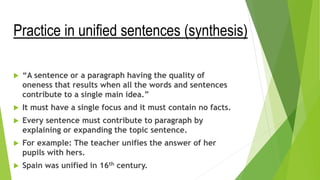
Practice in unified sentences (synthesis)
 “A sentence or a paragraph having the quality of
oneness that results when all the words and sentences
contribute to a single main idea.”
 It must have a single focus and it must contain no facts.
 Every sentence must contribute to paragraph by
explaining or expanding the topic sentence.
 For example: The teacher unifies the answer of her
pupils with hers.
 Spain was unified in 16th century.
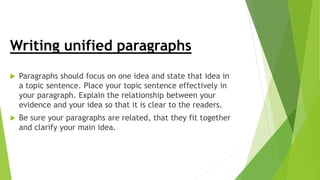
Writing unified paragraphs
 Paragraphs should focus on one idea and state that idea in
a topic sentence. Place your topic sentence effectively in
your paragraph. Explain the relationship between your
evidence and your idea so that it is clear to the readers.
 Be sure your paragraphs are related, that they fit together
and clarify your main idea.
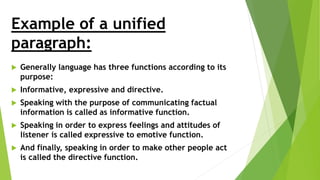
Example of a unified
paragraph:
 Generally language has three functions according to its
purpose:
 Informative, expressive and directive.
 Speaking with the purpose of communicating factual
information is called as informative function.
 Speaking in order to express feelings and attitudes of
listener is called expressive to emotive function.
 And finally, speaking in order to make other people act
is called the directive function.
Synthesis of sentences
 Synthesis means combination of a number of simple
sentences into one new sentence - simple, compound or
complex.
 The following are main ways of combining two or more
simple sentences into one large simple sentence.
 Examples:
 He sprang up to his feet.
 He ran away.
By using a participle
 He jumped up.
 He ran away.
Jumping up, he ran away.
 He was tired of play.
 He sat down to rest.
Tired of play, he sat down to rest.
 He is well versed in English.
 He was appointed as English teacher in the school.
Being well versed in English, he was appointed as the
teacher in the school.
By using noun or phrase
 Placing side by side two coordinate elements, the
second of which serves as explanation of the first.
 This is my friend. Her name is Sara.
This is my friend, Sara.
 I spent two days in London. It is one of the most
attractive places in England.
I spent two days in London, one of the most attractive
places in England.
Practice in unified sentences (synthesis) presentation.pptx

Practice in unified sentences (synthesis) presentation.pptx

  • 2.
    Group members  Sidra Zohra  Rafia  Komal  Aimen
  • 3.
  • 4.
    Practice in unifiedsentences (synthesis)  “A sentence or a paragraph having the quality of oneness that results when all the words and sentences contribute to a single main idea.”  It must have a single focus and it must contain no facts.  Every sentence must contribute to paragraph by explaining or expanding the topic sentence.  For example: The teacher unifies the answer of her pupils with hers.  Spain was unified in 16th century.
  • 5.
    Writing unified paragraphs Paragraphs should focus on one idea and state that idea in a topic sentence. Place your topic sentence effectively in your paragraph. Explain the relationship between your evidence and your idea so that it is clear to the readers.  Be sure your paragraphs are related, that they fit together and clarify your main idea.
  • 6.
    Example of aunified paragraph:  Generally language has three functions according to its purpose:  Informative, expressive and directive.  Speaking with the purpose of communicating factual information is called as informative function.  Speaking in order to express feelings and attitudes of listener is called expressive to emotive function.  And finally, speaking in order to make other people act is called the directive function.
  • 7.
    Synthesis of sentences Synthesis means combination of a number of simple sentences into one new sentence - simple, compound or complex.  The following are main ways of combining two or more simple sentences into one large simple sentence.  Examples:  He sprang up to his feet.  He ran away.
  • 8.
    By using aparticiple  He jumped up.  He ran away. Jumping up, he ran away.  He was tired of play.  He sat down to rest. Tired of play, he sat down to rest.  He is well versed in English.  He was appointed as English teacher in the school. Being well versed in English, he was appointed as the teacher in the school.
  • 9.
    By using nounor phrase  Placing side by side two coordinate elements, the second of which serves as explanation of the first.  This is my friend. Her name is Sara. This is my friend, Sara.  I spent two days in London. It is one of the most attractive places in England. I spent two days in London, one of the most attractive places in England.