

Galaxies , stars and their origin
More universes than ours ?
Earth-like planets ?
C. de Jager

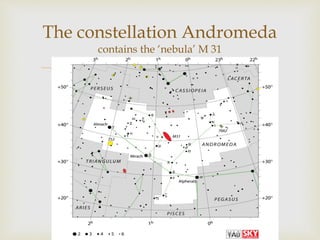
The constellation Andromeda
contains the ‘nebula’ M 31

It took 2.5 million years for
these photons to reach our
eyes
When the Neanderthalers still lived here
these photons had already finished 95%
of their trip

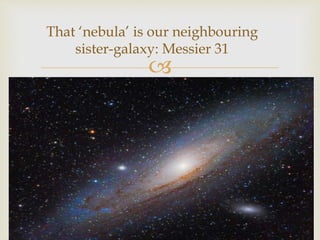
That ‘nebula’ is our neighbouring
sister-galaxy: Messier 31

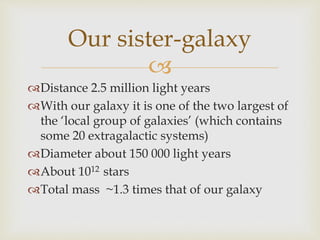
Distance 2.5 million light years
With our galaxy it is one of the two largest of
the ‘local group of galaxies’ (which contains
some 20 extragalactic systems)
Diameter about 150 000 light years
About 1012 stars
Total mass ~1.3 times that of our galaxy
Our sister-galaxy

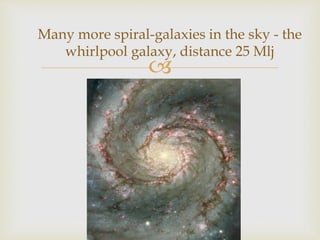
Many more spiral-galaxies in the sky - the
whirlpool galaxy, distance 25 Mlj

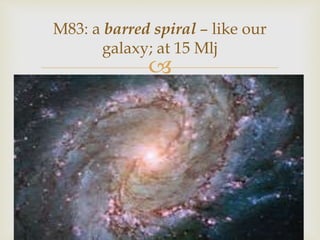
M83: a barred spiral – like our
galaxy; at 15 Mlj

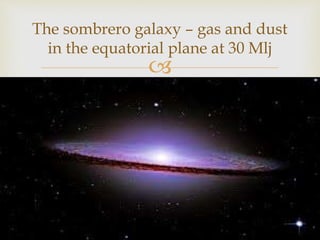
The sombrero galaxy – gas and dust
in the equatorial plane at 30 Mlj

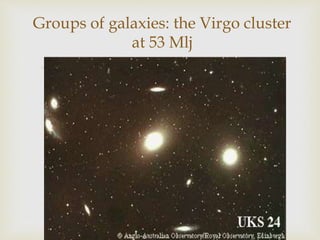
Groups of galaxies: the Virgo cluster
at 53 Mlj

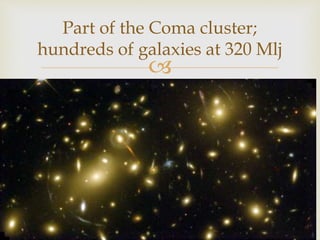
Part of the Coma cluster;
hundreds of galaxies at 320 Mlj

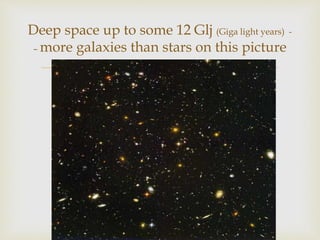
Deep space up to some 12 Glj (Giga light years) -
– more galaxies than stars on this picture

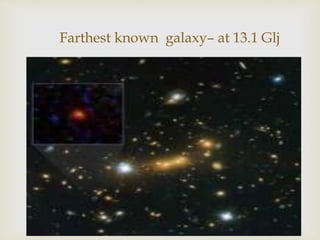
Farthest known galaxy– at 13.1 Glj

That was a rapid view of
our Universe
There were remarkable developments in the
early 20th century

 An essential question for Einstein (1915): Why does
the universe not collapse – the Earth existsed for
hundreds of millions of years if not longer; the
galaxies most probably too
 Did the universe exist that long without collapsing?
 To overcome this Einstein introduced an additional
term in his formulae – characterized by the Greek
capital Lambda. Keeping the universe in shape
Einstein’s dilemma

 Ten years after Einstein Hubble found that the
Universe is expanding
 Around 1920 - 30 that was already predicted by De
Sitter, Friedman and Lemaître
 Their suggestion: Universe is either expanding or
collapsing or (most improbable) just in balance
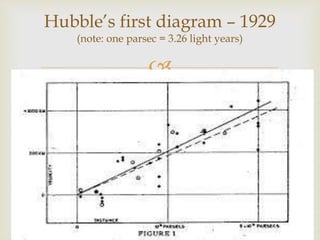
 Hubble could measure distances and found: it is
expanding
 Einstein: “Introducing Lambda was my biggest error”
Einstein’s ‘biggest error’

Hubble’s first diagram – 1929
(note: one parsec = 3.26 light years)

 A special type of supernovae (Supernovae type Ia) is
the most reliable standard candle
 A supernova Ia is due to the explosion of a white
dwarf star that, by collecting mass from a companion
star, exceeds its limiting mass of 1.4 solar masses
 Then it produces a radiation flux of 1010 times solar
radiation flux. Therefore visible till far in the depths
of the Universe
 All SN Ia are equally bright – that makes them a
good standard candle
Later improvements based on a
reliable standard candle


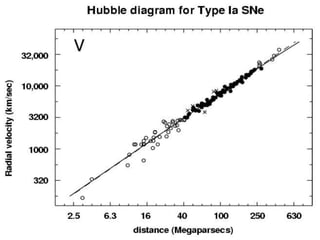
 From Hubble diagram we derive: Universe originated
13,8 Gigayears ago; must have been very small at that
time – how small?
 Lemaître (Leuven) introduced L’atome primitif: the
universe started extremely small ; elaborated by Gamov
 The hypothesis of an explosion with extremely small
origin met with much sceptisism
 Hoyle, cynically: “These fantasists with their big bang”
 Gradually – after more data and many investigations –
the conclusion became inevitable
“The day without yesterday”(Lemaître)

It was not an explosion !
Not an explosion of matter – space originated and grew
Before, there was no space; nor did time exist.
Before? That notion too had no sense

 Universe, space and time, originated from an instability
of the absolute vacuum – the Big Bang, but how?
 Perhaps the Casimir-Polder hypothesis (1948)?
 Basis: even the absolute vacuum does contain energy in
volumes as small as the Planck length – emergence and
decay of very enegetic virtual particles with positive and
negative energy explosions, and even with positive and
negative time excursions.
 Could an accumulation of energy in the sub-Planck
domain lead to an explosion followed by expansion and
decreasing temperature? Still very open question
Big Bang

 In times shorter that Planck time (1.35 x !0-43sec) and space
smaller than Planck length (4.05 x 10⁻³⁵ meter) notions
time and space lose their meaning. Virtual particle can
originate and decay.
 Formation involves positive and negative energy of order
of Planck energy (2x 10⁹ Joule) and associated pressures
 Corresponding temperature is 3.55x 032 K
 Could such an explosion have given rise to the Universe?
 And: why then only one universe ? A multiverse?
The Planck era and the Multiverse

 After its formation the universe expanded and cooled
 Basic constituents of chemcal elememts originated:
 Quark–gluon liquid after ~ 10-6 s; T = 1013 K
 Thereafter protons and neutrons formed and then the
simplest atomic nuclei (H, He, Li)
 After 300 seconds: T has decreased to ~ 109 K, universe
consisted of positive ions of Hydrogen, Deuterium,
Helium-3, Helium-4, Lithium and many electrons
 After 370 000 years: T smaller than 4000 K; recombination
of protons and electrons: universe became transparent
After Planck era: formation of first
chemical elements

This was the standard
picture
It was accepted till end of last century.
Recent new developments

 (a) Study of motions in (groups of) galaxies shows
there must exist more matter than what is visible
 Initial estimates: there is about five to ten times more
invisible than visible matter. What is it?
 Dark matter – nice name but explains nothing
 (b) But additionally it was found that expansion of
universe is accelerating (Einstein’s Lambda returns!)
 Enormous energy needed for this acceleration
 Dark energy – nice name but explains nothing
Dark matter and dark energy

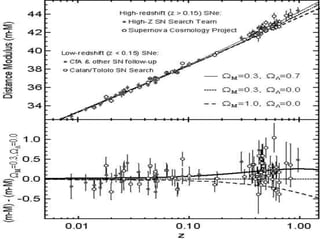
 The relation between velocity of expansion and distance
is not linear – the expansion accelerates!
 Acceleration by some form of energy. How much?
 We tranform energy into mass with E = m.c2
 Best agremeent is found for 30% mass (visible and
invisible) and 70% mass corresponding with dark
energy
 See next graph
More about the acceleration


A closer look at the
developing universe
After the first few minutes, the Universe, while
continuing to cool down, still consisted only of
atoms of Hydrogen and Helium.

 By recombination of electrons and protons the first
hydrogen atoms formed. The universe became practically
transparent (apart from absorption by He atoms)
 This happened after some 370 000 years . At that time T
had decreased till below 4000 K – but by exansion of
universe we see T = 2.7 K
 Do stars and galaxies originate at that time? Can we see
that ?
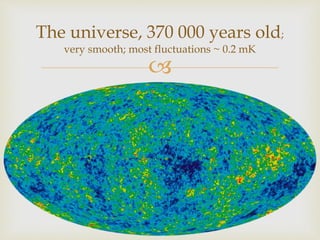
 WMAP and Planck satellites, observing at mm
wavelengths gave image of the universe at that time
 Result was disappointing: practically smooth universe
After 370 000 years

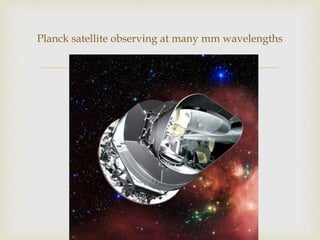
Planck satellite observing at many mm wavelengths

The universe, 370 000 years old;
very smooth; most fluctuations ~ 0.2 mK

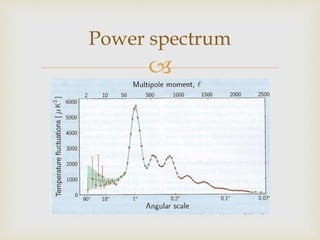
Power spectrum

 Total relative mass of visible matter (baryons and
electrons) is 0.0486 ± 0.0007
 Total relative mass of dark matter is 0.273 ± 0.006
 Total relative mass correspoding with dark energy is
0.68 ± 0.02
 Expansion velocity increases wit 67.3 ± 1.2
km/sec/megaparsec (Hubble constant); age of
univere 13.8 Giga-years
 Hence: visible matter: 5%; dark matter: one-fourth;
dark energy: two-thirds
Results of analysis

Birth of galaxies, stars
and planets
At that time: only Hydrogen-Helium bodies
Heavier atoms did not exist
Hence: no rocky planets possible
Life was neither possible

 With the given densities and radiation flux only
fairly small individual clouds of gas can form
 Mass of order 10 000 solar masses.
 This happened after 300 to 500 million years
 Gradually H2 molecules form, a fraction of 0.001 to
0.000 1 produces sufficient cooling allowing for more
mass accretion; thus these clouds grew
 After about 600 million year the mass has increased
to 1 – 10 million solar masses; not yet a galaxy.
 We call these objecs: proto-galaxies
Proto-galaxies

 Small density fluctuations in the proto-galaxies can lead
to fragmentation followed by further contraction – thus
the first stars form
 Size is limited by the absorption in the atmospheres – if
this is large enough, atmophere expands and escapes.
This limits the size of the star
 Present most massive stars contain enough absorbing
matter to keep their mass below 60 – 80 solar; their
radiation flux is one million times the solar value.
 In contrary: the earliest stars of the universe could reach
masses up to a thousand solar masses
The first stars - gigantic objects

 The early H-He stars had high central pressure and
temperature. Intense nuclear radiation and hence intense
radiation flux ( ~108 to 109 times solar value)
 Hence shortlived star
 Compare: sun is expected to live for 10 Gigayears; star of
100 solar masses lives only 1 – 3 million years
 Star of 1000 solar masses is expected to live not longer
than 30.000 years; ; they radiate few 100 million times
more intense than the sun
 Explosion at end of life – hypernova
 Remaining core becomes black hole of ~ 100 solar masses
Short living objects; hypernovae

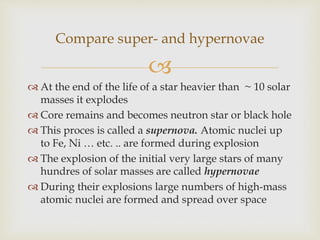
 At the end of the life of a star heavier than ~ 10 solar
masses it explodes
 Core remains and becomes neutron star or black hole
 This proces is called a supernova. Atomic nuclei up
to Fe, Ni … etc. .. are formed during explosion
 The explosion of the initial very large stars of many
hundres of solar masses are called hypernovae
 During their explosions large numbers of high-mass
atomic nuclei are formed and spread over space
Compare super- and hypernovae

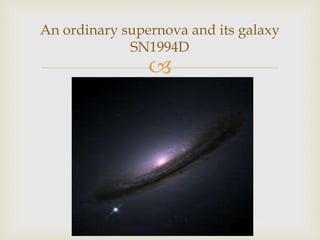
An ordinary supernova and its galaxy
SN1994D

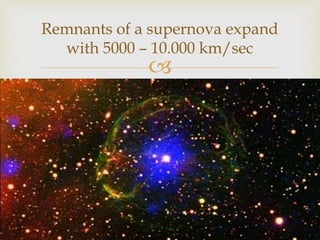
Remnants of a supernova expand
with 5000 – 10.000 km/sec

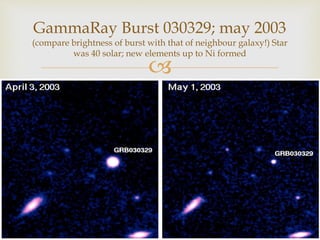
GammaRay Burst 030329; may 2003
(compare brightness of burst with that of neighbour galaxy!) Star
was 40 solar; new elements up to Ni formed

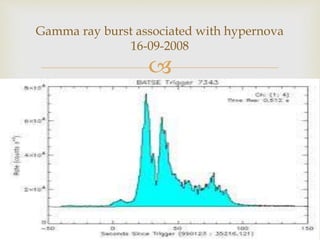
Gamma ray burst associated with hypernova
16-09-2008

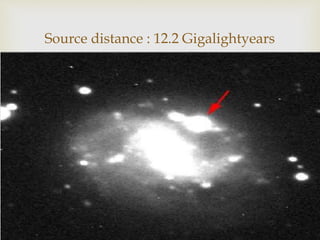
Source distance : 12.2 Gigalightyears

 Universe exists for 13.8 Gigayears
 0.37 million years: universe becomes transparent
 400 million years: first matter accumulated
 600 million years: protogalaxies; first hypergiant
stars, hundreds to thousand times larger than sun
 800 million years: first present-days galaxies; smaller
stars
 After 1 to 2 Gigayears: first sunlike stars
Summarizing (all data are aproximative)

We exist
You and me: We exist thanks to the
supergiant stars and to the super-
and hypernovae

 Sun-like stars can only exist if they contain enough
absorbing matter, which is atoms heavier than He
 In cores of massive stars (20 – 80 times sun) elements such
as O, Ne, Mg, Si are formed
 In ‘ordinary’ supernovae (mass above 10 solar, and up to
~ 80 solar) chemical elements up to atomic numbers
around Fe and Ni are formed during their explosion
 In hypernovae (more massive stars) formation of still
much massive chemical elements
 Thanks to such stars rocky planets and life can exist
We exist thanks to massive stars

Back to earth
Earth-like planets could therefore exist in
the universe
But how about life?

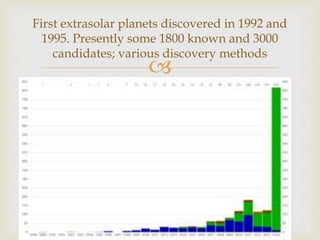
First extrasolar planets discovered in 1992 and
1995. Presently some 1800 known and 3000
candidates; various discovery methods

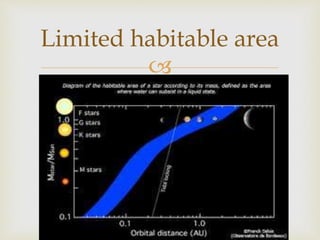
Limited habitable area

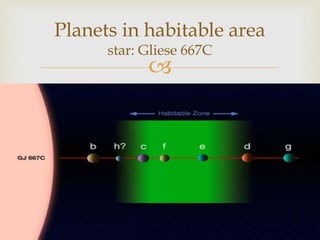
Planets in habitable area
star: Gliese 667C

 Only big planets can yet be discovered
 Only those that revolve close to the parent star
 Thus ‘hot Jupiters’ are frequently found
 The Earth reflecting only fraction 10 -10 of the sun’s
light, occulting some 10-4 part of the sun and
revolving around the sun in a time as long as one
year, would be very difficult to discover
 But Jupiter too would be a difficult object in spite of
its big mass, because of its long revolution time
Limitations to discoveries

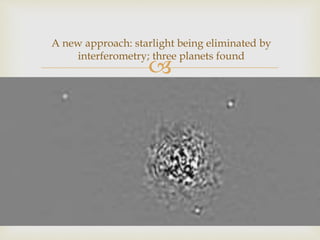
A new approach: starlight being eliminated by
interferometry; three planets found

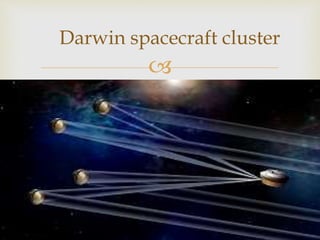
 Set of four spacecrafts, pointing same direction
 Mutual relative distances and distance to fifth
spacecraft to be controlled with extreme precission
 Light sent from the four to the central spacecraft
 By interferometry light of star is eliminated; light of
planet(s) remains
 Residual light inspected spectroscopically –search for
molecules that relate to life
 This is a proposal to ESA – not yet accepted
A fascinating proposal: the
Darwin mission

Darwin spacecraft cluster

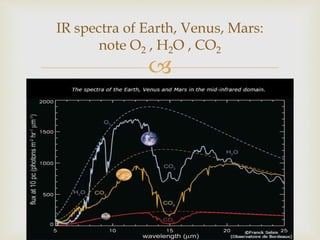
IR spectra of Earth, Venus, Mars:
note O2 , H2O , CO2
Containing at least one small rocky
planet, surrounded by a thin layer of
water and much thinner layer of gas.
A good Universe to live in
Go to page: presentations ; there to Universe
See also: oerknal
Eerste melkwegstelsels
Eerste sterren
Hete reuzenplaneten

10 wonderful-universe

  • 1.
    Galaxies , starsand their origin More universes than ours ? Earth-like planets ? C. de Jager
  • 2.
  • 3.
     It took 2.5million years for these photons to reach our eyes When the Neanderthalers still lived here these photons had already finished 95% of their trip
  • 4.
     That ‘nebula’ isour neighbouring sister-galaxy: Messier 31
  • 5.
     Distance 2.5 millionlight years With our galaxy it is one of the two largest of the ‘local group of galaxies’ (which contains some 20 extragalactic systems) Diameter about 150 000 light years About 1012 stars Total mass ~1.3 times that of our galaxy Our sister-galaxy
  • 6.
     Many more spiral-galaxiesin the sky - the whirlpool galaxy, distance 25 Mlj
  • 7.
     M83: a barredspiral – like our galaxy; at 15 Mlj
  • 8.
     The sombrero galaxy– gas and dust in the equatorial plane at 30 Mlj
  • 9.
     Groups of galaxies:the Virgo cluster at 53 Mlj
  • 10.
     Part of theComa cluster; hundreds of galaxies at 320 Mlj
  • 11.
     Deep space upto some 12 Glj (Giga light years) - – more galaxies than stars on this picture
  • 12.
  • 13.
     That was arapid view of our Universe There were remarkable developments in the early 20th century
  • 14.
      An essentialquestion for Einstein (1915): Why does the universe not collapse – the Earth existsed for hundreds of millions of years if not longer; the galaxies most probably too  Did the universe exist that long without collapsing?  To overcome this Einstein introduced an additional term in his formulae – characterized by the Greek capital Lambda. Keeping the universe in shape Einstein’s dilemma
  • 15.
      Ten yearsafter Einstein Hubble found that the Universe is expanding  Around 1920 - 30 that was already predicted by De Sitter, Friedman and Lemaître  Their suggestion: Universe is either expanding or collapsing or (most improbable) just in balance  Hubble could measure distances and found: it is expanding  Einstein: “Introducing Lambda was my biggest error” Einstein’s ‘biggest error’
  • 16.
     Hubble’s first diagram– 1929 (note: one parsec = 3.26 light years)
  • 17.
      A specialtype of supernovae (Supernovae type Ia) is the most reliable standard candle  A supernova Ia is due to the explosion of a white dwarf star that, by collecting mass from a companion star, exceeds its limiting mass of 1.4 solar masses  Then it produces a radiation flux of 1010 times solar radiation flux. Therefore visible till far in the depths of the Universe  All SN Ia are equally bright – that makes them a good standard candle Later improvements based on a reliable standard candle
  • 18.
  • 19.
      From Hubblediagram we derive: Universe originated 13,8 Gigayears ago; must have been very small at that time – how small?  Lemaître (Leuven) introduced L’atome primitif: the universe started extremely small ; elaborated by Gamov  The hypothesis of an explosion with extremely small origin met with much sceptisism  Hoyle, cynically: “These fantasists with their big bang”  Gradually – after more data and many investigations – the conclusion became inevitable “The day without yesterday”(Lemaître)
  • 20.
     It was notan explosion ! Not an explosion of matter – space originated and grew Before, there was no space; nor did time exist. Before? That notion too had no sense
  • 21.
      Universe, spaceand time, originated from an instability of the absolute vacuum – the Big Bang, but how?  Perhaps the Casimir-Polder hypothesis (1948)?  Basis: even the absolute vacuum does contain energy in volumes as small as the Planck length – emergence and decay of very enegetic virtual particles with positive and negative energy explosions, and even with positive and negative time excursions.  Could an accumulation of energy in the sub-Planck domain lead to an explosion followed by expansion and decreasing temperature? Still very open question Big Bang
  • 22.
      In timesshorter that Planck time (1.35 x !0-43sec) and space smaller than Planck length (4.05 x 10⁻³⁵ meter) notions time and space lose their meaning. Virtual particle can originate and decay.  Formation involves positive and negative energy of order of Planck energy (2x 10⁹ Joule) and associated pressures  Corresponding temperature is 3.55x 032 K  Could such an explosion have given rise to the Universe?  And: why then only one universe ? A multiverse? The Planck era and the Multiverse
  • 23.
      After itsformation the universe expanded and cooled  Basic constituents of chemcal elememts originated:  Quark–gluon liquid after ~ 10-6 s; T = 1013 K  Thereafter protons and neutrons formed and then the simplest atomic nuclei (H, He, Li)  After 300 seconds: T has decreased to ~ 109 K, universe consisted of positive ions of Hydrogen, Deuterium, Helium-3, Helium-4, Lithium and many electrons  After 370 000 years: T smaller than 4000 K; recombination of protons and electrons: universe became transparent After Planck era: formation of first chemical elements
  • 24.
     This was thestandard picture It was accepted till end of last century. Recent new developments
  • 25.
      (a) Studyof motions in (groups of) galaxies shows there must exist more matter than what is visible  Initial estimates: there is about five to ten times more invisible than visible matter. What is it?  Dark matter – nice name but explains nothing  (b) But additionally it was found that expansion of universe is accelerating (Einstein’s Lambda returns!)  Enormous energy needed for this acceleration  Dark energy – nice name but explains nothing Dark matter and dark energy
  • 26.
      The relationbetween velocity of expansion and distance is not linear – the expansion accelerates!  Acceleration by some form of energy. How much?  We tranform energy into mass with E = m.c2  Best agremeent is found for 30% mass (visible and invisible) and 70% mass corresponding with dark energy  See next graph More about the acceleration
  • 27.
  • 28.
     A closer lookat the developing universe After the first few minutes, the Universe, while continuing to cool down, still consisted only of atoms of Hydrogen and Helium.
  • 29.
      By recombinationof electrons and protons the first hydrogen atoms formed. The universe became practically transparent (apart from absorption by He atoms)  This happened after some 370 000 years . At that time T had decreased till below 4000 K – but by exansion of universe we see T = 2.7 K  Do stars and galaxies originate at that time? Can we see that ?  WMAP and Planck satellites, observing at mm wavelengths gave image of the universe at that time  Result was disappointing: practically smooth universe After 370 000 years
  • 30.
     Planck satellite observingat many mm wavelengths
  • 31.
     The universe, 370000 years old; very smooth; most fluctuations ~ 0.2 mK
  • 32.
  • 33.
      Total relativemass of visible matter (baryons and electrons) is 0.0486 ± 0.0007  Total relative mass of dark matter is 0.273 ± 0.006  Total relative mass correspoding with dark energy is 0.68 ± 0.02  Expansion velocity increases wit 67.3 ± 1.2 km/sec/megaparsec (Hubble constant); age of univere 13.8 Giga-years  Hence: visible matter: 5%; dark matter: one-fourth; dark energy: two-thirds Results of analysis
  • 34.
     Birth of galaxies,stars and planets At that time: only Hydrogen-Helium bodies Heavier atoms did not exist Hence: no rocky planets possible Life was neither possible
  • 35.
      With thegiven densities and radiation flux only fairly small individual clouds of gas can form  Mass of order 10 000 solar masses.  This happened after 300 to 500 million years  Gradually H2 molecules form, a fraction of 0.001 to 0.000 1 produces sufficient cooling allowing for more mass accretion; thus these clouds grew  After about 600 million year the mass has increased to 1 – 10 million solar masses; not yet a galaxy.  We call these objecs: proto-galaxies Proto-galaxies
  • 36.
      Small densityfluctuations in the proto-galaxies can lead to fragmentation followed by further contraction – thus the first stars form  Size is limited by the absorption in the atmospheres – if this is large enough, atmophere expands and escapes. This limits the size of the star  Present most massive stars contain enough absorbing matter to keep their mass below 60 – 80 solar; their radiation flux is one million times the solar value.  In contrary: the earliest stars of the universe could reach masses up to a thousand solar masses The first stars - gigantic objects
  • 37.
      The earlyH-He stars had high central pressure and temperature. Intense nuclear radiation and hence intense radiation flux ( ~108 to 109 times solar value)  Hence shortlived star  Compare: sun is expected to live for 10 Gigayears; star of 100 solar masses lives only 1 – 3 million years  Star of 1000 solar masses is expected to live not longer than 30.000 years; ; they radiate few 100 million times more intense than the sun  Explosion at end of life – hypernova  Remaining core becomes black hole of ~ 100 solar masses Short living objects; hypernovae
  • 38.
      At theend of the life of a star heavier than ~ 10 solar masses it explodes  Core remains and becomes neutron star or black hole  This proces is called a supernova. Atomic nuclei up to Fe, Ni … etc. .. are formed during explosion  The explosion of the initial very large stars of many hundres of solar masses are called hypernovae  During their explosions large numbers of high-mass atomic nuclei are formed and spread over space Compare super- and hypernovae
  • 39.
     An ordinary supernovaand its galaxy SN1994D
  • 40.
     Remnants of asupernova expand with 5000 – 10.000 km/sec
  • 41.
     GammaRay Burst 030329;may 2003 (compare brightness of burst with that of neighbour galaxy!) Star was 40 solar; new elements up to Ni formed
  • 42.
     Gamma ray burstassociated with hypernova 16-09-2008
  • 43.
     Source distance :12.2 Gigalightyears
  • 44.
      Universe existsfor 13.8 Gigayears  0.37 million years: universe becomes transparent  400 million years: first matter accumulated  600 million years: protogalaxies; first hypergiant stars, hundreds to thousand times larger than sun  800 million years: first present-days galaxies; smaller stars  After 1 to 2 Gigayears: first sunlike stars Summarizing (all data are aproximative)
  • 45.
     We exist You andme: We exist thanks to the supergiant stars and to the super- and hypernovae
  • 46.
      Sun-like starscan only exist if they contain enough absorbing matter, which is atoms heavier than He  In cores of massive stars (20 – 80 times sun) elements such as O, Ne, Mg, Si are formed  In ‘ordinary’ supernovae (mass above 10 solar, and up to ~ 80 solar) chemical elements up to atomic numbers around Fe and Ni are formed during their explosion  In hypernovae (more massive stars) formation of still much massive chemical elements  Thanks to such stars rocky planets and life can exist We exist thanks to massive stars
  • 47.
     Back to earth Earth-likeplanets could therefore exist in the universe But how about life?
  • 48.
     First extrasolar planetsdiscovered in 1992 and 1995. Presently some 1800 known and 3000 candidates; various discovery methods
  • 49.
  • 50.
     Planets in habitablearea star: Gliese 667C
  • 51.
      Only bigplanets can yet be discovered  Only those that revolve close to the parent star  Thus ‘hot Jupiters’ are frequently found  The Earth reflecting only fraction 10 -10 of the sun’s light, occulting some 10-4 part of the sun and revolving around the sun in a time as long as one year, would be very difficult to discover  But Jupiter too would be a difficult object in spite of its big mass, because of its long revolution time Limitations to discoveries
  • 52.
     A new approach:starlight being eliminated by interferometry; three planets found
  • 53.
      Set offour spacecrafts, pointing same direction  Mutual relative distances and distance to fifth spacecraft to be controlled with extreme precission  Light sent from the four to the central spacecraft  By interferometry light of star is eliminated; light of planet(s) remains  Residual light inspected spectroscopically –search for molecules that relate to life  This is a proposal to ESA – not yet accepted A fascinating proposal: the Darwin mission
  • 54.
  • 55.
     IR spectra ofEarth, Venus, Mars: note O2 , H2O , CO2
  • 56.
    Containing at leastone small rocky planet, surrounded by a thin layer of water and much thinner layer of gas. A good Universe to live in
  • 57.
    Go to page:presentations ; there to Universe See also: oerknal Eerste melkwegstelsels Eerste sterren Hete reuzenplaneten