1
RAJIV GANDHI COLLEGE OF ENGINEERING, RESEARCH & TECHNOLOGY,
CHANDRAPUR
(DR. BABASAHEB AMBEDKAR TECHNOLOGICAL UNIVERSITY, LONERE)
(2024-25)
HOD CSE Dept.
Dr. Nitin Janwe
Guided by:
Prof. Madhavi Tota
2
Activity 3: Group Presentation.
TOPIC : CONSTRUCTOR AND METHOD OVERLOADING
Group No. : 1
Submitted by:
1. Pranay Zade(01)
2. Dikshita Yesambare(02)
3. Kshitij Turankar(03)
4. Piyushchandra Vyas(04)
5. Adarsh Lattiwar(05)
6. Tanushree Thakur(06)
7. Arpit Bhandare(07)
8. Shubham Sainwar(08)
9. Mamta Suramwar(09)
3
OVERVIEW
1. What is Overloading?
2. Constructor Overloading .
3. Method Overloading.
4. Comparison Of Constructor Overloading and Method Overloading.
5. Benifits Of Overloading In Java.
6. Rules For Overloading.
7. Advantages & Disadvantages Of Overloading.
8. Best Practices For Overloading In Java.
9. Conclusion.
4
What is Overloading?
Overloading is a fundamental concept in object-oriented programming (OOP) that allows multiple
methods or constructors with the same name to be defined, but with different parameter lists.
This means that a single method or constructor name can be used to perform different actions,
depending on the number and types of arguments passed to it.
In other words, overloading allows a method or constructor to have multiple definitions, each
with a different signature, but with the same name. The signature of a method or constructor
includes the name, return type, and parameter list.
Overloading is useful when:
1.Multiple ways to perform a task: A single method or constructor can be used to perform
different tasks, depending on the input parameters.
2.Improved code readability: Overloading allows for more concise and expressive code, as a
single method or constructor name can be used to convey different meanings.
3.Increased flexibility: Overloading enables developers to write more flexible code that can
adapt to different scenarios and requirements.
5
Constructor Overloading
Constructor overloading is a technique in object-oriented programming (OOP) that allows multiple
constructors to be defined with the same name but with different parameter lists. This means that a
single constructor name can be used to create objects with different initial states, depending on the
number and types of arguments passed to it.
Example:public class Rectangle {
private int width;
private int height;
// Constructor 1: takes two int parameters
public Rectangle(int width, int height) {
this.width = width;
this.height = height;
}
// Constructor 2: takes four int parameters
public Rectangle(int width, int height, int x, int y) {
this.width = width;
this.height = height;
// additional initialization code using x and y
}
public void printDimensions() {
System.out.println("Width: " + width + ", Height: " +
height);
}
}
public class Main {
public static void main(String[] args) {
// Create a rectangle with width 10 and height 20
Rectangle rect1 = new Rectangle(10, 20);
rect1.printDimensions(); // Output: Width: 10,
Height: 20
// Create a rectangle with width 30, height 40, x 50,
and y 60
Rectangle rect2 = new Rectangle(30, 40, 50, 60);
rect2.printDimensions(); // Output: Width: 30,
Height: 40
}
}
6
Method Overloading
Method overloading is a technique in object-oriented programming (OOP) that allows multiple methods
with the same name to be defined, but with different parameter lists. This means that a single method
name can be used to perform different actions, depending on the number and types of arguments passed
to it.
Exampl
e:
public class Calculator {
// Method 1: takes two int parameters
public int add(int a, int b) {
return a + b;
}
// Method 2: takes two double parameters
public double add(double a, double b) {
return a + b;
}
// Method 3: takes three int parameters
public int add(int a, int b, int c) {
return a + b + c;
}
}
public class Main {
public static void main(String[] args) {
Calculator calc = new Calculator();
// Call add method with two int parameters
int result1 = calc.add(10, 20);
System.out.println("Result 1: " + result1); // Output: Result 1: 30
// Call add method with two double parameters
double result2 = calc.add(10.5, 20.8);
System.out.println("Result 2: " + result2); // Output: Result 2: 31.3
// Call add method with three int parameters
int result3 = calc.add(10, 20, 30);
System.out.println("Result 3: " + result3); // Output: Result 3: 60
}
}
7
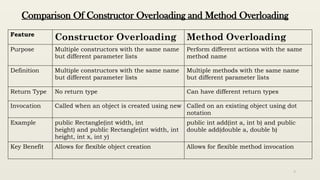
Comparison Of Constructor Overloading and Method Overloading
Feature
Constructor Overloading Method Overloading
Purpose Multiple constructors with the same name
but different parameter lists
Perform different actions with the same
method name
Definition Multiple constructors with the same name
but different parameter lists
Multiple methods with the same name
but different parameter lists
Return Type No return type Can have different return types
Invocation Called when an object is created using new Called on an existing object using dot
notation
Example public Rectangle(int width, int
height) and public Rectangle(int width, int
height, int x, int y)
public int add(int a, int b) and public
double add(double a, double b)
Key Benefit Allows for flexible object creation Allows for flexible method invocation
8
Benifits Of Overloading In Java
1. Improved Code Readability: Overloading allows for more concise
and expressive code, making it easier to read and understand.
2. Increased Flexibility: Overloading enables developers to write more
flexible code that can adapt to different scenarios and requirements.
3. Reduced Code Duplication: By using the same method or
constructor name, overloading reduces code duplication and makes
maintenance easier.
4. Enhanced Code Reusability: Overloading promotes code reusability
by allowing the same method or constructor to be used in different
contexts.
5. Simplified Method Invocation: Overloading simplifies method
invocation by allowing developers to use the same method name with
different parameter lists.
9
Rules For Overloading
1. Method Name: The method name must be the same for all overloaded methods.
2. Parameter List: The parameter list must be different for each overloaded method. This can
include differences in the number of parameters, the types of parameters, or both.
3. Return Type: The return type can be different for each overloaded method.
4. Method Signature: The method signature, which includes the method name and parameter
list, must be unique for each overloaded method.
5. Parameter Names: Parameter names can be the same or different for each overloaded
method
6. Method Body: The method body can be different for each overloaded method.
7. Access Modifiers: Access modifiers (public, private, protected, etc.) can be different for each
overloaded method.
8. throws Clause: The throws clause can be different for each overloaded method.
9. Method Overloading with Varargs: Java 5 and later versions support method overloading
with varargs (variable-length argument lists).
10. Constructor Overloading: Constructors can also be overloaded, but they must follow the
same rules as method overloading.
10
Advantages & Disadvantages Of Constructor Overloading
ADVANTAGES:
1. Improved Code Readability:- Overloading makes code more concise and easier to read.
2. Increased Flexibility :- Allows for more flexibility in method invocation with different
parameter lists.
3. Reduced Code Duplication:- Reduces code duplication by using the same method name with
different parameter lists.
4. Enhanced Code Reusability:- Promotes code reusability by allowing the same method to be
used in different contexts.
DISADVANTAGES:
1. Increased Complexity:-Overloading can increase code complexity, making it harder to
understand and maintain.
2. Ambiguity:-Can lead to ambiguity if multiple methods have similar parameter lists.
3. Error Prone:-Can be error-prone if not implemented correctly, leading to unexpected
behavior.
4. Debugging Challenges:-Can make debugging more challenging due to the multiple method
definitions.
11
Best Practices For Overloading In Java
To ensure that overloading is used effectively and efficiently in Java, follow these best practices:
1.Use Meaningful Method Names: Choose method names that clearly indicate the purpose of the method and the
parameters it accepts.
2.Avoid Ambiguity: Ensure that overloaded methods have distinct parameter lists to avoid ambiguity and
confusion.
3.Use Consistent Naming Conventions: Follow consistent naming conventions throughout the codebase to make
it easier to understand and maintain.
4.Keep it Simple: Avoid overloading methods with too many parameters, as this can lead to complexity and
confusion.
5.Document Overloaded Methods: Clearly document overloaded methods, including their purpose, parameters,
and return types, to make it easier for others to understand and use them.
6.Test Thoroughly: Thoroughly test overloaded methods to ensure they work as expected and do not introduce
any unexpected behavior.
7.Avoid Over-Engineering: Avoid over-engineering by not creating too many overloaded methods, as this can
lead to complexity and maintenance issues.
8.Follow the Principle of Least Surprise: Ensure that overloaded methods behave as expected and do not surprise
the user with unexpected behavior.
9.Code for Readability: Prioritize code readability and maintainability when using overloading, as this will make
it easier for others to understand and work with the code.
12
Conclusion
Constructor overloading allows for multiple constructors with the same name but different parameter lists,
enabling flexible object creation.Method overloading allows for multiple methods with the same name but
different parameter lists, enabling flexible method invocation.Overloading provides several benefits,
including improved code readability, increased flexibility, and reduced code duplication.However,
overloading also has some disadvantages, such as increased complexity, ambiguity, and error-prone
implementation.By following best practices, such as using meaningful method names, avoiding ambiguity,
and testing thoroughly, developers can effectively use overloading to improve their code. Constructor and
method overloading are powerful features in Java that enable flexible object creation and method
invocation. By using overloading, developers can write more concise, readable, and maintainable code.
However, overloading also has some disadvantages, such as increased complexity and ambiguity. By
following best practices, developers can effectively use overloading to improve their code and create more
robust and scalable software systems.
13
THANK YOU!!

JAVA PPT.pptxmjejsisisiksjsjsjkdkskdnejejje

  • 1.
    1 RAJIV GANDHI COLLEGEOF ENGINEERING, RESEARCH & TECHNOLOGY, CHANDRAPUR (DR. BABASAHEB AMBEDKAR TECHNOLOGICAL UNIVERSITY, LONERE) (2024-25) HOD CSE Dept. Dr. Nitin Janwe Guided by: Prof. Madhavi Tota
  • 2.
    2 Activity 3: GroupPresentation. TOPIC : CONSTRUCTOR AND METHOD OVERLOADING Group No. : 1 Submitted by: 1. Pranay Zade(01) 2. Dikshita Yesambare(02) 3. Kshitij Turankar(03) 4. Piyushchandra Vyas(04) 5. Adarsh Lattiwar(05) 6. Tanushree Thakur(06) 7. Arpit Bhandare(07) 8. Shubham Sainwar(08) 9. Mamta Suramwar(09)
  • 3.
    3 OVERVIEW 1. What isOverloading? 2. Constructor Overloading . 3. Method Overloading. 4. Comparison Of Constructor Overloading and Method Overloading. 5. Benifits Of Overloading In Java. 6. Rules For Overloading. 7. Advantages & Disadvantages Of Overloading. 8. Best Practices For Overloading In Java. 9. Conclusion.
  • 4.
    4 What is Overloading? Overloadingis a fundamental concept in object-oriented programming (OOP) that allows multiple methods or constructors with the same name to be defined, but with different parameter lists. This means that a single method or constructor name can be used to perform different actions, depending on the number and types of arguments passed to it. In other words, overloading allows a method or constructor to have multiple definitions, each with a different signature, but with the same name. The signature of a method or constructor includes the name, return type, and parameter list. Overloading is useful when: 1.Multiple ways to perform a task: A single method or constructor can be used to perform different tasks, depending on the input parameters. 2.Improved code readability: Overloading allows for more concise and expressive code, as a single method or constructor name can be used to convey different meanings. 3.Increased flexibility: Overloading enables developers to write more flexible code that can adapt to different scenarios and requirements.
  • 5.
    5 Constructor Overloading Constructor overloadingis a technique in object-oriented programming (OOP) that allows multiple constructors to be defined with the same name but with different parameter lists. This means that a single constructor name can be used to create objects with different initial states, depending on the number and types of arguments passed to it. Example:public class Rectangle { private int width; private int height; // Constructor 1: takes two int parameters public Rectangle(int width, int height) { this.width = width; this.height = height; } // Constructor 2: takes four int parameters public Rectangle(int width, int height, int x, int y) { this.width = width; this.height = height; // additional initialization code using x and y } public void printDimensions() { System.out.println("Width: " + width + ", Height: " + height); } } public class Main { public static void main(String[] args) { // Create a rectangle with width 10 and height 20 Rectangle rect1 = new Rectangle(10, 20); rect1.printDimensions(); // Output: Width: 10, Height: 20 // Create a rectangle with width 30, height 40, x 50, and y 60 Rectangle rect2 = new Rectangle(30, 40, 50, 60); rect2.printDimensions(); // Output: Width: 30, Height: 40 } }
  • 6.
    6 Method Overloading Method overloadingis a technique in object-oriented programming (OOP) that allows multiple methods with the same name to be defined, but with different parameter lists. This means that a single method name can be used to perform different actions, depending on the number and types of arguments passed to it. Exampl e: public class Calculator { // Method 1: takes two int parameters public int add(int a, int b) { return a + b; } // Method 2: takes two double parameters public double add(double a, double b) { return a + b; } // Method 3: takes three int parameters public int add(int a, int b, int c) { return a + b + c; } } public class Main { public static void main(String[] args) { Calculator calc = new Calculator(); // Call add method with two int parameters int result1 = calc.add(10, 20); System.out.println("Result 1: " + result1); // Output: Result 1: 30 // Call add method with two double parameters double result2 = calc.add(10.5, 20.8); System.out.println("Result 2: " + result2); // Output: Result 2: 31.3 // Call add method with three int parameters int result3 = calc.add(10, 20, 30); System.out.println("Result 3: " + result3); // Output: Result 3: 60 } }
  • 7.
    7 Comparison Of ConstructorOverloading and Method Overloading Feature Constructor Overloading Method Overloading Purpose Multiple constructors with the same name but different parameter lists Perform different actions with the same method name Definition Multiple constructors with the same name but different parameter lists Multiple methods with the same name but different parameter lists Return Type No return type Can have different return types Invocation Called when an object is created using new Called on an existing object using dot notation Example public Rectangle(int width, int height) and public Rectangle(int width, int height, int x, int y) public int add(int a, int b) and public double add(double a, double b) Key Benefit Allows for flexible object creation Allows for flexible method invocation
  • 8.
    8 Benifits Of OverloadingIn Java 1. Improved Code Readability: Overloading allows for more concise and expressive code, making it easier to read and understand. 2. Increased Flexibility: Overloading enables developers to write more flexible code that can adapt to different scenarios and requirements. 3. Reduced Code Duplication: By using the same method or constructor name, overloading reduces code duplication and makes maintenance easier. 4. Enhanced Code Reusability: Overloading promotes code reusability by allowing the same method or constructor to be used in different contexts. 5. Simplified Method Invocation: Overloading simplifies method invocation by allowing developers to use the same method name with different parameter lists.
  • 9.
    9 Rules For Overloading 1.Method Name: The method name must be the same for all overloaded methods. 2. Parameter List: The parameter list must be different for each overloaded method. This can include differences in the number of parameters, the types of parameters, or both. 3. Return Type: The return type can be different for each overloaded method. 4. Method Signature: The method signature, which includes the method name and parameter list, must be unique for each overloaded method. 5. Parameter Names: Parameter names can be the same or different for each overloaded method 6. Method Body: The method body can be different for each overloaded method. 7. Access Modifiers: Access modifiers (public, private, protected, etc.) can be different for each overloaded method. 8. throws Clause: The throws clause can be different for each overloaded method. 9. Method Overloading with Varargs: Java 5 and later versions support method overloading with varargs (variable-length argument lists). 10. Constructor Overloading: Constructors can also be overloaded, but they must follow the same rules as method overloading.
  • 10.
    10 Advantages & DisadvantagesOf Constructor Overloading ADVANTAGES: 1. Improved Code Readability:- Overloading makes code more concise and easier to read. 2. Increased Flexibility :- Allows for more flexibility in method invocation with different parameter lists. 3. Reduced Code Duplication:- Reduces code duplication by using the same method name with different parameter lists. 4. Enhanced Code Reusability:- Promotes code reusability by allowing the same method to be used in different contexts. DISADVANTAGES: 1. Increased Complexity:-Overloading can increase code complexity, making it harder to understand and maintain. 2. Ambiguity:-Can lead to ambiguity if multiple methods have similar parameter lists. 3. Error Prone:-Can be error-prone if not implemented correctly, leading to unexpected behavior. 4. Debugging Challenges:-Can make debugging more challenging due to the multiple method definitions.
  • 11.
    11 Best Practices ForOverloading In Java To ensure that overloading is used effectively and efficiently in Java, follow these best practices: 1.Use Meaningful Method Names: Choose method names that clearly indicate the purpose of the method and the parameters it accepts. 2.Avoid Ambiguity: Ensure that overloaded methods have distinct parameter lists to avoid ambiguity and confusion. 3.Use Consistent Naming Conventions: Follow consistent naming conventions throughout the codebase to make it easier to understand and maintain. 4.Keep it Simple: Avoid overloading methods with too many parameters, as this can lead to complexity and confusion. 5.Document Overloaded Methods: Clearly document overloaded methods, including their purpose, parameters, and return types, to make it easier for others to understand and use them. 6.Test Thoroughly: Thoroughly test overloaded methods to ensure they work as expected and do not introduce any unexpected behavior. 7.Avoid Over-Engineering: Avoid over-engineering by not creating too many overloaded methods, as this can lead to complexity and maintenance issues. 8.Follow the Principle of Least Surprise: Ensure that overloaded methods behave as expected and do not surprise the user with unexpected behavior. 9.Code for Readability: Prioritize code readability and maintainability when using overloading, as this will make it easier for others to understand and work with the code.
  • 12.
    12 Conclusion Constructor overloading allowsfor multiple constructors with the same name but different parameter lists, enabling flexible object creation.Method overloading allows for multiple methods with the same name but different parameter lists, enabling flexible method invocation.Overloading provides several benefits, including improved code readability, increased flexibility, and reduced code duplication.However, overloading also has some disadvantages, such as increased complexity, ambiguity, and error-prone implementation.By following best practices, such as using meaningful method names, avoiding ambiguity, and testing thoroughly, developers can effectively use overloading to improve their code. Constructor and method overloading are powerful features in Java that enable flexible object creation and method invocation. By using overloading, developers can write more concise, readable, and maintainable code. However, overloading also has some disadvantages, such as increased complexity and ambiguity. By following best practices, developers can effectively use overloading to improve their code and create more robust and scalable software systems.
  • 13.