Chemical Control
and Bio-Pesticides
Kinds of Insecticides:
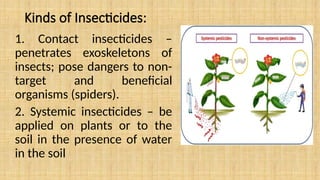
1. Contact insecticides –
penetrates exoskeletons of
insects; pose dangers to non-
target and beneficial
organisms (spiders).
2. Systemic insecticides – be
applied on plants or to the
soil in the presence of water
in the soil
Classification of insecticides based on
structure:
1. Organochlorines or chlorinated hydrocarbons –
DDT, dieldrin, endrin, endosulfan, heptachlor,
chlordane and lindane
•DDT/ Dichlorodiphenyltrichloroethane – most
widely used insecticide ever manufactured;
discovered by Paul Mueller of Geigy Chemical
Company in Switzerland. It was banned in 1972
in the USA and other countries.
Classification of insecticides based on structure:
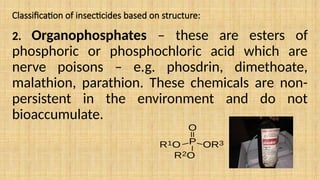
2. Organophosphates – these are esters of
phosphoric or phosphochloric acid which are
nerve poisons – e.g. phosdrin, dimethoate,
malathion, parathion. These chemicals are non-
persistent in the environment and do not
bioaccumulate.
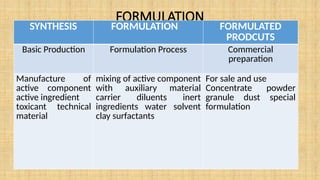
Classification of insecticides based on structure:
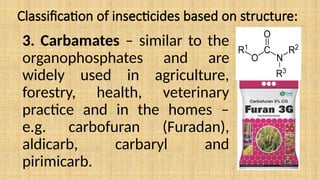
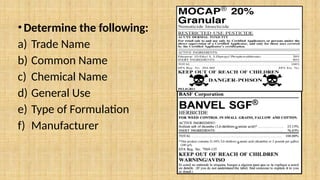
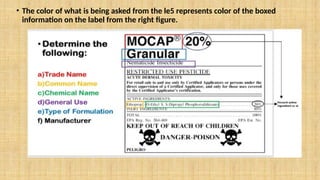
3. Carbamates – similar to the
organophosphates and are
widely used in agriculture,
forestry, health, veterinary
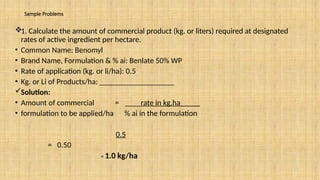
practice and in the homes –
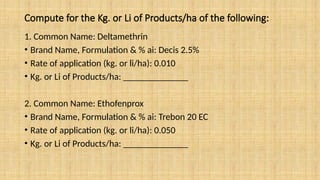
e.g. carbofuran (Furadan),
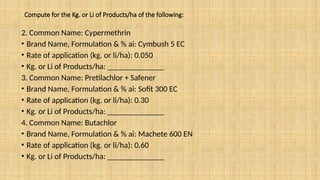
aldicarb, carbaryl and
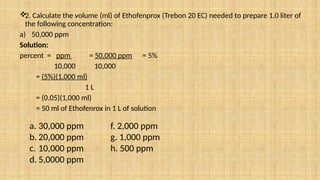
pirimicarb.
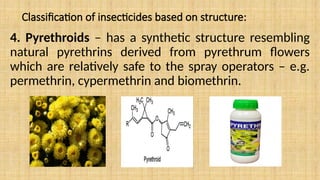
Classification of insecticides based on structure:
4. Pyrethroids – has a synthetic structure resembling
natural pyrethrins derived from pyrethrum flowers
which are relatively safe to the spray operators – e.g.
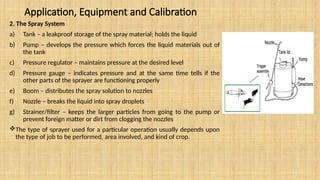
permethrin, cypermethrin and biomethrin.
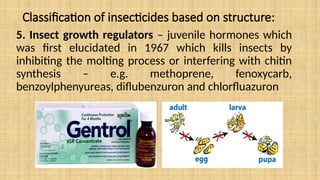
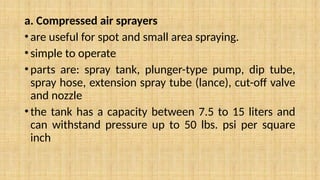
Classification of insecticides based on structure:
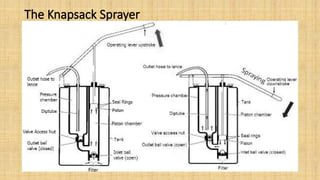
5. Insect growth regulators – juvenile hormones which
was first elucidated in 1967 which kills insects by
inhibiting the molting process or interfering with chitin
synthesis – e.g. methoprene, fenoxycarb,
benzoylphenyureas, diflubenzuron and chlorfluazuron
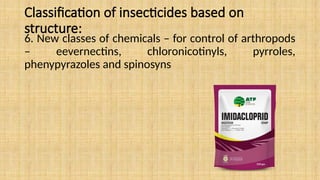
Classification of insecticides based on
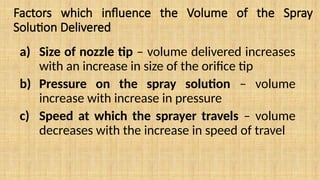
structure:
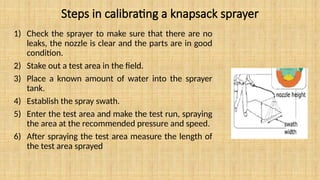
6. New classes of chemicals – for control of arthropods
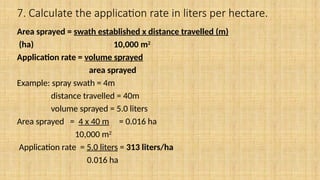
– eevernectins, chloronicotinyls, pyrroles,
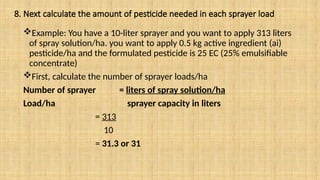
phenypyrazoles and spinosyns
Classification of insecticides based on structure:
7. Botanical insecticides – naturally existing compounds
in plants which have insecticidal properties.
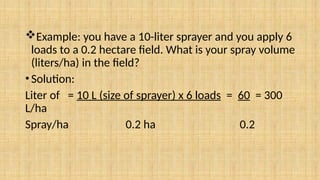
Commercial products are extracted from plant sources.
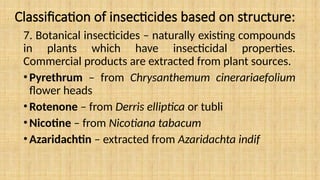
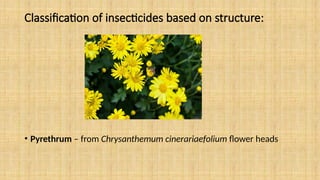
•Pyrethrum – from Chrysanthemum cinerariaefolium
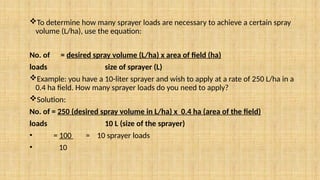
flower heads
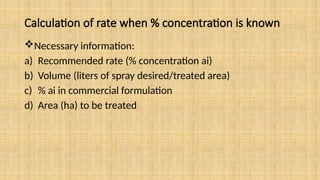
•Rotenone – from Derris elliptica or tubli
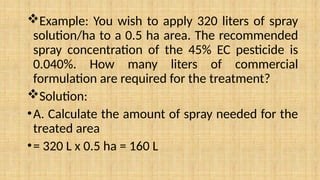
•Nicotine – from Nicotiana tabacum
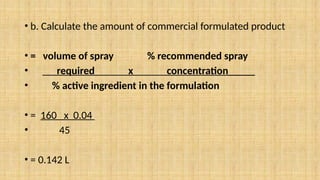
•Azaridachtin – extracted from Azaridachta indif
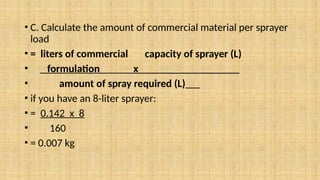
Classification of insecticides based on structure:
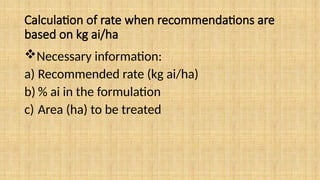
• Pyrethrum – from Chrysanthemum cinerariaefolium flower heads
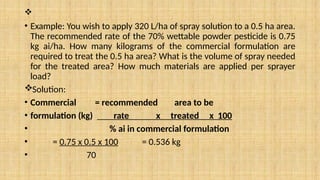
Classification of insecticides based on structure:
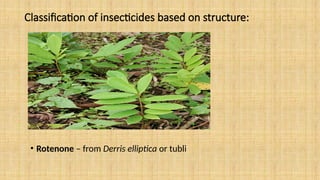
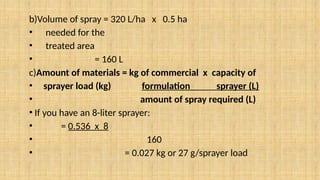
• Rotenone – from Derris elliptica or tubli
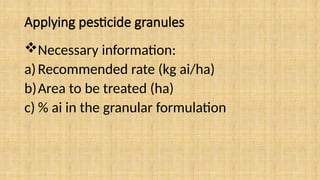
Classification of insecticides based on structure:
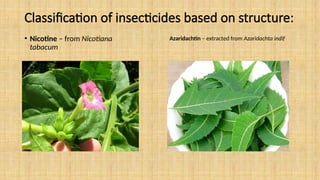
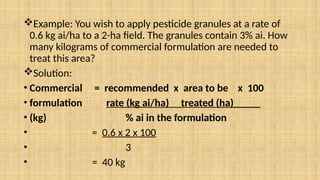
• Nicotine – from Nicotiana
tabacum
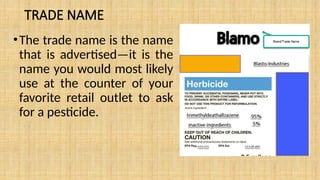
Azaridachtin – extracted from Azaridachta indif
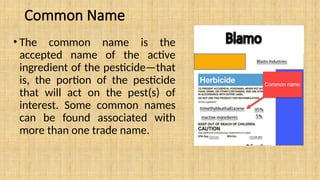
LABEL
• The label is an excellent source of information concerning the
safe and effective use of a pesticide. It is a written material or
graphic printed on the container of the pesticide.
• Regulations governing the registration of pesticides are such that
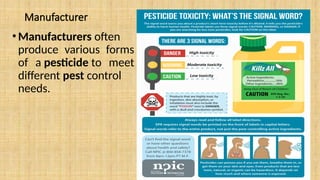
even the most highly toxic material can be used safely and
effectively if one follows label directions. On the other hand,
even the least toxic pesticide can be a hazard to people and the
environment, if it is not used properly. So, to attain the best
results from the use of pesticide, read, understand and follow
the directions on its label.
LABEL
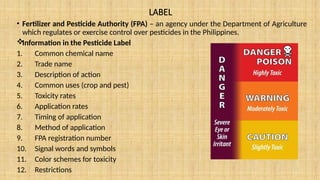
• Fertilizer and Pesticide Authority (FPA) – an agency under the Department of Agriculture
which regulates or exercise control over pesticides in the Philippines.

Information in the Pesticide Label
1. Common chemical name
2. Trade name
3. Description of action
4. Common uses (crop and pest)
5. Toxicity rates
6. Application rates
7. Timing of application
8. Method of application
9. FPA registration number
10. Signal words and symbols
11. Color schemes for toxicity
12. Restrictions
LABEL
What You Need to Know about Reading a Pesticide Label
Labels are legal documents providing directions on how to mix,
apply, store, and dispose of a pesticide product. This means using a
pesticide in a manner inconsistent with its labeling is a violation of
the law.
Why are labels important?
• Labels are legal documents providing directions on how to mix,
apply, store, and dispose of a pesticide product. This means using a
pesticide in a manner inconsistent with its labeling is a violation of
the law.
• The label is the manufacturer’s main way to give the user
information about the product.
LABEL
What information does the front of the label contain?
• Read the label first.
Trade or Brand Name
• Different names are used by different manufacturers even though their
products contain the same active ingredients. The brand name (or trade
or product name) is a unique name used to advertise the product.
Product Type
• Listed under the brand name, this indicates in general terms what the
product will control. Here are two examples:
• herbicide for the control of woody brush and weeds, and insecticide for
control of certain insects on fruits, nuts, and ornamentals.
LABEL
FPA Registration Number
•Indicates that the pesticide product has been registered and its
label was approved for sale by the Fertilizer and Pesticide
Authority (FPA).
FPA Establishment Number
•Identifies the facility that produced the product.
Manufacturer Name and Address
•Provides the manufacturer’s contact information in case you
want more information about the product, such as a Material
Safety Data Sheet (MSDS) that provides detailed toxicity
information, chemical properties, and precautions needed for
emergency personnel.
LABEL
• Ingredient Statement
• Provides the common and/or chemical name and amount of
each active ingredient and the total amount of inert
ingredients in the container.
• Active Ingredient
• The chemical(s) responsible for controlling the pest.
Individually listed on the label by common name and/or
chemical name and percentage in the product.
• Common Name
• A simpler name given by the FPA to a chemical name for
easier recognition.
LABEL
Chemical Name
• The complex name identifying the chemical components and structure of a
chemical.
Inert Ingredients
• Not required to be individually listed, but their percent of content must be.
Net Contents
• The amount a full container holds.
Signal Words
• Signal words indicate the relative acute toxicity of the product to humans
and animals. The statement, KEEP OUT OF REACH OF CHILDREN, must also
appear above the signal word on the label. If two products will control the
same pest, signal words can help you choose the least toxic chemical to
control the pest.
LABEL
DANGER☠ POISON—Highly toxic by any route of entry into
the body. Peligro, the Spanish word for danger, must also
appear on the label.
DANGER—Can cause severe eye damage or skin irritation.
WARNING—Moderately toxic either orally, dermally, or
through inhalation; causes moderate eye or skin irritation.
Aviso, the Spanish word for warning, must also appear on
the label.
CAUTION—Slightly toxic either orally, dermally, or through
inhalation; causes slight eye or skin irritation.
LABEL
What other information can be found on the
label?
•Precautionary Statements
Information about possible hazards. Additional
information can be found in the MSDS.
LABEL
Hazards to Humans and Domestic Animals
• Describes the potential hazards to people and pets, and actions
you can take to reduce those hazards, for example, wearing
gloves. These statements may also provide extra information on
how to protect children and pets.
Environmental Hazards
• Describes the product’s potential to harm wildlife, fish,
endangered plants and animals, wetlands, or water.
Physical and Chemical Hazards
• Describes any special fire, explosion, or chemical hazards the
product may pose.
First Aid or Statement of Practical Treatment
Details what to do if someone is accidentally
poisoned by a pesticide. ALWAYS call the National
Poison Center Hotline (1-800-222-1222) for further
medical instructions. Since the label has specific
instructions and information the physician will need, it
is important to have the pesticide label available when
calling the hotline or when taking someone to the
hospital.
Directions for use
It is a violation of federal law to use any pesticide in a manner inconsistent
with its labeling. This section on the label tells you how to properly use a
product to get the best results without harming yourself, others, and the
environment. The label’s directions for use will tell you:
• What pests the product is registered to control
• Where the product can be used (plants, animals, locations)
• How to apply the product
• How much product to use
• When the product should be applied
• How often to apply the product
• How soon the crop can be used or eaten after an application
• When people and animals can re-enter a treated area after application
Directions for use
Make sure the product is labeled for use against the
pest(s) that you are trying to control.
(For example, a product labeled only for termites may
not be labeled to control fleas.)
Also, make sure the product is only used where
(plants, animals, locations) the label indicates.
(For example, a pesticide labeled for use in an azalea
bed may not be labeled for use in an annual flower
bed.) Use only the amounts recommended, and
follow the directions exactly.
Storage and Disposal
Explains how to best store the product and what to
do with the unused portion of the product and the
empty container. Always keep products in original
containers, out of the reach of children, and in a
locked storage area. Be aware that temperature can
affect product quality and environmental safety. Do
not contaminate food or foodstuffs. To dispose of the
container, triple-rinse, puncture, and dispose of it
according to your local solid waste authority’s
requirements.
Color Scheme
Insecticides Rules, 1971, and contains information
such as brand name, name of manufacturer, name of
the antidote in case of accidental consumption etc.
A major aspect of the label is a color mark which
represents the toxicity of the material by a color code.
Thus the labelling scheme proposes four different
colour labels: viz red, yellow, blue, and green.
Color Scheme
Label Name Level of toxicity Oral lethal dose Listed chemicals
Red label Extremely toxic 1-50
Monocrotophos,
zinc phosphide,
ethyl mercury acetate,
and others.
Yellow label Highly toxic 51-500
Endosulfan, carbaryl,
[2] quinalphos,[2] and
others.
Blue label Moderately toxic 501-5000
Malathion, thiram,
glyphosate,[2] and
others.
Green label Slightly toxic More than 5000
Mancozeb, oxyfluorfen
, mosquito repellent
oils and liquids, and
most other household
insecticides.
FORMULATION
SYNTHESIS FORMULATION FORMULATED
PRODCUTS
Basic Production Formulation Process Commercial
preparation
Manufacture of
active component
active ingredient
toxicant technical
material
mixing of active component
with auxiliary material
carrier diluents inert
ingredients water solvent
clay surfactants
For sale and use
Concentrate powder
granule dust special
formulation
•Determine the following:
a) Trade Name
b) Common Name
c) Chemical Name
d) General Use
e) Type of Formulation
f) Manufacturer
Note: Some formulator indicate the specific gravity
of their products (the ratio of the weight of a given
volume of any liquid to the weight of an equal volume
of water) instead of giving the active ingredient as
percentage.
In the bioassay of pesticides, the concentrations of
test solutions are usually expressed in percent
concentration or parts per million.
Percent concentration – refers to the number of parts by
weight or volume of a constituent in 100 parts of the final
mixture by weight or volume.
Parts per million (ppm) – refers to the number of parts by
weight or volume of a constituent in 1 million parts of the
final mixture by weight or volume.
ppm = percent x 10,000
percent = ppm
10,000
Calculations
There is a need to know how to calculate
pesticide requirements because of
a) changing recommendations
b) the need to treat small or large areas
c) for precision and accuracy in experimental
work
Sample Problems
1. Calculate the amount of commercial product (kg. or liters) required at designated
rates of active ingredient per hectare.
• Common Name: Benomyl
• Brand Name, Formulation & % ai: Benlate 50% WP
• Rate of application (kg. or li/ha): 0.5
• Kg. or Li of Products/ha: ___________________
Solution:
• Amount of commercial = ____rate in kg.ha_____
• formulation to be applied/ha % ai in the formulation
0.5
= 0.50
= 1.0 kg/ha
Compute for the Kg. or Li of Products/ha of the following:
1. Common Name: Deltamethrin
• Brand Name, Formulation & % ai: Decis 2.5%
• Rate of application (kg. or li/ha): 0.010
• Kg. or Li of Products/ha: ______________
2. Common Name: Ethofenprox
• Brand Name, Formulation & % ai: Trebon 20 EC
• Rate of application (kg. or li/ha): 0.050
• Kg. or Li of Products/ha: ______________
Compute for the Kg. or Li of Products/ha of the following:
2. Common Name: Cypermethrin
• Brand Name, Formulation & % ai: Cymbush 5 EC
• Rate of application (kg. or li/ha): 0.050
• Kg. or Li of Products/ha: ______________
3. Common Name: Pretilachlor + Safener
• Brand Name, Formulation & % ai: Sofit 300 EC
• Rate of application (kg. or li/ha): 0.30
• Kg. or Li of Products/ha: ______________
4. Common Name: Butachlor
• Brand Name, Formulation & % ai: Machete 600 EN
• Rate of application (kg. or li/ha): 0.60
• Kg. or Li of Products/ha: ______________

2. Calculate the volume (ml) of Ethofenprox (Trebon 20 EC) needed to prepare 1.0 liter of
the following concentration:
a) 50,000 ppm
Solution:
percent = ppm = 50,000 ppm = 5%
10,000 10,000
= (5%)(1,000 ml)
1 L
= (0.05)(1,000 ml)
= 50 ml of Ethofenrox in 1 L of solution
a. 30,000 ppm f. 2,000 ppm
b. 20,000 ppm g. 1,000 ppm
c. 10,000 ppm h. 500 ppm
d. 5,0000 ppm
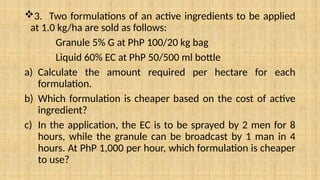
3. Two formulations of an active ingredients to be applied
at 1.0 kg/ha are sold as follows:
Granule 5% G at PhP 100/20 kg bag
Liquid 60% EC at PhP 50/500 ml bottle
a) Calculate the amount required per hectare for each
formulation.
b) Which formulation is cheaper based on the cost of active
ingredient?
c) In the application, the EC is to be sprayed by 2 men for 8
hours, while the granule can be broadcast by 1 man in 4
hours. At PhP 1,000 per hour, which formulation is cheaper
to use?
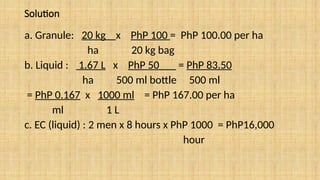
Solution
a. Granule: 20 kg x PhP 100 = PhP 100.00 per ha
ha 20 kg bag
b. Liquid : 1.67 L x PhP 50___ = PhP 83.50
ha 500 ml bottle 500 ml
= PhP 0.167 x 1000 ml = PhP 167.00 per ha
ml 1 L
c. EC (liquid) : 2 men x 8 hours x PhP 1000 = PhP16,000
hour
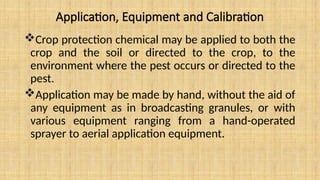
Application, Equipment and Calibration
Crop protection chemical may be applied to both the
crop and the soil or directed to the crop, to the
environment where the pest occurs or directed to the
pest.
Application may be made by hand, without the aid of
any equipment as in broadcasting granules, or with
various equipment ranging from a hand-operated
sprayer to aerial application equipment.
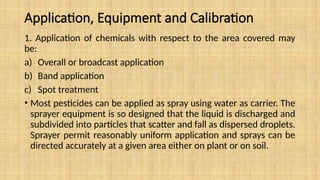
Application, Equipment and Calibration
1. Application of chemicals with respect to the area covered may
be:
a) Overall or broadcast application
b) Band application
c) Spot treatment
• Most pesticides can be applied as spray using water as carrier. The
sprayer equipment is so designed that the liquid is discharged and
subdivided into particles that scatter and fall as dispersed droplets.
Sprayer permit reasonably uniform application and sprays can be
directed accurately at a given area either on plant or on soil.
Application, Equipment and Calibration
2. The Spray System
a) Tank – a leakproof storage of the spray material; holds the liquid
b) Pump – develops the pressure which forces the liquid materials out of
the tank
c) Pressure regulator – maintains pressure at the desired level
d) Pressure gauge – indicates pressure and at the same time tells if the
other parts of the sprayer are functioning properly
e) Boom – distributes the spray solution to nozzles
f) Nozzle – breaks the liquid into spray droplets
g) Strainer/filter – keeps the larger particles from going to the pump or
prevent foreign matter or dirt from clogging the nozzles
The type of sprayer used for a particular operation usually depends upon
the type of job to be performed, area involved, and kind of crop.
a. Compressed air sprayers
•are useful for spot and small area spraying.
•simple to operate
•parts are: spray tank, plunger-type pump, dip tube,
spray hose, extension spray tube (lance), cut-off valve
and nozzle
•the tank has a capacity between 7.5 to 15 liters and
can withstand pressure up to 50 lbs. psi per square
inch
b. The Knapsack Sprayer
• Are carried on the back by means of shoulder straps.
• The tank is usually shaped to fit comfortably on the shoulder.
• The pump is operated by a hand lever which may be situated at the
bottom of the sprayer, so that if used, it extends along the side of the body
and under the arm.
• In other types the lever may be situated at the top of the sprayer and
passed over the shoulder to the form of the body with the handle shape
placed at a convenient height to be grasped by the hand.
• In any case, the lever is operated by one hand, the other hand is used to
control and direct the spray from the lance.
• In some sprayers, an automatic agitator is provided to maintain a perfectly
dispersed spray solution.
• A variety of nozzles can be used with these sprayers.
The Knapsack Sprayer
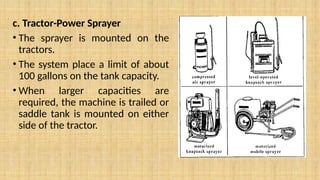
c. Tractor-Power Sprayer
• The sprayer is mounted on the
tractors.
• The system place a limit of about
100 gallons on the tank capacity.
• When larger capacities are
required, the machine is trailed or
saddle tank is mounted on either
side of the tractor.
Calibration
•The process of determining the amount of spray
solution delivered by specific equipment.
•Calibration of the equipment is usually done to ensure
that the correct volume of diluted pesticide is evenly
applied to the area to be tested.
•In the case of herbicide, too much herbicide may
result in crop damage while too little may result in
ineffective control.
Calibration
• Uneven spray distribution will lead to overdosed or
underdosed strips across the area and patchy weed control.
• The evenness of the nozzle delivery is an important
consideration especially when two or more nozzles are
used.
• The quality of nozzle delivery is easily checked by measuring
the total flow from each nozzle while the sprayer is operated
at constant pressure over a period of time.
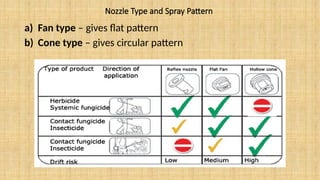
Nozzle Type and Spray Pattern
a) Fan type – gives flat pattern
b) Cone type – gives circular pattern
Factors which influence the Volume of the Spray
Solution Delivered
a) Size of nozzle tip – volume delivered increases
with an increase in size of the orifice tip
b) Pressure on the spray solution – volume
increase with increase in pressure
c) Speed at which the sprayer travels – volume
decreases with the increase in speed of travel
Steps in calibrating a knapsack sprayer
1) Check the sprayer to make sure that there are no
leaks, the nozzle is clear and the parts are in good
condition.
2) Stake out a test area in the field.
3) Place a known amount of water into the sprayer
tank.
4) Establish the spray swath.
5) Enter the test area and make the test run, spraying
the area at the recommended pressure and speed.
6) After spraying the test area measure the length of
the test area sprayed
7. Calculate the application rate in liters per hectare.
Area sprayed = swath established x distance travelled (m)
(ha) 10,000 m2
Application rate = volume sprayed
area sprayed
Example: spray swath = 4m
distance travelled = 40m
volume sprayed = 5.0 liters
Area sprayed = 4 x 40 m = 0.016 ha
10,000 m2
Application rate = 5.0 liters = 313 liters/ha
0.016 ha
8. Next calculate the amount of pesticide needed in each sprayer load
Example: You have a 10-liter sprayer and you want to apply 313 liters
of spray solution/ha. you want to apply 0.5 kg active ingredient (ai)
pesticide/ha and the formulated pesticide is 25 EC (25% emulsifiable
concentrate)
First, calculate the number of sprayer loads/ha
Number of sprayer = liters of spray solution/ha
Load/ha sprayer capacity in liters
= 313
10
= 31.3 or 31
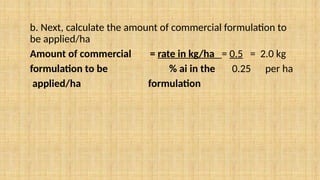
b. Next, calculate the amount of commercial formulation to
be applied/ha
Amount of commercial = rate in kg/ha = 0.5 = 2.0 kg
formulation to be % ai in the 0.25 per ha
applied/ha formulation
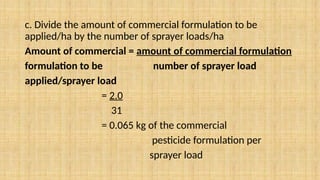
c. Divide the amount of commercial formulation to be
applied/ha by the number of sprayer loads/ha
Amount of commercial = amount of commercial formulation
formulation to be number of sprayer load
applied/sprayer load
= 2.0
31
= 0.065 kg of the commercial
pesticide formulation per
sprayer load
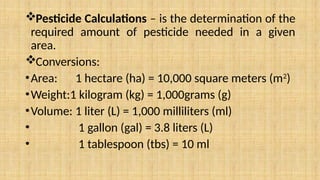
Pesticide Calculations – is the determination of the
required amount of pesticide needed in a given
area.
Conversions:
•Area: 1 hectare (ha) = 10,000 square meters (m2
)
•Weight:1 kilogram (kg) = 1,000grams (g)
•Volume: 1 liter (L) = 1,000 milliliters (ml)
• 1 gallon (gal) = 3.8 liters (L)
• 1 tablespoon (tbs) = 10 ml
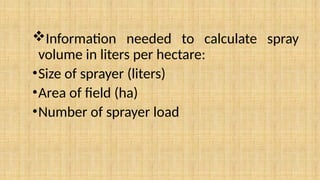
Information needed to calculate spray
volume in liters per hectare:
•Size of sprayer (liters)
•Area of field (ha)
•Number of sprayer load
Example: you have a 10-liter sprayer and you apply 6
loads to a 0.2 hectare field. What is your spray volume
(liters/ha) in the field?
•Solution:
Liter of = 10 L (size of sprayer) x 6 loads = 60 = 300
L/ha
Spray/ha 0.2 ha 0.2
To determine how many sprayer loads are necessary to achieve a certain spray
volume (L/ha), use the equation:
No. of = desired spray volume (L/ha) x area of field (ha)
loads size of sprayer (L)
Example: you have a 10-liter sprayer and wish to apply at a rate of 250 L/ha in a
0.4 ha field. How many sprayer loads do you need to apply?
Solution:
No. of = 250 (desired spray volume in L/ha) x 0.4 ha (area of the field)
loads 10 L (size of the sprayer)
• = 100 = 10 sprayer loads
• 10
Calculation of rate when % concentration is known
Necessary information:
a) Recommended rate (% concentration ai)
b) Volume (liters of spray desired/treated area)
c) % ai in commercial formulation
d) Area (ha) to be treated
Example: You wish to apply 320 liters of spray
solution/ha to a 0.5 ha area. The recommended
spray concentration of the 45% EC pesticide is
0.040%. How many liters of commercial
formulation are required for the treatment?
Solution:
•A. Calculate the amount of spray needed for the
treated area
•= 320 L x 0.5 ha = 160 L
• b. Calculate the amount of commercial formulated product
• = volume of spray % recommended spray
• required x concentration_____
• % active ingredient in the formulation
• = 160 x 0.04
• 45
• = 0.142 L
• C. Calculate the amount of commercial material per sprayer
load
• = liters of commercial capacity of sprayer (L)
• formulation x___________________
• amount of spray required (L)
• if you have an 8-liter sprayer:
• = 0.142 x 8
• 160
• = 0.007 kg
Calculation of rate when recommendations are
based on kg ai/ha
Necessary information:
a) Recommended rate (kg ai/ha)
b) % ai in the formulation
c) Area (ha) to be treated

• Example: You wish to apply 320 L/ha of spray solution to a 0.5 ha area.
The recommended rate of the 70% wettable powder pesticide is 0.75
kg ai/ha. How many kilograms of the commercial formulation are
required to treat the 0.5 ha area? What is the volume of spray needed
for the treated area? How much materials are applied per sprayer
load?
Solution:
• Commercial = recommended area to be
• formulation (kg) rate x treated x 100
• % ai in commercial formulation
• = 0.75 x 0.5 x 100 = 0.536 kg
• 70
b)Volume of spray = 320 L/ha x 0.5 ha
• needed for the
• treated area
• = 160 L
c)Amount of materials = kg of commercial x capacity of
• sprayer load (kg) formulation sprayer (L)
• amount of spray required (L)
• If you have an 8-liter sprayer:
• = 0.536 x 8
• 160
• = 0.027 kg or 27 g/sprayer load
Applying pesticide granules
Necessary information:
a)Recommended rate (kg ai/ha)
b)Area to be treated (ha)
c) % ai in the granular formulation
Example: You wish to apply pesticide granules at a rate of
0.6 kg ai/ha to a 2-ha field. The granules contain 3% ai. How
many kilograms of commercial formulation are needed to
treat this area?
Solution:
• Commercial = recommended x area to be x 100
• formulation rate (kg ai/ha) treated (ha)_____
• (kg) % ai in the formulation
• = 0.6 x 2 x 100
• 3
• = 40 kg
• The color of what is being asked from the le5 represents color of the boxed
information on the label from the right figure.
TRADE NAME
•The trade name is the name
that is advertised—it is the
name you would most likely
use at the counter of your
favorite retail outlet to ask
for a pesticide.
Common Name
• The common name is the
accepted name of the active
ingredient of the pesticide—that
is, the portion of the pesticide
that will act on the pest(s) of
interest. Some common names
can be found associated with
more than one trade name.
Chemical Name
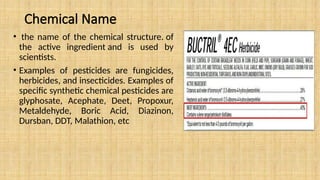
• the name of the chemical structure. of
the active ingredient and is used by
scientists.
• Examples of pesticides are fungicides,
herbicides, and insecticides. Examples of
specific synthetic chemical pesticides are
glyphosate, Acephate, Deet, Propoxur,
Metaldehyde, Boric Acid, Diazinon,
Dursban, DDT, Malathion, etc
General use
•General use
pesticide means a
pesticide that is
not a restricted
use pesticide.
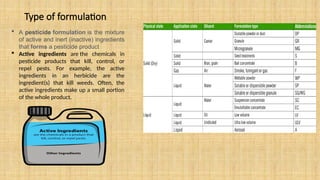
Type of formulation
 A pesticide formulation is the mixture
of active and inert (inactive) ingredients
that forms a pesticide product
 Active ingredients are the chemicals in
pesticide products that kill, control, or
repel pests. For example, the active
ingredients in an herbicide are the
ingredient(s) that kill weeds. Often, the
active ingredients make up a small portion
of the whole product.
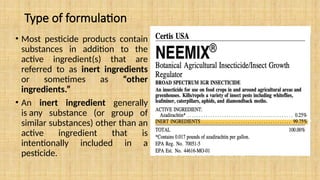
Type of formulation
• Most pesticide products contain
substances in addition to the
active ingredient(s) that are
referred to as inert ingredients
or sometimes as “other
ingredients.”
• An inert ingredient generally
is any substance (or group of
similar substances) other than an
active ingredient that is
intentionally included in a
pesticide.
Manufacturer
•Manufacturers often
produce various forms
of a pesticide to meet
different pest control
needs.

Chemical Control and different examples

  • 1.
  • 2.
    Kinds of Insecticides: 1.Contact insecticides – penetrates exoskeletons of insects; pose dangers to non- target and beneficial organisms (spiders). 2. Systemic insecticides – be applied on plants or to the soil in the presence of water in the soil
  • 3.
    Classification of insecticidesbased on structure: 1. Organochlorines or chlorinated hydrocarbons – DDT, dieldrin, endrin, endosulfan, heptachlor, chlordane and lindane •DDT/ Dichlorodiphenyltrichloroethane – most widely used insecticide ever manufactured; discovered by Paul Mueller of Geigy Chemical Company in Switzerland. It was banned in 1972 in the USA and other countries.
  • 4.
    Classification of insecticidesbased on structure: 2. Organophosphates – these are esters of phosphoric or phosphochloric acid which are nerve poisons – e.g. phosdrin, dimethoate, malathion, parathion. These chemicals are non- persistent in the environment and do not bioaccumulate.
  • 5.
    Classification of insecticidesbased on structure: 3. Carbamates – similar to the organophosphates and are widely used in agriculture, forestry, health, veterinary practice and in the homes – e.g. carbofuran (Furadan), aldicarb, carbaryl and pirimicarb.
  • 6.
    Classification of insecticidesbased on structure: 4. Pyrethroids – has a synthetic structure resembling natural pyrethrins derived from pyrethrum flowers which are relatively safe to the spray operators – e.g. permethrin, cypermethrin and biomethrin.
  • 7.
    Classification of insecticidesbased on structure: 5. Insect growth regulators – juvenile hormones which was first elucidated in 1967 which kills insects by inhibiting the molting process or interfering with chitin synthesis – e.g. methoprene, fenoxycarb, benzoylphenyureas, diflubenzuron and chlorfluazuron
  • 8.
    Classification of insecticidesbased on structure: 6. New classes of chemicals – for control of arthropods – eevernectins, chloronicotinyls, pyrroles, phenypyrazoles and spinosyns
  • 9.
    Classification of insecticidesbased on structure: 7. Botanical insecticides – naturally existing compounds in plants which have insecticidal properties. Commercial products are extracted from plant sources. •Pyrethrum – from Chrysanthemum cinerariaefolium flower heads •Rotenone – from Derris elliptica or tubli •Nicotine – from Nicotiana tabacum •Azaridachtin – extracted from Azaridachta indif
  • 10.
    Classification of insecticidesbased on structure: • Pyrethrum – from Chrysanthemum cinerariaefolium flower heads
  • 11.
    Classification of insecticidesbased on structure: • Rotenone – from Derris elliptica or tubli
  • 12.
    Classification of insecticidesbased on structure: • Nicotine – from Nicotiana tabacum Azaridachtin – extracted from Azaridachta indif
  • 13.
    LABEL • The labelis an excellent source of information concerning the safe and effective use of a pesticide. It is a written material or graphic printed on the container of the pesticide. • Regulations governing the registration of pesticides are such that even the most highly toxic material can be used safely and effectively if one follows label directions. On the other hand, even the least toxic pesticide can be a hazard to people and the environment, if it is not used properly. So, to attain the best results from the use of pesticide, read, understand and follow the directions on its label.
  • 14.
    LABEL • Fertilizer andPesticide Authority (FPA) – an agency under the Department of Agriculture which regulates or exercise control over pesticides in the Philippines.  Information in the Pesticide Label 1. Common chemical name 2. Trade name 3. Description of action 4. Common uses (crop and pest) 5. Toxicity rates 6. Application rates 7. Timing of application 8. Method of application 9. FPA registration number 10. Signal words and symbols 11. Color schemes for toxicity 12. Restrictions
  • 15.
    LABEL What You Needto Know about Reading a Pesticide Label Labels are legal documents providing directions on how to mix, apply, store, and dispose of a pesticide product. This means using a pesticide in a manner inconsistent with its labeling is a violation of the law. Why are labels important? • Labels are legal documents providing directions on how to mix, apply, store, and dispose of a pesticide product. This means using a pesticide in a manner inconsistent with its labeling is a violation of the law. • The label is the manufacturer’s main way to give the user information about the product.
  • 16.
    LABEL What information doesthe front of the label contain? • Read the label first. Trade or Brand Name • Different names are used by different manufacturers even though their products contain the same active ingredients. The brand name (or trade or product name) is a unique name used to advertise the product. Product Type • Listed under the brand name, this indicates in general terms what the product will control. Here are two examples: • herbicide for the control of woody brush and weeds, and insecticide for control of certain insects on fruits, nuts, and ornamentals.
  • 17.
    LABEL FPA Registration Number •Indicatesthat the pesticide product has been registered and its label was approved for sale by the Fertilizer and Pesticide Authority (FPA). FPA Establishment Number •Identifies the facility that produced the product. Manufacturer Name and Address •Provides the manufacturer’s contact information in case you want more information about the product, such as a Material Safety Data Sheet (MSDS) that provides detailed toxicity information, chemical properties, and precautions needed for emergency personnel.
  • 18.
    LABEL • Ingredient Statement •Provides the common and/or chemical name and amount of each active ingredient and the total amount of inert ingredients in the container. • Active Ingredient • The chemical(s) responsible for controlling the pest. Individually listed on the label by common name and/or chemical name and percentage in the product. • Common Name • A simpler name given by the FPA to a chemical name for easier recognition.
  • 19.
    LABEL Chemical Name • Thecomplex name identifying the chemical components and structure of a chemical. Inert Ingredients • Not required to be individually listed, but their percent of content must be. Net Contents • The amount a full container holds. Signal Words • Signal words indicate the relative acute toxicity of the product to humans and animals. The statement, KEEP OUT OF REACH OF CHILDREN, must also appear above the signal word on the label. If two products will control the same pest, signal words can help you choose the least toxic chemical to control the pest.
  • 20.
    LABEL DANGER☠ POISON—Highly toxicby any route of entry into the body. Peligro, the Spanish word for danger, must also appear on the label. DANGER—Can cause severe eye damage or skin irritation. WARNING—Moderately toxic either orally, dermally, or through inhalation; causes moderate eye or skin irritation. Aviso, the Spanish word for warning, must also appear on the label. CAUTION—Slightly toxic either orally, dermally, or through inhalation; causes slight eye or skin irritation.
  • 21.
    LABEL What other informationcan be found on the label? •Precautionary Statements Information about possible hazards. Additional information can be found in the MSDS.
  • 22.
    LABEL Hazards to Humansand Domestic Animals • Describes the potential hazards to people and pets, and actions you can take to reduce those hazards, for example, wearing gloves. These statements may also provide extra information on how to protect children and pets. Environmental Hazards • Describes the product’s potential to harm wildlife, fish, endangered plants and animals, wetlands, or water. Physical and Chemical Hazards • Describes any special fire, explosion, or chemical hazards the product may pose.
  • 23.
    First Aid orStatement of Practical Treatment Details what to do if someone is accidentally poisoned by a pesticide. ALWAYS call the National Poison Center Hotline (1-800-222-1222) for further medical instructions. Since the label has specific instructions and information the physician will need, it is important to have the pesticide label available when calling the hotline or when taking someone to the hospital.
  • 24.
    Directions for use Itis a violation of federal law to use any pesticide in a manner inconsistent with its labeling. This section on the label tells you how to properly use a product to get the best results without harming yourself, others, and the environment. The label’s directions for use will tell you: • What pests the product is registered to control • Where the product can be used (plants, animals, locations) • How to apply the product • How much product to use • When the product should be applied • How often to apply the product • How soon the crop can be used or eaten after an application • When people and animals can re-enter a treated area after application
  • 25.
    Directions for use Makesure the product is labeled for use against the pest(s) that you are trying to control. (For example, a product labeled only for termites may not be labeled to control fleas.) Also, make sure the product is only used where (plants, animals, locations) the label indicates. (For example, a pesticide labeled for use in an azalea bed may not be labeled for use in an annual flower bed.) Use only the amounts recommended, and follow the directions exactly.
  • 26.
    Storage and Disposal Explainshow to best store the product and what to do with the unused portion of the product and the empty container. Always keep products in original containers, out of the reach of children, and in a locked storage area. Be aware that temperature can affect product quality and environmental safety. Do not contaminate food or foodstuffs. To dispose of the container, triple-rinse, puncture, and dispose of it according to your local solid waste authority’s requirements.
  • 27.
    Color Scheme Insecticides Rules,1971, and contains information such as brand name, name of manufacturer, name of the antidote in case of accidental consumption etc. A major aspect of the label is a color mark which represents the toxicity of the material by a color code. Thus the labelling scheme proposes four different colour labels: viz red, yellow, blue, and green.
  • 28.
    Color Scheme Label NameLevel of toxicity Oral lethal dose Listed chemicals Red label Extremely toxic 1-50 Monocrotophos, zinc phosphide, ethyl mercury acetate, and others. Yellow label Highly toxic 51-500 Endosulfan, carbaryl, [2] quinalphos,[2] and others. Blue label Moderately toxic 501-5000 Malathion, thiram, glyphosate,[2] and others. Green label Slightly toxic More than 5000 Mancozeb, oxyfluorfen , mosquito repellent oils and liquids, and most other household insecticides.
  • 29.
    FORMULATION SYNTHESIS FORMULATION FORMULATED PRODCUTS BasicProduction Formulation Process Commercial preparation Manufacture of active component active ingredient toxicant technical material mixing of active component with auxiliary material carrier diluents inert ingredients water solvent clay surfactants For sale and use Concentrate powder granule dust special formulation
  • 30.
    •Determine the following: a)Trade Name b) Common Name c) Chemical Name d) General Use e) Type of Formulation f) Manufacturer
  • 31.
    Note: Some formulatorindicate the specific gravity of their products (the ratio of the weight of a given volume of any liquid to the weight of an equal volume of water) instead of giving the active ingredient as percentage. In the bioassay of pesticides, the concentrations of test solutions are usually expressed in percent concentration or parts per million.
  • 32.
    Percent concentration –refers to the number of parts by weight or volume of a constituent in 100 parts of the final mixture by weight or volume. Parts per million (ppm) – refers to the number of parts by weight or volume of a constituent in 1 million parts of the final mixture by weight or volume. ppm = percent x 10,000 percent = ppm 10,000
  • 33.
    Calculations There is aneed to know how to calculate pesticide requirements because of a) changing recommendations b) the need to treat small or large areas c) for precision and accuracy in experimental work
  • 34.
    Sample Problems 1. Calculatethe amount of commercial product (kg. or liters) required at designated rates of active ingredient per hectare. • Common Name: Benomyl • Brand Name, Formulation & % ai: Benlate 50% WP • Rate of application (kg. or li/ha): 0.5 • Kg. or Li of Products/ha: ___________________ Solution: • Amount of commercial = ____rate in kg.ha_____ • formulation to be applied/ha % ai in the formulation 0.5 = 0.50 = 1.0 kg/ha
  • 35.
    Compute for theKg. or Li of Products/ha of the following: 1. Common Name: Deltamethrin • Brand Name, Formulation & % ai: Decis 2.5% • Rate of application (kg. or li/ha): 0.010 • Kg. or Li of Products/ha: ______________ 2. Common Name: Ethofenprox • Brand Name, Formulation & % ai: Trebon 20 EC • Rate of application (kg. or li/ha): 0.050 • Kg. or Li of Products/ha: ______________
  • 36.
    Compute for theKg. or Li of Products/ha of the following: 2. Common Name: Cypermethrin • Brand Name, Formulation & % ai: Cymbush 5 EC • Rate of application (kg. or li/ha): 0.050 • Kg. or Li of Products/ha: ______________ 3. Common Name: Pretilachlor + Safener • Brand Name, Formulation & % ai: Sofit 300 EC • Rate of application (kg. or li/ha): 0.30 • Kg. or Li of Products/ha: ______________ 4. Common Name: Butachlor • Brand Name, Formulation & % ai: Machete 600 EN • Rate of application (kg. or li/ha): 0.60 • Kg. or Li of Products/ha: ______________
  • 37.
     2. Calculate thevolume (ml) of Ethofenprox (Trebon 20 EC) needed to prepare 1.0 liter of the following concentration: a) 50,000 ppm Solution: percent = ppm = 50,000 ppm = 5% 10,000 10,000 = (5%)(1,000 ml) 1 L = (0.05)(1,000 ml) = 50 ml of Ethofenrox in 1 L of solution a. 30,000 ppm f. 2,000 ppm b. 20,000 ppm g. 1,000 ppm c. 10,000 ppm h. 500 ppm d. 5,0000 ppm
  • 38.
    3. Two formulationsof an active ingredients to be applied at 1.0 kg/ha are sold as follows: Granule 5% G at PhP 100/20 kg bag Liquid 60% EC at PhP 50/500 ml bottle a) Calculate the amount required per hectare for each formulation. b) Which formulation is cheaper based on the cost of active ingredient? c) In the application, the EC is to be sprayed by 2 men for 8 hours, while the granule can be broadcast by 1 man in 4 hours. At PhP 1,000 per hour, which formulation is cheaper to use?
  • 39.
    Solution a. Granule: 20kg x PhP 100 = PhP 100.00 per ha ha 20 kg bag b. Liquid : 1.67 L x PhP 50___ = PhP 83.50 ha 500 ml bottle 500 ml = PhP 0.167 x 1000 ml = PhP 167.00 per ha ml 1 L c. EC (liquid) : 2 men x 8 hours x PhP 1000 = PhP16,000 hour
  • 40.
    Application, Equipment andCalibration Crop protection chemical may be applied to both the crop and the soil or directed to the crop, to the environment where the pest occurs or directed to the pest. Application may be made by hand, without the aid of any equipment as in broadcasting granules, or with various equipment ranging from a hand-operated sprayer to aerial application equipment.
  • 41.
    Application, Equipment andCalibration 1. Application of chemicals with respect to the area covered may be: a) Overall or broadcast application b) Band application c) Spot treatment • Most pesticides can be applied as spray using water as carrier. The sprayer equipment is so designed that the liquid is discharged and subdivided into particles that scatter and fall as dispersed droplets. Sprayer permit reasonably uniform application and sprays can be directed accurately at a given area either on plant or on soil.
  • 42.
    Application, Equipment andCalibration 2. The Spray System a) Tank – a leakproof storage of the spray material; holds the liquid b) Pump – develops the pressure which forces the liquid materials out of the tank c) Pressure regulator – maintains pressure at the desired level d) Pressure gauge – indicates pressure and at the same time tells if the other parts of the sprayer are functioning properly e) Boom – distributes the spray solution to nozzles f) Nozzle – breaks the liquid into spray droplets g) Strainer/filter – keeps the larger particles from going to the pump or prevent foreign matter or dirt from clogging the nozzles The type of sprayer used for a particular operation usually depends upon the type of job to be performed, area involved, and kind of crop.
  • 43.
    a. Compressed airsprayers •are useful for spot and small area spraying. •simple to operate •parts are: spray tank, plunger-type pump, dip tube, spray hose, extension spray tube (lance), cut-off valve and nozzle •the tank has a capacity between 7.5 to 15 liters and can withstand pressure up to 50 lbs. psi per square inch
  • 44.
    b. The KnapsackSprayer • Are carried on the back by means of shoulder straps. • The tank is usually shaped to fit comfortably on the shoulder. • The pump is operated by a hand lever which may be situated at the bottom of the sprayer, so that if used, it extends along the side of the body and under the arm. • In other types the lever may be situated at the top of the sprayer and passed over the shoulder to the form of the body with the handle shape placed at a convenient height to be grasped by the hand. • In any case, the lever is operated by one hand, the other hand is used to control and direct the spray from the lance. • In some sprayers, an automatic agitator is provided to maintain a perfectly dispersed spray solution. • A variety of nozzles can be used with these sprayers.
  • 45.
  • 46.
    c. Tractor-Power Sprayer •The sprayer is mounted on the tractors. • The system place a limit of about 100 gallons on the tank capacity. • When larger capacities are required, the machine is trailed or saddle tank is mounted on either side of the tractor.
  • 47.
    Calibration •The process ofdetermining the amount of spray solution delivered by specific equipment. •Calibration of the equipment is usually done to ensure that the correct volume of diluted pesticide is evenly applied to the area to be tested. •In the case of herbicide, too much herbicide may result in crop damage while too little may result in ineffective control.
  • 48.
    Calibration • Uneven spraydistribution will lead to overdosed or underdosed strips across the area and patchy weed control. • The evenness of the nozzle delivery is an important consideration especially when two or more nozzles are used. • The quality of nozzle delivery is easily checked by measuring the total flow from each nozzle while the sprayer is operated at constant pressure over a period of time.
  • 49.
    Nozzle Type andSpray Pattern a) Fan type – gives flat pattern b) Cone type – gives circular pattern
  • 50.
    Factors which influencethe Volume of the Spray Solution Delivered a) Size of nozzle tip – volume delivered increases with an increase in size of the orifice tip b) Pressure on the spray solution – volume increase with increase in pressure c) Speed at which the sprayer travels – volume decreases with the increase in speed of travel
  • 51.
    Steps in calibratinga knapsack sprayer 1) Check the sprayer to make sure that there are no leaks, the nozzle is clear and the parts are in good condition. 2) Stake out a test area in the field. 3) Place a known amount of water into the sprayer tank. 4) Establish the spray swath. 5) Enter the test area and make the test run, spraying the area at the recommended pressure and speed. 6) After spraying the test area measure the length of the test area sprayed
  • 52.
    7. Calculate theapplication rate in liters per hectare. Area sprayed = swath established x distance travelled (m) (ha) 10,000 m2 Application rate = volume sprayed area sprayed Example: spray swath = 4m distance travelled = 40m volume sprayed = 5.0 liters Area sprayed = 4 x 40 m = 0.016 ha 10,000 m2 Application rate = 5.0 liters = 313 liters/ha 0.016 ha
  • 53.
    8. Next calculatethe amount of pesticide needed in each sprayer load Example: You have a 10-liter sprayer and you want to apply 313 liters of spray solution/ha. you want to apply 0.5 kg active ingredient (ai) pesticide/ha and the formulated pesticide is 25 EC (25% emulsifiable concentrate) First, calculate the number of sprayer loads/ha Number of sprayer = liters of spray solution/ha Load/ha sprayer capacity in liters = 313 10 = 31.3 or 31
  • 54.
    b. Next, calculatethe amount of commercial formulation to be applied/ha Amount of commercial = rate in kg/ha = 0.5 = 2.0 kg formulation to be % ai in the 0.25 per ha applied/ha formulation
  • 55.
    c. Divide theamount of commercial formulation to be applied/ha by the number of sprayer loads/ha Amount of commercial = amount of commercial formulation formulation to be number of sprayer load applied/sprayer load = 2.0 31 = 0.065 kg of the commercial pesticide formulation per sprayer load
  • 56.
    Pesticide Calculations –is the determination of the required amount of pesticide needed in a given area. Conversions: •Area: 1 hectare (ha) = 10,000 square meters (m2 ) •Weight:1 kilogram (kg) = 1,000grams (g) •Volume: 1 liter (L) = 1,000 milliliters (ml) • 1 gallon (gal) = 3.8 liters (L) • 1 tablespoon (tbs) = 10 ml
  • 57.
    Information needed tocalculate spray volume in liters per hectare: •Size of sprayer (liters) •Area of field (ha) •Number of sprayer load
  • 58.
    Example: you havea 10-liter sprayer and you apply 6 loads to a 0.2 hectare field. What is your spray volume (liters/ha) in the field? •Solution: Liter of = 10 L (size of sprayer) x 6 loads = 60 = 300 L/ha Spray/ha 0.2 ha 0.2
  • 59.
    To determine howmany sprayer loads are necessary to achieve a certain spray volume (L/ha), use the equation: No. of = desired spray volume (L/ha) x area of field (ha) loads size of sprayer (L) Example: you have a 10-liter sprayer and wish to apply at a rate of 250 L/ha in a 0.4 ha field. How many sprayer loads do you need to apply? Solution: No. of = 250 (desired spray volume in L/ha) x 0.4 ha (area of the field) loads 10 L (size of the sprayer) • = 100 = 10 sprayer loads • 10
  • 60.
    Calculation of ratewhen % concentration is known Necessary information: a) Recommended rate (% concentration ai) b) Volume (liters of spray desired/treated area) c) % ai in commercial formulation d) Area (ha) to be treated
  • 61.
    Example: You wishto apply 320 liters of spray solution/ha to a 0.5 ha area. The recommended spray concentration of the 45% EC pesticide is 0.040%. How many liters of commercial formulation are required for the treatment? Solution: •A. Calculate the amount of spray needed for the treated area •= 320 L x 0.5 ha = 160 L
  • 62.
    • b. Calculatethe amount of commercial formulated product • = volume of spray % recommended spray • required x concentration_____ • % active ingredient in the formulation • = 160 x 0.04 • 45 • = 0.142 L
  • 63.
    • C. Calculatethe amount of commercial material per sprayer load • = liters of commercial capacity of sprayer (L) • formulation x___________________ • amount of spray required (L) • if you have an 8-liter sprayer: • = 0.142 x 8 • 160 • = 0.007 kg
  • 64.
    Calculation of ratewhen recommendations are based on kg ai/ha Necessary information: a) Recommended rate (kg ai/ha) b) % ai in the formulation c) Area (ha) to be treated
  • 65.
     • Example: Youwish to apply 320 L/ha of spray solution to a 0.5 ha area. The recommended rate of the 70% wettable powder pesticide is 0.75 kg ai/ha. How many kilograms of the commercial formulation are required to treat the 0.5 ha area? What is the volume of spray needed for the treated area? How much materials are applied per sprayer load? Solution: • Commercial = recommended area to be • formulation (kg) rate x treated x 100 • % ai in commercial formulation • = 0.75 x 0.5 x 100 = 0.536 kg • 70
  • 66.
    b)Volume of spray= 320 L/ha x 0.5 ha • needed for the • treated area • = 160 L c)Amount of materials = kg of commercial x capacity of • sprayer load (kg) formulation sprayer (L) • amount of spray required (L) • If you have an 8-liter sprayer: • = 0.536 x 8 • 160 • = 0.027 kg or 27 g/sprayer load
  • 67.
    Applying pesticide granules Necessaryinformation: a)Recommended rate (kg ai/ha) b)Area to be treated (ha) c) % ai in the granular formulation
  • 68.
    Example: You wishto apply pesticide granules at a rate of 0.6 kg ai/ha to a 2-ha field. The granules contain 3% ai. How many kilograms of commercial formulation are needed to treat this area? Solution: • Commercial = recommended x area to be x 100 • formulation rate (kg ai/ha) treated (ha)_____ • (kg) % ai in the formulation • = 0.6 x 2 x 100 • 3 • = 40 kg
  • 69.
    • The colorof what is being asked from the le5 represents color of the boxed information on the label from the right figure.
  • 70.
    TRADE NAME •The tradename is the name that is advertised—it is the name you would most likely use at the counter of your favorite retail outlet to ask for a pesticide.
  • 71.
    Common Name • Thecommon name is the accepted name of the active ingredient of the pesticide—that is, the portion of the pesticide that will act on the pest(s) of interest. Some common names can be found associated with more than one trade name.
  • 72.
    Chemical Name • thename of the chemical structure. of the active ingredient and is used by scientists. • Examples of pesticides are fungicides, herbicides, and insecticides. Examples of specific synthetic chemical pesticides are glyphosate, Acephate, Deet, Propoxur, Metaldehyde, Boric Acid, Diazinon, Dursban, DDT, Malathion, etc
  • 73.
    General use •General use pesticidemeans a pesticide that is not a restricted use pesticide.
  • 74.
    Type of formulation A pesticide formulation is the mixture of active and inert (inactive) ingredients that forms a pesticide product  Active ingredients are the chemicals in pesticide products that kill, control, or repel pests. For example, the active ingredients in an herbicide are the ingredient(s) that kill weeds. Often, the active ingredients make up a small portion of the whole product.
  • 75.
    Type of formulation •Most pesticide products contain substances in addition to the active ingredient(s) that are referred to as inert ingredients or sometimes as “other ingredients.” • An inert ingredient generally is any substance (or group of similar substances) other than an active ingredient that is intentionally included in a pesticide.
  • 76.
    Manufacturer •Manufacturers often produce variousforms of a pesticide to meet different pest control needs.

Editor's Notes

  • #2 Contact pesticides control pests when they come in direct contact with the pest. Many contact insecticides which include acephate (Orthene®), carbaryl (Sevin®), fipronil (Over 'N Out®), pyrethrins, pyrethroids (bifethrin, cyfluthrin, cypermethrin, deltamethrin, lambda-cyhalothin, permethrin, es-fenvalerate, tefluthrin or tralomethrin), and liquid fipronil or spinosad. Systemic pesticides, when applied to one area of a plant or animal, are transported throughout the plant or animal. They kill all pests which feed on or in that plant or animal. Result is high and long time result. Some of the common house and garden insecticides that are systemic include acephate (Orthene®), imidacloprid (Bayer's Tree & Shrub Insect Control™, Merit®) and dinotefuran (Greenlight Tree and Shrub Insect Control™, Safari®).
  • #4 Organophosphates are chemical compounds formed through the esterification process involving phosphoric acid and alcohol. These chemicals serve as primary components in herbicides, pesticides, and insecticides and have extensive application in manufacturing plastics and solvents. Examples of organophosphates include the following: Insecticides – Malathion, parathion, diazinon, fenthion, dichlorvos, chlorpyrifos, ethion organophosphates are a class of organophosphorus compounds with the general structure O=P(OR)₃, a central phosphate molecule with alkyl or aromatic substituents. They can be considered as esters of phosphoric acid.
  • #5 Aldicarb, carbaryl, propoxur, oxamyl and terbucarb are carbamates. Although these pesticides differ chemically, they act similarly. When applied to crops or directly to the soil as systemic insecticides, organophosphates and carbamates generally persist from only a few hours to several months. Carbamates are used as sprays or baits to kill insects by affecting their brains and nervous systems. They are used on crops and in the home to kill cockroaches, ants, fleas, crickets, aphids, scale, whitefly, lace bugs and mealy bugs. Some carbamates control mosquitoes.
  • #6 Pyrethroids are a group of man-made pesticides similar to the natural pesticide pyrethrum, which is produced by chrysanthemum flowers. Although more than 1,000 pyrethroids have been made, only a few are used in the United States. These include permethrin (Biomist®), resmethrin (Scourge®) and sumithrin (Anvil®). Pyrethroids are found in many commercial products used to control insects, including household insecticides, pet sprays and shampoos. Some pyrethroids also are used as lice treatments applied directly to the head and as mosquito repellents that can be applied to clothes.  pyrethroid is an organic compound similar to the natural pyrethrins, which are produced by the flowers of pyrethrums. Pyrethrins are pesticides found naturally in some .
  • #7 insect growth regulator (IGR) is used to describe compounds which interfere with the life cycle of pests by action on the hormonal control of development, either as agonists or as antagonists of juvenile hormone (JH). IGRs also include chitin synthesis inhibitors which affect development by halting moulting.
  • #8 Imidacloprid is a systemic insecticide, belonging to the class of chloronicotinyl neonicotinoid insecticides. It works by interfering with the transmission of nerve impulses in insects by binding irreversibly to specific insect nicotinic acetylcholine receptors. Imidacloprid is an insecticide that was made to mimic nicotine.
  • #10 Pyrethrum is the powdered, dried flower head of Chrysanthemum cinerariaefolium, and pyrethrins are composed of six related insecticidal compounds that occur naturally in the pyrethrum flowers. These are pyrethrin I, pyrethrin II, cinerin I, cinerin II, jamolin I, and jamolin II.
  • #69 EPA - Environmental Protection Agency of the Philippines is such an agency. It shall only deal with matters that have a relation only to the protection, preservation and enhancement of the environment.
  • #72 The trade name is the prominent name on the front of a pesticide label. Pesticides with different trade names can contain the same active ingredient, and some pesticides have more than one active ingredient. • The chemical name is the name of the chemical structure. of the active ingredient and is used by scientists.
  • #73 Insecticides are chemicals used to control insects by killing them or preventing them from engaging in undesirable or destructive behaviors. They are classified based on their structure and mode of action.