Bullying in SchoolsClick here© J.A. Gilmer CJS 380
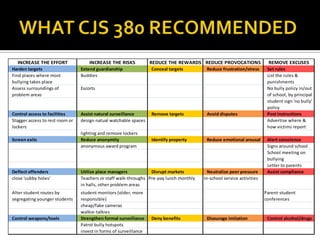
WHAT CJS 380 RECOMMENDED
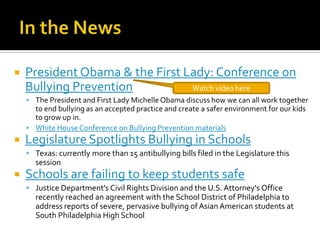
In the NewsPresident Obama & the First Lady: Conference on Bullying PreventionThe President and First Lady Michelle Obama discuss how we can all work together to end bullying as an accepted practice and create a safer environment for our kids to grow up in.White House Conference on Bullying Prevention materialsLegislature Spotlights Bullying in SchoolsTexas: currently more than 15 antibullying bills filed in the Legislature this sessionSchools are failing to keep students safeJustice Department's Civil Rights Division and the U.S. Attorney's Office recently reached an agreement with the School District of Philadelphia to address reports of severe, pervasive bullying of Asian American students at South Philadelphia High SchoolWatch video here
The ProblemBullying – in general [from POP Guide No. 12 (2002)]Is widespread and perhaps the most underreported safety problem on American school campuses10 to 29 percent of students reported to be either bullies or victimsHas long-lasting harmful effects, for both the victim and the bullyOccurs more often at school than on the way to and from.Occurs most frequently during elementary school, and slightly less often in middle schools.
What Constitutes BullyingBullying has two key components: repeated harmful actsan imbalance of powerBullying behaviors includes assault, tripping, intimidation, rumor-spreading and isolation, demands for money, destruction of property, theft of valued possessions, destruction of another's work, and name-calling.Also sexual harassment ostracism based on perceived sexual orientation; and hazing.
Reluctance To ReportMost students do not report bullying to adultsTeachers may underestimate extent of bullying and can identify only a portion of the actual bulliesReasons for underreportingFear retaliationVictims feel ashamedBelieve teachers won’t intervene or confidence that things will change if they doBelieve telling parents or teaches will make matters worseDon’t want to be a snitch
Student-witness role central  in creating bullying opportunitiesIn each bullying act, there is: a victimthe ringleader bully assistant bullies (join in) reinforcers (provide an audience or laugh with or encourage the bully)outsiders (stay away or take no sides), and defenders (step in, stick up for or comfort the victim)
Bullying BehaviorMore often at school than on the way to/fromBoys are more likely to bully than girlsBoys bully both boys and girlsTend to rely on physical aggression (direct bullying); Girl bullies Mainly bully girlsOften use teasing, rumor-spreading, exclusion, and social isolation (indirect bullying)Bullies have other peers involved about half the timeRacial/religious bullying about 25%, 8% frequently
Characteristics of BulliesAggressive (parents physically punish/violent)Dominant (with low empathy)Slightly below average in intelligence and reading ability (by middle school)At least of average popularity (most studies)Poor social skills (compensation)Young bullies tend to remain bullies, without appropriate intervention
Incidents of BullyingOccurs most often where adult supervision is low or absent: In schoolyards, cafeterias, bathrooms, hallways, on bussesClassroom bullying may have more to do with the classroom management techniques a teacher usesCyber-bullies can operate anonymously and harm a wide audience
Victims of BullyingMost victims in the same class or year as bully30% bully is older; 10% bully is youngerVictims often (not always) smaller and weaker than their peersNonassertive, socially incompetentHaving friends reduces chance of victimizationChronic victims: 6% of 10% of school age children
Consequences of BullyingPsychological and/or physical distressChronic absence, low concentrationLow self-esteem, can lead to depressionPhysical health problems for chronic victims
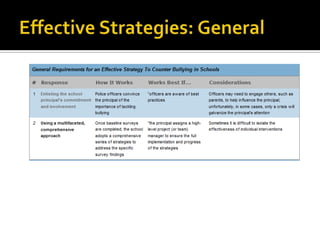
Effective Strategies: General
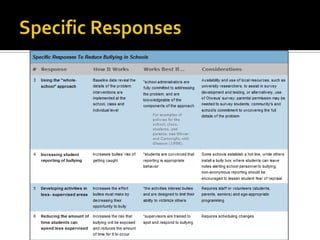
Specific Responses
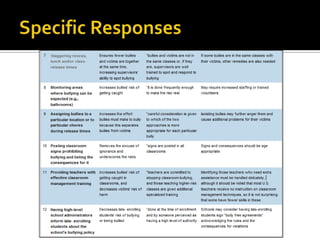
Specific Responses
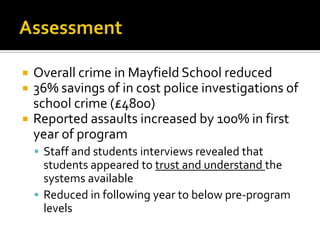
Operation Mullion (Tilley Award Winner) Hampshire ConstabularyLink to full reportReducing Anti-Social Behaviour and Crime in and around Mayfield SchoolIssue 1 Assaults / Bullying within schoolThe partnerships biggest concern, especially in the light of media publicity, was bullying. Over a 2-year period assaults within Mayfield reported to police had increased from 4 to 18 a year. All occurred during school hours and 17 were student on student related. The culture in the school between students appeared to be that bullying was accepted. A majority of the incidents reported were as a result of retaliation between students for some misunderstanding or confusion or tended to be related to long-term arguments. As bullying had become accepted within the society as the “norm,” many more incidents were occurring and going unreported due to a lack of confidence in the situation being managed effectively. Belief created an environment that allowed a bullying culture to flourish.The Underlying Causes appeared to be: Bullying between children and acceptance of this as the norm.
Lack of confidence in school reporting procedures.
Lack of appropriate rule setting.Partnership ResponseBest Practice in dealing with bullying is already in place … were analysedand in partnership consultation, a suitable Policy was drawn up by the school. This policy was then implemented by:Advertising a “No Bullying Campaign” throughout the School.
Postersin corridors with names and contact details of key individuals.

10 bullying in schools

  • 1.
    Bullying in SchoolsClickhere© J.A. Gilmer CJS 380
  • 2.
    WHAT CJS 380RECOMMENDED
  • 3.
    In the NewsPresidentObama & the First Lady: Conference on Bullying PreventionThe President and First Lady Michelle Obama discuss how we can all work together to end bullying as an accepted practice and create a safer environment for our kids to grow up in.White House Conference on Bullying Prevention materialsLegislature Spotlights Bullying in SchoolsTexas: currently more than 15 antibullying bills filed in the Legislature this sessionSchools are failing to keep students safeJustice Department's Civil Rights Division and the U.S. Attorney's Office recently reached an agreement with the School District of Philadelphia to address reports of severe, pervasive bullying of Asian American students at South Philadelphia High SchoolWatch video here
  • 4.
    The ProblemBullying –in general [from POP Guide No. 12 (2002)]Is widespread and perhaps the most underreported safety problem on American school campuses10 to 29 percent of students reported to be either bullies or victimsHas long-lasting harmful effects, for both the victim and the bullyOccurs more often at school than on the way to and from.Occurs most frequently during elementary school, and slightly less often in middle schools.
  • 5.
    What Constitutes BullyingBullyinghas two key components: repeated harmful actsan imbalance of powerBullying behaviors includes assault, tripping, intimidation, rumor-spreading and isolation, demands for money, destruction of property, theft of valued possessions, destruction of another's work, and name-calling.Also sexual harassment ostracism based on perceived sexual orientation; and hazing.
  • 6.
    Reluctance To ReportMoststudents do not report bullying to adultsTeachers may underestimate extent of bullying and can identify only a portion of the actual bulliesReasons for underreportingFear retaliationVictims feel ashamedBelieve teachers won’t intervene or confidence that things will change if they doBelieve telling parents or teaches will make matters worseDon’t want to be a snitch
  • 7.
    Student-witness role central in creating bullying opportunitiesIn each bullying act, there is: a victimthe ringleader bully assistant bullies (join in) reinforcers (provide an audience or laugh with or encourage the bully)outsiders (stay away or take no sides), and defenders (step in, stick up for or comfort the victim)
  • 8.
    Bullying BehaviorMore oftenat school than on the way to/fromBoys are more likely to bully than girlsBoys bully both boys and girlsTend to rely on physical aggression (direct bullying); Girl bullies Mainly bully girlsOften use teasing, rumor-spreading, exclusion, and social isolation (indirect bullying)Bullies have other peers involved about half the timeRacial/religious bullying about 25%, 8% frequently
  • 9.
    Characteristics of BulliesAggressive(parents physically punish/violent)Dominant (with low empathy)Slightly below average in intelligence and reading ability (by middle school)At least of average popularity (most studies)Poor social skills (compensation)Young bullies tend to remain bullies, without appropriate intervention
  • 10.
    Incidents of BullyingOccursmost often where adult supervision is low or absent: In schoolyards, cafeterias, bathrooms, hallways, on bussesClassroom bullying may have more to do with the classroom management techniques a teacher usesCyber-bullies can operate anonymously and harm a wide audience
  • 11.
    Victims of BullyingMostvictims in the same class or year as bully30% bully is older; 10% bully is youngerVictims often (not always) smaller and weaker than their peersNonassertive, socially incompetentHaving friends reduces chance of victimizationChronic victims: 6% of 10% of school age children
  • 12.
    Consequences of BullyingPsychologicaland/or physical distressChronic absence, low concentrationLow self-esteem, can lead to depressionPhysical health problems for chronic victims
  • 13.
  • 14.
  • 15.
  • 16.
    Operation Mullion (TilleyAward Winner) Hampshire ConstabularyLink to full reportReducing Anti-Social Behaviour and Crime in and around Mayfield SchoolIssue 1 Assaults / Bullying within schoolThe partnerships biggest concern, especially in the light of media publicity, was bullying. Over a 2-year period assaults within Mayfield reported to police had increased from 4 to 18 a year. All occurred during school hours and 17 were student on student related. The culture in the school between students appeared to be that bullying was accepted. A majority of the incidents reported were as a result of retaliation between students for some misunderstanding or confusion or tended to be related to long-term arguments. As bullying had become accepted within the society as the “norm,” many more incidents were occurring and going unreported due to a lack of confidence in the situation being managed effectively. Belief created an environment that allowed a bullying culture to flourish.The Underlying Causes appeared to be: Bullying between children and acceptance of this as the norm.
  • 17.
    Lack of confidencein school reporting procedures.
  • 18.
    Lack of appropriaterule setting.Partnership ResponseBest Practice in dealing with bullying is already in place … were analysedand in partnership consultation, a suitable Policy was drawn up by the school. This policy was then implemented by:Advertising a “No Bullying Campaign” throughout the School.
  • 19.
    Postersin corridors withnames and contact details of key individuals.