ABUSE and
HARASSMENT
(Youth Protection)
ABUSE and
HARASSMENT
SERDAR KELAHMET
EEMA PRESIDENT 2016-2018
İskenderun Rotary Club
District 2430 TURKEY
More than 300,000 young people participate in Rotary
International youth programs such as Interact, Rotary Youth
Exchange, and RYLA.
Youth Exchange involves more than 9,000 students annually
and represents more than 80 different countries or regions.
Traveling the world, either as an individual or as a Youth
Exchange ambassador, involves some risks.
What risks might youth exchange students face while
studying abroad?
— Theft
— Illness or injury
— Accident
— Travel difficulties
— Harassment
— Natural disaster
— Political unrest
— Drug/alcohol abuse
— Physical/sexual/emotional abuse
How are these risks different
from risks at home?
• These risks are present, in various degrees, when they are at
home.
• As foreigners, they may look very different from the local
population, making them a possible target for theft or violence.
• Because they are less familiar with the environment in their new
country, Youth Exchange students may have more difficulty
assessing risks and obtaining help when necessary.
• Youth Exchange students are usually very confident and may get
involved in riskier situations because
they think they can “handle it.”
Do you know the names that you will see on the screen now ?
Bill Clinton
Richard Nixon
Carlos Santana
Axl Rose
Ludwig van Beethoven
Charlize Theron
Shakira
Oprah Winfrey
Christina Aguilera
Do you know the names that you will see on the screen now ?
Bill Clinton abused by step father Roger Clinton
Richard Nixon suffered from physical abuse
Carlos Santana was a victim of sexual abuse
Axl Rose suffered from sexual abuse
Ludwig van Beethoven abused by his father
Charlize Theron grew up with an abusive father
Shakira suffered domestic abuse from an old boyfriend
Oprah Winfrey suffered from sexual abuse
Christina Aguilera was emotionally and physically abused by her father
WHAT ABOUT
WOODY ALLEN ?????
HARVEY WEINSTEIN ?????
BILL COSBY ?????
KEVIN SPACEY ?????
“If all the women who have been
sexually harassed or assaulted wrote
#MeToo
as a status, we might give people a sense of
the magnitude of the problem.”
Alyssa Milano on Twitter
Sunday 15th October 2017.
STATEMENT OF CONDUCT FOR WORKING WITH YOUTH
Rotary International is committed to creating
and maintaining the safest possible environment
for all participants in Rotary activities. It is the
duty of all Rotarians, Rotarians’ spouses,
partners, and other volunteers to safeguard to
the best of their ability the welfare of and to
prevent the physical, sexual, or emotional abuse
of children and young people with whom they
come into contact.
HOW DO WE MAINTAIN SAFE ENVIRONMENTS FOR
PROGRAM PARTICIPANTS?
• Selection and screening adult volunteers and host family members,
including reference and criminal background checks
• Creating a network of support for exchange students by:
o Providing students with club/district and emergency contacts
o Assigning a Rotarian counselor
o Providing students with local resources
• Training on abuse and harassment awareness for volunteers and
students and their parents/guardians
• Report allegations of abuse or harassment, and follow through in
accordance with RI policy
VOLUNTEER SELECTION AND SCREENING
• All adult volunteers and host family members must be
selected and screened with:
• Application
• Interview
• References
• Criminal Background Check
• Host Families – Must also have a home visit
before and after student placement
SENDING AND HOST STUDENTS MUST BE PROVIDED WITH
NAME AND CONTACT OF:
• Rotarian counselors
• Club presidents
• District chairs
• Governors
• 24-hour emergency contact
• Two non-Rotarian contacts (one male, one female)
SENDING AND HOST STUDENTS MUST BE PROVIDED WITH
LOCAL RESOURCES:
• Medical/Dental/Mental Healthcare Providers
• Local law enforcement
Also, if available:
• Suicide prevention hotline
• Rape crisis hotline
• Local child protection agencies
R.I. HAS ZERO TOLERANCE
ON ANY KIND OF ABUSE AND
HARRASMENT
WHAT IS ABUSE ?
WHAT IS HARRASMENT ?
DEFINITION OF ABUSE
Abuse is defined as;
Any action that intentionally harms or injures another person purpose in a
way that is harmful or morally wrong
Everything that is contrary to good order established by usage.
Departure from reasonable use; immoderate or improper use.
Physical or mental maltreatment.
To wrong in speech, reproach coarsely, disparage, revile, and malign.
Emotional or verbal abuse
Incidents in which an adult uses fear, humiliation,or verbal assaults to control the
behavior of a young person in his or her care.
Examples include rejecting the young person, preventing him or her from developing
normal social relationships, and making derogatory statements about the youth’s race,
religion, or personal appearance.
Psychological abuse
Victims of psychological abuse can be of any age or gender.
This form of abuse is often difficult to prove.
Psychological abuse includes:
emotional abuse
threats of harm or abandonment
deprivation of contact
humiliation
blaming
controlling
intimidation
coercion
harrassment
verbal abuse
cyber bullying
isolation
unreasonable and unjustified withdrawal of services or supportive networks
Physical abuse
Physical contact intended to cause pain, injury, or other physical suffering or
harm. The injuries can be inflicted by punching , kicking, biting,
burning, beating, or use of a weapon such as a
baseball bat or knife.
Physical abuse includes:
assault
hitting
slapping
pushing
misuse of medication
restraint or inappropriate physical sanctions
Neglect
Failure to provide the food, shelter, or medical care that is necessary to well-
being.
Neglect and acts of omission include:
ignoring medical, emotional or physical care needs
failure to provide access to appropriate health, care and support or educational services,
the withholding of the necessities of life, such as medication, adequate nutrition and
heating
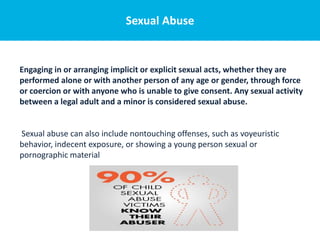
Sexual Abuse
Engaging in or arranging implicit or explicit sexual acts, whether they are
performed alone or with another person of any age or gender, through force
or coercion or with anyone who is unable to give consent. Any sexual activity
between a legal adult and a minor is considered sexual abuse.
Sexual abuse can also include nontouching offenses, such as voyeuristic
behavior, indecent exposure, or showing a young person sexual or
pornographic material
Sexual Abuse
Sexual abuse includes:
rape
indecent exposure
sexual harrassment
inapropriate looking or touching
sexual teasing or innuendo
sexual photography
subjection to pornography or witnessing sexual acts
indecent exposure and sexual assault or sexual acts to which the adult has not
consented or was pressured into
DEFINITION OF HARRASMENT
Harrasment is defined as;
Someone committing 3 or more acts, that were willful and malicious,
aimed at you, that were intended to cause you fear, intimidation, abuse or
damage to property, and that did in fact cause you fear, intimidation, abuse
or damage to property.
“Abuse” means causing or attempting to cause physical harm or causing fear
of imminent serious physical harm. Fear must be fear of being physically
hurt.
Or:
someone one time forcing you to have sex or threatening you into have sex
DEFINITION OF HARRASMENT
Harrasment is defined as;
Or:
someone committing one of the following crimes against you at least once:
Indecent assault and battery
Assault with intent to commit rape
Enticement of a child
Criminal stalking
Criminal harassment
Drugging for sexual intercourse
What types of behavior do you consider
harassment?
Sexual Harrasment
Sexual advances, requests for sexual favors, or verbal or physical conduct of a
sexual nature that is unwanted or directed at someone unwilling or unable to
provide consent. In some cases, sexual harassment precedes sexual abuse
and is used by sexual predators to desensitize or groom their victims.
Examples of Sexual Harrasment
••Sexual epithets or jokes, written or spoken references to sexual conduct,
gossip about one’s sex life, and comments about a person’s sexual activity,
deficiencies, or prowess
••Verbal abuse of a sexual nature
••Display of sexually suggestive objects or images
••Sexual leering or whistling
••Inappropriate physical contact, such as brushing against a person
••Obscene language or gestures, and suggestive or insulting comments
•
SIGNS OF ABUSE OR HARASSMENT
Physical changes
Anxiety
Changes in eating habits or body image
Depression
Delinquency
Withdrawal
Aggression
Age-inappropriate behavior
Why do Youth Exchange students
need specialized training in abuse and
harassment prevention?
 Whether they’re at home or abroad, young
people are at risk for incidents of abuse and
harassment.
 Abuse and harassment prevention is based on
awareness, which is why the topic is included in
training sessions for all Youth Exchange
participants.
When receiving a report of abuse or harassment, it is critical
that you respond in a neutral and responsible manner
••Listen attentively. Be encouraging to the person making the report, and do
not express strong emotions, particularly horror or disbelief, at what is being
said.
••Ask questions to establish facts. Be nonjudgmental and avoid asking “why?”
It may be interpreted as questioning the participant’s motives.
••Document the allegation during or soon after the participant’s report. Try
to use the participant’s exact words, and include details like the date and time
of the conversation.
Any Rotarian or other volunteer to whom a youth program
participant brings an allegation of abuse or harassment
must ensure that it is properly reported.
••Take immediate action to ensure the program participant’s health and well-
being, and get them medical or psychological care, if appropriate.
••Promptly report every allegation of abuse and harassment to the proper
law enforcement agency for investigation.
••Follow district policy on notifying specific Rotarians, such as the district
youth protection officer and district governor, when abuse or harassment is
alleged.
••Until the matter is resolved, remove all youth program participants from
contact with any person accused of sexual abuse or harassment.
••Report all allegations and other serious incidents, including accidents that
involve hospitalizations, serious crimes, early returns,and deaths, to RI
headquarters within 72 hours of learning of the incident.
During an independent and thorough investigation, protect
the safety of youth and the privacy of both the victim and
the accused.
••Cooperate fully with law enforcement and youth protection agencies and do not
interfere with their investigation.
••Consult social service agencies to discuss local standards and resources that support
program participants who report abuse or harassment.
••Contact the program participant’s parents or legal guardians to inform them of the
allegation and the actions being taken.
••At times, a program participant may be uncomfortable with conduct that may not be
legally defined as harassment, and law enforcement may decline to investigate an
allegation.
••When Youth Exchange students make allegations while abroad, they and their
parents or legal guardians should decide whether the students will remain on
Exchange or return home.
••Avoid gossip and blame.
Avoid comments against or in favor of the accuser,
or the accused.
“They made up the allegation”
“I know ____ personally, they
would never have done this”
“They had it coming because they were too drunk/dressed inappropriately/were
warned. They should have known better”
What are other examples of either victim blaming, or supporting the accused?
After the investigation, it may be necessary to enhance your
district’s youth protection policy to prevent recurrences.
••A club must terminate the membership of any Rotarian who admits to, is
convicted of, or is otherwise found to have engaged in sexual abuse or
harassment.
••If a law enforcement investigation is inconclusive, or if law enforcement
declines to investigate, the accused person may be reinstated as a program
volunteer at the district’s discretion.
••Additional safeguards for program volunteers can include limiting or
suspending their roles, depending on the allegation’s circumstances.
••Reinstatement is not a right and is not guaranteed.
••The district must review the situation to confirm that youth protection and
safety was the highest priority.
CHARACTERISTICS OF ABUSE AND HARASSMENT
The typical abuser blends into society:
••Perpetrators cannot be identified by age, economic status, community
standing, race, gender, or mental capacity.
••Many abuse incidents are perpetrated by someone known to and trusted by
the abused.
••Offenders can be male or female, and physical, emotional, or sexual abuse
and harassment can be perpetrated against a person of either sex.
••Offenders can be other young people.
••Victims of sexual abuse are often carefully chosen and skillfully manipulated.
••Offenders may seek positions that provide that proximity to youth.
The vast majority of allegations of
abuse or harassment go unreported
••Young people tend to minimize and deny abuse, not exaggerate or over-
report incidents.
••They might not tell anyone about an assault because they are convinced that
they’re to blame or they fear the potential consequences.
••Males are less likely to report abuse because of self-blame, social stigma, or
fears that they will not be believed or will be seen to have a particular sexual
orientation.
••In some cases, youth wait to report abuse until they are adults.
••Few child abusers are identified and prosecuted.
Who shares the responsibility for keeping
Youth Exchange students safe?
Rotarian and non-Rotarian volunteers
Host families
Counselors
Students
Parents
Teachers and others in the host community
Youth Exchange Support System
District governor
District Youth Exchange officers
Club president
Club Youth Exchange officer
Rotarian counselor
Host families
Parents
Students
Cultural Considerations
Can you think of an example of a
behavior in your culture that could
be misinterpreted as harassment by
someone from another culture?
Key points for Students
Abuse is unlikely to stop unless it is reported.
Even if you feel uncomfortable talking about
the situation,it is better to be safe than polite.
If you aren’t comfortable with the adult’s
response, tell someone else.
If it doesn’t feel right, it probably isn’t.
Key points for Students
The Youth Exchange program is committed to
protecting all participants.
To ensure the safety of all participants, we
are encouraging you to report any incident
of abuse or harassment.
QUESTIONS
ABIJ 2017 Sao Luıs
TEŞEKKÜR
EDERİM

serdar@kelahmet.com
skahmet@superonline.com

Abuse and Harassment

  • 1.
  • 2.
    ABUSE and HARASSMENT SERDAR KELAHMET EEMAPRESIDENT 2016-2018 İskenderun Rotary Club District 2430 TURKEY
  • 3.
    More than 300,000young people participate in Rotary International youth programs such as Interact, Rotary Youth Exchange, and RYLA. Youth Exchange involves more than 9,000 students annually and represents more than 80 different countries or regions. Traveling the world, either as an individual or as a Youth Exchange ambassador, involves some risks.
  • 4.
    What risks mightyouth exchange students face while studying abroad? — Theft — Illness or injury — Accident — Travel difficulties — Harassment — Natural disaster — Political unrest — Drug/alcohol abuse — Physical/sexual/emotional abuse
  • 5.
    How are theserisks different from risks at home? • These risks are present, in various degrees, when they are at home. • As foreigners, they may look very different from the local population, making them a possible target for theft or violence. • Because they are less familiar with the environment in their new country, Youth Exchange students may have more difficulty assessing risks and obtaining help when necessary. • Youth Exchange students are usually very confident and may get involved in riskier situations because they think they can “handle it.”
  • 6.
    Do you knowthe names that you will see on the screen now ? Bill Clinton Richard Nixon Carlos Santana Axl Rose Ludwig van Beethoven Charlize Theron Shakira Oprah Winfrey Christina Aguilera
  • 7.
    Do you knowthe names that you will see on the screen now ? Bill Clinton abused by step father Roger Clinton Richard Nixon suffered from physical abuse Carlos Santana was a victim of sexual abuse Axl Rose suffered from sexual abuse Ludwig van Beethoven abused by his father Charlize Theron grew up with an abusive father Shakira suffered domestic abuse from an old boyfriend Oprah Winfrey suffered from sexual abuse Christina Aguilera was emotionally and physically abused by her father
  • 8.
    WHAT ABOUT WOODY ALLEN????? HARVEY WEINSTEIN ????? BILL COSBY ????? KEVIN SPACEY ?????
  • 9.
    “If all thewomen who have been sexually harassed or assaulted wrote #MeToo as a status, we might give people a sense of the magnitude of the problem.” Alyssa Milano on Twitter Sunday 15th October 2017.
  • 10.
    STATEMENT OF CONDUCTFOR WORKING WITH YOUTH Rotary International is committed to creating and maintaining the safest possible environment for all participants in Rotary activities. It is the duty of all Rotarians, Rotarians’ spouses, partners, and other volunteers to safeguard to the best of their ability the welfare of and to prevent the physical, sexual, or emotional abuse of children and young people with whom they come into contact.
  • 11.
    HOW DO WEMAINTAIN SAFE ENVIRONMENTS FOR PROGRAM PARTICIPANTS? • Selection and screening adult volunteers and host family members, including reference and criminal background checks • Creating a network of support for exchange students by: o Providing students with club/district and emergency contacts o Assigning a Rotarian counselor o Providing students with local resources • Training on abuse and harassment awareness for volunteers and students and their parents/guardians • Report allegations of abuse or harassment, and follow through in accordance with RI policy
  • 12.
    VOLUNTEER SELECTION ANDSCREENING • All adult volunteers and host family members must be selected and screened with: • Application • Interview • References • Criminal Background Check • Host Families – Must also have a home visit before and after student placement
  • 13.
    SENDING AND HOSTSTUDENTS MUST BE PROVIDED WITH NAME AND CONTACT OF: • Rotarian counselors • Club presidents • District chairs • Governors • 24-hour emergency contact • Two non-Rotarian contacts (one male, one female)
  • 14.
    SENDING AND HOSTSTUDENTS MUST BE PROVIDED WITH LOCAL RESOURCES: • Medical/Dental/Mental Healthcare Providers • Local law enforcement Also, if available: • Suicide prevention hotline • Rape crisis hotline • Local child protection agencies
  • 15.
    R.I. HAS ZEROTOLERANCE ON ANY KIND OF ABUSE AND HARRASMENT
  • 16.
    WHAT IS ABUSE? WHAT IS HARRASMENT ?
  • 17.
    DEFINITION OF ABUSE Abuseis defined as; Any action that intentionally harms or injures another person purpose in a way that is harmful or morally wrong Everything that is contrary to good order established by usage. Departure from reasonable use; immoderate or improper use. Physical or mental maltreatment. To wrong in speech, reproach coarsely, disparage, revile, and malign.
  • 18.
    Emotional or verbalabuse Incidents in which an adult uses fear, humiliation,or verbal assaults to control the behavior of a young person in his or her care. Examples include rejecting the young person, preventing him or her from developing normal social relationships, and making derogatory statements about the youth’s race, religion, or personal appearance.
  • 19.
    Psychological abuse Victims ofpsychological abuse can be of any age or gender. This form of abuse is often difficult to prove. Psychological abuse includes: emotional abuse threats of harm or abandonment deprivation of contact humiliation blaming controlling intimidation coercion harrassment verbal abuse cyber bullying isolation unreasonable and unjustified withdrawal of services or supportive networks
  • 20.
    Physical abuse Physical contactintended to cause pain, injury, or other physical suffering or harm. The injuries can be inflicted by punching , kicking, biting, burning, beating, or use of a weapon such as a baseball bat or knife. Physical abuse includes: assault hitting slapping pushing misuse of medication restraint or inappropriate physical sanctions
  • 21.
    Neglect Failure to providethe food, shelter, or medical care that is necessary to well- being. Neglect and acts of omission include: ignoring medical, emotional or physical care needs failure to provide access to appropriate health, care and support or educational services, the withholding of the necessities of life, such as medication, adequate nutrition and heating
  • 22.
    Sexual Abuse Engaging inor arranging implicit or explicit sexual acts, whether they are performed alone or with another person of any age or gender, through force or coercion or with anyone who is unable to give consent. Any sexual activity between a legal adult and a minor is considered sexual abuse. Sexual abuse can also include nontouching offenses, such as voyeuristic behavior, indecent exposure, or showing a young person sexual or pornographic material
  • 23.
    Sexual Abuse Sexual abuseincludes: rape indecent exposure sexual harrassment inapropriate looking or touching sexual teasing or innuendo sexual photography subjection to pornography or witnessing sexual acts indecent exposure and sexual assault or sexual acts to which the adult has not consented or was pressured into
  • 24.
    DEFINITION OF HARRASMENT Harrasmentis defined as; Someone committing 3 or more acts, that were willful and malicious, aimed at you, that were intended to cause you fear, intimidation, abuse or damage to property, and that did in fact cause you fear, intimidation, abuse or damage to property. “Abuse” means causing or attempting to cause physical harm or causing fear of imminent serious physical harm. Fear must be fear of being physically hurt. Or: someone one time forcing you to have sex or threatening you into have sex
  • 25.
    DEFINITION OF HARRASMENT Harrasmentis defined as; Or: someone committing one of the following crimes against you at least once: Indecent assault and battery Assault with intent to commit rape Enticement of a child Criminal stalking Criminal harassment Drugging for sexual intercourse
  • 26.
    What types ofbehavior do you consider harassment?
  • 27.
    Sexual Harrasment Sexual advances,requests for sexual favors, or verbal or physical conduct of a sexual nature that is unwanted or directed at someone unwilling or unable to provide consent. In some cases, sexual harassment precedes sexual abuse and is used by sexual predators to desensitize or groom their victims.
  • 28.
    Examples of SexualHarrasment ••Sexual epithets or jokes, written or spoken references to sexual conduct, gossip about one’s sex life, and comments about a person’s sexual activity, deficiencies, or prowess ••Verbal abuse of a sexual nature ••Display of sexually suggestive objects or images ••Sexual leering or whistling ••Inappropriate physical contact, such as brushing against a person ••Obscene language or gestures, and suggestive or insulting comments
  • 30.
  • 31.
    SIGNS OF ABUSEOR HARASSMENT Physical changes Anxiety Changes in eating habits or body image Depression Delinquency Withdrawal Aggression Age-inappropriate behavior
  • 32.
    Why do YouthExchange students need specialized training in abuse and harassment prevention?  Whether they’re at home or abroad, young people are at risk for incidents of abuse and harassment.  Abuse and harassment prevention is based on awareness, which is why the topic is included in training sessions for all Youth Exchange participants.
  • 33.
    When receiving areport of abuse or harassment, it is critical that you respond in a neutral and responsible manner ••Listen attentively. Be encouraging to the person making the report, and do not express strong emotions, particularly horror or disbelief, at what is being said. ••Ask questions to establish facts. Be nonjudgmental and avoid asking “why?” It may be interpreted as questioning the participant’s motives. ••Document the allegation during or soon after the participant’s report. Try to use the participant’s exact words, and include details like the date and time of the conversation.
  • 34.
    Any Rotarian orother volunteer to whom a youth program participant brings an allegation of abuse or harassment must ensure that it is properly reported. ••Take immediate action to ensure the program participant’s health and well- being, and get them medical or psychological care, if appropriate. ••Promptly report every allegation of abuse and harassment to the proper law enforcement agency for investigation. ••Follow district policy on notifying specific Rotarians, such as the district youth protection officer and district governor, when abuse or harassment is alleged. ••Until the matter is resolved, remove all youth program participants from contact with any person accused of sexual abuse or harassment. ••Report all allegations and other serious incidents, including accidents that involve hospitalizations, serious crimes, early returns,and deaths, to RI headquarters within 72 hours of learning of the incident.
  • 35.
    During an independentand thorough investigation, protect the safety of youth and the privacy of both the victim and the accused. ••Cooperate fully with law enforcement and youth protection agencies and do not interfere with their investigation. ••Consult social service agencies to discuss local standards and resources that support program participants who report abuse or harassment. ••Contact the program participant’s parents or legal guardians to inform them of the allegation and the actions being taken. ••At times, a program participant may be uncomfortable with conduct that may not be legally defined as harassment, and law enforcement may decline to investigate an allegation. ••When Youth Exchange students make allegations while abroad, they and their parents or legal guardians should decide whether the students will remain on Exchange or return home. ••Avoid gossip and blame.
  • 36.
    Avoid comments againstor in favor of the accuser, or the accused. “They made up the allegation” “I know ____ personally, they would never have done this” “They had it coming because they were too drunk/dressed inappropriately/were warned. They should have known better” What are other examples of either victim blaming, or supporting the accused?
  • 37.
    After the investigation,it may be necessary to enhance your district’s youth protection policy to prevent recurrences. ••A club must terminate the membership of any Rotarian who admits to, is convicted of, or is otherwise found to have engaged in sexual abuse or harassment. ••If a law enforcement investigation is inconclusive, or if law enforcement declines to investigate, the accused person may be reinstated as a program volunteer at the district’s discretion. ••Additional safeguards for program volunteers can include limiting or suspending their roles, depending on the allegation’s circumstances. ••Reinstatement is not a right and is not guaranteed. ••The district must review the situation to confirm that youth protection and safety was the highest priority.
  • 38.
    CHARACTERISTICS OF ABUSEAND HARASSMENT The typical abuser blends into society: ••Perpetrators cannot be identified by age, economic status, community standing, race, gender, or mental capacity. ••Many abuse incidents are perpetrated by someone known to and trusted by the abused. ••Offenders can be male or female, and physical, emotional, or sexual abuse and harassment can be perpetrated against a person of either sex. ••Offenders can be other young people. ••Victims of sexual abuse are often carefully chosen and skillfully manipulated. ••Offenders may seek positions that provide that proximity to youth.
  • 39.
    The vast majorityof allegations of abuse or harassment go unreported ••Young people tend to minimize and deny abuse, not exaggerate or over- report incidents. ••They might not tell anyone about an assault because they are convinced that they’re to blame or they fear the potential consequences. ••Males are less likely to report abuse because of self-blame, social stigma, or fears that they will not be believed or will be seen to have a particular sexual orientation. ••In some cases, youth wait to report abuse until they are adults. ••Few child abusers are identified and prosecuted.
  • 40.
    Who shares theresponsibility for keeping Youth Exchange students safe? Rotarian and non-Rotarian volunteers Host families Counselors Students Parents Teachers and others in the host community
  • 41.
    Youth Exchange SupportSystem District governor District Youth Exchange officers Club president Club Youth Exchange officer Rotarian counselor Host families Parents Students
  • 42.
  • 43.
    Can you thinkof an example of a behavior in your culture that could be misinterpreted as harassment by someone from another culture?
  • 44.
    Key points forStudents Abuse is unlikely to stop unless it is reported. Even if you feel uncomfortable talking about the situation,it is better to be safe than polite. If you aren’t comfortable with the adult’s response, tell someone else. If it doesn’t feel right, it probably isn’t.
  • 45.
    Key points forStudents The Youth Exchange program is committed to protecting all participants. To ensure the safety of all participants, we are encouraging you to report any incident of abuse or harassment.
  • 46.
  • 47.
  • 48.