Bullying in Schools
Bureau of Indian Affairs
Office of Justice Services
Albuquerque NM
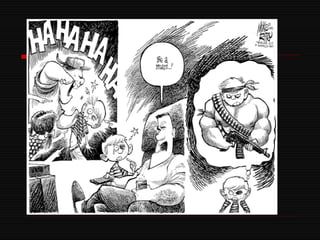
The Problem of Bullying in Schools
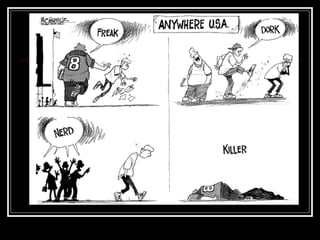
 Bullying affects students’ sense of security.
 Bullying is widespread and perhaps the
most underreported safety problem in
schools.
 Bullying is now KNOWN to have long-
lasting harmful effects.
 Approximately 2/3 of school shootings, the
attackers had been bullied.
The Problem of Bullying in Schools
 Bullying occurs at all grade levels-
most frequently during elementary
school.
 Bullies are more likely to develop a
criminal record than peers.
 Bullying victims suffer psychological
harm long after the bullying stops.
Definition of Bullying
 Bullying has two key components:
 Repeated harmful acts; and
 Imbalance of power
It involves repeated physical, verbal or
psychological attacks or intimidation directed
against a victim who cannot properly defend
him-or herself because of size or strength, or
because the victim is outnumbered or less
psychologically resilient.
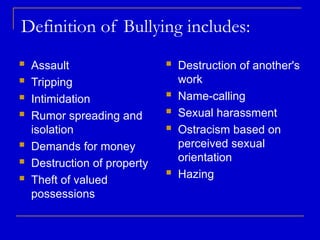
Definition of Bullying includes:
 Assault
 Tripping
 Intimidation
 Rumor spreading and
isolation
 Demands for money
 Destruction of property
 Theft of valued
possessions
 Destruction of another's
work
 Name-calling
 Sexual harassment
 Ostracism based on
perceived sexual
orientation
 Hazing
Definition of Bullying
 Not all taunting, teasing and fighting among
schoolchildren constitutes bullying.
 Bullying entails repeated acts by someone
perceived as physically or psychologically
more powerful.
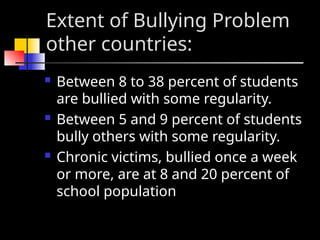
Extent of Bullying Problem
other countries:
 Between 8 to 38 percent of students
are bullied with some regularity.
 Between 5 and 9 percent of students
bully others with some regularity.
 Chronic victims, bullied once a week
or more, are at 8 and 20 percent of
school population
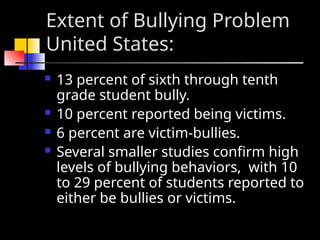
Extent of Bullying Problem
United States:
 13 percent of sixth through tenth
grade student bully.
 10 percent reported being victims.
 6 percent are victim-bullies.
 Several smaller studies confirm high
levels of bullying behaviors, with 10
to 29 percent of students reported to
either be bullies or victims.
Extent of Bullying Problem
The percentage of students who are
bullies and victims varies by research
study, often depending on the
definition used, the time frame
examined and other factors.
Despite these differences, bullying
appears to be widespread in schools in
every country studying the problem.
A Threshold Problem:
The Reluctance to Report
 Fearing retaliation
 Feeling shame at not
being able to stand up for
themselves.
 Fearing they would not
be believed.
 Not wanting to worry their
parents
 Having no confidence
that anything would
change.
 Thinking their parents’ or
teachers’ advice would
make the problem worse.
 Fearing their teacher
would tell the bully
 Thinking it was worse to
be a “snitch”
A Threshold Problem:
The Reluctance to Report
 The same is true of student-witnesses
 Rarely tell teachers and infrequently
intervene
 Worry that intervening will make them the
next target.
 Falsely believe that no one person has
responsibility to stop the bullying, absent a
teacher or parent.
A Threshold Problem:
The Reluctance to Report
 Student-witnesses appear to have a
central role in creating opportunities for
bullying.
 In one study of Juniors and Seniors, 88
percent reported having observed
bullying.
A Threshold Problem:
The Reluctance to Report
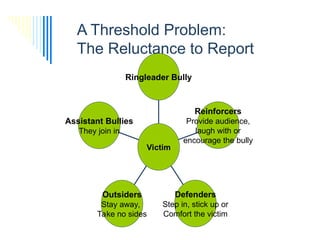
Assistant Bullies
They join in
Outsiders
Stay away,
Take no sides
Defenders
Step in, stick up or
Comfort the victim
Reinforcers
Provide audience,
laugh with or
encourage the bully
Ringleader Bully
Victim
A Threshold Problem:
The Reluctance to Report
Studies suggest only between 10 and 20
percent of noninvolved students provide
any real help when another student is
victimized.
Bullying Behavior
 Despite country and cultural differences,
certain similarities by gender, age, location
and type of victimization appear in the U.S.
and elsewhere.
 Takes place at school most often.
 Boy bullies rely on physical aggression.
 Girl bullies often use teasing, rumor spreading,
exclusion and social isolation.
Bullying Behavior
 Direct and Indirect bullying:
 Direct: physical and verbal (may be also indirect).
 Physical is the least common.
 Verbal is the most common.
 Indirect: teasing, rumor spreading etc…
 Girls tend to bully girls, boys will bully girls
and boys.
 Research shows boys are more likely to bully
than girls.
Bullying Behavior
 Bullies often do not operate alone. Almost
half of the incidents are one-on-one, the other
half involves additional kids.
 Bullying by boys declines at age 15.
 Bullying by girls declines at age 14.
Bullying Behavior
 Researchers believe bullying rates are
unrelated to school or class size, inner city or
suburb.
 Socially disadvantaged areas seem to have
higher rates.
 Classes with students with behavioral,
emotional or learning problems, have more
bullies and victims.
Bullying Behavior
 Racial bullying: 25 percent of students
victimized, reported they were belittled about
their race or religion.
 Black youth reported being bullied less than
Hispanic and White peers.
Bullying Behavior
 Unknown:
 Whether certain types of bullying are more
harmful than others.
 If certain types of bullying have longer-term
impact on victims.
 What happens when the bully stops, does another
step in?
 Must the victim change behavior to prevent
another from stepping in?
Bullies
 Tend to be aggressive, dominant, slightly
below average in intelligence and reading
ability.
 Average popularity
 Do not have much empathy for victims.
 Young bullies tend to remain bullies.
• “adolescent bullies tend to become adult bullies, and
then tend to have children who are bullies”
Bullies
 Possess similarities to other types of offenders.
 Come from lower socioeconomic-status
families with poor child-rearing techniques.
 Tend to be impulsive.
 Tend to be unsuccessful in school.
 Generally uncooperative.
 Come from dysfunctional families low on love.
Bullies
 Parents criticized them and strictly controlled.
 Research found a correlation between harsh
physical punishments and strict disciplinarian
parents and bullying.
 Bullies have been found to have poor social
skills.
 One study suggests that bullies have a keen
insight on others’ mental state and take
advantage of that by picking on the emotionally
less resilient.
Incidents of Bullying
 Most often occurs where adult supervision is
low or absent:
 Schoolyards
 Cafeterias
 Bathrooms
 Hallways
 “Olweus found that there is an inverse
relationship between the number of
supervising adults present and the number of
bully/victim incidents.”
Incidents of Bullying
 Classrooms
 School buses
 The internet
One student, whose address and phone
number were published on the site, was
barraged with calls from people calling her a
“slut” and a “prostitute.”
Victims of Bullying
 Most bullies victimize students in the same class
or year.
 Its unknown the extent of personal attributes that
play a role in victim selection.
 One major study found that the victims tended to
be smaller and weaker than their peers.
 Another found those to be nonassertive and
socially incompetent were more likely to be
victimized
Victims of Bullying
 Having friends appears to reduce the chances
of being bullied.
 One study found:
 “more than half of those who say they have no
friends are being bullied (51%), vs. only 11% of
those who say they have more than five friends”
Consequences of Bullying
 Embarrassment
 Psychological and/or
physical distress.
 Frequently absent from
school
 Cannot concentrate on
schoolwork.
 Low self-esteem
 Frequently
contemplated suicide
 Social dysfunction
 Anxiety
 Insomnia
 Depression
 Poor health
Consequences of Bullying
Chronic Victims of Bullying
 6 to 10% are chronic victims, bullied as often
as several times a week.
 Most are extremely passive and do not
defend themselves.
 Small number react aggressively toward the
bully due to their coping strategies.
Consequences of Bullying
Chronic Victims of Bullying
 These chronic victims tend to be anxious and
insecure.
 Less able to control their emotions, more
socially withdrawn.
 Chronic victims may return to the bully to try
to continue the perceived relationship.
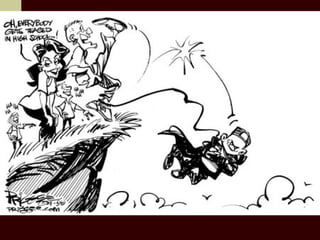
 Often remain victims after switching classes.
Consequences of Bullying
Chronic Victims of Bullying
 Olweus states:
“It does not require much imagination to
understand what it is to go through the school
years in a state of more or less permanent
anxiety and insecurity, and with poor self-
esteem. It is not surprising that the victims’
devaluation of themselves sometimes
becomes so overwhelming that they seen
suicide as the only possible solution.”
Consequences of Bullying
Chronic Victims of Bullying
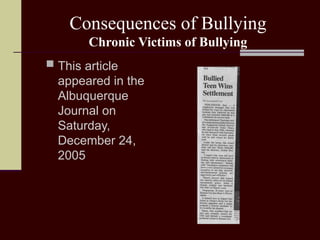
 This article
appeared in the
Albuquerque
Journal on
Saturday,
December 24,
2005
General Requirements for an
Effective Strategy to
Counter Bullying in Schools
1.
1. Enlisting the principals commitment and
Enlisting the principals commitment and
involvement.
involvement.
2.
2. Using a multifaceted, comprehensive
Using a multifaceted, comprehensive
approach.
approach.
Specific Responses to
Reduce Bullying in Schools
 Using the “whole-school” approach.
Using the “whole-school” approach.
 Increase student reporting of bullying.
Increase student reporting of bullying.
 Developing activities in less-supervised
Developing activities in less-supervised
areas.
areas.
 Reducing the amount time students can
Reducing the amount time students can
spend less supervised.
 Staggering recess, lunch and/or class-
Staggering recess, lunch and/or class-
release times.
release times.
Specific Responses to
Reduce Bullying in Schools
 Monitoring areas where bullying can be
Monitoring areas where bullying can be
expected.
expected.
 Assigning bullies to a particular location or
Assigning bullies to a particular location or
chores during release times.
 Posting classroom signs prohibiting bullying
Posting classroom signs prohibiting bullying
and listing consequences for it.
 Providing teachers with effective classroom
Providing teachers with effective classroom
management training.
 Having high-level school administrators
Having high-level school administrators
inform late-enrolling students about the
school’s bullying policy.
Responses with Limited
Effectiveness
Effectiveness
 Training students in conflict resolution
Training students in conflict resolution
and peer mediation.
and peer mediation.
 Adopting a “zero tolerance” policy.
Adopting a “zero tolerance” policy.
 Providing group therapy for bullies.
Providing group therapy for bullies.
 Encouraging victims to simply “stand up”
Encouraging victims to simply “stand up”
to bullies.
to bullies.
Understanding Your Local Problem
The information is only a generalized
description of bullying in schools.
You must combine this information with a
more specific understanding of your
school’s problem. Analyzing it will help
design a more effective response strategy.
Thank You

bullying. in schools.ppt

  • 1.
    Bullying in Schools Bureauof Indian Affairs Office of Justice Services Albuquerque NM
  • 3.
    The Problem ofBullying in Schools  Bullying affects students’ sense of security.  Bullying is widespread and perhaps the most underreported safety problem in schools.  Bullying is now KNOWN to have long- lasting harmful effects.  Approximately 2/3 of school shootings, the attackers had been bullied.
  • 4.
    The Problem ofBullying in Schools  Bullying occurs at all grade levels- most frequently during elementary school.  Bullies are more likely to develop a criminal record than peers.  Bullying victims suffer psychological harm long after the bullying stops.
  • 5.
    Definition of Bullying Bullying has two key components:  Repeated harmful acts; and  Imbalance of power It involves repeated physical, verbal or psychological attacks or intimidation directed against a victim who cannot properly defend him-or herself because of size or strength, or because the victim is outnumbered or less psychologically resilient.
  • 6.
    Definition of Bullyingincludes:  Assault  Tripping  Intimidation  Rumor spreading and isolation  Demands for money  Destruction of property  Theft of valued possessions  Destruction of another's work  Name-calling  Sexual harassment  Ostracism based on perceived sexual orientation  Hazing
  • 7.
    Definition of Bullying Not all taunting, teasing and fighting among schoolchildren constitutes bullying.  Bullying entails repeated acts by someone perceived as physically or psychologically more powerful.
  • 8.
    Extent of BullyingProblem other countries:  Between 8 to 38 percent of students are bullied with some regularity.  Between 5 and 9 percent of students bully others with some regularity.  Chronic victims, bullied once a week or more, are at 8 and 20 percent of school population
  • 9.
    Extent of BullyingProblem United States:  13 percent of sixth through tenth grade student bully.  10 percent reported being victims.  6 percent are victim-bullies.  Several smaller studies confirm high levels of bullying behaviors, with 10 to 29 percent of students reported to either be bullies or victims.
  • 10.
    Extent of BullyingProblem The percentage of students who are bullies and victims varies by research study, often depending on the definition used, the time frame examined and other factors. Despite these differences, bullying appears to be widespread in schools in every country studying the problem.
  • 11.
    A Threshold Problem: TheReluctance to Report  Fearing retaliation  Feeling shame at not being able to stand up for themselves.  Fearing they would not be believed.  Not wanting to worry their parents  Having no confidence that anything would change.  Thinking their parents’ or teachers’ advice would make the problem worse.  Fearing their teacher would tell the bully  Thinking it was worse to be a “snitch”
  • 12.
    A Threshold Problem: TheReluctance to Report  The same is true of student-witnesses  Rarely tell teachers and infrequently intervene  Worry that intervening will make them the next target.  Falsely believe that no one person has responsibility to stop the bullying, absent a teacher or parent.
  • 13.
    A Threshold Problem: TheReluctance to Report  Student-witnesses appear to have a central role in creating opportunities for bullying.  In one study of Juniors and Seniors, 88 percent reported having observed bullying.
  • 14.
    A Threshold Problem: TheReluctance to Report Assistant Bullies They join in Outsiders Stay away, Take no sides Defenders Step in, stick up or Comfort the victim Reinforcers Provide audience, laugh with or encourage the bully Ringleader Bully Victim
  • 15.
    A Threshold Problem: TheReluctance to Report Studies suggest only between 10 and 20 percent of noninvolved students provide any real help when another student is victimized.
  • 16.
    Bullying Behavior  Despitecountry and cultural differences, certain similarities by gender, age, location and type of victimization appear in the U.S. and elsewhere.  Takes place at school most often.  Boy bullies rely on physical aggression.  Girl bullies often use teasing, rumor spreading, exclusion and social isolation.
  • 17.
    Bullying Behavior  Directand Indirect bullying:  Direct: physical and verbal (may be also indirect).  Physical is the least common.  Verbal is the most common.  Indirect: teasing, rumor spreading etc…  Girls tend to bully girls, boys will bully girls and boys.  Research shows boys are more likely to bully than girls.
  • 18.
    Bullying Behavior  Bulliesoften do not operate alone. Almost half of the incidents are one-on-one, the other half involves additional kids.  Bullying by boys declines at age 15.  Bullying by girls declines at age 14.
  • 19.
    Bullying Behavior  Researchersbelieve bullying rates are unrelated to school or class size, inner city or suburb.  Socially disadvantaged areas seem to have higher rates.  Classes with students with behavioral, emotional or learning problems, have more bullies and victims.
  • 20.
    Bullying Behavior  Racialbullying: 25 percent of students victimized, reported they were belittled about their race or religion.  Black youth reported being bullied less than Hispanic and White peers.
  • 21.
    Bullying Behavior  Unknown: Whether certain types of bullying are more harmful than others.  If certain types of bullying have longer-term impact on victims.  What happens when the bully stops, does another step in?  Must the victim change behavior to prevent another from stepping in?
  • 22.
    Bullies  Tend tobe aggressive, dominant, slightly below average in intelligence and reading ability.  Average popularity  Do not have much empathy for victims.  Young bullies tend to remain bullies. • “adolescent bullies tend to become adult bullies, and then tend to have children who are bullies”
  • 23.
    Bullies  Possess similaritiesto other types of offenders.  Come from lower socioeconomic-status families with poor child-rearing techniques.  Tend to be impulsive.  Tend to be unsuccessful in school.  Generally uncooperative.  Come from dysfunctional families low on love.
  • 24.
    Bullies  Parents criticizedthem and strictly controlled.  Research found a correlation between harsh physical punishments and strict disciplinarian parents and bullying.  Bullies have been found to have poor social skills.  One study suggests that bullies have a keen insight on others’ mental state and take advantage of that by picking on the emotionally less resilient.
  • 26.
    Incidents of Bullying Most often occurs where adult supervision is low or absent:  Schoolyards  Cafeterias  Bathrooms  Hallways  “Olweus found that there is an inverse relationship between the number of supervising adults present and the number of bully/victim incidents.”
  • 27.
    Incidents of Bullying Classrooms  School buses  The internet One student, whose address and phone number were published on the site, was barraged with calls from people calling her a “slut” and a “prostitute.”
  • 28.
    Victims of Bullying Most bullies victimize students in the same class or year.  Its unknown the extent of personal attributes that play a role in victim selection.  One major study found that the victims tended to be smaller and weaker than their peers.  Another found those to be nonassertive and socially incompetent were more likely to be victimized
  • 29.
    Victims of Bullying Having friends appears to reduce the chances of being bullied.  One study found:  “more than half of those who say they have no friends are being bullied (51%), vs. only 11% of those who say they have more than five friends”
  • 30.
    Consequences of Bullying Embarrassment  Psychological and/or physical distress.  Frequently absent from school  Cannot concentrate on schoolwork.  Low self-esteem  Frequently contemplated suicide  Social dysfunction  Anxiety  Insomnia  Depression  Poor health
  • 31.
    Consequences of Bullying ChronicVictims of Bullying  6 to 10% are chronic victims, bullied as often as several times a week.  Most are extremely passive and do not defend themselves.  Small number react aggressively toward the bully due to their coping strategies.
  • 32.
    Consequences of Bullying ChronicVictims of Bullying  These chronic victims tend to be anxious and insecure.  Less able to control their emotions, more socially withdrawn.  Chronic victims may return to the bully to try to continue the perceived relationship.  Often remain victims after switching classes.
  • 33.
    Consequences of Bullying ChronicVictims of Bullying  Olweus states: “It does not require much imagination to understand what it is to go through the school years in a state of more or less permanent anxiety and insecurity, and with poor self- esteem. It is not surprising that the victims’ devaluation of themselves sometimes becomes so overwhelming that they seen suicide as the only possible solution.”
  • 35.
    Consequences of Bullying ChronicVictims of Bullying  This article appeared in the Albuquerque Journal on Saturday, December 24, 2005
  • 36.
    General Requirements foran General Requirements for an Effective Strategy to Effective Strategy to Counter Bullying in Schools Counter Bullying in Schools 1. 1. Enlisting the principals commitment and Enlisting the principals commitment and involvement. involvement. 2. 2. Using a multifaceted, comprehensive Using a multifaceted, comprehensive approach. approach.
  • 37.
    Specific Responses to SpecificResponses to Reduce Bullying in Schools Reduce Bullying in Schools  Using the “whole-school” approach. Using the “whole-school” approach.  Increase student reporting of bullying. Increase student reporting of bullying.  Developing activities in less-supervised Developing activities in less-supervised areas. areas.  Reducing the amount time students can Reducing the amount time students can spend less supervised. spend less supervised.  Staggering recess, lunch and/or class- Staggering recess, lunch and/or class- release times. release times.
  • 38.
    Specific Responses to SpecificResponses to Reduce Bullying in Schools Reduce Bullying in Schools  Monitoring areas where bullying can be Monitoring areas where bullying can be expected. expected.  Assigning bullies to a particular location or Assigning bullies to a particular location or chores during release times. chores during release times.  Posting classroom signs prohibiting bullying Posting classroom signs prohibiting bullying and listing consequences for it. and listing consequences for it.  Providing teachers with effective classroom Providing teachers with effective classroom management training. management training.  Having high-level school administrators Having high-level school administrators inform late-enrolling students about the inform late-enrolling students about the school’s bullying policy. school’s bullying policy.
  • 39.
    Responses with Limited Responseswith Limited Effectiveness Effectiveness  Training students in conflict resolution Training students in conflict resolution and peer mediation. and peer mediation.  Adopting a “zero tolerance” policy. Adopting a “zero tolerance” policy.  Providing group therapy for bullies. Providing group therapy for bullies.  Encouraging victims to simply “stand up” Encouraging victims to simply “stand up” to bullies. to bullies.
  • 40.
    Understanding Your LocalProblem The information is only a generalized description of bullying in schools. You must combine this information with a more specific understanding of your school’s problem. Analyzing it will help design a more effective response strategy.
  • 42.