Implementing 7 Steps to
School Safety
By Melissa Winfield
1. Develop and equitably enforce a Code of
Conduct for the district and building.
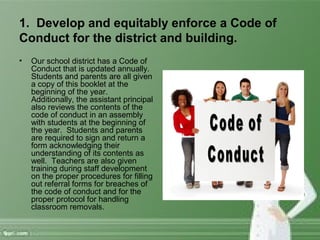
• Our school district has a Code of
Conduct that is updated annually.
Students and parents are all given
a copy of this booklet at the
beginning of the year.
Additionally, the assistant principal
also reviews the contents of the
code of conduct in an assembly
with students at the beginning of
the year. Students and parents
are required to sign and return a
form acknowledging their
understanding of its contents as
well. Teachers are also given
training during staff development
on the proper procedures for filling
out referral forms for breaches of
the code of conduct and for the
proper protocol for handling
classroom removals.
2. Develop district safety plans and building
emergency response plans to deal with serious
situations and conduct drills, tabletops and functional
exercises to increase the level of preparedness.
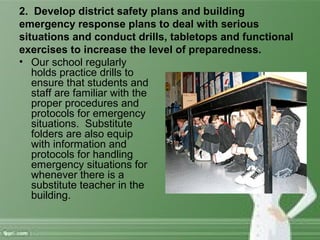
• Our school regularly
holds practice drills to
ensure that students and
staff are familiar with the
proper procedures and
protocols for emergency
situations. Substitute
folders are also equip
with information and
protocols for handling
emergency situations for
whenever there is a
substitute teacher in the
building.
3. Personalize the school environment.
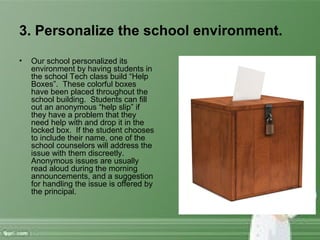
• Our school personalized its
environment by having students in
the school Tech class build “Help
Boxes”. These colorful boxes
have been placed throughout the
school building. Students can fill
out an anonymous “help slip” if
they have a problem that they
need help with and drop it in the
locked box. If the student chooses
to include their name, one of the
school counselors will address the
issue with them discreetly.
Anonymous issues are usually
read aloud during the morning
announcements, and a suggestion
for handling the issue is offered by
the principal.
4. Analyze Violent And Disruptive Incident Reports (VADIR) and
other student conduct data to provide information regarding
pockets of concern that require attention and program strengths
that could be replicated.
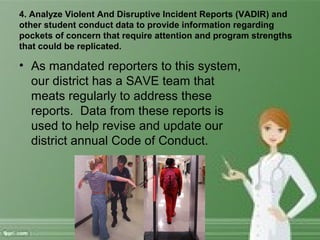
• As mandated reporters to this system,
our district has a SAVE team that
meats regularly to address these
reports. Data from these reports is
used to help revise and update our
district annual Code of Conduct.
5. Implement programs and activities that have
a proven record of achieving positive results;
Evaluate programs periodically for their
effectiveness and potential improvement.
• Our district has annually provided
an after school program for
students. This program provides
homework help as well as elective
type courses where students can
engage in activities that are of
interest to them. Additionally, our
city also has two other community
based programs affiliated with the
district where students can go for
after school support. Finally, our
local library also has a homework
help program for elementary
students. For two hours
afterschool daily, these students
can simply drop by with their
homework and receive assistance
from certified teachers for free.
6. Actively involve and engage parents and other
community members in addressing issues and
concerns.
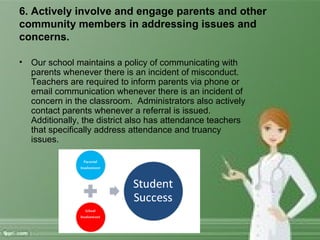
• Our school maintains a policy of communicating with
parents whenever there is an incident of misconduct.
Teachers are required to inform parents via phone or
email communication whenever there is an incident of
concern in the classroom. Administrators also actively
contact parents whenever a referral is issued.
Additionally, the district also has attendance teachers
that specifically address attendance and truancy
issues.
7. Make sure students, teachers, parents,
administrators, and other school staff are aware of
warning signs of violence and the need to
communicate to others.
Warning signs of youth violence that I have seen as an educator
include:
1. Anger and aggression toward other students and adults
2. Isolating oneself from friends and loved ones
3. Arguing with group members during paired group activities
4. Complaints from other students about behavior or language
5. Bullying behaviors
6. Attempting to justify violence as rough “horseplay”
7. Students bullying their parents or sibling in the home
environment
8. Signs of gang affiliation
9. Frequent bruises or disheveled appearance
10. Long sleeves, coats during hot weather could be signs of a
self mutilator (cutting on various parts of the body)
Sources
• http://www.p12.nysed.gov/sss/ssae/schoolsafe
Sources
• http://www.p12.nysed.gov/sss/ssae/schoolsafe

Implementing 7 steps to school safety

  • 1.
    Implementing 7 Stepsto School Safety By Melissa Winfield
  • 2.
    1. Develop andequitably enforce a Code of Conduct for the district and building. • Our school district has a Code of Conduct that is updated annually. Students and parents are all given a copy of this booklet at the beginning of the year. Additionally, the assistant principal also reviews the contents of the code of conduct in an assembly with students at the beginning of the year. Students and parents are required to sign and return a form acknowledging their understanding of its contents as well. Teachers are also given training during staff development on the proper procedures for filling out referral forms for breaches of the code of conduct and for the proper protocol for handling classroom removals.
  • 3.
    2. Develop districtsafety plans and building emergency response plans to deal with serious situations and conduct drills, tabletops and functional exercises to increase the level of preparedness. • Our school regularly holds practice drills to ensure that students and staff are familiar with the proper procedures and protocols for emergency situations. Substitute folders are also equip with information and protocols for handling emergency situations for whenever there is a substitute teacher in the building.
  • 4.
    3. Personalize theschool environment. • Our school personalized its environment by having students in the school Tech class build “Help Boxes”. These colorful boxes have been placed throughout the school building. Students can fill out an anonymous “help slip” if they have a problem that they need help with and drop it in the locked box. If the student chooses to include their name, one of the school counselors will address the issue with them discreetly. Anonymous issues are usually read aloud during the morning announcements, and a suggestion for handling the issue is offered by the principal.
  • 5.
    4. Analyze ViolentAnd Disruptive Incident Reports (VADIR) and other student conduct data to provide information regarding pockets of concern that require attention and program strengths that could be replicated. • As mandated reporters to this system, our district has a SAVE team that meats regularly to address these reports. Data from these reports is used to help revise and update our district annual Code of Conduct.
  • 6.
    5. Implement programsand activities that have a proven record of achieving positive results; Evaluate programs periodically for their effectiveness and potential improvement. • Our district has annually provided an after school program for students. This program provides homework help as well as elective type courses where students can engage in activities that are of interest to them. Additionally, our city also has two other community based programs affiliated with the district where students can go for after school support. Finally, our local library also has a homework help program for elementary students. For two hours afterschool daily, these students can simply drop by with their homework and receive assistance from certified teachers for free.
  • 7.
    6. Actively involveand engage parents and other community members in addressing issues and concerns. • Our school maintains a policy of communicating with parents whenever there is an incident of misconduct. Teachers are required to inform parents via phone or email communication whenever there is an incident of concern in the classroom. Administrators also actively contact parents whenever a referral is issued. Additionally, the district also has attendance teachers that specifically address attendance and truancy issues.
  • 8.
    7. Make surestudents, teachers, parents, administrators, and other school staff are aware of warning signs of violence and the need to communicate to others. Warning signs of youth violence that I have seen as an educator include: 1. Anger and aggression toward other students and adults 2. Isolating oneself from friends and loved ones 3. Arguing with group members during paired group activities 4. Complaints from other students about behavior or language 5. Bullying behaviors 6. Attempting to justify violence as rough “horseplay” 7. Students bullying their parents or sibling in the home environment 8. Signs of gang affiliation 9. Frequent bruises or disheveled appearance 10. Long sleeves, coats during hot weather could be signs of a self mutilator (cutting on various parts of the body)
  • 9.
  • 10.