Don’t be Invisible 
Statistics 
on bullying 
Cyber 
bullying 
Stopbullying 
.gov 
What is 
bullying 
Links 
What to 
do? 
Effects 
of 
bullying 
Risk 
factors
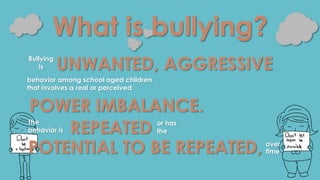
What is bullying? 
Bullying 
is UNWANTED, AGGRESSIVE 
behavior among school aged children 
that involves a real or perceived 
POWER IMBALANCE. 
The 
behavior is REPEATED or has 
the 
POTENTIAL TO BE REPEATED, over 
time.
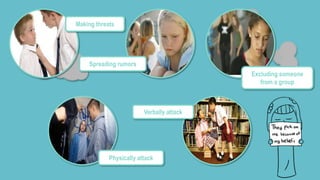
Spreading rumors 
Verbally attack 
Physically attack 
Excluding someone 
from a group 
Making threats
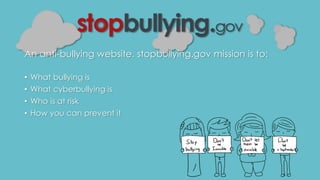
An anti-bullying website, stopbullying.gov mission is to: 
• What bullying is 
• What cyberbullying is 
• Who is at risk 
• How you can prevent it
Why we support 
this cause?
In general bullying is 
not seen 
as a big concern in Brunei.
The norm for victims of bullies is they are 
taught to stand up for themselves 
while the effects of bullying are very 
often neglected.
This cause acts as a support system 
for the victims, to show them that they 
are not alone and that help is always 
available.
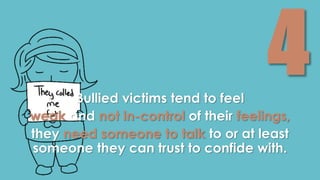
Bullied victims tend to feel 
weak and not in-control of their feelings, 
they need someone to talk to or at least 
someone they can trust to confide with.
Bullying is a serious matter that needs to be 
recognized. We have to try and understand 
why people bully and why people get 
bullied, 
for us to be able to help them.
What is it? 
Cyberbullying is bullying that 
takes place using electronic 
technology.
Examples 
Spreading rumors on 
social networking sites 
embarrassing 
pictures 
embarrassing 
videos 
fake 
profiles 
Mean text messages Mean emails
Prevent 
Cyberbullying
Be aware of what 
your kids are doing 
online
Know the sites your kids 
visit and their online 
activities and have a sense 
what they do online and in 
text.
Establish 
rules about 
technology
Be clear about what sites 
they can visit and what they 
are permitted to do when 
they’re online.
Report 
Cyberbullying
Take 
immediate 
steps
Don’t respond to and don’t 
forward cyberbullying 
messages.
Keep evidence of 
cyberbullying. Save and 
print screenshots, emails, 
and text messages.
Block the person who is 
cyberbullying.
Report 
Cyberbullying to 
Online Service 
Providers
Review their terms and 
conditions or rights and 
responsibilities sections.
Visit social media safety 
centers to learn how to 
block users and change 
settings to control who can 
contact you.
Report cyberbullying to the 
social media site so they 
can take action against 
users abusing the terms of 
service.
Report 
Cyberbullying to 
Law Enforcement
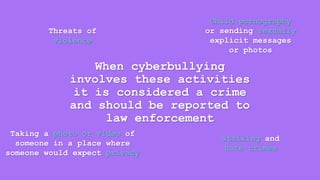
When cyberbullying 
involves these activities 
it is considered a crime 
and should be reported to 
law enforcement 
Threats of 
violence 
Child pornography 
or sending sexually 
explicit messages 
or photos 
Taking a photo or video of 
someone in a place where 
someone would expect privacy 
Stalking and 
hate crimes
Some states consider other 
forms of cyberbullying 
criminal. Consult your 
state’s laws and law 
enforcement for additional 
guidance.
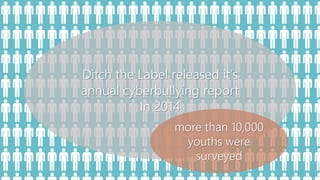
Ditch the Label released it’s 
annual cyberbullying report 
In 2014 
more than 10,000 
youths were 
surveyed
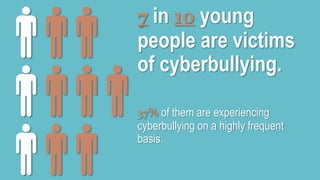
7 in 10 young 
people are victims 
of cyberbullying. 
37% of them are experiencing 
cyberbullying on a highly frequent 
basis.
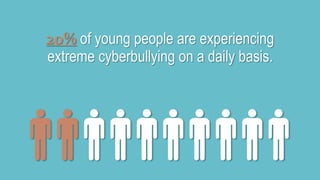
20% of young people are experiencing 
extreme cyberbullying on a daily basis.
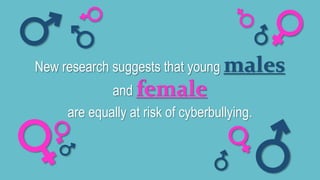
New research suggests that young males 
and female 
are equally at risk of cyberbullying.

Facebook, Ask.FM and Twitter found to be the 
most likely sources of cyberbullying, being the 
highest in traffic of all social networks.
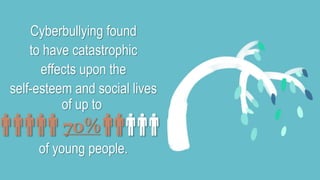
Cyberbullying found 
to have catastrophic 
effects upon the 
self-esteem and social lives 
of up to 
70% 
of young people.
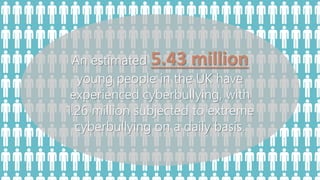
An estimated 5.43 million 
young people in the UK have 
experienced cyberbullying, with 
1.26 million subjected to extreme 
cyberbullying on a daily basis.
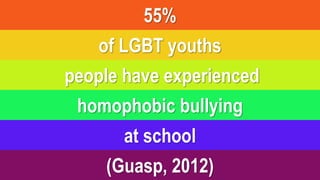
55% 
of LGBT youths 
people have experienced 
homophobic bullying 
at school 
(Guasp, 2012)
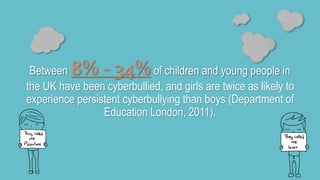
Between 8% - 34%of children and young people in 
the UK have been cyberbullied, and girls are twice as likely to 
experience persistent cyberbullying than boys (Department of 
Education London, 2011).
Other Statistics 
•44.2% of bullying is teasing (playing jokes, names) 
•43.3% of children have rumors and lies spread about 
them verbally or online. 
•36.3%of children experience pushing and shoving in 
lines or class.
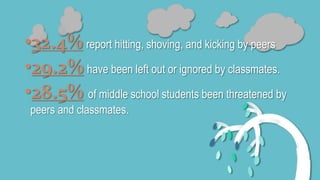
•32.4% report hitting, shoving, and kicking by peers 
•29.2% have been left out or ignored by classmates. 
•28.5% of middle school students been threatened by 
peers and classmates.
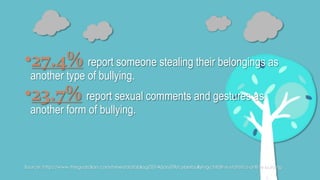
•27.4% report someone stealing their belongings as 
another type of bullying. 
•23.7% report sexual comments and gestures as 
another form of bullying. 

Source: http://www.theguardian.com/news/datablog/2014/jan/09/cyberbullying-childline-statistics-online-bullying
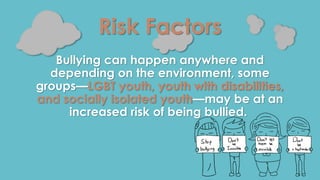
Risk Factors 
Bullying can happen anywhere and 
depending on the environment, some 
groups—LGBT youth, youth with disabilities, 
and socially isolated youth—may be at an 
increased risk of being bullied.
Children who are at risk 
of being bullied
Perceived as 
different
Perceived to 
be weak
Depresses, anxious, or 
have low self-esteem
Are less popular 
and have few 
friends
Do not get along 
well with others
Children more likely 
to bully others 
There are 2 types of kids who are likely to bully
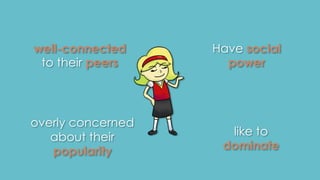
well-connected 
to their peers 
Have social 
power 
overly concerned 
about their 
popularity 
like to 
dominate
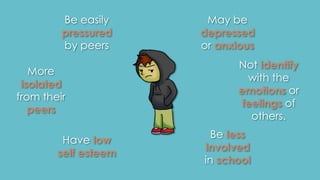
More 
isolated 
from their 
peers 
May be 
depressed 
or anxious 
Have low 
self esteem 
Not identify 
with the 
emotions or 
feelings of 
Be less 
involved 
in school 
others. 
Be easily 
pressured 
by peers
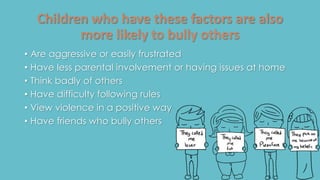
Children who have these factors are also 
more likely to bully others 
• Are aggressive or easily frustrated 
• Have less parental involvement or having issues at home 
• Think badly of others 
• Have difficulty following rules 
• View violence in a positive way 
• Have friends who bully others
Possible causes of 
bullying
Adolescent 
behavior
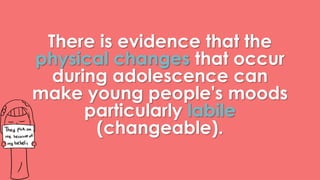
There is evidence that the 
physical changes that occur 
during adolescence can 
make young people's moods 
particularly labile 
(changeable).
Many adolescents feel that 
society and parents in 
particular, treat them like 
children when they feel they 
belong to the grown up world.
Adolescence is a time when 
people experiment 
personalities before 
establishing a more stable 
adult identity.
Poor discipline at 
home
Students of parents who are 
extremely lax are more likely 
to show conduct disorder
but then, so are parents of 
over strict parents or parents 
who use physical punishment 
or show lack of affection or 
attention.
According to Gadston et al, 
perhaps the most damaging 
type of discipline regime is an 
inconsistent one. This can lead 
to the child having a confused 
notion of 'right' and 'wrong'
Economic and 
social deprivation
There is a strong correlation 
between child delinquency 
and poverty. However the 
reasons for this are not clear.
Tony Sewell (1997) conducted 
a study that investigates the 
relationship between family 
life, street culture and 
schooling among African 
Carribbean boys raised in lone 
parents family.
He found out that about 18% of 
the boys rejected the norms 
and values of the school
They were confrontational and 
challenging, adopt a macho 
masculinity and demanding 
respect.
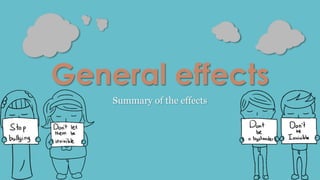
General effects 
Summary of the effects
Effects on the bullied 
Short-term and long-term
Short-term effects
Victim will have a lot of anger in 
them. They often like to be alone 
because they are afraid to speak 
up.
They often suffer from depression 
that could lead to suicidal 
thoughts.
They get very anxious for fear of 
being bullied again.
They tend to not do good in 
school.
Long-term effects
They will become increasingly 
susceptible to becoming 
depressed and/or angry and/or 
bitter
Interpersonal difficulties, including 
fear and avoidance of new social 
situations
Perception of self as easy to 
victimize, overly sensitive, and 
thin-skinned
They will have self-esteem 
problem.
Long-term bullying causes 
emotional damages to the victim.
Impact of bullies
They will feel disconnected from 
school and will eventually hate 
going to school.
They will get into fights and 
vandalize school property and will 
most probably end up leaving 
school early.
They could turn to drugs and 
alcohol as a way of living.
A more in-depth look 
Studies of effects of bullying
Victims of bullying may suffer a 
loss of self-esteem which can have 
an adverse effect on their lives 
and can simply be put off school 
and education in general. 
(Kidscape, 1999)
Bullying can lead to suicidal 
thoughts, anxiety, low self-esteem, 
hopelessness, and isolation. Many 
say they self-harm and are too 
scared to go to school and lose 
focus when they do attend. 
(Childline, 2006)
Hetrick-Martin Institute (HMI) found 
adults who were bullied 30 years 
ago considered that the effects 
remain with them. Bystanders are 
also affected – they feel 
compromised, helpless and guilty.
Steps of 
PREVENTION
Have a clear 
definition 
of bullying
Parents should explain to their children of what 
bullying is. They should also mention to them 
that there are other forms of bullying other 
than physical aggression (e.g. excluding 
someone and/or ignoring them)
Teach the 
importance 
of empathy
A child who is able to understand what it may 
feel like to be bullied and can understand and 
regulate his own emotions is less likely to 
engage in that behavior
Set a good 
example
Children are susceptible to being influenced 
by other's behavior. Parents should set a good 
example by practicing courtesy and respect.
Set clear and 
enforceable rules 
& expectation
Age-appropriate rules allow a student to know what 
behavior is expected. When kids are younger, keep 
rules simple. When kids are older, shape the rules to 
help them meet their maturity level.
Have open 
communication
When teachers have open 
communication with their students, 
their students will feel more open to 
talking to them about their problems— 
including bullying. Having classroom 
meetings is one way to build that 
communication.
Responding 
to bullying
Stop bullying 
on the spot
When adults respond quickly and consistently 
to bullying behavior, they send the message 
that it is not acceptable. Research shows this 
can stop bullying behavior over time.
Find out what 
happened
Whether you’ve just stopped bullying on the 
spot or a child has reached out to you for 
help, learn how to determine the best way to 
proceed. Steps include separate the kids 
involve and make sure everyone is safe. 
Don’t ignore it
Support the 
kids 
involved
All kids involved in bullying—whether they are 
bullied, bully others, or see bullying—can be 
affected. It is important to support all kids 
involved to make sure the bullying doesn’t 
continue and effects can be minimized.
Be more 
than a 
bystander
Every day, kids see bullying. They want to help, but 
don’t know how. Such steps include tell a trusted 
adult, help the victims get away and be the victims 
friend
Hold 
bystander 
accountable
Bystanders provide bullies an audience, 
and often actually encourage bullying. 
Explain that this type of behavior is 
wrong, will not be tolerated, and that 
they also have a right and a 
responsibility to stop bullying.

Don't be invisible

  • 1.
    Don’t be Invisible Statistics on bullying Cyber bullying Stopbullying .gov What is bullying Links What to do? Effects of bullying Risk factors
  • 2.
    What is bullying? Bullying is UNWANTED, AGGRESSIVE behavior among school aged children that involves a real or perceived POWER IMBALANCE. The behavior is REPEATED or has the POTENTIAL TO BE REPEATED, over time.
  • 3.
    Spreading rumors Verballyattack Physically attack Excluding someone from a group Making threats
  • 4.
    An anti-bullying website,stopbullying.gov mission is to: • What bullying is • What cyberbullying is • Who is at risk • How you can prevent it
  • 5.
    Why we support this cause?
  • 6.
    In general bullyingis not seen as a big concern in Brunei.
  • 7.
    The norm forvictims of bullies is they are taught to stand up for themselves while the effects of bullying are very often neglected.
  • 8.
    This cause actsas a support system for the victims, to show them that they are not alone and that help is always available.
  • 9.
    Bullied victims tendto feel weak and not in-control of their feelings, they need someone to talk to or at least someone they can trust to confide with.
  • 10.
    Bullying is aserious matter that needs to be recognized. We have to try and understand why people bully and why people get bullied, for us to be able to help them.
  • 11.
    What is it? Cyberbullying is bullying that takes place using electronic technology.
  • 12.
    Examples Spreading rumorson social networking sites embarrassing pictures embarrassing videos fake profiles Mean text messages Mean emails
  • 13.
  • 14.
    Be aware ofwhat your kids are doing online
  • 15.
    Know the sitesyour kids visit and their online activities and have a sense what they do online and in text.
  • 16.
  • 17.
    Be clear aboutwhat sites they can visit and what they are permitted to do when they’re online.
  • 18.
  • 19.
  • 20.
    Don’t respond toand don’t forward cyberbullying messages.
  • 21.
    Keep evidence of cyberbullying. Save and print screenshots, emails, and text messages.
  • 22.
    Block the personwho is cyberbullying.
  • 23.
    Report Cyberbullying to Online Service Providers
  • 24.
    Review their termsand conditions or rights and responsibilities sections.
  • 25.
    Visit social mediasafety centers to learn how to block users and change settings to control who can contact you.
  • 26.
    Report cyberbullying tothe social media site so they can take action against users abusing the terms of service.
  • 27.
    Report Cyberbullying to Law Enforcement
  • 28.
    When cyberbullying involvesthese activities it is considered a crime and should be reported to law enforcement Threats of violence Child pornography or sending sexually explicit messages or photos Taking a photo or video of someone in a place where someone would expect privacy Stalking and hate crimes
  • 29.
    Some states considerother forms of cyberbullying criminal. Consult your state’s laws and law enforcement for additional guidance.
  • 30.
    Ditch the Labelreleased it’s annual cyberbullying report In 2014 more than 10,000 youths were surveyed
  • 31.
    7 in 10young people are victims of cyberbullying. 37% of them are experiencing cyberbullying on a highly frequent basis.
  • 32.
    20% of youngpeople are experiencing extreme cyberbullying on a daily basis.
  • 33.
    New research suggeststhat young males and female are equally at risk of cyberbullying.
  • 34.
    Facebook, Ask.FM andTwitter found to be the most likely sources of cyberbullying, being the highest in traffic of all social networks.
  • 35.
    Cyberbullying found tohave catastrophic effects upon the self-esteem and social lives of up to 70% of young people.
  • 36.
    An estimated 5.43million young people in the UK have experienced cyberbullying, with 1.26 million subjected to extreme cyberbullying on a daily basis.
  • 37.
    55% of LGBTyouths people have experienced homophobic bullying at school (Guasp, 2012)
  • 38.
    Between 8% -34%of children and young people in the UK have been cyberbullied, and girls are twice as likely to experience persistent cyberbullying than boys (Department of Education London, 2011).
  • 39.
    Other Statistics •44.2%of bullying is teasing (playing jokes, names) •43.3% of children have rumors and lies spread about them verbally or online. •36.3%of children experience pushing and shoving in lines or class.
  • 40.
    •32.4% report hitting,shoving, and kicking by peers •29.2% have been left out or ignored by classmates. •28.5% of middle school students been threatened by peers and classmates.
  • 41.
    •27.4% report someonestealing their belongings as another type of bullying. •23.7% report sexual comments and gestures as another form of bullying. Source: http://www.theguardian.com/news/datablog/2014/jan/09/cyberbullying-childline-statistics-online-bullying
  • 42.
    Risk Factors Bullyingcan happen anywhere and depending on the environment, some groups—LGBT youth, youth with disabilities, and socially isolated youth—may be at an increased risk of being bullied.
  • 43.
    Children who areat risk of being bullied
  • 44.
  • 45.
  • 46.
    Depresses, anxious, or have low self-esteem
  • 47.
    Are less popular and have few friends
  • 48.
    Do not getalong well with others
  • 49.
    Children more likely to bully others There are 2 types of kids who are likely to bully
  • 50.
    well-connected to theirpeers Have social power overly concerned about their popularity like to dominate
  • 51.
    More isolated fromtheir peers May be depressed or anxious Have low self esteem Not identify with the emotions or feelings of Be less involved in school others. Be easily pressured by peers
  • 52.
    Children who havethese factors are also more likely to bully others • Are aggressive or easily frustrated • Have less parental involvement or having issues at home • Think badly of others • Have difficulty following rules • View violence in a positive way • Have friends who bully others
  • 53.
  • 54.
  • 55.
    There is evidencethat the physical changes that occur during adolescence can make young people's moods particularly labile (changeable).
  • 56.
    Many adolescents feelthat society and parents in particular, treat them like children when they feel they belong to the grown up world.
  • 57.
    Adolescence is atime when people experiment personalities before establishing a more stable adult identity.
  • 58.
  • 59.
    Students of parentswho are extremely lax are more likely to show conduct disorder
  • 60.
    but then, soare parents of over strict parents or parents who use physical punishment or show lack of affection or attention.
  • 61.
    According to Gadstonet al, perhaps the most damaging type of discipline regime is an inconsistent one. This can lead to the child having a confused notion of 'right' and 'wrong'
  • 62.
  • 63.
    There is astrong correlation between child delinquency and poverty. However the reasons for this are not clear.
  • 64.
    Tony Sewell (1997)conducted a study that investigates the relationship between family life, street culture and schooling among African Carribbean boys raised in lone parents family.
  • 65.
    He found outthat about 18% of the boys rejected the norms and values of the school
  • 66.
    They were confrontationaland challenging, adopt a macho masculinity and demanding respect.
  • 67.
  • 68.
    Effects on thebullied Short-term and long-term
  • 69.
  • 70.
    Victim will havea lot of anger in them. They often like to be alone because they are afraid to speak up.
  • 71.
    They often sufferfrom depression that could lead to suicidal thoughts.
  • 72.
    They get veryanxious for fear of being bullied again.
  • 73.
    They tend tonot do good in school.
  • 74.
  • 75.
    They will becomeincreasingly susceptible to becoming depressed and/or angry and/or bitter
  • 76.
    Interpersonal difficulties, including fear and avoidance of new social situations
  • 77.
    Perception of selfas easy to victimize, overly sensitive, and thin-skinned
  • 78.
    They will haveself-esteem problem.
  • 79.
    Long-term bullying causes emotional damages to the victim.
  • 80.
  • 81.
    They will feeldisconnected from school and will eventually hate going to school.
  • 82.
    They will getinto fights and vandalize school property and will most probably end up leaving school early.
  • 83.
    They could turnto drugs and alcohol as a way of living.
  • 84.
    A more in-depthlook Studies of effects of bullying
  • 85.
    Victims of bullyingmay suffer a loss of self-esteem which can have an adverse effect on their lives and can simply be put off school and education in general. (Kidscape, 1999)
  • 86.
    Bullying can leadto suicidal thoughts, anxiety, low self-esteem, hopelessness, and isolation. Many say they self-harm and are too scared to go to school and lose focus when they do attend. (Childline, 2006)
  • 87.
    Hetrick-Martin Institute (HMI)found adults who were bullied 30 years ago considered that the effects remain with them. Bystanders are also affected – they feel compromised, helpless and guilty.
  • 88.
  • 89.
    Have a clear definition of bullying
  • 90.
    Parents should explainto their children of what bullying is. They should also mention to them that there are other forms of bullying other than physical aggression (e.g. excluding someone and/or ignoring them)
  • 91.
  • 92.
    A child whois able to understand what it may feel like to be bullied and can understand and regulate his own emotions is less likely to engage in that behavior
  • 93.
    Set a good example
  • 94.
    Children are susceptibleto being influenced by other's behavior. Parents should set a good example by practicing courtesy and respect.
  • 95.
    Set clear and enforceable rules & expectation
  • 96.
    Age-appropriate rules allowa student to know what behavior is expected. When kids are younger, keep rules simple. When kids are older, shape the rules to help them meet their maturity level.
  • 97.
  • 98.
    When teachers haveopen communication with their students, their students will feel more open to talking to them about their problems— including bullying. Having classroom meetings is one way to build that communication.
  • 99.
  • 100.
  • 101.
    When adults respondquickly and consistently to bullying behavior, they send the message that it is not acceptable. Research shows this can stop bullying behavior over time.
  • 102.
    Find out what happened
  • 103.
    Whether you’ve juststopped bullying on the spot or a child has reached out to you for help, learn how to determine the best way to proceed. Steps include separate the kids involve and make sure everyone is safe. Don’t ignore it
  • 104.
  • 105.
    All kids involvedin bullying—whether they are bullied, bully others, or see bullying—can be affected. It is important to support all kids involved to make sure the bullying doesn’t continue and effects can be minimized.
  • 106.
    Be more thana bystander
  • 107.
    Every day, kidssee bullying. They want to help, but don’t know how. Such steps include tell a trusted adult, help the victims get away and be the victims friend
  • 108.
  • 109.
    Bystanders provide bulliesan audience, and often actually encourage bullying. Explain that this type of behavior is wrong, will not be tolerated, and that they also have a right and a responsibility to stop bullying.