Epidemiology and Control of Zoonotic Infections www.freelivedoctor.com
1 – Zoonosis Intro & TSE 2 – Rabies  3 – Classic Zoonoses  4 – Bioterrorism 5 – Vector-borne Diseases 6 – Parasitic Zoonoses 7 – Emerging Zoonoses 8 – Foodborne Illnesses
Epidemiology and Control of Zoonotic Infections   www.freelivedoctor.com
Part I:  Introduction to Zoonoses Part II: Transmissible Spongiform    Encephalopathies
Intro to Zoonoses Definition Importance Etiologies Animal Examples Transmission Routes Life Cycles
Zoonoses From the Greek: Zoon:  Animal Noson:  Disease Diseases and infections which are naturally transmitted between vertebrate animals and humans - WHO 1959
Zoonoses Does  NOT  include  Fish and reptile toxins Allergies to vertebrates Diseases in which animal-derived food serves as a vehicle (e.g. hepatitis A contaminated deli meat) Experimentally transmitted diseases
Zoonoses >  250 zoonotic diseases 60% of US Household have  ≥1 pet Multiple pets in the home Human-animal bond Exotic species as pets
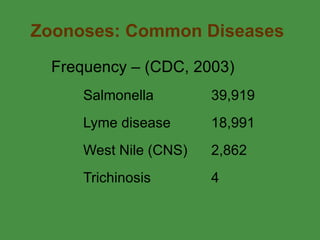
Zoonoses: Common Diseases Frequency – (CDC, 2003) Salmonella 39,919 Lyme disease 18,991 West Nile (CNS) 2,862 Trichinosis 4
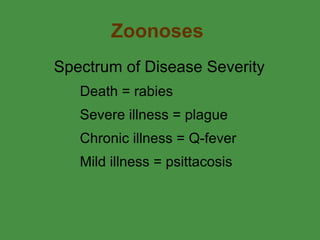
Zoonoses Spectrum of Disease Severity  Death = rabies Severe illness = plague Chronic illness = Q-fever Mild illness = psittacosis
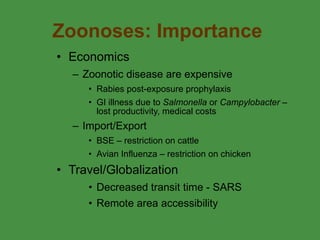
Zoonoses: Importance Economics  Zoonotic disease are expensive Rabies post-exposure prophylaxis GI illness due to  Salmonella  or  Campylobacter  – lost productivity, medical costs  Import/Export BSE – restriction on cattle Avian Influenza – restriction on chicken Travel/Globalization Decreased transit time - SARS Remote area accessibility
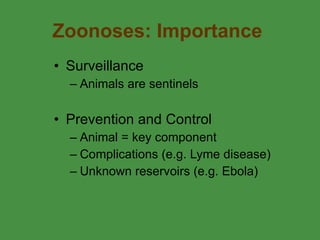
Zoonoses: Importance Surveillance Animals are sentinels Prevention and Control Animal = key component Complications (e.g. Lyme disease) Unknown reservoirs (e.g. Ebola)
Zoonoses: Etiologic Classification Viral  Bacterial Parasitic Mycotic
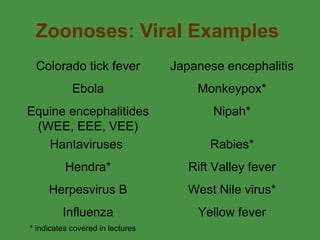
Zoonoses: Viral Examples * indicates covered in lectures  Colorado tick fever Japanese encephalitis Ebola Monkeypox* Equine encephalitides (WEE, EEE, VEE) Nipah* Hantaviruses  Rabies* Hendra* Rift Valley fever Herpesvirus B West Nile virus* Influenza Yellow fever
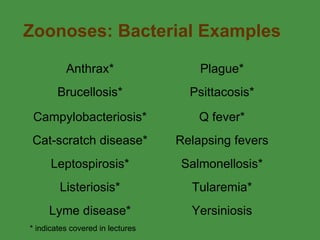
Zoonoses: Bacterial Examples * indicates covered in lectures  Anthrax* Plague* Brucellosis* Psittacosis* Campylobacteriosis* Q fever* Cat-scratch disease* Relapsing fevers Leptospirosis* Salmonellosis* Listeriosis* Tularemia* Lyme disease* Yersiniosis
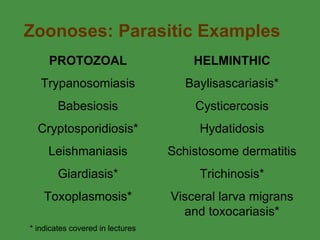
Zoonoses: Parasitic Examples * indicates covered in lectures  PROTOZOAL HELMINTHIC Trypanosomiasis Baylisascariasis* Babesiosis Cysticercosis Cryptosporidiosis* Hydatidosis Leishmaniasis Schistosome dermatitis Giardiasis* Trichinosis* Toxoplasmosis* Visceral larva migrans and toxocariasis*
Zoonoses: Mycotic Examples Aspergillosis Blastomycosis Cryptococcosis* Dermatophytosis* Histoplasmosis Sporotrichosis * indicates covered in lectures
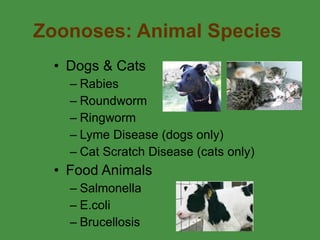
Zoonoses: Animal Species Dogs & Cats Rabies Roundworm Ringworm  Lyme Disease (dogs only) Cat Scratch Disease (cats only) Food Animals Salmonella E.coli Brucellosis
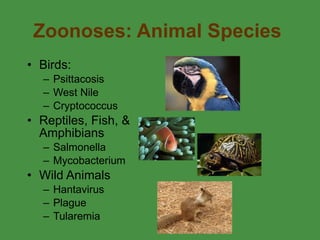
Zoonoses: Animal Species Birds:  Psittacosis West Nile Cryptococcus Reptiles, Fish, & Amphibians Salmonella Mycobacterium Wild Animals Hantavirus Plague Tularemia
Routes of Transmission Direct Droplet or Aerosol Oral  Contact  Indirect  Foodborne Water-borne Fomite Vector-borne Environmental
Zoonoses  - Life Cycle ORTHOZOONOSES May be perpetuated in nature by a single vertebrate species E.g. rabies, brucellosis, anthrax
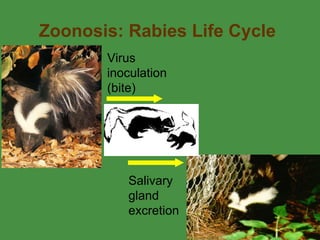
Zoonosis: Rabies Life Cycle Virus inoculation (bite) Salivary  gland  excretion
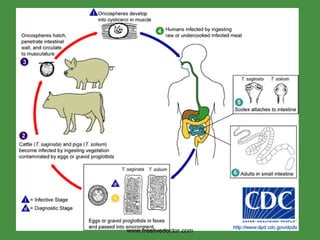
Zoonoses  - Maintenance Cycle CYCLOZOONOSES Requires more than one vertebrate species but no invertebrate host Most are cestodiases (tapeworm diseases) Taenia saginata  and  T. solium  require man to be one of vertebrate hosts Others, such as hydatidosis, man is accidentally involved
Life Cycle:                                                                                     www.freelivedoctor.com
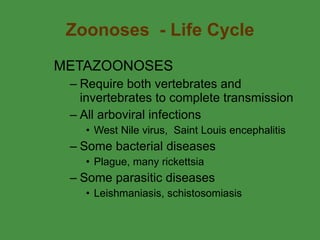
Zoonoses  - Life Cycle METAZOONOSES Require both vertebrates and invertebrates to complete transmission All arboviral infections  West Nile virus,  Saint Louis encephalitis Some bacterial diseases Plague, many rickettsia Some parasitic diseases Leishmaniasis, schistosomiasis
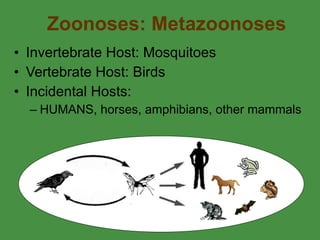
Zoonoses: Metazoonoses Invertebrate Host: Mosquitoes Vertebrate Host: Birds  Incidental Hosts:  HUMANS, horses, amphibians, other mammals
Risk Factors Companion Animal  Dogs & roundworm Rats & Rat Bite Fever Occupational  Animal control workers & rabies Wildlife biologists & hantavirus Foodborne  Raw meat & E.coli Unpasteurized dairy & Listeria
Risk Factors Recreational Activities  Camping & Lyme disease Farm Settings Sheep & Q-fever Cattle & Cryptosporidium Travel  Maylasia & Nipha Australia & Hendra
Reportable Diseases of Animals By veterinarian or other individual Reported to CA Department of Health Services Plague  Rabies Reportable to the CA Department of Food and Agriculture  Anthrax Brucellosis Glanders Listeriosis Rabies in livestock Venezuelan equine encephalomyelitis West Nile And more…

1 Zoonoses Intro Dunne

  • 1.
    Epidemiology and Controlof Zoonotic Infections www.freelivedoctor.com
  • 2.
    1 – ZoonosisIntro & TSE 2 – Rabies 3 – Classic Zoonoses 4 – Bioterrorism 5 – Vector-borne Diseases 6 – Parasitic Zoonoses 7 – Emerging Zoonoses 8 – Foodborne Illnesses
  • 3.
    Epidemiology and Controlof Zoonotic Infections www.freelivedoctor.com
  • 4.
    Part I: Introduction to Zoonoses Part II: Transmissible Spongiform Encephalopathies
  • 5.
    Intro to ZoonosesDefinition Importance Etiologies Animal Examples Transmission Routes Life Cycles
  • 6.
    Zoonoses From theGreek: Zoon: Animal Noson: Disease Diseases and infections which are naturally transmitted between vertebrate animals and humans - WHO 1959
  • 7.
    Zoonoses Does NOT include Fish and reptile toxins Allergies to vertebrates Diseases in which animal-derived food serves as a vehicle (e.g. hepatitis A contaminated deli meat) Experimentally transmitted diseases
  • 8.
    Zoonoses > 250 zoonotic diseases 60% of US Household have ≥1 pet Multiple pets in the home Human-animal bond Exotic species as pets
  • 9.
    Zoonoses: Common DiseasesFrequency – (CDC, 2003) Salmonella 39,919 Lyme disease 18,991 West Nile (CNS) 2,862 Trichinosis 4
  • 10.
    Zoonoses Spectrum ofDisease Severity Death = rabies Severe illness = plague Chronic illness = Q-fever Mild illness = psittacosis
  • 11.
    Zoonoses: Importance Economics Zoonotic disease are expensive Rabies post-exposure prophylaxis GI illness due to Salmonella or Campylobacter – lost productivity, medical costs Import/Export BSE – restriction on cattle Avian Influenza – restriction on chicken Travel/Globalization Decreased transit time - SARS Remote area accessibility
  • 12.
    Zoonoses: Importance SurveillanceAnimals are sentinels Prevention and Control Animal = key component Complications (e.g. Lyme disease) Unknown reservoirs (e.g. Ebola)
  • 13.
    Zoonoses: Etiologic ClassificationViral Bacterial Parasitic Mycotic
  • 14.
    Zoonoses: Viral Examples* indicates covered in lectures Colorado tick fever Japanese encephalitis Ebola Monkeypox* Equine encephalitides (WEE, EEE, VEE) Nipah* Hantaviruses Rabies* Hendra* Rift Valley fever Herpesvirus B West Nile virus* Influenza Yellow fever
  • 15.
    Zoonoses: Bacterial Examples* indicates covered in lectures Anthrax* Plague* Brucellosis* Psittacosis* Campylobacteriosis* Q fever* Cat-scratch disease* Relapsing fevers Leptospirosis* Salmonellosis* Listeriosis* Tularemia* Lyme disease* Yersiniosis
  • 16.
    Zoonoses: Parasitic Examples* indicates covered in lectures PROTOZOAL HELMINTHIC Trypanosomiasis Baylisascariasis* Babesiosis Cysticercosis Cryptosporidiosis* Hydatidosis Leishmaniasis Schistosome dermatitis Giardiasis* Trichinosis* Toxoplasmosis* Visceral larva migrans and toxocariasis*
  • 17.
    Zoonoses: Mycotic ExamplesAspergillosis Blastomycosis Cryptococcosis* Dermatophytosis* Histoplasmosis Sporotrichosis * indicates covered in lectures
  • 18.
    Zoonoses: Animal SpeciesDogs & Cats Rabies Roundworm Ringworm Lyme Disease (dogs only) Cat Scratch Disease (cats only) Food Animals Salmonella E.coli Brucellosis
  • 19.
    Zoonoses: Animal SpeciesBirds: Psittacosis West Nile Cryptococcus Reptiles, Fish, & Amphibians Salmonella Mycobacterium Wild Animals Hantavirus Plague Tularemia
  • 20.
    Routes of TransmissionDirect Droplet or Aerosol Oral Contact Indirect Foodborne Water-borne Fomite Vector-borne Environmental
  • 21.
    Zoonoses -Life Cycle ORTHOZOONOSES May be perpetuated in nature by a single vertebrate species E.g. rabies, brucellosis, anthrax
  • 22.
    Zoonosis: Rabies LifeCycle Virus inoculation (bite) Salivary gland excretion
  • 23.
    Zoonoses -Maintenance Cycle CYCLOZOONOSES Requires more than one vertebrate species but no invertebrate host Most are cestodiases (tapeworm diseases) Taenia saginata and T. solium require man to be one of vertebrate hosts Others, such as hydatidosis, man is accidentally involved
  • 24.
    Life Cycle:                                                                                    www.freelivedoctor.com
  • 25.
    Zoonoses -Life Cycle METAZOONOSES Require both vertebrates and invertebrates to complete transmission All arboviral infections West Nile virus, Saint Louis encephalitis Some bacterial diseases Plague, many rickettsia Some parasitic diseases Leishmaniasis, schistosomiasis
  • 26.
    Zoonoses: Metazoonoses InvertebrateHost: Mosquitoes Vertebrate Host: Birds Incidental Hosts: HUMANS, horses, amphibians, other mammals
  • 27.
    Risk Factors CompanionAnimal Dogs & roundworm Rats & Rat Bite Fever Occupational Animal control workers & rabies Wildlife biologists & hantavirus Foodborne Raw meat & E.coli Unpasteurized dairy & Listeria
  • 28.
    Risk Factors RecreationalActivities Camping & Lyme disease Farm Settings Sheep & Q-fever Cattle & Cryptosporidium Travel Maylasia & Nipha Australia & Hendra
  • 29.
    Reportable Diseases ofAnimals By veterinarian or other individual Reported to CA Department of Health Services Plague Rabies Reportable to the CA Department of Food and Agriculture Anthrax Brucellosis Glanders Listeriosis Rabies in livestock Venezuelan equine encephalomyelitis West Nile And more…

Editor's Notes

  • #2 Pictures of DaVinci horses from www2.truman.edu/ ~capter/jins343/vinc.htm Wing picture taken from www.geocities.com/ CollegePark/8265/gall4.htm
  • #7 Many definitions of zoonosis, for the class the WHO definition will be used. Historically zoonoses only referred to animal disease; however, the current use for disease and infections transmitted between animals and man. The term commonly is used to refer to the more specific and scientific terms of zooanthroponoses and anthropozoonoses
  • #8 Also does not include disease where invertebrates are part of the transmission cycle such as malaria.
  • #9 60-80% of all disease are zoonotic and 75% of all emerging diseases are zoonotic. 60% of US household have at least one pet and of those with pets 60% have more than 1.( Results of the AVMA survey on companion animal ownership in US pet-owning households. J. Karl Wise, PhD, CAE, Director; Brent L. Heathcott, CAE, Assistant Director; Martin L. Gonzalez, MS, Research Analyst.)
  • #23 drawn picture from www.inhs.uiuc.edu/dnr/ fur/addition/addskunk.html
  • #27 This is the natural transmission cycle from Mosquitos to Bird and birds to mosquitos. With “spill over” or incidental host being humans and other animals. This last year WNV has had other mechanisms of transmission including infection of mosquitoes by other vertebrates besides birds. In the past there has been transmission of WNV by tick but there has been no indication of this in the US yet.