@solentlearning
@tansyjtweets
Tansy Jessop, SLTI
SLBC Away Day, St Mary’s Stadium
11 September 2017
Bums on seats as the bottom line?
This session
• A story of loss
• Summary of data in brief
• The symptoms
• Three key areas to enhance retention through L&T:
1. Relationships
2. Sense of belonging
3. Active learning
• Devising strategies
Every student that drops out of their higher education course
is a loss: a loss to their university or college, a loss to the
future economy and, above all, a loss to that individual.
Equally, students who don’t actually drop out but who fail to
achieve their full potential also represent a significant loss to
both themselves and society.
(Thomas et al 2017)
Data in brief
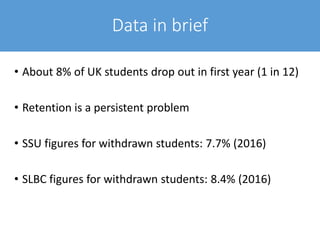
• About 8% of UK students drop out in first year (1 in 12)
• Retention is a persistent problem
• SSU figures for withdrawn students: 7.7% (2016)
• SLBC figures for withdrawn students: 8.4% (2016)
Why do students withdraw?
Go to www.menti.com and use the code 57 74 18
Select your top three reasons why you think
students withdraw
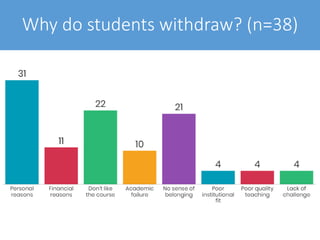
Why do students withdraw? (n=38)
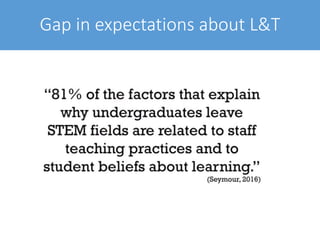
Gap in expectations about L&T
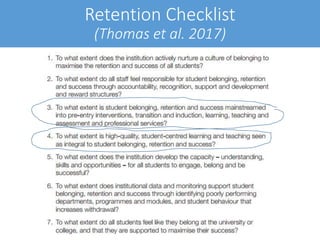
Retention Checklist
(Thomas et al. 2017)
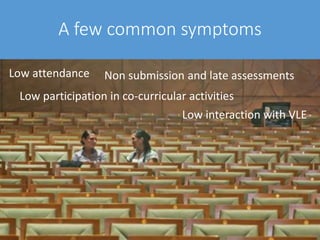
A few common symptoms
Low attendance
Low participation in co-curricular activities
Non submission and late assessments
Low interaction with VLE
Three key areas
•Being known
•Sense of belonging
•Active Learning
1. Being Known
It is the human side of higher education that
comes first – finding friends, feeling confident
and, above all, feeling a part of your course of
study and the institution – that is the necessary
starting point for academic success.
(Liz Thomas, What Works, 2012)
Mass HE is squeezing out dialogue
with the result that written feedback,
which is essentially a one-way communication,
has to carry almost all the burden of
student-teacher interaction
David Nicol 2010
What students say
Because they have to mark so many that our essay
becomes lost in the sea that they have to mark.
It was like ‘Who’s Holly?’ It’s that relationship
where you’re just a student.
Here they say ‘Oh yes, I don’t know who you are.
Got too many to remember, don’t really care, I’ll
mark you on your assignment’.
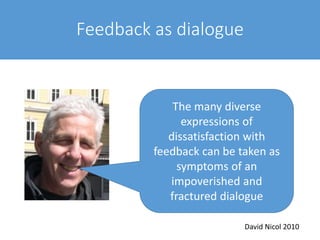
Feedback as dialogue
The many diverse
expressions of
dissatisfaction with
feedback can be taken as
symptoms of an
impoverished and
fractured dialogue
David Nicol 2010
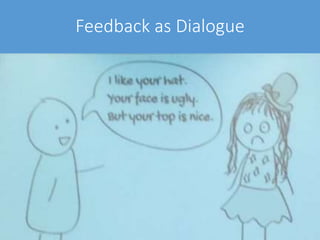
Feedback as Dialogue
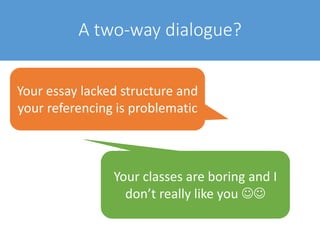
A two-way dialogue?
Your essay lacked structure and
your referencing is problematic
Your classes are boring and I
don’t really like you 
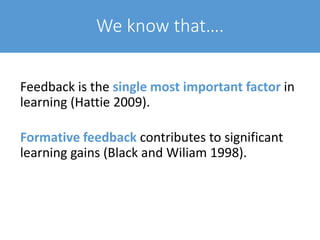
We know that….
Feedback is the single most important factor in
learning (Hattie 2009).
Formative feedback contributes to significant
learning gains (Black and Wiliam 1998).
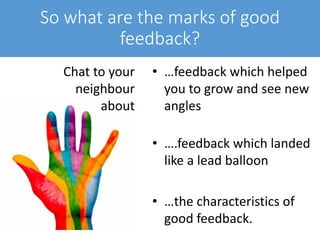
So what are the marks of good
feedback?
• …feedback which helped
you to grow and see new
angles
• ….feedback which landed
like a lead balloon
• …the characteristics of
good feedback.
Chat to your
neighbour
about
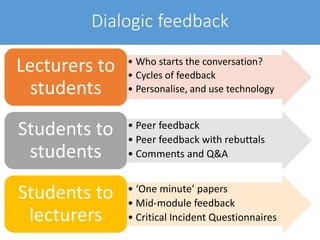
Dialogic feedback
• Who starts the conversation?
• Cycles of feedback
• Personalise, and use technology
Lecturers to
students
• Peer feedback
• Peer feedback with rebuttals
• Comments and Q&A
Students to
students
• ‘One minute’ papers
• Mid-module feedback
• Critical Incident Questionnaires
Students to
lecturers
Closing the feedback loop
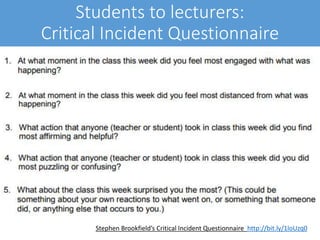
Students to lecturers:
Critical Incident Questionnaire
Stephen Brookfield’s Critical Incident Questionnaire http://bit.ly/1loUzq0
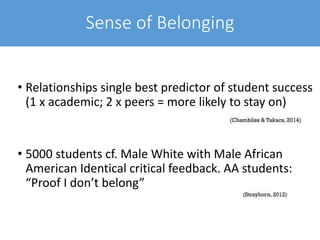
Sense of Belonging
• Relationships single best predictor of student success
(1 x academic; 2 x peers = more likely to stay on)
• 5000 students cf. Male White with Male African
American Identical critical feedback. AA students:
“Proof I don’t belong”
Pedagogic strategies to develop
a sense of belonging
• Knowing student names
• Carefully structured and lively group work
• In class activities which involve group tasks
• Curriculum design which speaks to diversity
• Academic relationships through RIT
Active Learning
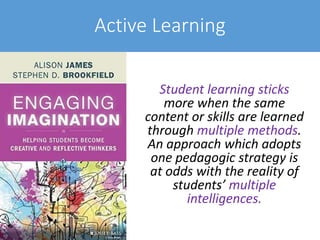
Student learning sticks
more when the same
content or skills are learned
through multiple methods.
An approach which adopts
one pedagogic strategy is
at odds with the reality of
students’ multiple
intelligences.
Your strategies
• What approaches could you use (or are you already
using) to enhance students’ sense of belonging, active
learning and being known?
• Discuss your ideas and make a poster representing your
key strategies
References
Barefoot, B. (2004) Higher education's revolving door: confronting the problem of student drop out in US
colleges and universities, Open Learning: The Journal of Open, Distance and e-Learning, 19:1, 9-18.
Felten, P. (2016) Mind the Gap. Keynote at University of Glasgow. Annual L&T Conference.
http://www.gla.ac.uk/myglasgow/leads/events/annuallearningandteachingconference/2016keynoteaddre
ssprofpeterfelten/
Mann, S. (2001) Alternative Perspectives on the Student Experience: Alienation and engagement, Studies
in Higher Education, 26:1, 7-19,
Nicol, D. (2010) From monologue to dialogue: improving written feedback processes in mass higher
education, Assessment & Evaluation in Higher Education, 35: 5, 501 – 517.
Thomas, L. (2012) Building student engagement and belonging in Higher Education at a time of change. ..
Funded by the Paul Hamlyn Foundation and delivered in partnership with the Higher Education Academy
and Action on Access.
Thomas, L., Hill, M., O’ Mahony, J. Yorke, M. (2017) ‘What works? Student retention and success’.
Summary Report, What works 2.. Funded by the Paul Hamlyn Foundation and delivered in partnership with
the Higher Education Academy and Action on Access.

Bums on seats as bottom line

  • 1.
    @solentlearning @tansyjtweets Tansy Jessop, SLTI SLBCAway Day, St Mary’s Stadium 11 September 2017 Bums on seats as the bottom line?
  • 2.
    This session • Astory of loss • Summary of data in brief • The symptoms • Three key areas to enhance retention through L&T: 1. Relationships 2. Sense of belonging 3. Active learning • Devising strategies
  • 3.
    Every student thatdrops out of their higher education course is a loss: a loss to their university or college, a loss to the future economy and, above all, a loss to that individual. Equally, students who don’t actually drop out but who fail to achieve their full potential also represent a significant loss to both themselves and society. (Thomas et al 2017)
  • 4.
    Data in brief •About 8% of UK students drop out in first year (1 in 12) • Retention is a persistent problem • SSU figures for withdrawn students: 7.7% (2016) • SLBC figures for withdrawn students: 8.4% (2016)
  • 5.
    Why do studentswithdraw? Go to www.menti.com and use the code 57 74 18 Select your top three reasons why you think students withdraw
  • 6.
    Why do studentswithdraw? (n=38)
  • 7.
  • 8.
  • 9.
    A few commonsymptoms Low attendance Low participation in co-curricular activities Non submission and late assessments Low interaction with VLE
  • 10.
    Three key areas •Beingknown •Sense of belonging •Active Learning
  • 11.
    1. Being Known Itis the human side of higher education that comes first – finding friends, feeling confident and, above all, feeling a part of your course of study and the institution – that is the necessary starting point for academic success. (Liz Thomas, What Works, 2012)
  • 12.
    Mass HE issqueezing out dialogue with the result that written feedback, which is essentially a one-way communication, has to carry almost all the burden of student-teacher interaction David Nicol 2010
  • 13.
    What students say Becausethey have to mark so many that our essay becomes lost in the sea that they have to mark. It was like ‘Who’s Holly?’ It’s that relationship where you’re just a student. Here they say ‘Oh yes, I don’t know who you are. Got too many to remember, don’t really care, I’ll mark you on your assignment’.
  • 14.
    Feedback as dialogue Themany diverse expressions of dissatisfaction with feedback can be taken as symptoms of an impoverished and fractured dialogue David Nicol 2010
  • 15.
  • 16.
    A two-way dialogue? Youressay lacked structure and your referencing is problematic Your classes are boring and I don’t really like you 
  • 17.
    We know that…. Feedbackis the single most important factor in learning (Hattie 2009). Formative feedback contributes to significant learning gains (Black and Wiliam 1998).
  • 18.
    So what arethe marks of good feedback? • …feedback which helped you to grow and see new angles • ….feedback which landed like a lead balloon • …the characteristics of good feedback. Chat to your neighbour about
  • 19.
    Dialogic feedback • Whostarts the conversation? • Cycles of feedback • Personalise, and use technology Lecturers to students • Peer feedback • Peer feedback with rebuttals • Comments and Q&A Students to students • ‘One minute’ papers • Mid-module feedback • Critical Incident Questionnaires Students to lecturers
  • 20.
  • 21.
    Students to lecturers: CriticalIncident Questionnaire Stephen Brookfield’s Critical Incident Questionnaire http://bit.ly/1loUzq0
  • 22.
    Sense of Belonging •Relationships single best predictor of student success (1 x academic; 2 x peers = more likely to stay on) • 5000 students cf. Male White with Male African American Identical critical feedback. AA students: “Proof I don’t belong”
  • 23.
    Pedagogic strategies todevelop a sense of belonging • Knowing student names • Carefully structured and lively group work • In class activities which involve group tasks • Curriculum design which speaks to diversity • Academic relationships through RIT
  • 24.
    Active Learning Student learningsticks more when the same content or skills are learned through multiple methods. An approach which adopts one pedagogic strategy is at odds with the reality of students’ multiple intelligences.
  • 25.
    Your strategies • Whatapproaches could you use (or are you already using) to enhance students’ sense of belonging, active learning and being known? • Discuss your ideas and make a poster representing your key strategies
  • 26.
    References Barefoot, B. (2004)Higher education's revolving door: confronting the problem of student drop out in US colleges and universities, Open Learning: The Journal of Open, Distance and e-Learning, 19:1, 9-18. Felten, P. (2016) Mind the Gap. Keynote at University of Glasgow. Annual L&T Conference. http://www.gla.ac.uk/myglasgow/leads/events/annuallearningandteachingconference/2016keynoteaddre ssprofpeterfelten/ Mann, S. (2001) Alternative Perspectives on the Student Experience: Alienation and engagement, Studies in Higher Education, 26:1, 7-19, Nicol, D. (2010) From monologue to dialogue: improving written feedback processes in mass higher education, Assessment & Evaluation in Higher Education, 35: 5, 501 – 517. Thomas, L. (2012) Building student engagement and belonging in Higher Education at a time of change. .. Funded by the Paul Hamlyn Foundation and delivered in partnership with the Higher Education Academy and Action on Access. Thomas, L., Hill, M., O’ Mahony, J. Yorke, M. (2017) ‘What works? Student retention and success’. Summary Report, What works 2.. Funded by the Paul Hamlyn Foundation and delivered in partnership with the Higher Education Academy and Action on Access.

Editor's Notes

  • #2 Tansy
  • #14 Impoverished dialogue
  • #19 Being known is a real challenge
  • #20 Students can increase their understanding of the language of assessment through their active engagement in: ‘observation, imitation, dialogue and practice’ (Rust, Price, and O’Donovan 2003, 152), Dialogue, clever strategies, social practice, relationship building, relinquishing power.
  • #22 Is anyone listening?
  • #23 Migrants