Bring it to them! An EPSS for Faculty
Development
Saul Carliner
David Price
Audrey Mariamo
Ezgi Ozyonum
Monica Lopez
Yuan Chen
Yang Gao
2
What is the likelihood that most regular,
full-time faculty will attend faculty
development workshops?
1. Extremely likely
2. Somewhat likely
3. Neither likely nor unlikely
4. Somewhat unlikely
5. Extremely unlikely
3
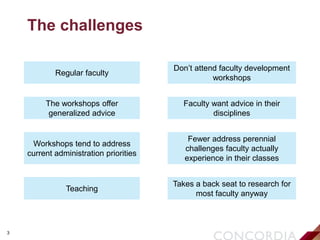
The challenges
Regular faculty
Don’t attend faculty development
workshops
The workshops offer
generalized advice
Faculty want advice in their
disciplines
Workshops tend to address
current administration priorities
Fewer address perennial
challenges faculty actually
experience in their classes
Teaching
Takes a back seat to research for
most faculty anyway
4
Consider this scenario.
A novice instructor who will be teaching his first undergraduate
large-scale course at Bayshore University. During the new faculty
orientation, he heard a lot of great stories about using group
assignments and activities from his colleagues, and he learned that
group activities could help students to learn effectively.
He decided to add some group activities for his new course. While
planning the activities, he realized that there are so many different
types of group activities, and he was not sure which one to pick. He
was confused, not sure where to start.
According to him: “I want to use the group activities because they
are fancy, and most of my colleagues are using them. But I don’t
know where to start and what I can do with the activities.”
5
Also consider this scenario.
You are a third-year STEM instructor who recently was called into the
Ombudsperson’s office after a student filed a complaint about the “fairness”
of the final exam.
You have always prepared test questions based on what you expect
students to know in the course, just as your professors have done in the
past.
The ombudsperson asked you to link each of your test questions to the
objectives of your course. You could not do that. The ombudsperson asked
you to explain how the incorrect responses (which he called distractors)
were generated. You could not explain that either.
The ombudsperson determined that you need to rewrite your final exam.
You do not want anyone to know that this has happened but you realize you
have no idea of how to write a multiple choice exam that would withstand
this level of evaluation.
6
Consider this scenario, too.
You are a history instructor. This term, you are teaching a second-year
course on Canadian history.
Feeling exacerbated after the second class, you complain to a
colleague about your students having no awareness of John A.
Macdonald and Louis Riel. As you mentioned to your colleague, “After
mentioning Wayne Gretzky in class, one of my students even
shamelessly asked in class, “Who is she?”
“SHE?” you said to your friend.
“Well, where are they from?” your colleague asked. That led to a
discussion about the backgrounds of your students, in which you
realized that, of your 50 students, only 25 were originally from Canada.
Ten are international students (primarily from China), another 8 were
recent immigrants from North Africa, and the rest are from Iran.
“That’s the issue,” your colleague said. “Your students aren’t stupid.
You’re just making some false assumptions about their cultural
knowledge.”
7
A proposed solution: An
Electronic Performance Support
System (EPSS)
EPSSs provide workers with the resources they need to
perform their job in the context of the job and at the
moment of need
8
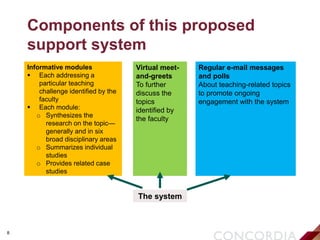
Components of this proposed
support system
Informative modules
 Each addressing a
particular teaching
challenge identified by the
faculty
 Each module:
o Synthesizes the
research on the topic—
generally and in six
broad disciplinary areas
o Summarizes individual
studies
o Provides related case
studies
Virtual meet-
and-greets
To further
discuss the
topics
identified by
the faculty
Regular e-mail messages
and polls
About teaching-related topics
to promote ongoing
engagement with the system
The system
9
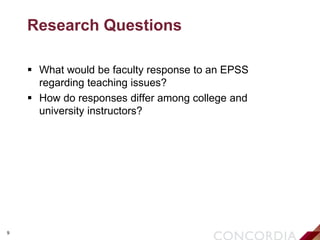
Research Questions
 What would be faculty response to an EPSS
regarding teaching issues?
 How do responses differ among college and
university instructors?
10
About EPSSs
 Manifestation of the concept of Human Performance
Technology (Improvement) (Gery, 1995; Carliner, 2002;
Gery, 2002; Mackenzie, 2002; Marion 2002).
 Used in a variety of contexts (Gery, 1991):
o Retail
o Industry
o Finance
o Consumer software
o Government
o Healthcare
o Education
 Guided by principles of performance-centered design
(Gery, 1995; Marion, 2002).
11
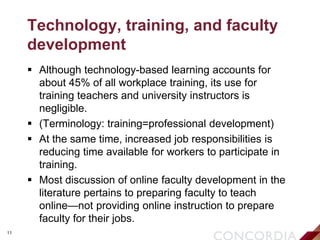
Technology, training, and faculty
development
 Although technology-based learning accounts for
about 45% of all workplace training, its use for
training teachers and university instructors is
negligible.
 (Terminology: training=professional development)
 At the same time, increased job responsibilities is
reducing time available for workers to participate in
training.
 Most discussion of online faculty development in the
literature pertains to preparing faculty to teach
online—not providing online instruction to prepare
faculty for their jobs.
12
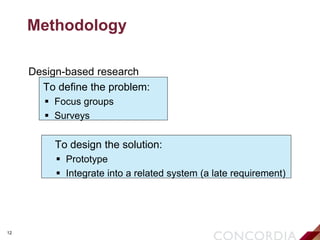
Methodology
Design-based research
To define the problem:
 Focus groups
 Surveys
To design the solution:
 Prototype
 Integrate into a related system (a late requirement)
13
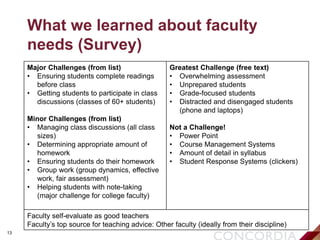
What we learned about faculty
needs (Survey)
Major Challenges (from list)
• Ensuring students complete readings
before class
• Getting students to participate in class
discussions (classes of 60+ students)
Minor Challenges (from list)
• Managing class discussions (all class
sizes)
• Determining appropriate amount of
homework
• Ensuring students do their homework
• Group work (group dynamics, effective
work, fair assessment)
• Helping students with note-taking
(major challenge for college faculty)
Greatest Challenge (free text)
• Overwhelming assessment
• Unprepared students
• Grade-focused students
• Distracted and disengaged students
(phone and laptops)
Not a Challenge!
• Power Point
• Course Management Systems
• Amount of detail in syllabus
• Student Response Systems (clickers)
Faculty self-evaluate as good teachers
Faculty’s top source for teaching advice: Other faculty (ideally from their discipline)
14
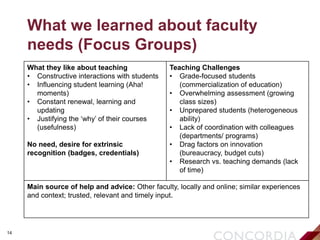
What we learned about faculty
needs (Focus Groups)
What they like about teaching
• Constructive interactions with students
• Influencing student learning (Aha!
moments)
• Constant renewal, learning and
updating
• Justifying the ‘why’ of their courses
(usefulness)
No need, desire for extrinsic
recognition (badges, credentials)
Teaching Challenges
• Grade-focused students
(commercialization of education)
• Overwhelming assessment (growing
class sizes)
• Unprepared students (heterogeneous
ability)
• Lack of coordination with colleagues
(departments/ programs)
• Drag factors on innovation
(bureaucracy, budget cuts)
• Research vs. teaching demands (lack
of time)
Main source of help and advice: Other faculty, locally and online; similar experiences
and context; trusted, relevant and timely input.
15
What we designed
One thing about design-based research: It can take
unexpected turns
16
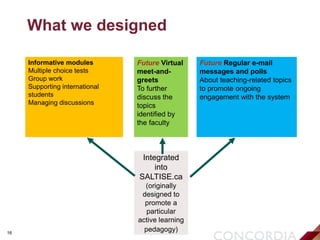
What we designed
Informative modules
Multiple choice tests
Group work
Supporting international
students
Managing discussions
Future Virtual
meet-and-
greets
To further
discuss the
topics
identified by
the faculty
Future Regular e-mail
messages and polls
About teaching-related topics
to promote ongoing
engagement with the system
Integrated
into
SALTISE.ca
(originally
designed to
promote a
particular
active learning
pedagogy)
17
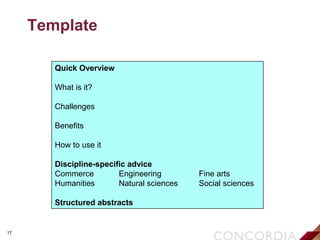
Template
Quick Overview
What is it?
Challenges
Benefits
How to use it
Discipline-specific advice
Commerce Engineering Fine arts
Humanities Natural sciences Social sciences
Structured abstracts
18
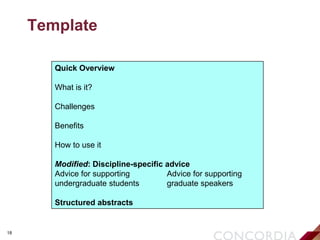
Template
Quick Overview
What is it?
Challenges
Benefits
How to use it
Modified: Discipline-specific advice
Advice for supporting Advice for supporting
undergraduate students graduate speakers
Structured abstracts
19
Conclusions
 Teaching problems often need to be addressed in the context of
teaching rather than in workshops that are separated from the
context of the problem
 Some of the greatest teaching challenges are perennial ones:
o Ensuring students prepare for class
o Writing fair assessments
o Managing classroom situations
o Helping students work in groups effectively
o Determining students’ prior knowledge
 Online resources offer great potential, but need to be designed to
match the way that instructors think and act—not the way
researchers do
Let’s discuss!
Saul Carliner saul.carliner@concordia.ca
Monica Lopez m.lopez@marianopolis.edu
David Price
Yuan Chen
Yang Gao
Ezgi Ozyonum
Audrey Mariamo
21
22
EXTRA SLIDE
Journey the instructor takes to
seeking assistance
 Wow! I wanna do a group assignment
 Seek help—know where to start. Google that unless I know of
something already.
 Which learning goals I want to use groupwork for.
 What type of groupwork do I wanna do. Types—ice breaker,
 Design the group work
 How to run the group work if I’m new. How to put students into groups.
 How to make them engage in the group work or start groupwork or make it
interesting
 Class time and try it. Observe.
 How did it go? Not great. Students won’t discuss. Not prepared.
 Ask for student feedback? Maybe receive complaints from students that the
activity is stupid or dumb.
 Ask others for suggestions.
 Change my plan afterwards.

EPSS for Faculty Development (In-Progress Project)

  • 1.
    Bring it tothem! An EPSS for Faculty Development Saul Carliner David Price Audrey Mariamo Ezgi Ozyonum Monica Lopez Yuan Chen Yang Gao
  • 2.
    2 What is thelikelihood that most regular, full-time faculty will attend faculty development workshops? 1. Extremely likely 2. Somewhat likely 3. Neither likely nor unlikely 4. Somewhat unlikely 5. Extremely unlikely
  • 3.
    3 The challenges Regular faculty Don’tattend faculty development workshops The workshops offer generalized advice Faculty want advice in their disciplines Workshops tend to address current administration priorities Fewer address perennial challenges faculty actually experience in their classes Teaching Takes a back seat to research for most faculty anyway
  • 4.
    4 Consider this scenario. Anovice instructor who will be teaching his first undergraduate large-scale course at Bayshore University. During the new faculty orientation, he heard a lot of great stories about using group assignments and activities from his colleagues, and he learned that group activities could help students to learn effectively. He decided to add some group activities for his new course. While planning the activities, he realized that there are so many different types of group activities, and he was not sure which one to pick. He was confused, not sure where to start. According to him: “I want to use the group activities because they are fancy, and most of my colleagues are using them. But I don’t know where to start and what I can do with the activities.”
  • 5.
    5 Also consider thisscenario. You are a third-year STEM instructor who recently was called into the Ombudsperson’s office after a student filed a complaint about the “fairness” of the final exam. You have always prepared test questions based on what you expect students to know in the course, just as your professors have done in the past. The ombudsperson asked you to link each of your test questions to the objectives of your course. You could not do that. The ombudsperson asked you to explain how the incorrect responses (which he called distractors) were generated. You could not explain that either. The ombudsperson determined that you need to rewrite your final exam. You do not want anyone to know that this has happened but you realize you have no idea of how to write a multiple choice exam that would withstand this level of evaluation.
  • 6.
    6 Consider this scenario,too. You are a history instructor. This term, you are teaching a second-year course on Canadian history. Feeling exacerbated after the second class, you complain to a colleague about your students having no awareness of John A. Macdonald and Louis Riel. As you mentioned to your colleague, “After mentioning Wayne Gretzky in class, one of my students even shamelessly asked in class, “Who is she?” “SHE?” you said to your friend. “Well, where are they from?” your colleague asked. That led to a discussion about the backgrounds of your students, in which you realized that, of your 50 students, only 25 were originally from Canada. Ten are international students (primarily from China), another 8 were recent immigrants from North Africa, and the rest are from Iran. “That’s the issue,” your colleague said. “Your students aren’t stupid. You’re just making some false assumptions about their cultural knowledge.”
  • 7.
    7 A proposed solution:An Electronic Performance Support System (EPSS) EPSSs provide workers with the resources they need to perform their job in the context of the job and at the moment of need
  • 8.
    8 Components of thisproposed support system Informative modules  Each addressing a particular teaching challenge identified by the faculty  Each module: o Synthesizes the research on the topic— generally and in six broad disciplinary areas o Summarizes individual studies o Provides related case studies Virtual meet- and-greets To further discuss the topics identified by the faculty Regular e-mail messages and polls About teaching-related topics to promote ongoing engagement with the system The system
  • 9.
    9 Research Questions  Whatwould be faculty response to an EPSS regarding teaching issues?  How do responses differ among college and university instructors?
  • 10.
    10 About EPSSs  Manifestationof the concept of Human Performance Technology (Improvement) (Gery, 1995; Carliner, 2002; Gery, 2002; Mackenzie, 2002; Marion 2002).  Used in a variety of contexts (Gery, 1991): o Retail o Industry o Finance o Consumer software o Government o Healthcare o Education  Guided by principles of performance-centered design (Gery, 1995; Marion, 2002).
  • 11.
    11 Technology, training, andfaculty development  Although technology-based learning accounts for about 45% of all workplace training, its use for training teachers and university instructors is negligible.  (Terminology: training=professional development)  At the same time, increased job responsibilities is reducing time available for workers to participate in training.  Most discussion of online faculty development in the literature pertains to preparing faculty to teach online—not providing online instruction to prepare faculty for their jobs.
  • 12.
    12 Methodology Design-based research To definethe problem:  Focus groups  Surveys To design the solution:  Prototype  Integrate into a related system (a late requirement)
  • 13.
    13 What we learnedabout faculty needs (Survey) Major Challenges (from list) • Ensuring students complete readings before class • Getting students to participate in class discussions (classes of 60+ students) Minor Challenges (from list) • Managing class discussions (all class sizes) • Determining appropriate amount of homework • Ensuring students do their homework • Group work (group dynamics, effective work, fair assessment) • Helping students with note-taking (major challenge for college faculty) Greatest Challenge (free text) • Overwhelming assessment • Unprepared students • Grade-focused students • Distracted and disengaged students (phone and laptops) Not a Challenge! • Power Point • Course Management Systems • Amount of detail in syllabus • Student Response Systems (clickers) Faculty self-evaluate as good teachers Faculty’s top source for teaching advice: Other faculty (ideally from their discipline)
  • 14.
    14 What we learnedabout faculty needs (Focus Groups) What they like about teaching • Constructive interactions with students • Influencing student learning (Aha! moments) • Constant renewal, learning and updating • Justifying the ‘why’ of their courses (usefulness) No need, desire for extrinsic recognition (badges, credentials) Teaching Challenges • Grade-focused students (commercialization of education) • Overwhelming assessment (growing class sizes) • Unprepared students (heterogeneous ability) • Lack of coordination with colleagues (departments/ programs) • Drag factors on innovation (bureaucracy, budget cuts) • Research vs. teaching demands (lack of time) Main source of help and advice: Other faculty, locally and online; similar experiences and context; trusted, relevant and timely input.
  • 15.
    15 What we designed Onething about design-based research: It can take unexpected turns
  • 16.
    16 What we designed Informativemodules Multiple choice tests Group work Supporting international students Managing discussions Future Virtual meet-and- greets To further discuss the topics identified by the faculty Future Regular e-mail messages and polls About teaching-related topics to promote ongoing engagement with the system Integrated into SALTISE.ca (originally designed to promote a particular active learning pedagogy)
  • 17.
    17 Template Quick Overview What isit? Challenges Benefits How to use it Discipline-specific advice Commerce Engineering Fine arts Humanities Natural sciences Social sciences Structured abstracts
  • 18.
    18 Template Quick Overview What isit? Challenges Benefits How to use it Modified: Discipline-specific advice Advice for supporting Advice for supporting undergraduate students graduate speakers Structured abstracts
  • 19.
    19 Conclusions  Teaching problemsoften need to be addressed in the context of teaching rather than in workshops that are separated from the context of the problem  Some of the greatest teaching challenges are perennial ones: o Ensuring students prepare for class o Writing fair assessments o Managing classroom situations o Helping students work in groups effectively o Determining students’ prior knowledge  Online resources offer great potential, but need to be designed to match the way that instructors think and act—not the way researchers do
  • 20.
    Let’s discuss! Saul Carlinersaul.carliner@concordia.ca Monica Lopez m.lopez@marianopolis.edu David Price Yuan Chen Yang Gao Ezgi Ozyonum Audrey Mariamo
  • 21.
  • 22.
    22 EXTRA SLIDE Journey theinstructor takes to seeking assistance  Wow! I wanna do a group assignment  Seek help—know where to start. Google that unless I know of something already.  Which learning goals I want to use groupwork for.  What type of groupwork do I wanna do. Types—ice breaker,  Design the group work  How to run the group work if I’m new. How to put students into groups.  How to make them engage in the group work or start groupwork or make it interesting  Class time and try it. Observe.  How did it go? Not great. Students won’t discuss. Not prepared.  Ask for student feedback? Maybe receive complaints from students that the activity is stupid or dumb.  Ask others for suggestions.  Change my plan afterwards.