Relate to Clients on a business levelUnderstanding your client1
IntroductionInteracting with Clients means	Developing positive relationshipsYour organisation must be committed to giving optimal serviceInternalExternalIf you want business you need Clients	2
What is a Client?A Client or customer is a person or organisation that you or your organisation provide with a product or service.
Who are your Clients?InternalPeople from within the organisation to whom you provide a product or serviceExternalPeople outside your organisation to whom you provide a product or service4
EXTERNAL CLIENT RELATIONSBUSINESSTOBUSINESSCLIENTSSuppliers>Contractors>Consumables>Marketing>Finance services>etc.Your Web DevCompany>Advertising>Marketing>Film/TV>Games>etc.PRODUCTSANDSERVICES>Animations>Video>Websites>Audio>SEM>SEODIRECTCLIENTS>Galleries>Shops>SME’s>etc.What are some other example you can think of??
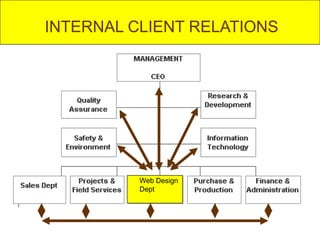
INTERNAL CLIENT RELATIONSWeb DesignDept
Client or customer service is:Performing tasks for clients,Development of products for clientsMaintaining products for clientsProviding information and advice to clients. 
How should you behave?Good manners?Modern/Business Etiquette?Business-like mannerReflective ListenerBe preparedEthically8Can you give me an example each of the above in normal life that isn’t applicable in a professional business situation?
What skills do you need?The essential skills for successful client interaction are:Active listeningQuestioning techniquesFeedbackUnderstandingEmpathy9
What do you need to be aware of?Organisational Standards & ValuesEthical PracticeCommunity StandardsIndustry CultureCulture StandardsRecent events in the organisation and in society10
What are the issues for IT?Some issues that you may encounter when working in the IT industry are:Determining both hardware and software requirementsTraining needsImplementing and training in new proceduresNegotiating support and service agreementsComplaints about technologyThe above are traditional IT issues but just as relevant in the web industry11
What questions do you need to ask yourself?Ask yourself these questions when dealing with a client:What is the most personable and professional way to greet my customers?How can I anticipate what my customers would like from me?How can I be sure I know a client’s requirements?12
What questions do you need to ask yourself?You need to ask yourself these questions when dealing with a client:Which method will give me the most useful feedback?How do I manage speedy, efficient service and keep the personal touch?What so I do when a customer is unhappy?How can I communicate well with my customers over the telephone?13
How do you ensure quality customer service?Follow Up!Maintain client recordsSeek feedbackReward customer loyaltyProvide after-sales service14
How do you ensure quality customer service?Telephone Skills‘The telephone is an organisation’s front line’Smile on the phoneAnswer promptlyConfirm record details15
How do you ensure quality customer service?Quality AssuranceUse systems to ensure consistent quality in products and service16
How do you ensure quality customer service?Problem Solving‘Complaints are an opportunity to fix problems and improve service!’Know your organisation’s proceduresStay clamGather the factsNegotiate a solution-follow it up!17
How do you ensure quality customer service?Greeting customers and identifying their needsApproach them in a friendly, professional mannerKnow your businessListen activelyAsk open questionsOffer a range of options18
In Class activityCustomer ServiceThink of a situation when you were on the receiving end of poor customer service. List the behaviours of the person that made you feel that the service was poor.Did you tell anyone about your experience?Did you buy the product or service you requested?List four things that the person serving you could have done to improve the exchange19

1 understanding your clients

  • 1.
    Relate to Clientson a business levelUnderstanding your client1
  • 2.
    IntroductionInteracting with Clientsmeans Developing positive relationshipsYour organisation must be committed to giving optimal serviceInternalExternalIf you want business you need Clients 2
  • 3.
    What is aClient?A Client or customer is a person or organisation that you or your organisation provide with a product or service.
  • 4.
    Who are yourClients?InternalPeople from within the organisation to whom you provide a product or serviceExternalPeople outside your organisation to whom you provide a product or service4
  • 5.
    EXTERNAL CLIENT RELATIONSBUSINESSTOBUSINESSCLIENTSSuppliers>Contractors>Consumables>Marketing>Financeservices>etc.Your Web DevCompany>Advertising>Marketing>Film/TV>Games>etc.PRODUCTSANDSERVICES>Animations>Video>Websites>Audio>SEM>SEODIRECTCLIENTS>Galleries>Shops>SME’s>etc.What are some other example you can think of??
  • 6.
  • 7.
    Client or customerservice is:Performing tasks for clients,Development of products for clientsMaintaining products for clientsProviding information and advice to clients. 
  • 8.
    How should youbehave?Good manners?Modern/Business Etiquette?Business-like mannerReflective ListenerBe preparedEthically8Can you give me an example each of the above in normal life that isn’t applicable in a professional business situation?
  • 9.
    What skills doyou need?The essential skills for successful client interaction are:Active listeningQuestioning techniquesFeedbackUnderstandingEmpathy9
  • 10.
    What do youneed to be aware of?Organisational Standards & ValuesEthical PracticeCommunity StandardsIndustry CultureCulture StandardsRecent events in the organisation and in society10
  • 11.
    What are theissues for IT?Some issues that you may encounter when working in the IT industry are:Determining both hardware and software requirementsTraining needsImplementing and training in new proceduresNegotiating support and service agreementsComplaints about technologyThe above are traditional IT issues but just as relevant in the web industry11
  • 12.
    What questions doyou need to ask yourself?Ask yourself these questions when dealing with a client:What is the most personable and professional way to greet my customers?How can I anticipate what my customers would like from me?How can I be sure I know a client’s requirements?12
  • 13.
    What questions doyou need to ask yourself?You need to ask yourself these questions when dealing with a client:Which method will give me the most useful feedback?How do I manage speedy, efficient service and keep the personal touch?What so I do when a customer is unhappy?How can I communicate well with my customers over the telephone?13
  • 14.
    How do youensure quality customer service?Follow Up!Maintain client recordsSeek feedbackReward customer loyaltyProvide after-sales service14
  • 15.
    How do youensure quality customer service?Telephone Skills‘The telephone is an organisation’s front line’Smile on the phoneAnswer promptlyConfirm record details15
  • 16.
    How do youensure quality customer service?Quality AssuranceUse systems to ensure consistent quality in products and service16
  • 17.
    How do youensure quality customer service?Problem Solving‘Complaints are an opportunity to fix problems and improve service!’Know your organisation’s proceduresStay clamGather the factsNegotiate a solution-follow it up!17
  • 18.
    How do youensure quality customer service?Greeting customers and identifying their needsApproach them in a friendly, professional mannerKnow your businessListen activelyAsk open questionsOffer a range of options18
  • 19.
    In Class activityCustomerServiceThink of a situation when you were on the receiving end of poor customer service. List the behaviours of the person that made you feel that the service was poor.Did you tell anyone about your experience?Did you buy the product or service you requested?List four things that the person serving you could have done to improve the exchange19