Customer Service
Customer Service
Objectives of the program:
 Who is a customer
 Identify your customer- Internal and External
 What quality characteristics are important for
Customer service
 How to create positive memorable experiences
for all customers
Caring Customer Service
Outcomes of this module are:
 Identify different kinds of customer
contact
 Demonstrate and use Caring Responses
 Create and use a series of Caring
Responses
Customer Service
You are among the growing group of
people who have joined a service
organization dedicated to meet needs of
others. The expectations today are very
high because customers expectations for
service have increased tremendously
Reactions
 What is often surprising is how long these
reactions last
 Good & bad customer care can arouse
powerful emotions
 Benefits- remarkable or disastrous
 Opportunity- retain/ lose customers & gain/
lose several more
 Research shows that someone who has had a
bad customer experience will tell at least 10
other people
Customer Service
Who are Customers?
 People who receive my output
 People who pay me
 They are the reason why I do my job
 People who want to avail my company’s
services
Foundation of Customer Service
Customers are of two types:
 Internal
 External
Foundation of Customer Service
Internal customer:
 Group of people you may serve within the
organization.
External customer:
 “someone who depends on the timeliness,
quality, and accuracy of someone else’s work.”
These are customers who come to your
organization for some services or products.
 You are a customer of others within an
organization and you also have customers.
Customer Service
What quality characteristics are important
to your customers?
 Accuracy
 Friendliness
 Timeliness
 Efficiency
 Courtesy
 Honesty
Why is Service so Difficult to
Define Accurately?
 It is not tangible
 It cant be measured/ weighed
 It is more emotional than rational
 You can sell it, but you cannot give a
customer a sample to take & show to
another
 Having given it, the customer may not
have acquired anything
Customer Service
Core service and Customer service
 Core Service: is the service or product your
organization provides to its customers- your
“reason for being”
 Customer Service: includes all of the
interactions you have with a customer while
you are conducting the business
Service can be Divided into
two main types:
MATERIAL:
 Price, Quantity, Quality, Type of equipment,
Routines, Working method, Manning etc.
PERSONAL:
 It is personal service which upgrades a
neutral impression about a service to a good
impression.
 A honest smile & full personal attention will
work wonders even if material service breaks
down.
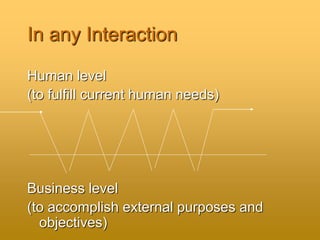
In any Interaction
Human level
(to fulfill current human needs)
Business level
(to accomplish external purposes and
objectives)
Customer Service
The four things the Customer wants:
 Friendly, caring service:
 Being interested
 Giving information
 Listening carefully
 Answering questions
 Warm friendly responses at all times especially
when customers are upset or have concerns
 Flexibility: Customer want the person to
“jiggle” the system to make it work for them.
They don’t want to hear “No”
Customer Service
The four things the Customer wants:
 Problem resolution:
 Business problems
 Non-business problem
 Recovery: If and when mistake is made,
customer wants you to take care of it
quickly and to their satisfaction
 Apology
 Fix it
 Extra Step
 Follow up
Moments Of Truth
 A moment of truth is any point in the
interaction during which the customer
has an opportunity to gain an
impression of the service provided by
the company
 Research has shown that it takes on
average 12 shining moments of truth
to compensate for one dull moment of
truth
Caring Responses
The Caring responses are skills that
can be used all the time, not just when
customers are upset. The four skills
are:
 Acknowledging
 Appreciating
 Affirming
 Assuring
Dont’s
 Don’t Forget
 Don’t Hesitate
 I will try
 Unfortunately
 Free
 Discount
 Sadly
 We cant do that
 Just a second
Dont’s
 I am afraid
 I don’t know
 Cost problem
 Don’t worry
 No problem
 But
 You will have to
 It’s a policy
The Benefits of Good
Customer Service
Personal Benefits WIFM:
 Less stress
 Higher efficiency
 More job satisfaction
Organizational Benefits:
 Key to survival and success
 Motivated teamwork
 Cost effective
 Adds to the company bottom line
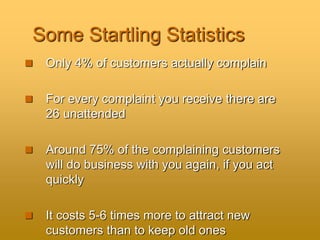
Some Startling Statistics
 Only 4% of customers actually complain
 For every complaint you receive there are
26 unattended
 Around 75% of the complaining customers
will do business with you again, if you act
quickly
 It costs 5-6 times more to attract new
customers than to keep old ones
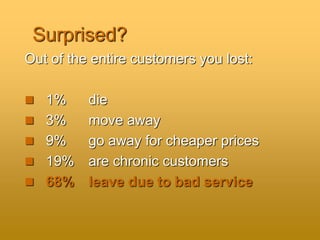
Surprised?
Out of the entire customers you lost:
 1% die
 3% move away
 9% go away for cheaper prices
 19% are chronic customers
 68% leave due to bad service
So Most Of All
Customers go elsewhere because the
people they deal with are indifferent to
their needs 68%.
The two types of Customer
Service
 Reactive Customer Service
 Proactive Customer Service
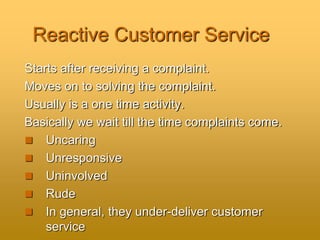
Reactive Customer Service
Starts after receiving a complaint.
Moves on to solving the complaint.
Usually is a one time activity.
Basically we wait till the time complaints come.
 Uncaring
 Unresponsive
 Uninvolved
 Rude
 In general, they under-deliver customer
service
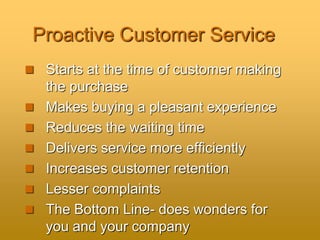
Proactive Customer Service
 Starts at the time of customer making
the purchase
 Makes buying a pleasant experience
 Reduces the waiting time
 Delivers service more efficiently
 Increases customer retention
 Lesser complaints
 The Bottom Line- does wonders for
you and your company
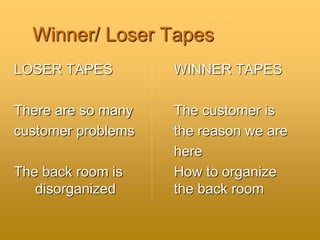
Winner/ Loser Tapes
LOSER TAPES WINNER TAPES
There are so many The customer is
customer problems the reason we are
here
The back room is How to organize
disorganized the back room
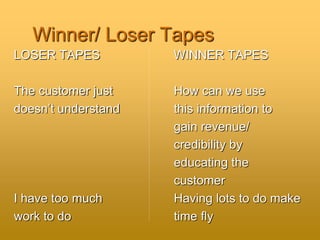
Winner/ Loser Tapes
LOSER TAPES WINNER TAPES
The customer just How can we use
doesn’t understand this information to
gain revenue/
credibility by
educating the
customer
I have too much Having lots to do make
work to do time fly
GUEST
 G- Greet the customers
 U- Understand customer needs
 E- Explain features and benefits
 S- Suggest additional items
 T- Thank the customer
Three Styles of
Communication
 Aggressive communication:
Communication becomes aggressive
when we stand up for our rights in
such a way that the other persons
rights are violated. It leads to a close
down in communication.
Three Styles of
Communication
 Submissive communication:
When we use submissive
communication we fail to stand up for
our rights or we express them in a way
that allows others to easily disregard
them. It leads to win lose
communication, where neither party is
satisfied.
Three Styles of
Communication
 Assertive communication:
It involves standing up for our own
rights in a way that it does not violate
the rights of others.
Customer Service Attitude
 Work – as if money is not important,
 Trust – as if never been ditched,
 Dance – as if nobody is watching,
 Love – as if never been hurt………..
Customer Service Attitude
“Thank you for calling Customer Service.
If you are calm and rational, press 1.
If you are a whiner, press 2.
If you are a hot head, press 3…….
Customer Service Attitude
Customer Service is
80% Attitude
&
20% Technique
What is Customer Service
Attitude……….?
“Customer Service Attitude is the inherent
ability to look at every interaction with the
customer as an opportunity for customer
delight and service excellence”
Displaying Customer Service
Attitude
 Projecting Confidence
 Thinking Positive
 Using Positive Language
 Being Enthusiastic
 Conveying Speed or urgency
 Taking Ownership or accountability
 Being Courteous
CONFIDENCE
“ Who has Confidence in himself will gain
the confidence of others”
Our beliefs fuel our actions.
Positive beliefs lead to positive actions
and negative beliefs lead to negative actions.
Thinking Positive
Using positive language!
The way you express yourself will affect
whether your message is received positively
or negatively
Conveying Speed or Urgency
Your problem is important
Taking Ownership
To the customer you are the Company
Courtesy
Please
Politeness goes far yet costs nothing
Thank you
A customer is not dependent upon
us……….
We are dependent upon him for our living
A customer is not a cold statistic.
He is flesh and blood human being with
emotions and prejudices just like our own
Best Model
 B: Being the customer interaction
Gauge mood
Build rapport
 E: Establish the customers agenda
Ask open and closed ended questions
Be quiet
Listen actively
Probe for specifics
Paraphrase
Best Model
 S : Satisfy the customer’s needs.
Generate more than one option
Consider the customer’s perspective
 T: Thank the customer and verify the
next step
Thank the customer
Verify who will do what by when
When we learn to appreciate one
another’s differences, we become more
willing to listen, more open to new ides
and more eager to grow.
Birds of different feathers come flocking to
us- we have to work together with them.
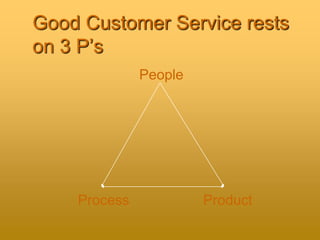
Good Customer Service rests
on 3 P’s
People
ProductProcess

Customer Service introduction

  • 1.
  • 2.
    Customer Service Objectives ofthe program:  Who is a customer  Identify your customer- Internal and External  What quality characteristics are important for Customer service  How to create positive memorable experiences for all customers
  • 3.
    Caring Customer Service Outcomesof this module are:  Identify different kinds of customer contact  Demonstrate and use Caring Responses  Create and use a series of Caring Responses
  • 4.
    Customer Service You areamong the growing group of people who have joined a service organization dedicated to meet needs of others. The expectations today are very high because customers expectations for service have increased tremendously
  • 5.
    Reactions  What isoften surprising is how long these reactions last  Good & bad customer care can arouse powerful emotions  Benefits- remarkable or disastrous  Opportunity- retain/ lose customers & gain/ lose several more  Research shows that someone who has had a bad customer experience will tell at least 10 other people
  • 6.
    Customer Service Who areCustomers?  People who receive my output  People who pay me  They are the reason why I do my job  People who want to avail my company’s services
  • 7.
    Foundation of CustomerService Customers are of two types:  Internal  External
  • 8.
    Foundation of CustomerService Internal customer:  Group of people you may serve within the organization. External customer:  “someone who depends on the timeliness, quality, and accuracy of someone else’s work.” These are customers who come to your organization for some services or products.  You are a customer of others within an organization and you also have customers.
  • 9.
    Customer Service What qualitycharacteristics are important to your customers?  Accuracy  Friendliness  Timeliness  Efficiency  Courtesy  Honesty
  • 10.
    Why is Serviceso Difficult to Define Accurately?  It is not tangible  It cant be measured/ weighed  It is more emotional than rational  You can sell it, but you cannot give a customer a sample to take & show to another  Having given it, the customer may not have acquired anything
  • 11.
    Customer Service Core serviceand Customer service  Core Service: is the service or product your organization provides to its customers- your “reason for being”  Customer Service: includes all of the interactions you have with a customer while you are conducting the business
  • 12.
    Service can beDivided into two main types: MATERIAL:  Price, Quantity, Quality, Type of equipment, Routines, Working method, Manning etc. PERSONAL:  It is personal service which upgrades a neutral impression about a service to a good impression.  A honest smile & full personal attention will work wonders even if material service breaks down.
  • 13.
    In any Interaction Humanlevel (to fulfill current human needs) Business level (to accomplish external purposes and objectives)
  • 14.
    Customer Service The fourthings the Customer wants:  Friendly, caring service:  Being interested  Giving information  Listening carefully  Answering questions  Warm friendly responses at all times especially when customers are upset or have concerns  Flexibility: Customer want the person to “jiggle” the system to make it work for them. They don’t want to hear “No”
  • 15.
    Customer Service The fourthings the Customer wants:  Problem resolution:  Business problems  Non-business problem  Recovery: If and when mistake is made, customer wants you to take care of it quickly and to their satisfaction  Apology  Fix it  Extra Step  Follow up
  • 16.
    Moments Of Truth A moment of truth is any point in the interaction during which the customer has an opportunity to gain an impression of the service provided by the company  Research has shown that it takes on average 12 shining moments of truth to compensate for one dull moment of truth
  • 17.
    Caring Responses The Caringresponses are skills that can be used all the time, not just when customers are upset. The four skills are:  Acknowledging  Appreciating  Affirming  Assuring
  • 18.
    Dont’s  Don’t Forget Don’t Hesitate  I will try  Unfortunately  Free  Discount  Sadly  We cant do that  Just a second
  • 19.
    Dont’s  I amafraid  I don’t know  Cost problem  Don’t worry  No problem  But  You will have to  It’s a policy
  • 20.
    The Benefits ofGood Customer Service Personal Benefits WIFM:  Less stress  Higher efficiency  More job satisfaction Organizational Benefits:  Key to survival and success  Motivated teamwork  Cost effective  Adds to the company bottom line
  • 21.
    Some Startling Statistics Only 4% of customers actually complain  For every complaint you receive there are 26 unattended  Around 75% of the complaining customers will do business with you again, if you act quickly  It costs 5-6 times more to attract new customers than to keep old ones
  • 22.
    Surprised? Out of theentire customers you lost:  1% die  3% move away  9% go away for cheaper prices  19% are chronic customers  68% leave due to bad service
  • 23.
    So Most OfAll Customers go elsewhere because the people they deal with are indifferent to their needs 68%.
  • 24.
    The two typesof Customer Service  Reactive Customer Service  Proactive Customer Service
  • 25.
    Reactive Customer Service Startsafter receiving a complaint. Moves on to solving the complaint. Usually is a one time activity. Basically we wait till the time complaints come.  Uncaring  Unresponsive  Uninvolved  Rude  In general, they under-deliver customer service
  • 26.
    Proactive Customer Service Starts at the time of customer making the purchase  Makes buying a pleasant experience  Reduces the waiting time  Delivers service more efficiently  Increases customer retention  Lesser complaints  The Bottom Line- does wonders for you and your company
  • 27.
    Winner/ Loser Tapes LOSERTAPES WINNER TAPES There are so many The customer is customer problems the reason we are here The back room is How to organize disorganized the back room
  • 28.
    Winner/ Loser Tapes LOSERTAPES WINNER TAPES The customer just How can we use doesn’t understand this information to gain revenue/ credibility by educating the customer I have too much Having lots to do make work to do time fly
  • 29.
    GUEST  G- Greetthe customers  U- Understand customer needs  E- Explain features and benefits  S- Suggest additional items  T- Thank the customer
  • 30.
    Three Styles of Communication Aggressive communication: Communication becomes aggressive when we stand up for our rights in such a way that the other persons rights are violated. It leads to a close down in communication.
  • 31.
    Three Styles of Communication Submissive communication: When we use submissive communication we fail to stand up for our rights or we express them in a way that allows others to easily disregard them. It leads to win lose communication, where neither party is satisfied.
  • 32.
    Three Styles of Communication Assertive communication: It involves standing up for our own rights in a way that it does not violate the rights of others.
  • 33.
    Customer Service Attitude Work – as if money is not important,  Trust – as if never been ditched,  Dance – as if nobody is watching,  Love – as if never been hurt………..
  • 34.
    Customer Service Attitude “Thankyou for calling Customer Service. If you are calm and rational, press 1. If you are a whiner, press 2. If you are a hot head, press 3…….
  • 35.
    Customer Service Attitude CustomerService is 80% Attitude & 20% Technique
  • 36.
    What is CustomerService Attitude……….? “Customer Service Attitude is the inherent ability to look at every interaction with the customer as an opportunity for customer delight and service excellence”
  • 37.
    Displaying Customer Service Attitude Projecting Confidence  Thinking Positive  Using Positive Language  Being Enthusiastic  Conveying Speed or urgency  Taking Ownership or accountability  Being Courteous
  • 38.
    CONFIDENCE “ Who hasConfidence in himself will gain the confidence of others”
  • 39.
    Our beliefs fuelour actions. Positive beliefs lead to positive actions and negative beliefs lead to negative actions. Thinking Positive
  • 40.
    Using positive language! Theway you express yourself will affect whether your message is received positively or negatively
  • 41.
    Conveying Speed orUrgency Your problem is important
  • 42.
    Taking Ownership To thecustomer you are the Company
  • 43.
    Courtesy Please Politeness goes faryet costs nothing Thank you
  • 44.
    A customer isnot dependent upon us………. We are dependent upon him for our living
  • 45.
    A customer isnot a cold statistic. He is flesh and blood human being with emotions and prejudices just like our own
  • 46.
    Best Model  B:Being the customer interaction Gauge mood Build rapport  E: Establish the customers agenda Ask open and closed ended questions Be quiet Listen actively Probe for specifics Paraphrase
  • 47.
    Best Model  S: Satisfy the customer’s needs. Generate more than one option Consider the customer’s perspective  T: Thank the customer and verify the next step Thank the customer Verify who will do what by when
  • 48.
    When we learnto appreciate one another’s differences, we become more willing to listen, more open to new ides and more eager to grow. Birds of different feathers come flocking to us- we have to work together with them.
  • 49.
    Good Customer Servicerests on 3 P’s People ProductProcess