Annual Review Meeting – 2019
HANDLING CUSTOMER
COMPLAINTS
By : Paresh Bhangale
Annual Review Meeting - 2019
1. What is complaint?
2. Is a complaint a gift? Why?
3. Who is our customer ?
4. Dealing with internal customers
5. Type of external customer
6. Dealing with complaints
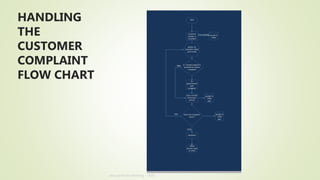
7. Handling the customer complaints- Flow chart
8. Key requirement for successful customer complaint handling
9. conclusion
CONTENT
Annual Review Meeting - 2019
Is AN expression
To organization > dissatisfaction on product/handling complaint
Expects resolution
25 complaints are always unexpressed prior to 1 complaint?
WHAT IS COMPLAINT ?
Annual Review Meeting - 2019
• Always free
• unexpected- usually comes as surprise
• Free information about service failures, competitors offerings
• Hold the key to happiness for the recipient organization by opportunity to
• Increase customer trust
• Build long term relationships
• Rectify service failures
• Engage customers as advocates
IS A COMPLAINT A GIFT? WHY?
Annual Review Meeting - 2019
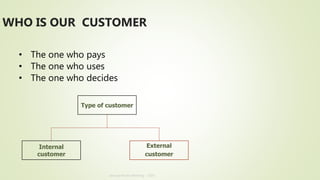
• The one who pays
• The one who uses
• The one who decides
WHO IS OUR CUSTOMER
Type of customer
Internal
customer
External
customer
DEALING WITH INTERNAL CUSTOMER
 3 situation can be possible.
1. You are friendly with internal customer
• You can use it to advantage
2. You have serious difference:
• Focus on issue and not on personality or past relationship
3. You have a neutral relationship
• Treat him with courtesy
Annual Review Meeting - 2019
1. The Meek Customer
- Generally, will not complain.
2. The Aggressive Customer
- Opposite of the Meek Customer. Readily complains, often loudly
3. The High-Roller Customer
- Expects the absolute best and is willing to pay for it. Likely to complain in a
reasonable manner
4. The Rip-Off Customer:
- The goal is not to get the complaint satisfied but rather to win by getting something
the customer is not entitled to receive. A constant, repetitive “not good enough”
response
5. The Chronic Complainer Customer:
- Is never satisfied; always something wrong. This customer’s mission is to complain
TYPE OF EXTERNAL CUSTOMER
Annual Review Meeting - 2017
1. Be calm
2. Use open ended questions
3. Listen
4. Empathize
5. Do not justify lapses
6. Make notes and clarify doubts
7. Agree on a course of action
8. Promise less perform better
9. If you know you can’t help him, get someone who can
10. Follow through
Make the customer part of the solution; not part of the problem
DEALING WITH COMPLAINTS
Annual Review Meeting - 2019
HANDLING
THE
CUSTOMER
COMPLAINT
FLOW CHART
Annual Review Meeting - 2017
1. Listening ability
2. Talking to the point
3. Communication skill
4. Body language
5. Equipped with right information and tools
6. Professionalism
7. Empowerment
KEY REQUIREMENTS FOR SUCCESSFUL
CUSTOMER COMPLAINT HANDLING
CONCLUSION:
• If we don’t take care of our customers, someone else will
• Complaints are opportunities
• internal customer- Sharing credit, no crab syndrome; parental role
• External customer- Apology for complaint; Deal with courtesy
• Importance to value system
Thank you !

Handling customer complaints

  • 1.
    Annual Review Meeting– 2019 HANDLING CUSTOMER COMPLAINTS By : Paresh Bhangale
  • 2.
    Annual Review Meeting- 2019 1. What is complaint? 2. Is a complaint a gift? Why? 3. Who is our customer ? 4. Dealing with internal customers 5. Type of external customer 6. Dealing with complaints 7. Handling the customer complaints- Flow chart 8. Key requirement for successful customer complaint handling 9. conclusion CONTENT
  • 3.
    Annual Review Meeting- 2019 Is AN expression To organization > dissatisfaction on product/handling complaint Expects resolution 25 complaints are always unexpressed prior to 1 complaint? WHAT IS COMPLAINT ?
  • 4.
    Annual Review Meeting- 2019 • Always free • unexpected- usually comes as surprise • Free information about service failures, competitors offerings • Hold the key to happiness for the recipient organization by opportunity to • Increase customer trust • Build long term relationships • Rectify service failures • Engage customers as advocates IS A COMPLAINT A GIFT? WHY?
  • 5.
    Annual Review Meeting- 2019 • The one who pays • The one who uses • The one who decides WHO IS OUR CUSTOMER Type of customer Internal customer External customer
  • 6.
    DEALING WITH INTERNALCUSTOMER  3 situation can be possible. 1. You are friendly with internal customer • You can use it to advantage 2. You have serious difference: • Focus on issue and not on personality or past relationship 3. You have a neutral relationship • Treat him with courtesy
  • 7.
    Annual Review Meeting- 2019 1. The Meek Customer - Generally, will not complain. 2. The Aggressive Customer - Opposite of the Meek Customer. Readily complains, often loudly 3. The High-Roller Customer - Expects the absolute best and is willing to pay for it. Likely to complain in a reasonable manner 4. The Rip-Off Customer: - The goal is not to get the complaint satisfied but rather to win by getting something the customer is not entitled to receive. A constant, repetitive “not good enough” response 5. The Chronic Complainer Customer: - Is never satisfied; always something wrong. This customer’s mission is to complain TYPE OF EXTERNAL CUSTOMER
  • 8.
    Annual Review Meeting- 2017 1. Be calm 2. Use open ended questions 3. Listen 4. Empathize 5. Do not justify lapses 6. Make notes and clarify doubts 7. Agree on a course of action 8. Promise less perform better 9. If you know you can’t help him, get someone who can 10. Follow through Make the customer part of the solution; not part of the problem DEALING WITH COMPLAINTS
  • 9.
    Annual Review Meeting- 2019 HANDLING THE CUSTOMER COMPLAINT FLOW CHART
  • 10.
    Annual Review Meeting- 2017 1. Listening ability 2. Talking to the point 3. Communication skill 4. Body language 5. Equipped with right information and tools 6. Professionalism 7. Empowerment KEY REQUIREMENTS FOR SUCCESSFUL CUSTOMER COMPLAINT HANDLING
  • 11.
    CONCLUSION: • If wedon’t take care of our customers, someone else will • Complaints are opportunities • internal customer- Sharing credit, no crab syndrome; parental role • External customer- Apology for complaint; Deal with courtesy • Importance to value system Thank you !

Editor's Notes

  • #4 an expression of dissatisfaction made to an organization, related to its products or services, or the complaints-handling process itself, where a response or resolution is explicitly or implicitly expected” It is estimated that for every customer complaint received, there are at least 25 complaints that are never expressed. What are the implications of this statistic?