ACCOUNT MANAGEMENT 101
By Edwin Irvanus & Laode Iman Tauffany
WHAT IS ACCOUNT MANAGEMENT
•  There have been thousands of definitions what an account handler is. We prefer to define what
makes a good account handler. It is that person who finds out what the client needs,
and then does the best job possible to get the client to do it.
•  A good account handler can analyze a problem to its core, direct the creative firepower of the
agency precisely at the core, and respond to and participate in the creative answers to that
problem.
•  Not "find out what the client wants" but "find out what the client needs".
THE ACCOUNT TEAM
1.  The team comprises a maximum of four levels:
•  Group Account Director,
•  Account Director,
•  Account Supervisor and
•  Account Executive.
2.  It is the account team's overall responsibility to understand the marketing needs of its client's
business and co-ordinate the Media and Creative department in the development of effective
advertising. It achieves this by preparing an advertising strategy in tandem with the client. It
then ensures this is adhered to, as by definition, effective advertising must be on-strategy.
3.  The account team in essence manages the Agency's clients and depending on the size and
complexity of each client, an individual can expect to work on anything from one to six
accounts.
4.  Clearly the job function of each team member will alter according to his/her level.
GENERAL RESPONSIBILITIES OF THE ACCOUNT
GROUP
1.  The account manager represents the agency to the
client, and the client to the agency.
2.  The account group should create a climate that
breeds outstanding creative work.
3.  The account manager must provide information. Facts
about the product, the market, the target audience.
4.  The first requirement for great advertising is a great
strategy - one that is simple and persuasive. One the
creative group can embrace.
5.  Creative thinking requires time. The account
supervisor must provide the time in which big ideas
can be conceived and grow.
6.  The account manager should show faith by leaving the
creative team alone to do its work.
7.  An essential skill is developing and evaluating copy.
The account manager should be a student of
advertising, able to comment knowledgeably (rather
than nit-pick).
GENERAL RESPONSIBILITIES OF THE ACCOUNT
GROUP
8.  Creative work and creative people must be protected from
too many meetings that waste time and erode advertising
ideas.
9.  Once the agency recommendation is settled, the account
manager is responsible for organizing the most persuasive
way of presenting the agency's work.
10.  One mark of a good account partner is the courage to
support original ideas.
GENERAL RESPONSIBILITIES OF THE ACCOUNT
GROUP
Principles of Account Management
19 key principles of account management
1.  Stay Involved In Your Client's Business
His business is your business. You should know as much as
he does about his product and its marketing. This will earn
his respect as well as make you a partner in his business.
2.  Keep Your Client's Sale Healthy
Identify the key factors to your client's business success
and work on them. Good advertising usually goes hand in
hand with good sales results.
3.  First Earn Your Client's Respect. Love Will Follow.
Do your homework, prepare your point of view, and
present it with conviction. But be willing to admit you are
wrong when the logic is on the other side.
4.  Respect your client.
Learn to appreciate their problems. There is no faster way to
kill a client-agency relationship than to have an account man
"bad mouthing" his client in the agency, showing in his manner
with the client that he doesn't respect him.
5.  Make your client look good
Help your client look good in his company. The better he looks,
the better you and the agency look. And he will become a
better friend for it.
6.  Stay ahead of your client
Anticipate. Lead. Keep the initiative. Think ahead about the
important as well as solving the urgent problems of the day.
Principles of Account Management
19 key principles of account management
7.  Stay out of client politics
Avoid taking sides in internal client hassles. Be objective
and honest. Stick to business rather than people.
8.  Ideas are your business
Not only advertising ideas, but product, packaging,
promotion or other ideas that will build client sales. New
product ideas really tell a client you are committed to his
growth.
9.  Have guts
Be willing to err for an idea or unpopular view. No risks,
no big gains. Put your ego on the table when your
instincts tell you that your idea has potential or that the
majority is wrong.
Principles of Account Management
19 key principles of account management
10. Be responsible.
Never assume that something will happen unless you have
made sure it will happen. Button down details. Check and
double-check. Rehearse. Follow up. Worry.
11. Work hard with competitive urgency.
The more your capacity increases. The more you idle, the
more difficult it is to get anything done well or on time.
There are a lot of smart people in advertising. The hard
workers succeed.
12. Be task oriented, more than people
Don't rely on secondary or tertiary sources about your
market. Talk to consumer, work with salesmen, and meet
retailers or others in the channels of distribution.
Principles of Account Management
19 key principles of account management
13. Learn to be a good salesman
A great idea isn't anything until it is sold. Learn
to persuade. Don't be tricky in your
presentation. You must be able to sell your ideas
or point of view
14. Learn to be an excellent communicator
You must be able to write and present well.
These traits are acquired, not inherited. Practice.
15. Put it on paper, but be brief
Nobody likes excess paper work. But there is no
better discipline for thinking out a problem than
a short memo (long, rambling documents are
easy to write to put it on one page is tough). Put
your major recommendations to clients on
paper.
Principles of Account Management
19 key principles of account management
16. Inform and involve the agency in your
account
Encourage everyone working on your account in the
agency to contribute as a generalist rather than
solely in a specialist capacity. This is best done in
small face-to-face meeting.
17.  Build the faith with your creative brothers
Help get great advertising on your account by
building a good relationship with your creative
counterparts. You must sense the needs of the
writer and the artist. You must protect them from
difficult clients.
Principles of Account Management
19 key principles of account management
18. You are speaking for the agency - not for yourself
Your client is hiring the agency you work for, not you. The
client assumes your recommendations are those of the
agency. You must work with all departments and hammer
out an agency agreement.
19. If you want to grow, learn to let go
Hire the best people you can find. Train them. then let them
fly. Learn to hope the client will call them, not you. As they
grow, you grow.
Principles of Account Management
19 key principles of account management
1.  Account handlers are very important people, and a lot is expected of them.
2.  The eight most important things, which is expected from an account Handler, and upon which
performance will be largely evaluated:
Have You Done Your Homework :
The Brand Book
§  Above	
   all,	
   hold	
   yourself	
   responsible	
   for	
   genera5ng	
   the	
  
best	
  crea5ve	
  work	
  in	
  your	
  client's	
  category.	
  
§  Know	
   your	
   client's	
   consumer	
   be>er	
   than	
   anybody	
   else	
  
does.	
  
§  Be	
  an	
  expert	
  in	
  your	
  client's	
  business	
  
§  Generate	
  well	
  thought-­‐out	
  strategies	
  
§  Surprise	
  your	
  client	
  with	
  ideas	
  to	
  build	
  his	
  business	
  
§  Be	
  the	
  best	
  briefer	
  in	
  the	
  agency	
  
§  Be	
  able	
  to	
  account	
  for	
  every	
  Rp.	
  spent	
  by	
  the	
  agency	
  for	
  
your	
  client	
  
§  Create	
   a	
   produc5ve	
   team	
   environment	
   involving	
   your	
  
crea5ve	
  and	
  media	
  partners	
  and	
  your	
  client.	
  
•  They are always associated with great creative work
•  They always have the respect of their creative colleagues
•  Their clients love them
•  They always have the respect of their media colleagues.
How to Recognize a Good Account Handler
A Good Account Handler Is an Efficient Administrator
The Account Handler's Key Objective
1.  It is their entire responsibility to make sure that
sensational, distinctive and relevant creative work is
consistently produced for their clients.
2.  One of the characteristics of a good Account Handler
is that he is an efficient administrator.
3.  Administrator isn't God-given asset. It must be learned
and every Account Handler simply has to be superb at
it.
4.  There are several pieces of formulized documentation
that are mandatory. They must be used for every
client, and in some cases for every job this will be
evident in each description.
Brand Book
Purpose
•  The brand book is simply a collection of the basic, central
facts about a brand. These are put together in one easily
portable volume. The aim is to give a clear picture of the
account as it currently stands.
•  We have brand books for two main reasons:
•  They make life easier. Whether you are in a meeting, or
writing a report at your own desk, it is extremely
convenient to be able to look up the essential facts in a
second or two.
•  (They make the briefing of new Account Handler much
simpler and any hand-over much more efficient.
Brand Book
These Documents are The Brand Book Which
Contains
1.  Brand Profile
2.  Marketing Strategy and Client brief
3.  Creative Strategy
4.  Quarterly Report
5.  Status Report
•  The brand book is maintained and kept by the
Account Executive. It should always be in a fit
state for use. And it should always be taken to
meetings, so that the unexpected question can be
answered quickly.
Brand Books
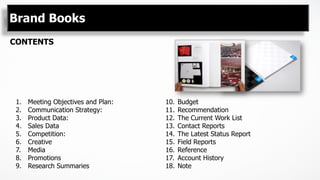
CONTENTS
1.  Meeting Objectives and Plan:
2.  Communication Strategy:
3.  Product Data:
4.  Sales Data
5.  Competition:
6.  Creative
7.  Media
8.  Promotions
9.  Research Summaries
10.  Budget
11.  Recommendation
12.  The Current Work List
13.  Contact Reports
14.  The Latest Status Report
15.  Field Reports
16.  Reference
17.  Account History
18.  Note
CREATIVE STRATEGY
17 Strategy Checkpoints
Here are some tips to keep in mind as you and your
agency hammer out a creative strategy.
1.  Make the creative strategy fit the marketing
plan
Don't let the product, price, and package go off in one
direction, while the advertising goes off in another.
The team must work in harness
2. Keep your objectives reasonable
Over ambition is the pitfall of most strategies. Don't
try to talk to everyone (instead of likely users), don't
sell a product for allocations, don't as people to
change their habits (instead of just their brand).
Changing deeply ingrained habits may be the hardest
job for advertising.
17 Strategy Checkpoints
3.  Make your strategy easy to use
It should be very short, very sharp, and leave no room for
misunderstanding. One page - with as much backup
rationale as you need.
4. Be single-minded
Great ideas are simple. Give the copywriter clear, single-
minded direction if you expect a big idea to reach the
consumer.
5. State a business objective
Recipe advertising usually means the strategy aims to build
usage of a product already in the home. The strategy has
at its heart a clear statement of the problem to be solved.
6.  Decide where your business is going to come
from
Strategies should recognize source. Unless you have a
unique new product that brings new consumer into
the market, your business generally comes out of
someone else's business.
7.  Understand your target audience
Most strategies spend too much time on product
attributes, too little on the consumer. Go beyond age
and income. Define attitude and usage patterns that
will help the copywriter talk to the most likely buyer.
17 Strategy Checkpoints
8.  Make a meaningful promise to the consumer
Your product's benefit to the consumer must be
meaningful and strong if the advertising is to do its
job.
9.  Support your promise
Do something to make your promise convincing.
10. Set yourself apart
Look for an empty niche in the market. Avoid
positioning that is exactly the same as your
competitor's. if you want to be in the same general
area as your competitor, build some element that will
see your brand apart.
17 Strategy Checkpoints
11. Give your product a distinctive personality
It is very hard to do. Many products never achieve a
"brand image" of their own. This personality goes
beyond the product itself; it is an aura that helps set
your brand apart from all others
12. Advertise what is important, not what is obvious
The right strategy is to talk about important benefits
not so apparent.
13. Think ahead
Being first is best. Being first is with something your
competitors will take a long time to imitate - a
preemptive element-is best of all. Don't underestimate
your competition.
17 Strategy Checkpoints
14. Keep your strategy up to date
Parts of your strategy-the key benefit and the personality-
should almost never change, and then only with a real
understanding of the implications of a new positioning.
But as you get new information, polish the strategy and
keep it up to date.
15. Don't change your strategy without good reason
Falling sales could result from poor executions of a good
strategy. Or new competition in the market. Take a hard
look at all aspects of your business before you think about
changing your strategy. Then, test.
17 Strategy Checkpoints
16. Put the strategy in writing
It's easy to fall in love with a new campaign, and forget
the discipline of positioning. Get your strategy statement
in writing, and refer to it. The first question to be asked of
any advertisement is: "Is it on strategy?“
17. Have a better product
Too many business and advertising people are so
convinced of the power of the advertising that they
believe it can sell anything. While great advertising can
give products a place in the market, usually there is a real
product advantage behind marketing successes. Better
advertising starts with a better product.
17 Strategy Checkpoints
The Account Executive's Role In The Creative
Process
•  Everybody agrees that it is the quality of your creative
product which, more than anything else, creates the
visibility for the Agency, puts us on Client's Shopping Lists,
and wins us new accounts.
•  Once the account is won, it is the account service persons -
not the creative people who are primarily responsible for
the servicing of the account. To use a military analogy, our
account handlers are our front line troops.
•  But it is the account executive that the client tends to
relate to, and to complain to. And it is through the account
executive that most communications are made between
Client and the Agency.
The Account Executive's Role In The
Creative Process
•  The creative process starts with a Client brief and is not
complete until the client has accepted the Agency's
recommendation and its implementation. He, the
account executive, is part of it and therefore must carry
an equal share of the responsibility.
•  So the account executive's responsibility starts with the
advertising brief and he must ensure that the execution
reflects the strategy.
THANK YOU
Edwin	
  Irvanus	
  (sukmolelono@gmail.com)	
  
Laode	
  Iman	
  Tauffany	
  (itauffany@gmail.com)	
  

Account Management 101

  • 1.
    ACCOUNT MANAGEMENT 101 ByEdwin Irvanus & Laode Iman Tauffany
  • 2.
    WHAT IS ACCOUNTMANAGEMENT •  There have been thousands of definitions what an account handler is. We prefer to define what makes a good account handler. It is that person who finds out what the client needs, and then does the best job possible to get the client to do it. •  A good account handler can analyze a problem to its core, direct the creative firepower of the agency precisely at the core, and respond to and participate in the creative answers to that problem. •  Not "find out what the client wants" but "find out what the client needs".
  • 3.
    THE ACCOUNT TEAM 1. The team comprises a maximum of four levels: •  Group Account Director, •  Account Director, •  Account Supervisor and •  Account Executive. 2.  It is the account team's overall responsibility to understand the marketing needs of its client's business and co-ordinate the Media and Creative department in the development of effective advertising. It achieves this by preparing an advertising strategy in tandem with the client. It then ensures this is adhered to, as by definition, effective advertising must be on-strategy. 3.  The account team in essence manages the Agency's clients and depending on the size and complexity of each client, an individual can expect to work on anything from one to six accounts. 4.  Clearly the job function of each team member will alter according to his/her level.
  • 4.
    GENERAL RESPONSIBILITIES OFTHE ACCOUNT GROUP 1.  The account manager represents the agency to the client, and the client to the agency. 2.  The account group should create a climate that breeds outstanding creative work. 3.  The account manager must provide information. Facts about the product, the market, the target audience. 4.  The first requirement for great advertising is a great strategy - one that is simple and persuasive. One the creative group can embrace. 5.  Creative thinking requires time. The account supervisor must provide the time in which big ideas can be conceived and grow.
  • 5.
    6.  The accountmanager should show faith by leaving the creative team alone to do its work. 7.  An essential skill is developing and evaluating copy. The account manager should be a student of advertising, able to comment knowledgeably (rather than nit-pick). GENERAL RESPONSIBILITIES OF THE ACCOUNT GROUP
  • 6.
    8.  Creative workand creative people must be protected from too many meetings that waste time and erode advertising ideas. 9.  Once the agency recommendation is settled, the account manager is responsible for organizing the most persuasive way of presenting the agency's work. 10.  One mark of a good account partner is the courage to support original ideas. GENERAL RESPONSIBILITIES OF THE ACCOUNT GROUP
  • 7.
  • 8.
    Principles of AccountManagement 19 key principles of account management 1.  Stay Involved In Your Client's Business His business is your business. You should know as much as he does about his product and its marketing. This will earn his respect as well as make you a partner in his business. 2.  Keep Your Client's Sale Healthy Identify the key factors to your client's business success and work on them. Good advertising usually goes hand in hand with good sales results. 3.  First Earn Your Client's Respect. Love Will Follow. Do your homework, prepare your point of view, and present it with conviction. But be willing to admit you are wrong when the logic is on the other side.
  • 9.
    4.  Respect yourclient. Learn to appreciate their problems. There is no faster way to kill a client-agency relationship than to have an account man "bad mouthing" his client in the agency, showing in his manner with the client that he doesn't respect him. 5.  Make your client look good Help your client look good in his company. The better he looks, the better you and the agency look. And he will become a better friend for it. 6.  Stay ahead of your client Anticipate. Lead. Keep the initiative. Think ahead about the important as well as solving the urgent problems of the day. Principles of Account Management 19 key principles of account management
  • 10.
    7.  Stay outof client politics Avoid taking sides in internal client hassles. Be objective and honest. Stick to business rather than people. 8.  Ideas are your business Not only advertising ideas, but product, packaging, promotion or other ideas that will build client sales. New product ideas really tell a client you are committed to his growth. 9.  Have guts Be willing to err for an idea or unpopular view. No risks, no big gains. Put your ego on the table when your instincts tell you that your idea has potential or that the majority is wrong. Principles of Account Management 19 key principles of account management
  • 11.
    10. Be responsible. Never assumethat something will happen unless you have made sure it will happen. Button down details. Check and double-check. Rehearse. Follow up. Worry. 11. Work hard with competitive urgency. The more your capacity increases. The more you idle, the more difficult it is to get anything done well or on time. There are a lot of smart people in advertising. The hard workers succeed. 12. Be task oriented, more than people Don't rely on secondary or tertiary sources about your market. Talk to consumer, work with salesmen, and meet retailers or others in the channels of distribution. Principles of Account Management 19 key principles of account management
  • 12.
    13. Learn to bea good salesman A great idea isn't anything until it is sold. Learn to persuade. Don't be tricky in your presentation. You must be able to sell your ideas or point of view 14. Learn to be an excellent communicator You must be able to write and present well. These traits are acquired, not inherited. Practice. 15. Put it on paper, but be brief Nobody likes excess paper work. But there is no better discipline for thinking out a problem than a short memo (long, rambling documents are easy to write to put it on one page is tough). Put your major recommendations to clients on paper. Principles of Account Management 19 key principles of account management
  • 13.
    16. Inform and involvethe agency in your account Encourage everyone working on your account in the agency to contribute as a generalist rather than solely in a specialist capacity. This is best done in small face-to-face meeting. 17.  Build the faith with your creative brothers Help get great advertising on your account by building a good relationship with your creative counterparts. You must sense the needs of the writer and the artist. You must protect them from difficult clients. Principles of Account Management 19 key principles of account management
  • 14.
    18. You are speakingfor the agency - not for yourself Your client is hiring the agency you work for, not you. The client assumes your recommendations are those of the agency. You must work with all departments and hammer out an agency agreement. 19. If you want to grow, learn to let go Hire the best people you can find. Train them. then let them fly. Learn to hope the client will call them, not you. As they grow, you grow. Principles of Account Management 19 key principles of account management
  • 15.
    1.  Account handlersare very important people, and a lot is expected of them. 2.  The eight most important things, which is expected from an account Handler, and upon which performance will be largely evaluated: Have You Done Your Homework : The Brand Book §  Above   all,   hold   yourself   responsible   for   genera5ng   the   best  crea5ve  work  in  your  client's  category.   §  Know   your   client's   consumer   be>er   than   anybody   else   does.   §  Be  an  expert  in  your  client's  business   §  Generate  well  thought-­‐out  strategies   §  Surprise  your  client  with  ideas  to  build  his  business   §  Be  the  best  briefer  in  the  agency   §  Be  able  to  account  for  every  Rp.  spent  by  the  agency  for   your  client   §  Create   a   produc5ve   team   environment   involving   your   crea5ve  and  media  partners  and  your  client.  
  • 16.
    •  They arealways associated with great creative work •  They always have the respect of their creative colleagues •  Their clients love them •  They always have the respect of their media colleagues. How to Recognize a Good Account Handler
  • 17.
    A Good AccountHandler Is an Efficient Administrator
  • 18.
    The Account Handler'sKey Objective 1.  It is their entire responsibility to make sure that sensational, distinctive and relevant creative work is consistently produced for their clients. 2.  One of the characteristics of a good Account Handler is that he is an efficient administrator. 3.  Administrator isn't God-given asset. It must be learned and every Account Handler simply has to be superb at it. 4.  There are several pieces of formulized documentation that are mandatory. They must be used for every client, and in some cases for every job this will be evident in each description.
  • 19.
    Brand Book Purpose •  Thebrand book is simply a collection of the basic, central facts about a brand. These are put together in one easily portable volume. The aim is to give a clear picture of the account as it currently stands. •  We have brand books for two main reasons: •  They make life easier. Whether you are in a meeting, or writing a report at your own desk, it is extremely convenient to be able to look up the essential facts in a second or two. •  (They make the briefing of new Account Handler much simpler and any hand-over much more efficient.
  • 20.
    Brand Book These Documentsare The Brand Book Which Contains 1.  Brand Profile 2.  Marketing Strategy and Client brief 3.  Creative Strategy 4.  Quarterly Report 5.  Status Report •  The brand book is maintained and kept by the Account Executive. It should always be in a fit state for use. And it should always be taken to meetings, so that the unexpected question can be answered quickly.
  • 21.
    Brand Books CONTENTS 1.  MeetingObjectives and Plan: 2.  Communication Strategy: 3.  Product Data: 4.  Sales Data 5.  Competition: 6.  Creative 7.  Media 8.  Promotions 9.  Research Summaries 10.  Budget 11.  Recommendation 12.  The Current Work List 13.  Contact Reports 14.  The Latest Status Report 15.  Field Reports 16.  Reference 17.  Account History 18.  Note
  • 22.
  • 23.
    17 Strategy Checkpoints Hereare some tips to keep in mind as you and your agency hammer out a creative strategy. 1.  Make the creative strategy fit the marketing plan Don't let the product, price, and package go off in one direction, while the advertising goes off in another. The team must work in harness 2. Keep your objectives reasonable Over ambition is the pitfall of most strategies. Don't try to talk to everyone (instead of likely users), don't sell a product for allocations, don't as people to change their habits (instead of just their brand). Changing deeply ingrained habits may be the hardest job for advertising.
  • 24.
    17 Strategy Checkpoints 3. Make your strategy easy to use It should be very short, very sharp, and leave no room for misunderstanding. One page - with as much backup rationale as you need. 4. Be single-minded Great ideas are simple. Give the copywriter clear, single- minded direction if you expect a big idea to reach the consumer. 5. State a business objective Recipe advertising usually means the strategy aims to build usage of a product already in the home. The strategy has at its heart a clear statement of the problem to be solved.
  • 25.
    6.  Decide whereyour business is going to come from Strategies should recognize source. Unless you have a unique new product that brings new consumer into the market, your business generally comes out of someone else's business. 7.  Understand your target audience Most strategies spend too much time on product attributes, too little on the consumer. Go beyond age and income. Define attitude and usage patterns that will help the copywriter talk to the most likely buyer. 17 Strategy Checkpoints
  • 26.
    8.  Make ameaningful promise to the consumer Your product's benefit to the consumer must be meaningful and strong if the advertising is to do its job. 9.  Support your promise Do something to make your promise convincing. 10. Set yourself apart Look for an empty niche in the market. Avoid positioning that is exactly the same as your competitor's. if you want to be in the same general area as your competitor, build some element that will see your brand apart. 17 Strategy Checkpoints
  • 27.
    11. Give your producta distinctive personality It is very hard to do. Many products never achieve a "brand image" of their own. This personality goes beyond the product itself; it is an aura that helps set your brand apart from all others 12. Advertise what is important, not what is obvious The right strategy is to talk about important benefits not so apparent. 13. Think ahead Being first is best. Being first is with something your competitors will take a long time to imitate - a preemptive element-is best of all. Don't underestimate your competition. 17 Strategy Checkpoints
  • 28.
    14. Keep your strategyup to date Parts of your strategy-the key benefit and the personality- should almost never change, and then only with a real understanding of the implications of a new positioning. But as you get new information, polish the strategy and keep it up to date. 15. Don't change your strategy without good reason Falling sales could result from poor executions of a good strategy. Or new competition in the market. Take a hard look at all aspects of your business before you think about changing your strategy. Then, test. 17 Strategy Checkpoints
  • 29.
    16. Put the strategyin writing It's easy to fall in love with a new campaign, and forget the discipline of positioning. Get your strategy statement in writing, and refer to it. The first question to be asked of any advertisement is: "Is it on strategy?“ 17. Have a better product Too many business and advertising people are so convinced of the power of the advertising that they believe it can sell anything. While great advertising can give products a place in the market, usually there is a real product advantage behind marketing successes. Better advertising starts with a better product. 17 Strategy Checkpoints
  • 30.
    The Account Executive'sRole In The Creative Process •  Everybody agrees that it is the quality of your creative product which, more than anything else, creates the visibility for the Agency, puts us on Client's Shopping Lists, and wins us new accounts. •  Once the account is won, it is the account service persons - not the creative people who are primarily responsible for the servicing of the account. To use a military analogy, our account handlers are our front line troops. •  But it is the account executive that the client tends to relate to, and to complain to. And it is through the account executive that most communications are made between Client and the Agency.
  • 31.
    The Account Executive'sRole In The Creative Process •  The creative process starts with a Client brief and is not complete until the client has accepted the Agency's recommendation and its implementation. He, the account executive, is part of it and therefore must carry an equal share of the responsibility. •  So the account executive's responsibility starts with the advertising brief and he must ensure that the execution reflects the strategy.
  • 32.
    THANK YOU Edwin  Irvanus  (sukmolelono@gmail.com)   Laode  Iman  Tauffany  (itauffany@gmail.com)