SOLVING A BIOLOGICAL PROBLEMS
Class 9th Biology Chapter 02
Youtube/Pointbiology
CHAPTER 02
©
Pointbiology
INTRODUCTION:
• Biology helped us to know the cause and cure of many disease.
• There is nothing magical about science.
• You are curious, like new and different thing?
• You are scientist… !
• Needed to use scientific method.
©
Pointbiology
BIOLOGICAL METHOD:
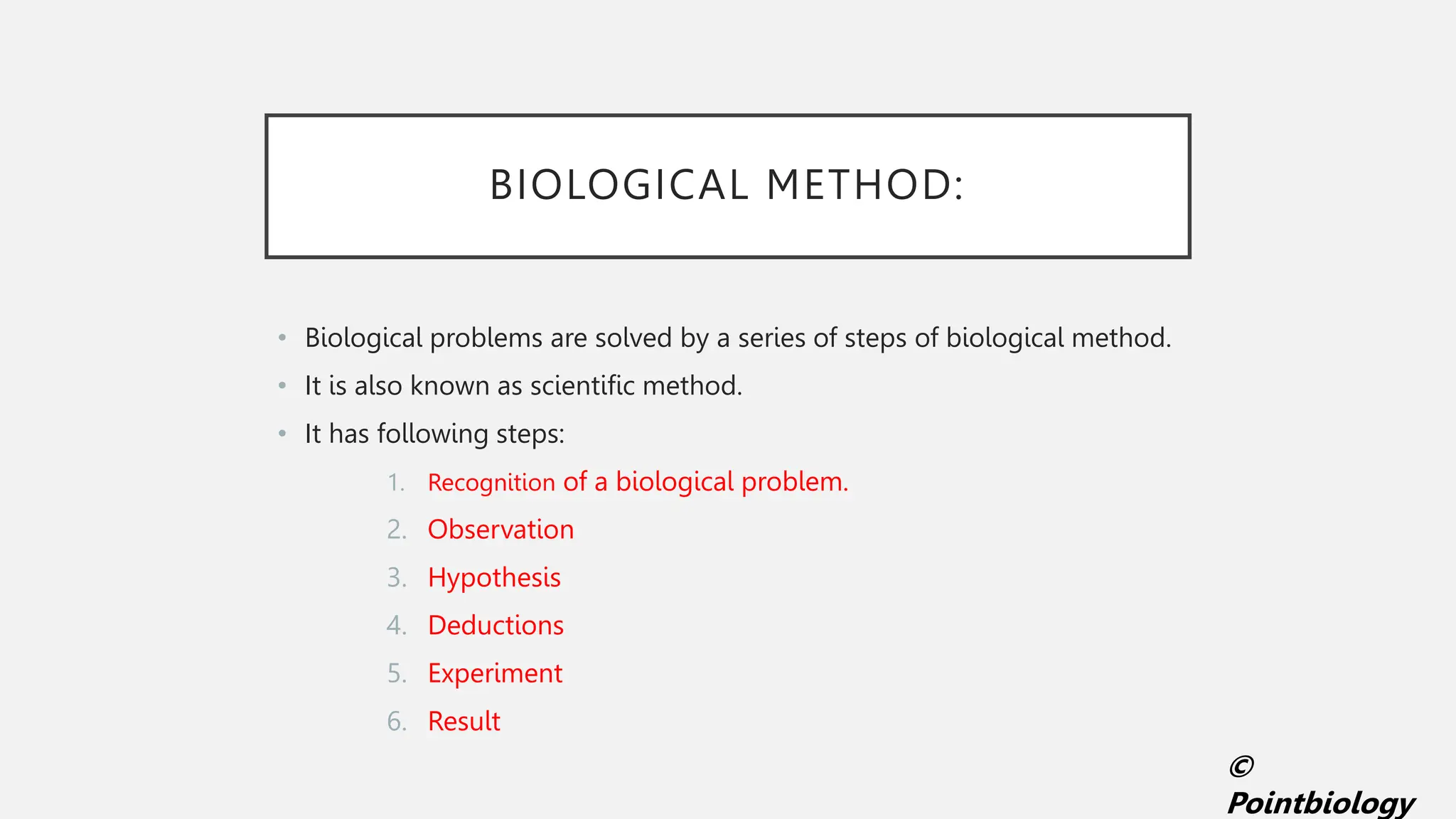
• Biological problems are solved by a series of steps of biological method.
• It is also known as scientific method.
• It has following steps:
1. Recognition of a biological problem.
2. Observation
3. Hypothesis
4. Deductions
5. Experiment
6. Result
©
Pointbiology
1. RECOGNITION OF
BIOLOGICAL PROBLEMS
• It is a question related to living
organisms
• Either asked by someone
• Comes in mind of researcher.
• How ?
• When ?
• Where ?
• Why ?
• What ? Etc.
E.g., Malaria was a problem since
ancient times. But the cause was not
known. So, the problem is what is
the cause of Malaria.
©
Pointbiology
2.OBSERVATIONS
• Observation are made by FIVE senses.
1. Vision
2. Hearing
3. Smell
4. Taste
5. Touch
• There are two types of observation.
1. Qualitative observations
2. Quantitative observations.
There were FOUR major Observation about malaria:
1. 1. Malaria and marshy areas have some relation.
2. 2. Quinine is an effective drug for treating malaria.
3. 3. Drinking the water of marshes does not cause
malaria.
4. 4.Plasmodium is seen in the blood of malarial
patients. Based on
quality e.g., hot
water
Based on
measurable
value e.g., 1L of
water
©
Pointbiology
3. FORMULATION OF
HYPOTHESIS
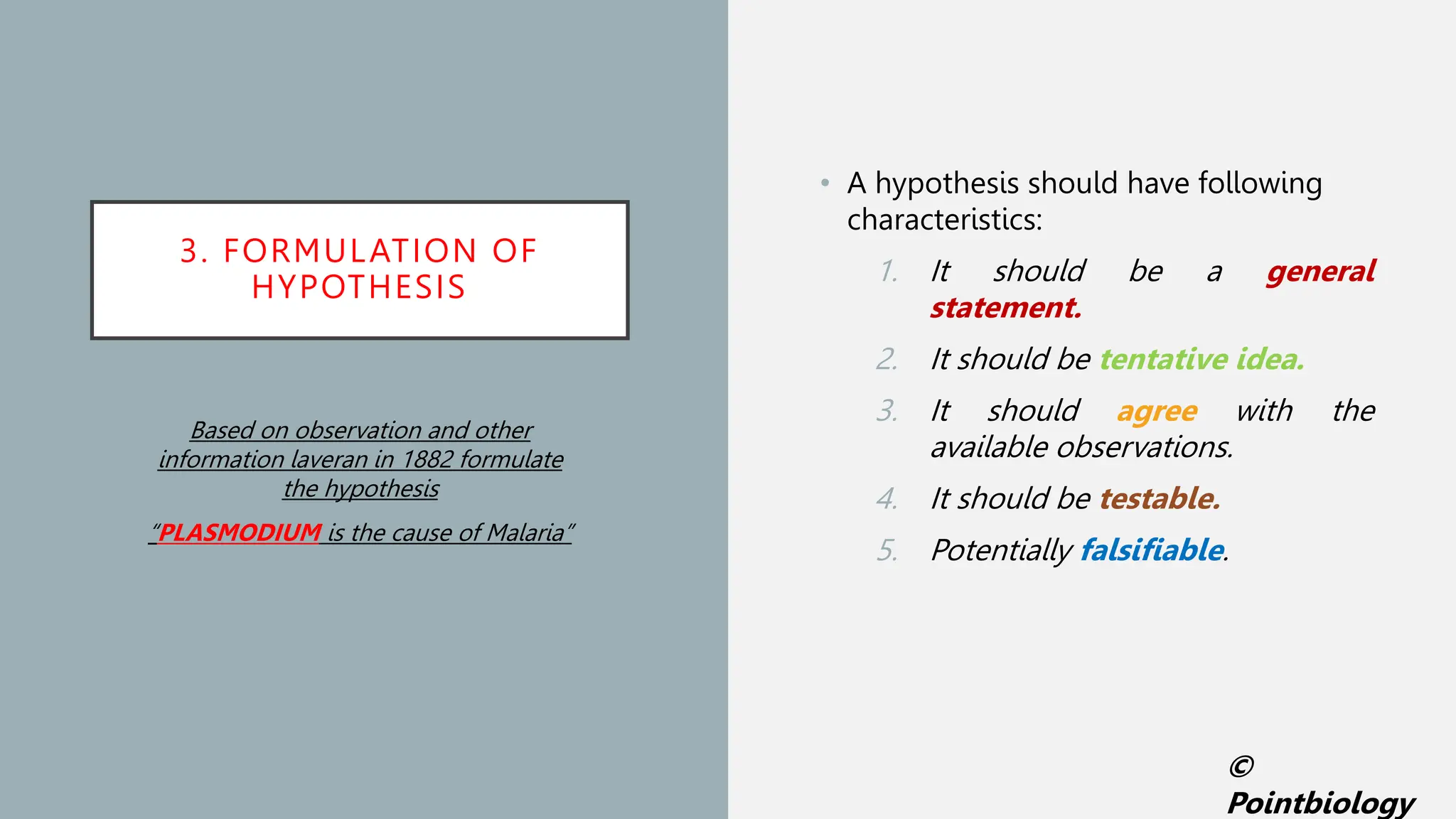
• A hypothesis should have following
characteristics:
1. It should be a general
statement.
2. It should be tentative idea.
3. It should agree with the
available observations.
4. It should be testable.
5. Potentially falsifiable.
Based on observation and other
information laveran in 1882 formulate
the hypothesis
“PLASMODIUM is the cause of Malaria”
©
Pointbiology
4. DEDUCTIONS
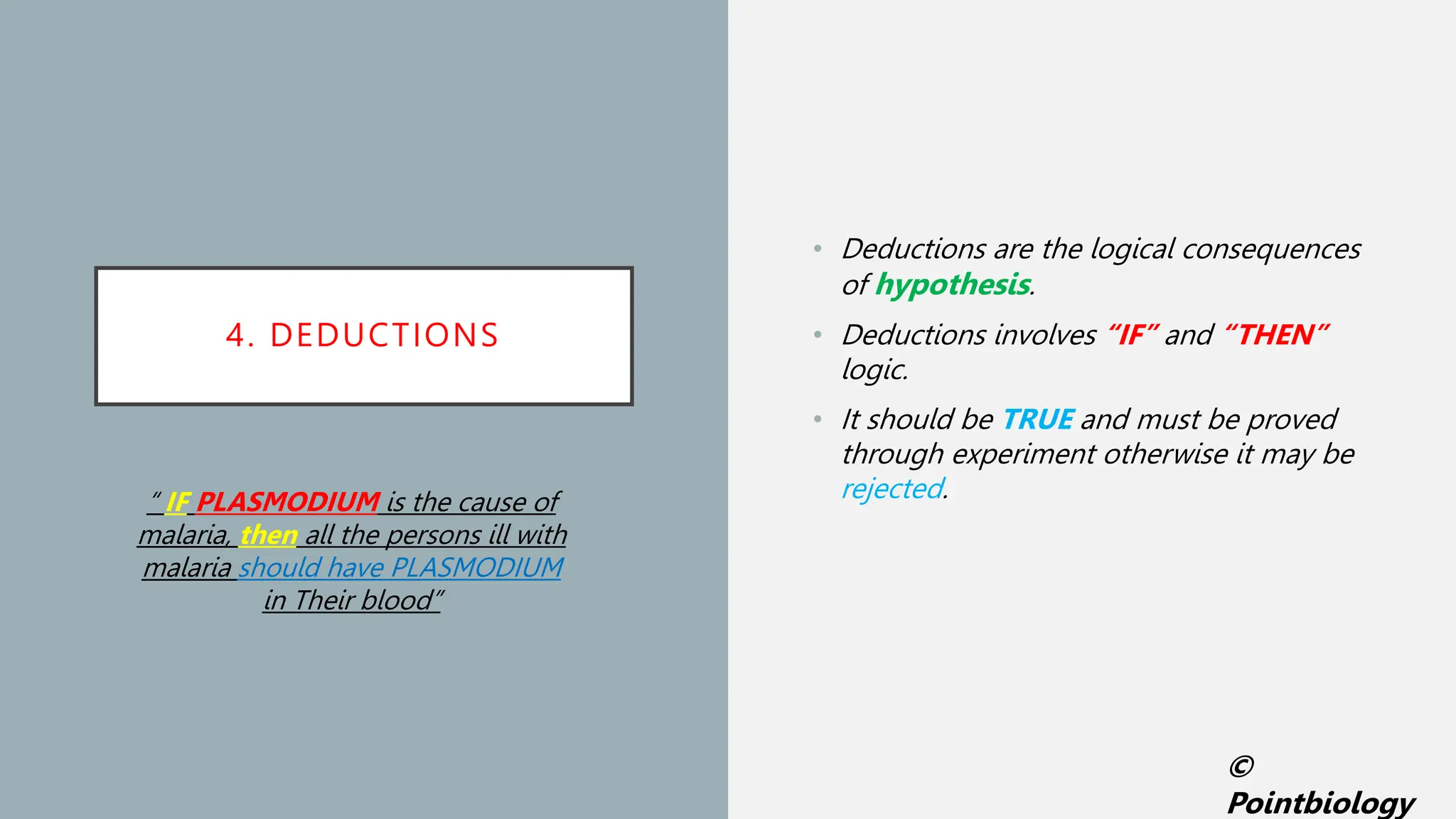
• Deductions are the logical consequences
of hypothesis.
• Deductions involves “IF” and “THEN”
logic.
• It should be TRUE and must be proved
through experiment otherwise it may be
rejected.
“ IF PLASMODIUM is the cause of
malaria, then all the persons ill with
malaria should have PLASMODIUM
in Their blood”
©
Pointbiology
5.EXPERIMENTATION
• Experiment are performed to prove if
hypothesis is true or not.
• The deductions drawn from
experiment are subjected to rigorous
testing.
• Through experimentation, biologist
learns which hypothesis is correct.
Blood of 100 patients was
examined under microscope. The
results shows that almost all
malarial patients had
PLASMODIUM in their blood.
©
Pointbiology
6.SUMMARIZATION OF
RESULTS
• Actual quantitative data from
experiment.
• This data arranged to draw results.
Result was quite convincing to
prove the hypothesis that
“PLASMODIUM is the cause of
malaria”
©
Pointbiology
SEE YOU IN THE NEXT VIDEO...
©
Pointbiology

9th Biology chapter 02. Solving a biological problemspptx

  • 1.
    SOLVING A BIOLOGICALPROBLEMS Class 9th Biology Chapter 02 Youtube/Pointbiology CHAPTER 02 © Pointbiology
  • 2.
    INTRODUCTION: • Biology helpedus to know the cause and cure of many disease. • There is nothing magical about science. • You are curious, like new and different thing? • You are scientist… ! • Needed to use scientific method. © Pointbiology
  • 3.
    BIOLOGICAL METHOD: • Biologicalproblems are solved by a series of steps of biological method. • It is also known as scientific method. • It has following steps: 1. Recognition of a biological problem. 2. Observation 3. Hypothesis 4. Deductions 5. Experiment 6. Result © Pointbiology
  • 4.
    1. RECOGNITION OF BIOLOGICALPROBLEMS • It is a question related to living organisms • Either asked by someone • Comes in mind of researcher. • How ? • When ? • Where ? • Why ? • What ? Etc. E.g., Malaria was a problem since ancient times. But the cause was not known. So, the problem is what is the cause of Malaria. © Pointbiology
  • 5.
    2.OBSERVATIONS • Observation aremade by FIVE senses. 1. Vision 2. Hearing 3. Smell 4. Taste 5. Touch • There are two types of observation. 1. Qualitative observations 2. Quantitative observations. There were FOUR major Observation about malaria: 1. 1. Malaria and marshy areas have some relation. 2. 2. Quinine is an effective drug for treating malaria. 3. 3. Drinking the water of marshes does not cause malaria. 4. 4.Plasmodium is seen in the blood of malarial patients. Based on quality e.g., hot water Based on measurable value e.g., 1L of water © Pointbiology
  • 6.
    3. FORMULATION OF HYPOTHESIS •A hypothesis should have following characteristics: 1. It should be a general statement. 2. It should be tentative idea. 3. It should agree with the available observations. 4. It should be testable. 5. Potentially falsifiable. Based on observation and other information laveran in 1882 formulate the hypothesis “PLASMODIUM is the cause of Malaria” © Pointbiology
  • 7.
    4. DEDUCTIONS • Deductionsare the logical consequences of hypothesis. • Deductions involves “IF” and “THEN” logic. • It should be TRUE and must be proved through experiment otherwise it may be rejected. “ IF PLASMODIUM is the cause of malaria, then all the persons ill with malaria should have PLASMODIUM in Their blood” © Pointbiology
  • 8.
    5.EXPERIMENTATION • Experiment areperformed to prove if hypothesis is true or not. • The deductions drawn from experiment are subjected to rigorous testing. • Through experimentation, biologist learns which hypothesis is correct. Blood of 100 patients was examined under microscope. The results shows that almost all malarial patients had PLASMODIUM in their blood. © Pointbiology
  • 9.
    6.SUMMARIZATION OF RESULTS • Actualquantitative data from experiment. • This data arranged to draw results. Result was quite convincing to prove the hypothesis that “PLASMODIUM is the cause of malaria” © Pointbiology
  • 10.
    SEE YOU INTHE NEXT VIDEO... © Pointbiology