CELLULAR
Organization
 Cells organize in three ways to make the
bodies of organisms…
Unicellular organization
Colonial organization
Multicellular organization
Unicellular Organization
 “uni-” = one
““Only one cell make the life of anOnly one cell make the life of an
organism.”organism.”
All the life activities are carried outAll the life activities are carried out
by the only cell.by the only cell.
ExampleExample::
 Prokaryotes are unicellular
organisms
Colonial organization
Many unicellular organisms live
together but do not have any division
of labour among them.
Each unicellular organism in a
colony live its own life and does not
depend on other cells for its vital
requirements.
Volvox,
a green alga
live in water
Multicellular Organisms
 “multi-” = more than one
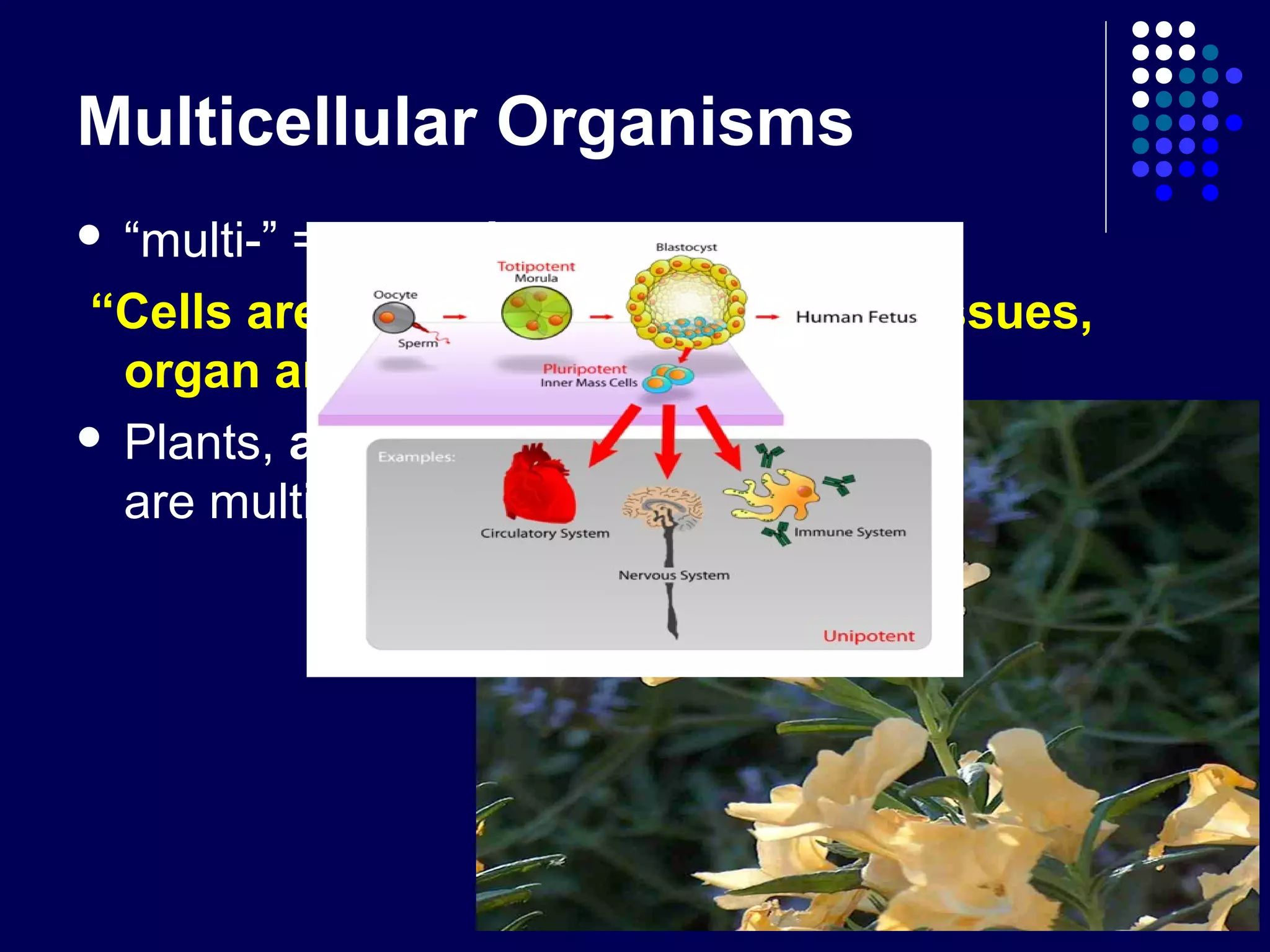
“Cells are organized in the form of tissues,
organ and organ system.”
 Plants, animals, some protists, and most fungi
are multicellular
Multi….
Example:
 Frog
 Mustard
Multicellular Characteristics
 Larger size = have less predators and have more
options of things to eat
 Longer life – organism will continue to live even if
a single cell dies
Multi…
Mustard plant
(Brassica compestris)
 It is sown in winter.
 It produces seed at the end of
winter.
Two groups
 The organs of the body is divided into two
groups
Vegetative organs
Reproductive organs
Root
Stem
Branches
leaves
flower
FROG
(Rana tigrina)
 The body is made up of organ system
 Each organ system consist of related organs.
 All organs are made of specific tissues
 Epithelial
 Glandular
 Muscular
 nervous

6 cellular organization