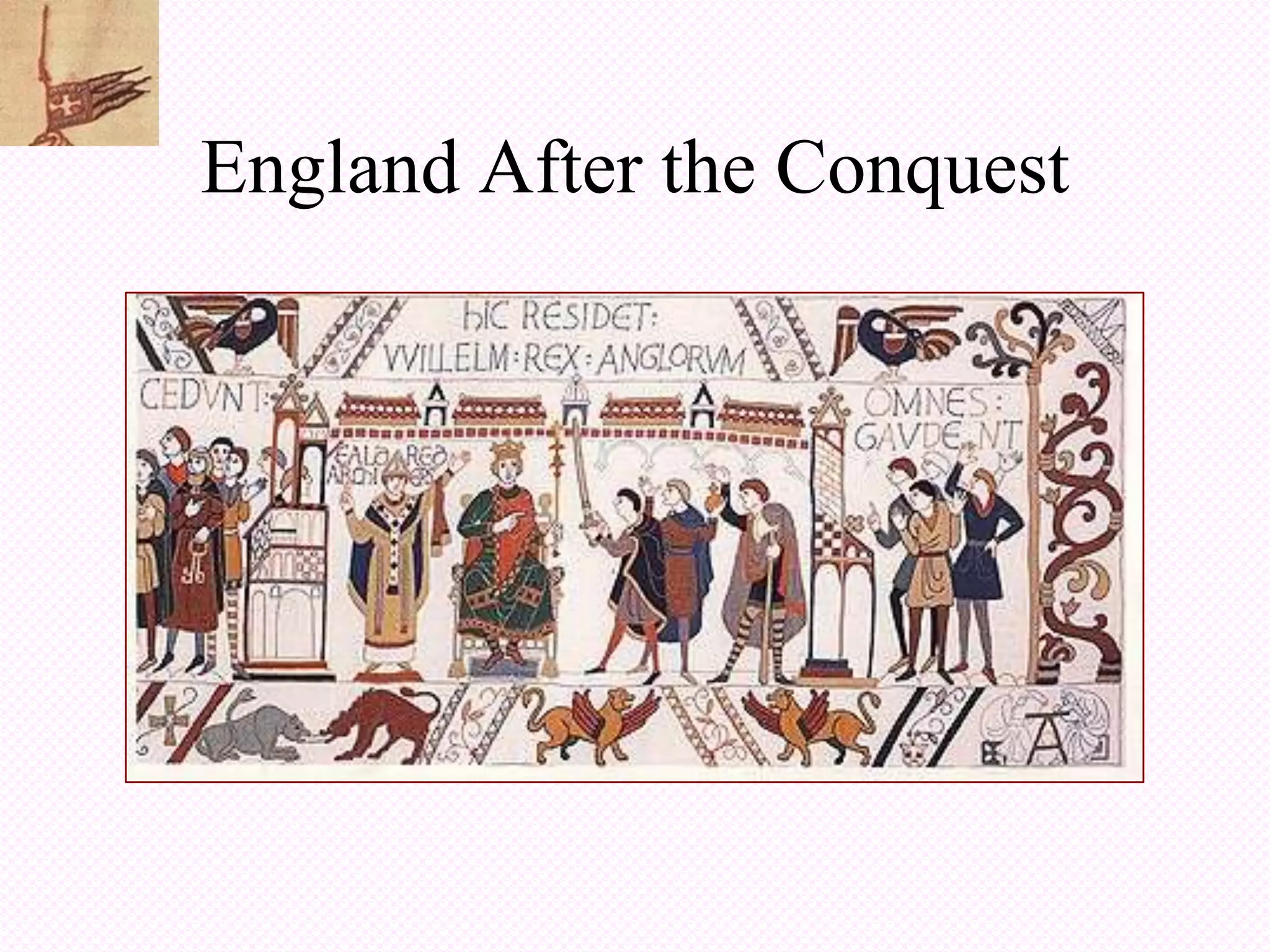
England After the Conquest
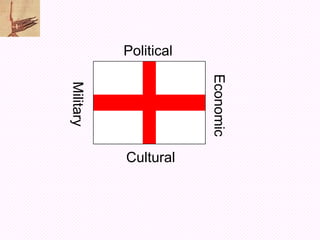
Political


                       Economic
Military


           Cultural
Some Themes (1066-1327)
• Problem of succession
• Development of Common Law
• Distribution of power
  – King
  – Nobles
  – Commoners
Some Themes (1066-1327+)
• King vs. Church; England vs. Rome
• England vs. France
Legacy – Pre-Conquest England
•   Tax system – Danegeld, heregeld
•   Shiring
•   Cities
•   Law – Charters in the vernacular
•   Concentration of land ownership
•   Agricultural advancements
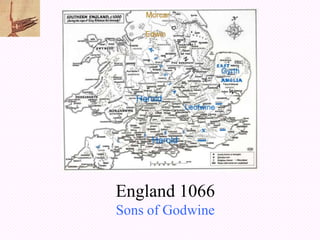
England 1066
Sons of Godwine
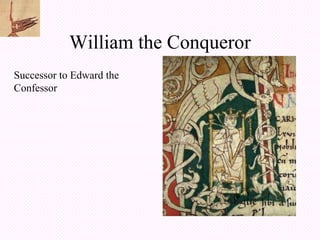
William the Conqueror
Successor to Edward the
Confessor
William the Rightful Successor
• …above all else the one God to be venerated
  throughout his entire kingdom; the one Christian
  faith always to be kept inviolate; peace and
  security to be maintained between Englishmen and
  Normans
• … I wish and enjoin: that in [cases affecting]
  lands, as in all other matters, all shall keep and
  hold the law of King Edward, with the addition of
  those [amendments] which I have made for the
  benefit of the English people
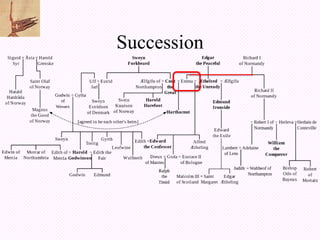
Succession
Succession - Different Customs
Normandy
   A bequest, made formally, in the presence of
   witnesses, it could not legally be revoked
England
   Verba novissima An act made on one's death-bed, in
   extremis, was taken to supersede previous donations
   of the same property

John S. Beckerman “Succession in Normandy, 1087, and in
England, 1066: The Role of Testamentary Custom”
Speculum, Vol. 47, No. 2 (Apr., 1972), pp. 258-260
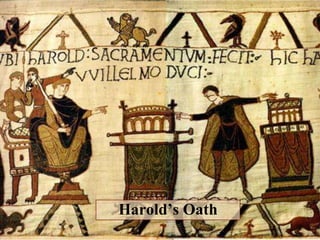
Harold’s Oath
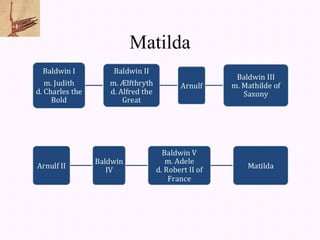
Matilda
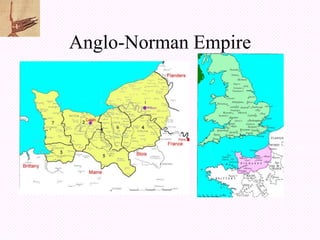
Anglo-Norman Empire
Feudalism
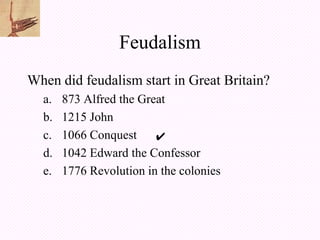
When did feudalism start in Great Britain?
  a.   873 Alfred the Great
  b.   1215 John
  c.   1066 Conquest ✔
  d.   1042 Edward the Confessor
  e.   1776 Revolution in the colonies
Feudalism
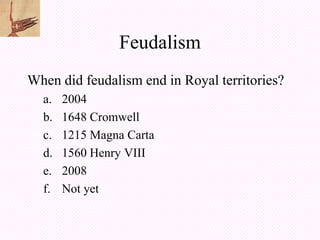
When did feudalism end in Royal territories?
  a.   2004
  b.   1648 Cromwell
  c.   1215 Magna Carta
  d.   1560 Henry VIII
  e.   2008
  f.   Not yet
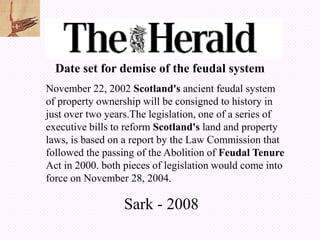
Date set for demise of the feudal system
November 22, 2002 Scotland's ancient feudal system
of property ownership will be consigned to history in
just over two years.The legislation, one of a series of
executive bills to reform Scotland's land and property
laws, is based on a report by the Law Commission that
followed the passing of the Abolition of Feudal Tenure
Act in 2000. both pieces of legislation would come into
force on November 28, 2004.

                  Sark - 2008
Royal Finances - Feudal
• ‘Aids’
  – knighthood, marriage, ransom
• Relief
  – Payments on inheritance
  – Marriage, wardship
• Scutage
Royal Finances – Non-feudal
• Geld
  – land based tax
• Income from royal demesne
  – rent
  – sale of crops and livestock
• Tallage
  – tax imposed upon residents of King’s land,
    townsmen and Jews
Royal Finances – Judicial
• Judicial writs        Enforcement
• Fines            • Foresters
• Forest           • Sheriffs
Choices for the Anglo-Saxons
• Capture
  – gentile confinement
  – monastery
• Flee
  –   Scotland
  –   Flanders
  –   Scandinavia
  –   Byzantium
Choices for the Anglo-Saxons
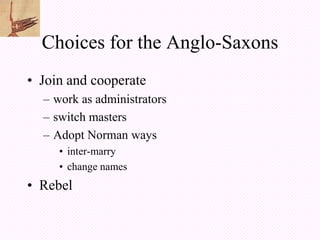
• Join and cooperate
  – work as administrators
  – switch masters
  – Adopt Norman ways
     • inter-marry
     • change names
• Rebel
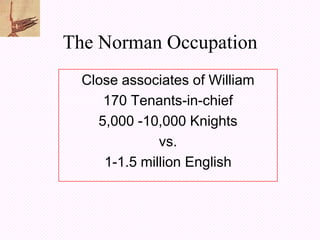
The Norman Occupation
  Close associates of William
     170 Tenants-in-chief
    5,000 -10,000 Knights
              vs.
     1-1.5 million English
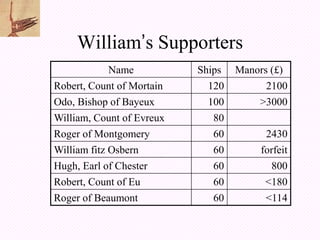
William’s Supporters
           Name            Ships   Manors (£)
Robert, Count of Mortain     120         2100
Odo, Bishop of Bayeux        100        >3000
William, Count of Evreux      80
Roger of Montgomery           60         2430
William fitz Osbern           60        forfeit
Hugh, Earl of Chester         60           800
Robert, Count of Eu           60         <180
Roger of Beaumont             60         <114
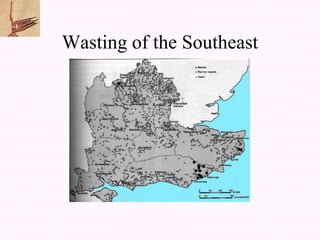
Wasting of the Southeast
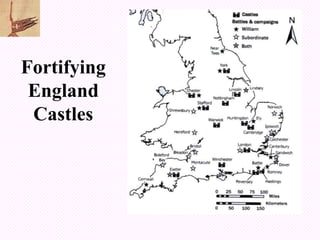
Fortifying
 England
 Castles
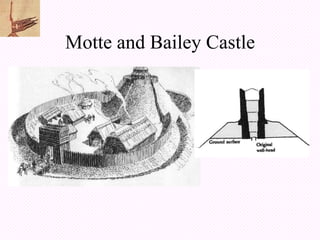
Motte and Bailey
Motte and Bailey Castle
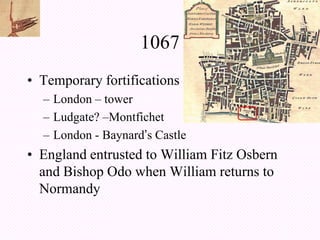
1067
• Temporary fortifications
  – London – tower
  – Ludgate? –Montfichet
  – London - Baynard’s Castle
• England entrusted to William Fitz Osbern
  and Bishop Odo when William returns to
  Normandy
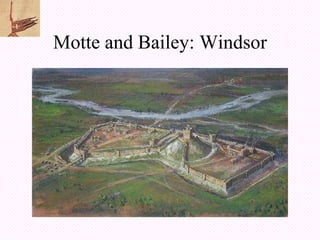
Motte and Bailey: Windsor
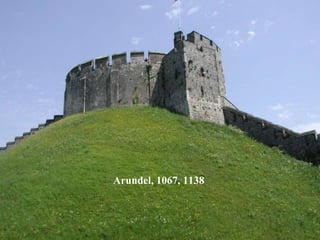
Arundel, 1067, 1138
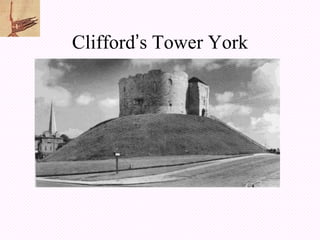
Clifford’s Tower York
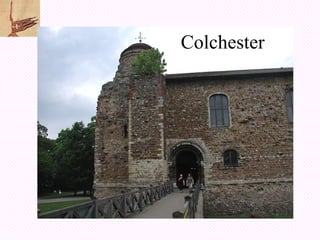
Colchester
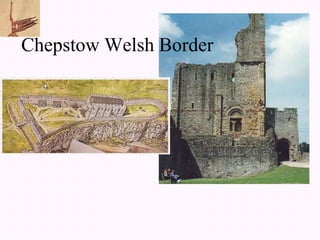
Chepstow Welsh Border
Expanding Territory
             Fighting Rebels
• Anglo-Saxon holdouts
  –   Danish allies
  –   Norse allies
  –   Welsh allies
  –   Scottish allies
• Disgruntled Normans

1 S2013 England after the Conquest

  • 1.
  • 2.
    Political Economic Military Cultural
  • 3.
    Some Themes (1066-1327) •Problem of succession • Development of Common Law • Distribution of power – King – Nobles – Commoners
  • 4.
    Some Themes (1066-1327+) •King vs. Church; England vs. Rome • England vs. France
  • 5.
    Legacy – Pre-ConquestEngland • Tax system – Danegeld, heregeld • Shiring • Cities • Law – Charters in the vernacular • Concentration of land ownership • Agricultural advancements
  • 6.
  • 7.
    William the Conqueror Successorto Edward the Confessor
  • 8.
    William the RightfulSuccessor • …above all else the one God to be venerated throughout his entire kingdom; the one Christian faith always to be kept inviolate; peace and security to be maintained between Englishmen and Normans • … I wish and enjoin: that in [cases affecting] lands, as in all other matters, all shall keep and hold the law of King Edward, with the addition of those [amendments] which I have made for the benefit of the English people
  • 9.
  • 10.
    Succession - DifferentCustoms Normandy A bequest, made formally, in the presence of witnesses, it could not legally be revoked England Verba novissima An act made on one's death-bed, in extremis, was taken to supersede previous donations of the same property John S. Beckerman “Succession in Normandy, 1087, and in England, 1066: The Role of Testamentary Custom” Speculum, Vol. 47, No. 2 (Apr., 1972), pp. 258-260
  • 11.
  • 12.
  • 13.
  • 14.
    Feudalism When did feudalismstart in Great Britain? a. 873 Alfred the Great b. 1215 John c. 1066 Conquest ✔ d. 1042 Edward the Confessor e. 1776 Revolution in the colonies
  • 15.
    Feudalism When did feudalismend in Royal territories? a. 2004 b. 1648 Cromwell c. 1215 Magna Carta d. 1560 Henry VIII e. 2008 f. Not yet
  • 16.
    Date set fordemise of the feudal system November 22, 2002 Scotland's ancient feudal system of property ownership will be consigned to history in just over two years.The legislation, one of a series of executive bills to reform Scotland's land and property laws, is based on a report by the Law Commission that followed the passing of the Abolition of Feudal Tenure Act in 2000. both pieces of legislation would come into force on November 28, 2004. Sark - 2008
  • 17.
    Royal Finances -Feudal • ‘Aids’ – knighthood, marriage, ransom • Relief – Payments on inheritance – Marriage, wardship • Scutage
  • 18.
    Royal Finances –Non-feudal • Geld – land based tax • Income from royal demesne – rent – sale of crops and livestock • Tallage – tax imposed upon residents of King’s land, townsmen and Jews
  • 19.
    Royal Finances –Judicial • Judicial writs Enforcement • Fines • Foresters • Forest • Sheriffs
  • 20.
    Choices for theAnglo-Saxons • Capture – gentile confinement – monastery • Flee – Scotland – Flanders – Scandinavia – Byzantium
  • 21.
    Choices for theAnglo-Saxons • Join and cooperate – work as administrators – switch masters – Adopt Norman ways • inter-marry • change names • Rebel
  • 22.
    The Norman Occupation Close associates of William 170 Tenants-in-chief 5,000 -10,000 Knights vs. 1-1.5 million English
  • 23.
    William’s Supporters Name Ships Manors (£) Robert, Count of Mortain 120 2100 Odo, Bishop of Bayeux 100 >3000 William, Count of Evreux 80 Roger of Montgomery 60 2430 William fitz Osbern 60 forfeit Hugh, Earl of Chester 60 800 Robert, Count of Eu 60 <180 Roger of Beaumont 60 <114
  • 24.
    Wasting of theSoutheast
  • 26.
  • 27.
  • 28.
  • 29.
    1067 • Temporary fortifications – London – tower – Ludgate? –Montfichet – London - Baynard’s Castle • England entrusted to William Fitz Osbern and Bishop Odo when William returns to Normandy
  • 30.
  • 31.
  • 32.
  • 33.
  • 34.
  • 35.
    Expanding Territory Fighting Rebels • Anglo-Saxon holdouts – Danish allies – Norse allies – Welsh allies – Scottish allies • Disgruntled Normans

Editor's Notes

  • #6 The Danegeld (pron.: /ˈdeɪn.ɡɛld/;[1] &quot;Danish tax&quot;, literally &quot;Dane Money&quot;) was a tax raised to pay tribute to the Viking raiders to save a land from being ravaged. It was called the geld or gafol in eleventh-century sources;[2] the term Danegeld did not appear until the early twelfth century.[3] It was characteristic of royal policy in both England and Francia during the ninth through eleventh centuries, collected both as tributary, to buy off the attackers, and as stipendiary, to pay the defensive forcesHeregeld A tribute or tax levied for the maintenance of an army.
  • #32 11th C. 1067c.1070 1101/2Saxon Burgh on east bank of River Arun. Roger of Montgomery granted western Sussex, established seat at Arundel, on west bank. Builds earthwork and tim- ber castle with two wards in a similar pattern to Windsor.Gatehouse built in stone. [Pulborough stone, brought down river]. Roger’s son, Robert of Bellême, rebels against Henry I. Besieged. Surrenders after 3 months. King takes over castle. Later his wife, Alice inherits castle.1138Alice marries William d’Albini (of Buck- enham and Castle Rising. D’Albinibuildsshellkeep in stone