Asymetric Distribution and Transport of
ions
The aim is to understand:
• generation of the resting potential, receptor potential, and
action potential in the excitable cells.
• Internal energy (Thermal motion) and Diffusion
• Chemical potential energy and diffusion
• The concept of flux and membrane permeability and the
relationship between them. Fick’s Law
• Osmotic pressure- Osmosis
• The movement of ions can generate electrical potential
difference across a membrane
• Concept of Equilibrium potential and Nernst equation
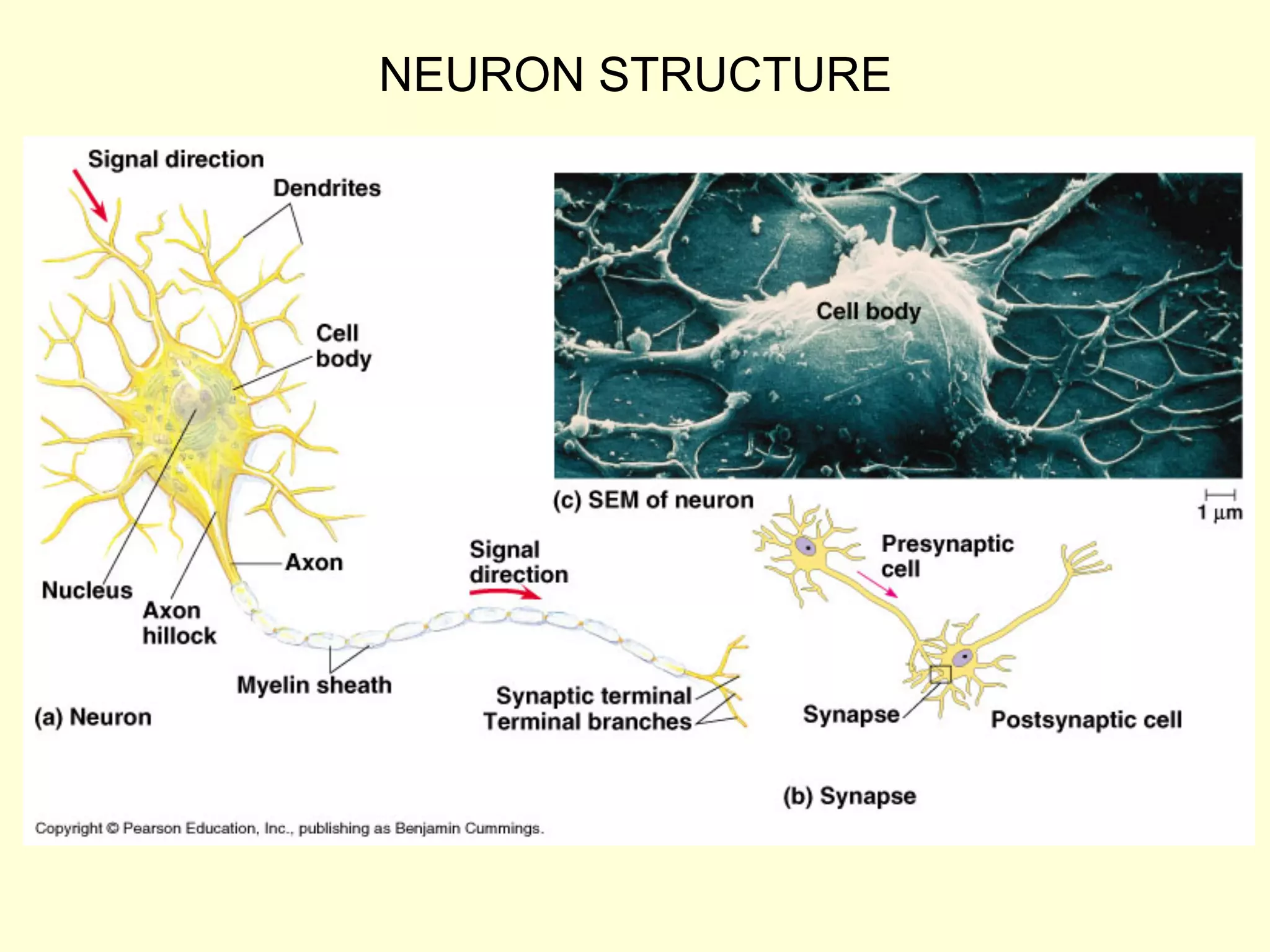
NEURON STRUCTURE
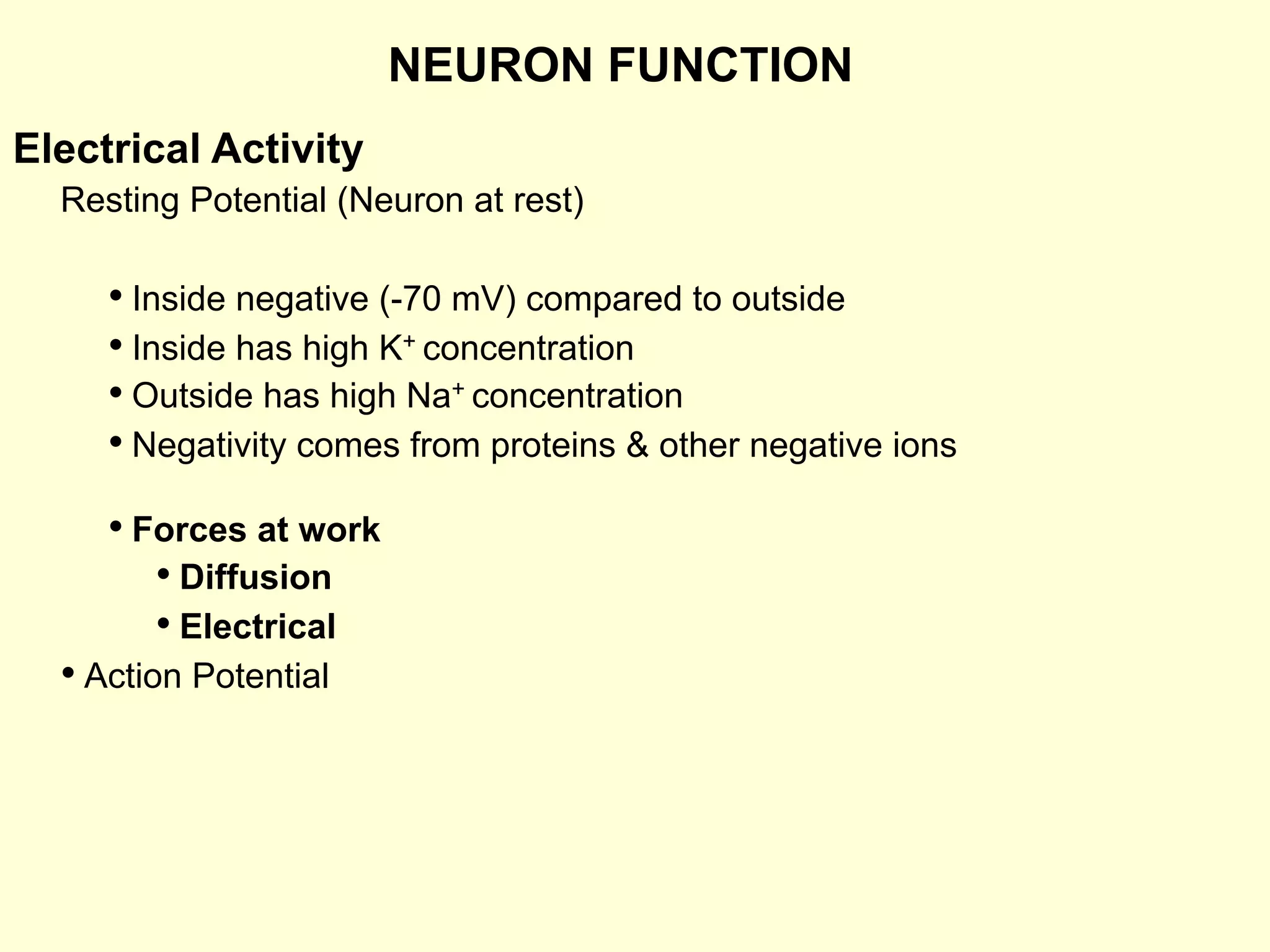
NEURON FUNCTION
Electrical Activity
Resting Potential (Neuron at rest)
• Inside negative (-70 mV) compared to outside
• Inside has high K+ concentration
• Outside has high Na+ concentration
• Negativity comes from proteins & other negative ions
• Forces at work
• Diffusion
• Electrical
• Action Potential
Chemical Potential Energy: Concentration Difference
Flow Due to a Concentration Difference is Diffusion
(Brownian Motion)
.
.
http://imc.gsm.com/demos/hpdemo/program/section1/1ch2/s1ch2_7.htm
Diffusion is the process by which molecules flow from higher
concentrations to lower concentrations.
The energy providing the force for diffusion arises from internal energy
(thermal motion) of the system. At absolute 0 degrees Kelvin (-273oC),
the thermal energy of a system is zero and the motion of all particles
stops.
At higher temperatures, the heat content of the solution causes Brownian
motion.
Diffusion of a Solute is defined by Fick’s Equation
Because of Brownian motion, there is a force (the force due to diffusion,
Fd) on each of the particles due to concentration gradient
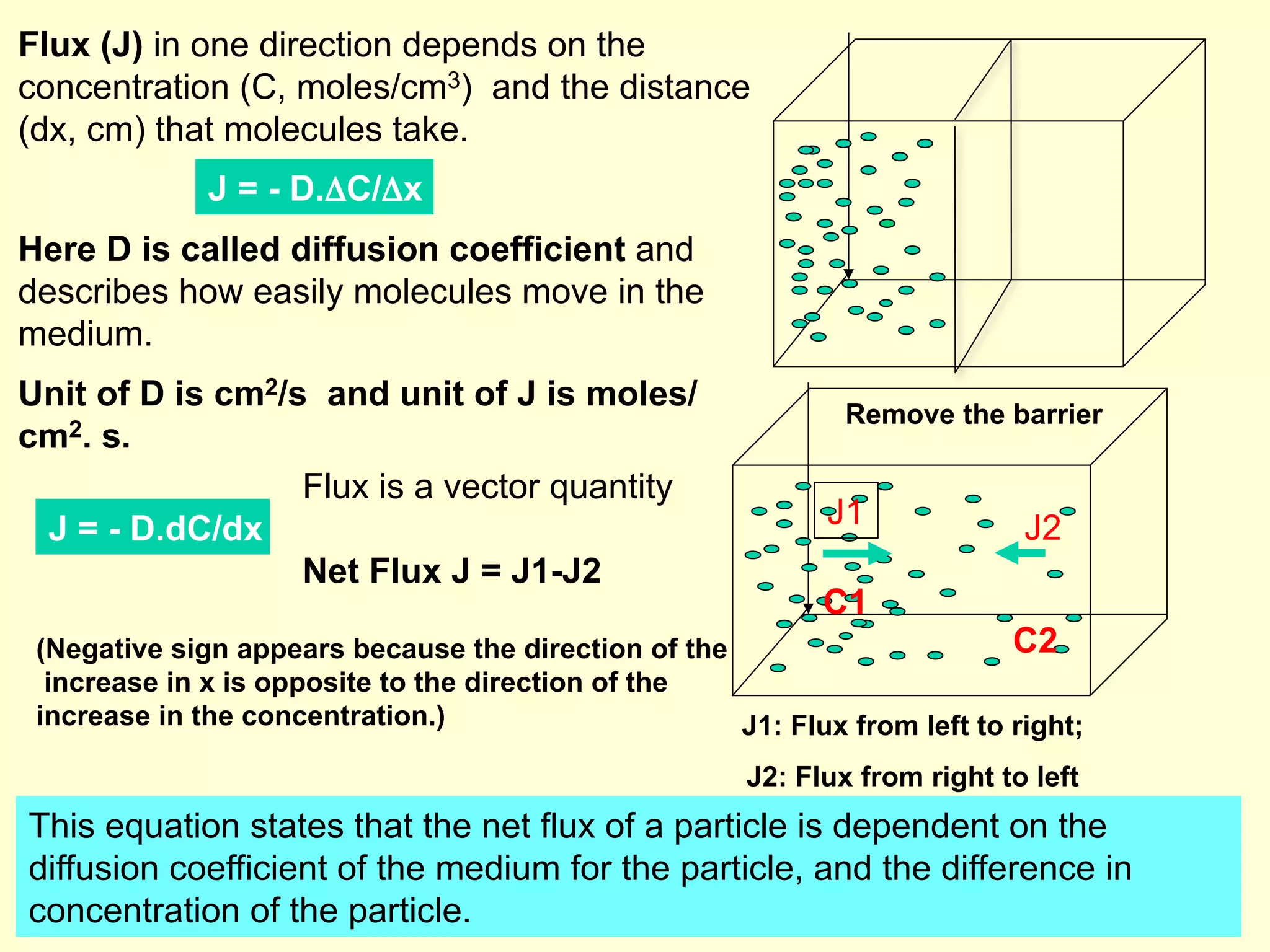
J2
C2
J1
C1
J1: Flux from left to right;
J2: Flux from right to left
Flux (J) in one direction depends on the
concentration (C, moles/cm3) and the distance
(dx, cm) that molecules take.
Here D is called diffusion coefficient and
describes how easily molecules move in the
medium.
Unit of D is cm2/s and unit of J is moles/
cm2. s.
Flux is a vector quantity
Net Flux J = J1-J2
J = - D.dC/dx
(Negative sign appears because the direction of the
increase in x is opposite to the direction of the
increase in the concentration.)
This equation states that the net flux of a particle is dependent on the
diffusion coefficient of the medium for the particle, and the difference in
concentration of the particle.
J = - D.ΔC/Δx
Remove the barrier
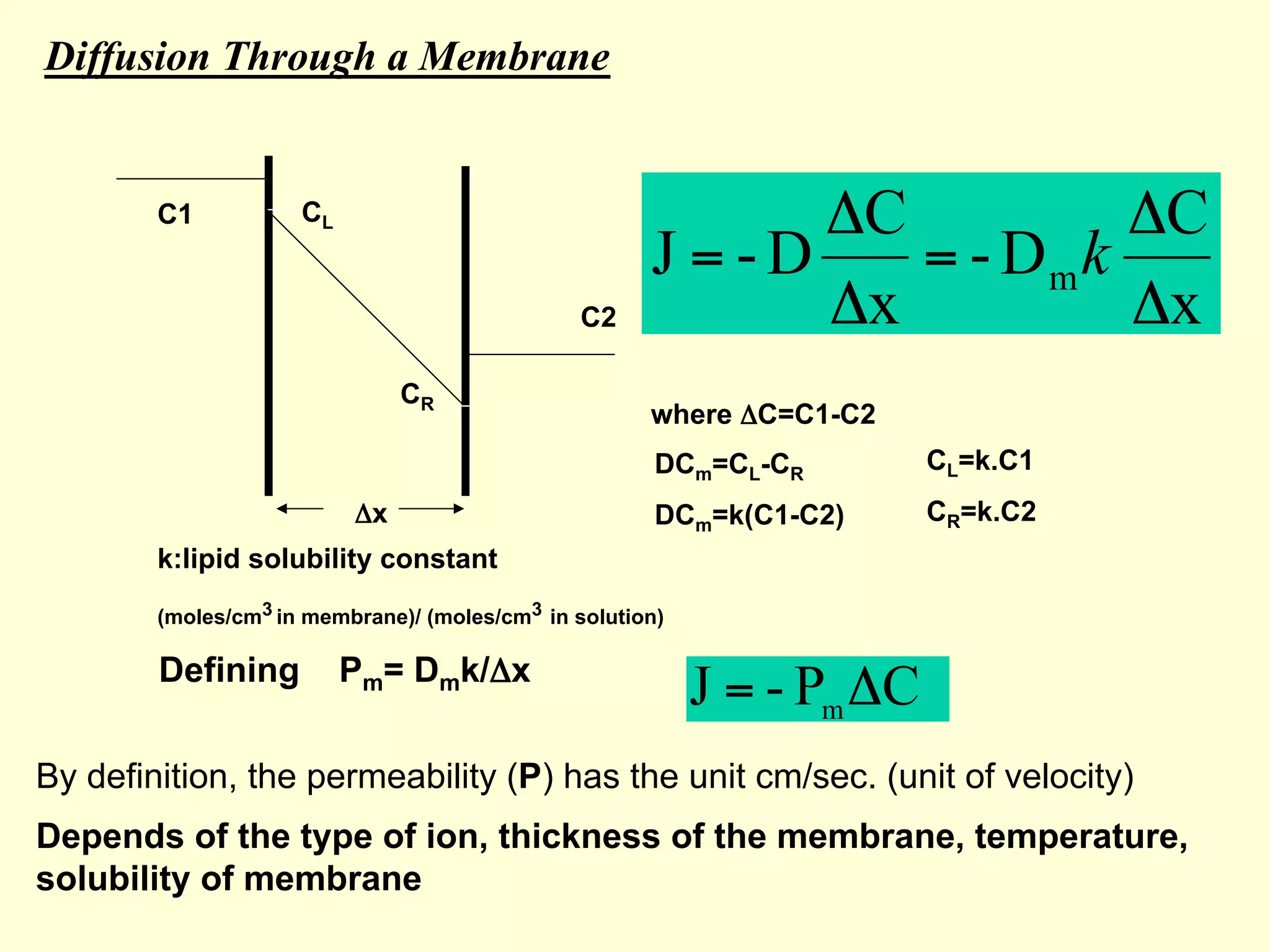
Diffusion Through a Membrane
CL
CR
C2
C1
Δx
CL=k.C1
CR=k.C2
k:lipid solubility constant
(moles/cm3 in membrane)/ (moles/cm3 in solution)
DCm=CL-CR
DCm=k(C1-C2)
x
C
D
-
x
C
D
-
J m
Δ
Δ
=
Δ
Δ
= k
where ΔC=C1-C2
Defining Pm= Dmk/Δx
C
P
-
J m
Δ
=
By definition, the permeability (P) has the unit cm/sec. (unit of velocity)
Depends of the type of ion, thickness of the membrane, temperature,
solubility of membrane
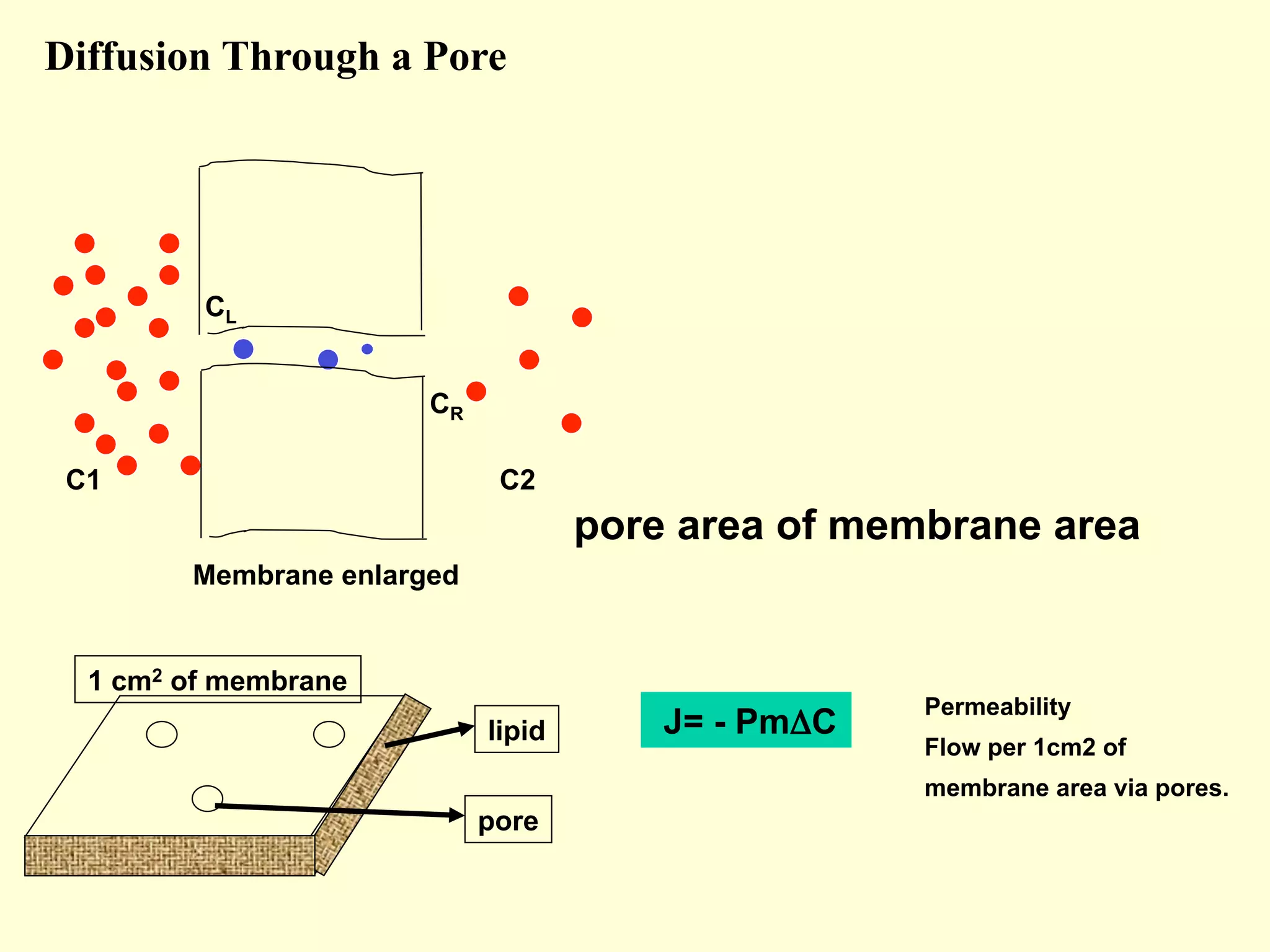
Diffusion Through a Pore
pore area of membrane area
Permeability
Flow per 1cm2 of
membrane area via pores.
J= - PmΔC
CL
CR
C1 C2
Membrane enlarged
lipid
pore
1 cm2 of membrane
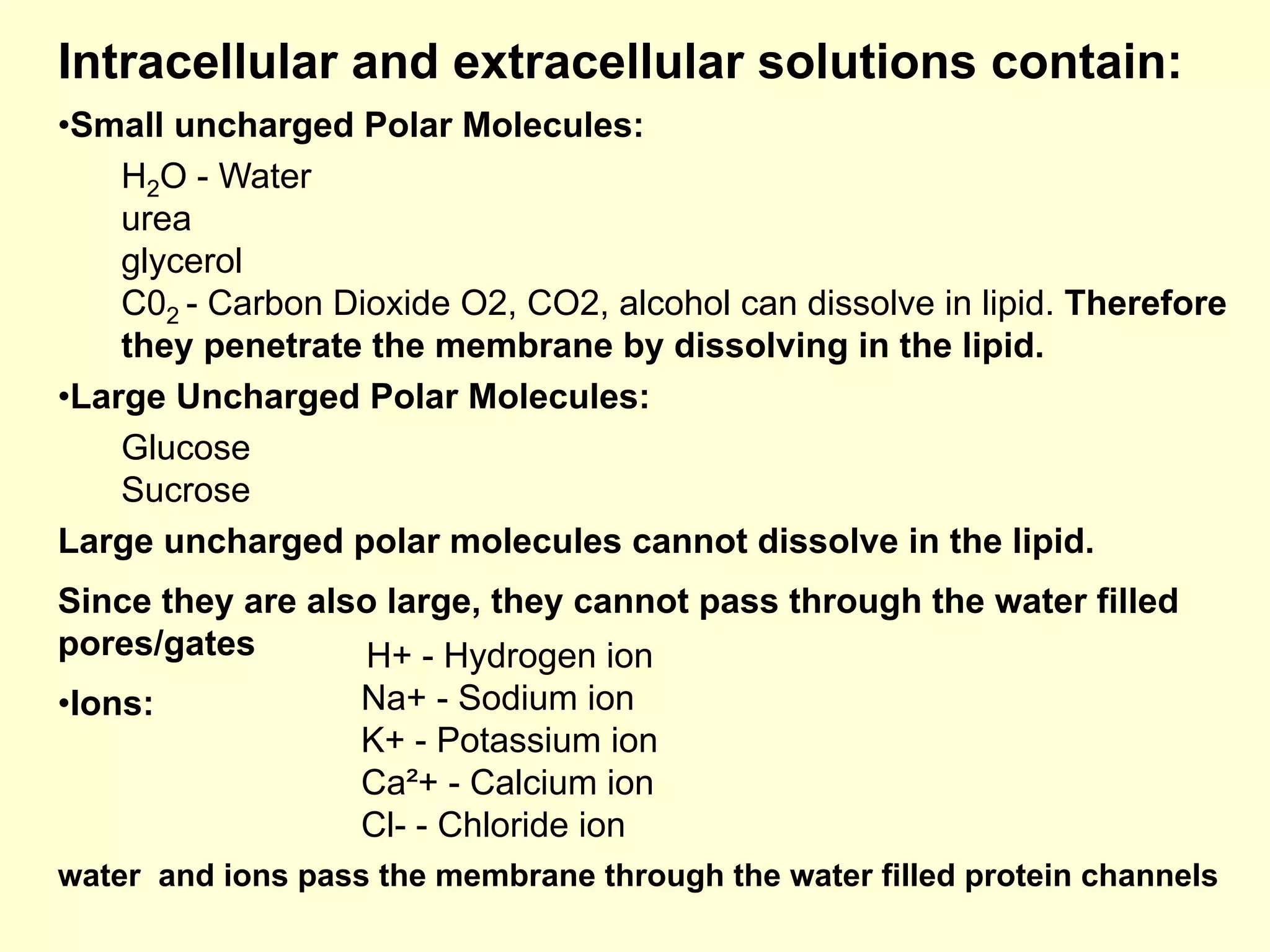
• Small uncharged Polar Molecules:
H2O - Water
urea
glycerol
C02 - Carbon Dioxide O2, CO2, alcohol can dissolve in lipid. Therefore
they penetrate the membrane by dissolving in the lipid.
• Large Uncharged Polar Molecules:
Glucose
Sucrose
Large uncharged polar molecules cannot dissolve in the lipid.
Since they are also large, they cannot pass through the water filled
pores/gates
• Ions:
water and ions pass the membrane through the water filled protein channels
Intracellular and extracellular solutions contain:
H+ - Hydrogen ion
Na+ - Sodium ion
K+ - Potassium ion
Ca²+ - Calcium ion
Cl- - Chloride ion
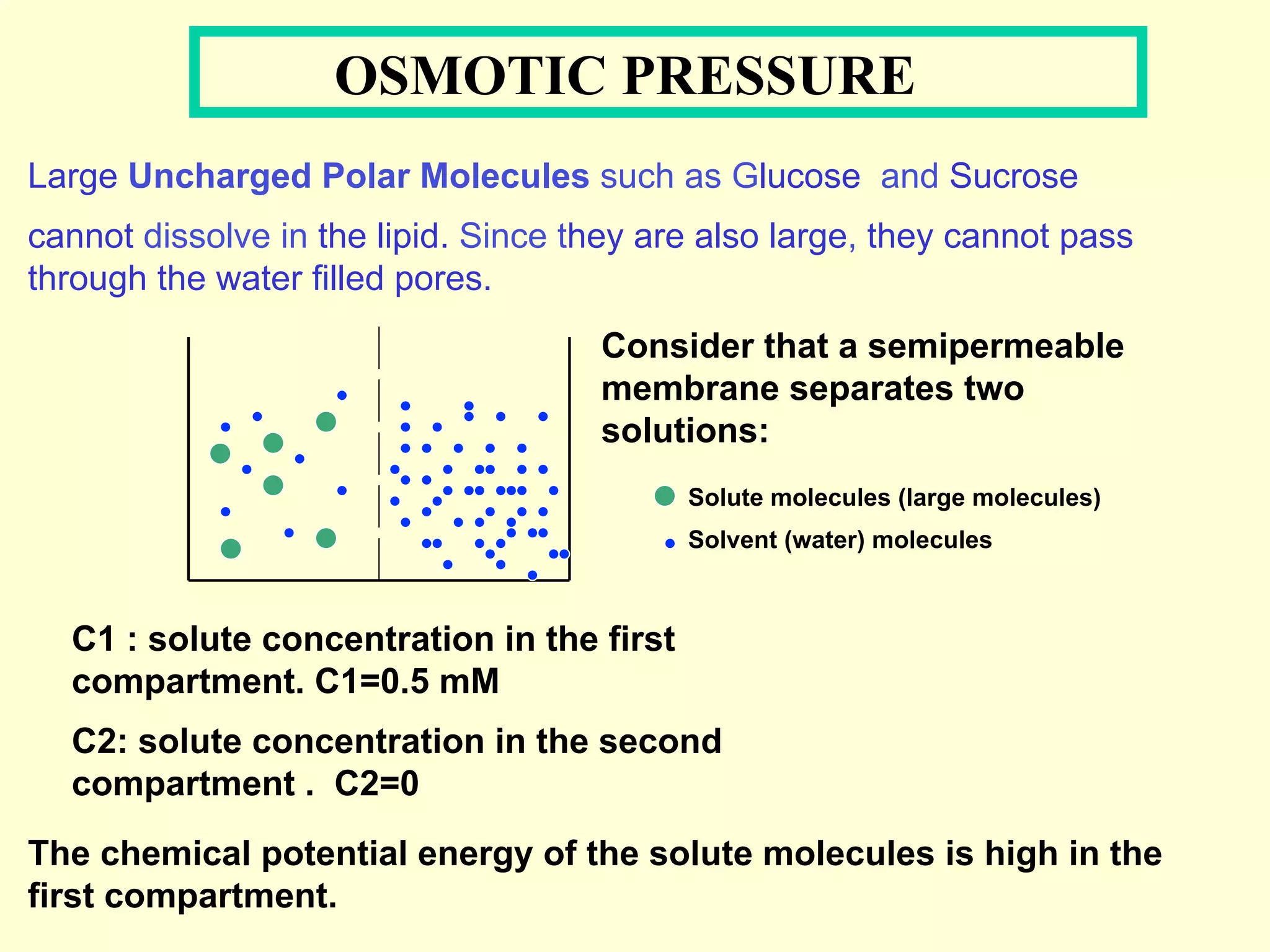
C1 : solute concentration in the first
compartment. C1=0.5 mM
C2: solute concentration in the second
compartment . C2=0
The chemical potential energy of the solute molecules is high in the
first compartment.
Solute molecules (large molecules)
Solvent (water) molecules
Consider that a semipermeable
membrane separates two
solutions:
OSMOTIC PRESSURE
Large Uncharged Polar Molecules such as Glucose and Sucrose
cannot dissolve in the lipid. Since they are also large, they cannot pass
through the water filled pores.
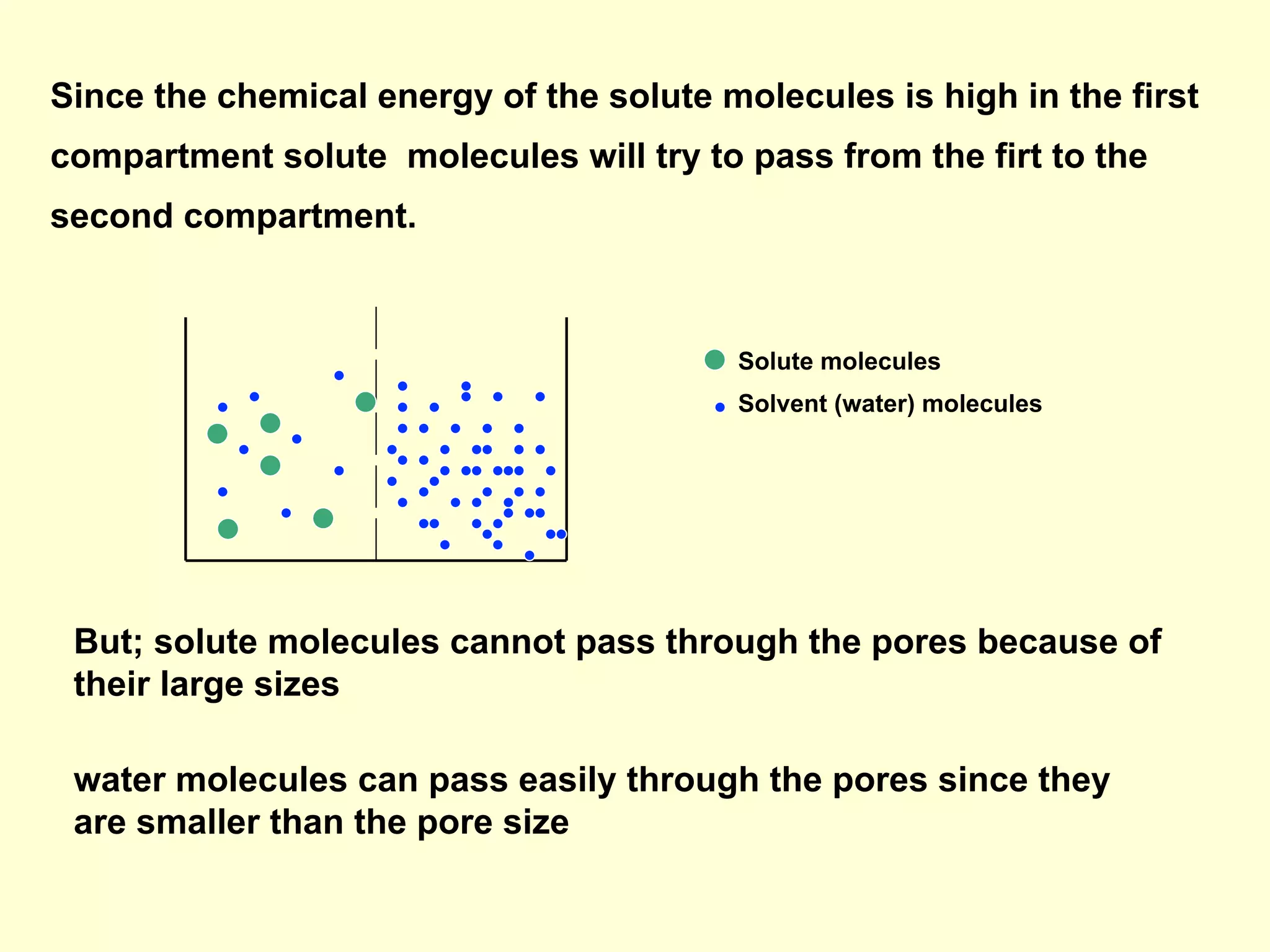
Solute molecules
Solvent (water) molecules
But; solute molecules cannot pass through the pores because of
their large sizes
Since the chemical energy of the solute molecules is high in the first
compartment solute molecules will try to pass from the firt to the
second compartment.
water molecules can pass easily through the pores since they
are smaller than the pore size
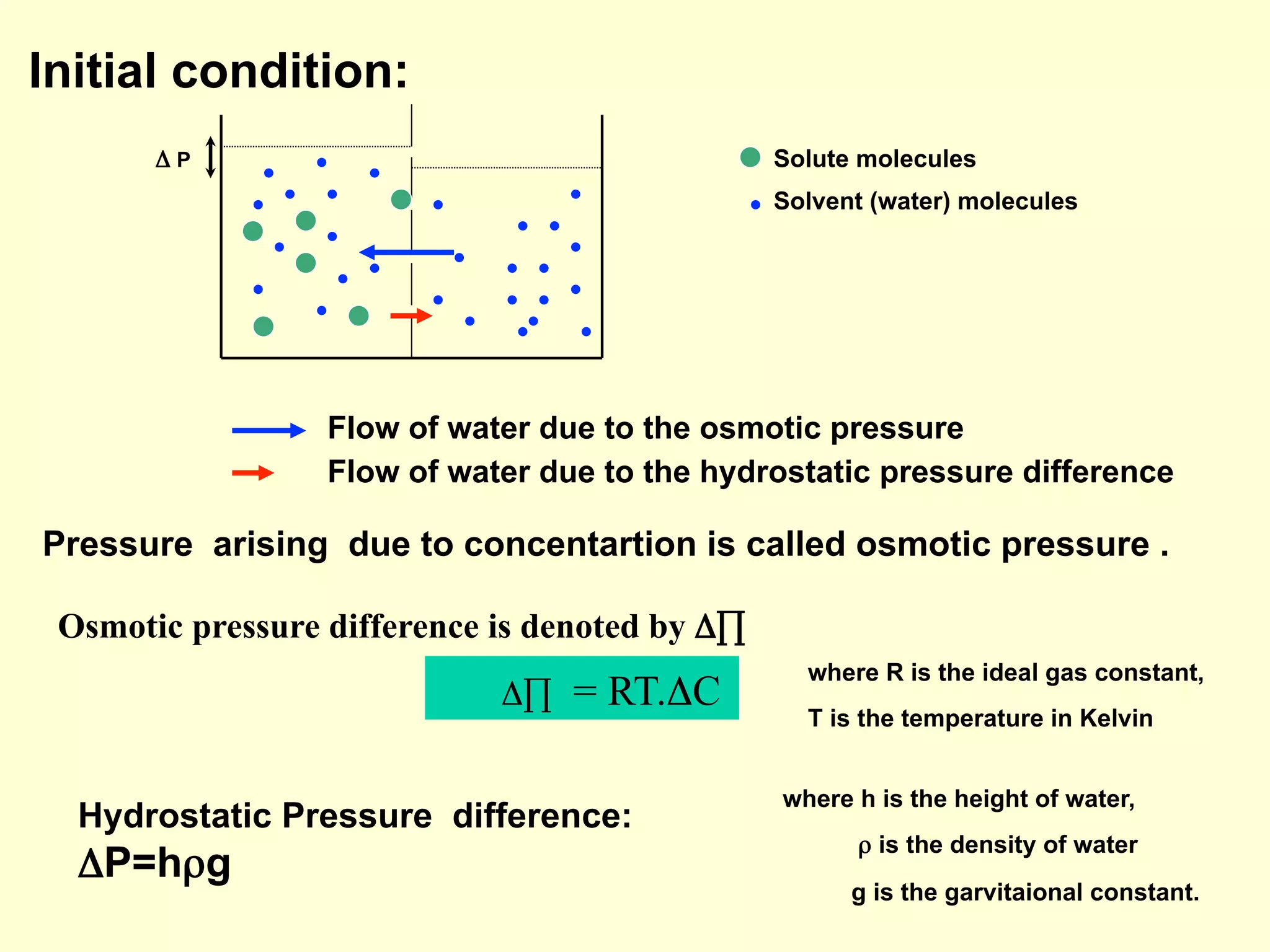
Solute molecules
Solvent (water) molecules
Δ P
Flow of water due to the osmotic pressure
Flow of water due to the hydrostatic pressure difference
Initial condition:
Osmotic pressure difference is denoted by Δ∏
Δ∏ = RT.ΔC
where R is the ideal gas constant,
T is the temperature in Kelvin
Hydrostatic Pressure difference:
ΔP=hρg
where h is the height of water,
ρ is the density of water
g is the garvitaional constant.
Pressure arising due to concentartion is called osmotic pressure .
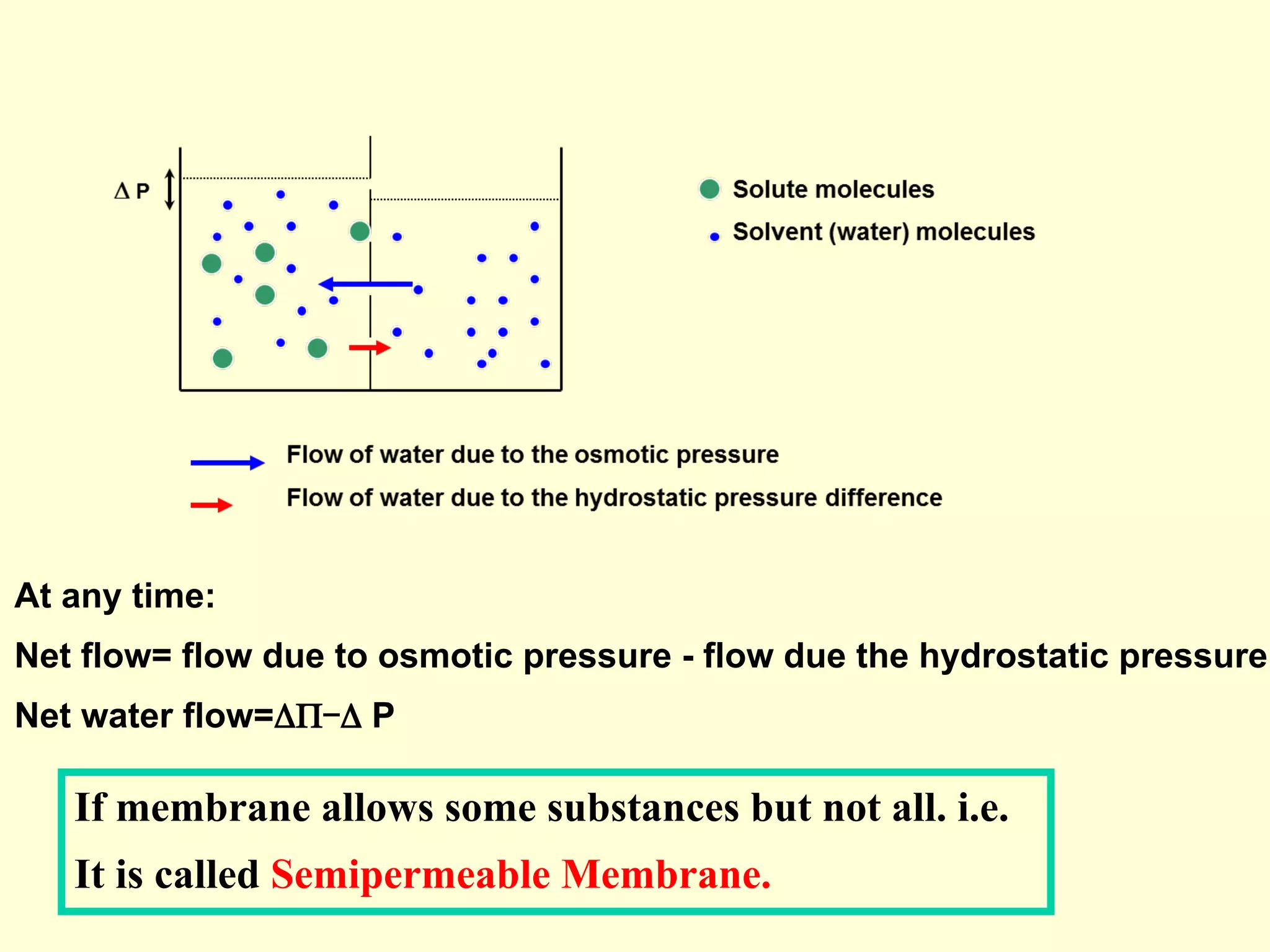
At any time:
Net flow= flow due to osmotic pressure - flow due the hydrostatic pressure
Net water flow=ΔΠ-Δ P
If membrane allows some substances but not all. i.e.
It is called Semipermeable Membrane.
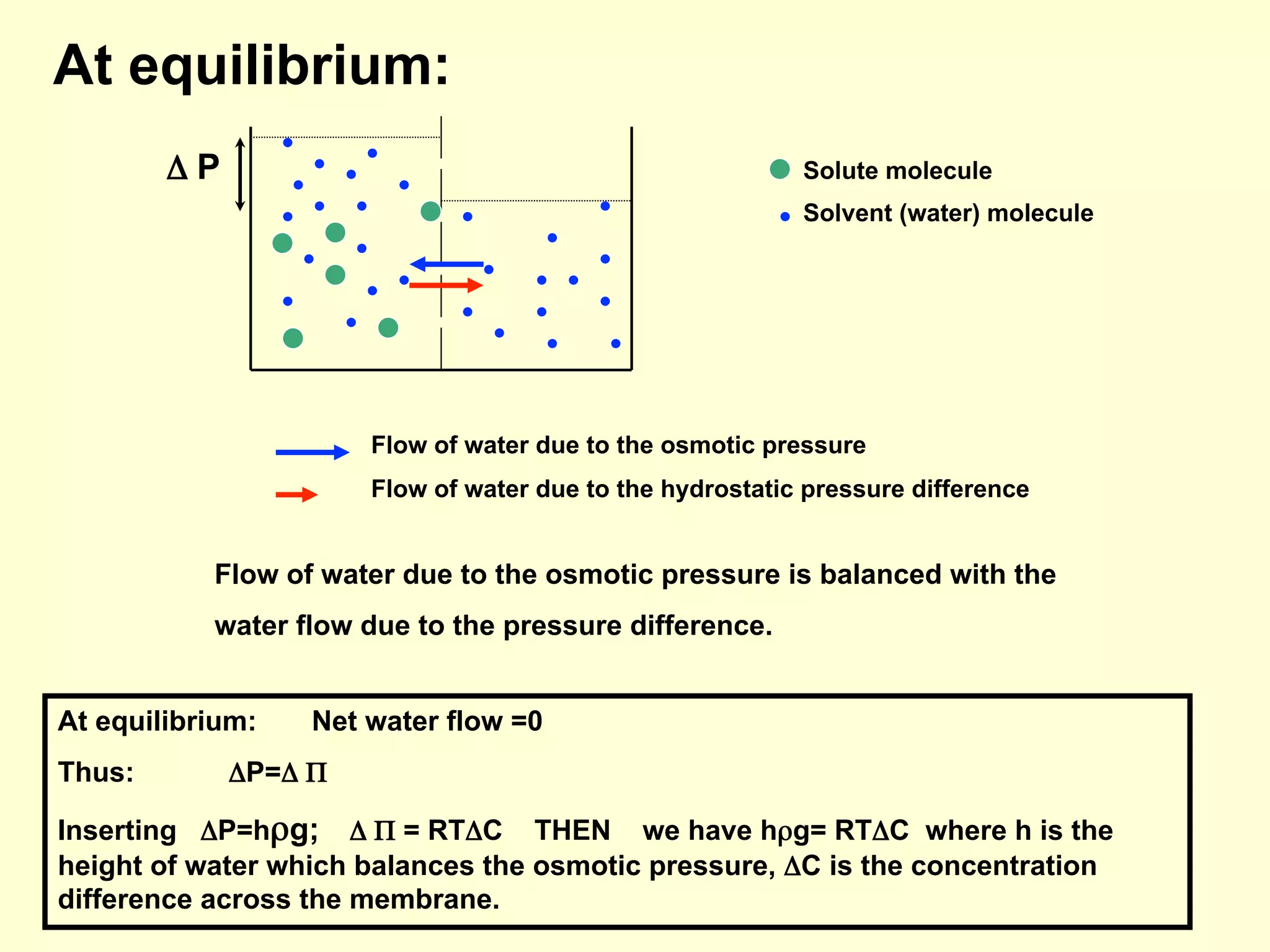
Solute molecule
Solvent (water) molecule
Δ P
Flow of water due to the osmotic pressure
Flow of water due to the hydrostatic pressure difference
Flow of water due to the osmotic pressure is balanced with the
water flow due to the pressure difference.
At equilibrium:
At equilibrium: Net water flow =0
Thus: ΔP=Δ Π
Inserting ΔP=hρg; Δ Π = RTΔC THEN we have hρg= RTΔC where h is the
height of water which balances the osmotic pressure, ΔC is the concentration
difference across the membrane.
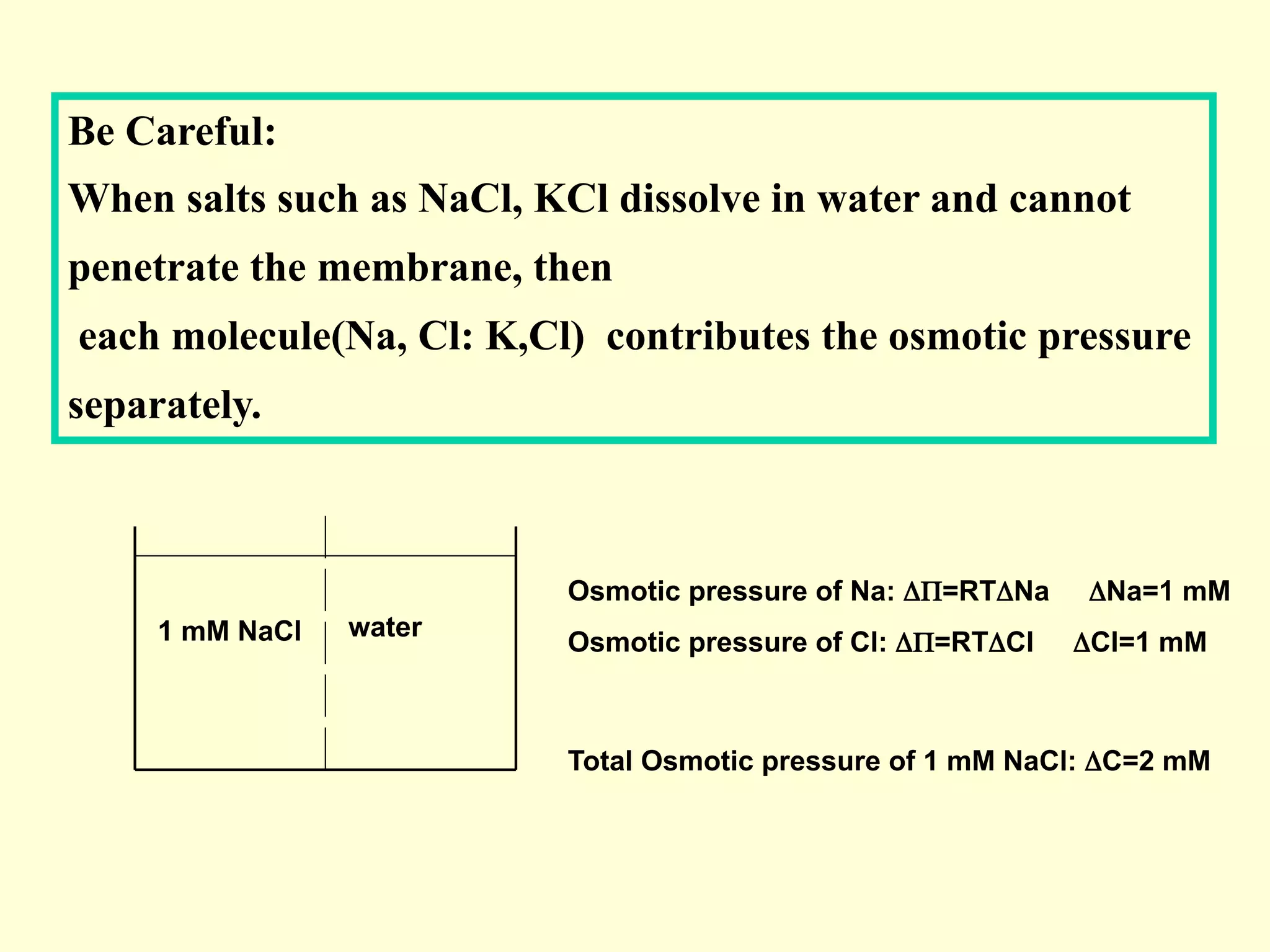
Be Careful:
When salts such as NaCl, KCl dissolve in water and cannot
penetrate the membrane, then
each molecule(Na, Cl: K,Cl) contributes the osmotic pressure
separately.
1 mM NaCl water
Osmotic pressure of Na: ΔΠ=RTΔNa ΔNa=1 mM
Osmotic pressure of Cl: ΔΠ=RTΔCl ΔCl=1 mM
Total Osmotic pressure of 1 mM NaCl: ΔC=2 mM

1 ionic diffosmosis_2022 (3)

  • 1.
    Asymetric Distribution andTransport of ions The aim is to understand: • generation of the resting potential, receptor potential, and action potential in the excitable cells. • Internal energy (Thermal motion) and Diffusion • Chemical potential energy and diffusion • The concept of flux and membrane permeability and the relationship between them. Fick’s Law • Osmotic pressure- Osmosis • The movement of ions can generate electrical potential difference across a membrane • Concept of Equilibrium potential and Nernst equation
  • 2.
  • 3.
    NEURON FUNCTION Electrical Activity RestingPotential (Neuron at rest) • Inside negative (-70 mV) compared to outside • Inside has high K+ concentration • Outside has high Na+ concentration • Negativity comes from proteins & other negative ions • Forces at work • Diffusion • Electrical • Action Potential
  • 4.
    Chemical Potential Energy:Concentration Difference Flow Due to a Concentration Difference is Diffusion (Brownian Motion) . . http://imc.gsm.com/demos/hpdemo/program/section1/1ch2/s1ch2_7.htm Diffusion is the process by which molecules flow from higher concentrations to lower concentrations. The energy providing the force for diffusion arises from internal energy (thermal motion) of the system. At absolute 0 degrees Kelvin (-273oC), the thermal energy of a system is zero and the motion of all particles stops. At higher temperatures, the heat content of the solution causes Brownian motion. Diffusion of a Solute is defined by Fick’s Equation Because of Brownian motion, there is a force (the force due to diffusion, Fd) on each of the particles due to concentration gradient
  • 6.
    J2 C2 J1 C1 J1: Flux fromleft to right; J2: Flux from right to left Flux (J) in one direction depends on the concentration (C, moles/cm3) and the distance (dx, cm) that molecules take. Here D is called diffusion coefficient and describes how easily molecules move in the medium. Unit of D is cm2/s and unit of J is moles/ cm2. s. Flux is a vector quantity Net Flux J = J1-J2 J = - D.dC/dx (Negative sign appears because the direction of the increase in x is opposite to the direction of the increase in the concentration.) This equation states that the net flux of a particle is dependent on the diffusion coefficient of the medium for the particle, and the difference in concentration of the particle. J = - D.ΔC/Δx Remove the barrier
  • 7.
    Diffusion Through aMembrane CL CR C2 C1 Δx CL=k.C1 CR=k.C2 k:lipid solubility constant (moles/cm3 in membrane)/ (moles/cm3 in solution) DCm=CL-CR DCm=k(C1-C2) x C D - x C D - J m Δ Δ = Δ Δ = k where ΔC=C1-C2 Defining Pm= Dmk/Δx C P - J m Δ = By definition, the permeability (P) has the unit cm/sec. (unit of velocity) Depends of the type of ion, thickness of the membrane, temperature, solubility of membrane
  • 8.
    Diffusion Through aPore pore area of membrane area Permeability Flow per 1cm2 of membrane area via pores. J= - PmΔC CL CR C1 C2 Membrane enlarged lipid pore 1 cm2 of membrane
  • 9.
    • Small uncharged PolarMolecules: H2O - Water urea glycerol C02 - Carbon Dioxide O2, CO2, alcohol can dissolve in lipid. Therefore they penetrate the membrane by dissolving in the lipid. • Large Uncharged Polar Molecules: Glucose Sucrose Large uncharged polar molecules cannot dissolve in the lipid. Since they are also large, they cannot pass through the water filled pores/gates • Ions: water and ions pass the membrane through the water filled protein channels Intracellular and extracellular solutions contain: H+ - Hydrogen ion Na+ - Sodium ion K+ - Potassium ion Ca²+ - Calcium ion Cl- - Chloride ion
  • 10.
    C1 : soluteconcentration in the first compartment. C1=0.5 mM C2: solute concentration in the second compartment . C2=0 The chemical potential energy of the solute molecules is high in the first compartment. Solute molecules (large molecules) Solvent (water) molecules Consider that a semipermeable membrane separates two solutions: OSMOTIC PRESSURE Large Uncharged Polar Molecules such as Glucose and Sucrose cannot dissolve in the lipid. Since they are also large, they cannot pass through the water filled pores.
  • 11.
    Solute molecules Solvent (water)molecules But; solute molecules cannot pass through the pores because of their large sizes Since the chemical energy of the solute molecules is high in the first compartment solute molecules will try to pass from the firt to the second compartment. water molecules can pass easily through the pores since they are smaller than the pore size
  • 12.
    Solute molecules Solvent (water)molecules Δ P Flow of water due to the osmotic pressure Flow of water due to the hydrostatic pressure difference Initial condition: Osmotic pressure difference is denoted by Δ∏ Δ∏ = RT.ΔC where R is the ideal gas constant, T is the temperature in Kelvin Hydrostatic Pressure difference: ΔP=hρg where h is the height of water, ρ is the density of water g is the garvitaional constant. Pressure arising due to concentartion is called osmotic pressure .
  • 13.
    At any time: Netflow= flow due to osmotic pressure - flow due the hydrostatic pressure Net water flow=ΔΠ-Δ P If membrane allows some substances but not all. i.e. It is called Semipermeable Membrane.
  • 14.
    Solute molecule Solvent (water)molecule Δ P Flow of water due to the osmotic pressure Flow of water due to the hydrostatic pressure difference Flow of water due to the osmotic pressure is balanced with the water flow due to the pressure difference. At equilibrium: At equilibrium: Net water flow =0 Thus: ΔP=Δ Π Inserting ΔP=hρg; Δ Π = RTΔC THEN we have hρg= RTΔC where h is the height of water which balances the osmotic pressure, ΔC is the concentration difference across the membrane.
  • 15.
    Be Careful: When saltssuch as NaCl, KCl dissolve in water and cannot penetrate the membrane, then each molecule(Na, Cl: K,Cl) contributes the osmotic pressure separately. 1 mM NaCl water Osmotic pressure of Na: ΔΠ=RTΔNa ΔNa=1 mM Osmotic pressure of Cl: ΔΠ=RTΔCl ΔCl=1 mM Total Osmotic pressure of 1 mM NaCl: ΔC=2 mM