Transport of Substances Throughthe Cell Membrane
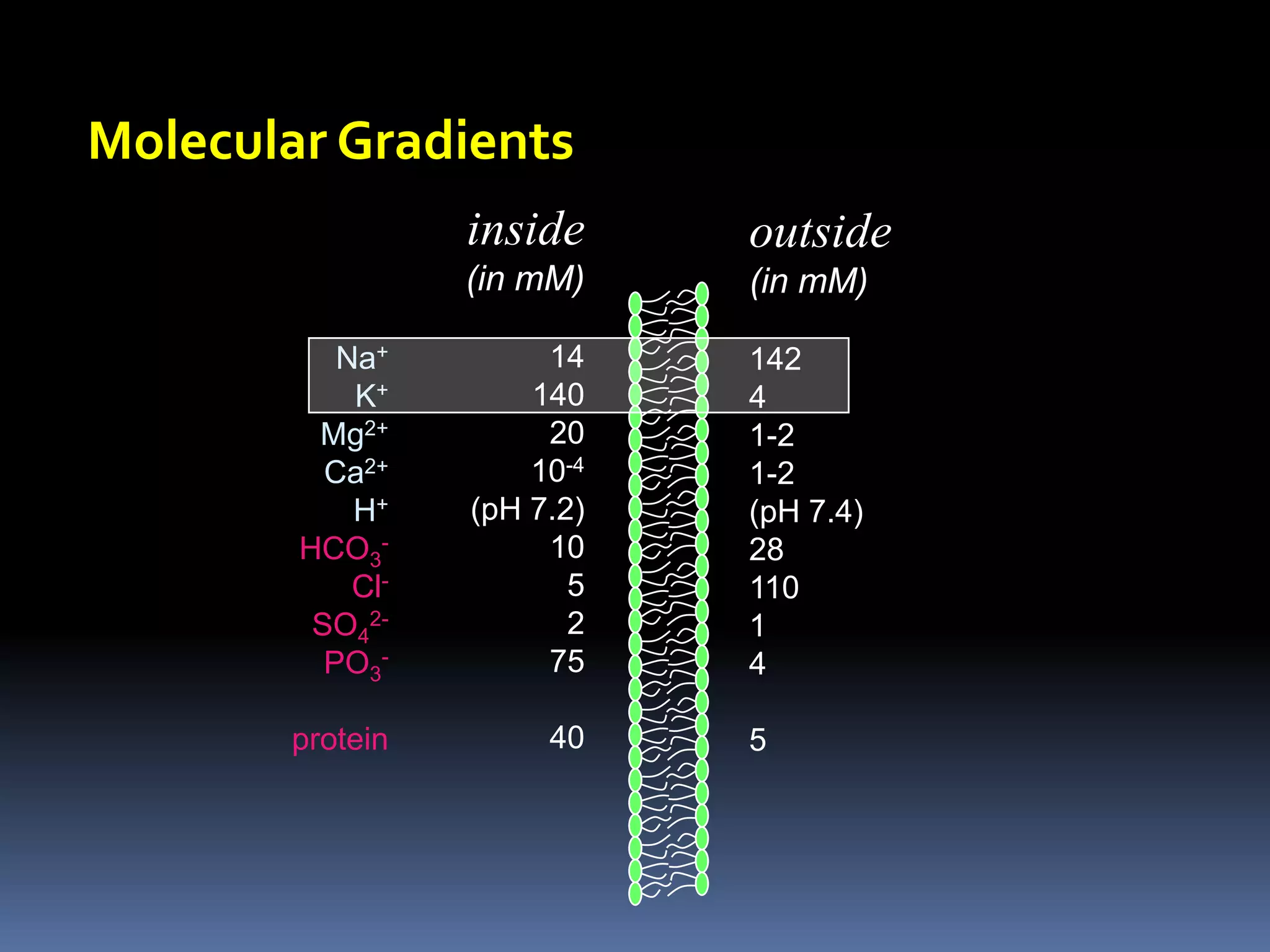
Molecular Gradientsinside(in mM)141402010-4(pH 7.2)10527540outside(in mM)14241-21-2(pH 7.4)28110145Na+K+Mg2+Ca2+H+HCO3-Cl-SO42-PO3-protein
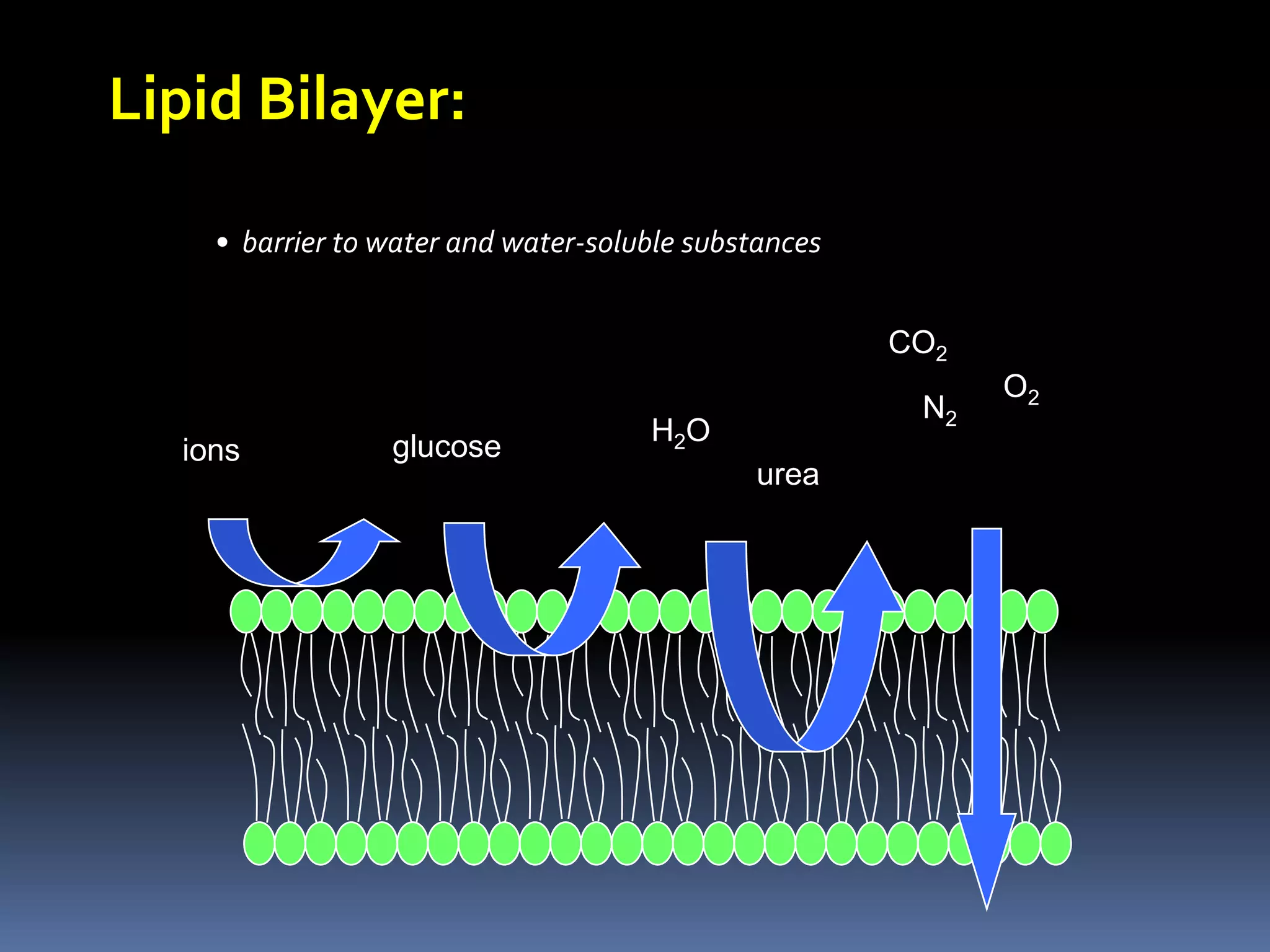
CO2O2N2H2OureaLipid Bilayer:  barrier to water and water-soluble substancesglucoseions
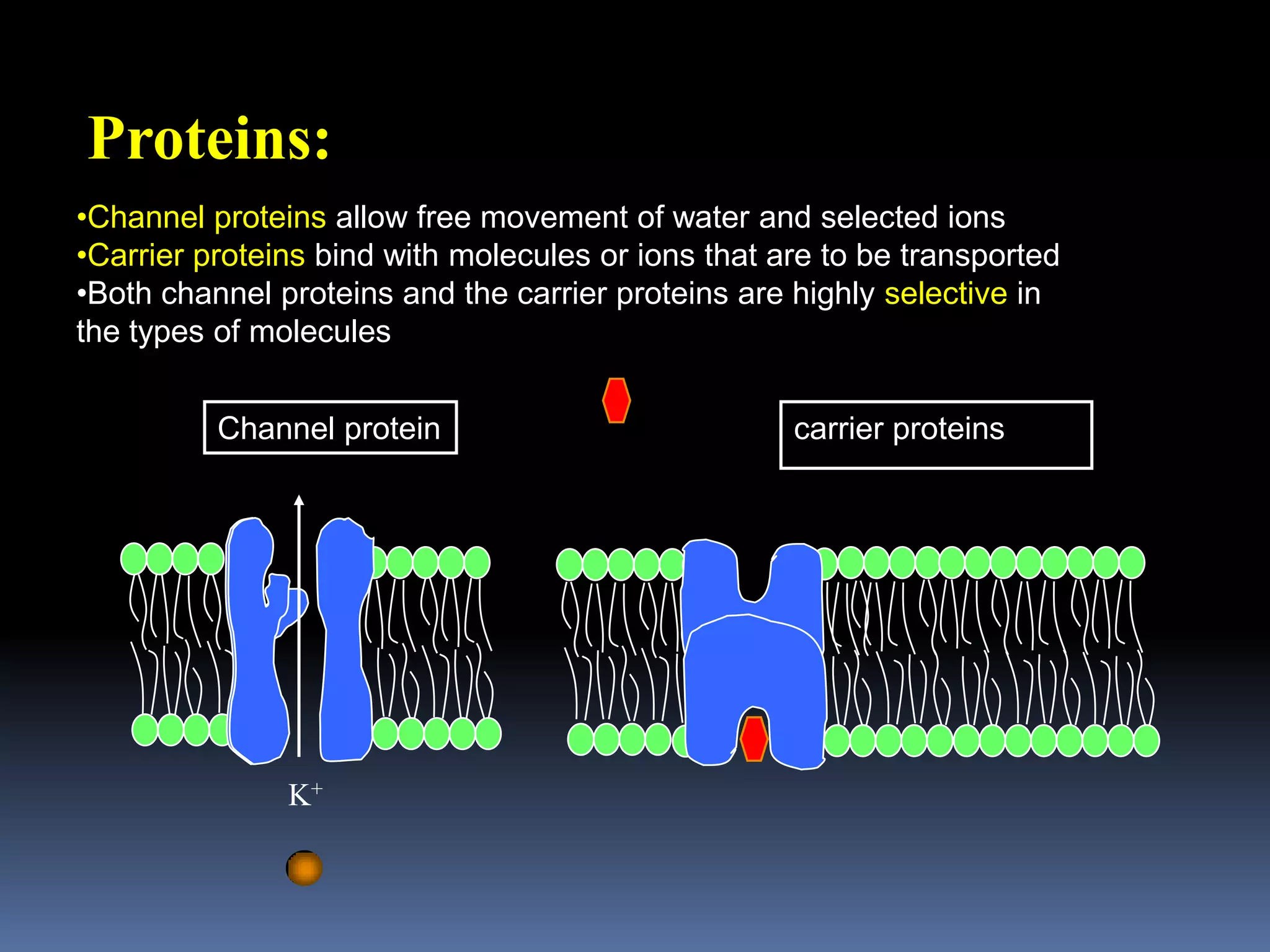
Proteins:Channel proteins allow free movement of water and selected ions
Carrier proteins bind with molecules or ions that are to be transported
Both channel proteins and the carrier proteins are highly selective in the types of moleculesChannel proteincarrier proteinsK+
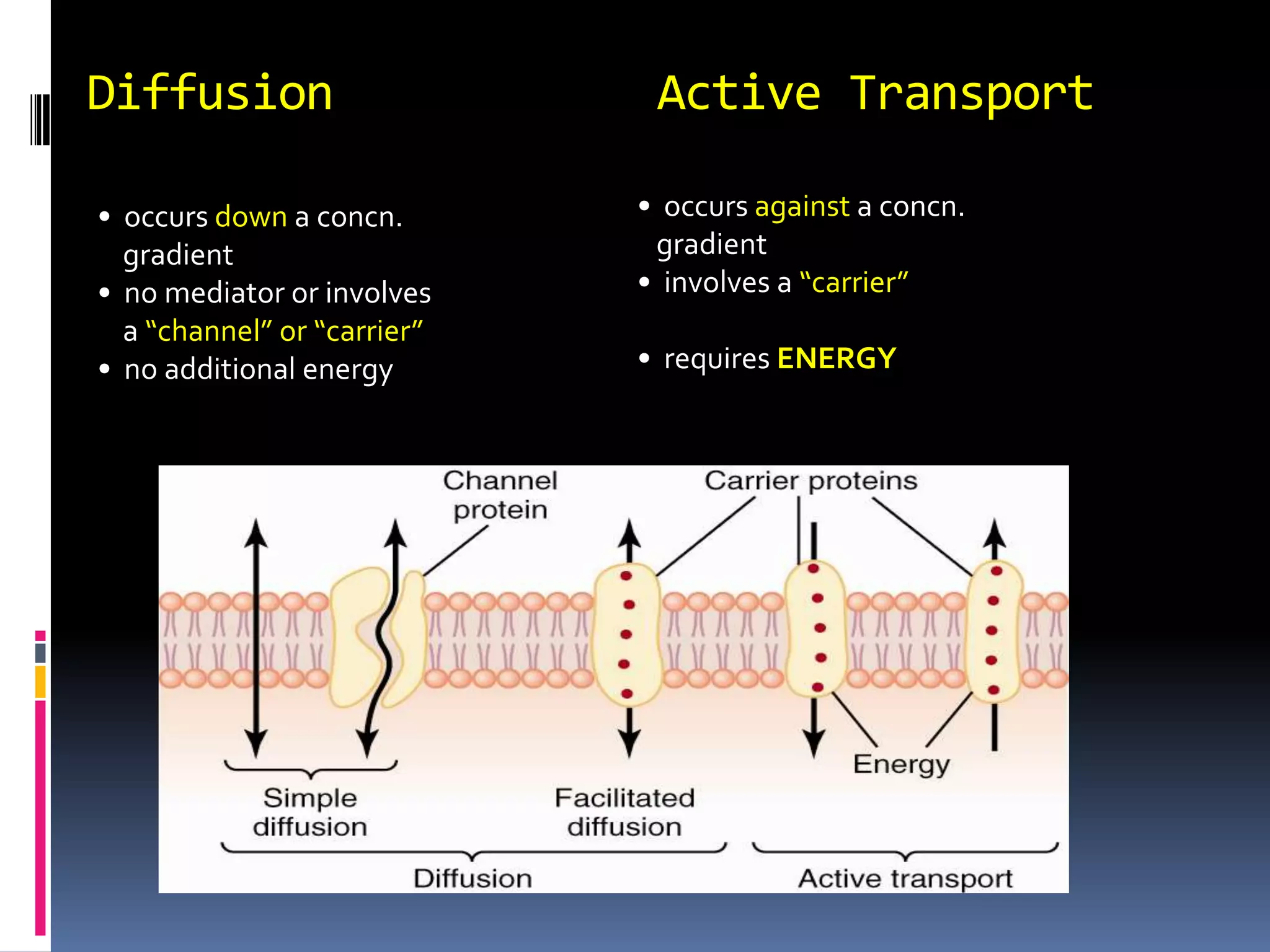
DiffusionActive Transport  occurs against a concn.   gradient  involves a “carrier”
  requires ENERGY
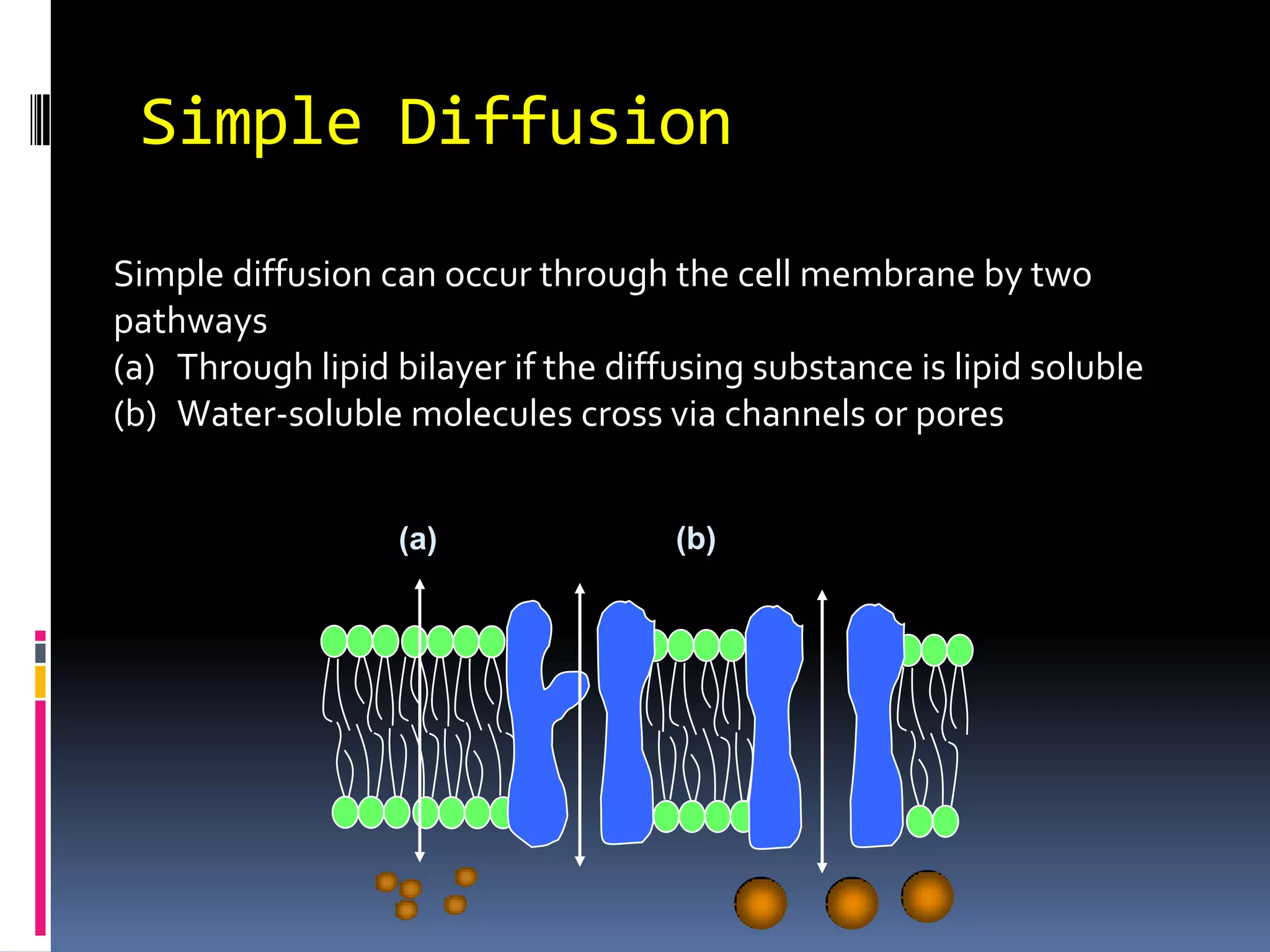
  occurs down a concn.     gradient  no mediator or involves    a “channel” or “carrier”  no additional energySimple diffusion can occur through the cell membrane by two pathways Through lipid bilayer if the diffusing substance is lipid solubleWater-soluble molecules cross via channels or pores(b)(a)Simple Diffusion
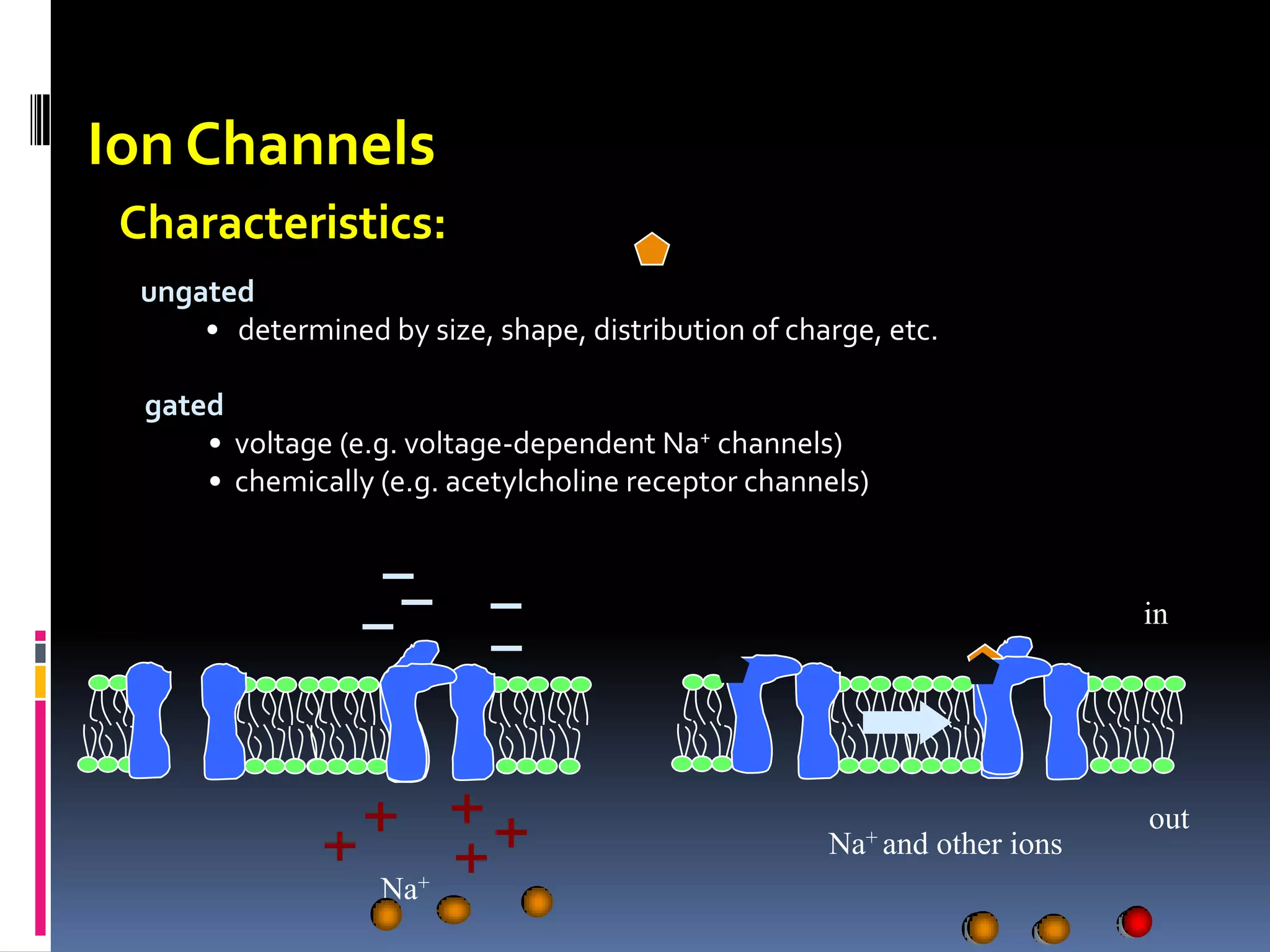
Ion ChannelsCharacteristics:ungateddetermined by size, shape, distribution of charge, etc.gated  voltage (e.g. voltage-dependent Na+ channels)
  chemically (e.g. acetylcholine receptor channels)inoutNa+ and other ionsNa+
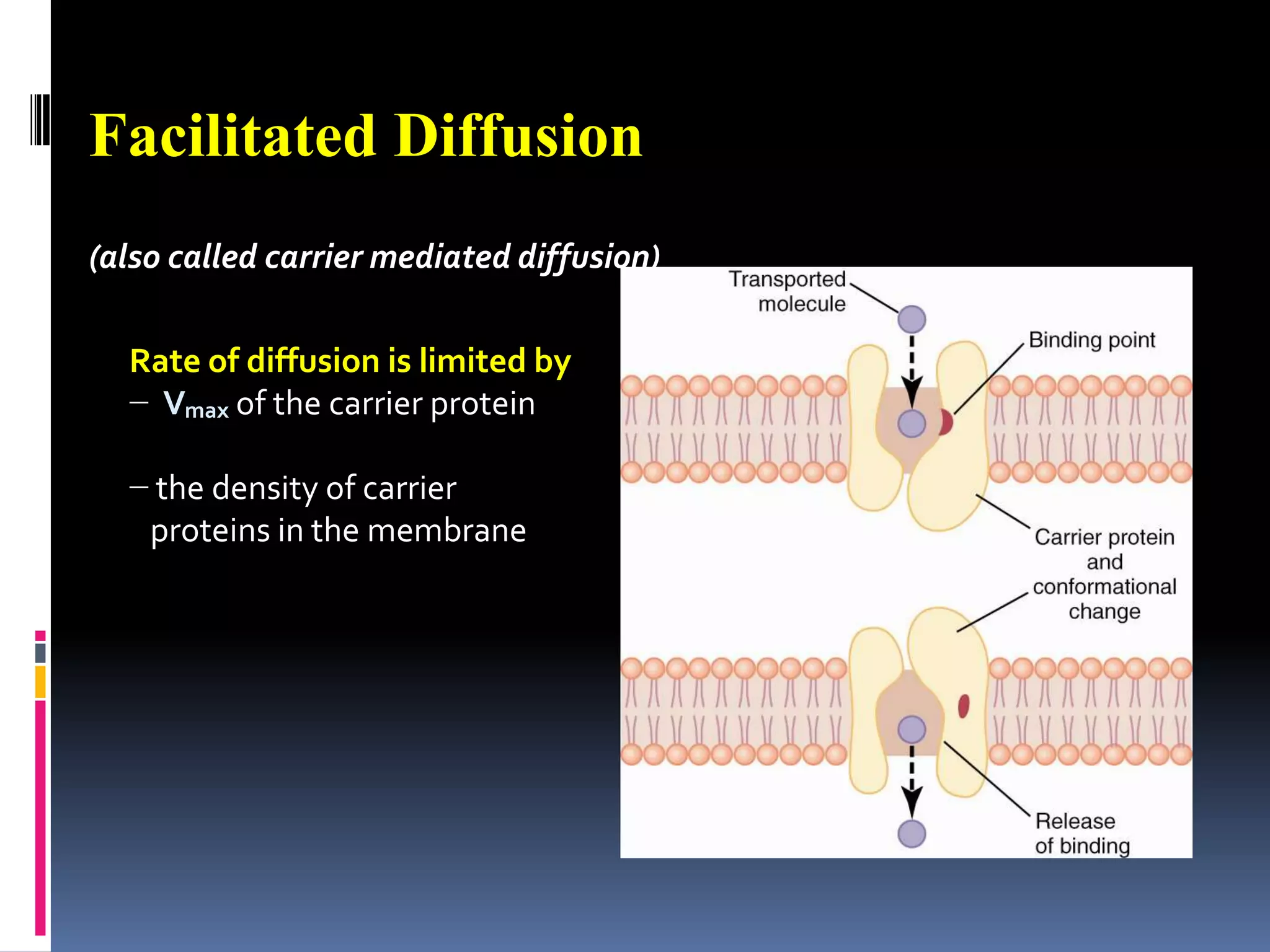
Facilitated Diffusion(also called carrier mediated diffusion)Rate of diffusion is limited by Vmax of the carrier protein
 the density of carrier    proteins in the membrane
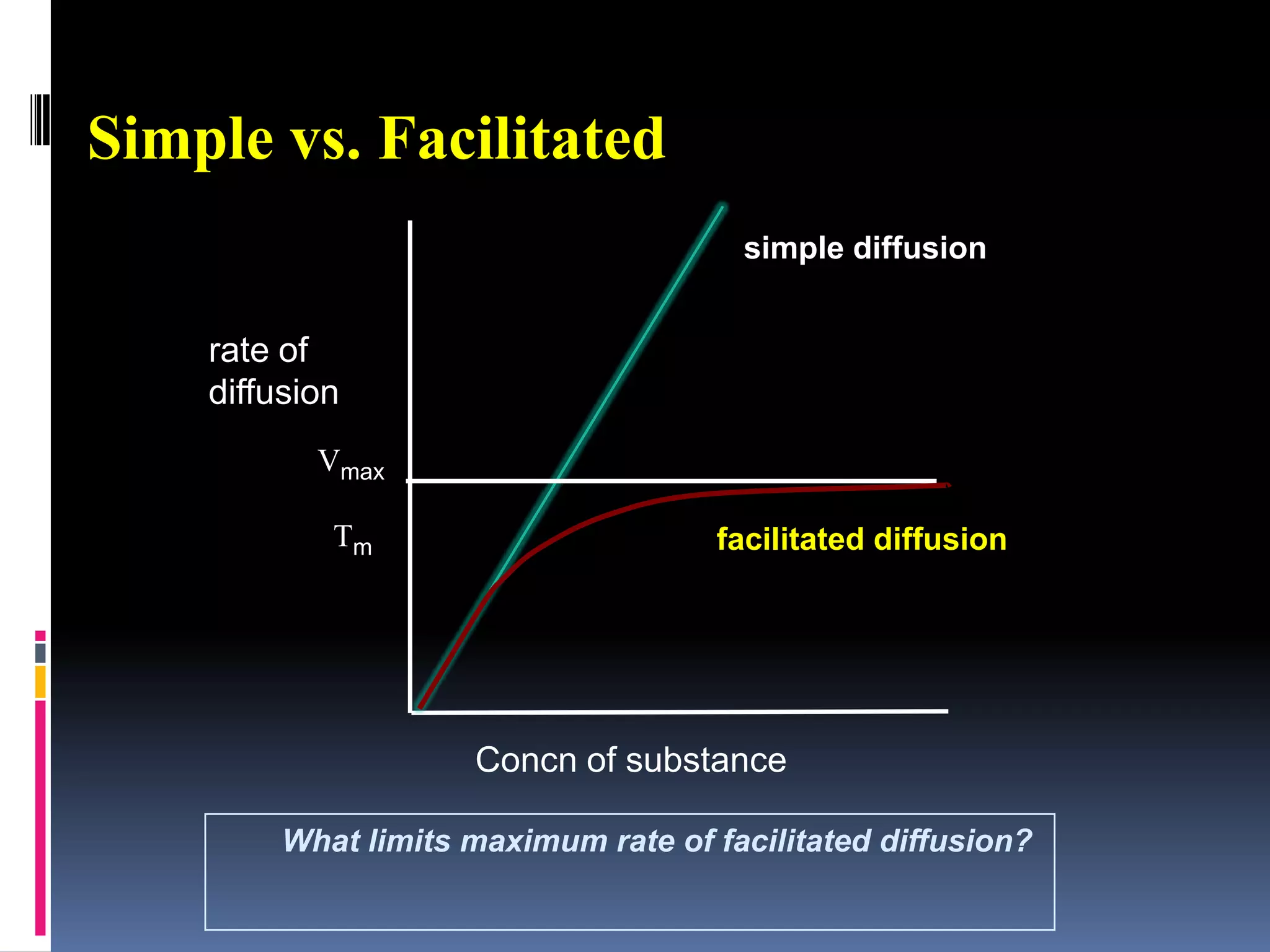
Simple vs. Facilitatedsimple diffusionrate of diffusionVmaxTmfacilitated diffusionConcn of substanceWhat limits maximum rate of facilitated diffusion?
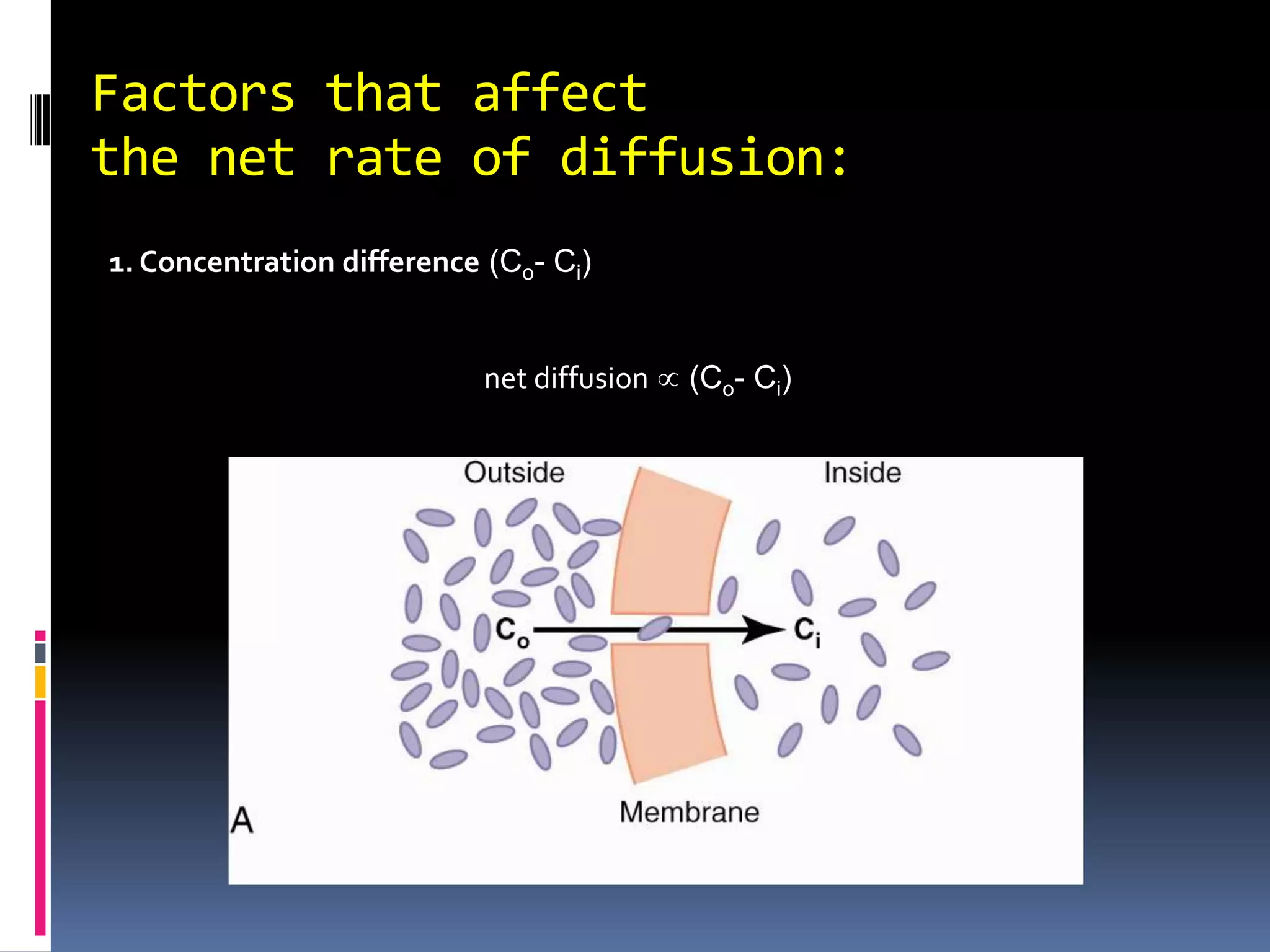
Factors that affect the net rate of diffusion:1. Concentration difference (Co- Ci)net diffusion (Co- Ci)
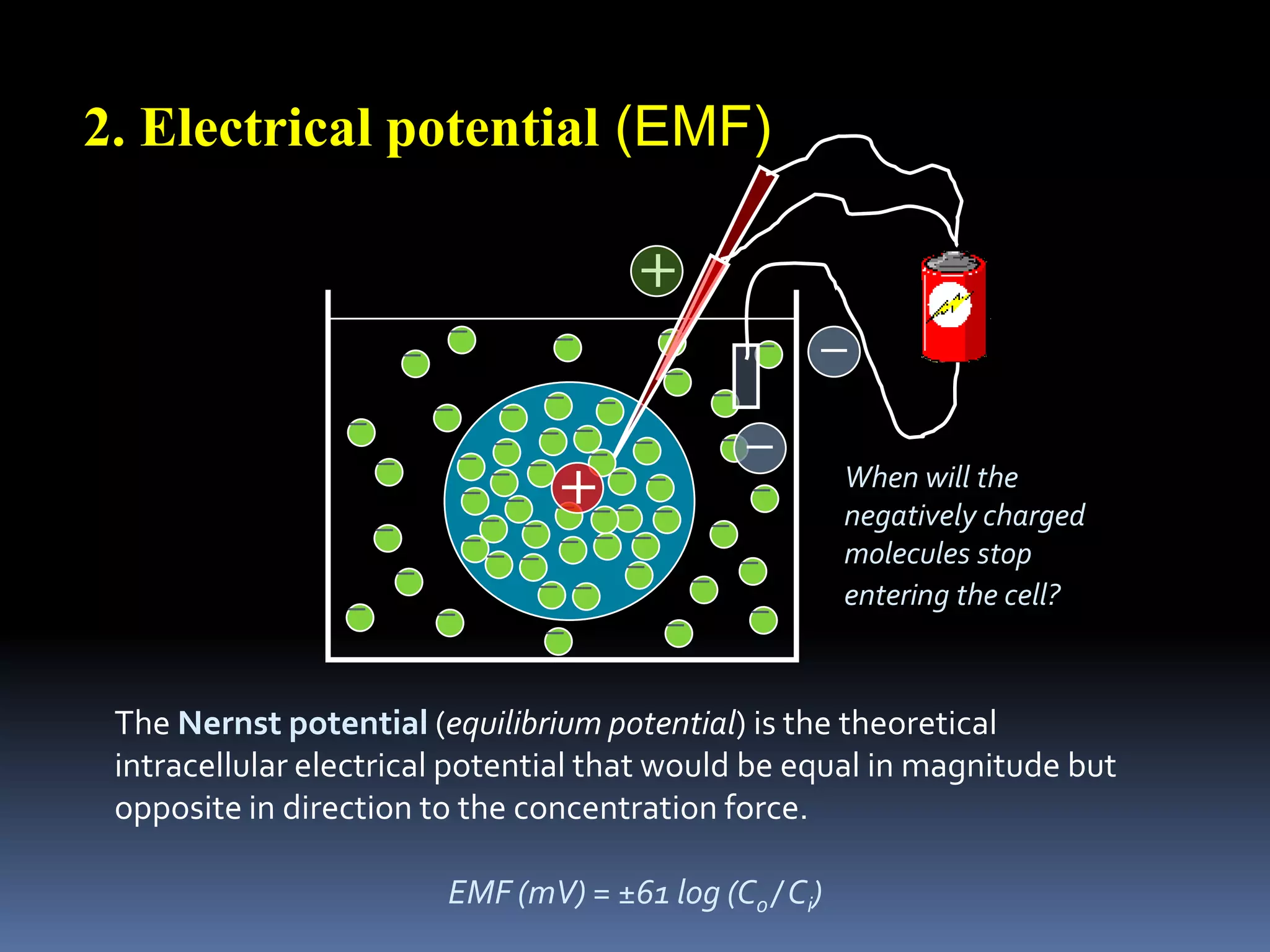
+------- ----- -- --- -- ----- -- --- --- --------------------+--2. Electrical potential (EMF)When will the negatively charged molecules stop entering the cell?The Nernst potential (equilibrium potential) is the theoretical intracellular electrical potential that would be equal in magnitude but opposite in direction to the concentration force.EMF (mV) = ±61 log (Co / Ci)
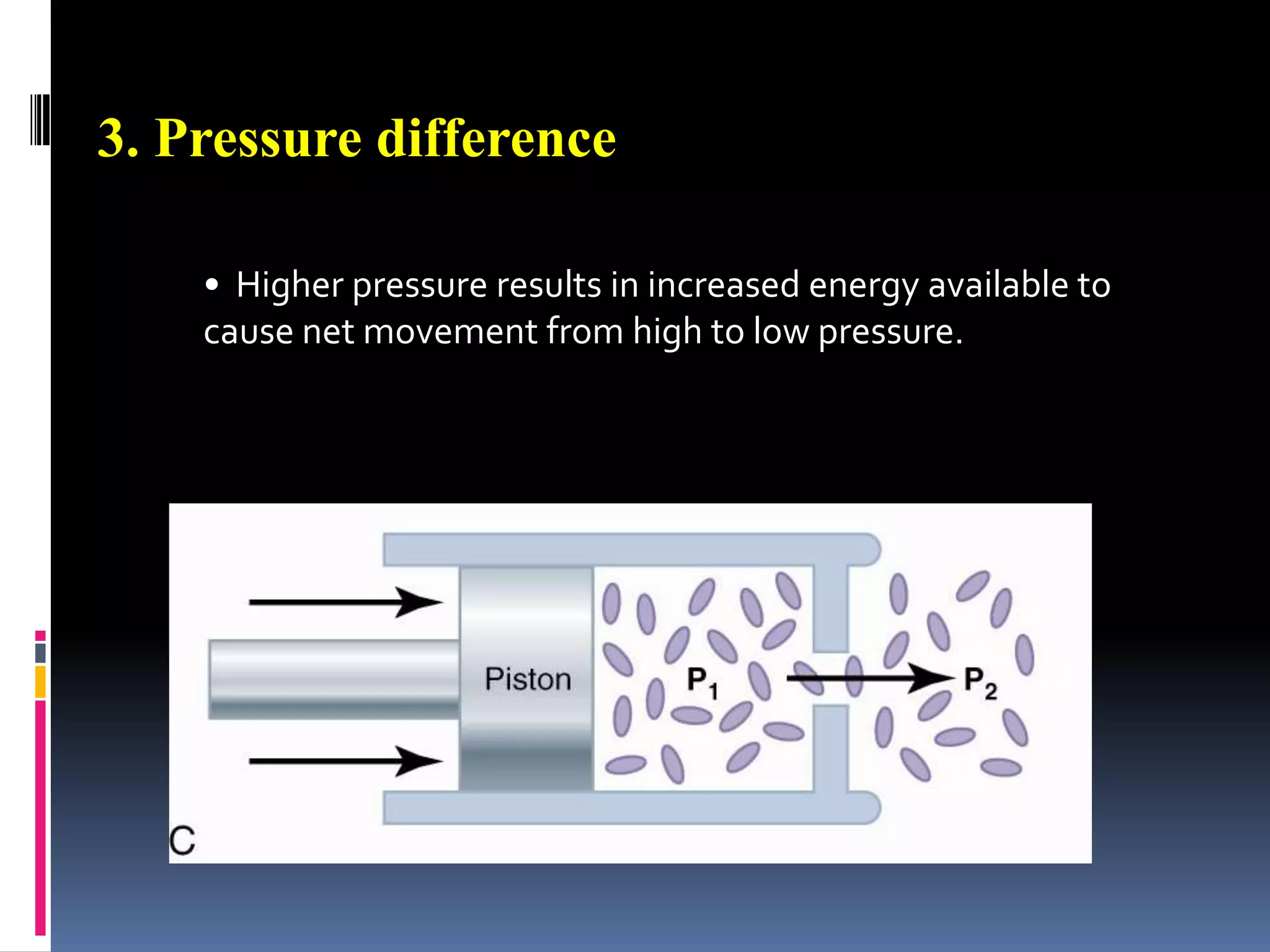
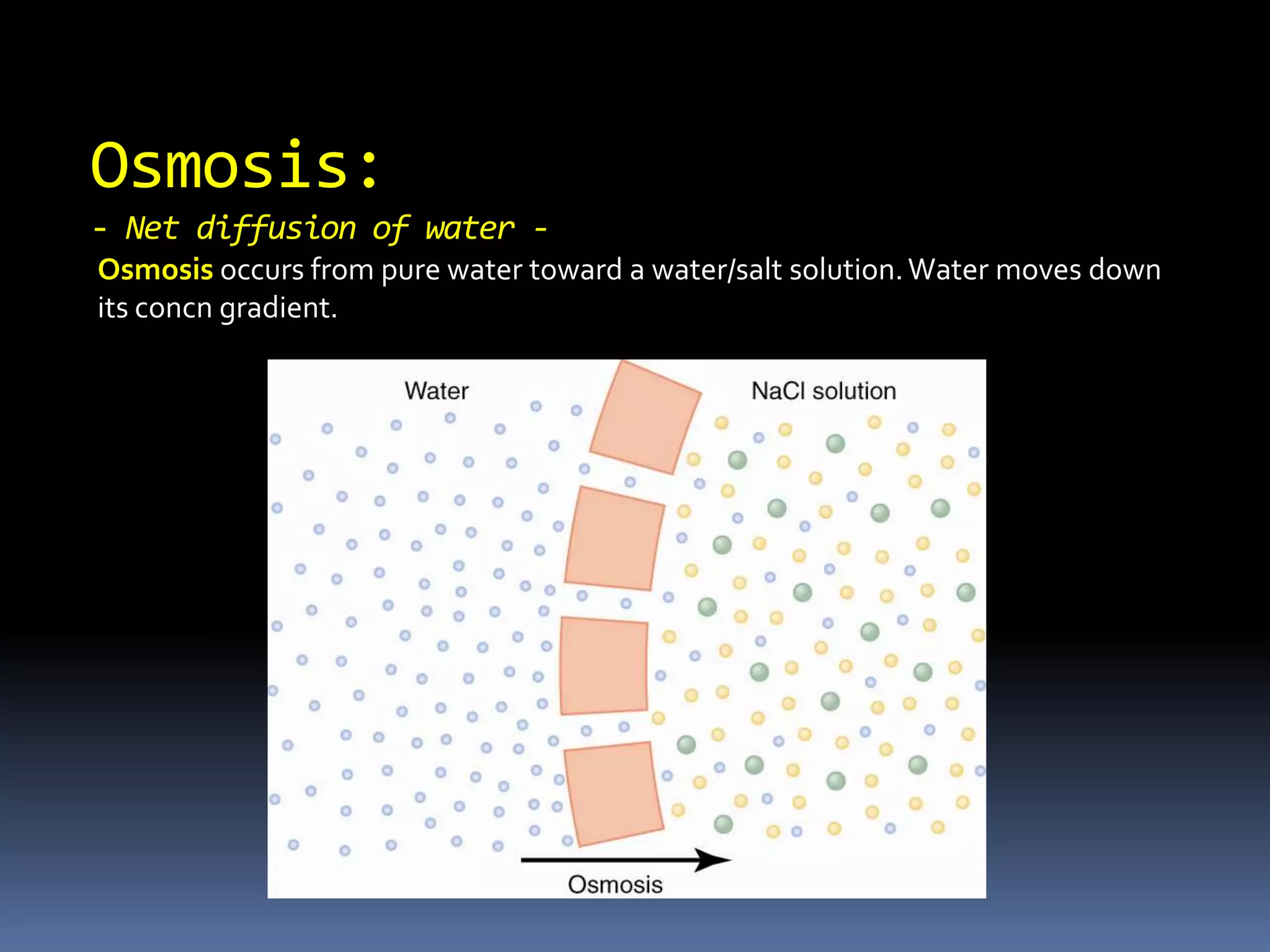
3. Pressure difference  Higher pressure results in increased energy available to cause net movement from high to low pressure.Osmosis:- Net diffusion of water -Osmosis occurs from pure water toward a water/salt solution. Water moves down its concn gradient.
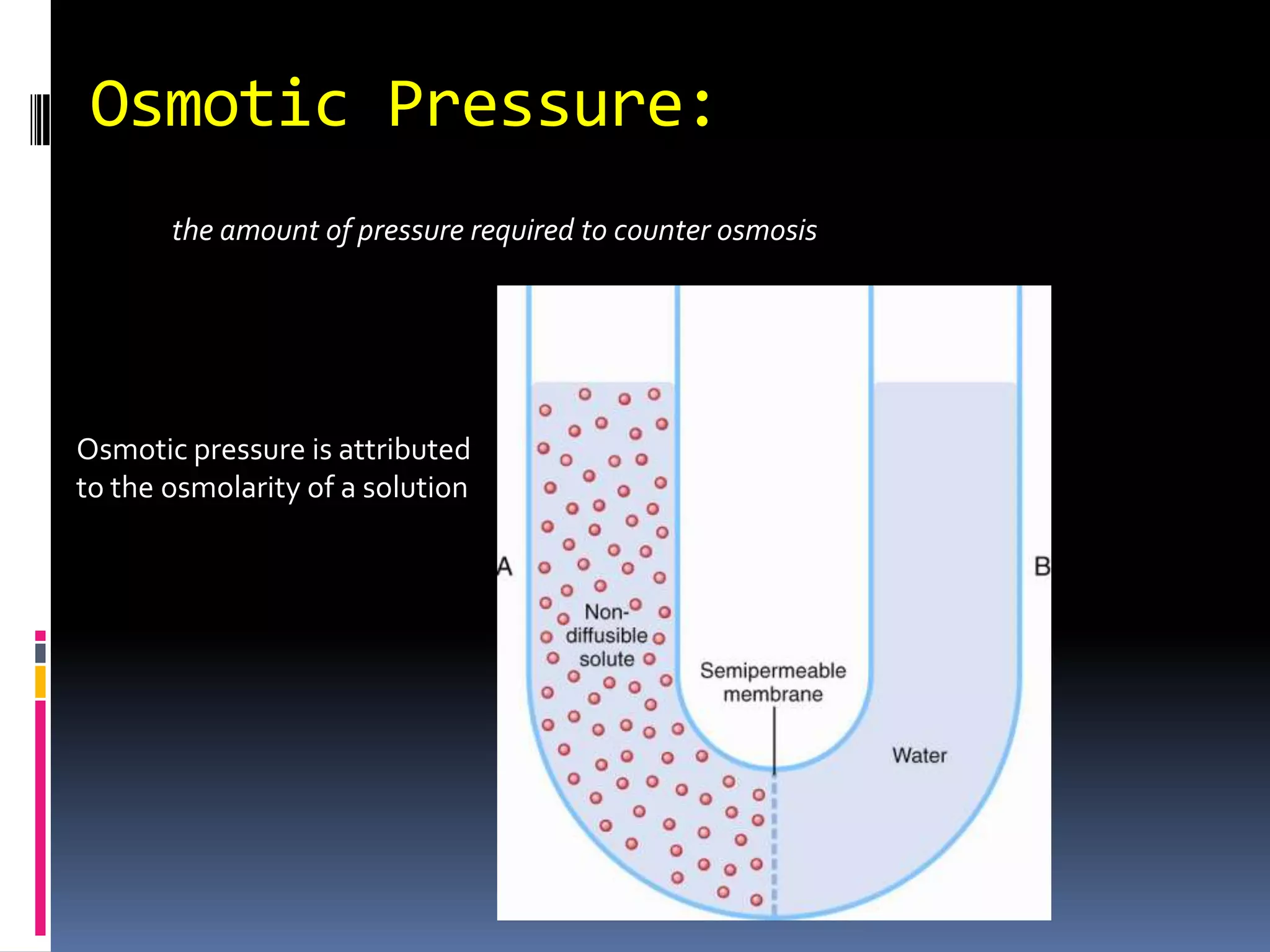
Osmotic Pressure:the amount of pressure required to counter osmosisOsmotic pressure is attributed to the osmolarity of a solution
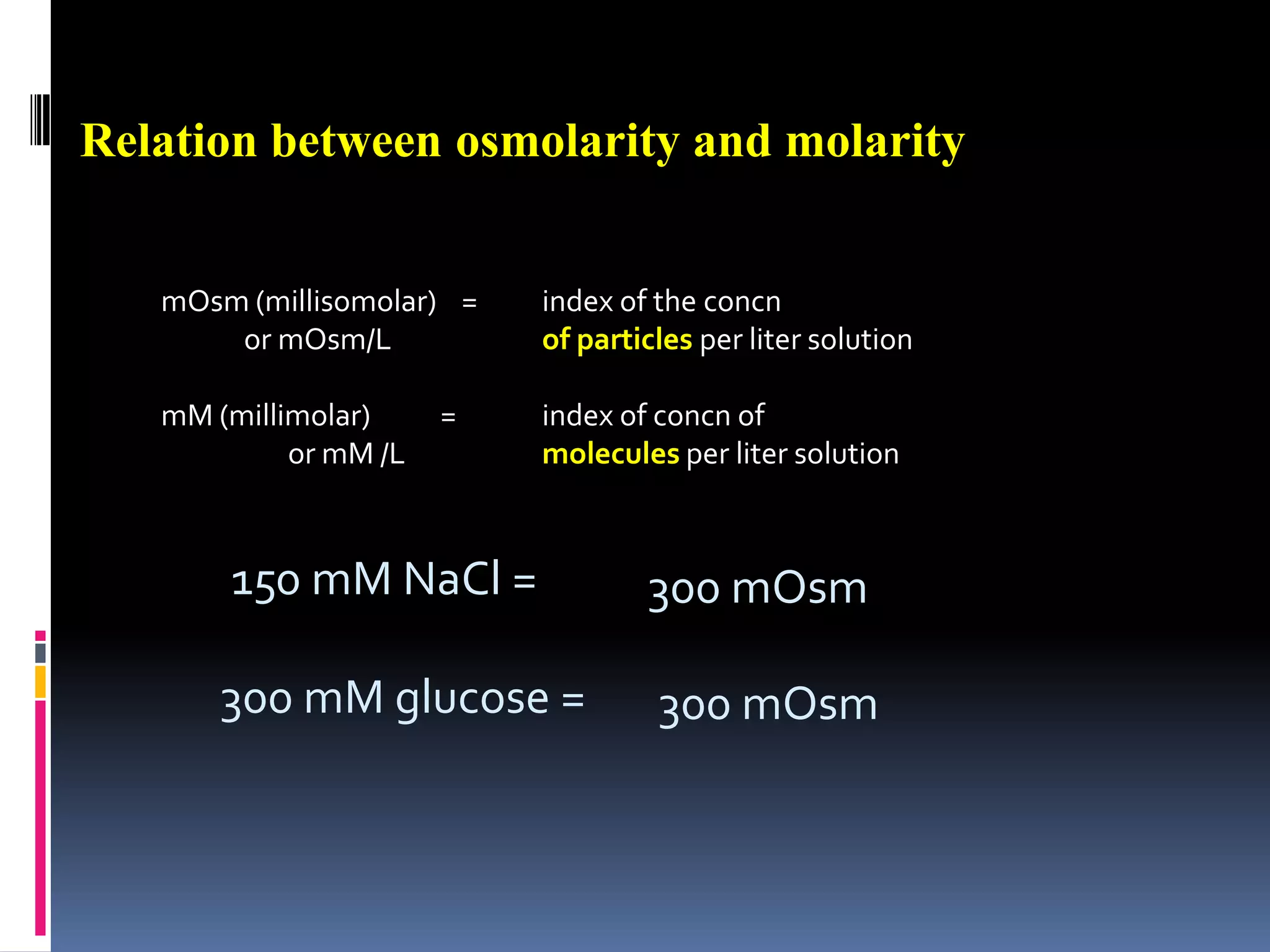
Relation between osmolarity and molaritymOsm (millisomolar)    = 	index of the concn             or mOsm/L 		of particles per liter solutionmM (millimolar)           =	index of concn of 	or mM /L		molecules per liter solution150 mM NaCl =300 mM glucose =300 mOsm300 mOsm
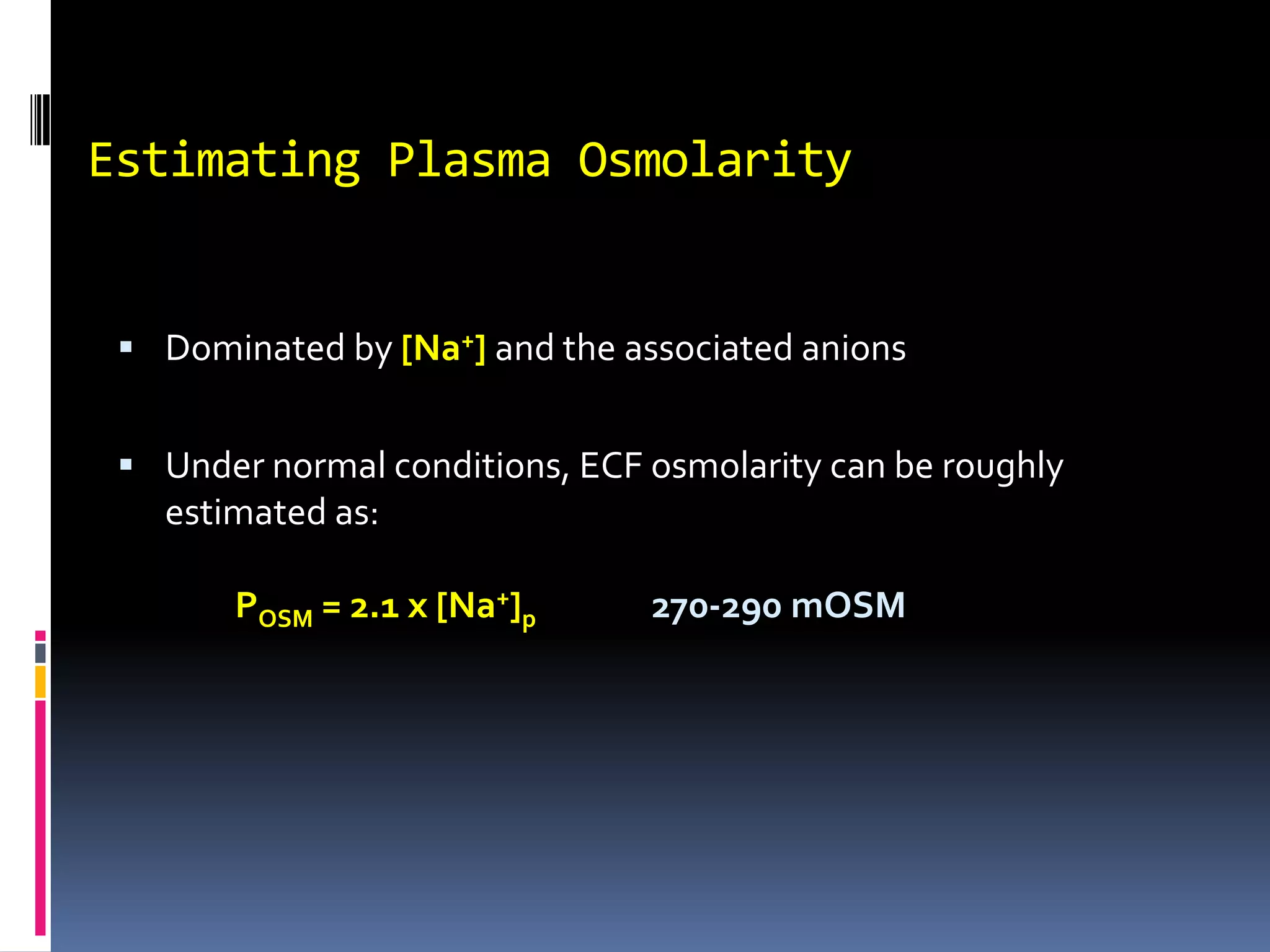
Estimating Plasma OsmolarityDominated by [Na+]and the associated anionsUnder normal conditions, ECF osmolarity can be roughly estimated as:POSM = 2.1 x [Na+]p270-290 mOSM
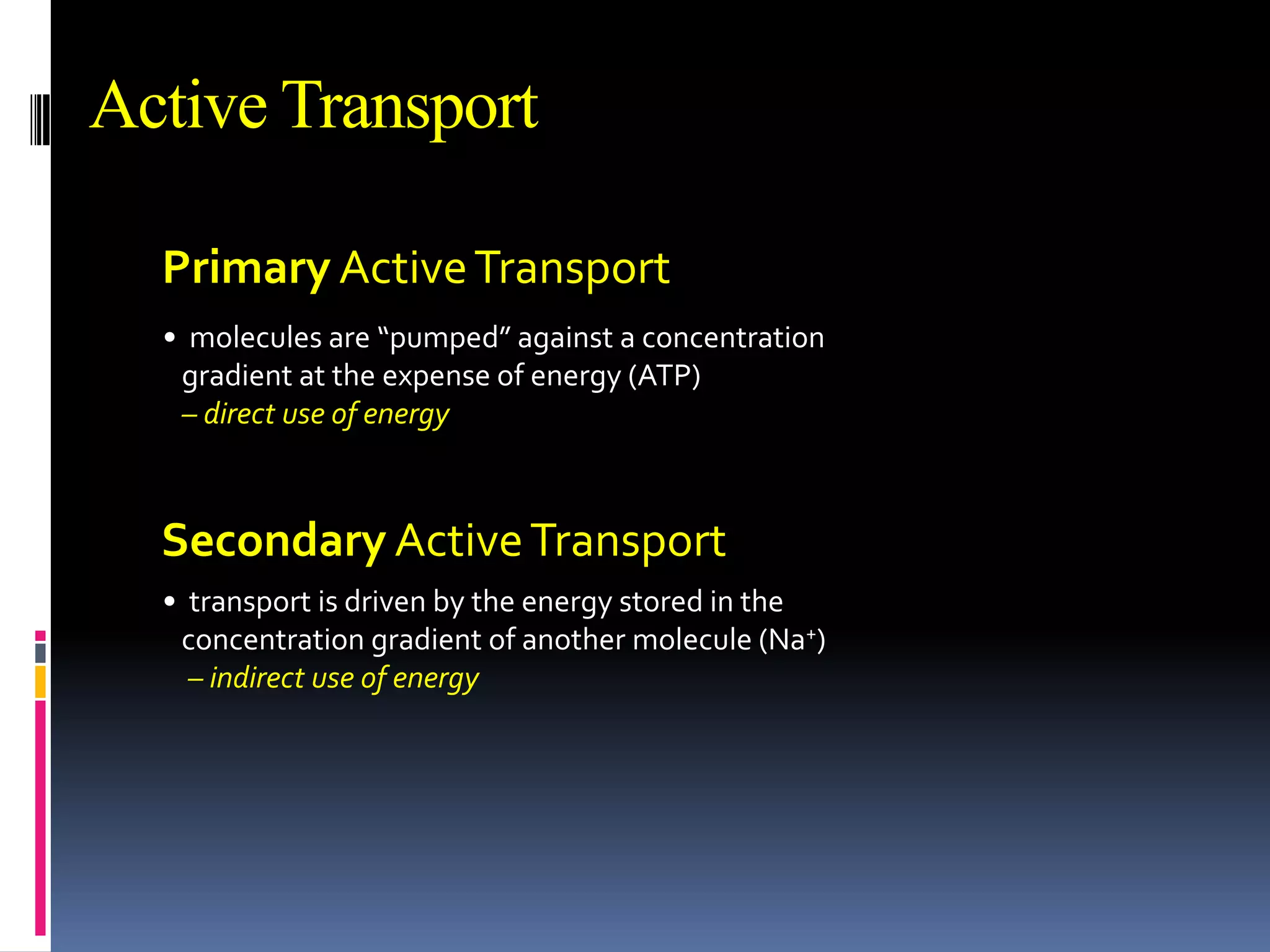
Active TransportPrimary Active Transport  molecules are “pumped” against a concentration    gradient at the expense of energy (ATP) – direct use of energySecondary Active Transport  transport is driven by the energy stored in the    concentration gradient of another molecule (Na+)– indirect use of energy

Lec121.10.10

  • 1.
    Transport of SubstancesThroughthe Cell Membrane
  • 2.
    Molecular Gradientsinside(in mM)141402010-4(pH7.2)10527540outside(in mM)14241-21-2(pH 7.4)28110145Na+K+Mg2+Ca2+H+HCO3-Cl-SO42-PO3-protein
  • 3.
    CO2O2N2H2OureaLipid Bilayer: barrier to water and water-soluble substancesglucoseions
  • 4.
    Proteins:Channel proteins allowfree movement of water and selected ions
  • 5.
    Carrier proteins bindwith molecules or ions that are to be transported
  • 6.
    Both channel proteinsand the carrier proteins are highly selective in the types of moleculesChannel proteincarrier proteinsK+
  • 7.
    DiffusionActive Transport occurs against a concn. gradient involves a “carrier”
  • 8.
    requiresENERGY
  • 9.
    occursdown a concn. gradient no mediator or involves a “channel” or “carrier” no additional energySimple diffusion can occur through the cell membrane by two pathways Through lipid bilayer if the diffusing substance is lipid solubleWater-soluble molecules cross via channels or pores(b)(a)Simple Diffusion
  • 10.
    Ion ChannelsCharacteristics:ungateddetermined bysize, shape, distribution of charge, etc.gated voltage (e.g. voltage-dependent Na+ channels)
  • 11.
    chemically(e.g. acetylcholine receptor channels)inoutNa+ and other ionsNa+
  • 12.
    Facilitated Diffusion(also calledcarrier mediated diffusion)Rate of diffusion is limited by Vmax of the carrier protein
  • 13.
    the densityof carrier proteins in the membrane
  • 14.
    Simple vs. Facilitatedsimplediffusionrate of diffusionVmaxTmfacilitated diffusionConcn of substanceWhat limits maximum rate of facilitated diffusion?
  • 15.
    Factors that affectthe net rate of diffusion:1. Concentration difference (Co- Ci)net diffusion (Co- Ci)
  • 16.
    +------- ----- ----- -- ----- -- --- --- --------------------+--2. Electrical potential (EMF)When will the negatively charged molecules stop entering the cell?The Nernst potential (equilibrium potential) is the theoretical intracellular electrical potential that would be equal in magnitude but opposite in direction to the concentration force.EMF (mV) = ±61 log (Co / Ci)
  • 17.
    3. Pressure difference Higher pressure results in increased energy available to cause net movement from high to low pressure.Osmosis:- Net diffusion of water -Osmosis occurs from pure water toward a water/salt solution. Water moves down its concn gradient.
  • 18.
    Osmotic Pressure:the amountof pressure required to counter osmosisOsmotic pressure is attributed to the osmolarity of a solution
  • 19.
    Relation between osmolarityand molaritymOsm (millisomolar) = index of the concn or mOsm/L of particles per liter solutionmM (millimolar) = index of concn of or mM /L molecules per liter solution150 mM NaCl =300 mM glucose =300 mOsm300 mOsm
  • 20.
    Estimating Plasma OsmolarityDominatedby [Na+]and the associated anionsUnder normal conditions, ECF osmolarity can be roughly estimated as:POSM = 2.1 x [Na+]p270-290 mOSM
  • 21.
    Active TransportPrimary ActiveTransport molecules are “pumped” against a concentration gradient at the expense of energy (ATP) – direct use of energySecondary Active Transport transport is driven by the energy stored in the concentration gradient of another molecule (Na+)– indirect use of energy
  • 22.
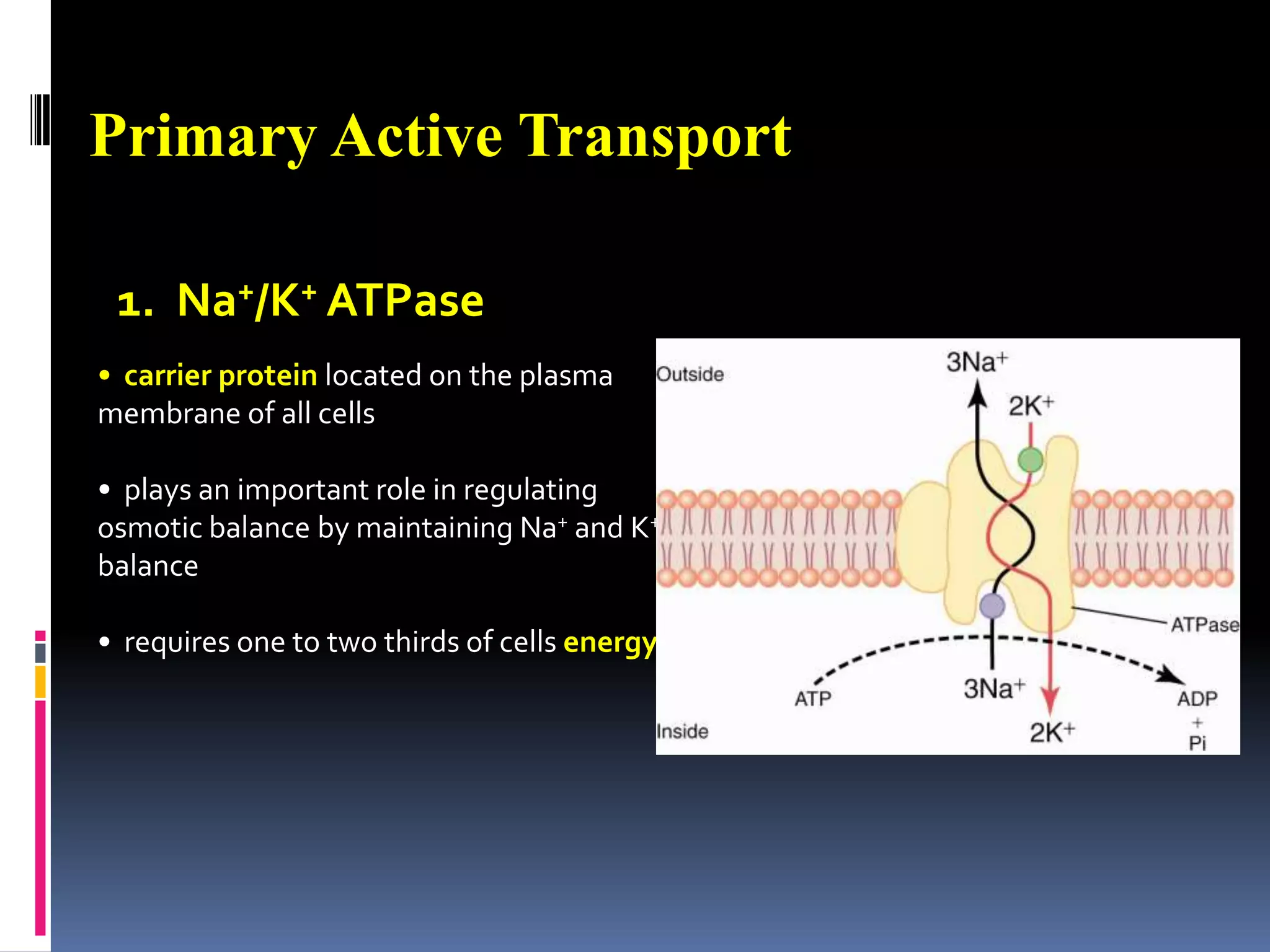
    Primary Active Transport1. Na+/K+ ATPasecarrier proteinlocated on the plasma membrane of all cells
  • 23.
    playsan important role in regulating osmotic balance by maintaining Na+ and K+balance
  • 24.
    requiresone to two thirds of cells energy2. Ca2+ ATPase present on the cell membrane and the sarcoplasmic reticulum maintains a low cytosolic Ca2+ concentration 3. H+ ATPase found in parietal cells of gastric glands (HCl secretion) and intercalated cells of renal tubules (controls blood pH)
  • 25.
    Na+gluc2 HCO3-Na+Na+AASecondary ActiveTransport- co-transport and counter-transport -Co-transport (co-porters): substance is transported in the same direction as the “driver” ion (Na+)Examples:outsideinside
  • 26.
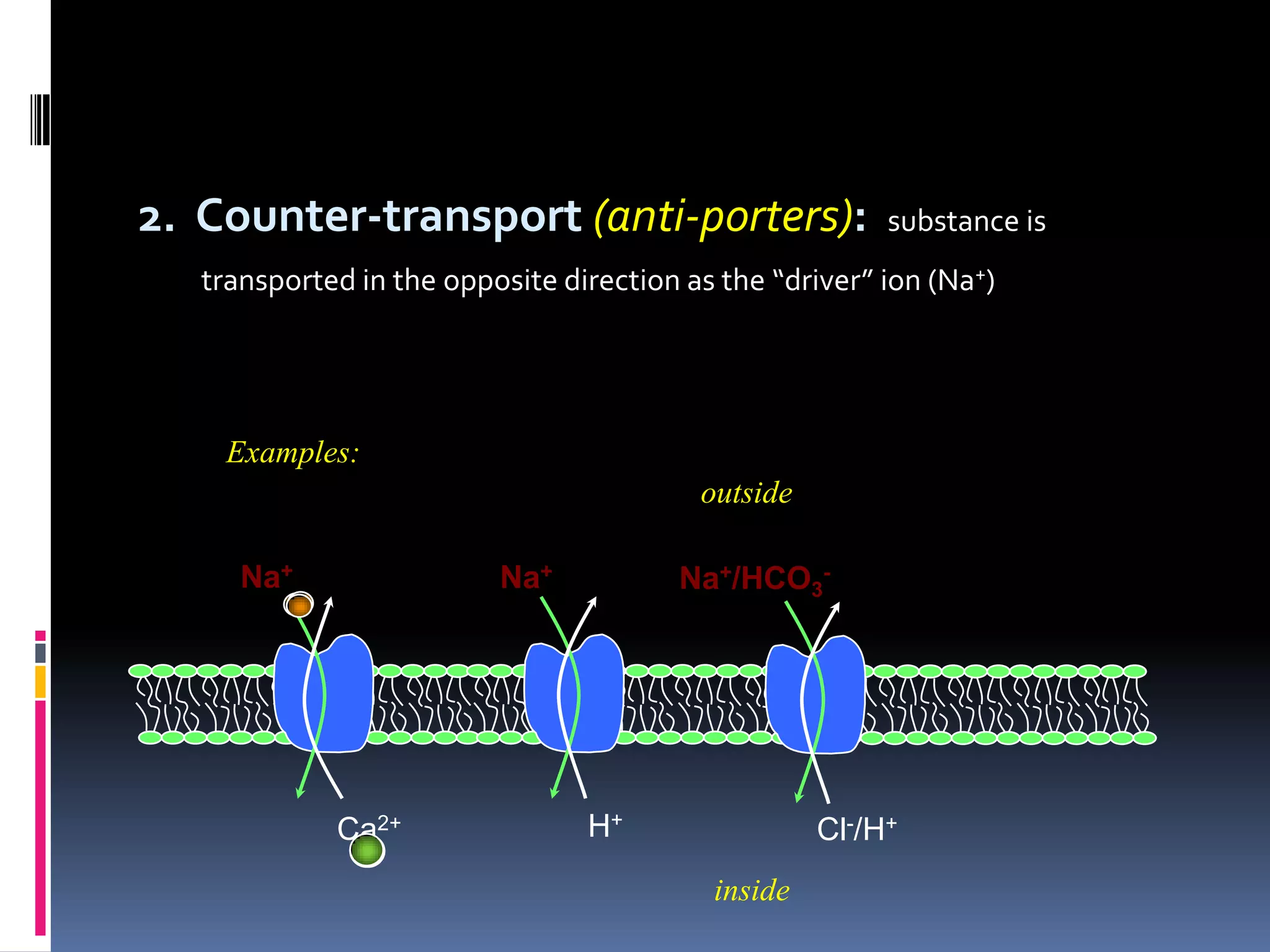
    Na+/HCO3-Na+Na+Cl-/H+H+Ca2+2. Counter-transport(anti-porters):substance is transported in the opposite direction as the “driver” ion (Na+)Examples:outsideinside