INTRODUCTION TO PATIENTS SAFETY
Dr. Hayat AKOUM
OBJECTIVES
 After completing this lecture you should:
 Recognize the magnitude and the importance of patient safety
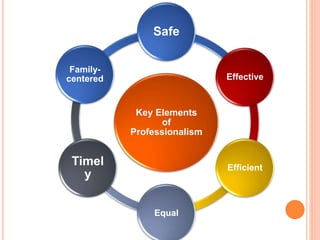
 Define and describe the key elements of healthcare quality
 Summarize the differences between error and harm
 Recognizing characteristics of a just culture
 Differentiate between the different types of clinical incidence
 Describe several specific behaviors you can practice to foster a
culture of safety in your workplace
2
DEFINING PATIENT SAFETY
The reduction of risk of unnecessary harm
associated with health care to an
acceptable minimum. (WHO, World
Alliance for Patient Safety 2009).
3
INTRODUCTION
 Significant numbers of patients are harmed due to their health
care, either resulting in permanent injury, increased length of
stay (LOS) in health-care facilities, or even death.
 44 – 98,000 deaths annually caused by medical error.
 There are more deaths annually as a result of health care than
from road accidents, breast cancer and AIDS combined.
4
Key Elements
of
Professionalism
Safe
Effective
Efficient
Equal
Timel
y
Family-
centered
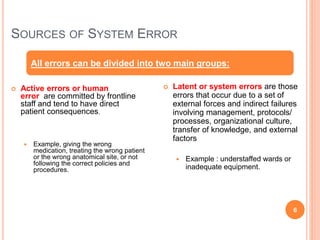
SOURCES OF SYSTEM ERROR
6
 Active errors or human
error are committed by frontline
staff and tend to have direct
patient consequences.
 Example, giving the wrong
medication, treating the wrong patient
or the wrong anatomical site, or not
following the correct policies and
procedures.
 Latent or system errors are those
errors that occur due to a set of
external forces and indirect failures
involving management, protocols/
processes, organizational culture,
transfer of knowledge, and external
factors
 Example : understaffed wards or
inadequate equipment.
All errors can be divided into two main groups:
ERROR IN MEDICINE
 Errors in health care can be caused by ‘‘active failures’’
or ‘‘latent conditions.’’
 Most errors are not a result of personal error or
negligence, but arise from system flaws or organizational
failures
7
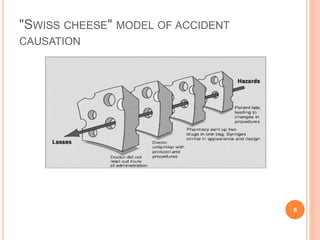
"SWISS CHEESE" MODEL OF ACCIDENT
CAUSATION
8
"SWISS CHEESE" MODEL OF ACCIDENT
CAUSATION
9
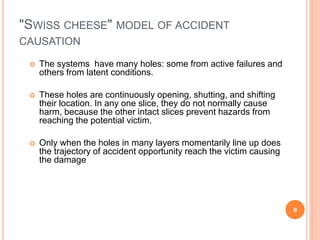
 The systems have many holes: some from active failures and
others from latent conditions.
 These holes are continuously opening, shutting, and shifting
their location. In any one slice, they do not normally cause
harm, because the other intact slices prevent hazards from
reaching the potential victim.
 Only when the holes in many layers momentarily line up does
the trajectory of accident opportunity reach the victim causing
the damage
DEFINITION OF PATIENT SAFETY CULTURE
An integrated pattern of individual and organizational behavior,
based on a system of shared beliefs and values, that
continuously seeks to minimize patient harm that may result from
the process of care delivery.
10
PATIENT SAFETY CULTURE
 If a patient is found to have received the wrong medication and
suffered a subsequent allergic reaction,
 Blame culture: we look for the individual student, pharmacist, nurse or
doctor who ordered, dispensed or administered the wrong drug and
blame that person for the patient’s condition care at the time of the
incident and hold them accountable
 Just Culture: we look for the system defect such as communication ,
protocols and processes for medication management , in addition to
investigate the negligence or recklessness of the worker
11
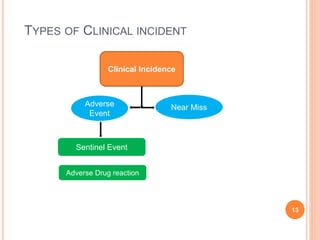
THE CONCEPT OF CLINICAL INCIDENT:
12
 A clinical incident is an event or
circumstance resulting from health
care which could have, or did lead
to unintended harm to a person,
loss or damage, and/or a
complaint. (deviation from
standard of care and safety )
 Medication errors (e.G. Wrong medication,
omission, overdose);
 Patient falls;
 Intended self harm or suicidal behaviour;
 Therapeutic equipment failure;
 Contaminated food;
 Problems with blood products;
 Documentation errors;
 Delayed diagnosis;
 Surgical operation complications;
 Hospital acquired infection;
Definition: Examples:
TYPES OF CLINICAL INCIDENT
13
Clinical Incidence
Adverse
Event
Near Miss
Sentinel Event
Adverse Drug reaction
TYPES OF CLINICAL INCIDENT
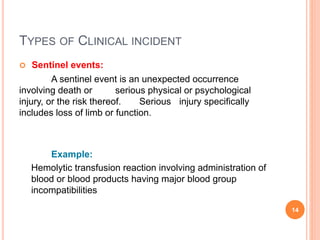
 Sentinel events:
A sentinel event is an unexpected occurrence
involving death or serious physical or psychological
injury, or the risk thereof. Serious injury specifically
includes loss of limb or function.
Example:
Hemolytic transfusion reaction involving administration of
blood or blood products having major blood group
incompatibilities
14
TYPES OF CLINICAL INCIDENT
 Near miss:
Is any situations that did not cause harm to
patients (that did not reach the patient) , but
could have done.
15
TYPES OF CLINICAL INCIDENT
 Adverse Drug Reaction:
A response to a drug which is noxious and unintended, and which
occurs at doses normally used in man for the prophylaxis,
diagnosis, or therapy of disease, or for the modifications of
physiological function'.( WHO,1972)
17
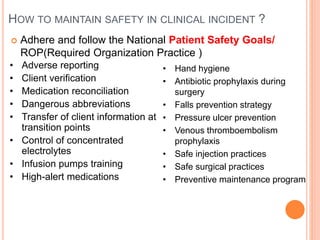
HOW TO MAINTAIN SAFETY IN CLINICAL INCIDENT ?
 Adhere and follow the National Patient Safety Goals/
ROP(Required Organization Practice )
• Adverse reporting
• Client verification
• Medication reconciliation
• Dangerous abbreviations
• Transfer of client information at
transition points
• Control of concentrated
electrolytes
• Infusion pumps training
• High-alert medications
• Hand hygiene
• Antibiotic prophylaxis during
surgery
• Falls prevention strategy
• Pressure ulcer prevention
• Venous thromboembolism
prophylaxis
• Safe injection practices
• Safe surgical practices
• Preventive maintenance program
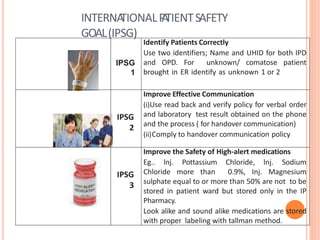
INTERNA
TIONALP
A
TIENTSAFETY
GOAL(IPSG)
IPSG
1
Identify Patients Correctly
Use two identifiers; Name and UHID for both IPD
and OPD. For unknown/ comatose patient
brought in ER identify as unknown 1 or 2
IPSG
2
Improve Effective Communication
(i)Use read back and verify policy for verbal order
and laboratory test result obtained on the phone
and the process ( for handover communication)
(ii)Comply to handover communication policy
IPSG
3
Improve the Safety of High-alert medications
Eg.. lnj. Pottassium Chloride, lnj. Sodium
Chloride more than 0.9%, Inj. Magnesium
sulphate equal to or more than 50% are not to be
stored in patient ward but stored only in the IP
Pharmacy.
Look alike and sound alike medications are stored
with proper labeling with tallman method.
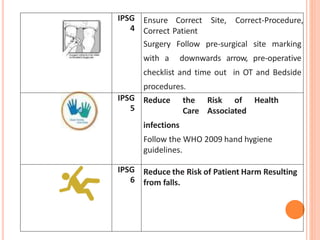
IPSG
4
Ensure Correct Site, Correct-Procedure,
Correct Patient
Surgery Follow pre-surgical site marking
with a downwards arrow, pre-operative
checklist and time out in OT and Bedside
procedures.
IPSG
5
Reduce the Risk of Health
Care Associated
infections
Follow the WHO 2009 hand hygiene
guidelines.
IPSG
6
Reduce the Risk of Patient Harm Resulting
from falls.
 A 38-year-old woman comes to the hospital with 20
minutes of itchy red rash and facial swelling; she has
a history of serious allergic reactions
 A nurse draws up 10 mls of 1:10,000 adrenaline
(epinephrine) into a 10 ml syringe and leaves it at the
bedside ready to use (1 mg in total) just in case the
doctor requests it
 Meanwhile the doctor inserts an intravenous cannula
 The doctor sees the 10 ml syringe of clear fluid that
the nurse has drawn up and assumes it is normal
saline
CONTINUE….
 There is no communication between the doctor and the nurse at this time
 The doctor gives all 10 mls of adrenaline (epinephrine)through the intravenous
cannula thinking he is using saline to flush the line.
 The patient suddenly feels terrible, anxious, becomes tachycardia and then
becomes unconscious with no pulse
 She is discovered to be in ventricular tachycardia, is resuscitated and
fortunately makes a good recovery
 Recommended dose of adrenaline (epinephrine) in anaphylaxis is 0.3 - 0.5 mg
IM, this patient received 1mg IV
Can you identify the contributing factors for
this error?
24
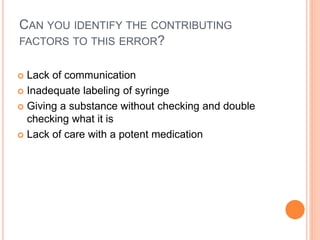
CAN YOU IDENTIFY THE CONTRIBUTING
FACTORS TO THIS ERROR?
 Lack of communication
 Inadequate labeling of syringe
 Giving a substance without checking and double
checking what it is
 Lack of care with a potent medication
CONCLUSION
 Patient safety is the avoidance, prevention and amelioration of harm from healthcare.
 Two approaches to the problem of human fallibility exist:
 The person approach focuses on the errors of individuals, blaming them
 The system approach concentrates on the conditions under which individuals work
 Some errors cause harm but many do not.
 Blaming and then punishing individuals is not an effective approach for improving safety within the
system
 Adverse events often occur because of system breakdowns
 Standardizing and simplifying clinical processes is a powerful way of improving patient safety
26

patient safety.pptx

  • 1.
    INTRODUCTION TO PATIENTSSAFETY Dr. Hayat AKOUM
  • 2.
    OBJECTIVES  After completingthis lecture you should:  Recognize the magnitude and the importance of patient safety  Define and describe the key elements of healthcare quality  Summarize the differences between error and harm  Recognizing characteristics of a just culture  Differentiate between the different types of clinical incidence  Describe several specific behaviors you can practice to foster a culture of safety in your workplace 2
  • 3.
    DEFINING PATIENT SAFETY Thereduction of risk of unnecessary harm associated with health care to an acceptable minimum. (WHO, World Alliance for Patient Safety 2009). 3
  • 4.
    INTRODUCTION  Significant numbersof patients are harmed due to their health care, either resulting in permanent injury, increased length of stay (LOS) in health-care facilities, or even death.  44 – 98,000 deaths annually caused by medical error.  There are more deaths annually as a result of health care than from road accidents, breast cancer and AIDS combined. 4
  • 5.
  • 6.
    SOURCES OF SYSTEMERROR 6  Active errors or human error are committed by frontline staff and tend to have direct patient consequences.  Example, giving the wrong medication, treating the wrong patient or the wrong anatomical site, or not following the correct policies and procedures.  Latent or system errors are those errors that occur due to a set of external forces and indirect failures involving management, protocols/ processes, organizational culture, transfer of knowledge, and external factors  Example : understaffed wards or inadequate equipment. All errors can be divided into two main groups:
  • 7.
    ERROR IN MEDICINE Errors in health care can be caused by ‘‘active failures’’ or ‘‘latent conditions.’’  Most errors are not a result of personal error or negligence, but arise from system flaws or organizational failures 7
  • 8.
    "SWISS CHEESE" MODELOF ACCIDENT CAUSATION 8
  • 9.
    "SWISS CHEESE" MODELOF ACCIDENT CAUSATION 9  The systems have many holes: some from active failures and others from latent conditions.  These holes are continuously opening, shutting, and shifting their location. In any one slice, they do not normally cause harm, because the other intact slices prevent hazards from reaching the potential victim.  Only when the holes in many layers momentarily line up does the trajectory of accident opportunity reach the victim causing the damage
  • 10.
    DEFINITION OF PATIENTSAFETY CULTURE An integrated pattern of individual and organizational behavior, based on a system of shared beliefs and values, that continuously seeks to minimize patient harm that may result from the process of care delivery. 10
  • 11.
    PATIENT SAFETY CULTURE If a patient is found to have received the wrong medication and suffered a subsequent allergic reaction,  Blame culture: we look for the individual student, pharmacist, nurse or doctor who ordered, dispensed or administered the wrong drug and blame that person for the patient’s condition care at the time of the incident and hold them accountable  Just Culture: we look for the system defect such as communication , protocols and processes for medication management , in addition to investigate the negligence or recklessness of the worker 11
  • 12.
    THE CONCEPT OFCLINICAL INCIDENT: 12  A clinical incident is an event or circumstance resulting from health care which could have, or did lead to unintended harm to a person, loss or damage, and/or a complaint. (deviation from standard of care and safety )  Medication errors (e.G. Wrong medication, omission, overdose);  Patient falls;  Intended self harm or suicidal behaviour;  Therapeutic equipment failure;  Contaminated food;  Problems with blood products;  Documentation errors;  Delayed diagnosis;  Surgical operation complications;  Hospital acquired infection; Definition: Examples:
  • 13.
    TYPES OF CLINICALINCIDENT 13 Clinical Incidence Adverse Event Near Miss Sentinel Event Adverse Drug reaction
  • 14.
    TYPES OF CLINICALINCIDENT  Sentinel events: A sentinel event is an unexpected occurrence involving death or serious physical or psychological injury, or the risk thereof. Serious injury specifically includes loss of limb or function. Example: Hemolytic transfusion reaction involving administration of blood or blood products having major blood group incompatibilities 14
  • 15.
    TYPES OF CLINICALINCIDENT  Near miss: Is any situations that did not cause harm to patients (that did not reach the patient) , but could have done. 15
  • 17.
    TYPES OF CLINICALINCIDENT  Adverse Drug Reaction: A response to a drug which is noxious and unintended, and which occurs at doses normally used in man for the prophylaxis, diagnosis, or therapy of disease, or for the modifications of physiological function'.( WHO,1972) 17
  • 18.
    HOW TO MAINTAINSAFETY IN CLINICAL INCIDENT ?  Adhere and follow the National Patient Safety Goals/ ROP(Required Organization Practice ) • Adverse reporting • Client verification • Medication reconciliation • Dangerous abbreviations • Transfer of client information at transition points • Control of concentrated electrolytes • Infusion pumps training • High-alert medications • Hand hygiene • Antibiotic prophylaxis during surgery • Falls prevention strategy • Pressure ulcer prevention • Venous thromboembolism prophylaxis • Safe injection practices • Safe surgical practices • Preventive maintenance program
  • 19.
    INTERNA TIONALP A TIENTSAFETY GOAL(IPSG) IPSG 1 Identify Patients Correctly Usetwo identifiers; Name and UHID for both IPD and OPD. For unknown/ comatose patient brought in ER identify as unknown 1 or 2 IPSG 2 Improve Effective Communication (i)Use read back and verify policy for verbal order and laboratory test result obtained on the phone and the process ( for handover communication) (ii)Comply to handover communication policy IPSG 3 Improve the Safety of High-alert medications Eg.. lnj. Pottassium Chloride, lnj. Sodium Chloride more than 0.9%, Inj. Magnesium sulphate equal to or more than 50% are not to be stored in patient ward but stored only in the IP Pharmacy. Look alike and sound alike medications are stored with proper labeling with tallman method.
  • 20.
    IPSG 4 Ensure Correct Site,Correct-Procedure, Correct Patient Surgery Follow pre-surgical site marking with a downwards arrow, pre-operative checklist and time out in OT and Bedside procedures. IPSG 5 Reduce the Risk of Health Care Associated infections Follow the WHO 2009 hand hygiene guidelines. IPSG 6 Reduce the Risk of Patient Harm Resulting from falls.
  • 22.
     A 38-year-oldwoman comes to the hospital with 20 minutes of itchy red rash and facial swelling; she has a history of serious allergic reactions  A nurse draws up 10 mls of 1:10,000 adrenaline (epinephrine) into a 10 ml syringe and leaves it at the bedside ready to use (1 mg in total) just in case the doctor requests it  Meanwhile the doctor inserts an intravenous cannula  The doctor sees the 10 ml syringe of clear fluid that the nurse has drawn up and assumes it is normal saline
  • 23.
    CONTINUE….  There isno communication between the doctor and the nurse at this time  The doctor gives all 10 mls of adrenaline (epinephrine)through the intravenous cannula thinking he is using saline to flush the line.  The patient suddenly feels terrible, anxious, becomes tachycardia and then becomes unconscious with no pulse  She is discovered to be in ventricular tachycardia, is resuscitated and fortunately makes a good recovery  Recommended dose of adrenaline (epinephrine) in anaphylaxis is 0.3 - 0.5 mg IM, this patient received 1mg IV
  • 24.
    Can you identifythe contributing factors for this error? 24
  • 25.
    CAN YOU IDENTIFYTHE CONTRIBUTING FACTORS TO THIS ERROR?  Lack of communication  Inadequate labeling of syringe  Giving a substance without checking and double checking what it is  Lack of care with a potent medication
  • 26.
    CONCLUSION  Patient safetyis the avoidance, prevention and amelioration of harm from healthcare.  Two approaches to the problem of human fallibility exist:  The person approach focuses on the errors of individuals, blaming them  The system approach concentrates on the conditions under which individuals work  Some errors cause harm but many do not.  Blaming and then punishing individuals is not an effective approach for improving safety within the system  Adverse events often occur because of system breakdowns  Standardizing and simplifying clinical processes is a powerful way of improving patient safety 26