WELCOME
Transplantation immunology
Content
1) Introduction.
2) Types of transplants.
3) Specificity & memory of the rejection responses.
4) Role of cell mediated responses.
5) Transplantation antigens.
6) Tissue typing.
7) Immunology of transplant rejection.
8) Clinical manifestation of graft rejection.
9) Immunosuppressive therapy.
10)Conclusion.
11)References.
Introduction
Transplantation-the act of transferring cells,
tissues, or organs from one site to another.
The individual who provides the graft is called
the Donor, and the one who receive the graft
is called either the recipient or the host.
Transfusion is the transplantation of
circulating blood cells or plasma from one
individual to another.
A major limitation to the success of
transplantation is the immune response of the
recipient to the donor tissue.
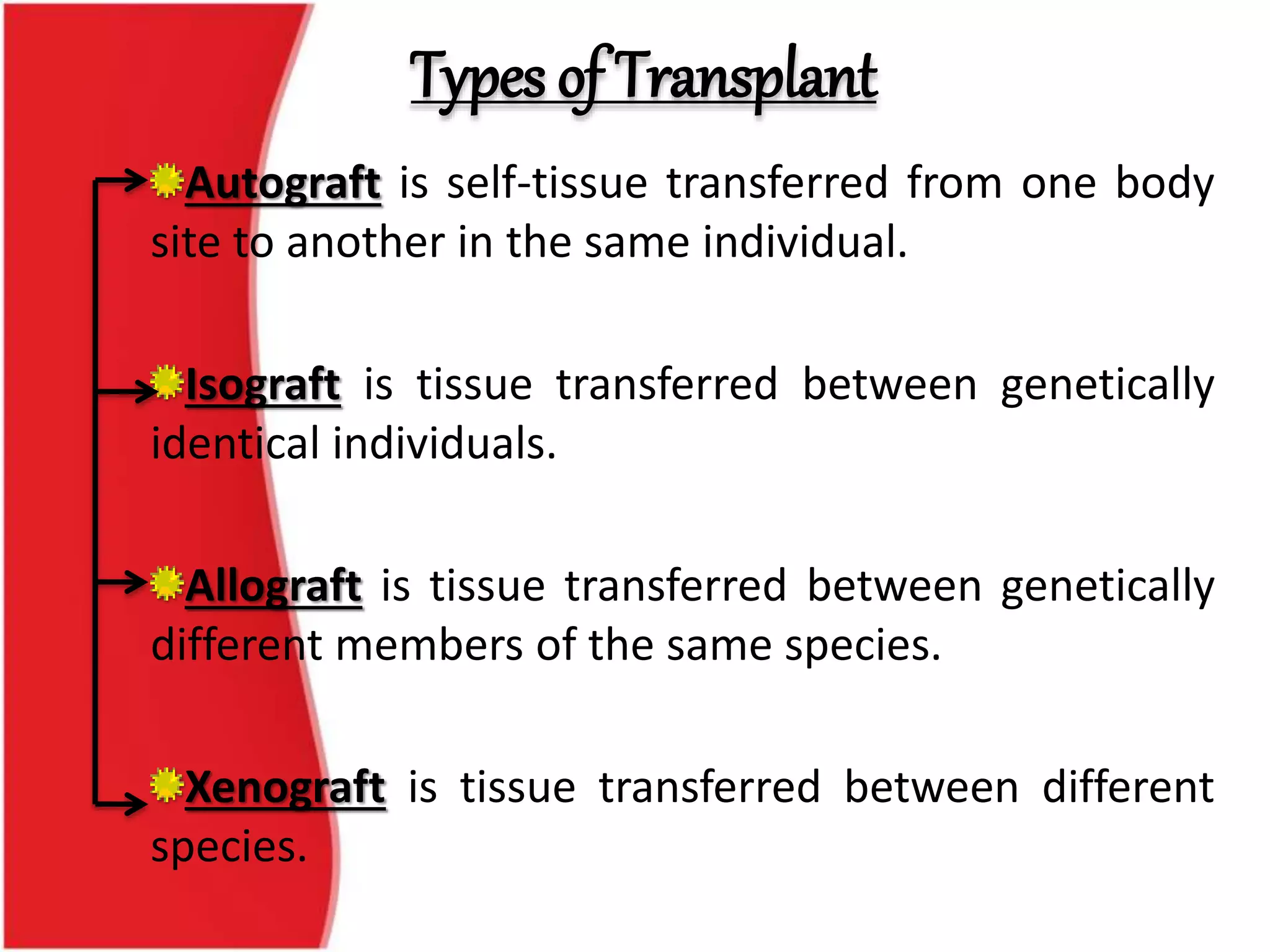
Types of Transplant
Autograft is self-tissue transferred from one body
site to another in the same individual.
Isograft is tissue transferred between genetically
identical individuals.
Allograft is tissue transferred between genetically
different members of the same species.
Xenograft is tissue transferred between different
species.
Specificity and memory of the rejection
response
The time sequence of allograft
rejection varies according to tissue
involved.
Graft rejection always displays the
attributes of specificity and memory.
Fig-Schematic diagrams of the process of graft acceptance and rejection.
Role of cell-Mediatedresponses
Lymphocytes, but not serum antibody, could
transfer allograft immunity (1950s by Avrion
Mitchison )
T-cells derived from an allograft-primed
mouse were shown to transfer second-set
allograft rejection to an unprimed sygeneic
recipient , as long as that recipient was grafed
with the same allogeneic tissue.
Analysis of the T-cell subpopulations involved
in allograft rejection has implicated both CD4+
and CD8+ populations.
Experimental demonstration
Both CD4+ and CD8+ T-cells participated in
rejection and that the collaboration of both
subpopulation resulted in more pronounced graft
rejection.
Role of CD4 & CD8 T-cells in allograft rejection
Transplantation Antigens
Tissue that are antigenically similar are
said to be Histocompatible.
Tissues that display significantly antigenic
differences are Histoincompatible, such
tissues do induce an immune response
that leads to tissue rejection
Encoded by more than 40 different loci.
MHC inheritance in outbred population is
more complex.
TISSUE TYPING
ABO blood-group compatibility.
HLA typing
Microcytotoxicity test
Mixed-lymphocyte reaction
(MLR)
MLR
Immunology of Transplant Rejection
Components of the Immune system involved in graft Rejection :
1) Antigen presenting cells –
• Dendritic cells
• Macrophages
• Activated B Cells
2) B cells and antibodies –
• Natural antibodies
• Preformed antibodies from prior sensatization
• Induced antibodies
3) T cells
4) Other cells –
• Natural killer cells
• T cells that express NK cell – associated Markers
• Monocytes/Macrophages
The Immunology of Allogeneic Transplantation
• Recognition of transplanted cells that are self
or foreign is determined by polymorphic
genes (MHC) that are inherited from both
parents and are expressed co-dominantly.
• Alloantigens elicit both cell-mediated and
humoral immune responses.
Recognition of Alloantigens
• Direct Presentation
Recognition of an intact MHC molecule displayed by
donor APC in the graft
Basically, self MHC molecule recognizes the structure of
an intact allogeneic MHC molecule
Involves both CD8+ and CD4+ T cells.
. Indirect Presentation
 Donor MHC is processed and presented by recipient
APC
 Basically, donor MHC molecule is handled like any other
foreign antigen
 Involve only CD4+ T cells.
 Antigen presentation by class II MHC molecules.
The process of graft rejection can be dividedintotwo
stages-
An effector stageSensitization
phase
Sensitization stage
CD4 & CD8 T-cells recognize alloantigens expressed
on cells of the foreign graft & proliferate in response.
Both dendritic cells & vascular endothelial cells from
an allogeneic graft induce host T-cell proliferation.
The degree & type of immunologic response varies
with the type of transplant.
Effector stage
A variety of effector mechanisms participate, these
are cell-mediated reactions involving delayed-type
hypersensitivity & CTL-mediated cytotoxicity (most
common).
Less common mechanisms are-
Ab plus-complement lysis.
Destruction by ADCC.
Involves influx of T-cells & macrophages into the
graft.
Cytokines secreted by TH cells play a central role.
Effector mechanisminvolvedin graft rejection
RoleofCytokinesinGraftRejection
• IL – 2, IFN – , and TNF -  are important mediators of graft
rejection.
• IL – α promotes T-cell proliferation and generation of T –
Lymphocytes.
• IFN -  is central to the development of DTH response.
• TNF -  has direct cytotoxic effect on the cells of graft.
• A number of cytokines promote graft rejection by inducing
expression of class – I or class – II MHC molecule on graft
cell.
• The interferon (α,  and ), TNF – α and TNF -  all
increases class – I MHC expression, and IFN -  increases
class – II MHC expression as well.
Clinicalmanifestationsofgraftrejection
1) Hyperacute rejection
Caused by preexisting host serum Abs specific for antigens of the
graft.
Activates complement cascade.
2) Acute rejection-
Cell mediated allograft rejection.
begins about 10days after
transplantation.
Massive infiltration of macrophages
& lymphocytes at site of tissue
destruction.
TH cell activation and proliferation.
3) Chronic rejection
Develop after months or years after
transplantation.
Include both humoral & CMI response by
recipient.
Not prevented in most cases.
Difficult to manage with
immunosuppressive drugs.
General immunosuppressive therapy
Allogeneic transplantation requires some
degree of immunosuppression if transplant is
to survive.
Mitotic inhibitors- Azathioprine,
Cyclophosphamide, Methotrexate
Corticosteroids- Prednisone, Dexamethasone,
Cyclosporin A, FK506, Rapamycin.
Total lymphoid irradiation- 200rads/day.
Specific immunosuppressive therapy
1) Monoclonal antibody therapy-
a) Monoclonal antibody directed against various
surface molecules on cells of immune system.
Use of monoclonal antibody to CD3 molecule of
TCR complex.
Cytotoxic agent such as Diphtheria toxin coupled
with antibody.
Use of monoclonal antibody specific for high
affinity IL2 receptor.
Anti-CD4 monoclonal antibody.
.b) Cell surface adhesion molecules
Monoclonal antibodies to adhesion molecules
ICAM1 & LFA-1
Monoclonal antibodies specific for cytokines.
Monoclonal antibodies to TNF-.
Monoclonal antibodies to IFN ϒ & IL2.
2) Agents that block co-stimulatory signals
By interaction of B7 molecules on the membrane
of APC with CD28 or CTLA-4 molecule on T-cells.
Interaction of CD40 (present on APC) & CD40
ligand(present on T-cells)
Blocking co-stimulatory signals
(a) (B)
Tissue and Organ Transplantation
Today it is possible to transplant many different
organs and tissues including.
Most common transplantation is blood
transfusion.
Bone Marrow transplantation
Organs : Heart, kidneys, pancrease, lungs, liver
and intestines.
Tissues : include bones, corneas, skin, heart
values, veins, cartilage and other connective
tissues.
Clinical transplantation
Conclusion
More than 50,000 people, waiting for compatible donor. For
ethical an practical reasons, species closely related to human
such as Chimpanzee have not been widely used.
Xenogeneic transplantation may be major issue of research
xenograft technology including genetically modified animal
may become a new source of organ supply.
Side effects of immunosuppressive agent use for graft need a
change of specificity in action and avoiding general immune
suppression.
Techniques such as transgenic animal production and wide
range of research in this field hope to result in opening a new
window for the process of transplantation immunology.
References
Kuby immunology (4th edition), Richard A.
Goldsby, Thomas J. Kindt, Barbara A. Osborne.
Cellular & molecular immunology (5th edition),
Abdul K. Abbas, Andrew H. Lichtman.
Immunology (6th edition), Ivan Roitt, Jonathan
Brostoff, David Male.
.
Transplantation immunology

Transplantation immunology

  • 1.
  • 2.
  • 3.
    Content 1) Introduction. 2) Typesof transplants. 3) Specificity & memory of the rejection responses. 4) Role of cell mediated responses. 5) Transplantation antigens. 6) Tissue typing. 7) Immunology of transplant rejection. 8) Clinical manifestation of graft rejection. 9) Immunosuppressive therapy. 10)Conclusion. 11)References.
  • 4.
    Introduction Transplantation-the act oftransferring cells, tissues, or organs from one site to another. The individual who provides the graft is called the Donor, and the one who receive the graft is called either the recipient or the host. Transfusion is the transplantation of circulating blood cells or plasma from one individual to another. A major limitation to the success of transplantation is the immune response of the recipient to the donor tissue.
  • 5.
    Types of Transplant Autograftis self-tissue transferred from one body site to another in the same individual. Isograft is tissue transferred between genetically identical individuals. Allograft is tissue transferred between genetically different members of the same species. Xenograft is tissue transferred between different species.
  • 6.
    Specificity and memoryof the rejection response The time sequence of allograft rejection varies according to tissue involved. Graft rejection always displays the attributes of specificity and memory.
  • 7.
    Fig-Schematic diagrams ofthe process of graft acceptance and rejection.
  • 8.
    Role of cell-Mediatedresponses Lymphocytes,but not serum antibody, could transfer allograft immunity (1950s by Avrion Mitchison ) T-cells derived from an allograft-primed mouse were shown to transfer second-set allograft rejection to an unprimed sygeneic recipient , as long as that recipient was grafed with the same allogeneic tissue. Analysis of the T-cell subpopulations involved in allograft rejection has implicated both CD4+ and CD8+ populations.
  • 9.
    Experimental demonstration Both CD4+and CD8+ T-cells participated in rejection and that the collaboration of both subpopulation resulted in more pronounced graft rejection.
  • 10.
    Role of CD4& CD8 T-cells in allograft rejection
  • 11.
    Transplantation Antigens Tissue thatare antigenically similar are said to be Histocompatible. Tissues that display significantly antigenic differences are Histoincompatible, such tissues do induce an immune response that leads to tissue rejection Encoded by more than 40 different loci. MHC inheritance in outbred population is more complex.
  • 12.
    TISSUE TYPING ABO blood-groupcompatibility. HLA typing Microcytotoxicity test Mixed-lymphocyte reaction (MLR)
  • 14.
  • 15.
    Immunology of TransplantRejection Components of the Immune system involved in graft Rejection : 1) Antigen presenting cells – • Dendritic cells • Macrophages • Activated B Cells 2) B cells and antibodies – • Natural antibodies • Preformed antibodies from prior sensatization • Induced antibodies 3) T cells 4) Other cells – • Natural killer cells • T cells that express NK cell – associated Markers • Monocytes/Macrophages
  • 16.
    The Immunology ofAllogeneic Transplantation • Recognition of transplanted cells that are self or foreign is determined by polymorphic genes (MHC) that are inherited from both parents and are expressed co-dominantly. • Alloantigens elicit both cell-mediated and humoral immune responses.
  • 17.
    Recognition of Alloantigens •Direct Presentation Recognition of an intact MHC molecule displayed by donor APC in the graft Basically, self MHC molecule recognizes the structure of an intact allogeneic MHC molecule Involves both CD8+ and CD4+ T cells.
  • 18.
    . Indirect Presentation Donor MHC is processed and presented by recipient APC  Basically, donor MHC molecule is handled like any other foreign antigen  Involve only CD4+ T cells.  Antigen presentation by class II MHC molecules.
  • 19.
    The process ofgraft rejection can be dividedintotwo stages- An effector stageSensitization phase
  • 20.
    Sensitization stage CD4 &CD8 T-cells recognize alloantigens expressed on cells of the foreign graft & proliferate in response. Both dendritic cells & vascular endothelial cells from an allogeneic graft induce host T-cell proliferation. The degree & type of immunologic response varies with the type of transplant.
  • 21.
    Effector stage A varietyof effector mechanisms participate, these are cell-mediated reactions involving delayed-type hypersensitivity & CTL-mediated cytotoxicity (most common). Less common mechanisms are- Ab plus-complement lysis. Destruction by ADCC. Involves influx of T-cells & macrophages into the graft. Cytokines secreted by TH cells play a central role.
  • 22.
  • 23.
    RoleofCytokinesinGraftRejection • IL –2, IFN – , and TNF -  are important mediators of graft rejection. • IL – α promotes T-cell proliferation and generation of T – Lymphocytes. • IFN -  is central to the development of DTH response. • TNF -  has direct cytotoxic effect on the cells of graft. • A number of cytokines promote graft rejection by inducing expression of class – I or class – II MHC molecule on graft cell. • The interferon (α,  and ), TNF – α and TNF -  all increases class – I MHC expression, and IFN -  increases class – II MHC expression as well.
  • 24.
    Clinicalmanifestationsofgraftrejection 1) Hyperacute rejection Causedby preexisting host serum Abs specific for antigens of the graft. Activates complement cascade.
  • 25.
    2) Acute rejection- Cellmediated allograft rejection. begins about 10days after transplantation. Massive infiltration of macrophages & lymphocytes at site of tissue destruction. TH cell activation and proliferation.
  • 26.
    3) Chronic rejection Developafter months or years after transplantation. Include both humoral & CMI response by recipient. Not prevented in most cases. Difficult to manage with immunosuppressive drugs.
  • 27.
    General immunosuppressive therapy Allogeneictransplantation requires some degree of immunosuppression if transplant is to survive. Mitotic inhibitors- Azathioprine, Cyclophosphamide, Methotrexate Corticosteroids- Prednisone, Dexamethasone, Cyclosporin A, FK506, Rapamycin. Total lymphoid irradiation- 200rads/day.
  • 28.
    Specific immunosuppressive therapy 1)Monoclonal antibody therapy- a) Monoclonal antibody directed against various surface molecules on cells of immune system. Use of monoclonal antibody to CD3 molecule of TCR complex. Cytotoxic agent such as Diphtheria toxin coupled with antibody. Use of monoclonal antibody specific for high affinity IL2 receptor. Anti-CD4 monoclonal antibody.
  • 29.
    .b) Cell surfaceadhesion molecules Monoclonal antibodies to adhesion molecules ICAM1 & LFA-1 Monoclonal antibodies specific for cytokines. Monoclonal antibodies to TNF-. Monoclonal antibodies to IFN ϒ & IL2. 2) Agents that block co-stimulatory signals By interaction of B7 molecules on the membrane of APC with CD28 or CTLA-4 molecule on T-cells. Interaction of CD40 (present on APC) & CD40 ligand(present on T-cells)
  • 30.
  • 31.
    Tissue and OrganTransplantation Today it is possible to transplant many different organs and tissues including. Most common transplantation is blood transfusion. Bone Marrow transplantation Organs : Heart, kidneys, pancrease, lungs, liver and intestines. Tissues : include bones, corneas, skin, heart values, veins, cartilage and other connective tissues.
  • 32.
  • 33.
    Conclusion More than 50,000people, waiting for compatible donor. For ethical an practical reasons, species closely related to human such as Chimpanzee have not been widely used. Xenogeneic transplantation may be major issue of research xenograft technology including genetically modified animal may become a new source of organ supply. Side effects of immunosuppressive agent use for graft need a change of specificity in action and avoiding general immune suppression. Techniques such as transgenic animal production and wide range of research in this field hope to result in opening a new window for the process of transplantation immunology.
  • 34.
    References Kuby immunology (4thedition), Richard A. Goldsby, Thomas J. Kindt, Barbara A. Osborne. Cellular & molecular immunology (5th edition), Abdul K. Abbas, Andrew H. Lichtman. Immunology (6th edition), Ivan Roitt, Jonathan Brostoff, David Male.
  • 35.