1/4/2016 1
Biological Anthropology:
Evolution
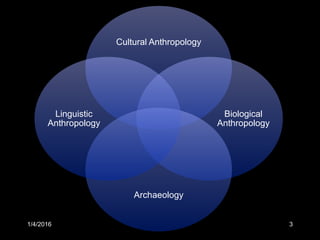
Anthropology
• Anthropology: the holistic study of
humanity.
• In the US, Anthropology is broken up
into four main sub-fields.
1/4/2016 2
1/4/2016 3
Cultural Anthropology
Biological
Anthropology
Archaeology
Linguistic
Anthropology
1/4/2016 4
Biological Anthropology
• Biological Anthropology is the study of
the human species from a biological
perspective.
• Biological anthropologists rely on a
scientific framework to make their
claims about humans.
1/4/2016 5
Scientific Framework
• If something cannot be observed with
the senses it can not be studied
scientifically.
• Similarly, things that cannot be
observed cannot be used for scientific
explanations.
1/4/2016 6
Evolution
Evolution: Fact or Theory?
1/4/2016 7
What is a fact?
A fact is something that has been
repeatedly observed and verified.
Hypothesis
• A hypothesis is an educated guess as
to why something observed happens.
• Hypotheses are tested to determine
their accuracy.
1/4/2016 8
1/4/2016 9
What is a theory?
A theory is an well-supported
explanation for why something
observed (facts) occurs.
Theories are derived from hypotheses
that have continually provided accurate
explanations.
1/4/2016 10
Evolution
Evolution is defined as change (in gene
frequencies) within populations over time.
1/4/2016 11
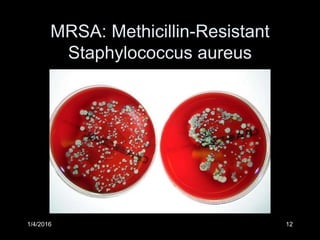
Evolution is Fact
• Changes in gene frequencies within
populations have been observed many
times.
MRSA: Methicillin-Resistant
Staphylococcus aureus
1/4/2016 12
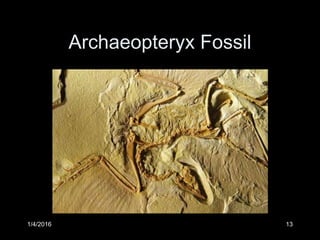
Archaeopteryx Fossil
1/4/2016 13
1/4/2016 14
Theories of Evolution
Numerous scientists have attempted to
explain the fact of evolution. This is
what is meant by evolutionary theory.
1/4/2016 15
Theory of Natural Selection
Charles Darwin published The Origin of
Species, in 1859. This book outlined his
theory (or explanation) of evolution.
1/4/2016 16
Darwin’s First Point
• Within any population there is variation.
1/4/2016 17
Darwin’s Second Point
• Darwin suggested some of these
characteristics were transmitted from
parents to offspring.
1/4/2016 18
Darwin’s Third Point
• More organisms are born than can be
supported by the environment. Limited
resources result in some level of
competition between organisms.
1/4/2016 19
Darwin’s Observations
• Darwin suggested that some traits
provided an advantage to organisms
within a given environment.
1/4/2016 20
Darwin’s conclusion
Natural Selection: Organisms
possessing traits that make them well-
adapted to their environment have a
greater chance of surviving and passing
on their traits to their offspring than
those less well-adapted,
1/4/2016 21
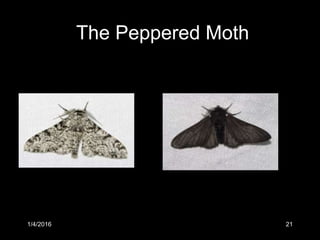
The Peppered Moth
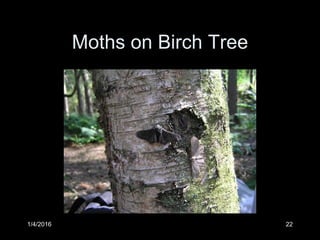
Moths on Birch Tree
1/4/2016 22
Evolution is NOT…
• Evolution is not necessarily about
becoming more “advanced” or
“complex.”
1/4/2016 23
Evolution
• Evolution relies on random
mutations…just because a trait would
be desirable in a given situation does
NOT mean it will necessarily emerge.
1/4/2016 24
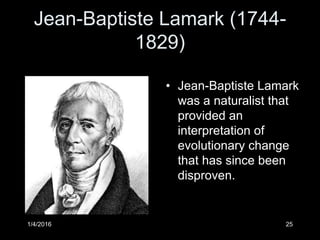
Jean-Baptiste Lamark (1744-
1829)
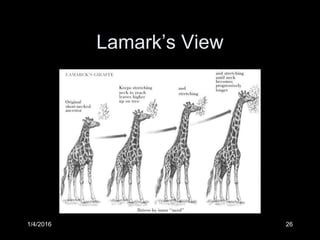
• Jean-Baptiste Lamark
was a naturalist that
provided an
interpretation of
evolutionary change
that has since been
disproven.
1/4/2016 25
Lamark’s View
1/4/2016 26

1 Evolution