Exploring Evolution
Learning Outcome
- Describe the evidence of
evolution such as homology,
DNA/protein sequences, plate
tectonics, the fossil record,
embryology, and artificial
selection/agriculture.
Whatis evolution?
- Evolution: The gradual change in
species over many generations
resulting from their genetic
adaptation to the environment.
Evidence of Evolution
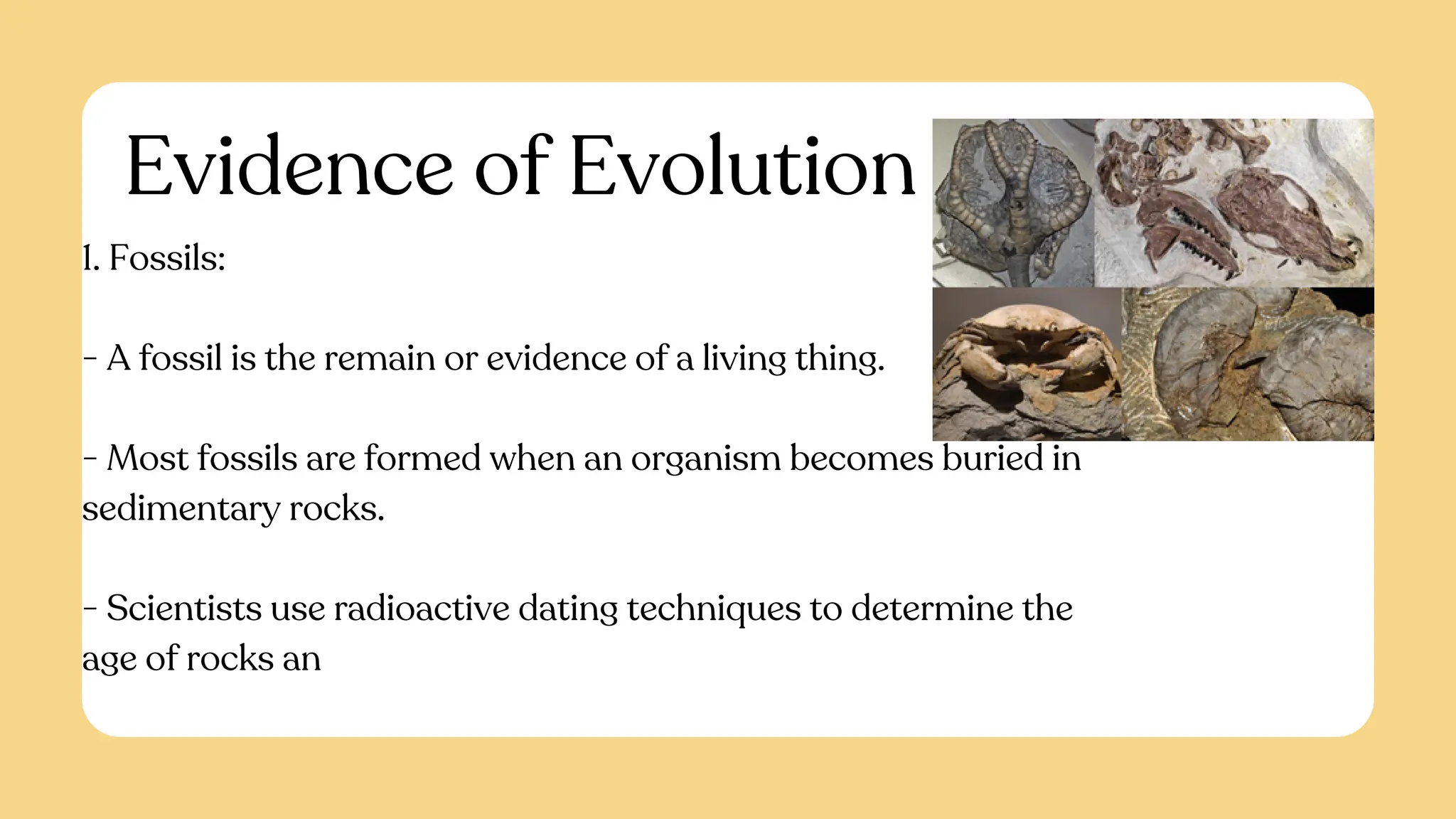
1. Fossils:
- A fossil is the remain or evidence of a living thing.
- Most fossils are formed when an organism becomes buried in
sedimentary rocks.
- Scientists use radioactive dating techniques to determine the
age of rocks an
- The growth and development of an embryo are controlled by
genes.
- Similarities in the early stages of embryo development show that
organisms evolved from the same ancestor.
Embryological evidence:
Homologous structures:
- The age of fossils is used to determine the characteristics of the
layers of sedimentary rocks where the fossils are found.
- Similarities in the shape and arrangement of bones show they
evolved from the same ancest
4. DNA AND PROTEIN
SEQUENCE:
- Similarities in DNA and protein
sequences show that two or more
organisms are closely related.
VESTIGIAL STRUCTURES
- A vestigial structure is a body part that is
reduced in size and does not seem to have a
function.
- Example: The tiny leg bones of snakes
suggest that they evolved from an ancestor
that had legs.
THEORIES OF EVOLUTION
1. Theory of Acquired Traits (Jean Baptiste de Lamarck)
- Organisms desire to improve themselves and become more advanced.
- Effort to improve causes some body structures to be constantly used,
while unused structures weaken and disappear (principle of use and
disuse).
- Modifications of structures due to use or disuse are inherited by offspring
(inheritance of acquired characteristics).
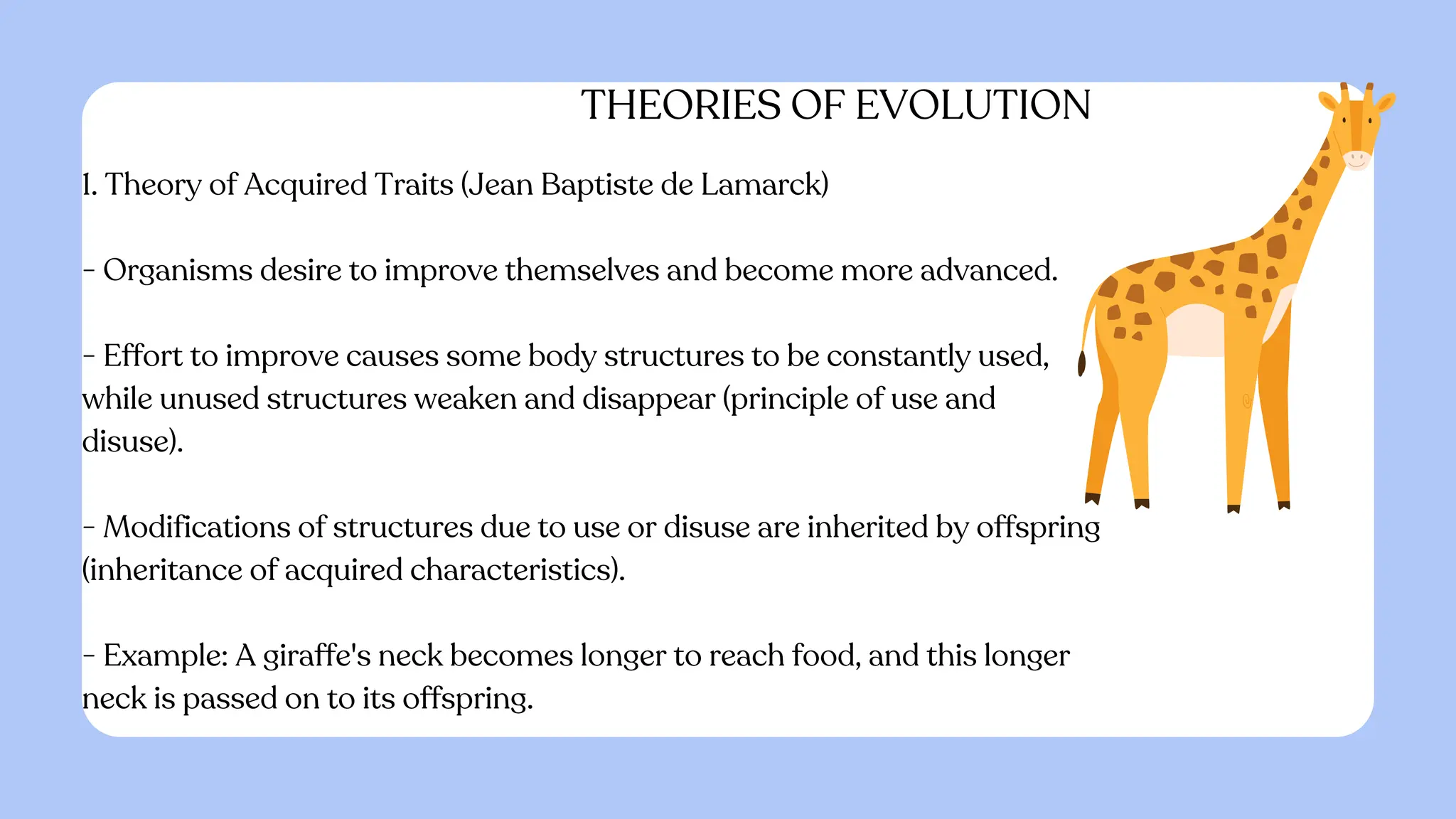
- Example: A giraffe's neck becomes longer to reach food, and this longer
neck is passed on to its offspring.
2. Theory of Natural Selection (Charles Robert Darwin)
- The number of offspring is usually greater than the available
resources necessary for survival.
- Every organism must struggle to survive.
- Some variations allow members to survive and reproduce better
than others.
- Organisms that survive and reproduce pass their traits to their
offspring, and helpful traits gradually appear in more offspring.
Factors That Bring About
Organismal Diversity
1. Mutation:
- Changes in the chromosomes of organisms that are heritable and permanent.
- Mutations can be changes in quantity or quality.
- Mutations are responsible for the evolution of a group of organisms from one
generation to another.
- Examples: Albinism, sickle cell anemia, and cystic fibrosis.
2. Genetic Drift:
- Evolution by chance.
- Refers to an increase or decrease in the
relative abundance of different cells through
successive generations.
- It is a random fluctuation in allele frequencies
over time.
3. Gene Flow:
- A change in allele frequencies due to
immigration (new individuals enter the
population) or emigration (some
individuals leave).
- Gene flow among organisms is based on
the physical dispersal of alleles and tends
to decrease divergence that might arise
through other evolutionary factors.
1. Natural Selection:
- In any population, more offspring tend to be produced
than can survive to reproductive age.
- Members of the population vary in form and behavior.
- Some heritable traits are more adaptive than others,
improving chances of survival and reproduction in
prevailing environmental conditions.
Key Concepts in Evolution
and Classification
2. Speciation:
- A new species is formed when individuals of a
population continue to breed among themselves over a
long period and accumulate a new set of traits unique to
them.
- These traits are already different from those of the
original species.
3. Adaptation:
- Adaptation refers to the process whereby a species can
tolerate the environmental conditions of a place and
efficiently compete with other species.
- If environmental conditions change drastically, only
species with adaptations to new conditions will survive.
4. Classifying Organisms Based on Evolutionary
Relationships:
- Modern classification started with the work of Carolus
Linnaeus, classifying organisms by their similarities.
- The Linnaean system divides living things into
kingdoms (like plant and animal).
- Within each kingdom, organisms are divided into phyla,
then classes, orders, families, genus, and species.
Significance of Classifying Organisms
- Systematic Organization: Classification
provides an easy and systematic way of
finding a category where an organism belongs
and how it relates to others. As you go down
the scale from kingdom to species, the
resemblance between organisms becomes
much closer.
- Relationship and Origin: Classifying
organisms shows the relationship of
organisms, traces the possible origin of
organisms, and the development of their
present forms.
- Evolutionary Mechanisms:
Taxonomy goes beyond naming and
classifying organisms to clarify new
methods and theories to explain the
mechanisms of evolution.
- Common Descent: The principle
behind the evolutionary states that
similarities among organisms are due
to common descent, or inheritance
from a common ancestor.

THATS ALL, THANKYOUUUU
(RECAP)

Evolution_20251023_071526_0000.pdf for grade 12

  • 1.
  • 2.
    Learning Outcome - Describethe evidence of evolution such as homology, DNA/protein sequences, plate tectonics, the fossil record, embryology, and artificial selection/agriculture.
  • 3.
    Whatis evolution? - Evolution:The gradual change in species over many generations resulting from their genetic adaptation to the environment.
  • 4.
    Evidence of Evolution 1.Fossils: - A fossil is the remain or evidence of a living thing. - Most fossils are formed when an organism becomes buried in sedimentary rocks. - Scientists use radioactive dating techniques to determine the age of rocks an
  • 5.
    - The growthand development of an embryo are controlled by genes. - Similarities in the early stages of embryo development show that organisms evolved from the same ancestor. Embryological evidence:
  • 6.
    Homologous structures: - Theage of fossils is used to determine the characteristics of the layers of sedimentary rocks where the fossils are found. - Similarities in the shape and arrangement of bones show they evolved from the same ancest
  • 7.
    4. DNA ANDPROTEIN SEQUENCE: - Similarities in DNA and protein sequences show that two or more organisms are closely related.
  • 8.
    VESTIGIAL STRUCTURES - Avestigial structure is a body part that is reduced in size and does not seem to have a function. - Example: The tiny leg bones of snakes suggest that they evolved from an ancestor that had legs.
  • 9.
    THEORIES OF EVOLUTION 1.Theory of Acquired Traits (Jean Baptiste de Lamarck) - Organisms desire to improve themselves and become more advanced. - Effort to improve causes some body structures to be constantly used, while unused structures weaken and disappear (principle of use and disuse). - Modifications of structures due to use or disuse are inherited by offspring (inheritance of acquired characteristics). - Example: A giraffe's neck becomes longer to reach food, and this longer neck is passed on to its offspring.
  • 10.
    2. Theory ofNatural Selection (Charles Robert Darwin) - The number of offspring is usually greater than the available resources necessary for survival. - Every organism must struggle to survive. - Some variations allow members to survive and reproduce better than others. - Organisms that survive and reproduce pass their traits to their offspring, and helpful traits gradually appear in more offspring.
  • 11.
    Factors That BringAbout Organismal Diversity 1. Mutation: - Changes in the chromosomes of organisms that are heritable and permanent. - Mutations can be changes in quantity or quality. - Mutations are responsible for the evolution of a group of organisms from one generation to another. - Examples: Albinism, sickle cell anemia, and cystic fibrosis.
  • 12.
    2. Genetic Drift: -Evolution by chance. - Refers to an increase or decrease in the relative abundance of different cells through successive generations. - It is a random fluctuation in allele frequencies over time.
  • 13.
    3. Gene Flow: -A change in allele frequencies due to immigration (new individuals enter the population) or emigration (some individuals leave). - Gene flow among organisms is based on the physical dispersal of alleles and tends to decrease divergence that might arise through other evolutionary factors.
  • 14.
    1. Natural Selection: -In any population, more offspring tend to be produced than can survive to reproductive age. - Members of the population vary in form and behavior. - Some heritable traits are more adaptive than others, improving chances of survival and reproduction in prevailing environmental conditions. Key Concepts in Evolution and Classification
  • 15.
    2. Speciation: - Anew species is formed when individuals of a population continue to breed among themselves over a long period and accumulate a new set of traits unique to them. - These traits are already different from those of the original species.
  • 16.
    3. Adaptation: - Adaptationrefers to the process whereby a species can tolerate the environmental conditions of a place and efficiently compete with other species. - If environmental conditions change drastically, only species with adaptations to new conditions will survive.
  • 17.
    4. Classifying OrganismsBased on Evolutionary Relationships: - Modern classification started with the work of Carolus Linnaeus, classifying organisms by their similarities. - The Linnaean system divides living things into kingdoms (like plant and animal). - Within each kingdom, organisms are divided into phyla, then classes, orders, families, genus, and species.
  • 18.
    Significance of ClassifyingOrganisms - Systematic Organization: Classification provides an easy and systematic way of finding a category where an organism belongs and how it relates to others. As you go down the scale from kingdom to species, the resemblance between organisms becomes much closer.
  • 19.
    - Relationship andOrigin: Classifying organisms shows the relationship of organisms, traces the possible origin of organisms, and the development of their present forms.
  • 20.
    - Evolutionary Mechanisms: Taxonomygoes beyond naming and classifying organisms to clarify new methods and theories to explain the mechanisms of evolution.
  • 21.
    - Common Descent:The principle behind the evolutionary states that similarities among organisms are due to common descent, or inheritance from a common ancestor.
  • 22.